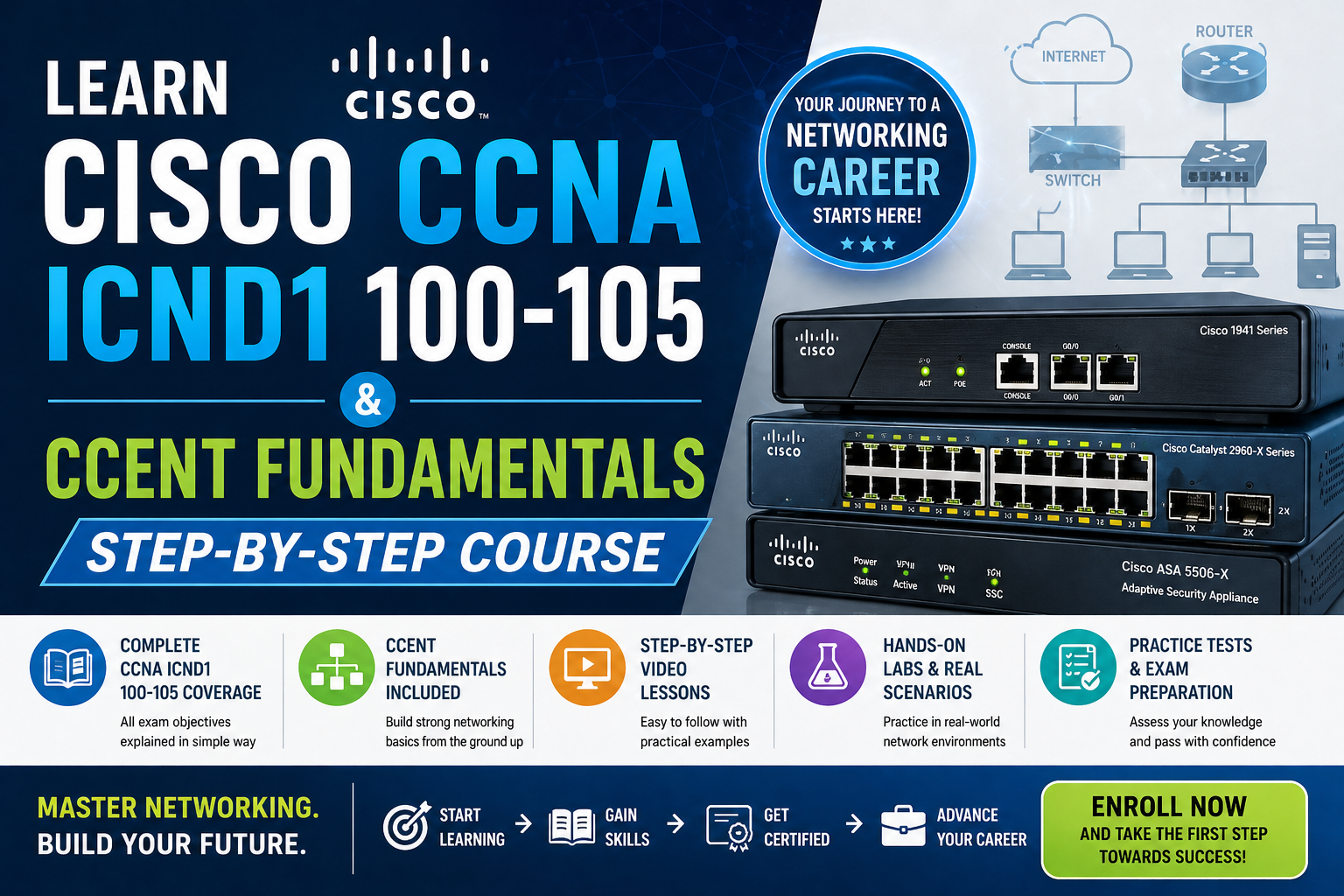
The Cisco CCENT ICND1 certification has long been recognized as one of the most important entry points into the world of networking. It represents the foundational layer of knowledge required to understand how data moves across systems, how devices communicate, and how organizations maintain reliable and secure connectivity. With updates to the exam structure over time, the focus has continued to shift toward more practical understanding of real-world networking rather than purely theoretical concepts.
At its core, the CCENT ICND1 framework is designed to introduce learners to the essential building blocks of network infrastructure. This includes how devices are physically connected, how logical communication is established between systems, and how information flows across both small and large-scale environments. For anyone entering IT, this foundational understanding is critical because nearly every modern technology relies on networking in some form.
What makes this certification particularly significant is that it does not limit itself to one vendor ecosystem in practice, even though it is rooted in Cisco technologies. Instead, it helps learners understand universal networking principles that apply across different platforms, operating systems, and enterprise environments. Whether dealing with cloud systems, traditional data centers, or hybrid infrastructures, the same core principles remain relevant.
The updated ICND1 structure emphasizes hands-on comprehension. Instead of simply memorizing terms or commands, learners are encouraged to understand why networks behave the way they do. This shift reflects the growing demand in the industry for professionals who can troubleshoot, adapt, and design solutions rather than just follow predefined instructions.
The Foundational Role of Networking in Information Technology
Networking is often described as the backbone of all modern digital systems, and this description is not an exaggeration. Every application, service, or digital platform depends on a network to function. Whether it is sending an email, streaming content, accessing cloud storage, or running enterprise systems, data must travel between devices through structured communication pathways.
Understanding networking means understanding how these pathways are created and maintained. It involves recognizing how devices identify each other, how data is segmented into manageable units, and how errors are detected and corrected during transmission. Without this knowledge, IT professionals may struggle to diagnose issues or optimize performance in real environments.
In many IT roles, networking knowledge is often underestimated until problems arise. For example, a system administrator might assume a server issue is related to software when the root cause is actually network congestion or misconfiguration. Similarly, a developer might deploy an application that performs poorly due to inefficient data routing, not realizing that the underlying network design is responsible.
This is why foundational networking knowledge is so important. It creates a mental model that allows professionals to trace problems back to their source rather than making assumptions. This ability to think systematically is one of the key outcomes of learning CCENT ICND1 concepts.
Networking knowledge also supports decision-making at organizational levels. Businesses rely on IT professionals to design infrastructure that is both cost-effective and scalable. Without an understanding of networking principles, decisions may be based on incomplete information, leading to inefficiencies or unnecessary expenditures.
Understanding Network Components and Their Interactions
A network is composed of multiple interconnected components, each serving a specific function. At the most basic level, there are end devices such as computers, phones, and servers. These devices generate and consume data, making them the primary participants in network communication.
Between these devices are intermediary components such as switches, routers, and access points. These devices are responsible for directing traffic, ensuring data reaches the correct destination, and maintaining efficient communication paths. Each plays a distinct role in how a network operates.
Switches, for instance, operate primarily within local networks. They receive incoming data and forward it to the appropriate device based on addressing information. This allows multiple devices to communicate efficiently within the same environment without unnecessary data collisions.
Routers, on the other hand, operate between different networks. They determine the best path for data to travel across multiple network segments, often connecting internal systems to external networks such as the internet. This makes routers essential for large-scale communication and connectivity.
Access points provide wireless connectivity, allowing devices to connect without physical cables. They translate wireless signals into network data, enabling mobile and remote devices to participate in the network environment.
Understanding how these components interact is essential for grasping how networks function as a whole. Each device depends on the others to maintain stability and efficiency. A failure in one component can affect the entire system, highlighting the importance of proper configuration and monitoring.
The Importance of Cabling and Physical Network Infrastructure
While modern networking often focuses on wireless technologies and virtual systems, physical infrastructure remains a critical foundation. Cabling is responsible for transmitting data between devices in a wired network, and the quality of this infrastructure can significantly impact performance.
Different types of cables are used depending on the requirements of the network. Ethernet cables are commonly used in local networks, while fiber optic cables are used for high-speed and long-distance communication. Each type has its own advantages in terms of speed, reliability, and cost.
Proper cabling design ensures that data flows efficiently without interference or loss. Poorly designed or damaged cabling can lead to packet loss, slow performance, and intermittent connectivity issues. These problems are often difficult to diagnose without a solid understanding of physical networking principles.
In enterprise environments, structured cabling systems are used to organize and manage network connections. This involves planning cable routes, labeling connections, and ensuring scalability for future expansion. A well-designed physical infrastructure reduces maintenance complexity and improves long-term reliability.
Even as wireless technologies continue to expand, physical infrastructure remains essential for backbone connectivity, data centers, and high-performance systems. Understanding this layer of networking provides a more complete view of how digital communication is supported at a fundamental level.
Network Diagrams and Logical Thinking in Infrastructure Design
Network diagrams are visual representations of how devices and systems are connected. They play an important role in planning, documentation, and troubleshooting. By providing a clear overview of network structure, diagrams help professionals understand how data flows within an environment.
There are different types of network diagrams, each serving a specific purpose. Physical diagrams focus on actual hardware placement and cabling, while logical diagrams represent data flow and network relationships. Both perspectives are important for understanding the full scope of a network.
Logical thinking is a key skill in interpreting and creating these diagrams. It involves understanding how individual components interact and predicting how changes in one part of the network may affect the whole system. This type of thinking is essential for designing efficient and scalable infrastructures.
Network diagrams also play a critical role in troubleshooting. When issues arise, diagrams help identify potential points of failure and isolate problems more quickly. Without a clear visual representation, diagnosing complex network issues becomes significantly more difficult.
In large organizations, network diagrams are constantly updated to reflect infrastructure changes. This ensures that IT teams always have an accurate understanding of the system they are managing. Over time, these diagrams become essential tools for maintaining operational stability.
Understanding Data Flow and Communication Principles
At the heart of networking is the concept of data flow. When information is transmitted across a network, it is broken down into smaller units known as packets. These packets travel independently through the network and are reassembled at their destination.
This process allows networks to efficiently manage large volumes of data without overwhelming communication channels. It also provides flexibility, as packets can take different routes to reach the same destination depending on network conditions.
Communication between devices follows structured protocols that define how data is formatted, transmitted, and interpreted. These protocols ensure that devices from different manufacturers or systems can communicate effectively without compatibility issues.
One of the key principles of networking is layered communication. This means that different aspects of data transmission are handled at different levels within the system. Each layer has a specific responsibility, such as addressing, routing, or error checking.
Understanding these principles helps professionals troubleshoot issues more effectively. For example, if data is not reaching its destination, it may be necessary to determine whether the issue lies in addressing, routing, or physical connectivity.
Data flow also depends on timing and synchronization. Devices must coordinate communication to ensure that information is sent and received correctly. Any disruption in this process can lead to delays or data loss.
The Role of Addressing and Identification in Networks
Every device on a network must have a unique identifier to communicate effectively. This is typically achieved through IP addressing, which assigns numerical labels to devices within a network. These addresses allow systems to locate and communicate with each other.
IP addressing can be complex, especially in large networks where multiple subnets and segments are involved. Proper addressing design ensures that devices can communicate without conflicts or routing issues.
In addition to IP addresses, devices also use hardware addresses that are permanently assigned to network interfaces. These addresses operate at a different layer of communication and are used for local data delivery.
Understanding how addressing works is essential for troubleshooting connectivity issues. Incorrect or misconfigured addresses can prevent devices from communicating, even if all physical components are functioning correctly.
Addressing also plays a role in network organization. By grouping devices into logical segments, administrators can improve performance, enhance security, and simplify management.
Building a Mental Model of Network Behavior
One of the most important outcomes of studying CCENT ICND1 concepts is the development of a mental model of how networks behave. This means understanding not just individual components, but how they interact as a system.
This mental model allows IT professionals to predict outcomes, identify potential problems, and design more efficient solutions. Instead of reacting to issues blindly, they can approach problems systematically and logically.
For example, if a user reports slow network performance, someone with a strong mental model might consider factors such as bandwidth usage, routing efficiency, device configuration, or physical infrastructure. This structured approach leads to faster and more accurate troubleshooting.
Developing this level of understanding requires both theoretical knowledge and practical exposure. It is not enough to memorize terms or definitions; learners must engage with real-world scenarios and observe how systems behave under different conditions.
Over time, this approach builds confidence and expertise, allowing professionals to handle increasingly complex environments with ease.
Understanding the OSI Model as a Structured Thinking Framework
One of the most important mental frameworks in networking is the OSI model, which breaks down communication into seven distinct layers. This structure is not just theoretical; it provides a practical way to understand how data moves from one device to another and where potential issues may occur when something goes wrong.
Each layer of the OSI model has a specific responsibility. The lower layers deal with physical transmission of data, while the upper layers focus on application-level communication. By separating functions into layers, networking becomes easier to design, troubleshoot, and optimize.
For example, when a user experiences connectivity issues, the OSI model helps narrow down the problem. If there is a physical cable issue, the problem lies in the lower layers. If an application cannot connect to a server, the issue may exist in higher layers. This structured thinking reduces guesswork and improves efficiency in troubleshooting.
The real value of the OSI model is not memorization but interpretation. It teaches professionals to think in terms of responsibilities rather than isolated technologies. This way of thinking is applicable across all networking environments, regardless of vendor or platform.
Understanding how each layer interacts with the others creates a foundation for analyzing complex systems. It also helps professionals communicate more effectively, since they can describe problems using a shared structured language.
TCP/IP Model and Real-World Communication Flow
While the OSI model provides a conceptual framework, the TCP/IP model represents how networks actually function in real-world environments. It condenses communication into fewer layers, focusing on practical implementation rather than theoretical separation.
The TCP/IP model is centered around how data is transmitted across interconnected systems, particularly the Internet. It defines how packets are addressed, routed, transmitted, and received between devices across multiple networks.
At the core of this model is reliability. TCP ensures that data is delivered accurately and in the correct order, while IP handles addressing and routing. Together, they form the foundation of modern communication systems.
Understanding this model allows professionals to interpret how applications like web browsers, email systems, and cloud services communicate over networks. Every interaction between a user and an online service relies on this layered communication process.
The relationship between the OSI and TCP/IP models is also important. While OSI is often used for learning and troubleshooting, TCP/IP represents a real-world implementation. Understanding both provides a more complete view of networking behavior.
Switching Logic and MAC Address Learning Behavior
Switching is one of the most fundamental processes in local networks. Unlike routing, which connects different networks, switching operates within a single network segment. Its primary responsibility is to forward data efficiently between devices.
Switches rely on MAC addresses to identify devices on the same network. When a device sends data, the switch examines the source MAC address and records it in a table. This process is known as MAC address learning.
Over time, the switch builds a complete map of devices connected to it. This allows it to forward data directly to the correct destination rather than broadcasting it to all devices. This improves performance and reduces unnecessary network traffic.
If a switch does not know the destination MAC address, it temporarily broadcasts the data to all connected devices. Once the destination responds, the switch updates its internal table for future communication.
This dynamic learning process makes switching highly efficient in managing local communication. It also reduces congestion and ensures that network resources are used effectively.
Understanding switching behavior is essential for diagnosing local network issues. Problems such as incorrect cabling, duplicate MAC entries, or misconfigured ports can all affect switching performance.
Routing Decisions and Path Selection Principles
Routing is the process of moving data between different networks. Unlike switching, which operates locally, routing determines how information travels across larger and more complex infrastructures.
Routers use IP addresses to identify destination networks and determine the best path for data transmission. They maintain routing tables that contain information about available routes and network destinations.
When a packet arrives at a router, it examines the destination IP address and compares it with entries in its routing table. Based on this information, it forwards the packet to the next appropriate hop in the network.
Routing decisions are influenced by multiple factors, including distance, network congestion, and administrative configurations. These factors help ensure that data takes the most efficient path possible.
Dynamic routing protocols allow routers to exchange information with each other and automatically update routing tables based on network conditions. This adaptability is essential in large-scale environments where network paths may change frequently.
Understanding routing behavior is crucial for diagnosing connectivity issues that occur between different networks. Misconfigured routes or incorrect gateway settings can prevent communication even when local networks are functioning properly.
Subnetting as a Logical Network Design Tool
Subnetting is one of the most important concepts in network design. It involves dividing a larger network into smaller, more manageable segments. This improves organization, performance, and security.
Each subnet acts as a separate logical network, even though it may exist within the same physical infrastructure. This separation allows administrators to control traffic flow and reduce unnecessary congestion.
Subnetting also helps optimize IP address usage. Instead of assigning large blocks of addresses to a single network, subnetting allows for more efficient allocation based on actual requirements.
The process of subnetting requires understanding binary calculations and IP structure. Although it may seem complex at first, it becomes a powerful tool for designing scalable networks.
In enterprise environments, subnetting is used to separate departments, devices, or services. For example, a company might use different subnets for finance, operations, and guest access to improve security and performance.
Proper subnet design also simplifies troubleshooting. When networks are logically segmented, it becomes easier to isolate issues and identify affected areas.
VLAN Architecture and Logical Network Segmentation
Virtual Local Area Networks, commonly known as VLANs, extend the concept of subnetting into switching environments. VLANs allow multiple logical networks to exist on the same physical infrastructure.
By assigning devices to different VLANs, administrators can separate traffic without requiring separate physical hardware. This improves flexibility and reduces infrastructure costs.
VLANs operate at the switch level and use tagging mechanisms to identify traffic belonging to different segments. This ensures that data is delivered only to devices within the same logical group.
One of the key advantages of VLANs is improved security. By isolating network traffic, sensitive information can be protected from unauthorized access within the same physical environment.
VLANs also enhance performance by reducing broadcast traffic. Instead of sending data to all devices, switches can limit communication to specific VLAN groups.
Understanding VLAN configuration is essential for modern network design. It allows professionals to build scalable, secure, and efficient infrastructures without increasing physical complexity.
ARP Mechanism and Device Discovery Process
Address Resolution Protocol (ARP) plays a critical role in connecting logical IP addresses with physical MAC addresses. When a device wants to communicate with another device on the same network, it must first determine its MAC address.
ARP works by broadcasting a request across the network asking which device owns a specific IP address. The device with that IP responds with its MAC address, allowing communication to proceed.
This process is essential for local network communication because IP addresses alone are not sufficient for data delivery at the hardware level.
ARP tables are stored temporarily on devices to speed up communication. Once an address is resolved, it is cached for future use, reducing the need for repeated requests.
However, ARP can also be a source of issues if entries become outdated or incorrect. In such cases, devices may attempt to send data to incorrect destinations, leading to communication failures.
Understanding ARP behavior helps professionals diagnose connectivity problems and verify whether devices are properly communicating within a network segment.
ICMP and Network Diagnostics Communication Layer
Internet Control Message Protocol (ICMP) is primarily used for diagnostic and error reporting purposes. It is one of the most useful tools for understanding network connectivity.
ICMP allows devices to send messages about network conditions, such as unreachable destinations or packet loss. One of its most common uses is the “ping” function, which tests whether a device is reachable across a network.
When a ping request is sent, ICMP packets travel to the destination device and return a response if communication is successful. This helps determine whether a network path is functioning correctly.
ICMP also provides information about latency, packet loss, and routing issues. These metrics are essential for diagnosing performance problems in both local and wide-area networks.
Although ICMP does not carry application data, it plays a vital role in maintaining network reliability. It acts as a feedback mechanism that helps administrators monitor and troubleshoot systems.
Troubleshooting Methodology and Structured Problem Solving
Effective troubleshooting in networking requires a structured approach rather than random testing. A systematic method ensures that problems are identified efficiently and resolved correctly.
The first step in troubleshooting is identifying the scope of the issue. This involves determining whether the problem affects a single device, a network segment, or the entire system.
Next, professionals isolate the problem by testing different layers of the network. This may involve checking physical connections, verifying configurations, or analyzing routing behavior.
Once the issue is isolated, the root cause can be identified and corrected. This process requires both technical knowledge and logical reasoning.
After resolving the issue, verification is essential to ensure that the solution is effective and that no additional problems have been introduced.
Structured troubleshooting reduces downtime and improves system reliability. It also helps professionals build confidence in handling complex network environments.
Hands-On Practice and Real-World Network Simulation Thinking
Practical experience is essential in networking because theoretical knowledge alone is not sufficient for real-world problem-solving. Hands-on practice allows learners to observe how systems behave under different conditions.
Working with actual devices or simulated environments helps reinforce concepts such as routing, switching, and configuration. It also exposes learners to real-world challenges that cannot be fully understood through theory alone.
Practical experience also improves decision-making skills. When professionals encounter unexpected issues, they can rely on prior hands-on experience to guide their response.
Another benefit of hands-on practice is the development of intuition. Over time, learners begin to recognize patterns in network behavior, allowing them to diagnose problems more quickly.
This type of experience is particularly important for building confidence in high-pressure environments where quick and accurate decisions are required.
IPv6 Structure and Modern Addressing Evolution
As networks continue to grow, the limitations of traditional IP addressing systems have become more apparent. IPv6 was introduced to address these limitations by providing a significantly larger address space.
Unlike older addressing systems, IPv6 uses a more complex structure designed to support the increasing number of connected devices worldwide. This ensures that future growth in networking infrastructure can be sustained.
IPv6 also introduces improvements in routing efficiency and network configuration. It reduces the need for certain manual configurations and simplifies communication between devices.
Understanding IPv6 is important for modern networking professionals because it represents the future direction of global communication systems.
Although adoption is gradual, IPv6 is increasingly being integrated into enterprise and cloud environments, making it a critical area of knowledge for IT professionals.
Developing Analytical Thinking for Network Environments
Beyond technical knowledge, networking requires strong analytical thinking skills. Professionals must be able to evaluate systems, identify inefficiencies, and predict outcomes based on network behavior.
Analytical thinking involves breaking down complex systems into smaller components and understanding how each part contributes to overall functionality.
This skill is particularly useful when dealing with large-scale infrastructures where multiple systems interact simultaneously. It allows professionals to maintain control over complexity and make informed decisions.
Over time, analytical thinking becomes a natural part of how network professionals approach problems. It transforms reactive troubleshooting into proactive system design and management.
Building Scalable Network Designs for Real-World Environments
Modern networks are no longer small, isolated systems. They are large, interconnected infrastructures that must support thousands or even millions of devices simultaneously. Designing such systems requires a deep understanding of scalability, performance, and reliability.
A scalable network can grow without requiring a complete redesign. This means that as more users, devices, or services are added, the network continues to function efficiently. Achieving this requires careful planning at every layer of the infrastructure.
One of the key principles of scalable design is modularity. Instead of building a single, tightly coupled system, networks are divided into smaller segments that can operate independently. These segments can then be expanded or modified without affecting the entire structure.
Another important factor is redundancy. In large environments, failure is not a matter of if, but when. Redundant systems ensure that if one component fails, another can take over without disrupting service. This improves reliability and reduces downtime.
Scalability also depends on efficient addressing and routing design. Poorly planned addressing schemes can lead to confusion and inefficiency as the network grows. Proper structure ensures that expansion remains manageable over time.
Network Performance Optimization and Traffic Flow Management
As networks grow, performance optimization becomes increasingly important. Even a well-designed network can suffer from slowdowns if traffic is not properly managed. Understanding how data flows through a system is essential for maintaining efficiency.
Traffic management involves controlling how data moves across different parts of a network. This includes prioritizing important traffic, reducing congestion, and ensuring that critical applications receive sufficient resources.
One common challenge in network performance is congestion. When too much data is transmitted through a single path, delays and packet loss can occur. To address this, networks often use multiple paths or load distribution techniques.
Bandwidth allocation also plays a major role in performance. Different applications have different requirements, and allocating resources appropriately ensures that high-priority services function smoothly.
Latency is another critical factor. Even if bandwidth is sufficient, delays in data transmission can affect user experience. Reducing latency often involves optimizing routing paths and minimizing unnecessary hops.
Monitoring tools are often used to analyze network performance in real time. These tools help identify bottlenecks, track usage patterns, and provide insights for optimization.
Security Principles in Network Infrastructure Design
Security is a fundamental aspect of modern networking. As systems become more interconnected, the risk of unauthorized access and data breaches increases. Designing secure networks requires a layered approach that addresses multiple potential vulnerabilities.
One of the core principles of network security is segmentation. By dividing a network into smaller sections, access can be controlled more effectively. This limits the spread of potential threats and isolates sensitive systems from general traffic.
Another important concept is access control. This involves defining who can access specific resources within the network. Proper access control ensures that only authorized users and devices can interact with critical systems.
Encryption also plays a vital role in protecting data. When information is transmitted across a network, encryption ensures that it cannot be easily intercepted or understood by unauthorized parties.
Firewalls are commonly used to monitor and control incoming and outgoing traffic. They act as a barrier between trusted and untrusted networks, filtering data based on predefined rules.
Security monitoring is equally important. Continuous observation of network activity helps detect unusual behavior that may indicate a security threat.
The Role of Network Automation in Modern Infrastructure
As networks become more complex, manual configuration becomes increasingly inefficient. Network automation has emerged as a solution to manage large-scale systems more effectively.
Automation involves using software tools to perform repetitive tasks such as configuration, monitoring, and troubleshooting. This reduces human error and improves consistency across the network.
One of the main benefits of automation is speed. Tasks that would normally take hours or days can be completed in minutes. This is particularly valuable in large environments where changes must be deployed quickly.
Automation also improves scalability. As networks grow, manual management becomes impractical. Automated systems can handle large volumes of devices without requiring proportional increases in human resources.
Another advantage is accuracy. Manual configuration often leads to mistakes, especially in complex environments. Automation ensures that configurations are applied consistently across all devices.
Monitoring and alerting systems are also commonly automated. These systems continuously check network health and notify administrators when issues arise.
Cloud Connectivity and Distributed Network Structures
Modern networks are no longer confined to a single physical location. Cloud computing has introduced distributed network structures where resources are spread across multiple data centers and locations.
In a distributed environment, data and applications are hosted remotely and accessed over the internet. This allows organizations to scale resources dynamically based on demand.
Cloud connectivity relies heavily on robust networking principles. Reliable communication between local systems and cloud services is essential for performance and availability.
One of the challenges in distributed networks is maintaining consistency. Since resources are spread across different locations, ensuring that data remains synchronized can be complex.
Latency and bandwidth also play a critical role in cloud performance. Since data must travel across long distances, optimizing network paths becomes essential.
Security in cloud environments is equally important. Data must be protected both during transmission and while stored in remote systems.
Understanding cloud networking requires combining traditional networking knowledge with modern distributed system concepts.
Wireless Networking Fundamentals and Signal Behavior
Wireless networking has become an essential part of modern communication systems. It allows devices to connect without physical cables, providing flexibility and mobility.
Wireless communication relies on radio signals to transmit data between devices. These signals are affected by distance, obstacles, and interference, which can impact performance.
Access points play a central role in wireless networks. They act as bridges between wired infrastructure and wireless devices, managing communication and signal distribution.
One of the challenges in wireless networking is signal strength. As the distance from the access point increases, signal quality decreases, leading to reduced performance.
Interference from other devices can also affect wireless communication. This is particularly common in environments with many overlapping networks.
Channel selection and frequency management are important techniques used to improve wireless performance. By selecting optimal channels, networks can reduce interference and improve reliability.
Understanding wireless behavior is essential for designing effective modern networks, especially in environments where mobility is required.
Network Address Translation and Internet Communication
Network Address Translation (NAT) is a technique used to allow multiple devices within a private network to share a single public IP address. This is essential for conserving global IP address space.
NAT works by modifying IP address information in packet headers as data passes through a router. This allows internal devices to communicate with external networks without exposing their private addresses.
One of the main benefits of NAT is improved security. Since internal addresses are hidden from external systems, it becomes more difficult for unauthorized users to directly access internal devices.
NAT also simplifies network design by reducing the need for large numbers of public IP addresses. This is especially useful for home and small business networks.
However, NAT can introduce challenges for certain applications that require direct device-to-device communication. In such cases, additional configuration may be required.
Understanding NAT behavior is important for troubleshooting connectivity issues between internal networks and external services.
Advanced Routing Concepts and Dynamic Network Adaptation
In complex networks, static routing is often insufficient. Dynamic routing protocols allow networks to automatically adapt to changes in topology and traffic conditions.
These protocols enable routers to exchange information about available paths and update routing tables in real time. This ensures that data can always find the most efficient route.
Dynamic routing improves resilience by allowing networks to recover quickly from failures. If one path becomes unavailable, alternative routes are automatically used.
Routing decisions in dynamic systems are based on metrics such as distance, speed, and reliability. These metrics help determine the best path for data transmission.
Understanding dynamic routing behavior is essential for managing large-scale networks where manual configuration would be impractical.
Data Encapsulation and Transmission Process Layers
Data encapsulation is the process of wrapping information with necessary headers and trailers as it moves through network layers. This ensures that each layer can interpret and process the data correctly.
As data moves down the network stack, each layer adds its own information. This includes addressing, error checking, and protocol details.
At the receiving end, the process is reversed. Each layer removes its corresponding information until the original data is delivered to the application.
This structured approach ensures consistency and reliability in communication. It allows different systems to interpret data in a standardized way.
Encapsulation also helps in troubleshooting, as problems can often be isolated to a specific layer in the communication process.
Role of Port Numbers and Application Communication
Port numbers are used to identify specific applications or services running on a device. While IP addresses identify devices, port numbers identify processes within those devices.
This allows multiple services to operate simultaneously on a single system without conflict. For example, web services and email services can run independently using different ports.
When data arrives at a device, the port number determines which application should process the information. This ensures that data is delivered to the correct destination within the system.
Understanding port behavior is essential for configuring services and troubleshooting application-level connectivity issues.
Network Monitoring and Continuous System Awareness
Network monitoring involves continuously observing system performance, traffic patterns, and device behavior. This allows administrators to detect issues before they become critical.
Monitoring tools collect data such as bandwidth usage, latency, and error rates. This information provides insight into overall network health.
Continuous monitoring also helps identify unusual activity that may indicate security threats or configuration problems.
By maintaining awareness of network conditions, administrators can make informed decisions about optimization and maintenance.
Evolution of Networking Knowledge in IT Careers
Networking knowledge continues to evolve as technology advances. Modern IT professionals are expected to understand both traditional infrastructure and emerging technologies such as cloud computing and automation.
This evolution requires continuous learning and adaptation. Foundational knowledge remains important, but it must be expanded with new skills and concepts.
Understanding networking provides a strong base for exploring advanced IT domains. It enables professionals to transition into areas such as cybersecurity, cloud architecture, and systems engineering.
As technology becomes more interconnected, networking knowledge becomes even more critical for career development in the IT industry.
Conclusion
The study of networking through foundational concepts like those covered in the CCENT ICND1 framework represents far more than preparation for an exam or familiarity with a set of technical terms. It builds a way of thinking that influences how professionals understand, design, and interact with modern technology systems. In today’s interconnected world, nearly every digital service depends on reliable network communication, making networking knowledge one of the most valuable skill sets in the entire IT landscape.
One of the most important takeaways from this learning journey is the realization that networking is not an isolated discipline. It is deeply integrated into every area of information technology. Whether someone works in software development, cloud computing, cybersecurity, systems administration, or data engineering, they are constantly relying on networks to perform their tasks. Without a clear understanding of how data moves, how devices communicate, and how systems interconnect, even advanced technical skills can be limited in effectiveness.
Another key insight is the importance of structured thinking. Networking concepts encourage professionals to break down complex systems into manageable layers and components. This layered approach, whether seen in models like OSI or in real-world architectures such as TCP/IP, provides a consistent framework for understanding how communication occurs. It allows problems to be isolated, analyzed, and resolved in a logical manner rather than through guesswork. This structured mindset becomes especially valuable when dealing with large-scale or unpredictable network environments.
Hands-on understanding also plays a critical role in mastering networking principles. Theoretical knowledge alone is not enough to fully grasp how networks behave in real conditions. Practical exposure helps reinforce abstract concepts by showing how they function in real-time environments. It also builds confidence, allowing professionals to approach real-world issues with clarity rather than uncertainty. Over time, this combination of theory and practice develops intuition, which is one of the most powerful tools in technical problem-solving.
As networks continue to evolve, the importance of adaptability becomes increasingly clear. Technologies such as cloud computing, wireless communication, virtualization, and automation are continuously reshaping how networks are designed and managed. However, despite these advancements, the core principles of networking remain consistent. Concepts such as addressing, routing, switching, segmentation, and data flow continue to form the foundation of all modern systems. Understanding these fundamentals ensures that professionals are prepared to adapt to new technologies without losing sight of essential principles.
Security considerations further highlight the importance of networking knowledge. As systems become more connected, the potential for vulnerabilities increases. Understanding how data travels across networks, how devices communicate, and how systems are structured allows professionals to design more secure environments. Security is no longer an optional layer added at the end of a design process; it is deeply integrated into every aspect of network planning and implementation. Professionals who understand networking fundamentals are better equipped to identify risks and implement effective safeguards.
Scalability and performance optimization also depend heavily on strong networking foundations. As organizations grow, their networks must expand without compromising efficiency or reliability. This requires careful planning of addressing schemes, routing structures, traffic management, and infrastructure design. Without a solid understanding of networking principles, scaling systems becomes chaotic and inefficient. With proper knowledge, however, growth can be managed in a structured and sustainable way.
Ultimately, networking knowledge empowers IT professionals to see beyond individual devices or applications and understand the larger systems that connect everything together. It transforms reactive problem-solving into proactive design thinking. Instead of simply responding to issues as they arise, professionals can anticipate challenges, design better systems, and improve overall efficiency.
The value of these skills extends beyond technical environments. Networking concepts encourage logical reasoning, analytical thinking, and structured decision-making, all of which are applicable in many areas of professional life. As technology continues to advance and become even more deeply integrated into everyday operations, the demand for individuals who understand these foundational principles will only continue to grow.
In essence, networking is not just about cables, routers, or protocols. It is about understanding how information flows through systems that power the modern world. It is about building the invisible infrastructure that supports communication, innovation, and connectivity on a global scale.