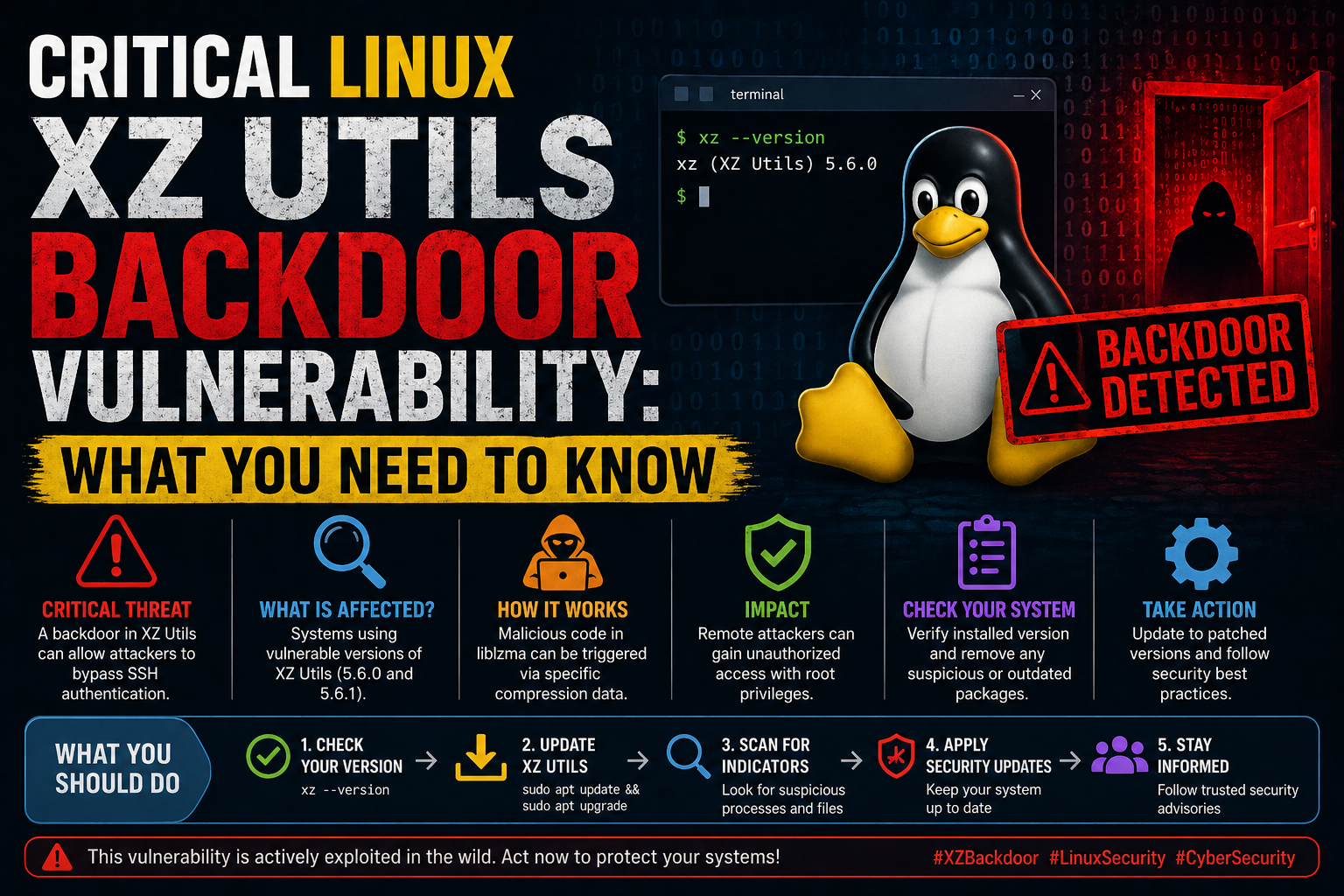
Modern computing systems often appear solid and secure on the surface, but underneath that surface lies an extremely complex network of interconnected components. These components are not built in isolation. Instead, they rely heavily on shared libraries, open-source utilities, and small background tools that quietly support critical operations.
Linux, in particular, is built on this layered structure. It is not a single monolithic system controlled by one organization. Instead, it is an ecosystem made up of thousands of independent software packages maintained by individuals and communities across the world. These packages handle everything from file compression to network communication, memory management, encryption, and system logging.
One of these small but important tools is XZ Utils, a data compression utility. On its own, it does not appear powerful. It simply compresses and decompresses files efficiently, helping systems save storage space and speed up data transfer. However, in modern Linux distributions, even small utilities like this can become deeply embedded into system workflows.
What makes this important is not the function of XZ Utils itself, but the trust placed in it. When a tool is widely used, it becomes part of the invisible foundation of countless servers, applications, and services. Many system administrators and developers never directly interact with it, yet it operates constantly in the background.
This invisible dependency is where risk begins to form. The more foundational a tool becomes, the more dangerous it is if something goes wrong with it. The XZ Utils incident demonstrated how even a small and obscure component can become a gateway to potentially catastrophic system compromise when trust is manipulated over time.
The Role of XZ Utils in the Linux Ecosystem
XZ Utils is a compression software package used in Linux and Unix-like systems. Its primary purpose is to reduce file sizes using the LZMA compression algorithm, which is known for achieving high compression ratios. This makes it particularly valuable in environments where bandwidth, storage, and performance optimization are important.
Although it is not a visible application that users interact with directly, it plays a supporting role in many operations. Software packages, system updates, and even core operating system components may rely on compressed archives that require tools like XZ Utils to unpack.
Because of its efficiency and reliability, it became widely adopted in Linux distributions. Over time, it became part of the default software stack included in many operating system builds. This meant that it was not just installed optionally, but often pre-installed and integrated into system-level processes.
This integration is what makes such utilities critical. When a tool is used at the system level, it gains elevated importance. Any modification to it, even small and subtle, can potentially influence a wide range of dependent services.
The XZ Utils case is particularly notable because it was not a flashy or complex application. It was simple, stable, and widely trusted. This combination made it an ideal target for long-term manipulation, as changes would be less likely to attract immediate attention.
The Nature of Open Source Trust and Its Hidden Weaknesses
Open-source software is built on transparency and collaboration. Anyone can view the code, suggest improvements, and contribute changes. This model has been one of the strongest drivers of innovation in modern computing, enabling rapid development and widespread peer review.
However, this openness also introduces a structural challenge. While the code is visible, the scale of the ecosystem makes continuous deep inspection difficult. Many projects depend on voluntary contributors, and maintainers often work without formal funding or organizational support.
In many cases, a single individual or a very small group maintains a widely used package. These maintainers are responsible for reviewing contributions, fixing bugs, and ensuring stability. Because of limited resources, they often prioritize functionality and stability over exhaustive security audits.
This creates an environment where trust becomes essential. Contributors who consistently provide helpful improvements over time may gradually gain credibility. Once trust is established, their changes are less likely to be scrutinized with the same intensity as those of unknown contributors.
This is not a flaw unique to open-source systems, but it becomes more pronounced due to the scale and decentralization involved. Thousands of packages depend on each other, and reviewing every dependency in depth is practically impossible for most organizations.
The XZ Utils incident highlighted how this trust-based model can be exploited when someone is willing to invest years into building credibility before introducing malicious changes.
The Beginning of a Long-Term Infiltration Strategy
The backdoor in XZ Utils did not appear suddenly. It was not a case of a quick exploit or an accidental vulnerability. Instead, it was the result of a carefully planned and slow-moving infiltration strategy that unfolded over several years.
A user operating under the identity “Jia Tan” began contributing to the XZ Utils project around 2021. At first, the contributions appeared normal. They included small improvements, bug fixes, and suggestions aimed at improving performance and compatibility.
These early contributions were not suspicious on their own. In open-source environments, such participation is common. New contributors often start with minor changes to build familiarity with the project and its maintainers.
Over time, Jia Tan’s involvement increased. More substantial contributions were submitted, and the user gradually became more active in discussions and development decisions. This steady increase in engagement helped establish credibility within the project’s ecosystem.
This gradual approach is significant because it mirrors legitimate contributor behavior. There were no obvious red flags in the early stages, which allowed trust to build naturally.
The strategy relied heavily on patience. Instead of attempting immediate exploitation, the attacker focused on integration into the development workflow. This approach made it easier for their contributions to be accepted without deep suspicion.
Pressure Points in Software Maintenance
The XZ Utils project was primarily maintained by a single individual, Lasse Collin, who had been working on it for many years. Like many open-source maintainers, his work was largely voluntary and driven by personal commitment rather than institutional backing.
Over time, maintaining such a widely used tool became increasingly demanding. User expectations grew, dependency chains expanded, and integration requirements became more complex. At the same time, available time and resources remained limited.
This imbalance creates pressure points in software ecosystems. When maintainers are overextended, they may rely more heavily on trusted contributors to share responsibility. This is a natural and often necessary adaptation, but it also introduces risk.
In the case of XZ Utils, this environment created an opportunity for the attacker to gain more influence. As trust in contributions increased, the scrutiny applied to those contributions decreased.
This is not due to negligence, but rather due to human limitations. No single maintainer can realistically audit every line of code in a large and widely used project over many years, especially when external pressure and workload are high.
The attackers exploited this reality by positioning themselves as reliable contributors during a period when additional support was needed.
How Subtle Code Changes Can Create System-Level Risk
What makes supply chain attacks particularly dangerous is not the size of the malicious code, but its placement. Instead of attacking systems directly, attackers modify trusted components that are already part of the system.
In the case of XZ Utils, the malicious changes were designed to interact with other system components, particularly SSH authentication processes. SSH is a critical protocol used to securely access remote servers. It is widely deployed across cloud infrastructure, enterprise systems, and internet-facing servers.
By targeting a compression utility that is indirectly connected to system operations, attackers can potentially create a pathway that activates under specific conditions. This makes detection extremely difficult because the malicious behavior is not constantly visible.
The backdoor was engineered to remain hidden during normal operation. It would only activate under certain conditions related to system authentication processes. This selective behavior helps avoid detection during routine testing or casual inspection.
The sophistication of this approach lies in its subtlety. Instead of disrupting systems, it integrates into them quietly and waits for the right moment to activate.
The Gradual Integration of Malicious Functionality
Over time, modifications were introduced into the XZ Utils codebase that appeared legitimate on the surface. These changes were small, incremental, and aligned with normal development patterns.
However, when combined, they formed a structure capable of enabling unauthorized access. The malicious logic was not obvious in isolation, but rather emerged through interaction between multiple components.
This layered approach is what makes detection difficult. Each change may appear harmless, but the cumulative effect creates a hidden capability that can be exploited later.
This method is often used in advanced supply chain attacks because it bypasses traditional security review processes. Human reviewers tend to evaluate changes incrementally rather than analyzing long-term structural implications.
As a result, the vulnerability was effectively embedded into the software over an extended period without triggering immediate alarms.
The Importance of Observation in Detecting System Anomalies
One of the most critical aspects of the XZ Utils discovery was not automated detection, but human observation. A software engineer noticed that a system process related to SSH was behaving slightly differently than expected.
The difference was extremely subtle, involving minor delays and unusual resource usage. These kinds of anomalies are often dismissed as background noise in complex systems.
However, in this case, the inconsistency triggered further investigation. The engineer began tracing the source of the behavior, eventually linking it back to the compression utility.
This investigative process highlights how important careful observation can be in complex systems. Automated tools are essential, but they often rely on predefined rules and patterns. Subtle deviations may not always trigger alerts.
Human intuition, especially from experienced engineers familiar with system behavior, plays a crucial role in identifying irregularities that automated systems might overlook.
The discovery of the XZ Utils backdoor demonstrates how even highly sophisticated attacks can be exposed through attention to small, seemingly insignificant details in system performance.
The Hidden Architecture of Modern Linux Dependencies
Modern Linux systems are not built in a straightforward, top-down structure. Instead, they resemble a deeply layered pyramid of dependencies where each layer relies on many smaller components beneath it. At the top are user-facing applications, but beneath them are system services, libraries, compilers, runtime environments, and ultimately small utility programs that rarely receive attention.
XZ Utils sits near the base of this pyramid. Although it appears insignificant, it is embedded in workflows that support higher-level system functionality. This includes package compression, archive handling, and distribution packaging processes used by Linux maintainers.
The importance of such a component is not measured by how often users interact with it directly, but by how many other systems depend on it indirectly. When a tool is integrated into packaging systems or system initialization workflows, it becomes part of a critical trust chain.
This trust chain is fragile because each layer assumes the integrity of the layer below it. When even one small component is compromised, the effects can propagate upward through the entire system stack without immediate detection.
The XZ Utils case exposed how deeply modern computing depends on components that are rarely audited at scale. This dependency structure is efficient, but it also concentrates systemic risk into small, overlooked pieces of software.
SSH and the Critical Role of Authentication Layers
Secure Shell (SSH) is one of the most widely used protocols for remote system administration. It allows administrators to securely access servers over unsecured networks using encrypted communication channels.
Because SSH is often the primary method of managing cloud infrastructure and enterprise servers, any vulnerability affecting it can have widespread consequences. SSH is not just another application; it is a gateway into system-level control.
The XZ Utils backdoor was designed to interact with SSH processes indirectly. Rather than targeting SSH itself, the attack focused on modifying behavior in a supporting library that SSH depends on during authentication workflows.
This indirect approach is important. Attacking SSH directly would likely be detected quickly due to its high scrutiny. Instead, by inserting malicious logic into a dependency layer, the attackers attempted to remain invisible while still influencing authentication outcomes.
This technique demonstrates a broader principle in cybersecurity: the most dangerous vulnerabilities are often not in the most obvious places, but in the supporting systems that critical software relies upon.
SSH’s widespread deployment across nearly all Linux-based infrastructure makes it a high-value target for any attacker seeking broad access. Even a small modification in its authentication pipeline can potentially affect millions of systems globally.
The Social Engineering Dimension of Long-Term Attacks
Unlike traditional malware attacks that rely on technical exploits alone, the XZ Utils incident involved a strong social engineering component. Instead of targeting machines directly, the attackers targeted human trust relationships within the development ecosystem.
Open-source projects depend heavily on voluntary collaboration. Contributors are often evaluated based on their past behavior, helpfulness, and consistency over time. This creates an environment where reputation becomes a form of access control.
In the XZ Utils case, the attacker slowly built credibility by submitting legitimate improvements over an extended period. These contributions were not immediately harmful and often improved performance or stability.
This gradual approach is essential in long-term infiltration strategies. If malicious intent is revealed too early, trust is lost, and access is cut off. By pacing contributions carefully, the attacker was able to remain within the trusted contributor group.
This strategy also exploits cognitive biases. Human reviewers tend to focus on recent changes rather than analyzing long-term contributor behavior patterns. Once a contributor is perceived as reliable, their future submissions receive less scrutiny.
This creates a structural weakness in distributed development environments where trust is cumulative, but verification is often episodic.
The Role of Maintainer Overload in System Vulnerability
Many critical open-source projects are maintained by individuals or very small teams. These maintainers are responsible for reviewing code, managing releases, fixing bugs, and responding to community issues.
In the case of XZ Utils, maintenance responsibilities were heavily concentrated. The primary maintainer faced long-term workload pressures, including personal constraints that limited available time for deep code auditing.
This situation is not unusual in open-source ecosystems. Many foundational tools are maintained by volunteers who contribute in their spare time without institutional support.
When the workload exceeds capacity, maintainers must prioritize. Stability and functionality often take precedence over exhaustive security reviews. This is a practical necessity rather than a weakness in judgment.
However, this prioritization creates an opportunity for attackers. If a malicious actor is patient enough to introduce changes gradually, they can exploit periods where review depth is reduced due to time constraints.
The XZ Utils case highlights how resource limitations can indirectly affect security posture. It is not a failure of individuals, but rather a structural challenge in sustaining critical infrastructure with limited human resources.
The Gradual Build-Up of Malicious Infrastructure
One of the most striking aspects of the XZ Utils attack is the timeline. Instead of introducing malicious code in a single step, the attacker built up functionality incrementally over multiple years.
Each stage of development served a dual purpose. On the surface, it appeared to be a legitimate improvement. Beneath that surface, it contributed to a larger hidden objective.
This incremental design allowed malicious components to blend into normal development activity. Small modifications are less likely to trigger alarms than large structural changes.
Over time, these components formed a coordinated system capable of influencing authentication behavior. However, because each piece individually appeared harmless, detection became extremely difficult.
This approach mirrors principles seen in complex systems engineering. Large systems are often built through modular components. When malicious actors mimic this process, they can embed functionality in a way that appears structurally legitimate.
The danger lies in the fact that system-level behavior only emerges when multiple components interact. Isolated inspection of individual changes may not reveal the full picture.
Build Systems and the Trust in Compilation Pipelines
Modern software is not only defined by source code but also by the systems used to build and distribute it. Compilation pipelines, package managers, and automated build systems play a critical role in transforming source code into deployable software.
In Linux distributions, build systems are often automated and rely on reproducible processes. This ensures consistency across installations but also introduces dependency on build integrity.
If malicious code is introduced into a widely used source package before compilation, it becomes part of every downstream binary package. This is one of the reasons supply chain attacks are so dangerous.
The XZ Utils backdoor exploited this principle by targeting upstream source code rather than individual installations. Once integrated into official distributions, the compromised code could propagate widely without requiring direct targeting of individual systems.
This distribution model is efficient but assumes upstream trustworthiness. When that trust is compromised, the entire downstream ecosystem is affected.
The Importance of Release Cycles in Software Security
Software projects typically operate on release cycles, where changes are accumulated, reviewed, and then packaged into stable versions. These cycles are designed to balance innovation with stability.
However, release cycles also introduce windows of opportunity for attackers. If malicious changes are introduced gradually and timed correctly, they may be included in stable releases before being detected.
In the XZ Utils case, the malicious modifications were positioned in such a way that they aligned with release processes. This increased the likelihood that they would be distributed widely once included in official builds.
Release engineering relies heavily on trust in contributor history and automated testing. While testing can detect functional issues, it may not detect carefully hidden logic that only activates under specific conditions.
This creates a gap between functional correctness and security integrity. A system may pass all tests while still containing deeply embedded malicious behavior.
Distribution Maintainers and Downstream Trust Chains
Linux distributions such as Debian, Fedora, and others act as intermediaries between upstream projects and end users. They package software, apply patches, and ensure compatibility across systems.
These maintainers rely heavily on upstream code integrity. While they may review changes, the sheer volume of packages makes deep inspection of every dependency impractical.
As a result, trust is extended from upstream maintainers to distribution maintainers and finally to end users. This creates a long trust chain where compromise at any level can propagate widely.
The XZ Utils incident demonstrates how upstream compromise can bypass multiple layers of downstream validation. Even well-managed distributions may inadvertently include compromised code if it originates from a trusted upstream source.
This highlights the interconnected nature of modern software ecosystems, where security depends not just on individual components but on the integrity of the entire distribution pipeline.
The Subtle Art of Avoiding Detection in Complex Systems
One of the most sophisticated aspects of the XZ Utils backdoor was its ability to avoid detection for an extended period. This was achieved through careful control of visibility and behavior.
The malicious components were designed to remain dormant under normal conditions. This meant that routine testing and casual use would not reveal unusual behavior.
Additionally, the code was structured to blend into existing system logic. Rather than introducing entirely new mechanisms, it modified existing workflows in subtle ways.
This is a key characteristic of advanced supply chain attacks. Instead of creating obvious anomalies, they modify existing structures in ways that are difficult to distinguish from legitimate changes.
Detection in such cases often requires contextual awareness across multiple systems, rather than isolated inspection of individual components.
Why the Attack Almost Succeeded on a Global Scale
The XZ Utils backdoor came extremely close to widespread deployment across production systems. At the time of discovery, it had already been integrated into certain development and pre-release versions of major Linux distributions.
If it had progressed slightly further through release pipelines, it could have reached a large portion of internet-facing servers globally. This includes cloud infrastructure, enterprise systems, and critical services.
The scale of potential impact was enormous because of how deeply Linux is embedded in global computing infrastructure. From web servers to embedded devices, Linux forms the backbone of much of the modern internet.
The narrow window in which the vulnerability was discovered highlights how timing plays a critical role in cybersecurity. A delay of even a few weeks could have significantly changed the outcome.
This near-miss scenario emphasizes how fragile system security can be when trust is exploited over long periods without detection.
The Relationship Between Visibility and Security in Open Systems
Open-source systems are built on the principle of transparency. Code visibility allows anyone to inspect, modify, and improve software. However, visibility alone does not guarantee active scrutiny.
In large-scale ecosystems, the assumption that “someone else is reviewing it” often repactualn actu al detailed review. This creates gaps in oversight, especially for less prominent components.
The XZ Utils case demonstrates that visibility must be paired with active and continuous review to be effective as a security mechanism.
When visibility is high,, but scrutiny is distributed and inconsistent, vulnerabilities can persist unnoticed even in publicly available codebases.
This creates an important distinction between theoretical transparency and practical security assurance in open systems.
The Moment of Discovery and the Importance of Behavioral Observation
The XZ Utils backdoor was not discovered through automated scanning tools or scheduled security audits. Instead, it was uncovered through careful observation of unusual system behavior during routine usage. This is an important distinction because it highlights how many critical vulnerabilities are still detected through human intuition rather than machine-driven analysis.
The initial clue was extremely subtle. A system process related to SSH authentication was taking slightly longer than expected. The delay was measured in milliseconds, far below what most users or administrators would ever notice during normal operations.
However, in high-performance and security-sensitive environments, even small deviations can signal deeper issues. Experienced engineers often develop a sense for what “normal” system behavior looks like. When something deviates from that baseline, even slightly, it can trigger deeper investigation.
In this case, the engineer began examining system logs, CPU usage patterns, and memory behavior. These small anomalies eventually pointed toward compression-related libraries that were not directly associated with SSH but were part of the broader dependency chain.
This type of investigation requires not just technical skill, but also curiosity and persistence. Many similar anomalies are dismissed as noise in complex systems. What made this case different was the decision to follow the anomaly instead of ignoring it.
The discovery demonstrates how security often depends on individuals willing to question assumptions about system behavior, even when everything appears functional on the surface.
Tracing the Dependency Chain to Its Root Cause
Once unusual behavior was identified in SSH-related processes, the next step was to trace the dependency chain backward. Modern Linux systems are highly modular, meaning that a single observed behavior may originate from multiple layers of abstraction.
SSH does not operate in isolation. It depends on authentication libraries, system utilities, compression tools, and runtime environments. Each of these components can influence how SSH behaves indirectly.
Through systematic analysis, the anomaly was traced to a compression utility within the system. This utility, XZ Utils, was not directly part of SSH but interacted with components used during authentication processes.
This indirect relationship is crucial. It shows how vulnerabilities do not need to exist inside a target system itself to affect it. Instead, they can exist in supporting infrastructure that influences system behavior.
Once XZ Utils was identified as a potential source, further investigation revealed that certain parts of its codebase behaved differently under specific conditions. These conditions were rare and not easily triggered during normal testing.
This made detection even more difficult because standard usage patterns would not expose the underlying issue.
The Architecture of Hidden Execution Paths
One of the most sophisticated aspects of the XZ Utils backdoor was its reliance on hidden execution paths. These are conditional code paths that only activate under very specific circumstances.
In secure software design, conditional logic is common. Programs often behave differently depending on inputs, environment variables, or system states. However, this flexibility can also be exploited to hide malicious behavior.
The backdoor logic in XZ Utils was structured in such a way that it remained inactive under normal testing conditions. This meant that typical debugging, benchmarking, or casual usage would not reveal its presence.
Only under specific system states—related to authentication flows—would the hidden logic activate. This selective activation is what made the vulnerability so difficult to detect using standard security tools.
The use of hidden execution paths is a known technique in advanced persistent threats. It allows malicious functionality to remain dormant until a target environment is reached, reducing the likelihood of detection during development or staging phases.
The Role of Compression Libraries in System-Level Security
Compression libraries like XZ Utils are often considered low-risk components because they perform a narrow and well-defined function. However, in modern systems, even simple utilities can become deeply embedded in critical workflows.
Compression is used in package management, data transfer, logging systems, and backup processes. This means that a compromised compression library can influence multiple layers of system operation.
What makes this particularly dangerous is that compression is often treated as a passive operation. It is assumed to be safe because it does not directly execute business logic or user-facing functionality.
However, when integrated into system pipelines, compression tools can influence how data is processed before it reaches higher-level applications. This gives them indirect access to sensitive workflows.
In the case of XZ Utils, this indirect access became a pathway for influencing authentication behavior. It was not the compression itself that was dangerous, but its position within the system architecture.
The Exploitation of Trust in Contributor Identity
One of the most critical elements of the XZ Utils incident was the exploitation of trust in contributor identity. In open-source ecosystems, contributors are often evaluated based on their history of participation rather than formal verification.
The attacker operated under a pseudonymous identity and gradually built credibility over time. This identity submitted legitimate improvements and engaged constructively with the project, reinforcing the perception of trustworthiness.
This gradual trust-building process is essential in social engineering attacks. Instead of attempting immediate exploitation, the attacker integrates into the community and establishes a reputation.
Once trust is established, contributions are less likely to be deeply scrutinized. This reduces the likelihood that malicious changes will be detected during code review.
This approach is particularly effective in decentralized development environments where formal identity verification is not strictly enforced.
The XZ Utils case demonstrates how identity trust can become a vulnerability when it is not paired with continuous verification mechanisms.
The Psychology of Code Review Fatigue
Code review is a critical part of software security. However, it is also a human process, and therefore subject to limitations such as fatigue, cognitive overload, and trust bias.
In long-term projects, reviewers may become accustomed to certain contributors and their coding styles. Over time, this familiarity can reduce the level of scrutiny applied to their contributions.
This phenomenon is often referred to as review fatigue. When reviewers are exposed to large volumes of code over extended periods, their ability to detect subtle anomalies decreases.
In the XZ Utils case, the malicious contributions were designed to blend in with normal development patterns. This made them less likely to stand out during routine review.
Additionally, the incremental nature of changes meant that no single modification appeared suspicious on its own. This further reduced the likelihood of detection.
The combination of trust and fatigue creates an environment where subtle malicious behavior can persist undetected for extended periods.
The Importance of Building Integrity in Software Distribution
Modern software distribution relies heavily on automated build systems. These systems take source code, compile it, and package it for distribution across various platforms.
This process is designed to ensure consistency and reproducibility. However, it also introduces a critical assumption: that the source code being built is trustworthy.
If malicious code is present in the source, it will be compiled and distributed just like legitimate code. This means that the integrity of the entire distribution pipeline depends on the integrity of upstream sources.
In the XZ Utils incident, the compromised code existed at the source level. This allowed it to pass through build systems without triggering alarms, since build systems typically do not analyze intent—only correctness.
This highlights a fundamental limitation of automated build processes. They ensure technical correctness but do not guarantee security integrity.
The Challenge of Detecting Multi-Year Infiltration Campaigns
One of the most difficult aspects of the XZ Utils backdoor was its long-term nature. The malicious activity was spread across multiple years, making it difficult to detect as a single coordinated event.
Security systems are often designed to detect short-term anomalies or sudden changes in behavior. However, when malicious activity is distributed over long periods, it becomes harder to identify patterns.
In this case, the attacker gradually introduced changes, allowing each modification to appear normal in isolation. This slow progression reduced the likelihood of triggering security alerts.
Long-term infiltration campaigns rely on patience and consistency. The goal is not to cause immediate disruption but to slowly build capability within trusted systems.
This makes detection significantly more difficult because traditional security models are optimized for immediate threats rather than gradual systemic changes.
The Role of Observability in Complex Systems
Observability refers to the ability to understand the internal state of a system based on its external outputs. In complex systems like Linux, observability is essential for debugging and security monitoring.
However, observability has limitations. While logs, metrics, and traces provide valuable information, they do not always reveal intent or hidden logic.
In the XZ Utils case, observability tools initially showed only minor anomalies. These anomalies were not sufficient to immediately indicate malicious behavior.
It was only through deeper correlation of multiple signals—performance changes, authentication delays, and unusual system interactions—that the issue became visible.
This demonstrates that observability is necessary but not sufficient for detecting advanced threats. It must be combined with analytical reasoning and contextual understanding.
Lessons from a Near-Global Security Event
The XZ Utils backdoor represents one of the closest-known instances of a potential large-scale supply chain compromise in Linux history. Its discovery prevented widespread exploitation, but it also revealed structural weaknesses in software ecosystems.
The incident shows how trust, complexity, and resource limitations can combine to create conditions where sophisticated attacks can remain hidden for extended periods.
It also highlights the importance of continuous vigilance, not just in code review but in system behavior monitoring, contributor evaluation, and dependency management.
Modern security is not solely about preventing direct attacks but about understanding how indirect relationships between components can be exploited.
The XZ Utils case stands as an example of how deeply interconnected systems can be influenced through small, carefully placed modifications that exploit both technical and human factors.
Conclusion
The XZ Utils backdoor incident stands as one of the most important warnings in modern computing security, not because it caused widespread damage, but because it came extremely close to doing so without being noticed. It exposed how fragile trust can become when it is stretched across complex systems, long timeframes, and loosely coordinated global development communities.
At its core, this event was not just about a piece of malicious code hidden inside a compression utility. It was about how modern software ecosystems function as interconnected chains of dependency, where even the smallest and least visible components can have an outsized influence on global infrastructure.
XZ Utils was not a popular application in the way end-user software is popular. Most people who rely on systems affected by it have never heard of it, and most administrators do not interact with it directly. Yet it was deeply embedded in the foundation of Linux distributions, which themselves power servers, cloud platforms, financial systems, telecommunications infrastructure, and countless other critical services.
This is what makes the incident so significant: it demonstrated that modern security risks are not always located in obvious, high-profile systems. Instead, they often exist in the background layers that most people assume are safe by default.
One of the most important lessons from this case is the reality of trust in open-source ecosystems. Open-source development is built on transparency, collaboration, and shared responsibility. However, it also relies heavily on implicit trust—trust in maintainers, contributors, and the long chain of dependencies that connect one small project to thousands of downstream systems.
When that trust is manipulated over time, it becomes extremely difficult to detect malicious intent using traditional security methods. The XZ Utils backdoor did not appear as a sudden intrusion or an obvious exploit. It was constructed gradually, embedded within normal development activity, and designed to look like legitimate progress.
This long-term approach is what made the vulnerability so dangerous. Instead of triggering alarms through abrupt changes, the malicious code was introduced in small increments that blended into routine maintenance work. By the time the system reached a critical stage, the malicious structure was already deeply integrated into trusted software.
Another key takeaway is the human dimension of cybersecurity. While technical defenses such as code review, automated testing, and vulnerability scanning are essential, they are not sufficient on their own. Human factors such as fatigue, workload pressure, trust bias, and familiarity play a major role in how software is evaluated and approved.
The XZ Utils case highlighted how attackers can exploit these human limitations. By gradually building credibility within a project, they reduced the likelihood that their contributions would be deeply scrutinized. Once trust was established, scrutiny naturally decreased, allowing more significant changes to pass through review processes with less resistance.
This is not a failure of individuals, but a reflection of how human systems operate under real-world constraints. No maintainer or reviewer can realistically perform exhaustive analysis on every contribution in large-scale, fast-moving projects. As a result, security becomes a balance between efficiency and vigilance.
The incident also highlights the structural risks created by dependency chains in modern software. Linux systems, like many modern platforms, are built on layered abstractions where each component depends on many others beneath it. This design enables flexibility and scalability, but it also creates cascading risk.
A vulnerability in a low-level utility can propagate upward through multiple layers, affecting systems far beyond its immediate scope. This means that even small components can become critical points of failure if they are widely integrated and trusted.
What makes this particularly challenging is that many of these foundational components receive relatively little attention compared to more visible applications. They are assumed to be stable, mature, and secure simply because they are widely used. The XZ Utils incident demonstrated that this assumption can be dangerous when long-term infiltration is involved.
Another important insight is the role of timing in cybersecurity. The vulnerability was discovered at a stage where it had not yet fully propagated through stable distribution channels. This timing was crucial in preventing a potentially large-scale impact across global infrastructure.
If discovery had occurred later, the consequences could have been significantly more severe. This underscores how cybersecurity is not only about preventing attacks but also about detecting them early enough to prevent widespread deployment.
The event also reinforces the importance of behavioral observation in security monitoring. While automated systems are essential for scaling detection efforts, they often struggle to identify subtle anomalies that fall outside predefined patterns. In this case, a small deviation in system behavior—barely noticeable in normal operation—became the key indicator that led to deeper investigation.
This shows that human curiosity and attention to detail remain critical components of cybersecurity. Even in highly automated environments, it is often careful observation of small inconsistencies that reveals deeper systemic issues.
Ultimately, the XZ Utils backdoor serves as a reminder that modern cybersecurity is not just a technical challenge but a systemic one. It involves code, infrastructure, processes, and people working together in complex and sometimes fragile ways. Security cannot be guaranteed by any single layer of defense. It requires continuous awareness across all layers of the system, from individual lines of code to global distribution networks.
The incident did not result in a large-scale breach, but its significance lies in how close it came to becoming one. It exposed vulnerabilities not just in software, but in the assumptions, workflows, and trust models that underpin the entire open-source ecosystem.