The digital age has quietly reshaped how the world operates, and at the center of this transformation sits data. Every click, transaction, swipe, and interaction generates a trail of information. However, raw data on its own is meaningless without interpretation. This is where the data scientist steps in—not just as a technical expert, but as a translator between numbers and decisions. The role has grown far beyond its early definition, evolving into one of the most influential and dynamic professions in the modern workforce.
A data scientist is not confined to a single discipline. Instead, the role blends elements of mathematics, computer science, and business strategy into one cohesive function. This combination allows professionals to uncover patterns hidden within complex datasets and turn those patterns into actionable insights. While the title may sound technical, the essence of the work is deeply practical. Organizations rely on data scientists to answer questions that directly impact revenue, efficiency, and long-term planning.
Over time, the role has matured significantly. In its early days, data science was often associated with academic research or niche analytical teams. Today, it has become a core business function across industries such as finance, healthcare, retail, logistics, and entertainment. This expansion has not only increased demand but has also diversified the responsibilities that fall under the title.
The Core Responsibilities That Define the Role
At its foundation, the work of a data scientist revolves around extracting meaning from data. However, the process is far more complex than simply analyzing numbers. It begins with identifying a problem or question that needs to be addressed. This could range from understanding customer behavior to predicting future market trends. Once the objective is clear, the data scientist must gather relevant data, often from multiple sources that may not be clean or structured.
Cleaning and preparing data is one of the most time-consuming aspects of the job. Real-world data is rarely perfect. It may contain missing values, inconsistencies, or errors that need to be corrected before any meaningful analysis can begin. This stage requires patience and attention to detail, as even small inaccuracies can lead to misleading conclusions.
After preparing the data, the next step involves exploration. This is where statistical techniques come into play. By examining patterns, correlations, and distributions, data scientists begin to form hypotheses about what the data might reveal. This stage is both analytical and creative, as it requires thinking beyond obvious trends to uncover deeper insights.
Model building follows exploration. Using algorithms and machine learning techniques, data scientists create predictive models that can forecast outcomes or classify information. These models are tested and refined to ensure accuracy and reliability. The goal is not just to build a model, but to create one that can perform consistently in real-world scenarios.
The final step involves communication. Insights are only valuable if they can be understood and acted upon. Data scientists must translate complex findings into clear, concise explanations that stakeholders can use to make decisions. This often involves creating visualizations or presentations that highlight key points without overwhelming the audience.
The Interdisciplinary Nature of Data Science
One of the defining characteristics of data science is its interdisciplinary nature. Unlike many traditional roles that focus on a single skill set, data science requires proficiency in multiple areas. Statistics provides the foundation for understanding data, while programming enables the manipulation and analysis of large datasets. At the same time, domain knowledge ensures that insights are relevant and actionable within a specific industry.
This combination makes the role both challenging and rewarding. A data scientist must constantly switch between different modes of thinking. One moment may involve writing code to process data, while the next requires interpreting results in a business context. This dynamic workflow keeps the role engaging but also demands continuous learning and adaptation.
The need for diverse skills also means that there is no single path into the field. Some professionals come from a background in mathematics or statistics, while others transition from software engineering or business analysis. What unites them is a shared ability to think critically and solve problems using data.
How Data Science Differs from Related Roles
Although the term “data scientist” is widely used, it is often confused with other roles in the data ecosystem. Understanding these distinctions is important for grasping the unique value that data scientists bring to an organization.
Data analysts, for example, focus primarily on interpreting existing data to identify trends and generate reports. Their work is often descriptive, answering questions about what has happened in the past. Data scientists, on the other hand, go a step further by building models that predict future outcomes or uncover hidden patterns.
Machine learning engineers specialize in deploying and maintaining models in production environments. While data scientists may build models, machine learning engineers ensure that those models function efficiently at scale. This includes optimizing performance, managing infrastructure, and integrating models into applications.
Data engineers play a crucial role in managing the flow of data within an organization. They design and maintain the systems that collect, store, and process data, ensuring that it is accessible and reliable. Without their work, data scientists would struggle to obtain the information needed for analysis.
These roles often overlap, especially in smaller organizations where individuals may take on multiple responsibilities. However, the core focus of a data scientist remains centered on extracting insights and driving decision-making through data.
The Growing Importance of Data in Decision-Making
In today’s competitive landscape, decisions driven by intuition alone are no longer sufficient. Organizations increasingly rely on data to guide their strategies, and this shift has elevated the importance of data scientists. Their ability to provide evidence-based insights helps businesses reduce risk, identify opportunities, and optimize performance.
For example, in retail, data scientists analyze customer behavior to improve product recommendations and pricing strategies. In healthcare, they use data to predict patient outcomes and enhance treatment plans. In finance, they develop models to detect fraud and manage risk. These applications demonstrate how data science directly impacts real-world outcomes.
The rise of big data has further amplified this importance. With the volume of data growing exponentially, organizations need professionals who can make sense of it all. Data scientists bridge the gap between raw information and meaningful action, turning data into a strategic asset.
The Tools and Technologies That Power the Field
The effectiveness of a data scientist depends heavily on the tools and technologies they use. Programming languages such as Python and R are commonly used for data analysis and modeling. These languages offer a wide range of libraries that simplify complex tasks, making it easier to process data and build models.
Databases and query languages are also essential. Structured data is often stored in relational databases, and the ability to retrieve and manipulate this data efficiently is a fundamental skill. This involves writing queries that can extract relevant information without unnecessary complexity.
Visualization tools play a critical role in communicating insights. Charts, graphs, and dashboards help transform abstract data into visual representations that are easier to understand. Effective visualization can highlight trends and patterns that might otherwise go unnoticed.
Cloud computing has become increasingly important in recent years. As datasets grow larger, traditional computing resources may no longer be sufficient. Cloud platforms provide scalable solutions that allow data scientists to process and analyze data without being limited by local hardware.
The choice of tools often depends on the specific needs of a project or organization. However, the ability to adapt to new technologies is a key trait for success in this field. As the landscape continues to evolve, data scientists must stay updated with the latest developments to remain effective.
The Role of Curiosity and Problem-Solving
Beyond technical skills, one of the most important qualities of a data scientist is curiosity. The ability to ask the right questions is often more valuable than simply finding answers. Data scientists must be willing to explore data from multiple angles, challenge assumptions, and seek a deeper understanding.
Problem-solving is at the heart of the role. Each project presents unique challenges that require creative solutions. This may involve experimenting with different models, refining approaches, or finding innovative ways to interpret data. The process is rarely straightforward, and persistence is essential.
Curiosity also drives continuous learning. The field of data science is constantly evolving, with new techniques and technologies emerging regularly. Staying relevant requires a commitment to ongoing education and a willingness to adapt.
The Human Element Behind the Numbers
While data science is often associated with algorithms and models, the human element should not be overlooked. Data scientists work closely with stakeholders from various departments, each with their own perspectives and priorities. Effective communication is essential for bridging these gaps and ensuring that insights are understood and applied correctly.
Understanding the context in which data is used is equally important. Numbers alone do not tell the full story. Data scientists must consider factors such as market conditions, customer behavior, and organizational goals when interpreting results. This holistic approach ensures that insights are not only accurate but also relevant.
Collaboration is another key aspect of the role. Data science projects often involve cross-functional teams, including engineers, analysts, and business leaders. Working effectively within these teams requires strong interpersonal skills and the ability to align technical work with broader objectives.
The Expanding Scope of Data Science Applications
As technology continues to advance, the scope of data science applications is expanding rapidly. Artificial intelligence and machine learning are opening new possibilities for automation and innovation. From self-driving vehicles to personalized recommendations, data science is driving some of the most significant technological developments of our time.
Industries that once relied on traditional methods are now embracing data-driven approaches. Agriculture uses data to optimize crop yields, while energy companies analyze data to improve efficiency and sustainability. Even sports teams rely on data science to enhance performance and strategy.
This expansion creates new opportunities for data scientists but also introduces new challenges. Ethical considerations, such as data privacy and bias, are becoming increasingly important. Data scientists must navigate these issues carefully, ensuring that their work aligns with ethical standards and societal expectations.
The Career Path and Professional Growth
The journey of a data scientist is rarely linear. Early career stages often involve building foundational skills and gaining practical experience. As professionals progress, they may choose to specialize in areas such as machine learning, data engineering, or business analytics.
Career growth often involves taking on greater responsibility. This may include leading projects, mentoring junior team members, or contributing to strategic decision-making. Senior roles require not only technical expertise but also leadership and communication skills.
Opportunities for advancement are abundant, given the high demand for skilled professionals. However, competition is also increasing as more individuals enter the field. Standing out requires a combination of technical proficiency, practical experience, and the ability to deliver tangible results.
The evolving nature of the field means that learning never stops. Data scientists must continuously update their skills to keep pace with new developments. This commitment to growth is one of the defining characteristics of the profession.
The Impact of Market Demand on the Profession
The demand for data scientists has been steadily increasing, driven by the growing importance of data in business and technology. Organizations across industries are investing heavily in data-driven strategies, creating a strong need for skilled professionals who can support these initiatives.
This demand has a direct impact on the profession, influencing everything from job opportunities to salary levels. Companies are often willing to offer competitive compensation packages to attract and retain talent. However, the level of demand can vary depending on factors such as location, industry, and economic conditions.
The global nature of the field also plays a role. Remote work has made it possible for data scientists to collaborate with teams around the world, expanding opportunities beyond local markets. This has increased competition but also opened new avenues for career growth.
As the field continues to evolve, the balance between supply and demand will shape its future. While the current outlook remains strong, staying competitive requires continuous development and a willingness to adapt to changing trends.
How Location Shapes Data Scientist Salaries Across Different Markets
Compensation in data science is deeply influenced by geography, and understanding this relationship is essential for anyone evaluating job offers or planning a career move. While the role itself may be similar across companies, the salary attached to it can vary dramatically depending on where the job is located. This variation is not random. It reflects differences in cost of living, competition for talent, industry concentration, and the maturity of local tech ecosystems.
In major technology hubs, salaries tend to be significantly higher than the national average. Cities known for their dense concentration of technology companies and startups often experience intense competition for skilled professionals. Employers in these areas are not only competing with local firms but also with global organizations that have established offices in the same region. As a result, salaries are driven upward as companies attempt to attract and retain top talent.
However, higher salaries in these regions are often balanced by a higher cost of living. Housing, transportation, and everyday expenses can consume a substantial portion of income. This means that a higher salary does not always translate to greater purchasing power. In contrast, smaller cities or emerging tech markets may offer lower salaries, but the reduced cost of living can make these roles equally, if not more, financially attractive.
Another important factor is the presence of industry clusters. Certain cities specialize in specific sectors, such as finance, healthcare, or manufacturing. These industries influence the demand for data scientists and the types of skills that are most valued. For example, a city with a strong financial sector may prioritize expertise in risk modeling and quantitative analysis, while a region focused on healthcare may emphasize experience with clinical data and predictive modeling.
The rise of remote work has added a new dimension to location-based salary dynamics. Many organizations now offer remote or hybrid roles, allowing data scientists to work from virtually anywhere. This has created opportunities for professionals to earn salaries aligned with high-paying markets while living in areas with lower living costs. At the same time, some companies adjust compensation based on the employee’s location, leading to a more complex and varied salary landscape.
Understanding these geographic factors is crucial for making informed decisions. It allows professionals to evaluate offers not just in terms of salary, but also in relation to living expenses, career opportunities, and overall quality of life.
Salary Ranges and What They Reveal About the Industry
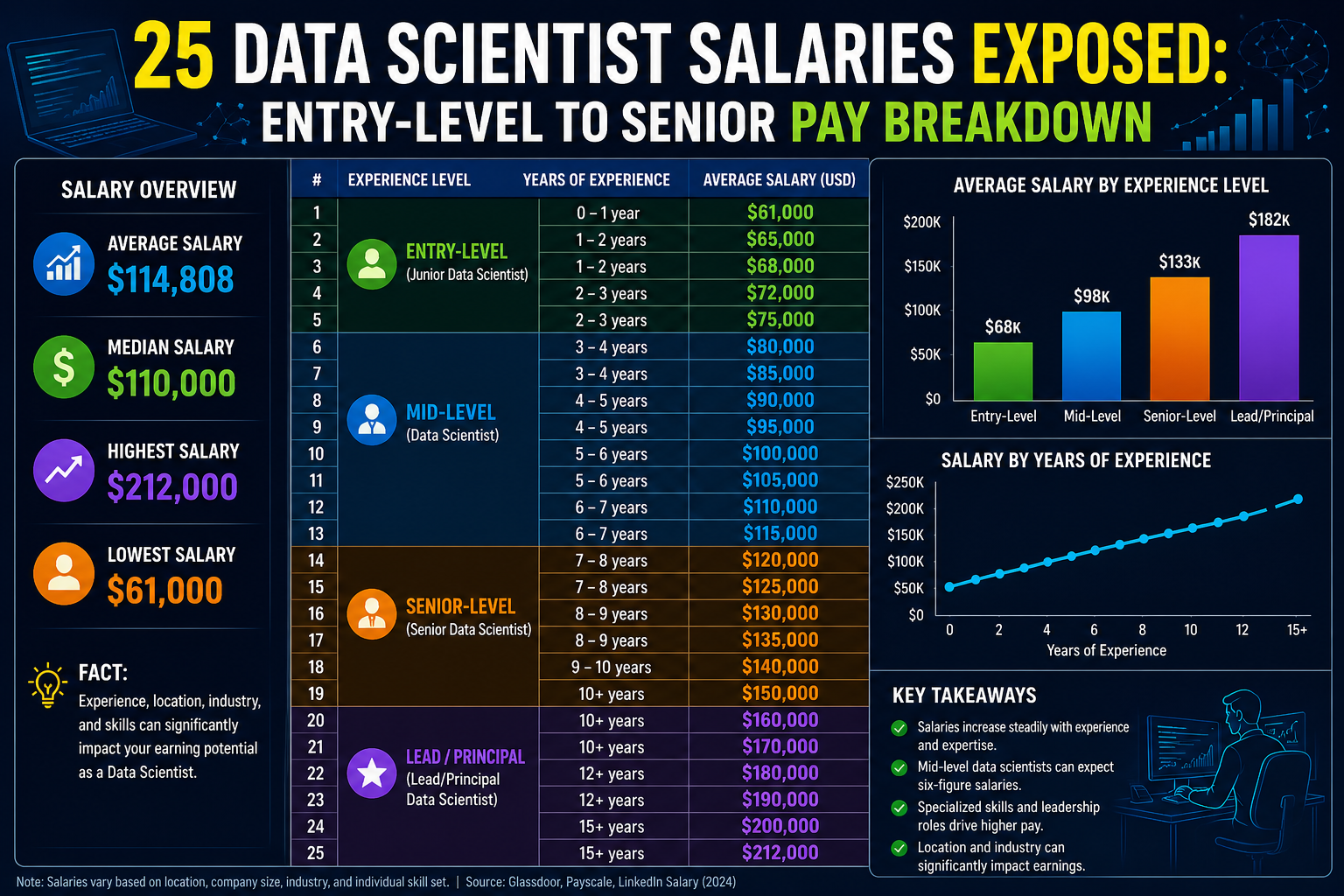
When examining salary data, it becomes clear that there is no single “standard” income for data scientists. Instead, salaries are distributed across a wide range, reflecting differences in experience, specialization, and organizational needs. This distribution can be better understood by looking at three general tiers: lower range, midpoint, and higher range.
The lower range typically includes entry-level positions and roles in smaller organizations. These positions often focus on foundational tasks such as data cleaning, basic analysis, and supporting senior team members. While salaries in this range may be lower, they provide valuable opportunities for gaining experience and building essential skills.
The midpoint represents the average salary for data scientists with a moderate level of experience. Professionals in this category are expected to handle more complex tasks, including building predictive models and collaborating with cross-functional teams. Their work has a direct impact on business outcomes, and their compensation reflects this increased responsibility.
The higher range includes senior roles and specialized positions. These professionals often lead projects, design advanced models, and contribute to strategic decision-making. Their expertise is highly valued, and their salaries reflect both their experience and the impact of their work. In some cases, these roles also include additional compensation such as bonuses or equity, further increasing overall earnings.
One of the most striking observations from salary data is the variation within each location. Even within the same city, salaries can differ significantly based on factors such as company size, industry, and individual qualifications. This variation highlights the importance of considering the full context when evaluating salary figures.
Another key insight is the relationship between salary ranges and career progression. As professionals gain experience and develop specialized skills, they move through these tiers, increasing their earning potential. However, this progression is not automatic. It requires continuous learning, strong performance, and the ability to demonstrate value to employers.
The Influence of Experience on Earnings Growth
Experience is one of the most consistent predictors of salary growth in data science. As professionals spend more time in the field, they acquire new skills, gain practical knowledge, and build a track record of successful projects. These factors contribute to increased earning potential and open the door to more advanced roles.
In the early stages of a career, the focus is often on learning and development. Entry-level data scientists typically work on well-defined tasks under the guidance of more experienced team members. This period is crucial for building a strong foundation in programming, statistics, and data analysis. While salaries at this stage may be modest compared to more experienced roles, the knowledge gained is invaluable for future growth.
As professionals move into mid-level positions, their responsibilities expand. They are expected to take on more complex projects, work independently, and contribute to decision-making processes. This stage often involves developing predictive models, optimizing algorithms, and collaborating with other departments. Salaries increase accordingly, reflecting the greater impact of their work.
Senior-level roles represent the highest tier of experience. At this stage, data scientists are not only technical experts but also leaders within their organizations. They may oversee teams, set strategic direction, and ensure that data-driven initiatives align with business goals. Their work has a significant impact on organizational success, and their compensation reflects this level of responsibility.
It is important to note that experience alone is not enough to guarantee salary growth. The quality of experience matters just as much as the quantity. Professionals who actively seek out challenging projects, develop new skills, and stay updated with industry trends are more likely to advance and increase their earnings.
Industry-Specific Trends in Data Science Compensation
Different industries place varying levels of value on data science, and this is reflected in compensation levels. While the core skills of a data scientist remain consistent, the context in which those skills are applied can influence salary significantly.
In the technology sector, data science is often at the heart of product development and innovation. Companies in this space rely heavily on data to drive decisions, optimize performance, and create new features. As a result, they tend to offer some of the highest salaries in the field. The fast-paced nature of the industry also means that professionals are constantly working on cutting-edge projects, which can further enhance their skills and market value.
The finance industry is another major employer of data scientists. Here, the focus is often on risk management, fraud detection, and investment strategies. The high stakes involved in financial decision-making lead to competitive compensation packages. Professionals in this sector are expected to have strong analytical skills and a deep understanding of financial concepts.
Healthcare is an area where data science is rapidly gaining importance. From predicting patient outcomes to optimizing treatment plans, data-driven insights are transforming the industry. While salaries in healthcare may not always match those in technology or finance, the work often has a direct impact on people’s lives, which can be a significant motivating factor for many professionals.
Retail and e-commerce companies use data science to understand customer behavior, improve marketing strategies, and optimize supply chains. These organizations value data scientists who can translate complex data into actionable insights that drive sales and customer satisfaction. Compensation in this sector can vary widely depending on the size and success of the company.
Other industries, such as manufacturing, energy, and transportation, are also increasingly adopting data science. As these sectors continue to evolve, the demand for skilled professionals is expected to grow, potentially leading to higher salaries in the future.
The Role of Skills and Specialization in Salary Growth
While experience provides a general framework for salary progression, specific skills and areas of specialization can have a significant impact on earning potential. Data science is a broad field, and professionals who develop expertise in high-demand areas often command higher salaries.
Machine learning is one of the most sought-after specializations. Professionals who can design, train, and deploy advanced models are highly valued across industries. Their ability to create systems that learn from data and improve over time makes them indispensable in many applications.
Deep learning, a subset of machine learning, is another area of high demand. It is particularly relevant in fields such as computer vision and natural language processing. These technologies are used in applications ranging from image recognition to voice assistants, and expertise in this area can significantly boost earning potential.
Data engineering skills are also increasingly important. As datasets grow larger and more complex, the ability to build and maintain data pipelines becomes critical. Data scientists who can handle both analysis and infrastructure are often seen as more versatile and valuable.
Cloud computing is another key area. Familiarity with cloud platforms allows data scientists to work with large-scale data and deploy models in production environments. This skill is particularly important as organizations continue to move their operations to the cloud.
Soft skills should not be overlooked. Communication, teamwork, and problem-solving abilities are essential for translating technical work into business value. Professionals who can effectively convey their insights and collaborate with others are often more successful in advancing their careers.
The Impact of Company Size and Structure on Compensation
The size and structure of an organization can also influence data scientist salaries. Large corporations often have more resources and established compensation frameworks, which can lead to higher base salaries and additional benefits. These companies may also offer opportunities for career advancement and professional development.
Startups, on the other hand, may offer lower base salaries but compensate with equity or other incentives. Working in a startup environment can provide valuable experience and the opportunity to work on a wide range of projects. However, it may also involve greater risk and uncertainty.
Mid-sized companies often strike a balance between these two extremes. They may offer competitive salaries along with a more stable work environment. The specific compensation structure will depend on factors such as the company’s financial health, industry, and growth stage.
Organizational structure also plays a role. Companies that prioritize data-driven decision-making are more likely to invest in data science teams and offer competitive compensation. In contrast, organizations that are still developing their data capabilities may offer lower salaries but provide opportunities for growth and influence.
Understanding these factors can help professionals identify opportunities that align with their career goals and financial expectations.
Building a High-Value Skill Set That Drives Long-Term Earnings
Sustained growth in data science is rarely the result of chance. It comes from deliberately building a skill set that aligns with real-world demand while remaining adaptable to change. The most successful professionals in this field are not those who simply learn tools, but those who understand why those tools matter and how to apply them in evolving environments.
A strong foundation begins with programming fluency. While many languages exist, the emphasis is less on mastering every syntax detail and more on developing the ability to think logically and solve problems efficiently. Writing clean, maintainable code becomes increasingly important as projects grow in complexity and collaboration becomes essential. Over time, the focus shifts from simply making code work to ensuring that it scales, performs well, and integrates seamlessly with other systems.
Mathematical understanding is another cornerstone. Concepts such as probability, linear algebra, and optimization underpin many of the techniques used in data science. However, practical application matters more than theoretical memorization. Professionals who can connect mathematical concepts to real-world problems are better equipped to build models that deliver meaningful results.
Equally important is the ability to work with data in its raw form. Real-world datasets are rarely neat or complete. Learning how to handle inconsistencies, missing values, and large volumes of information is a skill that distinguishes experienced professionals from beginners. This aspect of the work often requires patience and attention to detail, as small errors can lead to significant inaccuracies.
As the field continues to evolve, adaptability becomes a defining trait. New tools and frameworks emerge regularly, and the ability to learn quickly ensures that skills remain relevant. Rather than focusing on any single technology, successful data scientists develop a mindset that allows them to transition between tools as needed. This flexibility not only enhances productivity but also increases resilience in a rapidly changing job market.
The Strategic Role of Specialization in Career Growth
While a broad skill set provides versatility, specialization often determines how far a data scientist can progress in terms of both responsibility and compensation. As industries become more data-driven, the demand for niche expertise continues to grow. Professionals who position themselves within high-impact areas often find greater opportunities for advancement.
One approach to specialization involves focusing on a specific type of problem. For example, predictive modeling, recommendation systems, and anomaly detection each require distinct techniques and approaches. By developing deep expertise in one of these areas, a data scientist can become a go-to resource within their organization or industry.
Another path involves aligning with a particular domain. Industry knowledge adds context to technical skills, making insights more relevant and actionable. A data scientist working in healthcare, for instance, benefits from understanding clinical workflows and regulatory considerations. Similarly, those in finance must be familiar with market dynamics and risk management principles. This combination of technical and domain expertise enhances credibility and effectiveness.
Emerging fields also offer opportunities for specialization. Areas such as artificial intelligence, natural language processing, and computer vision are expanding rapidly, creating demand for professionals who can navigate their complexities. These specializations often require continuous learning, as advancements occur at a fast pace.
However, specialization should not come at the expense of foundational skills. A balanced approach ensures that professionals remain adaptable while still offering unique value. The goal is to build depth in a chosen area while maintaining the ability to collaborate across different aspects of data science.
The Importance of Real-World Experience and Practical Application
Knowledge alone is not enough to succeed in data science. Practical experience plays a critical role in translating theory into results. Working on real-world projects exposes professionals to challenges that cannot be fully understood through study alone. These experiences build confidence and develop problem-solving skills that are essential for career growth.
Projects often involve dealing with imperfect data, unclear objectives, and evolving requirements. Navigating these challenges requires not only technical expertise but also the ability to communicate effectively with stakeholders. Understanding business needs and aligning technical solutions with those needs is a key aspect of the role.
Experience also contributes to the development of intuition. Over time, data scientists learn to recognize patterns, anticipate potential issues, and make informed decisions more quickly. This intuition is difficult to teach but becomes increasingly valuable as professionals take on more complex responsibilities.
Collaboration is another important element of practical experience. Data science rarely occurs in isolation. Teams often include engineers, analysts, and business leaders, each contributing their expertise to a project. Learning how to work effectively within these teams enhances both the quality of work and the overall impact of data-driven initiatives.
As professionals gain experience, they also build a portfolio of work that demonstrates their capabilities. This portfolio serves as tangible evidence of skills and achievements, making it easier to secure new opportunities and negotiate higher compensation.
Leadership and Its Influence on Career Advancement
As data scientists progress in their careers, technical expertise alone becomes insufficient for continued growth. Leadership skills play an increasingly important role, particularly for those aiming to move into senior or managerial positions. Leadership in data science is not limited to managing people; it also involves guiding projects, influencing decisions, and shaping strategy.
One aspect of leadership is the ability to mentor others. Sharing knowledge and supporting the development of junior team members contribute to the overall strength of the organization. It also demonstrates a level of maturity and responsibility that is often recognized and rewarded.
Another key element is strategic thinking. Senior data scientists are expected to look beyond individual tasks and consider the broader impact of their work. This includes identifying opportunities for data-driven improvements, prioritizing projects, and aligning efforts with organizational goals.
Communication becomes even more critical at this stage. Leaders must be able to convey complex ideas in a way that is accessible to non-technical stakeholders. This ensures that insights are understood and acted upon, maximizing their value.
Decision-making is also a central component of leadership. Data scientists often face situations where there is no clear answer, requiring them to weigh different options and make informed choices. The ability to make sound decisions under uncertainty is a valuable skill that contributes to career advancement.
The Evolving Role of Data Science in Business Strategy
Data science has moved beyond its initial role as a support function and is now a central component of business strategy. Organizations increasingly rely on data-driven insights to guide their decisions, from product development to market expansion. This shift has elevated the importance of data scientists within organizations.
In many cases, data scientists are involved in shaping strategic initiatives. Their ability to analyze trends and predict outcomes provides valuable input for decision-making processes. This influence extends to various areas, including customer experience, operational efficiency, and revenue growth.
The integration of data science into business strategy also requires a deeper understanding of organizational goals. Data scientists must be able to connect their work to broader objectives, ensuring that their efforts contribute to measurable outcomes. This alignment enhances the impact of their work and increases their value within the organization.
As businesses continue to embrace digital transformation, the role of data science is expected to expand further. New technologies and data sources will create additional opportunities for innovation, while also introducing new challenges. Data scientists who can navigate this evolving landscape will be well-positioned for long-term success.
Ethical Considerations and Responsible Data Use
As the influence of data science grows, so does the importance of ethical considerations. The use of data has significant implications for privacy, fairness, and transparency. Data scientists must be mindful of these issues and ensure that their work adheres to ethical standards.
One key concern is data privacy. Handling sensitive information requires careful attention to security and compliance with regulations. Protecting user data is not only a legal requirement but also a matter of trust. Organizations that fail to safeguard data risk damaging their reputation and losing customer confidence.
Bias in data and algorithms is another important issue. If not addressed, bias can lead to unfair or discriminatory outcomes. Data scientists must be vigilant in identifying and mitigating bias, ensuring that their models produce equitable results.
Transparency is also essential. Stakeholders should have a clear understanding of how data is used and how decisions are made. This includes explaining the limitations of models and acknowledging uncertainty where it exists.
By prioritizing ethical considerations, data scientists contribute to the responsible use of data and help build trust in data-driven systems. This not only benefits organizations but also supports the broader goal of using data for positive impact.
Adapting to Future Trends and Opportunities in Data Science
The field of data science is constantly evolving, driven by technological advancements and changing business needs. Staying ahead requires an awareness of emerging trends and a willingness to adapt. Professionals who embrace change are more likely to thrive in this dynamic environment.
One notable trend is the increasing automation of routine tasks. Tools that automate data preparation and model building are becoming more sophisticated, allowing data scientists to focus on higher-level analysis and strategy. This shift emphasizes the importance of critical thinking and creativity.
Another trend is the growing integration of data science with other disciplines. Fields such as engineering, design, and operations are increasingly incorporating data-driven approaches. This creates opportunities for collaboration and expands the scope of data science applications.
The rise of real-time data is also shaping the field. Organizations are moving towards systems that can process and analyze data as it is generated, enabling faster decision-making. Data scientists must adapt to this shift by developing skills in streaming data and real-time analytics.
Globalization continues to influence the profession as well. Remote work and distributed teams are becoming more common, allowing data scientists to collaborate across borders. This expands opportunities but also requires the ability to work effectively in diverse and dynamic environments.
As these trends continue to unfold, the future of data science remains promising. The demand for skilled professionals is expected to persist, driven by the increasing importance of data in all aspects of society. Those who invest in their skills, remain adaptable, and approach their work with curiosity and responsibility will be well-equipped to succeed in this evolving field.
Conclusion
Data science has firmly established itself as one of the most influential and future-focused career paths in the modern world. It sits at the intersection of technology, business, and human decision-making, transforming raw information into insights that shape how organizations operate and grow. As industries continue to generate vast amounts of data, the need for professionals who can interpret and apply that data effectively will only increase. This sustained demand is a key reason why data science remains both a stable and highly rewarding profession.
At the same time, the field is far from uniform. Salaries vary widely based on location, experience, industry, and skill set, reflecting the complexity of the role and the diverse environments in which data scientists work. High-paying tech hubs continue to set the upper benchmarks, but emerging markets and remote opportunities are reshaping what competitive compensation looks like. Understanding these dynamics allows professionals to make smarter career decisions, whether they are entering the field or aiming to move into more advanced roles.
Experience plays a central role in shaping career progression. Early stages focus on building technical foundations and gaining practical exposure, while mid-level roles demand greater independence and impact. Senior positions require not only deep expertise but also leadership, strategic thinking, and the ability to influence business outcomes. This progression highlights an important reality: success in data science is not just about technical ability, but also about growth, adaptability, and the willingness to take on increasing responsibility.
Skills and specialization further define earning potential and career direction. While a broad understanding of data science fundamentals is essential, developing expertise in high-demand areas can significantly enhance opportunities. At the same time, the ability to apply knowledge in real-world contexts remains one of the most valuable assets a data scientist can possess. Practical experience, combined with strong communication and collaboration skills, ensures that insights are not only accurate but also actionable.
The evolving role of data science within organizations underscores its importance. No longer confined to analytical support, it has become a strategic function that directly influences decision-making at the highest levels. This shift brings both opportunity and responsibility. Data scientists are now expected to contribute to long-term planning, guide innovation, and ensure that data is used ethically and effectively.
Looking ahead, the field will continue to evolve alongside advancements in technology and changes in business needs. Automation, real-time analytics, and cross-disciplinary integration are shaping the future of data science, creating new possibilities while also redefining existing roles. Professionals who remain curious, adaptable, and committed to continuous learning will be best positioned to navigate these changes.
Ultimately, data science is more than just a career—it is a discipline that empowers individuals to make sense of complexity and drive meaningful impact. Whether analyzing customer behavior, improving healthcare outcomes, or optimizing operations, the work of a data scientist has far-reaching implications. For those willing to invest in their skills and embrace the challenges of the field, the rewards extend beyond financial compensation to include intellectual growth, professional fulfillment, and the opportunity to shape the future in a data-driven world.