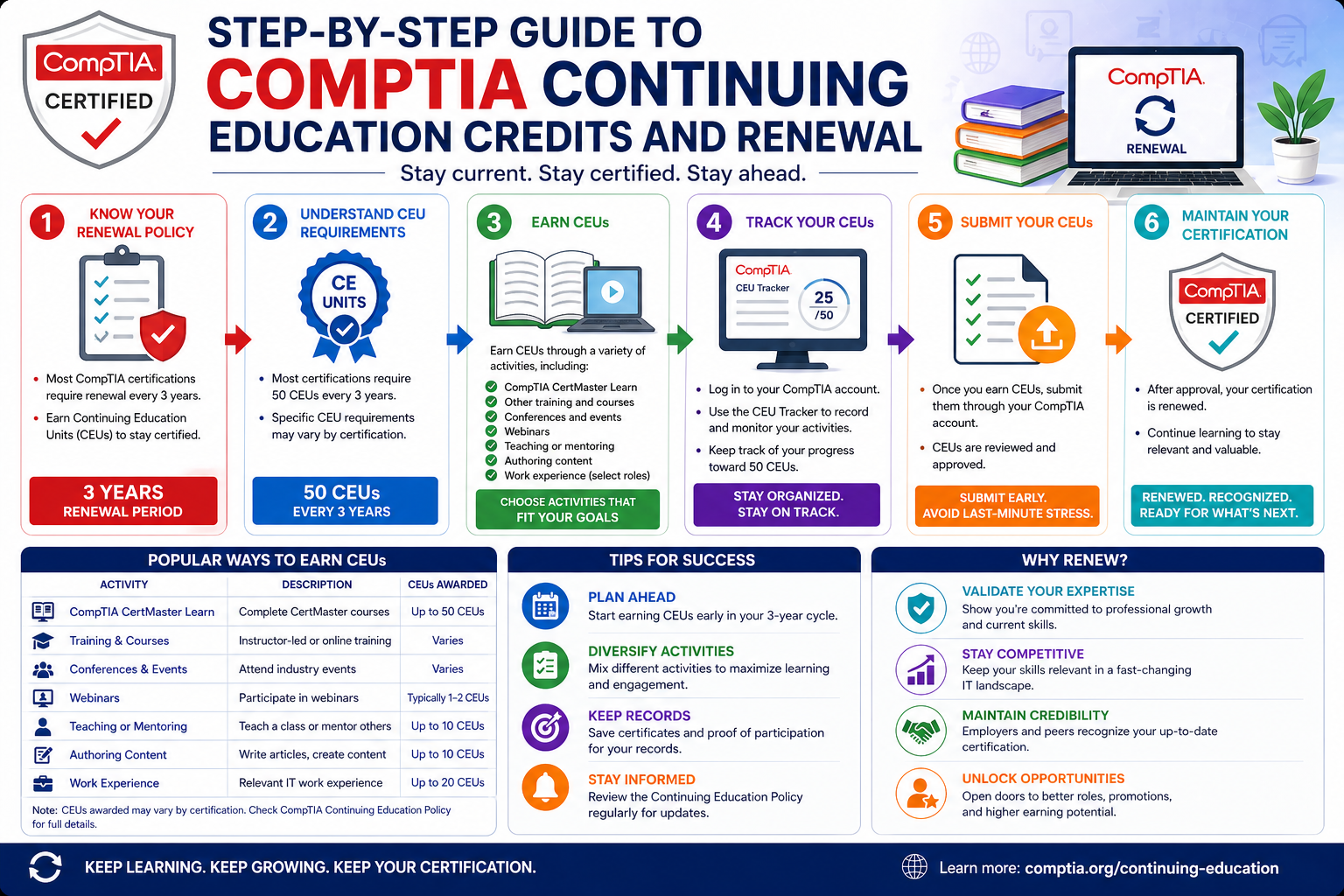
Continuing education credits are a structured way for certified professionals to maintain the validity of their credentials over time. In the field of information technology, certifications are often not permanent achievements but rather qualifications that require ongoing learning to remain current. This approach ensures that professionals stay aligned with evolving technologies, updated practices, and emerging industry standards.
A continuing education credit system is built around the idea that learning does not stop after passing an initial certification exam. Instead, it continues throughout a professional’s career. These credits are typically earned through structured learning activities such as completing training modules, attending technical sessions, or engaging in skill development programs that are aligned with the certification objectives.
Each credit represents a measurable unit of learning, often tied to a specific amount of instructional time. The purpose is not only to track participation but also to ensure that the learning experience contributes meaningfully to professional growth. In technical fields, this becomes especially important because systems, tools, and security practices evolve rapidly, requiring professionals to continuously update their knowledge base.
The structure of continuing education programs varies depending on the certification authority, but the core principle remains consistent: professionals must demonstrate ongoing competency in their field. This requirement helps maintain the credibility of certifications and ensures that individuals holding them remain capable of performing relevant job functions in modern environments.
In many cases, continuing education credits are accumulated over a fixed renewal cycle, which may span multiple years. Within this cycle, certified individuals must earn a required number of credits to maintain their certification status. Failure to meet these requirements can result in the expiration of the certification, requiring retesting or alternative renewal methods.
This system also encourages self-directed learning, allowing professionals to choose educational activities that align with their career goals. While some credits may come from structured programs, others may be earned through practical experience or advanced certifications. This flexibility helps individuals tailor their learning journey according to their specialization and interests within the broader IT landscape.
Certification Lifecycle and the Role of Renewal Requirements
Professional certifications typically follow a lifecycle that includes initial achievement, active status, and renewal. The renewal phase is a critical component, as it ensures that certification holders remain aligned with current industry expectations. Without renewal requirements, certifications would gradually lose relevance as technologies and methodologies evolve.
Once an individual earns a certification, they are generally granted a validity period during which the certification is considered active. This period is designed to provide enough time for professionals to apply their skills in real-world environments while also preparing for renewal. The renewal process is introduced to verify continued competence beyond the initial exam.
Renewal requirements often include multiple pathways, allowing flexibility based on the professional’s career progression. One common method is retaking the most recent version of the certification exam, which directly assesses updated knowledge. Another method involves earning a higher-level certification, which demonstrates expanded expertise beyond the original credential.
A third and increasingly common approach is the completion of continuing education activities. This method allows professionals to accumulate credits through structured learning rather than formal re-examination. It is particularly useful for individuals who prefer continuous learning over periodic high-stakes testing.
The renewal cycle is typically designed to encourage consistent engagement rather than last-minute preparation. By spreading learning activities across the entire cycle, professionals are able to gradually build knowledge and apply it in practical scenarios. This approach supports deeper understanding and long-term retention of skills.
Certification renewal also plays an important role in workforce development. Employers benefit from knowing that certified staff maintains up-to-date knowledge, while professionals benefit from staying competitive in the job market. In fast-changing technical environments, this balance between validation and ongoing learning becomes essential for maintaining industry standards.
Pathways for Maintaining Active Certification Status
Maintaining an active certification status is not limited to a single method. Instead, professionals are usually provided with multiple pathways that reflect different learning styles and career goals. These pathways ensure that individuals can choose the most appropriate route based on their experience, available time, and professional development needs.
One pathway involves retaking the most current version of the certification exam. This method ensures that the individual’s knowledge is fully aligned with the latest exam objectives. It is often chosen by those who prefer structured assessment and want to validate their understanding through formal testing rather than incremental learning.
Another pathway involves earning a higher-level certification within the same professional track or a related field. This approach allows professionals to demonstrate advancement in their expertise while simultaneously renewing their existing credentials. For example, progressing from an entry-level certification to an intermediate or advanced certification can satisfy renewal requirements while expanding career opportunities.
The third pathway focuses on continuing education activities, which provide a more flexible and continuous approach to certification maintenance. Through this method, professionals engage in approved learning experiences that contribute toward credit accumulation. These activities are designed to reinforce existing knowledge while introducing new concepts relevant to evolving industry practices.
This flexibility in renewal options acknowledges that professionals have different learning preferences and career trajectories. Some may prefer structured exam preparation, while others may benefit more from ongoing skill development through incremental learning. By offering multiple pathways, certification systems accommodate a broader range of learners.
In practice, many professionals combine these pathways over the course of their careers. For example, an individual may initially renew through continuing education activities and later choose to advance through higher-level certifications. This blended approach supports both immediate renewal needs and long-term career development goals.
Ultimately, these pathways are designed to ensure that certification holders remain competent, adaptable, and capable of meeting the demands of modern technical environments. By maintaining an active status, professionals demonstrate their commitment to continuous improvement and industry relevance.
Structure and Measurement of Continuing Education Units
Continuing education units are used as a standardized way to measure learning activities within certification renewal systems. Each unit represents a defined amount of instructional time or learning effort, allowing professionals and certification bodies to track progress consistently.
The structure of these units is typically based on time spent in educational activities. For example, one unit may correspond to one hour of structured learning. This time-based measurement ensures that credit accumulation reflects actual engagement with educational content rather than passive participation.
Learning activities that contribute to these units can take many forms, including video-based instruction, instructor-led training, self-paced modules, or hands-on technical exercises. The key requirement is that the activity must be relevant to the certification objectives and contribute to skill development in the field.
To maintain consistency, continuing education programs often define a set of approved learning categories. These categories help ensure that the content aligns with the intended purpose of professional development. Activities outside these categories typically do not qualify for credit accumulation.
The measurement system also includes verification mechanisms to confirm that learning has been completed successfully. This may involve completion tracking, assessments, or documented participation. The goal is to ensure that credits reflect genuine learning rather than incomplete or superficial engagement.
Accumulated units are then recorded within a professional’s certification profile and tracked over the renewal cycle. This allows both the individual and the certification authority to monitor progress toward renewal requirements. Once the required number of units is reached, the certification can be renewed without the need for additional examination.
This structured approach to measurement provides clarity and transparency. Professionals understand exactly how much learning is required, while certification bodies maintain consistent standards across all participants. It also encourages steady participation in educational activities rather than concentrated effort at the end of the renewal period.
Learning Activities That Contribute to Credit Accumulation
A wide range of learning activities can contribute to continuing education credit accumulation. These activities are designed to support different learning preferences and professional needs while maintaining alignment with certification objectives.
One common type of activity is structured online learning, where professionals engage with pre-designed instructional content. This format allows for flexible pacing and accessibility, making it suitable for individuals balancing work and study responsibilities. The content is typically divided into modules that focus on specific technical topics.
Instructor-led training sessions represent another form of qualifying activity. These sessions provide real-time interaction with subject matter experts and allow for deeper discussion of complex topics. The interactive nature of this format often enhances understanding and supports the practical application of concepts.
Self-directed learning activities may also contribute to credit accumulation, provided they meet predefined criteria. This can include studying technical materials, completing guided exercises, or engaging in simulation-based environments. The emphasis is on structured learning outcomes rather than informal exploration.
Hands-on technical practice is another valuable component of continuing education. In fields such as information technology, practical experience plays a crucial role in skill development. Activities that involve configuring systems, troubleshooting issues, or implementing solutions can contribute meaningfully to professional growth.
In addition to formal training, some programs recognize cross-certification learning. This allows professionals to earn credits through related certifications that expand their expertise. This approach encourages broader skill development while supporting specialization within a technical domain.
Each of these learning activities is evaluated to ensure it meets quality and relevance standards. Only approved activities contribute toward credit accumulation, maintaining the integrity of the renewal process. This ensures that continuing education remains focused on meaningful professional development rather than passive participation.
Importance of Ongoing Skill Development in Technical Fields
In rapidly evolving technical environments, ongoing skill development is essential for maintaining professional competence. Technologies, tools, and best practices change frequently, requiring individuals to continuously update their knowledge base to remain effective in their roles.
Without regular learning, skills can quickly become outdated, leading to gaps in understanding and reduced effectiveness in practical scenarios. Continuing education systems address this challenge by encouraging structured and consistent learning over time.
Ongoing skill development also supports adaptability. Professionals who regularly engage in learning activities are better equipped to handle new technologies, transition between systems, and respond to changing industry demands. This adaptability is particularly important in fields where innovation is constant.
In addition to technical skills, continuing education often reinforces problem-solving abilities and analytical thinking. Exposure to new concepts and scenarios helps professionals develop a more flexible approach to challenges, improving overall performance in real-world situations.
Another important aspect is career progression. Continuous learning enhances professional credibility and can lead to increased opportunities for advancement. Employers often value individuals who demonstrate commitment to staying current with industry developments.
Ongoing education also contributes to standardization within the industry. By ensuring that certified professionals maintain a consistent level of knowledge, organizations can rely on certifications as a reliable measure of competence.
Overall, continuous skill development is not just a requirement for maintaining certification but a fundamental aspect of long-term professional success in technical fields.
Administrative Framework Behind Continuing Education Programs
Continuing education systems rely on a structured administrative framework that ensures consistency, fairness, and transparency in how professional learning is recognized and recorded. This framework is typically designed to manage large volumes of certified individuals while maintaining accurate tracking of their ongoing educational activities.
At the core of this structure is a centralized record system that maintains each professional’s certification status, renewal timeline, and accumulated learning credits. This record serves as the official reference point for determining whether an individual has met the requirements for maintaining active certification status. Every approved learning activity is added to this record after verification.
The administrative framework also defines clear rules for what qualifies as acceptable learning. These rules ensure that only relevant, structured, and verifiable activities contribute toward credit accumulation. Without such standards, the system would lack consistency, and the value of certification maintenance would be diminished.
Another key function of the framework is validation. When professionals complete learning activities, these must be verified before being officially counted. Verification ensures that the activity was completed as claimed and meets the required standards. This may involve automated tracking systems, completion certificates, or submission of documented proof.
In addition, administrative systems are responsible for enforcing renewal cycles. Each certification has a defined validity period, and the system monitors deadlines to ensure timely completion of requirements. Notifications, reminders, and status updates are often used to help professionals stay aware of their progress.
This framework also supports dispute resolution. In cases where learning credits are not properly recorded or are questioned, administrative procedures allow for review and correction. This helps maintain trust in the system and ensures fairness for all participants.
Overall, the administrative framework acts as the backbone of continuing education programs, ensuring that the entire process remains organized, reliable, and aligned with professional standards.
Tracking and Documentation of Learning Activities
Accurate tracking and documentation are essential components of continuing education systems. Without proper records, it would be impossible to verify whether professionals have met their renewal requirements. As a result, documentation practices are carefully structured and standardized.
Each learning activity completed by a professional is recorded with specific details such as duration, type of activity, and relevance to certification requirements. This information forms the basis for calculating accumulated credits over time. The consistency of this data ensures that all participants are evaluated fairly.
Documentation typically includes proof of completion, which confirms that the individual actively participated in the learning activity. This may be in the form of completion records, attendance logs, or automated system tracking. The goal is to ensure that credits reflect actual engagement rather than intended participation.
In many cases, professionals are responsible for maintaining personal records of their continuing education activities. This includes keeping track of completed training, verifying credit submissions, and ensuring that all activities are properly recorded within the certification system.
The tracking process is designed to be cumulative, meaning that credits are added over time until the renewal requirement is met. This encourages consistent learning behavior rather than last-minute completion of activities.
Documentation also plays a critical role during audits or verification checks. If there is any discrepancy in recorded credits, documented evidence is used to confirm the validity of claimed activities. This reinforces the importance of maintaining accurate and complete records.
Through structured tracking and documentation, continuing education systems ensure transparency, accountability, and reliability in the certification maintenance process.
Strategic Planning for Certification Renewal
Effective certification renewal often requires strategic planning. Rather than approaching renewal as a single event, professionals benefit from distributing their learning activities across the entire renewal cycle. This approach allows for steady progress and reduces pressure as deadlines approach.
Strategic planning begins with understanding the total number of credits required and the time available to achieve them. By breaking this requirement into smaller, manageable segments, professionals can create a realistic learning schedule that aligns with their work and personal commitments.
Another important aspect of planning involves selecting appropriate learning activities. Since not all activities contribute equally to professional development, choosing relevant and high-value learning experiences helps maximize the benefit of the time invested.
Time management is also a key factor in strategic planning. Professionals often balance multiple responsibilities, making it necessary to allocate dedicated time for continuing education. Consistent scheduling helps ensure steady progress toward renewal goals.
In addition, strategic planning includes monitoring progress regularly. By reviewing accumulated credits periodically, professionals can adjust their learning approach if needed. This prevents last-minute shortages and reduces the risk of certification expiration.
Some professionals also align their continuing education activities with career development goals. This means selecting learning experiences that not only contribute to renewal but also enhance specific technical skills relevant to their job roles.
Overall, strategic planning transforms continuing education from a reactive requirement into a proactive development process that supports both certification maintenance and long-term career growth.
Compliance Requirements and Certification Standards
Compliance is a critical aspect of continuing education systems. Certification bodies establish specific standards that define how credits must be earned, documented, and submitted. These standards ensure uniformity across all certified professionals.
Compliance requirements typically specify the minimum number of credits needed within a renewal cycle, as well as the types of activities that qualify. These requirements are designed to ensure that professionals engage in meaningful learning that supports their certification level.
In addition to credit requirements, compliance standards also define time constraints. Credits must usually be earned within a specified period to be considered valid for renewal. This ensures that learning is continuous rather than accumulated irregularly over long periods.
Certification standards also regulate the quality of learning activities. Only approved or recognized activities are eligible for credit accumulation. This prevents inconsistencies and ensures that all learning contributes to relevant skill development.
Failure to meet compliance requirements can result in certification expiration. In such cases, professionals may need to retake examinations or complete additional requirements to regain active status. This reinforces the importance of adhering to established standards.
Compliance systems are also designed to maintain fairness. All certified individuals are held to the same expectations, regardless of their experience level or career position. This consistency helps preserve the credibility of the certification.
Through strict compliance requirements and clearly defined standards, continuing education systems maintain structure, fairness, and professional integrity.
Common Challenges in Maintaining Continuing Education Requirements
While continuing education systems are designed to support professional development, individuals often face challenges in meeting their renewal requirements. These challenges can vary depending on workload, access to learning resources, and time availability.
One common challenge is time management. Many professionals struggle to balance full-time work responsibilities with ongoing learning requirements. This can lead to delays in completing required credits or difficulty maintaining a consistent learning schedule.
Another challenge involves selecting appropriate learning activities. With a wide range of available options, it can be difficult to determine which activities are most relevant or beneficial for both certification renewal and career growth.
Tracking progress can also present difficulties. Without careful documentation, professionals may lose track of completed activities or fail to properly record credits, leading to gaps in their renewal records.
In some cases, a lack of awareness about renewal requirements can create additional challenges. Professionals may not fully understand the number of credits needed or the deadlines associated with their certification cycle.
Motivation is another factor that can influence success in continuing education. Without immediate rewards, it can be challenging to maintain consistent engagement in learning activities over time.
Technical barriers may also exist, particularly for individuals who have limited access to structured learning environments. This can impact their ability to complete approved activities efficiently.
Despite these challenges, structured planning and consistent engagement can help professionals overcome obstacles and successfully meet their continuing education requirements.
Role of Employers in Supporting Continuing Education
Employers play a significant role in supporting continuing education for certified professionals. Since skilled employees contribute directly to organizational performance, many employers encourage ongoing learning as part of workforce development strategies.
One way employers support continuing education is by providing access to training opportunities. This may include structured learning programs, internal workshops, or sponsored educational activities that align with certification requirements.
Employers may also allocate dedicated time for employees to engage in learning activities. This helps reduce the conflict between work responsibilities and educational requirements, making it easier for professionals to maintain certification status.
In some cases, organizations offer financial support for continuing education activities. This can include covering the cost of training or providing resources that enable employees to complete required learning efficiently.
Another important aspect of employer support is aligning continuing education with job roles. When learning activities are relevant to daily responsibilities, employees can apply new knowledge directly in the workplace, reinforcing skill development.
Employers also benefit from encouraging certification maintenance because it ensures that their workforce remains up to date with industry standards. This contributes to improved performance, reduced skill gaps, and increased operational efficiency.
By actively supporting continuing education, employers help create a culture of continuous learning that benefits both individuals and organizations.
Evolving Nature of Learning in Technical Certification Systems
Continuing education systems evolve alongside changes in technology and industry practices. As new tools, methodologies, and frameworks emerge, certification requirements are updated to reflect current professional standards.
This evolution ensures that certifications remain relevant in rapidly changing technical environments. Without regular updates, certifications would quickly become outdated and lose their value in the industry.
Modern learning systems increasingly emphasize flexibility. Professionals are now able to engage in diverse learning formats that accommodate different schedules and learning preferences. This flexibility supports broader participation in continuing education programs.
The integration of digital learning platforms has also transformed how continuing education is delivered. Structured online learning, interactive modules, and self-paced content have made it easier for professionals to access educational resources regardless of location.
Another important evolution is the increasing recognition of practical experience as a valid form of learning. Hands-on engagement with systems and technologies is now widely acknowledged as a valuable contributor to professional development.
Certification systems are also becoming more adaptive, allowing professionals to tailor their learning paths based on specialization and career goals. This personalization enhances the relevance and effectiveness of continuing education.
As the industry continues to evolve, continuing education systems will remain essential for ensuring that professionals maintain current skills and adapt to emerging technological demands.
Long-Term Value of Continuous Professional Learning
Continuous professional learning provides long-term benefits that extend beyond certification renewal. It contributes to sustained career growth, improved technical competence, and increased adaptability in changing work environments.
Over time, professionals who engage consistently in continuing education develop a deeper understanding of their field. This accumulated knowledge enhances their ability to solve complex problems and make informed decisions.
Continuous learning also supports career mobility. Professionals who maintain up-to-date certifications are often better positioned for new opportunities, promotions, or transitions into specialized roles.
In addition, ongoing education fosters confidence in technical abilities. As professionals expand their knowledge base, they become more capable of handling advanced tasks and responsibilities within their roles.
Another long-term benefit is resilience in the face of technological change. Individuals who continuously update their skills are less likely to experience skill obsolescence, allowing them to remain relevant in their industry.
Continuous professional learning also contributes to industry advancement as a whole. As more professionals engage in structured learning, the overall quality and consistency of technical expertise within the workforce improve.
Through sustained engagement in continuing education, professionals build a strong foundation for long-term success and adaptability in their careers.
Professional Growth Through Continuing Education Systems
Continuing education systems are not only designed to maintain certification status but also to support long-term professional growth. In technical fields, where innovation and system updates occur frequently, structured learning plays a critical role in shaping career development paths.
Professional growth in this context is achieved through a combination of skill reinforcement and skill expansion. Reinforcement ensures that existing knowledge remains strong and applicable, while expansion introduces new concepts and technologies that broaden a professional’s capabilities.
As individuals engage in ongoing learning activities, they gradually build a more advanced understanding of their field. This deeper knowledge allows them to take on more complex responsibilities and contribute more effectively to technical environments.
Continuing education also encourages exploration of adjacent skills. For example, a professional focused on networking may gradually gain exposure to security concepts, cloud systems, or automation tools. This broadening of expertise enhances versatility and employability.
Over time, continuous learning contributes to the development of specialized expertise. Professionals often discover areas of interest through repeated exposure to different learning modules, leading them toward niche roles that require advanced technical understanding.
This growth is not limited to technical ability alone. It also includes improved analytical thinking, problem-solving efficiency, and adaptability to new systems. These competencies are highly valued in modern IT environments, where rapid decision-making and system understanding are essential.
Ultimately, continuing education serves as a structured pathway for transforming foundational certification knowledge into advanced professional capability over time.
Knowledge Retention and Reinforcement in Technical Learning
One of the key benefits of continuing education is improved knowledge retention. In technical fields, information can become complex and layered, making it essential to revisit and reinforce concepts regularly.
Without reinforcement, knowledge acquired during initial certification preparation may gradually fade over time. Continuing education addresses this by reintroducing core concepts through structured learning activities.
Repetition in learning is not simply about revisiting the same material but about engaging with it in different contexts. This helps professionals strengthen their understanding and apply knowledge more effectively in real-world situations.
Reinforcement also allows individuals to connect theoretical knowledge with practical experience. As professionals work in technical environments, they encounter scenarios that relate directly to previously learned concepts, making continued learning more meaningful.
In addition, structured learning helps correct misunderstandings that may have developed over time. By revisiting topics through updated educational material, professionals can refine their understanding and eliminate outdated assumptions.
Knowledge retention is further strengthened through incremental learning. Instead of relying on a single large learning event, continuing education spreads content over time, improving long-term memory and comprehension.
This ongoing reinforcement ensures that certified professionals maintain a strong and reliable knowledge base throughout their careers.
Impact of Continuing Education on Workplace Performance
Continuing education has a direct impact on workplace performance by ensuring that professionals remain up to date with current technologies and practices. This ongoing alignment with industry standards improves efficiency and reduces the likelihood of errors in technical tasks.
In practical environments, updated knowledge allows professionals to work more effectively with modern systems. They are better equipped to troubleshoot issues, configure tools, and implement solutions using current methodologies.
Improved performance is also reflected in decision-making abilities. Professionals who engage in continuous learning are more likely to make informed decisions based on current information rather than outdated practices.
Continuing education also enhances collaboration within teams. When all team members maintain updated knowledge, communication becomes more effective, and technical alignment improves across projects.
In addition, organizations benefit from reduced downtime and increased system reliability when employees maintain up-to-date skills. This contributes to overall operational efficiency and improved service delivery.
Another important impact is increased innovation. Professionals who are exposed to new technologies through continuing education are more likely to contribute creative solutions and improvements within their workplace.
Through consistent learning, individuals enhance not only their personal performance but also the performance of the organizations they work for.
Integration of Practical Experience and Structured Learning
A key aspect of modern continuing education systems is the integration of practical experience with structured learning. This combination ensures that professionals are not only learning theoretical concepts but also applying them in real-world scenarios.
Practical experience plays a crucial role in reinforcing learning outcomes. When professionals apply concepts in actual technical environments, they gain a deeper understanding of how those concepts function in practice.
Structured learning provides the theoretical foundation, while practical application strengthens comprehension and skill execution. Together, these elements create a balanced learning approach that enhances overall competency.
In many technical fields, hands-on experience is essential for mastering complex systems. Continuing education recognizes this by incorporating activities that encourage practical engagement with tools and technologies.
This integration also supports problem-solving development. When professionals encounter real-world challenges, they can relate them to structured learning content, improving their ability to identify and resolve issues efficiently.
Another benefit of combining practical and structured learning is improved adaptability. Professionals become more comfortable working with new systems because they have experience applying similar concepts in controlled learning environments.
Over time, this integrated approach leads to a more confident and capable workforce, capable of handling diverse technical challenges.
Motivation and Engagement in Continuous Learning
Maintaining motivation is an important aspect of completing continuing education requirements. Since learning is often spread over long periods, professionals must remain engaged to ensure consistent progress.
Motivation in continuing education is influenced by both intrinsic and extrinsic factors. Intrinsic motivation comes from personal interest in learning and career development, while extrinsic motivation may come from certification requirements or workplace expectations.
One of the key ways to maintain engagement is by selecting learning activities that align with personal career goals. When professionals see direct relevance between learning content and their job roles, they are more likely to stay motivated.
Another factor that supports motivation is progress tracking. Seeing accumulated credits and completed activities provides a sense of achievement and encourages continued participation.
Variety in learning formats also helps maintain engagement. Different types of educational activities prevent monotony and make the learning process more dynamic and interesting.
In addition, applying newly learned skills in real-world environments reinforces motivation. When professionals see immediate benefits from their learning, they are more likely to continue engaging in educational activities.
Motivation is further strengthened when learning contributes directly to career advancement opportunities. Professionals who understand the long-term benefits of continuing education are more likely to remain committed throughout the renewal cycle.
Technological Advancements in Learning Delivery Systems
The delivery of continuing education has evolved significantly due to technological advancements. Modern systems now offer flexible, accessible, and interactive learning environments that support diverse learning needs.
Digital learning platforms have become a central component of continuing education systems. These platforms allow professionals to access structured content from virtually any location, making learning more convenient and efficient.
Interactive learning tools have also improved engagement by providing simulations, scenario-based exercises, and real-time feedback. These features enhance understanding by allowing learners to apply concepts in controlled environments.
Automation has improved the tracking and recording of learning activities. Instead of manual recordkeeping, systems can now automatically log completed activities and update credit balances in real time.
Another advancement is the use of adaptive learning systems. These systems adjust content based on the learner’s progress, ensuring that individuals receive appropriate levels of challenge and support.
Mobile access to learning materials has also increased flexibility. Professionals can now engage in continuing education activities during short breaks or non-working hours, making it easier to integrate learning into daily routines.
These technological improvements have made continuing education more accessible, efficient, and personalized than ever before.
Standardization and Quality Assurance in Continuing Education
Maintaining consistency and quality is essential in continuing education systems. Standardization ensures that all learning activities meet defined criteria and provide meaningful value to professionals.
Quality assurance processes are used to evaluate educational content before it is approved for credit eligibility. This ensures that learning materials are accurate, relevant, and aligned with certification objectives.
Standardization also ensures that credit values are assigned consistently across different types of learning activities. This prevents discrepancies and maintains fairness in credit accumulation.
In addition, quality assurance mechanisms monitor the effectiveness of learning programs over time. Feedback from participants and performance outcomes help improve future educational content.
Certification bodies also regularly update standards to reflect changes in technology and industry practices. This ensures that continuing education remains aligned with current professional expectations.
Standardization contributes to trust in certification systems by ensuring that all professionals meet the same learning requirements regardless of location or learning format.
Through consistent quality assurance and standardized processes, continuing education systems maintain their credibility and value.
Long-Term Career Sustainability Through Continuous Learning
Continuous learning plays a critical role in long-term career sustainability. In rapidly evolving technical fields, professionals must continuously update their skills to remain relevant and competitive.
Career sustainability is achieved by maintaining adaptability. Professionals who engage in ongoing education are better prepared to transition between roles, adopt new technologies, and respond to industry changes.
Over time, continuous learning reduces the risk of skill obsolescence. As technologies evolve, outdated knowledge can limit career opportunities, making ongoing education essential for maintaining employability.
Continuous learning also supports career diversification. Professionals who expand their skill sets can move into specialized or advanced roles that require broader expertise.
In addition, sustained engagement in education enhances professional reputation. Employers and peers often view continuous learners as committed, capable, and forward-thinking individuals.
Another important aspect of career sustainability is resilience. Professionals who continuously update their skills are better equipped to handle disruptions and changes in their industry.
Through long-term commitment to learning, individuals build stable and adaptable careers that can evolve alongside technological advancements.
The Future Direction of Continuing Education Systems
Continuing education systems are expected to continue evolving in response to changes in technology, workforce needs, and industry expectations. Future developments will likely focus on increased personalization, automation, and integration with real-world applications.
Personalized learning paths will become more prominent, allowing professionals to tailor their education based on specific career goals and skill gaps. This will make learning more efficient and targeted.
Automation will continue to improve administrative processes, making credit tracking, validation, and reporting more seamless. This will reduce administrative burden and improve user experience.
Integration with real-world work environments will also expand. Learning activities will increasingly reflect practical job scenarios, allowing professionals to apply knowledge directly within their roles.
Another expected development is greater emphasis on continuous skill assessment. Instead of focusing solely on credit accumulation, systems may incorporate ongoing evaluations of competency.
As industries continue to evolve, continuing education will remain a central component of professional development, ensuring that individuals remain capable, relevant, and prepared for future challenges.
Conclusion
Continuing education has become a foundational element in maintaining professional competence in modern technical fields, where knowledge quickly evolves, and practical skills must remain aligned with current industry expectations. Rather than treating certification as a one-time achievement, continuing education systems emphasize ongoing development, ensuring that certified professionals remain capable of working with updated technologies, refined methodologies, and emerging best practices throughout their careers.
At its core, the concept of continuing education is built around sustained learning over time. This approach recognizes that initial certification only represents a starting point in a professional journey. As systems grow more complex and interconnected, the need for consistent skill enhancement becomes increasingly important. Structured learning activities, credit-based systems, and renewal cycles all work together to encourage professionals to remain actively engaged in their field.
One of the most important strengths of continuing education is its flexibility. Professionals are not restricted to a single method of learning; instead, they can engage in a variety of structured activities that suit their personal learning preferences and career goals. This flexibility allows individuals to balance professional responsibilities with skill development, making it more practical to maintain certification status while continuing to grow in their roles.
Another key benefit lies in the reinforcement of knowledge. Over time, even well-established technical concepts can become less familiar if they are not regularly applied or revisited. Continuing education helps prevent this by reintroducing important topics in structured formats, allowing professionals to strengthen their understanding and maintain confidence in their abilities. This repeated engagement not only preserves knowledge but also enhances the ability to apply it effectively in real-world situations.
The impact of continuing education extends beyond individual professionals and into the workplace. Organizations benefit significantly when their teams maintain up-to-date certifications and skills. Employees who engage in ongoing learning are better equipped to handle new technologies, solve complex problems, and contribute to improved operational efficiency. This creates a workforce that is more adaptable, innovative, and aligned with industry demands.
Continuing education also plays a critical role in career development. Professionals who actively participate in learning activities often find themselves better positioned for advancement opportunities. Their commitment to skill improvement demonstrates adaptability and dedication, qualities that are highly valued in competitive job markets. Over time, this consistent engagement with learning can open pathways to specialized roles, leadership positions, and broader career opportunities.
From a broader perspective, continuing education helps maintain the credibility and relevance of certification systems themselves. Without ongoing renewal requirements, certifications would quickly lose their value as technology advances. By ensuring that professionals must continuously update their knowledge, certification bodies preserve the integrity and trust associated with their credentials. This creates a standardized benchmark for competence that remains meaningful across industries and time.
Despite its benefits, continuing education also requires discipline and planning. Professionals must manage their time effectively, choose relevant learning activities, and track their progress carefully to meet renewal requirements. While these responsibilities may seem demanding, they also encourage a structured approach to personal development that ultimately strengthens long-term career resilience.
As technology continues to evolve at an accelerating pace, the importance of continuing education will only increase. New systems, tools, and methodologies will continue to emerge, requiring professionals to remain flexible and committed to lifelong learning. In this environment, the ability to adapt through structured education becomes not just an advantage but a necessity.
Ultimately, continuing education represents more than a requirement for maintaining certification. It is a continuous journey of improvement, adaptation, and professional growth. It ensures that individuals remain competent in their fields, organizations maintain a skilled workforce, and industries continue to advance with confidence in the capabilities of their professionals.