The shift toward cloud computing has reshaped how software is built, deployed, and maintained across industries. In earlier computing models, organizations relied heavily on physical infrastructure, such as on-premises servers, local storage systems, and dedicated networking hardware. This traditional approach often required significant upfront investment, ongoing maintenance, and limited flexibility when scaling applications. As digital transformation accelerated, businesses began to seek more adaptable solutions that could support rapid growth, global accessibility, and efficient resource utilization.
Cloud computing emerged as a response to these needs, introducing a model where computing resources are delivered over the internet. Among the leading platforms in this transformation, Amazon Web Services has played a central role in redefining how applications are developed and deployed. It offers a broad ecosystem of services that support everything from computing power and storage to machine learning, analytics, and serverless architectures. This ecosystem has become deeply integrated into modern software development practices, influencing how developers approach problem-solving and system design.
Within this environment, developers are no longer limited to writing code in isolation. They are expected to understand how their applications interact with distributed systems, how resources scale under demand, and how data flows across services. This shift has created a demand for professionals who are not only skilled in programming but also capable of working within cloud-native environments. AWS has become a standard platform in this domain, making its services a core part of many development workflows.
The growing adoption of AWS has also influenced hiring practices across the technology sector. Organizations increasingly prefer candidates who demonstrate familiarity with cloud infrastructure, particularly those who can build applications that align with AWS architectural principles. This preference has led to the creation of structured certifications that validate a developer’s ability to work effectively within the AWS ecosystem. These certifications serve as benchmarks for practical knowledge and technical competence in cloud-based development.
As cloud computing continues to expand, the role of developers has evolved into one that requires both traditional programming expertise and cloud-specific understanding. This combination is essential for building scalable, secure, and efficient applications in modern environments. AWS has positioned itself as a key platform in this transformation, making knowledge of its services increasingly valuable for developers across all experience levels.
Understanding the Purpose of AWS Certified Developer Associate
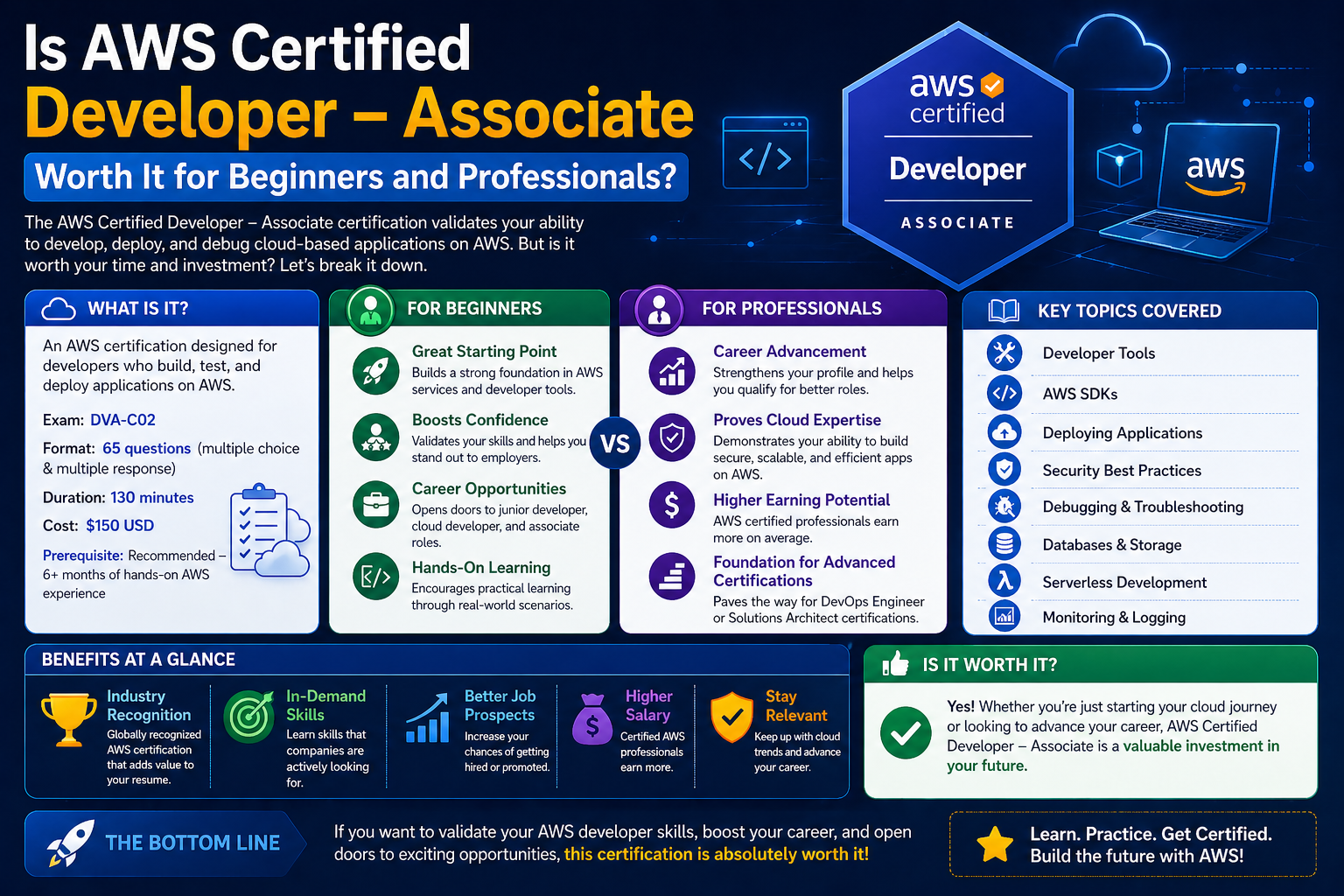
The AWS Certified Developer Associate credential is designed to validate the technical abilities of individuals who work in software development roles involving AWS services. It focuses on assessing practical knowledge rather than theoretical understanding alone, emphasizing how developers apply AWS tools to real-world application scenarios. This includes designing, building, testing, and maintaining applications that run on the AWS platform.
The certification is structured to reflect the responsibilities commonly found in cloud development roles. It is not intended for beginners with no programming experience, but rather for individuals who already have a foundation in software development. The purpose is to ensure that candidates can effectively translate their programming skills into cloud-based solutions using AWS services. This includes understanding how different services interact, how to optimize application performance, and how to troubleshoot issues within distributed systems.
One of the key aspects of this certification is its focus on applied knowledge. Instead of simply memorizing service features, candidates are expected to understand how and why specific AWS services are used in different development scenarios. This includes selecting appropriate storage solutions, implementing secure authentication methods, and integrating services through APIs and SDKs. The certification, therefore, serves as a practical measure of a developer’s readiness to work in AWS-driven environments.
Another important purpose of the certification is to standardize expectations for AWS developers across industries. As organizations adopt cloud technologies at different levels of maturity, there is a need for a consistent benchmark that defines what competent AWS development looks like. The certification helps establish this benchmark by outlining core competencies that are universally relevant to cloud development roles.
It also plays a role in professional development by guiding individuals toward best practices in cloud application design. Developers preparing for the certification are exposed to architectural principles that emphasize scalability, reliability, and security. These principles are not only relevant for passing an exam but are also critical for building production-grade applications in real-world environments.
Ultimately, the certification serves as both a validation tool and a learning framework. It confirms that a developer has the necessary skills to work with AWS services effectively while also encouraging the development of a deeper technical understanding. This dual purpose makes it a significant milestone for individuals pursuing careers in cloud development.
Core Skills Expected from AWS Developers in Professional Environments
AWS developers are expected to possess a combination of programming proficiency and cloud-specific knowledge that enables them to build and maintain scalable applications. At the core of these expectations is the ability to write efficient code in at least one high-level programming language. This forms the foundation upon which cloud integration skills are built, as developers must translate application logic into cloud-compatible structures.
Beyond programming, AWS developers must understand how to interact with a wide range of AWS services. These services include compute resources, storage systems, databases, messaging platforms, and deployment tools. Each service plays a specific role in application architecture, and developers must know how to combine them effectively. This requires a strong understanding of service functionality as well as the ability to evaluate which tools are most suitable for different use cases.
Security is another critical skill area for AWS developers. In cloud environments, applications are exposed to a wide range of potential vulnerabilities, making secure coding practices essential. Developers must understand how to implement authentication mechanisms, manage access permissions, and protect data both at rest and in transit. This involves working with identity management systems and applying security principles consistently across applications.
Deployment and automation skills are also central to the role. AWS developers are often responsible for ensuring that applications can be deployed efficiently and updated without disrupting service availability. This requires familiarity with deployment pipelines, version control systems, and automation tools that support continuous integration and delivery. The ability to automate repetitive tasks helps improve reliability and reduces the likelihood of human error during deployment processes.
Troubleshooting and debugging are equally important competencies. In distributed cloud environments, issues can arise from multiple sources, including network configurations, service integrations, and resource limitations. Developers must be able to identify the root causes of problems and apply appropriate solutions quickly. This requires not only technical knowledge but also analytical thinking and problem-solving skills.
Monitoring application performance is another essential responsibility. AWS provides various tools for tracking system health, resource usage, and application behavior. Developers must be able to interpret this data and use it to optimize performance. This includes identifying bottlenecks, adjusting resource allocation, and improving application efficiency based on observed metrics.
Together, these skills form the foundation of what is expected from AWS developers in professional settings. They reflect a balance between traditional software development abilities and cloud-specific expertise, both of which are necessary for building modern applications.
Real-World Responsibilities of AWS Developers in Organizations
In professional environments, AWS developers are responsible for a wide range of tasks that go beyond writing code. Their role is deeply integrated into the overall software development lifecycle, which includes planning, design, implementation, testing, deployment, and maintenance of applications. Each stage of this lifecycle requires coordination with other team members, including system architects, project managers, and operations teams.
One of the primary responsibilities is developing applications that are designed to run efficiently on AWS infrastructure. This involves selecting appropriate services for different components of the application and ensuring that they work together seamlessly. Developers must consider factors such as scalability, availability, and cost efficiency when making architectural decisions.
Another key responsibility is maintaining existing applications. Many organizations operate large-scale systems that require continuous updates and improvements. AWS developers are often tasked with optimizing performance, fixing bugs, and implementing new features without disrupting existing functionality. This requires careful planning and an understanding of how changes affect the broader system.
Collaboration is also an essential part of the role. Developers frequently work with cross-functional teams to ensure that application requirements are properly understood and implemented. This includes participating in discussions about system design, providing input on technical feasibility, and aligning development efforts with business objectives.
In addition, AWS developers are involved in ensuring application reliability. This includes implementing monitoring solutions, responding to system alerts, and addressing performance issues as they arise. Reliability is a critical aspect of cloud applications, as users expect consistent availability and responsiveness.
Cost optimization is another important responsibility. AWS operates on a usage-based pricing model, which means that inefficient resource usage can lead to unnecessary expenses. Developers must be mindful of how their applications consume resources and look for ways to optimize usage without compromising performance.
Security management is also part of daily responsibilities. Developers must ensure that applications comply with organizational security standards and industry regulations. This includes managing user access, securing APIs, and protecting sensitive data from unauthorized access.
These responsibilities highlight the practical nature of AWS development roles. They require a combination of technical expertise, problem-solving ability, and collaboration skills to ensure that applications meet both technical and business requirements.
Knowledge Areas Aligned with AWS Services and Application Development
AWS development requires familiarity with a wide range of services that support different aspects of application architecture. These services are grouped into functional categories such as compute, storage, databases, networking, and application integration. Each category plays a specific role in building scalable and efficient cloud applications.
Compute services are used to run application code and process workloads. Developers must understand how these services operate and how to choose the appropriate compute model based on application requirements. This includes understanding the differences between virtual servers, containerized environments, and serverless computing models.
Storage services are used to manage data in various forms. Developers must know how to store, retrieve, and manage data efficiently while ensuring durability and availability. Different storage options are used depending on the type of data and access patterns required by the application.
Database services play a critical role in managing structured and unstructured data. Developers must understand how to design database schemas, optimize queries, and ensure data consistency across distributed systems. This includes working with both relational and non-relational database models.
Networking knowledge is essential for configuring how applications communicate within the cloud environment. Developers must understand concepts such as virtual networks, routing, and load balancing to ensure that applications are accessible and secure.
Application integration services allow different components of a system to communicate effectively. Developers must understand how to use messaging systems and event-driven architectures to build loosely coupled applications that are scalable and resilient.
Monitoring and logging services are used to track application behavior and system performance. Developers must be able to interpret logs and metrics to identify issues and improve system reliability.
Together, these knowledge areas form the technical foundation required for AWS development. They ensure that developers can build applications that are not only functional but also scalable, secure, and efficient in cloud environments.
Experience Expectations and Professional Readiness for AWS Development Roles
Professional readiness for AWS development roles typically requires hands-on experience in software development environments. This experience helps individuals understand how applications behave in real-world scenarios and how different components interact within complex systems. It also provides exposure to common challenges such as debugging, performance optimization, and system integration.
Experience with programming is a fundamental requirement. Developers are expected to be comfortable writing code, understanding algorithms, and working with data structures. This forms the basis for all other cloud-related skills, as AWS services are often integrated directly into application code.
Practical experience with cloud environments is equally important. Developers should have exposure to deploying applications, managing resources, and working with distributed systems. This helps them understand how cloud infrastructure differs from traditional environments and how to adapt their development practices accordingly.
Exposure to collaborative development environments is also valuable. Most AWS development work takes place in team settings where developers must coordinate with others. This includes participating in code reviews, working with version control systems, and following structured development processes.
Problem-solving experience is another key aspect of readiness. Developers must be able to analyze issues, identify root causes, and implement effective solutions. This skill becomes especially important in cloud environments where problems can be complex and multi-layered.
An understanding of best practices is also expected. This includes knowledge of coding standards, security principles, and architectural guidelines that ensure applications are robust and maintainable. Developers must be able to apply these practices consistently in their work.
Overall, professional readiness for AWS development roles is built through a combination of technical knowledge, practical experience, and exposure to real-world development challenges.
Practical Application of AWS Services in Software Development
In modern software development environments, AWS services are not used in isolation but as interconnected components that form complete application architectures. Developers working within AWS ecosystems must understand how to combine different services to build systems that are scalable, reliable, and efficient. This practical application is what distinguishes cloud development from traditional software development, where infrastructure concerns are often abstracted or handled separately.
One of the most important aspects of AWS application development is the ability to design systems that are modular. Instead of building monolithic applications, developers are encouraged to break functionality into smaller components that can operate independently. This approach allows each component to scale separately based on demand, improving both performance and resource efficiency. AWS provides services that support this architecture by enabling communication between components through APIs, messaging systems, and event-driven workflows.
Compute services play a central role in application execution. Developers must decide how application logic will be executed in the cloud environment. Some applications require persistent virtual servers, while others are better suited to event-driven execution models where code runs only when triggered by specific actions. Understanding these differences is essential for designing cost-effective and scalable systems.
Storage integration is another key aspect of application design. Applications often require multiple types of storage depending on the nature of the data being processed. Some data needs to be accessed frequently with low latency, while other data can be stored in long-term archival systems. Developers must structure their applications to use the appropriate storage solutions while maintaining data integrity and accessibility.
Database integration also plays a significant role in AWS development. Applications must be designed to interact efficiently with databases that store structured or semi-structured data. Developers need to consider how data is modeled, how queries are executed, and how performance can be optimized under heavy workloads. In distributed systems, ensuring data consistency and reliability becomes a critical responsibility.
Networking configuration is another important area of application development. AWS provides virtual networking capabilities that allow developers to define how applications communicate internally and externally. Proper network design ensures that applications are secure, accessible, and capable of handling traffic efficiently. Developers must understand routing rules, security boundaries, and traffic distribution mechanisms.
Integration of services is where AWS development becomes particularly powerful. Applications rarely rely on a single service; instead, they combine multiple services to achieve complex functionality. For example, an application might use compute services for processing, storage services for data retention, and messaging services for communication between components. Developers must understand how to orchestrate these services to work together seamlessly.
This level of integration requires careful planning and architectural understanding. Developers must anticipate how different services will interact under varying conditions, including peak load scenarios and failure situations. Designing for resilience is essential, as cloud applications must remain functional even when individual components experience issues.
Deployment Strategies and Automation in AWS Environments
Deployment in AWS environments is a structured process that involves moving applications from development stages into production environments. Unlike traditional deployment methods, cloud-based deployment emphasizes automation, repeatability, and minimal downtime. Developers must be familiar with deployment strategies that allow applications to be updated efficiently without disrupting user experience.
One common approach is incremental deployment, where updates are gradually introduced to a subset of users before being rolled out to the entire system. This method reduces risk by allowing developers to monitor application behavior and identify issues early. If problems arise, deployments can be rolled back quickly without affecting all users.
Automation plays a central role in modern deployment practices. Developers are expected to automate repetitive tasks such as code integration, testing, and deployment. This reduces manual effort and ensures consistency across different environments. Automated pipelines help maintain a steady flow of updates while minimizing human error.
Version control is another critical component of deployment workflows. Developers must manage different versions of application code and ensure that changes are tracked systematically. This allows teams to collaborate effectively and revert to previous versions if necessary. Version control also supports branching strategies that enable parallel development efforts.
Testing is integrated into the deployment process to ensure that applications function correctly before being released. Automated testing frameworks are often used to validate code changes and identify potential issues early in the development cycle. This helps maintain application stability and reduces the likelihood of production failures.
Environment management is also an important consideration. Applications typically move through multiple environments before reaching production, including development, testing, and staging environments. Each environment serves a specific purpose and must be configured consistently to ensure accurate testing results.
Deployment strategies in AWS environments also focus heavily on scalability. Applications must be able to handle varying levels of demand without performance degradation. Developers must design deployment systems that allow resources to scale automatically based on usage patterns. This ensures that applications remain responsive even during high traffic periods.
Monitoring deployment outcomes is another essential responsibility. Developers must track application performance after deployment to ensure that updates have not introduced issues. This involves analyzing system metrics, user behavior, and error logs to identify potential problems quickly.
Security Implementation and Best Practices in AWS Development
Security is one of the most critical aspects of AWS development, as applications are often exposed to a wide range of potential threats. Developers must implement security measures at every stage of the development lifecycle to protect data, ensure user privacy, and maintain system integrity. This includes securing application code, managing access controls, and protecting communication channels.
Access management is a foundational element of cloud security. Developers must define who can access specific resources and under what conditions. This involves creating roles and permissions that restrict access based on user responsibilities. Proper access management ensures that only authorized users can interact with sensitive components of an application.
Data protection is another essential area of focus. Applications often handle sensitive information that must be protected from unauthorized access. Developers must ensure that data is encrypted both during transmission and while stored in databases or storage systems. Encryption helps prevent data breaches and ensures compliance with security standards.
Application security also involves protecting against common vulnerabilities such as injection attacks, unauthorized access, and data leaks. Developers must follow secure coding practices that minimize these risks. This includes validating user input, sanitizing data, and implementing secure authentication mechanisms.
Network security plays a significant role in protecting applications from external threats. Developers must configure network boundaries to control traffic flow between different components of the system. This includes setting up firewalls, defining access rules, and isolating sensitive resources from public exposure.
Monitoring and auditing are also critical for maintaining security. Developers must track system activity to detect unusual behavior or potential security breaches. Logging mechanisms provide visibility into application operations and help identify suspicious activities early.
Incident response is another important aspect of security management. When security issues are detected, developers must be able to respond quickly to mitigate damage. This includes isolating affected components, applying patches, and restoring system integrity.
Security best practices in AWS development emphasize a proactive approach rather than a reactive one. Developers are expected to anticipate potential threats and design systems that are resilient against them. This includes regularly updating systems, reviewing security configurations, and staying informed about emerging vulnerabilities.
Debugging, Monitoring, and Performance Optimization in AWS Systems
In AWS development environments, debugging and monitoring are essential for maintaining application stability and performance. Because cloud applications are distributed across multiple services and components, identifying the source of issues can be complex. Developers must use structured approaches to diagnose problems and ensure that applications operate efficiently.
Debugging in cloud environments often involves analyzing logs generated by different services. These logs provide detailed information about system behavior, including errors, warnings, and performance metrics. Developers must be able to interpret these logs to identify the root cause of issues and apply appropriate fixes.
Monitoring tools provide real-time insights into application performance. Developers use these tools to track metrics such as response times, resource utilization, and system health. Continuous monitoring helps ensure that applications remain stable and responsive under varying workloads.
Performance optimization is a key responsibility in AWS development. Applications must be designed to handle increasing traffic without degradation in performance. Developers achieve this by optimizing code, improving resource allocation, and reducing unnecessary processing overhead.
Scaling strategies are an important part of performance management. Applications must be able to adjust resources dynamically based on demand. Developers must understand how to configure scaling mechanisms that automatically increase or decrease resources depending on usage patterns.
Latency reduction is another important optimization goal. Applications must respond quickly to user requests, which requires minimizing delays in data processing and communication between services. Developers must design systems that reduce bottlenecks and improve response times.
Resource efficiency is also critical in cloud environments where costs are directly tied to usage. Developers must ensure that applications use resources effectively without unnecessary waste. This includes optimizing compute usage, storage consumption, and network traffic.
Error detection and resolution are ongoing responsibilities in AWS development. Developers must continuously monitor systems for unexpected behavior and resolve issues promptly. This ensures that applications remain reliable and maintain a high level of user satisfaction.
Integration of AWS Development Practices in Real-World Scenarios
AWS development practices are widely applied across industries where scalable and reliable applications are required. Organizations use AWS to support a variety of use cases, including web applications, mobile backends, data processing systems, and enterprise platforms. Developers working in these environments must adapt their skills to meet diverse requirements.
In web application development, AWS provides the infrastructure needed to support dynamic and interactive platforms. Developers must ensure that applications can handle user traffic efficiently while maintaining performance and security standards. This involves integrating multiple services to support frontend and backend functionality.
In mobile application backends, AWS is used to manage data synchronization, user authentication, and real-time communication. Developers must design systems that support seamless interactions between mobile devices and cloud services.
Data processing systems rely heavily on AWS services for handling large volumes of information. Developers must build pipelines that can process, analyze, and store data efficiently. This requires careful orchestration of services to ensure accuracy and performance.
Enterprise applications often involve complex workflows and integrations with multiple systems. Developers must ensure that AWS services are configured to support business processes while maintaining reliability and security.
Across all these scenarios, AWS development practices emphasize scalability, flexibility, and resilience. Developers must be able to design systems that adapt to changing requirements and operate effectively under varying conditions.
These practical applications demonstrate how AWS development extends beyond theoretical knowledge into real-world implementation. Developers must combine technical expertise with architectural understanding to build systems that meet modern digital demands.
Career Impact and Industry Demand for AWS Developers
The demand for cloud-skilled professionals has grown steadily as organizations continue migrating infrastructure, applications, and data systems to cloud environments. Among the various cloud roles, AWS developers hold a particularly important position because they bridge the gap between software engineering and cloud architecture. Their ability to design, build, and maintain applications on AWS makes them highly valuable in a wide range of industries, from technology companies to finance, healthcare, retail, and government sectors.
One of the key reasons behind this demand is the widespread adoption of cloud-first strategies. Organizations are no longer treating cloud computing as an optional enhancement but as a core foundation for digital operations. This shift has created a consistent need for developers who understand how to build applications that are optimized for cloud environments rather than traditional infrastructure.
AWS, being one of the most widely used cloud platforms globally, has naturally become a central focus for hiring managers. Companies that rely on AWS infrastructure prefer developers who are already familiar with its services and development practices. This reduces onboarding time and ensures that teams can maintain productivity while working on complex cloud-based systems.
Another important factor contributing to demand is scalability. Businesses today must handle unpredictable workloads, global user bases, and real-time data processing. AWS developers are trained to design applications that can scale automatically based on demand. This capability is essential for modern digital products that must remain responsive under varying traffic conditions.
The rise of microservices architecture has also increased the need for AWS developers. Instead of building large monolithic systems, organizations are breaking applications into smaller, independent services. AWS provides the infrastructure required to support these architectures, and developers who understand how to implement microservices effectively are highly sought after.
In addition to technical demand, AWS developers also benefit from strong career mobility. Because cloud computing is a global standard, skills gained in AWS development are transferable across industries and geographic regions. This allows professionals to pursue opportunities in different markets without needing to completely retrain.
Professional Growth Pathways in AWS Development Careers
AWS development offers a structured yet flexible career progression path that allows individuals to grow from entry-level roles into advanced engineering and architectural positions. This progression is largely based on experience, technical depth, and the ability to design complex systems rather than simply writing code.
At the early stage of a career, developers typically focus on building foundational skills in cloud application development. This includes learning how to integrate AWS services, deploy applications, and debug basic issues. During this phase, the emphasis is on understanding how cloud environments function and how applications behave within distributed systems.
As developers gain experience, they begin taking on more responsibility in system design and optimization. This stage involves making decisions about architecture, selecting appropriate services, and ensuring that applications are scalable and secure. Developers are expected to contribute to design discussions and provide input on technical strategies.
With further experience, professionals often move into senior development roles. In these positions, they are responsible not only for writing and reviewing code but also for guiding technical direction. Senior developers play a key role in ensuring that applications align with organizational goals and follow best practices in cloud architecture.
Beyond senior development roles, many professionals transition into cloud architecture positions. These roles focus on designing entire systems rather than individual components. Architects are responsible for defining how different services interact, ensuring scalability, and maintaining system reliability at a high level.
Another possible career path is specialization in areas such as security, data engineering, or DevOps. AWS provides a wide range of services that support these domains, allowing developers to deepen their expertise in specific areas. Specialization often leads to roles with higher responsibility and increased compensation.
Leadership roles are also part of the long-term career pathway. Experienced AWS professionals may move into engineering management positions where they oversee teams of developers and coordinate large-scale projects. These roles require both technical knowledge and strong organizational skills.
Career growth in AWS development is strongly influenced by continuous learning. Because cloud technology evolves rapidly, professionals must stay updated with new services, features, and best practices. This ongoing learning process ensures that skills remain relevant and aligned with industry standards.
Strategic Value of AWS Certification in Professional Development
AWS certification plays a significant role in validating a developer’s technical abilities and enhancing their professional credibility. While practical experience remains essential, certification provides a structured way to demonstrate knowledge of AWS services and development principles.
One of the key strategic benefits of certification is standardization. It provides a consistent benchmark that employers can use to evaluate candidates. This is particularly valuable in global job markets where educational backgrounds and work experiences may vary widely. Certification helps establish a common understanding of skill levels.
Another important benefit is skill validation. Preparing for certification requires developers to study a broad range of AWS services and understand how they interact. This process reinforces practical knowledge and fills gaps that may not be encountered during day-to-day work.
Certification also helps professionals stay aligned with industry best practices. AWS regularly updates its services and architectural guidelines, and certification materials are updated accordingly. This ensures that certified developers are aware of current standards and recommended approaches.
From a career perspective, certification can improve visibility in competitive job markets. Recruiters often use certifications as a filtering criterion when evaluating candidates. Having recognized credentials can increase the likelihood of being shortlisted for technical roles.
Certification also supports career transitions. Developers moving from traditional software development into cloud-focused roles can use certification to demonstrate their readiness for new responsibilities. This can be particularly useful when entering AWS-based environments for the first time.
In addition, certification can contribute to confidence-building. Developers who complete certification exams often gain a clearer understanding of AWS services and how they are applied in real-world scenarios. This increased confidence can improve performance in professional settings.
However, it is important to recognize that certification alone is not sufficient for long-term career success. It must be combined with hands-on experience and continuous skill development. The most successful AWS professionals are those who integrate certification knowledge with practical application.
Challenges Faced by AWS Developers in Real Environments
Despite the opportunities available in AWS development, professionals in this field also face several challenges. These challenges arise primarily from the complexity of cloud systems and the rapidly evolving nature of the technology landscape.
One of the main challenges is system complexity. AWS environments often involve multiple interconnected services, each with its own configuration and behavior. Understanding how these services interact requires deep technical knowledge and careful system design.
Another challenge is cost management. AWS operates on a pay-as-you-use model, which means that inefficient resource usage can lead to unexpectedly high costs. Developers must constantly monitor usage patterns and optimize applications to ensure cost efficiency.
Security management is also a significant challenge. As applications become more distributed, ensuring consistent security across all components becomes increasingly difficult. Developers must stay vigilant and apply security best practices at every stage of development.
Performance optimization in cloud environments can also be complex. Applications must be able to handle varying workloads while maintaining responsiveness. Identifying performance bottlenecks in distributed systems requires careful analysis and monitoring.
Keeping up with continuous updates is another challenge. AWS frequently introduces new services and updates existing ones. Developers must stay informed about these changes to ensure that their skills and applications remain current.
Debugging distributed systems is often more difficult than debugging traditional applications. Issues may arise from multiple sources, including network latency, service misconfiguration, or resource limitations. Identifying the root cause requires a structured and methodical approach.
Despite these challenges, AWS development remains a highly rewarding field. The complexity of the environment also provides opportunities for significant professional growth and skill development.
Long-Term Value of AWS Development Skills in the Technology Industry
AWS development skills hold long-term value because cloud computing has become a foundational element of modern technology infrastructure. As organizations continue to adopt digital transformation strategies, the demand for cloud-native applications will continue to grow.
One of the key reasons for this long-term value is adaptability. AWS skills are not limited to a single industry or application type. They can be applied across a wide range of domains, including web development, mobile applications, enterprise systems, and data analytics.
Another reason is technological evolution. Cloud platforms are continuously expanding their capabilities, integrating advanced technologies such as artificial intelligence, machine learning, and serverless computing. AWS developers who stay updated with these advancements remain relevant in an evolving industry.
The global nature of cloud computing also contributes to long-term value. AWS skills are recognized worldwide, allowing professionals to work across different regions and industries. This global applicability enhances career flexibility and opportunity.
Automation and scalability trends further reinforce the importance of AWS development skills. As organizations seek to automate infrastructure management and scale applications efficiently, developers who understand cloud automation tools will remain in high demand.
In addition, the shift toward digital-first business models ensures that cloud computing will remain central to technology strategies for the foreseeable future. This guarantees continued relevance for AWS developers in both technical and strategic roles.
Perspective on AWS Developer Associate Relevance in Modern Careers
The AWS Developer Associate certification and the skills associated with it represent more than just technical knowledge. They reflect an understanding of how modern software systems are built, deployed, and maintained in cloud environments.
For individuals entering the field, it provides a structured pathway into cloud development. For experienced developers, it reinforces and validates existing knowledge while expanding expertise in AWS services.
The combination of practical application, industry demand, and long-term relevance makes AWS development a significant area of focus in modern technology careers. It continues to evolve alongside advancements in cloud computing, ensuring that professionals who invest in these skills remain aligned with the future of software development.
Conclusion
The AWS Certified Developer Associate certification represents a meaningful step in the evolution of a software developer’s career, especially in a technology landscape that is increasingly centered around cloud computing. As organizations continue to move away from traditional infrastructure and embrace scalable, distributed cloud systems, the role of developers has expanded significantly. It is no longer sufficient to only write functional code; developers are now expected to understand how applications behave in complex cloud environments, how services interact, and how systems can be optimized for performance, security, and cost efficiency.
AWS, as one of the most widely adopted cloud platforms, plays a central role in this transformation. Its ecosystem of services allows developers to build highly scalable and resilient applications, but it also introduces a level of complexity that requires structured learning and hands-on experience. The AWS Developer Associate certification helps bridge this gap by providing a clear framework of skills and knowledge areas that are directly aligned with real-world development requirements. It validates the ability to work with core AWS services, deploy applications effectively, implement security best practices, and troubleshoot issues in distributed systems.
From a career perspective, the certification holds strong value because it aligns with current industry demands. Employers across various sectors actively seek professionals who can contribute to cloud-based development projects with minimal onboarding time. Having a verified understanding of AWS services signals that a developer is capable of working within modern cloud architectures and can adapt to the technical expectations of contemporary software teams. This makes the certification not just a learning milestone but also a professional advantage in competitive job markets.
However, its true value is best realized when combined with practical experience. Cloud development is inherently hands-on, and theoretical knowledge alone is not enough to handle real-world challenges. Developers must engage with AWS services directly, build applications, experiment with deployments, and learn from debugging and optimization scenarios. This practical exposure strengthens understanding and ensures that certification knowledge translates into real capability.
Another important aspect is long-term relevance. Cloud computing is not a temporary trend but a foundational shift in how technology systems are designed and operated. As AWS continues to evolve and introduce new services, developers who understand its core principles will remain adaptable and relevant. The skills gained through preparing for this certification extend beyond a single exam and contribute to a broader understanding of scalable system design, automation, and modern software architecture.
In addition, the certification encourages a mindset of continuous learning. The cloud industry changes rapidly, and staying updated is essential for sustained success. Developers who adopt this mindset are better positioned to grow into advanced roles such as senior developers, cloud architects, or technical leads. The certification serves as an early foundation for this progression, helping professionals build confidence and direction in their career paths.
Ultimately, the AWS Developer Associate certification is more than just a credential. It represents a structured approach to understanding cloud development and serves as a stepping stone toward deeper expertise in one of the most important areas of modern technology. For developers aiming to build a strong, future-ready career in software engineering, it offers both practical value and long-term professional significance.