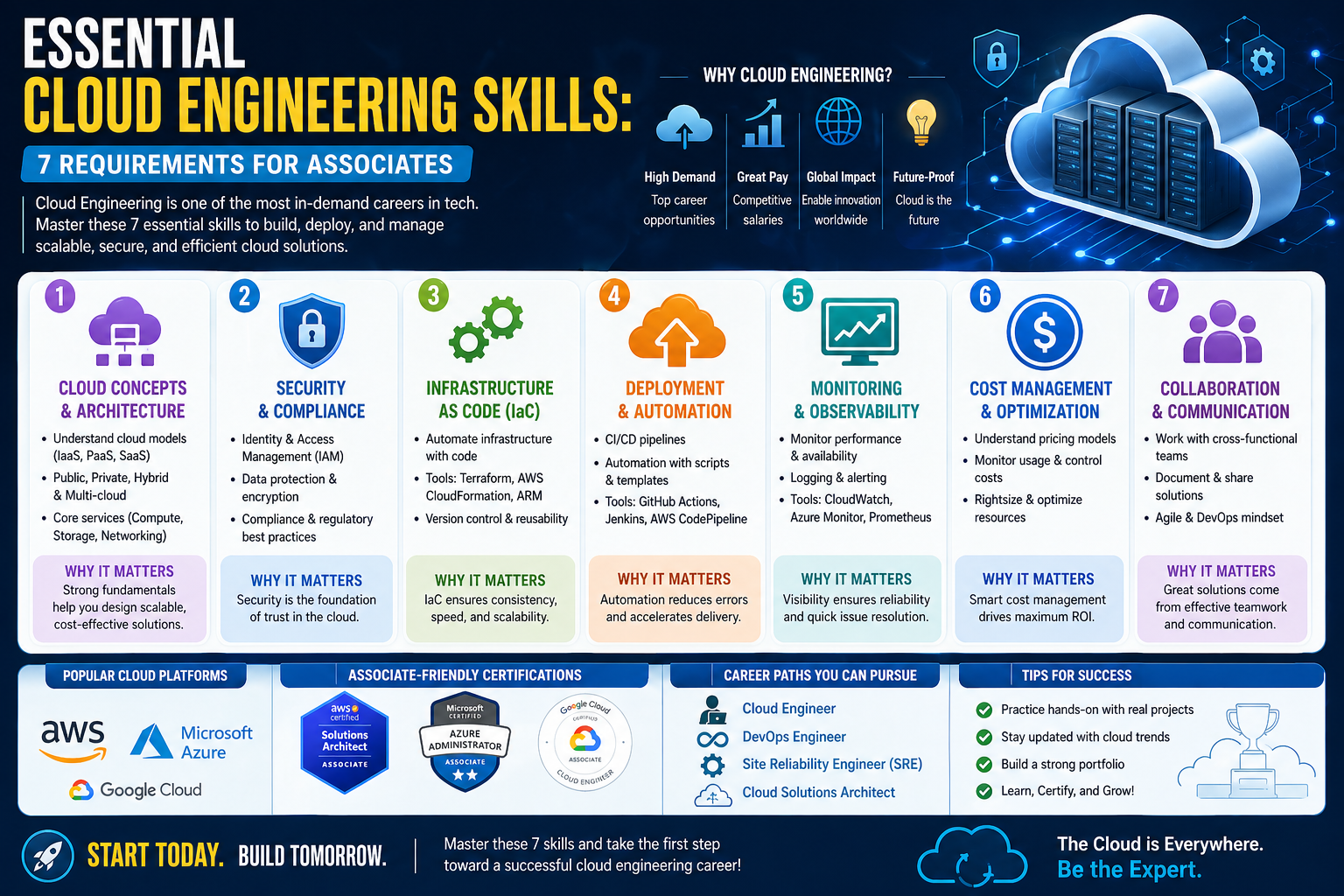
The evolution of computing has shifted the way organizations design, deploy, and maintain their digital infrastructure. Traditional data centers, once heavily dependent on physical servers and manual configurations, are increasingly being replaced or extended by cloud-based environments. In this changing landscape, the role of an Associate Cloud Engineer has emerged as a foundational position responsible for supporting and managing cloud infrastructure in a structured and efficient manner. This role sits at the intersection of system administration, networking, automation, and software-driven infrastructure management, requiring a blend of technical understanding and practical adaptability.
Unlike earlier IT environments, where roles were clearly segmented into hardware, networking, or system administration, cloud environments integrate these domains into unified platforms. As a result, professionals working in cloud engineering are expected to understand how different layers of technology interact with each other. This includes operating systems, virtual networks, identity systems, and storage services, all of which function together to deliver scalable computing resources. The Associate Cloud Engineer role is often considered an entry-to-intermediate position, but the expectations placed on individuals in this role are substantial because they act as operational enablers of cloud systems.
One of the most important aspects of this role is the ability to translate traditional IT knowledge into cloud-native thinking. In a cloud environment, resources are not fixed or permanently allocated; instead, they are dynamically provisioned, scaled, and released based on demand. This requires a shift in mindset from managing physical infrastructure to managing programmable infrastructure. Every action, from deploying a server to configuring access permissions, is often handled through software interfaces or automation tools rather than manual intervention.
The skills required for this role are not limited to theoretical understanding. Practical application is essential because cloud environments are highly interactive and constantly evolving. An Associate Cloud Engineer must be capable of troubleshooting issues in real time, interpreting system behavior, and ensuring that services remain available and secure. This demands familiarity with core computing concepts, as well as the ability to adapt those concepts to cloud platforms where services are abstracted and distributed.
Another defining aspect of this role is its reliance on foundational technologies that have existed long before the rise of cloud computing. Operating systems, networking protocols, virtualization techniques, and identity management systems all form the backbone of modern cloud platforms. While cloud providers abstract much of this complexity, understanding what happens beneath the abstraction layer is critical for effective problem-solving and system design.
In addition to technical proficiency, cloud engineers must also develop an understanding of how cloud systems are consumed and managed at scale. This includes recognizing how services interact with one another, how data flows across distributed systems, and how performance is influenced by configuration decisions. Even small misconfigurations can lead to performance degradation, security vulnerabilities, or unexpected costs, making attention to detail an essential trait in this field.
As organizations continue to migrate workloads to cloud environments, the demand for professionals who can manage these systems effectively continues to grow. The Associate Cloud Engineer role serves as a gateway into more advanced cloud careers, but it is also a critical operational role in its own right. It ensures that cloud systems remain functional, secure, and optimized for business needs.
Understanding the skills required for this role provides a roadmap for anyone looking to enter the cloud computing field. These skills are not isolated topics but interconnected domains that collectively form the foundation of cloud engineering practice. Each skill contributes to a broader understanding of how cloud environments operate, and together they enable professionals to manage complex systems with confidence and precision.
Linux for Cloud Engineering
Linux serves as one of the most fundamental building blocks of modern cloud infrastructure. A significant portion of cloud services, whether public or private, is powered by Linux-based operating systems running behind the scenes. Even when users interact with cloud platforms through graphical dashboards or simplified interfaces, the underlying systems are often based on Linux distributions. This makes Linux knowledge essential for anyone working as an Associate Cloud Engineer, as it provides direct insight into how cloud resources operate at the system level.
At its core, Linux is an open-source operating system known for its stability, flexibility, and efficiency in handling server workloads. Unlike desktop operating systems that prioritize user-friendly interfaces, Linux is designed for performance, control, and scalability. These characteristics make it ideal for cloud environments where systems must run continuously, handle high workloads, and support automated processes without interruption.
In cloud engineering, Linux is frequently used to manage virtual machines, configure server environments, and deploy applications. Many cloud instances are created using Linux-based images because they are lightweight, secure, and highly customizable. Understanding how to navigate the Linux environment allows cloud engineers to interact directly with these systems, perform configurations, and troubleshoot issues when they arise.
One of the key aspects of working with Linux in a cloud context is understanding the file system structure and how system resources are organized. Everything in Linux is treated as a file or process, which provides a consistent model for managing system components. This structure allows engineers to locate configuration files, manage system logs, and monitor resource usage efficiently. Without this understanding, diagnosing system behavior in cloud environments becomes significantly more difficult.
Another important element of Linux knowledge is process management. Cloud systems often run multiple applications simultaneously, each consuming system resources such as memory and CPU. Linux provides tools and mechanisms for monitoring and controlling these processes, ensuring that system performance remains stable. For cloud engineers, this is particularly important when dealing with scalable applications that automatically increase or decrease their resource usage based on demand.
Security is also deeply tied to Linux in cloud environments. Since cloud systems are exposed to networks and often accessible remotely, securing these systems is a critical responsibility. Linux provides a robust permission model that controls access to files, processes, and system resources. Understanding how these permissions work allows cloud engineers to configure secure environments and prevent unauthorized access.
In addition, Linux plays a central role in automation within cloud environments. Many cloud operations are performed through scripts and command-line tools that run on Linux systems. These automated tasks may include deploying applications, scaling resources, or performing system updates. A strong understanding of Linux enables cloud engineers to work effectively with these automation processes and ensure they function correctly.
Another dimension of Linux in cloud engineering is its compatibility with container technologies and virtualization platforms. Modern cloud environments often rely on containerized applications, which run on lightweight Linux-based systems. These containers allow applications to be deployed consistently across different environments. Understanding how Linux supports these technologies helps cloud engineers manage application deployment more efficiently.
The importance of Linux extends beyond technical operations. It also provides a conceptual framework for understanding how cloud systems are structured. Many cloud services abstract Linux functionality, but the underlying principles remain the same. By understanding Linux, cloud engineers gain insight into how virtual machines are created, how resources are allocated, and how services interact within a cloud ecosystem.
Ultimately, Linux serves as the operational foundation for cloud computing. It enables the execution of workloads, the management of resources, and the implementation of security controls. For an Associate Cloud Engineer, mastering Linux is not just about learning commands or system navigation; it is about understanding the underlying architecture that supports modern cloud infrastructure.
Networking Foundations for Cloud Environments
Networking is one of the most critical components of cloud computing, forming the communication layer that allows different systems and services to interact with each other. In cloud environments, networking is not limited to physical hardware configurations but extends into virtualized networks that are created and managed through software. This shift introduces both flexibility and complexity, requiring cloud engineers to have a strong understanding of networking principles and how they apply in distributed systems.
At a fundamental level, networking in the cloud involves the transmission of data between virtual machines, storage systems, applications, and external users. These interactions rely on protocols and configurations that ensure data is delivered accurately and securely. While cloud platforms abstract much of the physical networking infrastructure, the underlying principles remain consistent with traditional networking concepts such as IP addressing, routing, and subnetting.
One of the key differences in cloud networking is the use of virtual networks. Instead of relying on physical switches and routers, cloud environments create software-defined networks that simulate traditional networking behavior. These virtual networks allow engineers to segment environments, control traffic flow, and isolate resources. Understanding how these virtual networks operate is essential for managing cloud infrastructure effectively.
In cloud environments, networking also plays a critical role in scalability and performance. Applications often need to handle varying levels of traffic, and cloud systems must be able to distribute this traffic efficiently across multiple resources. This involves load balancing, routing strategies, and traffic management techniques that ensure systems remain responsive under different conditions. Cloud engineers must understand how these mechanisms work to maintain system reliability.
Security is another major aspect of cloud networking. Since cloud resources are often accessible over the internet, protecting data in transit and controlling access to resources is essential. Networking configurations determine how traffic flows between systems and who can access specific services. Misconfigured networks can expose sensitive data or create vulnerabilities within the system. Therefore, understanding firewalls, security groups, and access control mechanisms is a key part of cloud networking knowledge.
Cloud networking also involves understanding how different services communicate within a cloud platform. Many applications are built using multiple components that interact through APIs and internal network calls. These interactions depend on properly configured network routes and permissions. Cloud engineers must ensure that these components can communicate efficiently without exposing unnecessary access points.
Another important concept in cloud networking is latency and performance optimization. Since cloud systems are often distributed across multiple regions and availability zones, data may need to travel long distances between systems. This can introduce delays that affect application performance. Understanding how to design network architectures that minimize latency is an important skill for cloud engineers.
Networking in cloud environments is also closely tied to automation and infrastructure management. Many networking configurations are defined using code or templates, allowing systems to be deployed consistently across different environments. This approach reduces manual configuration errors and ensures that networking setups remain consistent and scalable.
In addition, cloud networking supports hybrid and multi-cloud environments where systems operate across different platforms or data centers. This introduces additional complexity, as engineers must ensure that networks can communicate across different infrastructures while maintaining security and performance standards.
Overall, networking in cloud environments is not just about connectivity but about designing systems that are secure, scalable, and efficient. For an Associate Cloud Engineer, mastering networking principles is essential for building and maintaining cloud systems that meet modern computing demands.
Virtualization in Cloud Computing
Virtualization is one of the most foundational technologies that enables modern cloud computing environments to function at scale, and it plays a central role in the responsibilities of an Associate Cloud Engineer. At its core, virtualization refers to the creation of virtual versions of physical computing resources such as servers, storage devices, and network components. Instead of relying on dedicated physical hardware for each workload, virtualization allows multiple isolated environments to run on a single physical machine, thereby maximizing efficiency and flexibility. In cloud computing, this concept is extended across massive data centers where thousands of physical machines are abstracted into pools of shared resources that can be allocated dynamically based on demand. This abstraction layer is what allows cloud platforms to deliver on their promise of scalability and elasticity, enabling users to provision resources instantly without worrying about underlying hardware constraints.
For an Associate Cloud Engineer, understanding virtualization means understanding how cloud instances are created, managed, and maintained behind the scenes. When a virtual machine is launched in a cloud environment, it is not running on a dedicated physical server but instead on a hypervisor that divides physical hardware into multiple virtual instances. Each of these instances operates independently, with its own operating system, memory allocation, and processing power. This separation ensures that workloads remain isolated, secure, and efficient even when sharing the same physical infrastructure. The engineer must be aware of how these virtual machines are provisioned, how resources are allocated, and how performance is managed across multiple virtual environments.
Virtualization also introduces the concept of resource pooling, where computing resources such as CPU, memory, and storage are aggregated and distributed as needed. This pooling mechanism allows cloud providers to optimize hardware utilization and reduce waste. Instead of dedicating fixed resources to a single application, cloud systems can dynamically assign resources to workloads that require them at any given time. This dynamic allocation is essential for handling fluctuating workloads, especially in environments where demand can change rapidly and unpredictably. The Associate Cloud Engineer must understand how to monitor and manage these allocations to ensure optimal performance and cost efficiency.
Another important aspect of virtualization is the abstraction of hardware dependencies. In traditional computing environments, applications often depend on specific hardware configurations, which can limit portability and scalability. Virtualization removes these constraints by creating standardized virtual environments that can run on any compatible physical infrastructure. This means that applications can be moved, scaled, or replicated across different servers without modification. For cloud engineers, this abstraction simplifies deployment processes and enables greater flexibility in system design and maintenance.
Virtualization also plays a critical role in disaster recovery and system redundancy. Because virtual machines are not tied to physical hardware, they can be replicated or migrated across different physical servers with minimal disruption. This allows cloud systems to maintain high availability even in the event of hardware failures. Engineers must understand how to configure and manage these replication processes to ensure that systems remain resilient under different conditions. This includes knowledge of snapshots, backups, and failover mechanisms that are commonly used in virtualized environments.
In addition to virtual machines, modern cloud platforms also use virtualization for storage and networking. Storage virtualization allows physical storage devices to be combined into unified logical storage pools, while network virtualization enables the creation of virtual networks that operate independently of physical network infrastructure. These technologies allow cloud environments to be highly flexible and configurable, supporting complex architectures that would be difficult to implement using physical hardware alone. The Associate Cloud Engineer must understand how these virtualized components interact and how they can be configured to meet application requirements.
Virtualization is also closely tied to performance optimization. Since multiple virtual machines share the same physical resources, it is important to ensure that workloads are balanced and that no single resource becomes a bottleneck. Cloud engineers must be able to monitor system performance, identify inefficiencies, and adjust configurations as needed to maintain optimal operation. This requires an understanding of how virtual machines consume resources and how those resources are managed at the hypervisor level.
Ultimately, virtualization serves as the backbone of cloud computing, enabling the abstraction, flexibility, and scalability that define modern cloud environments. For an Associate Cloud Engineer, mastering virtualization is essential for understanding how cloud systems operate at a fundamental level and for effectively managing the virtualized infrastructure that supports modern applications.
Identity and Access Management in Cloud Systems
Identity and Access Management is a critical component of cloud computing security and operational control, and it represents one of the most important areas of responsibility for an Associate Cloud Engineer. In cloud environments, where resources are distributed and accessible over networks, controlling who can access what resources and under what conditions is essential for maintaining system integrity and security. Identity and Access Management provides the framework through which users, applications, and services are authenticated and authorized to interact with cloud resources.
At a basic level, identity management involves verifying the identity of a user or system attempting to access cloud services. This process typically involves authentication mechanisms such as passwords, tokens, or cryptographic keys. Once identity is verified, access management determines what actions that identity is permitted to perform. This combination of authentication and authorization forms the foundation of secure cloud operations. Without proper identity management, cloud systems would be vulnerable to unauthorized access and potential data breaches.
In cloud environments, identity management systems are designed to be highly granular and flexible. Instead of assigning permissions to individual users on a case-by-case basis, cloud platforms use roles and policies to define access levels. A role represents a set of permissions that can be assigned to users, applications, or services. These roles simplify access management by allowing engineers to define permissions once and apply them consistently across multiple entities. This approach reduces complexity and improves security by ensuring that access is granted based on predefined rules rather than manual configuration.
For an Associate Cloud Engineer, working with identity management involves understanding how roles are created, configured, and assigned. Each role defines what actions can be performed on specific resources, such as reading data from storage systems, launching virtual machines, or modifying network configurations. Engineers must ensure that roles are designed according to the principle of least privilege, meaning that entities are granted only the permissions necessary to perform their tasks and nothing more. This minimizes the risk of unauthorized access and limits potential damage in case of security incidents.
Identity management also includes the concept of service identities, which are used by applications and automated processes to interact with cloud resources. Unlike human users, service identities operate without manual intervention and require carefully defined permissions to function correctly. For example, an application may need to access a database or storage system, and this access is granted through a service identity with specific permissions. Cloud engineers must ensure that these identities are properly configured to prevent unintended access or security vulnerabilities.
Another important aspect of identity management is federation, which allows external identity providers to be integrated with cloud platforms. This enables organizations to use existing authentication systems, such as corporate directories, to manage access to cloud resources. Federation simplifies identity management by centralizing authentication processes and reducing the need for multiple credentials. For cloud engineers, understanding how federated identity systems work is important for managing hybrid environments where cloud and on-premises systems coexist.
Security is a central concern in identity and access management. Cloud environments are constantly exposed to potential threats, and identity systems serve as the first line of defense against unauthorized access. Engineers must ensure that authentication mechanisms are strong, that access policies are correctly configured, and that identity logs are monitored for suspicious activity. This includes tracking login attempts, monitoring permission changes, and auditing access to sensitive resources.
Identity management also plays a key role in automation and scalability. In large cloud environments, manually managing access for every user and service would be impractical. Instead, identity systems are designed to scale automatically, applying policies across thousands of resources and users. This allows cloud engineers to manage complex environments efficiently while maintaining strict security controls.
Overall, identity and access management are essential for securing cloud environments and ensuring that resources are used appropriately. For an Associate Cloud Engineer, mastering this domain is critical for maintaining secure, scalable, and well-organized cloud systems.
APIs and Automation in Cloud Engineering
Application Programming Interfaces and automation are central to modern cloud computing, enabling systems to be controlled, configured, and managed programmatically rather than manually. For an Associate Cloud Engineer, understanding APIs and automation is essential because cloud environments are designed to be operated through code-driven interactions. This approach allows infrastructure to be treated as programmable components that can be deployed, modified, and scaled dynamically.
An API serves as an interface that allows different software systems to communicate with each other. In cloud computing, APIs are used to interact with virtually every service, including computing instances, storage systems, networking configurations, and identity management systems. Instead of manually configuring resources through graphical interfaces, engineers can use APIs to perform operations programmatically. This enables faster deployment, greater consistency, and improved scalability.
Automation builds on the concept of APIs by enabling repetitive tasks to be executed without manual intervention. In cloud environments, automation is used for a wide range of operations, including resource provisioning, system monitoring, scaling, and maintenance. By automating these tasks, cloud engineers can reduce human error, improve efficiency, and ensure that systems respond quickly to changing conditions.
For an Associate Cloud Engineer, working with automation involves understanding how scripts, templates, and orchestration tools interact with cloud APIs. These tools allow engineers to define infrastructure configurations in a declarative manner, specifying what the system should look like rather than how to achieve it step by step. This approach simplifies infrastructure management and ensures consistency across different environments.
Automation also plays a critical role in scalability. Cloud systems are designed to handle variable workloads, and automation enables resources to be adjusted dynamically based on demand. For example, when system load increases, additional computing resources can be automatically provisioned, and when demand decreases, those resources can be released. This dynamic scaling ensures that systems remain efficient and cost-effective.
Another important aspect of APIs and automation is integration. Cloud environments often consist of multiple services that must work together seamlessly. APIs enable these services to communicate and exchange data, while automation ensures that these interactions occur smoothly and consistently. This integration is essential for building complex cloud architectures that support modern applications.
Security is also a key consideration in API usage and automation. Since APIs provide direct access to cloud resources, they must be properly secured to prevent unauthorized use. This includes implementing authentication mechanisms, controlling access permissions, and monitoring API activity. Cloud engineers must ensure that automation processes also adhere to security best practices to avoid exposing sensitive systems.
Ultimately, APIs and automation form the foundation of modern cloud operations. They enable cloud environments to be flexible, scalable, and efficient, allowing engineers to manage complex systems with precision and control.
Storage Concepts in Cloud Environments
Storage in cloud computing represents one of the most important foundational pillars of modern infrastructure, and for an Associate Cloud Engineer, it is essential to understand how data is organized, accessed, and managed in distributed environments. Unlike traditional on-premises systems, where storage is typically tied to physical devices such as hard drives, storage in the cloud is abstracted, distributed, and highly scalable. This abstraction allows organizations to store vast amounts of data without worrying about physical limitations, hardware maintenance, or manual scaling. Instead, storage becomes a service that can expand or contract dynamically based on demand.
In cloud environments, storage is not treated as a single uniform system but as a collection of different models designed for specific use cases. These models include object storage, block storage, and file storage. Each model serves a distinct purpose and is optimized for different types of workloads. Understanding how these storage types differ and when to use each one is a core skill for cloud engineers, as improper storage selection can lead to performance inefficiencies, increased costs, or architectural limitations.
Object storage is one of the most widely used storage types in cloud platforms. It is designed for storing large amounts of unstructured data such as images, videos, backups, and logs. In object storage systems, data is stored as individual objects within containers often referred to as buckets. Each object contains the data itself, metadata describing the data, and a unique identifier used for retrieval. This structure allows for massive scalability, as objects can be distributed across multiple physical locations without requiring a hierarchical file system. For an Associate Cloud Engineer, understanding object storage is crucial because many cloud-native applications rely heavily on this model for storing static content and large datasets.
Block storage, on the other hand, is designed for performance-intensive workloads that require low latency and direct access to storage volumes. In block storage systems, data is divided into fixed-size blocks that are stored independently. These blocks can be assembled into complete files by the operating system. This type of storage is commonly used for virtual machines, databases, and applications that require consistent performance. Cloud engineers must understand how block storage volumes are attached to virtual machines, how they are configured, and how they impact system performance.
File storage represents a more traditional approach to data organization, where data is stored in a hierarchical structure of folders and files. This model is often used in shared environments where multiple systems or users need to access the same data simultaneously. File storage systems in the cloud are typically managed through network file systems that allow distributed access while maintaining file structure consistency. Understanding file storage is important for cloud engineers working with applications that rely on shared data access or legacy systems.
One of the key advantages of cloud storage systems is scalability. Unlike traditional storage systems that require physical expansion, cloud storage can grow dynamically based on demand. This elasticity allows organizations to store petabytes of data without worrying about hardware constraints. However, this scalability also introduces complexity in terms of cost management and performance optimization. Cloud engineers must understand how storage usage impacts billing and how to optimize storage configurations to balance performance and cost.
Another important concept in cloud storage is data redundancy. Cloud providers replicate data across multiple physical locations to ensure durability and availability. This means that even if one data center experiences failure, data remains accessible from another location. For cloud engineers, understanding how replication works is essential for designing resilient systems that can withstand hardware or network failures without data loss.
Data lifecycle management is also a critical aspect of cloud storage. Over time, data may become less frequently accessed, and storing it in high-performance storage systems may no longer be cost-effective. Cloud platforms provide mechanisms for automatically transitioning data between different storage tiers based on usage patterns. For example, frequently accessed data may be stored in high-performance storage, while older data may be moved to lower-cost archival storage. Engineers must understand how to configure these policies to optimize storage efficiency.
Security is another major consideration in cloud storage systems. Data stored in the cloud must be protected from unauthorized access, both at rest and in transit. Cloud platforms provide encryption mechanisms, access controls, and auditing tools to ensure data security. For an Associate Cloud Engineer, understanding how to configure these security features is essential for protecting sensitive information and maintaining compliance with organizational policies.
Performance optimization is also an important aspect of storage management. Different storage types offer different performance characteristics, and selecting the appropriate storage model for a given workload is critical. Engineers must consider factors such as latency, throughput, and IOPS when designing storage architectures. Poor storage design can lead to bottlenecks that affect overall system performance.
Overall, storage in cloud environments is a complex but essential domain that requires a deep understanding of different storage models, scalability principles, security mechanisms, and performance considerations. For an Associate Cloud Engineer, mastering storage concepts is critical for building efficient and reliable cloud systems.
Billing and Cost Management in Cloud Computing
Billing and cost management represent one of the most important yet often underestimated aspects of cloud computing. Unlike traditional IT environments, where costs are primarily fixed and predictable, cloud environments operate on a consumption-based pricing model. This means that organizations are charged based on the actual usage of resources rather than upfront hardware investments. While this model provides flexibility and scalability, it also introduces complexity in tracking, predicting, and optimizing costs. For an Associate Cloud Engineer, understanding billing practices is essential to ensure that cloud resources are used efficiently and within budget constraints.
In cloud computing, every service has its own pricing structure. These pricing models vary depending on factors such as compute time, storage usage, data transfer, and additional service features. For example, virtual machines may be billed based on the amount of time they are running, while storage services may be billed based on the amount of data stored and the frequency of access. Network traffic may also incur costs depending on data ingress and egress patterns. This granular pricing structure requires engineers to have a clear understanding of how each service contributes to overall costs.
One of the key challenges in cloud billing is cost visibility. Because cloud environments are highly dynamic, resources can be created and destroyed rapidly, making it difficult to track usage manually. Cloud platforms provide billing dashboards and reporting tools that allow organizations to monitor resource consumption in real time. These tools help engineers identify which services are consuming the most resources and where optimization opportunities exist.
Cost allocation is another important concept in cloud billing. In large organizations, multiple teams or projects may share the same cloud infrastructure. To manage costs effectively, cloud platforms allow resources to be tagged or labeled so that usage can be attributed to specific departments or projects. This enables better accountability and helps organizations understand how resources are being consumed across different parts of the business.
Budgeting and cost control mechanisms are also essential in cloud environments. Cloud platforms allow users to set spending limits or alerts that notify administrators when usage exceeds predefined thresholds. These controls help prevent unexpected costs and ensure that resources remain within financial constraints. For cloud engineers, understanding how to configure and monitor these controls is a key responsibility.
Another important aspect of cloud billing is cost optimization. Because cloud resources are billed based on usage, inefficient configurations can lead to unnecessary expenses. For example, running virtual machines that are not actively used or storing large amounts of data in high-cost storage tiers can significantly increase costs. Cloud engineers must be able to identify such inefficiencies and implement strategies to reduce costs without affecting system performance.
Data transfer costs are also a significant factor in cloud billing. Moving data between different services, regions, or external systems can incur additional charges. Understanding how data flows within cloud architectures is essential for minimizing these costs. Engineers must design systems in a way that reduces unnecessary data movement and optimizes network usage.
Resource scaling also impacts billing. While cloud systems allow automatic scaling of resources based on demand, this flexibility can lead to unexpected cost increases if not properly managed. For example, applications that scale rapidly during high traffic periods may consume significantly more resources than anticipated. Engineers must ensure that scaling policies are aligned with budget expectations.
Overall, billing and cost management in cloud computing require a combination of technical understanding and financial awareness. For an Associate Cloud Engineer, mastering this domain is essential for ensuring that cloud environments remain efficient, predictable, and cost-effective.
Cloud Operations and System Monitoring
Cloud operations and system monitoring form the backbone of maintaining reliable and efficient cloud environments. In distributed systems where resources are dynamically provisioned and scaled, continuous monitoring is essential for ensuring system stability, performance, and security. For an Associate Cloud Engineer, understanding how to monitor cloud systems and manage operational tasks is a critical skill that directly impacts the reliability of applications and services.
System monitoring in cloud environments involves tracking the performance and health of various resources such as virtual machines, storage systems, databases, and network components. These resources generate metrics that provide insights into system behavior, including CPU usage, memory consumption, disk activity, and network traffic. By analyzing these metrics, engineers can identify performance bottlenecks, detect anomalies, and ensure that systems are operating within expected parameters.
Logging is another important aspect of cloud operations. Logs provide detailed records of system events, application behavior, and user activity. These logs are essential for troubleshooting issues, diagnosing failures, and understanding system behavior over time. Cloud platforms typically provide centralized logging systems that aggregate logs from multiple sources, making it easier for engineers to analyze and correlate events.
Alerting systems are also a key component of cloud monitoring. Alerts notify engineers when specific conditions are met, such as high resource utilization, system errors, or security incidents. These alerts enable proactive response to potential issues before they escalate into critical failures. For cloud engineers, configuring effective alerting mechanisms is essential for maintaining system reliability.
Operational automation also plays a significant role in cloud management. Many routine tasks, such as system updates, resource scaling, and backup management, can be automated to reduce manual intervention. Automation ensures consistency, reduces human error, and improves operational efficiency. Engineers must understand how to design and implement automation workflows that integrate with monitoring systems.
Incident response is another important area of cloud operations. When system issues occur, engineers must be able to quickly identify the root cause and implement corrective actions. This requires a combination of monitoring data, logs, and system knowledge. Effective incident response minimizes downtime and ensures that services remain available to users.
Performance optimization is also closely tied to cloud operations. By continuously monitoring system metrics, engineers can identify areas where performance can be improved. This may involve adjusting resource allocations, optimizing application configurations, or redesigning system architectures.
Security monitoring is another critical responsibility in cloud operations. Cloud environments are constantly exposed to potential threats, and monitoring systems must be able to detect unusual activity or unauthorized access attempts. Engineers must ensure that security logs are regularly reviewed and that appropriate responses are implemented when threats are detected.
Overall, cloud operations and monitoring are essential for maintaining the health and stability of cloud environments. For an Associate Cloud Engineer, mastering these skills ensures that systems remain reliable, efficient, and secure in dynamic cloud environments.
Conclusion
The role of an Associate Cloud Engineer represents a significant shift in how modern IT systems are designed, deployed, and maintained. As organizations continue moving away from traditional on-premises infrastructure and toward cloud-based environments, the responsibilities associated with this role have become increasingly important. What once required separate specialists for systems administration, networking, storage management, and security is now integrated into a unified cloud ecosystem where all components are interconnected and dynamically managed. This transformation has redefined the skill set required to operate effectively in the IT industry.
At the core of this role is the ability to understand and work with foundational technologies such as Linux, networking, virtualization, identity management, APIs, storage systems, billing structures, and operational monitoring. Each of these domains contributes to the overall functioning of cloud environments, and none of them exists in isolation. Instead, they form an interdependent system where changes in one area can directly impact others. For example, a misconfigured network can affect application performance, improper identity management can introduce security risks, and inefficient storage usage can significantly increase operational costs. This interconnected nature makes it essential for cloud engineers to develop a holistic understanding of cloud systems rather than focusing on a single area.
Another important aspect of this role is adaptability. Cloud technologies evolve rapidly, with new services, tools, and architectural patterns emerging regularly. As a result, cloud engineers must continuously update their knowledge and remain flexible in their approach to problem-solving. The ability to learn and apply new concepts quickly is just as important as mastering existing ones. This adaptability ensures that engineers can respond effectively to changing business requirements and technological advancements.
Efficiency and automation also play a major role in cloud engineering. Unlike traditional IT environments, where manual processes were common, cloud systems rely heavily on automation to manage scale and complexity. Engineers are expected to use APIs, scripts, and orchestration tools to deploy resources, manage workloads, and maintain system health. This shift toward automation not only improves efficiency but also reduces the likelihood of human error, leading to more stable and reliable systems.
Security and cost awareness are equally critical in cloud environments. Since cloud resources are accessible over networks and billed based on usage, engineers must ensure that systems are both secure and cost-effective. This involves implementing strong identity and access controls, monitoring system activity, and optimizing resource usage to prevent unnecessary expenses. A well-designed cloud system must balance performance, security, and cost simultaneously.
Ultimately, the Associate Cloud Engineer role serves as a foundational step into the broader field of cloud computing. It provides the technical grounding necessary to progress into more advanced roles such as cloud architect, DevOps engineer, or cloud security specialist. More importantly, it equips professionals with a modern skill set that is directly aligned with the needs of today’s digital infrastructure.
As cloud computing continues to evolve, the demand for skilled professionals who can manage these environments will only increase. Those who develop a strong understanding of these core skills position themselves not just for immediate job opportunities but for long-term career growth in an industry that is central to the future of technology.