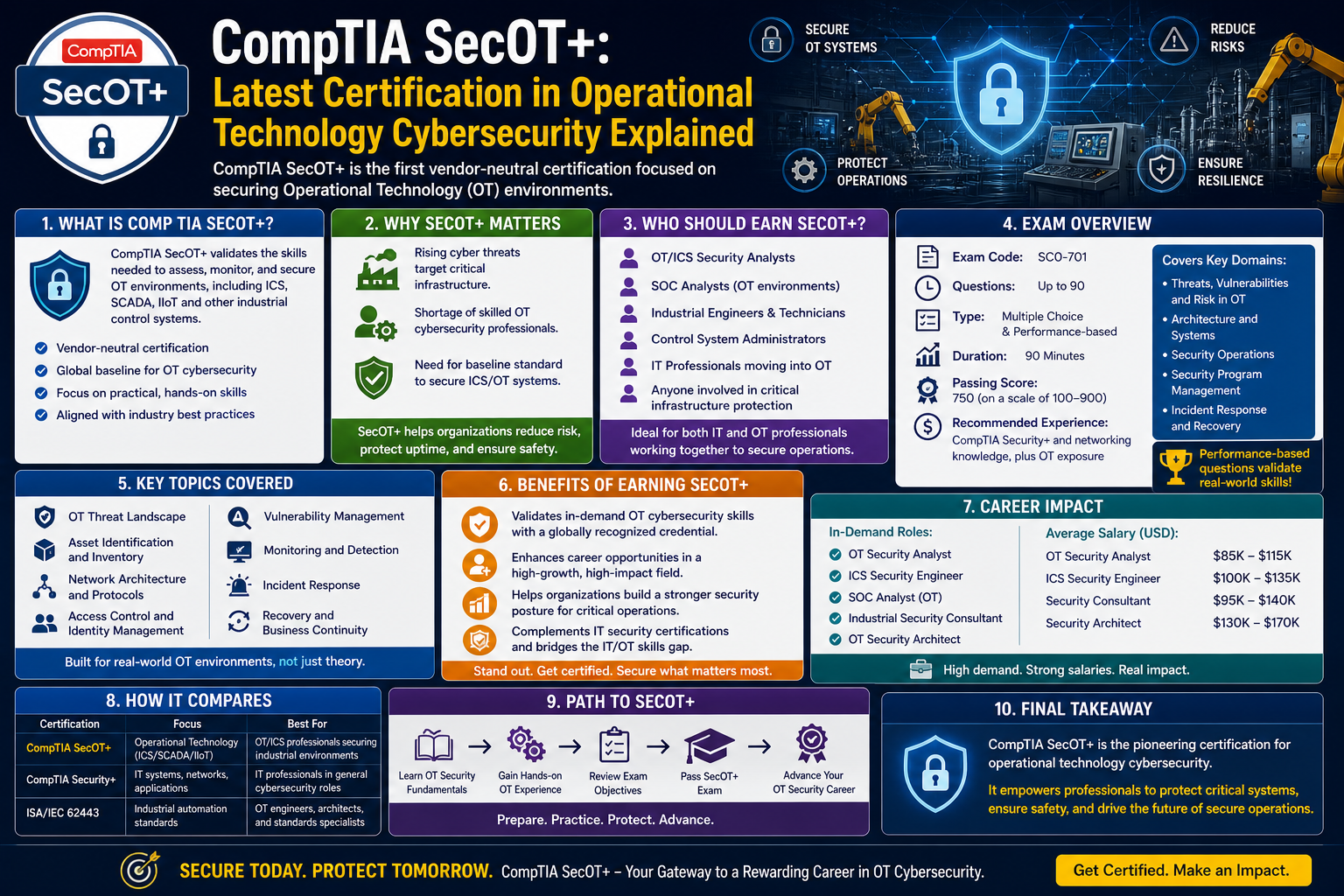
CompTIA SecOT+ represents a shift in how cybersecurity skills are being aligned with industrial and physical-world systems. Unlike traditional certifications that concentrate mainly on enterprise IT networks, this emerging credential is designed to address the security challenges found in operational technology environments. These environments include the systems that control factories, energy infrastructure, transportation networks, and other essential services that keep modern society functioning.
Operational technology has always existed alongside information technology, but the relationship between the two has changed significantly in recent years. As industrial systems become more connected, digitized, and remotely managed, the attack surface has expanded. SecOT+ is being developed in response to this transformation, with a focus on bridging the knowledge gap between IT security professionals and OT engineers.
Understanding Operational Technology in Modern Infrastructure
Operational technology refers to the hardware and software systems that monitor and control physical devices and processes. These systems are responsible for operating machinery in manufacturing plants, regulating electricity in power grids, controlling water treatment facilities, and managing transportation systems such as rail networks and air traffic control.
Unlike traditional IT environments, where the primary focus is on data confidentiality and digital security, OT environments prioritize availability, safety, and continuous operation. A disruption in these systems can lead to real-world consequences such as production shutdowns, equipment damage, environmental hazards, or even threats to human life.
For many years, OT systems were isolated from external networks. They operated in closed environments, often using proprietary protocols and legacy hardware that were not designed with cybersecurity in mind. However, modernization efforts have introduced connectivity, remote access, and integration with cloud platforms. While these advancements have improved efficiency and monitoring capabilities, they have also introduced new vulnerabilities.
Why SecOT+ Is Being Introduced Now
The timing of SecOT+ reflects a growing recognition that operational technology is no longer isolated from cyber threats. Industrial environments are increasingly targeted by sophisticated attackers who understand that disrupting physical systems can have more immediate and severe consequences than traditional data breaches.
One of the key drivers behind this certification is the rapid convergence of IT and OT systems. Organizations now rely on interconnected networks where business systems and industrial control systems share data and infrastructure. This convergence improves decision-making and operational efficiency but also creates pathways for cyberattacks to move between environments.
Another factor is the increasing frequency and severity of attacks targeting critical infrastructure. Reports from cybersecurity organizations consistently show that industrial sectors are experiencing a rise in ransomware, espionage campaigns, and disruptive attacks. These incidents highlight the need for professionals who understand both digital security principles and industrial operational constraints.
SecOT+ is being developed as a response to this skills gap, aiming to equip professionals with the ability to secure systems where downtime is not just inconvenient but potentially dangerous.
The Difference Between IT and OT Security Perspectives
One of the central challenges in securing operational environments is the difference in mindset between IT professionals and OT engineers. IT security typically focuses on protecting data integrity, confidentiality, and network access. In contrast, OT security prioritizes system stability, physical safety, and continuous uptime.
IT professionals are accustomed to applying updates, patching systems, and rebooting servers when necessary. In OT environments, however, such actions can be disruptive or even unsafe. A production line in a factory cannot simply be shut down for updates without considering operational costs, safety risks, and production schedules.
Similarly, OT engineers are deeply familiar with physical processes and machinery but may not always have extensive cybersecurity training. This creates a gap where both sides understand their own domains but may lack insight into the other’s priorities.
SecOT+ aims to bridge this divide by promoting a shared security framework that respects both perspectives. It encourages collaboration between IT and OT teams, ensuring that security decisions take into account both cyber risks and physical operational constraints.
The Expanding Threat Landscape in Industrial Systems
Cyber threats targeting operational technology environments have evolved significantly over the past decade. Attacks are no longer limited to opportunistic malware or isolated incidents. Instead, they are often highly targeted, well-funded, and strategically designed to disrupt critical infrastructure.
Industrial control systems, supervisory control and data acquisition (SCADA) systems, and programmable logic controllers (PLCs) are increasingly being targeted by attackers. These systems were traditionally built for reliability rather than security, making them attractive targets for exploitation.
One major concern is ransomware attacks that lock operators out of critical systems. In industrial settings, even a short disruption can have cascading effects across supply chains and essential services. In some cases, organizations may be forced to shut down operations entirely until systems are restored.
Another growing threat is the manipulation of physical processes. Unlike traditional cyberattacks that focus on stealing data, these attacks aim to alter system behavior. This could involve changing temperature controls in a manufacturing process, disrupting power distribution, or interfering with transportation signaling systems.
The consequences of such attacks extend beyond financial loss. They can impact public safety, environmental stability, and national security. This is why operational technology security is now considered a critical component of global cybersecurity strategy.
Legacy Systems and the Security Challenge
One of the most difficult aspects of securing operational technology environments is the widespread use of legacy systems. Many industrial facilities rely on equipment and software that have been in operation for decades. These systems were often designed without modern cybersecurity considerations, and in some cases, they cannot be easily updated or replaced.
Legacy systems may run on outdated operating systems, use unencrypted communication protocols, or lack authentication mechanisms. Despite these weaknesses, they remain in use because they are reliable, expensive to replace, and deeply integrated into operational processes.
Securing these systems requires a different approach than traditional IT security. Instead of relying solely on patching and updates, organizations must implement compensating controls such as network segmentation, monitoring, and strict access management.
SecOT+ places emphasis on understanding these constraints and developing strategies that enhance security without disrupting essential operations. This includes identifying vulnerabilities in older systems and applying layered security measures that reduce risk while maintaining functionality.
Risk-Based Thinking in Operational Environments
Risk management in operational technology environments differs significantly from traditional IT environments. In IT, risks are often evaluated based on data sensitivity and financial impact. In OT, risk assessments must also consider physical safety, environmental impact, and operational continuity.
A risk-based approach involves evaluating the potential consequences of system failures or cyber incidents and prioritizing security measures accordingly. Not all systems can be treated equally, and resources must be allocated to protect the most critical assets.
For example, a disruption in a water treatment facility could have immediate public health implications, while a failure in a non-critical monitoring system might have a limited impact. Understanding these distinctions is essential for effective OT security planning.
SecOT+ incorporates this concept by encouraging professionals to assess risk in a broader context that includes both cyber and physical dimensions. This approach ensures that security decisions align with real-world operational priorities.
Compliance, Standards, and Industrial Security Frameworks
Operational technology environments are often governed by strict regulatory requirements and industry standards. These frameworks are designed to ensure safety, reliability, and consistency across critical infrastructure sectors.
Standards such as IEC 62443 and NIST guidelines for industrial control systems provide structured approaches to securing OT environments. They cover areas such as access control, system integrity, incident response, and secure configuration.
Compliance is not just about meeting regulatory requirements. It also plays a key role in establishing baseline security practices that organizations can build upon. However, implementing these standards in real-world industrial environments can be challenging due to legacy systems and operational constraints.
SecOT+ is expected to incorporate knowledge of these frameworks, helping professionals understand how to apply them in practical settings. This includes balancing compliance requirements with operational realities and ensuring that security measures are both effective and feasible.
The Role of Cyber-Physical Systems in Modern Security
Operational technology is closely tied to cyber-physical systems, where digital control systems interact directly with physical processes. These systems form the backbone of modern industrial automation and are central to sectors such as manufacturing, energy production, and transportation.
The integration of cyber and physical components introduces unique security challenges. Unlike traditional IT systems, where the impact of an attack is usually confined to digital assets, cyber-physical systems can directly affect real-world operations.
For example, altering sensor data in a manufacturing plant could lead to defective products, while interfering with control systems in a power grid could result in widespread outages. These risks highlight the importance of securing both digital and physical layers of industrial systems.
SecOT+ recognizes this complexity by focusing on the interaction between cyber systems and physical processes. It encourages professionals to think beyond traditional network security and consider the broader implications of system compromise.
Workforce Challenges and the Need for Hybrid Skills
One of the most significant challenges in operational technology security is the shortage of professionals who understand both IT and OT environments. Traditionally, these fields have developed separately, with different skill sets, tools, and priorities.
IT professionals may have strong cybersecurity knowledge but a limited understanding of industrial processes. OT professionals, on the other hand, have deep expertise in physical systems but may lack formal cybersecurity training.
This divide creates a gap in organizational security strategies. As threats become more sophisticated, there is a growing need for professionals who can operate effectively in both domains.
SecOT+ is designed to address this challenge by promoting hybrid skills that combine cybersecurity principles with operational awareness. This includes understanding how industrial systems function, how they are controlled, and how they can be protected without disrupting essential operations.
The demand for such skills is expected to grow as industries continue to digitize and integrate their systems. Organizations are increasingly looking for professionals who can act as a bridge between IT security teams and operational engineers, ensuring that both perspectives are represented in security planning.
Preparing the Ground for a New Security Discipline
The emergence of SecOT+ reflects a broader shift in how cybersecurity is being applied to real-world systems. Operational technology security is no longer a niche concern but a core component of critical infrastructure protection.
As industrial environments become more connected and complex, the need for specialized knowledge continues to grow. SecOT+ represents an effort to formalize this knowledge into a structured certification that reflects the realities of modern industrial systems.
This evolution marks the beginning of a new discipline where cybersecurity is not confined to digital environments but extends directly into the physical world.
Building a Unified Security Model for Industrial and Digital Environments
As operational technology environments continue to merge with traditional IT systems, organizations are being forced to rethink how security is structured across their entire infrastructure. Instead of treating IT and OT as separate domains, modern security strategies increasingly focus on unified models that account for both digital and physical systems.
This shift is not simply architectural; it represents a change in how organizations understand risk, responsibility, and system behavior. In traditional setups, IT security teams managed servers, applications, and user access, while OT teams focused on machinery, production systems, and industrial control logic. These two groups often operated independently, with limited overlap in communication or planning.
However, convergence has changed this dynamic. Data now flows continuously between enterprise systems and industrial environments. Production data is analyzed in real time, maintenance systems are connected to cloud platforms, and remote monitoring has become standard practice. As a result, security must now function across both layers seamlessly.
SecOT+ reflects this reality by emphasizing the importance of integrated defense strategies. Rather than treating OT as a separate entity, it encourages professionals to view industrial systems as part of a broader interconnected ecosystem. This approach helps reduce blind spots and ensures that security controls are applied consistently across environments.
Security Architecture in Converged Industrial Networks
The architecture of modern industrial networks has evolved significantly from isolated control systems to highly interconnected environments. These networks typically include a combination of enterprise IT systems, supervisory control layers, and field devices that directly interact with physical processes.
One of the key challenges in securing such environments is maintaining separation between critical control systems and less-trusted networks. This is often achieved through segmentation strategies that divide the network into zones based on function and risk level.
In industrial settings, segmentation is not just a best practice but a necessity. Without it, a compromise in an enterprise system could potentially spread into production environments. Properly designed architectures ensure that even if one segment is compromised, the impact is contained.
Another important aspect of industrial network architecture is the use of industrial demilitarized zones. These zones act as controlled interfaces between IT and OT systems, allowing data exchange while enforcing strict security controls.
SecOT+ places emphasis on understanding these architectural principles, including how data flows between systems, where vulnerabilities can arise, and how segmentation can be used to limit exposure. Professionals are expected to think beyond traditional network diagrams and consider the operational implications of architectural decisions.
Hardening Industrial Systems Without Disrupting Operations
System hardening in operational environments presents unique challenges compared to traditional IT systems. In enterprise networks, hardening often involves disabling unnecessary services, applying patches, and enforcing strict configuration policies. In industrial environments, however, these actions must be carefully balanced against operational stability.
Many industrial systems run on legacy hardware and software that cannot be easily modified or updated. In some cases, even minor changes can lead to unexpected behavior or system downtime. As a result, hardening strategies must be designed with extreme caution.
One common approach is to implement compensating controls rather than directly modifying critical systems. This includes using network-level protections, monitoring tools, and access restrictions to reduce exposure without altering core system functionality.
Another important technique is passive monitoring, where security tools observe system behavior without interfering with operations. This allows organizations to detect anomalies and potential threats without introducing risk to production systems.
SecOT+ emphasizes the importance of understanding these constraints and developing security strategies that are both effective and non-disruptive. Professionals must learn how to evaluate risks, prioritize controls, and implement protections in a way that preserves system integrity.
Supply Chain Exposure in Operational Technology Ecosystems
Modern industrial systems rely heavily on complex supply chains that include hardware vendors, software providers, third-party integrators, and maintenance contractors. Each of these components introduces potential security risks that must be carefully managed.
Supply chain vulnerabilities can arise at multiple stages, including during manufacturing, software development, deployment, and maintenance. A compromised component introduced early in the supply chain can remain undetected until it is deployed in a live operational environment.
One of the most concerning aspects of supply chain risk is its indirect nature. Organizations may not have direct control over all components within their systems, making it difficult to assess trustworthiness at every level.
In operational environments, supply chain security is particularly critical because compromised components can affect physical systems. For example, malicious firmware in a control device could alter system behavior in ways that are difficult to detect.
SecOT+ addresses this challenge by encouraging professionals to evaluate supply chain risk as part of overall security planning. This includes assessing vendor practices, verifying system integrity, and implementing controls that monitor third-party interactions.
Incident Response in Critical Infrastructure Environments
Incident response in operational technology environments differs significantly from traditional IT incident handling. In enterprise systems, the primary goal is often to restore data integrity and resume normal operations as quickly as possible. In industrial environments, however, safety and operational continuity take priority.
When a security incident occurs in a production system, responders must carefully evaluate the potential impact of each action. Simply isolating a system may prevent further compromise, but it could also disrupt critical processes.
This creates a complex decision-making environment where security teams must balance containment with operational risk. In some cases, it may be safer to allow a controlled compromise to continue temporarily while implementing mitigation strategies.
Effective incident response in OT environments requires close coordination between IT security teams, operational engineers, and management personnel. Each group brings a different perspective that is essential for making informed decisions.
SecOT+ places emphasis on understanding these dynamics and preparing professionals to respond to incidents in a way that minimizes both cyber and physical risk. This includes developing response plans that account for system dependencies and operational constraints.
The Role of Human Factors in Operational Security
Human behavior plays a critical role in the security of operational technology environments. Many incidents are not caused by technical vulnerabilities alone but by human actions such as misconfigurations, procedural errors, or social engineering attacks.
In industrial settings, operators and engineers often focus on maintaining system performance and safety. Security procedures may sometimes be viewed as secondary to operational efficiency. This can lead to situations where security controls are bypassed or improperly implemented.
Training and awareness are essential components of operational security. However, traditional cybersecurity training may not always be sufficient for OT environments, where workflows and responsibilities differ significantly from IT settings.
One of the key challenges is ensuring that security practices are integrated into daily operational routines rather than treated as separate tasks. This requires aligning security objectives with operational goals so that both can be achieved simultaneously.
SecOT+ highlights the importance of human factors in security design, encouraging professionals to consider how people interact with systems and how behavior influences risk. This includes understanding operator workflows, maintenance procedures, and access patterns.
Monitoring and Visibility Across Industrial Systems
Visibility is one of the most important aspects of operational technology security. Without proper monitoring, it is difficult to detect anomalies, identify threats, or respond effectively to incidents.
Industrial environments often consist of a wide range of devices, including sensors, controllers, and monitoring systems. These devices generate large amounts of data that can be used to assess system health and detect potential security issues.
However, gaining visibility in OT environments is not always straightforward. Many systems were not designed with modern monitoring tools in mind, and some may not support traditional logging mechanisms.
To address this challenge, organizations often use specialized monitoring solutions that are designed for industrial protocols and environments. These tools can observe network traffic, analyze device behavior, and identify deviations from normal operations.
SecOT+ emphasizes the importance of visibility as a foundational element of security. Professionals are expected to understand how monitoring tools operate, what data they collect, and how that information can be used to improve security posture.
Threat Modeling for Industrial Control Systems
Threat modeling is a structured approach to identifying potential risks within a system. In operational technology environments, this process involves analyzing both digital and physical components to determine how they could be targeted by attackers.
Unlike traditional IT systems, where threats are often focused on data theft or unauthorized access, industrial systems must also consider physical consequences. This includes equipment damage, process disruption, and safety hazards.
Effective threat modeling in OT environments requires a deep understanding of system architecture, operational workflows, and interdependencies between components. It also involves considering how an attacker might move through both IT and OT networks.
One of the key challenges in this process is accounting for legacy systems and undocumented configurations. Many industrial environments have evolved, resulting in complex and sometimes poorly documented architectures.
SecOT+ encourages a comprehensive approach to threat modeling that incorporates both technical and operational perspectives. This helps ensure that potential risks are identified before they can be exploited.
Industrial Communication Protocols and Security Implications
Operational technology systems rely on a variety of communication protocols designed specifically for industrial environments. These protocols enable devices to exchange information, coordinate actions, and monitor system performance.
Many of these protocols were developed decades ago and were not originally designed with cybersecurity in mind. As a result, they often lack encryption, authentication, and integrity protections.
While these protocols remain widely used due to their reliability and efficiency, they also present security challenges. Attackers who gain access to industrial networks may be able to intercept or manipulate communications if proper safeguards are not in place.
Securing industrial protocols requires a combination of network segmentation, monitoring, and protocol-aware security tools. It also involves understanding how different protocols operate and where vulnerabilities may exist.
SecOT+ includes awareness of these communication mechanisms as part of its broader focus on operational security. Professionals are expected to understand how industrial data flows and how communication channels can be protected.
Governance and Operational Security Alignment
Governance plays a crucial role in ensuring that security practices are consistently applied across operational environments. It involves defining policies, assigning responsibilities, and establishing oversight mechanisms that guide security decision-making.
In industrial settings, governance must account for both cybersecurity requirements and operational constraints. This includes ensuring that security policies do not interfere with production processes while still maintaining acceptable levels of risk.
One of the challenges in governance is aligning different organizational priorities. IT departments may prioritize security controls, while operational teams may prioritize uptime and efficiency. Effective governance frameworks help reconcile these differences.
SecOT+ reflects this need for alignment by emphasizing the importance of structured decision-making in operational environments. Professionals are expected to understand how governance frameworks influence security practices and how to apply them in real-world settings.
Advanced Threat Landscapes in Operational Technology Environments
Operational technology environments are no longer isolated from the broader cyber threat landscape. As industrial systems become more connected, attackers have adapted their methods to target the unique characteristics of these environments. Unlike traditional IT attacks that primarily focus on data theft or financial gain, threats in OT environments often aim to disrupt physical processes, damage equipment, or create widespread operational failure.
One of the most significant changes in recent years is the professionalization of attackers targeting industrial systems. Instead of opportunistic malware, organizations now face highly coordinated campaigns that are often well-funded and strategically planned. These attacks may be linked to criminal organizations, nation-state actors, or advanced persistent threat groups with long-term objectives.
A key characteristic of modern OT-focused attacks is patience. Attackers may remain undetected within systems for extended periods, observing processes and identifying critical vulnerabilities before launching an attack. This level of persistence makes detection and response significantly more challenging than in traditional IT environments.
SecOT+ is being developed with these realities in mind, emphasizing the importance of understanding not only how systems operate, but also how they might be exploited over time. This includes recognizing behavioral patterns, identifying subtle anomalies, and understanding how attackers move laterally across converged IT and OT networks.
The Expansion of Attack Surfaces in Industrial Systems
The attack surface in operational technology environments has expanded dramatically due to digital transformation. Systems that were once isolated are now connected to enterprise networks, cloud platforms, remote monitoring tools, and even mobile devices used by field technicians.
Each new connection point introduces potential vulnerabilities. Remote access solutions, for example, allow engineers to manage industrial systems from off-site locations, but they also create entry points that attackers can target if not properly secured.
Similarly, integration with cloud-based analytics platforms has improved operational efficiency but also introduced dependencies on external systems. If these connections are compromised, attackers may be able to manipulate data or gain indirect access to industrial environments.
The expansion of wireless technologies within industrial facilities has also increased exposure. While wireless communication improves flexibility and reduces infrastructure costs, it requires strong authentication and encryption mechanisms to prevent unauthorized access.
SecOT+ highlights the importance of understanding these expanded attack surfaces and encourages professionals to evaluate security risks across all connected components. This includes not only core industrial systems but also supporting infrastructure and third-party integrations.
Persistence Mechanisms in Industrial Cyberattacks
One of the most concerning aspects of modern OT-focused cyberattacks is the use of persistence mechanisms designed to maintain long-term access to systems. Unlike short-term attacks that aim to cause immediate disruption, persistent threats focus on remaining undetected while gradually expanding control over systems.
Attackers may embed themselves within engineering workstations, modify firmware on industrial controllers, or exploit trusted maintenance channels to maintain access. These techniques make detection difficult because the systems continue to function normally even while compromised.
In some cases, attackers may deliberately avoid causing immediate damage to preserve their access for future use. This allows them to observe operational behavior, identify critical processes, and plan more impactful attacks later.
Detecting persistent threats requires continuous monitoring, behavioral analysis, and a deep understanding of normal system operations. Traditional signature-based detection methods are often insufficient in these environments.
SecOT+ emphasizes the importance of understanding persistence techniques and encourages professionals to develop strategies for identifying long-term compromises within industrial systems.
Safety-Critical Systems and Cybersecurity Interdependencies
In operational technology environments, cybersecurity is closely linked to physical safety. Many industrial systems control processes that, if disrupted, could lead to hazardous conditions such as equipment failure, environmental damage, or risk to human life.
This interdependency between cyber and physical systems creates a unique security challenge. Unlike IT environments, where data loss may be the primary concern, OT environments must consider the potential impact of cyber incidents on physical safety.
For example, in a chemical processing plant, unauthorized changes to control systems could lead to dangerous reactions. In energy distribution systems, manipulation of load balancing controls could result in widespread outages or equipment damage.
Because of these risks, cybersecurity decisions in OT environments must always consider safety implications. Security controls must be designed not only to protect data and systems but also to ensure that physical processes remain stable and predictable.
SecOT+ reflects this reality by emphasizing the importance of safety-aware cybersecurity practices. Professionals are expected to understand how cyber threats can translate into physical consequences and how to mitigate those risks effectively.
Digital Twins and Their Security Implications
Digital twin technology is increasingly being used in operational technology environments to simulate and monitor physical systems in real time. A digital twin is a virtual representation of a physical system that mirrors its behavior, allowing operators to analyze performance, predict failures, and optimize operations.
While digital twins offer significant benefits, they also introduce new security considerations. Because they are connected to real-world systems, any compromise of a digital twin could potentially influence physical operations.
If attackers gain access to a digital twin system, they may be able to manipulate simulations, alter predictive models, or mislead operators about system conditions. In advanced scenarios, this could lead to incorrect operational decisions based on false data.
Securing digital twins requires the same level of protection as physical systems, including access control, data integrity verification, and continuous monitoring. It also requires ensuring that communication between digital and physical systems cannot be intercepted or altered.
SecOT+ recognizes the growing importance of digital twin technology and incorporates awareness of its security implications as part of broader OT cybersecurity knowledge.
Artificial Intelligence in Industrial Security Environments
Artificial intelligence is playing an increasingly important role in operational technology security. AI-driven systems are used to analyze large volumes of operational data, detect anomalies, and predict potential failures before they occur.
In cybersecurity contexts, AI can help identify unusual behavior patterns that may indicate an ongoing attack. This includes detecting deviations in network traffic, unexpected changes in system performance, or abnormal user behavior.
However, AI also introduces new risks. If machine learning models are trained on incomplete or manipulated data, they may produce inaccurate predictions or fail to detect threats. Additionally, attackers may attempt to exploit AI systems by feeding them misleading information.
Another concern is the increasing reliance on automated decision-making systems. In some industrial environments, AI systems may directly influence operational decisions. If these systems are compromised, the impact could extend beyond digital systems into physical processes.
SecOT+ encourages awareness of both the benefits and risks of AI in operational environments. Professionals are expected to understand how AI is used in security monitoring and how it can be protected from manipulation.
Cloud Integration and Hybrid Industrial Environments
The integration of cloud computing into operational technology environments has transformed how industrial systems are managed. Cloud platforms enable remote monitoring, centralized data analysis, and scalable computing resources that were previously unavailable in traditional OT setups.
However, this integration also introduces new security challenges. Data transmitted between industrial systems and cloud platforms must be protected against interception, modification, and unauthorized access.
Hybrid environments, where on-premises industrial systems are connected to cloud infrastructure, require careful security design. Trust boundaries must be clearly defined, and access between systems must be tightly controlled.
One of the main risks in cloud-integrated OT environments is misconfiguration. Improperly configured access controls or insecure APIs can create vulnerabilities that attackers may exploit to gain access to sensitive systems.
SecOT+ emphasizes the importance of understanding hybrid architectures and the security implications of cloud integration. Professionals must be able to evaluate risks across both local and remote systems.
Identity and Access Management in Operational Contexts
Identity and access management play a critical role in securing operational technology environments. Controlling who can access systems, when they can access them, and what actions they can perform is essential for maintaining security and operational integrity.
In industrial environments, access control is often more complex than in traditional IT systems. Multiple stakeholders, including engineers, operators, contractors, and vendors, may require access to different parts of the system.
This complexity requires carefully designed access policies that balance security with operational needs. Overly restrictive controls can hinder productivity, while overly permissive access can increase risk.
Multi-factor authentication, role-based access control, and privileged access management are commonly used to strengthen identity security in OT environments. However, implementing these controls must be done in a way that does not disrupt critical operations.
SecOT+ highlights the importance of identity management as a foundational security component in industrial systems. Professionals are expected to understand how access control policies are designed and enforced in complex operational environments.
Vulnerability Management in Industrial Systems
Vulnerability management in operational technology environments presents unique challenges due to system availability requirements and legacy infrastructure constraints. Unlike traditional IT systems, where patches can be applied regularly, industrial systems often require careful scheduling to avoid operational disruption.
In many cases, vulnerabilities may remain unpatched for extended periods because updating systems could interfere with production processes. This creates a situation where risk must be managed through alternative controls.
Organizations often rely on compensating measures such as network segmentation, intrusion detection, and strict access controls to mitigate vulnerabilities when patching is not possible.
Another challenge is the identification of vulnerabilities in systems that were not designed with modern security standards in mind. Many industrial devices lack built-in security features, making them inherently difficult to secure.
SecOT+ emphasizes the importance of understanding vulnerability management in constrained environments. Professionals must be able to assess risk, prioritize remediation efforts, and implement layered defenses.
Regulatory Pressure and Industrial Cybersecurity Accountability
Governments and regulatory bodies are increasingly focusing on the security of critical infrastructure. This has led to the development of stricter compliance requirements for organizations operating industrial systems.
These regulations often require organizations to implement specific security controls, conduct regular risk assessments, and report incidents within defined timeframes. Failure to comply can result in legal penalties, financial losses, or reputational damage.
Compliance is not only a legal requirement but also a framework for improving security practices. However, implementing regulatory requirements in industrial environments can be challenging due to operational constraints and legacy systems.
Organizations must find ways to meet compliance obligations without disrupting essential services. This often involves creative solutions that balance security, safety, and operational efficiency.
SecOT+ reflects this growing regulatory landscape by emphasizing awareness of compliance requirements and their practical application in industrial environments.
Evolution of Professional Roles in OT Security
As operational technology security becomes more complex, professional roles within this field are also evolving. Traditional job roles that focused exclusively on either IT or OT are being replaced by hybrid positions that require knowledge of both domains.
New roles such as OT security analysts, industrial cybersecurity engineers, and critical infrastructure protection specialists are becoming more common. These roles require a combination of technical cybersecurity knowledge and an understanding of industrial processes.
Professionals in these roles must be able to collaborate across disciplines, communicate effectively with both IT and engineering teams, and understand the operational impact of security decisions.
SecOT+ aligns with this evolution by providing a structured framework for developing the skills needed in modern industrial cybersecurity roles. It reflects the growing demand for professionals who can operate at the intersection of digital security and physical systems.
Conclusion
The emergence of CompTIA SecOT+ reflects a significant turning point in how cybersecurity is being applied to industrial and critical infrastructure environments. Operational technology is no longer a niche or isolated domain. It now sits at the center of modern society’s most essential services, including energy distribution, manufacturing, transportation, water systems, and healthcare infrastructure. As these systems become more interconnected with traditional IT networks and cloud platforms, the need for specialized security expertise has become unavoidable.
What makes this shift particularly important is the nature of the systems being protected. Unlike conventional IT environments, where the primary concern is data confidentiality, operational technology environments are directly tied to physical processes. A cyber incident in these systems is not limited to digital disruption; it can result in equipment damage, production shutdowns, environmental harm, or even risks to human life. This elevates OT cybersecurity from a technical discipline to a safety-critical responsibility.
SecOT+ represents an effort to formally recognize and address this reality. It brings together concepts from cybersecurity, industrial engineering, risk management, and systems operations into a unified body of knowledge. Rather than treating IT and OT as separate worlds, it acknowledges that the future of security depends on collaboration between these domains. The certification emphasizes shared understanding, common frameworks, and integrated defense strategies that reflect how modern industrial environments actually operate.
One of the most important ideas reinforced by SecOT+ is the concept of convergence. As industrial systems adopt digital technologies, the boundaries between enterprise networks and operational systems continue to blur. This convergence improves efficiency, enables real-time decision-making, and supports advanced analytics, but it also increases exposure to cyber threats. Attackers no longer need to target isolated systems; instead, they can exploit interconnected environments to move laterally and reach critical infrastructure.
At the same time, SecOT+ highlights the importance of respecting the constraints of operational environments. Security in industrial systems cannot be approached in the same way as traditional IT security. Availability, safety, and reliability often take priority over rapid patching or system reconfiguration. This means that cybersecurity strategies must be carefully designed to avoid disrupting essential operations while still reducing risk. It requires a balance between protection and practicality, something that can only be achieved through a deep understanding of both domains.
Another key takeaway from the SecOT+ perspective is the growing importance of risk-based thinking. In operational environments, risk is not just about financial loss or data exposure; it includes physical consequences and safety implications. This broader view of risk forces organizations to evaluate threats in a more holistic way, considering how cyber incidents could affect real-world processes. It also requires prioritization, since not all systems carry the same level of criticality.
Human factors also play a central role in this evolving landscape. Many security incidents in industrial environments are not caused solely by technical vulnerabilities but by misconfigurations, procedural gaps, or human error. As a result, effective OT security must include awareness, training, and collaboration across different teams. Operators, engineers, and security professionals must work together to ensure that security practices are practical, understood, and consistently applied.
Looking forward, the demand for professionals who understand both cybersecurity and operational systems is expected to continue growing. Industries are increasingly seeking individuals who can bridge the gap between IT security teams and OT engineering teams. These hybrid professionals are essential for designing, implementing, and maintaining security strategies that work in complex, real-world environments. SecOT+ is positioned as a response to this demand, offering a structured path for developing these combined skills.
The rise of technologies such as artificial intelligence, digital twins, and cloud-integrated industrial platforms will further accelerate this transformation. While these innovations bring significant operational benefits, they also introduce new security challenges that must be carefully managed. As industrial systems become more intelligent and autonomous, ensuring their security will require continuous adaptation and deeper technical understanding.
Ultimately, SecOT+ symbolizes more than just a certification; it reflects a broader shift in how society views cybersecurity. It acknowledges that protecting digital systems is no longer enough. Security must extend into the physical world, safeguarding the infrastructure that supports everyday life. As operational technology continues to evolve, the professionals who understand both its opportunities and its risks will play a critical role in shaping a safer, more resilient future.