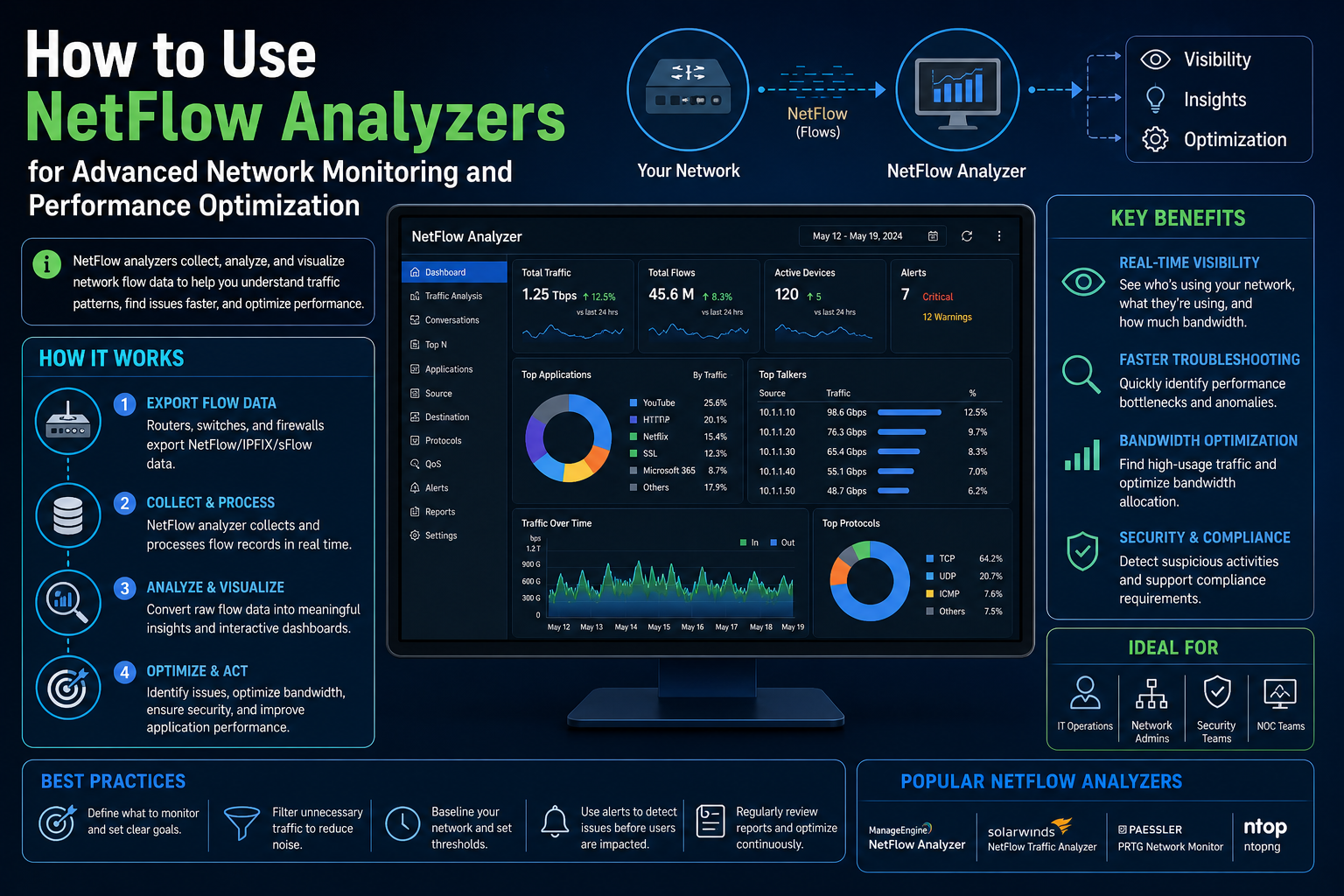
NetFlow is a foundational technology used in network monitoring that provides detailed visibility into how data moves across a digital environment. Originally developed to help manage routing efficiency, it has evolved into one of the most widely used methods for analyzing network traffic behavior. At its core, NetFlow is designed to answer three essential questions about network activity: who is communicating, what type of traffic is being generated, and where that traffic is going.
In modern IT environments, where networks are constantly handling large volumes of data from applications, users, devices, and cloud services, having this level of insight is essential. Without it, network administrators are left guessing when performance issues arise or when suspicious activity occurs. NetFlow removes that uncertainty by converting raw traffic data into structured information that can be analyzed in real time or stored for later review.
The strength of NetFlow lies in its ability to provide context. Unlike traditional monitoring tools that focus on device health or uptime, NetFlow focuses on traffic behavior. It shows how bandwidth is being used, which applications are consuming the most resources, and how traffic patterns change over time. This makes it an essential tool for performance optimization, capacity planning, and security analysis.
How NetFlow Works in a Network Environment
NetFlow operates by collecting metadata about network traffic flows rather than capturing the actual data packets themselves. A flow is defined as a sequence of packets that share common characteristics, such as source IP address, destination IP address, source port, destination port, protocol type, and the interface through which the traffic passes.
When data moves through a network device such as a router or switch, that device identifies and groups packets into flows. Instead of forwarding every packet detail to a monitoring system, the device summarizes the flow information and exports it to a centralized collector for analysis. This process significantly reduces the amount of data that needs to be processed while still preserving meaningful insights.
The NetFlow process typically involves three main components:
The first component is the exporter, which is usually a router or switch that generates flow records. These devices monitor traffic as it passes through and create summaries based on defined parameters.
The second component is the collector, which receives exported flow data from multiple devices across the network. The collector stores this data and organizes it for further processing.
The third component is the analyzer, which interprets the collected data and presents it in a human-readable format. This is where NetFlow analyzers come into play, transforming raw flow records into dashboards, graphs, and reports that reveal network behavior.
By separating these functions, NetFlow allows organizations to monitor large and complex networks without overwhelming system resources.
The Evolution of NetFlow Technology
The development of NetFlow began with the work of Cisco in the mid-1990s. At that time, network administrators primarily relied on basic monitoring tools that provided limited visibility into network performance. These tools could show whether a device was up or down, but they could not explain why network congestion or slow performance was occurring.
NetFlow was introduced as a way to improve routing efficiency and provide better insight into traffic patterns. Initially, it was used mainly for optimizing access control lists and improving packet forwarding decisions. However, as networks grew in size and complexity, its potential for traffic analysis became more apparent.
Over time, NetFlow evolved beyond its original purpose. It became widely adopted across different vendors and eventually influenced the development of IPFIX, an industry-standard protocol for flow-based monitoring. This evolution allowed NetFlow-like functionality to be used in multi-vendor environments, expanding its reach far beyond its original implementation.
As data centers, cloud computing, and distributed applications became more common, the volume of network traffic increased dramatically. Traditional monitoring systems struggled to keep up with this growth, leading to the need for more advanced analysis tools. This is where NetFlow analyzers emerged as a critical solution, capable of processing large-scale flow data and turning it into actionable insights.
Introduction to NetFlow Analyzers and Their Purpose
NetFlow analyzers are specialized software tools designed to interpret and visualize NetFlow data. While NetFlow itself is responsible for collecting and exporting flow information, analyzers are responsible for making sense of that information.
Raw NetFlow data is highly technical and not easily understood without processing. It consists of structured records that contain details about traffic flows, but these records need to be aggregated and analyzed to provide meaningful insights. NetFlow analyzers take this raw data and convert it into dashboards, reports, and visualizations that highlight important trends and anomalies.
The primary purpose of a NetFlow analyzer is to improve network visibility. By providing a clear picture of traffic behavior, these tools help network administrators understand how resources are being used and where potential issues may exist. This includes identifying bandwidth-heavy applications, detecting unusual traffic spikes, and tracking communication patterns between devices.
In addition to visibility, NetFlow analyzers also support performance optimization. By analyzing traffic patterns, organizations can identify inefficiencies in their network infrastructure and make adjustments to improve speed and reliability. This might involve reallocating bandwidth, adjusting routing policies, or optimizing application performance.
Security is another critical area where NetFlow analyzers play an important role. By monitoring traffic flows, these tools can detect suspicious behavior such as unexpected data transfers, communication with unknown external servers, or sudden increases in traffic volume. This makes them valuable for identifying potential security threats before they escalate.
Why Network Visibility Has Become Essential
Modern networks are far more complex than those of the past. With the rise of cloud computing, remote work, mobile devices, and distributed applications, data no longer flows in predictable patterns. Instead, it moves dynamically across multiple environments, often crossing internal and external boundaries.
This complexity makes network visibility more important than ever. Without a clear understanding of how traffic flows through the network, organizations risk performance issues, security vulnerabilities, and inefficient resource usage.
NetFlow analyzers address this challenge by providing a centralized view of network activity. Instead of relying on fragmented data from individual devices, administrators can see the entire network ecosystem in one place. This holistic view makes it easier to identify patterns, detect anomalies, and respond to issues quickly.
Visibility also plays a key role in capacity planning. As networks grow, it becomes important to understand how much bandwidth is being used and where demand is increasing. NetFlow analyzers provide historical data that can be used to forecast future requirements and prevent bottlenecks before they occur.
Core Components of NetFlow Data Collection
To fully understand how NetFlow analyzers operate, it is important to examine the structure of the data they process. NetFlow records contain several key elements that describe each traffic flow in detail.
One of the most important elements is the source and destination information. This includes the IP addresses of both the sender and receiver, which helps identify communication patterns between devices and external systems.
Another important element is the port information. Ports indicate which applications or services are being used during communication. By analyzing port usage, administrators can determine which applications are consuming the most resources.
Protocol information is also included in NetFlow records. This identifies whether the traffic is using TCP, UDP, or another protocol, providing additional context about the nature of the communication.
Flow duration and volume are also tracked. These metrics show how long a communication session lasts and how much data is transferred during that session. This information is useful for identifying long-running connections or unusually large data transfers.
Finally, interface data indicates where the traffic entered and exited the network device. This helps map traffic paths and understand how data moves through different segments of the network.
Together, these components form a comprehensive picture of network activity that NetFlow analyzers can interpret and visualize.
The Role of NetFlow Analyzers in Modern IT Infrastructure
NetFlow analyzers have become an essential part of modern IT infrastructure because they bridge the gap between raw network data and actionable intelligence. In large organizations, where thousands of devices may be connected simultaneously, manual monitoring is no longer feasible.
By automating the process of data collection and analysis, NetFlow analyzers allow IT teams to focus on higher-level decision-making rather than manual troubleshooting. They provide continuous monitoring, which ensures that issues are detected as soon as they occur.
These tools also support collaboration between different IT teams. For example, network engineers, security analysts, and system administrators can all use the same data to understand different aspects of network performance. This shared visibility improves coordination and reduces the time required to resolve issues.
Another important aspect of NetFlow analyzers is their ability to integrate with other monitoring systems. In many environments, they are used alongside security tools, application performance monitors, and infrastructure management platforms. This integration creates a more complete monitoring ecosystem that enhances overall operational efficiency.
Common Use Cases for NetFlow Analysis in Enterprise Networks
NetFlow analysis is used in a wide range of scenarios across enterprise networks. One of the most common use cases is bandwidth management. By identifying which applications or users are consuming the most bandwidth, organizations can enforce policies to ensure fair usage and prevent congestion.
Another important use case is troubleshooting network performance issues. When users experience slow connectivity or application delays, NetFlow data can help pinpoint the source of the problem. Whether it is a specific device, application, or network segment, the analyzer provides the information needed to resolve the issue quickly.
Security monitoring is also a major application of NetFlow analysis. By tracking traffic patterns, organizations can detect unusual behavior that may indicate a security threat. This includes data exfiltration attempts, denial-of-service attacks, or unauthorized access attempts.
Capacity planning is another critical use case. NetFlow analyzers provide historical data that helps organizations understand how network usage changes over time. This information can be used to plan infrastructure upgrades and ensure that the network can handle future demand.
Application performance monitoring is also supported by NetFlow analysis. By understanding how applications interact with the network, organizations can optimize performance and ensure that critical services remain responsive.
Transition from Traditional Monitoring to Flow-Based Analysis
Before the introduction of flow-based monitoring, network administrators relied heavily on tools such as SNMP to monitor device performance. While SNMP provided useful information about device health, it lacked the ability to show detailed traffic behavior.
This limitation made it difficult to understand why network issues were occurring. For example, SNMP might show that a router was experiencing high CPU usage, but it would not explain which traffic was causing the load.
NetFlow analyzers changed this by introducing traffic-level visibility. Instead of focusing solely on device metrics, they provided insight into the actual data being transmitted across the network.
This shift represented a major advancement in network monitoring. It allowed organizations to move from reactive troubleshooting to proactive optimization. Instead of waiting for problems to occur, administrators could identify potential issues early and take corrective action.
As networks continue to evolve, flow-based analysis remains one of the most effective methods for understanding and managing complex traffic environments.
Building a NetFlow Monitoring Architecture at Scale
Designing a NetFlow monitoring system for a small network is relatively straightforward, but scaling it for enterprise environments introduces a new level of complexity. Large organizations often operate across multiple data centers, cloud platforms, branch offices, and remote endpoints. Each of these environments generates continuous streams of flow data that must be collected, processed, and analyzed efficiently.
At scale, NetFlow monitoring is no longer just a single tool—it becomes an architecture. This architecture is typically distributed, meaning that multiple collectors and analyzers work together to handle the volume of incoming data. The goal is to ensure that no traffic information is lost while still maintaining performance and responsiveness.
A scalable NetFlow architecture usually begins with strategically placed exporters. These are network devices such as routers and switches that generate flow records. In large environments, exporters are deployed across multiple network layers, including core, distribution, and access layers. This ensures that traffic visibility is maintained at every point where data flows through the infrastructure.
Once flow data is generated, it must be transported to collectors. In high-volume environments, a single collector is often insufficient. Instead, organizations deploy multiple collectors that are distributed geographically or logically segmented by network zones. This helps balance the load and prevents bottlenecks during peak traffic periods.
The collected data is then forwarded to processing systems where it is normalized, aggregated, and prepared for analysis. At this stage, raw flow records are converted into structured datasets that can be queried and visualized. These processing systems are often designed to scale horizontally, allowing additional computing resources to be added as network traffic increases.
Finally, the analyzed data is presented through visualization platforms that provide dashboards, reports, and alerts. These interfaces allow network administrators to interact with the data in real time and gain insights into network behavior.
Flow Data Processing Pipelines and Collection Strategies
Flow data processing is a critical component of any NetFlow monitoring system. Without efficient processing pipelines, even the most advanced analyzers can become overwhelmed by the volume of incoming data.
A typical flow processing pipeline begins with ingestion. During ingestion, raw flow records are received from exporters and temporarily stored in a buffer. This buffer acts as a staging area, ensuring that data is not lost during high traffic periods.
Once ingested, the data moves into normalization. NetFlow records can vary depending on the device or vendor generating them. Normalization ensures that all records follow a consistent format, making it easier to analyze them collectively.
After normalization, the data undergoes enrichment. This step involves adding contextual information such as geographic location of IP addresses, application identification, or user identity mapping. Enrichment transforms raw flow data into meaningful insights.
The next stage is aggregation. Instead of analyzing every single flow individually, similar flows are grouped together. This reduces data volume and improves processing efficiency. For example, multiple connections between the same source and destination may be combined into a single aggregated record.
Finally, the processed data is stored in databases optimized for time-series or analytical queries. These databases allow users to retrieve historical data quickly and compare traffic patterns over time.
Collection strategies also play an important role in system performance. One common approach is flow sampling, where only a subset of traffic is analyzed instead of every single packet. This reduces system load while still providing statistically accurate insights.
Another strategy involves selective monitoring, where only specific network segments or types of traffic are analyzed. This is useful in environments where full visibility is not required for all systems.
Real-Time Network Visibility and Dashboard Engineering
Real-time visibility is one of the most powerful capabilities of NetFlow analyzers. It allows network administrators to see exactly what is happening on the network at any given moment. However, achieving true real-time visibility requires careful dashboard design and efficient data processing.
Dashboards serve as the primary interface between raw flow data and human interpretation. A well-designed dashboard does more than display numbers—it tells a story about network behavior. It highlights trends, identifies anomalies, and provides context for decision-making.
Real-time dashboards typically include metrics such as current bandwidth usage, top active applications, most active users, and live traffic flows between network segments. These metrics are continuously updated as new flow data arrives.
One of the key challenges in dashboard engineering is balancing detail with clarity. Too much information can overwhelm users, while too little can hide important insights. Effective dashboards prioritize critical metrics and allow users to drill down into deeper layers of data when needed.
Another important aspect is responsiveness. Real-time dashboards must update quickly without causing delays or performance issues. This requires efficient backend processing systems that can handle continuous data streams.
Visualization techniques also play a major role. Graphs, heatmaps, and flow diagrams are commonly used to represent network activity. These visual elements help users quickly identify patterns that would be difficult to detect in raw data.
Traffic Analysis Techniques for Performance Optimization
Traffic analysis is at the heart of NetFlow usage. It involves examining flow data to understand how network resources are being utilized and identifying opportunities for optimization.
One of the most common techniques is identifying top talkers. These are devices or applications that consume the most bandwidth. By analyzing top talkers, administrators can determine whether network resources are being used efficiently or if certain users are disproportionately impacting performance.
Another important technique is application-based analysis. Instead of focusing solely on IP addresses, NetFlow analyzers can identify specific applications generating traffic. This allows organizations to understand how business-critical applications are performing compared to non-essential services.
Time-based analysis is also widely used. By examining traffic patterns over different time periods, administrators can identify peak usage hours and plan resource allocation accordingly. This helps prevent congestion during high-demand periods.
Flow path analysis is another valuable technique. It tracks how data moves through different network segments, helping identify inefficient routing paths or bottlenecks.
In addition, comparative analysis allows organizations to compare current traffic behavior with historical data. This helps detect deviations from normal patterns and provides insight into long-term trends.
Detecting Network Anomalies and Behavioral Patterns
One of the most valuable applications of NetFlow analyzers is anomaly detection. Anomalies are deviations from normal network behavior, and they often indicate performance issues or security threats.
Behavioral baselining is the foundation of anomaly detection. By analyzing historical flow data, NetFlow systems establish a baseline of normal network activity. This baseline includes typical bandwidth usage, common communication patterns, and expected traffic volumes.
Once a baseline is established, the system continuously compares real-time data against it. Any significant deviation triggers an alert or flag for further investigation.
Anomalies can take many forms. A sudden spike in traffic may indicate a denial-of-service attack or misconfigured application. Unusual communication between internal systems and external IP addresses may suggest unauthorized access or malware activity.
Behavioral patterns are also important for identifying gradual changes in network usage. For example, a slow but steady increase in bandwidth consumption over time may indicate growing demand for certain applications.
Machine learning techniques are increasingly being used to enhance anomaly detection. These systems can automatically adapt to changing network conditions and improve detection accuracy over time.
Security Intelligence Derived from Flow Data
NetFlow analyzers are not just performance tools—they are also powerful security instruments. By analyzing traffic flows, they provide deep visibility into network activity that can help identify security threats.
One of the key security applications is detecting data exfiltration. This occurs when sensitive data is transferred outside the network without authorization. NetFlow data can reveal unusual outbound traffic patterns that may indicate such activity.
Another important application is identifying command-and-control communication. Malware often communicates with external servers to receive instructions. NetFlow analyzers can detect suspicious communication patterns between internal devices and unknown external IP addresses.
Port scanning detection is also possible through flow analysis. Rapid connections to multiple ports on a single host may indicate reconnaissance activity by an attacker.
Distributed denial-of-service detection is another critical use case. Sudden spikes in traffic from multiple sources targeting a single destination can be identified through flow analysis.
Security teams often use NetFlow data in conjunction with other security tools to build a comprehensive defense strategy. This combination provides both macro-level visibility and detailed forensic information.
Bandwidth Management and Quality of Service Decisions
Effective bandwidth management is essential for maintaining network performance. NetFlow analyzers play a key role in helping organizations allocate bandwidth efficiently and enforce quality of service policies.
By analyzing traffic patterns, administrators can determine which applications require priority access to network resources. Business-critical applications are typically given higher priority, while less important traffic may be limited during peak usage periods.
NetFlow data also helps identify bandwidth wastage. This includes non-essential applications consuming excessive resources or misconfigured systems generating unnecessary traffic.
Quality of service decisions are often based on real-time flow data. For example, during periods of high network usage, administrators may temporarily adjust traffic prioritization to ensure that critical services remain unaffected.
Bandwidth forecasting is another important application. By analyzing historical flow data, organizations can predict future bandwidth requirements and plan infrastructure upgrades accordingly.
Challenges in Large-Scale Flow Monitoring Systems
While NetFlow analyzers provide significant benefits, they also introduce challenges, especially in large-scale environments.
One major challenge is data volume. As network size increases, the amount of flow data generated can become overwhelming. This requires robust storage and processing systems capable of handling high throughput.
Another challenge is latency. Real-time analysis requires fast processing, but large datasets can introduce delays. Optimizing data pipelines is essential to maintain responsiveness.
Configuration complexity is also a concern. Managing flow exporters across hundreds or thousands of devices requires careful planning and coordination.
Network overhead is another consideration. Although NetFlow is efficient, excessive flow export configurations can still impact device performance.
Data Accuracy, Sampling, and Interpretation Issues
Data accuracy is critical in flow analysis, but it is not always perfect. One common approach to managing large data volumes is sampling, where only a portion of traffic is analyzed.
While sampling reduces system load, it can also introduce inaccuracies. For example, rare events may be missed if they fall outside the sampled data set.
Interpretation of flow data also requires careful consideration. Raw metrics do not always tell the full story. Context is essential for understanding whether a traffic pattern is normal or abnormal.
Misinterpretation can lead to incorrect conclusions, such as identifying normal traffic spikes as security threats or overlooking subtle performance issues.
Integrating NetFlow Analysis with IT Operations Workflows
NetFlow analysis becomes most effective when integrated into broader IT operations workflows. This integration allows different teams to work together using shared data and insights.
In many organizations, NetFlow data is combined with incident management systems. When anomalies are detected, automated alerts can trigger incident creation and response workflows.
It is also integrated with performance monitoring systems to provide a complete view of infrastructure health. This allows teams to correlate application performance issues with underlying network behavior.
Automation plays an increasing role in integration. Automated responses can be triggered based on specific flow conditions, reducing the need for manual intervention.
By embedding NetFlow analysis into operational processes, organizations can achieve faster response times, improved coordination, and more efficient network management.
Advanced NetFlow Analytics and Deep Traffic Intelligence
As network environments grow more complex, basic traffic visibility is no longer enough. Organizations now need deeper intelligence that explains not only what is happening on the network, but why it is happening and what it means for long-term performance and security. This is where advanced NetFlow analytics becomes essential.
Advanced analytics goes beyond simple dashboards and summaries. It focuses on interpreting flow data in a way that reveals hidden patterns, correlations, and behavioral trends. Instead of viewing traffic as isolated events, it treats it as part of a continuous system of interactions between users, applications, devices, and services.
At this level of analysis, NetFlow data becomes a strategic asset. It can be used to predict future network behavior, identify inefficiencies that are not immediately visible, and uncover subtle security risks that traditional monitoring tools might miss. This transforms network management from reactive troubleshooting into proactive intelligence-driven decision-making.
One of the most important aspects of advanced analytics is correlation. Flow data is rarely analyzed in isolation. Instead, it is combined with logs, performance metrics, and security events to build a complete picture of network activity. This multi-layered approach helps organizations understand how different systems interact and influence each other.
Another key element is segmentation. Instead of analyzing the entire network as a single entity, advanced NetFlow systems break it down into logical segments such as departments, applications, or geographic regions. This makes it easier to identify localized issues and understand how specific parts of the network contribute to overall performance.
Behavioral Baselines and Adaptive Network Modeling
A critical foundation of advanced NetFlow analytics is the concept of behavioral baselines. A baseline represents what normal network activity looks like over time. It is established by continuously analyzing historical flow data and identifying consistent patterns.
These patterns may include typical bandwidth usage during working hours, common communication paths between servers, or expected levels of application traffic. Once a baseline is established, it becomes a reference point for detecting deviations.
However, modern networks are not static. Usage patterns change constantly due to new applications, remote work trends, seasonal demand, and infrastructure upgrades. Because of this, baselines must be adaptive rather than fixed.
Adaptive modeling allows NetFlow systems to continuously refine their understanding of normal behavior. Instead of relying on static thresholds, the system evolves with the network. This reduces false alerts and improves detection accuracy.
Machine learning techniques are often used to support adaptive baselines. These systems analyze large volumes of flow data to identify patterns that may not be obvious to human analysts. Over time, they become better at distinguishing between legitimate changes in behavior and genuine anomalies.
Adaptive modeling is particularly useful in environments with dynamic workloads, such as cloud platforms and virtualized infrastructure. In these environments, traffic patterns can change rapidly, making static monitoring approaches ineffective.
Predictive Analysis and Network Trend Forecasting
One of the most powerful capabilities of modern NetFlow analyzers is predictive analysis. Instead of simply reporting what has already happened, predictive systems estimate what is likely to happen in the future based on historical trends.
Predictive analysis is built on time-series data collected from flow records. By examining how traffic evolves over days, weeks, or months, the system can identify recurring patterns and project future behavior.
For example, if bandwidth usage consistently increases during certain periods, predictive models can forecast when the network will reach capacity limits. This allows administrators to take proactive steps before performance issues occur.
Predictive analysis is also used for capacity planning. By understanding long-term growth trends, organizations can make informed decisions about infrastructure upgrades, resource allocation, and scaling strategies.
Another important application is anomaly forecasting. Instead of waiting for an anomaly to occur, predictive systems can identify conditions that are likely to lead to abnormal behavior. This provides early warning signals that help prevent incidents before they impact users.
Forecasting is not limited to performance metrics. It can also be applied to security patterns. For example, if certain types of suspicious traffic begin to increase gradually, the system can highlight this trend before it escalates into a full-scale attack.
Deep Packet Context Through Flow Enrichment
While NetFlow does not capture full packet data, it can still provide deep contextual insight through enrichment. Flow enrichment involves adding external information to raw flow records to make them more meaningful.
One common type of enrichment is geographic mapping. By mapping IP addresses to physical locations, NetFlow analyzers can show where traffic is originating and where it is going. This is particularly useful for identifying unexpected international connections or unusual access patterns.
Another form of enrichment is application identification. Instead of simply showing port numbers, advanced systems can identify specific applications generating traffic. This provides much clearer insight into how network resources are being used.
User identity mapping is also an important enrichment technique. In enterprise environments, it is often useful to know which users are responsible for specific traffic flows. By integrating with authentication systems, NetFlow analyzers can link network activity to individual users.
Threat intelligence feeds are another powerful enrichment source. These feeds provide updated information about known malicious IP addresses, domains, and behaviors. When combined with flow data, they allow systems to quickly identify potential security threats.
Enrichment transforms raw flow records into rich, contextual datasets. This makes it possible to answer complex questions about network behavior that would otherwise be difficult to resolve.
Application-Centric Network Visibility
Traditional network monitoring focuses on infrastructure components such as routers, switches, and links. However, modern IT environments are increasingly application-driven. Users are less concerned with network performance at the device level and more concerned with how well applications perform.
Application-centric visibility shifts the focus from infrastructure to services. Instead of asking how a router is performing, the system asks how an application is behaving across the network.
NetFlow analyzers support this shift by identifying traffic associated with specific applications. This allows administrators to see how much bandwidth each application is consuming, how it is distributed across the network, and whether it is performing as expected.
Application visibility also helps in troubleshooting. When users report slow performance, administrators can quickly determine whether the issue is related to the network, the application itself, or external dependencies.
In addition, application-centric monitoring supports optimization efforts. By understanding which applications are most critical to business operations, organizations can prioritize resources accordingly.
This approach is particularly important in cloud and hybrid environments, where applications are distributed across multiple locations. Without application-level visibility, it becomes difficult to understand how these services interact with the underlying network.
Network Forensics and Historical Flow Investigation
NetFlow data is not only useful for real-time monitoring; it is also a powerful tool for network forensics. When incidents occur, historical flow data can be analyzed to reconstruct what happened.
Network forensics involves examining past traffic behavior to identify the source of performance issues or security breaches. Because NetFlow records include detailed information about communication patterns, they provide a valuable audit trail.
For example, if a security breach is detected, analysts can review flow data to determine how the attacker gained access, which systems were affected, and what data may have been exposed.
Similarly, performance issues can be investigated by analyzing traffic patterns leading up to the incident. This helps identify whether congestion, misconfiguration, or external factors were responsible.
Historical flow data also supports compliance requirements. Many industries require organizations to maintain records of network activity for auditing purposes. NetFlow analyzers provide a structured way to store and retrieve this information.
One of the challenges in network forensics is data retention. Because flow data can accumulate quickly, organizations must balance storage capacity with retention requirements. Older data may be archived or compressed to reduce storage costs.
Despite these challenges, the ability to reconstruct network events is one of the most valuable aspects of NetFlow analysis.
Multi-Tenant Environments and Cloud Flow Visibility
As organizations adopt cloud computing and multi-tenant architectures, network visibility becomes more complex. In these environments, multiple users, applications, and services share the same underlying infrastructure.
NetFlow analyzers help address this complexity by providing segmented visibility. Instead of viewing the network as a single entity, they allow administrators to break it down by tenant, application, or environment.
In cloud environments, flow data may originate from virtual machines, containers, or software-defined networking components. This requires specialized collection and processing techniques to ensure accurate visibility.
Multi-tenancy also introduces challenges in data isolation. Each tenant must only have access to its own flow data, while administrators need a global view of the entire system.
NetFlow analyzers support this through role-based access control and data segmentation. This ensures that sensitive information is protected while still enabling effective monitoring.
Cloud-native environments also benefit from dynamic scaling of flow analysis systems. As workloads increase or decrease, monitoring infrastructure must adapt accordingly to maintain performance.
Performance Tuning and Infrastructure Optimization
One of the primary goals of NetFlow analysis is to improve network performance. This involves identifying inefficiencies and making adjustments to optimize resource usage.
Performance tuning begins with identifying bottlenecks. These may occur at various points in the network, such as overloaded links, misconfigured devices, or high-traffic applications.
Once bottlenecks are identified, administrators can take corrective actions. This may include adjusting routing paths, upgrading bandwidth capacity, or redistributing traffic loads.
NetFlow data also helps optimize Quality of Service configurations. By understanding which types of traffic are most important, organizations can prioritize critical applications over less important ones.
Another important aspect of performance tuning is eliminating unnecessary traffic. This includes identifying redundant communication, unused services, or inefficient application behavior.
Over time, continuous optimization leads to a more stable and efficient network environment. This reduces downtime, improves user experience, and maximizes infrastructure investments.
Automation in Flow-Based Network Management
Automation is becoming increasingly important in modern network management. With the volume of data generated by NetFlow systems, manual analysis is no longer practical at scale.
Automated systems can process flow data in real time and take predefined actions based on specific conditions. For example, if unusual traffic patterns are detected, the system may automatically trigger alerts or adjust routing policies.
Automation also supports incident response. When anomalies are detected, workflows can be automatically initiated to investigate and resolve issues.
In some cases, automation can even implement corrective actions without human intervention. This includes blocking suspicious traffic, reallocating bandwidth, or isolating affected network segments.
The goal of automation is not to replace human oversight, but to enhance it. By handling repetitive tasks and real-time responses, automation allows network teams to focus on strategic decision-making.
Emerging Trends in Flow-Based Network Intelligence
Flow-based network intelligence continues to evolve as new technologies emerge. One of the most significant trends is the integration of artificial intelligence and machine learning.
AI-driven NetFlow systems are capable of analyzing massive datasets and identifying patterns that would be impossible for humans to detect manually. These systems improve over time as they process more data.
Another emerging trend is the convergence of network and security analytics. Instead of treating these as separate domains, modern platforms combine them into a unified system.
Cloud-native monitoring is also becoming increasingly important. As organizations move more infrastructure to cloud environments, NetFlow analyzers are adapting to handle distributed and ephemeral workloads.
Edge computing is another area of growth. As data processing moves closer to the source, flow analysis must also adapt to decentralized architectures.
These trends indicate that NetFlow analysis will continue to play a central role in network management, but in increasingly intelligent and automated ways.
Conclusion
NetFlow analyzers have become a cornerstone of modern network management, offering far more than simple traffic monitoring. They transform raw flow data into meaningful intelligence that helps organizations understand how their networks behave, where resources are being consumed, and what actions are needed to maintain performance and security. In environments where data flows continuously across on-premises infrastructure, cloud platforms, and remote users, this level of visibility is no longer optional—it is essential for stable and efficient operations.
At their core, NetFlow analyzers provide clarity in complex systems. Networks today are highly dynamic, with applications constantly communicating across multiple services and locations. Without structured flow analysis, it becomes difficult to identify which users or applications are responsible for traffic changes, performance issues, or security anomalies. By capturing detailed metadata about each communication flow, these tools bring order to what would otherwise be an overwhelming stream of data.
One of the most important strengths of NetFlow analysis lies in its ability to support both real-time monitoring and long-term insight. In real time, administrators can detect congestion, identify unusual spikes in traffic, and respond quickly to emerging issues. Over time, historical data reveals trends that support capacity planning, infrastructure upgrades, and performance optimization. This dual capability allows organizations to move from reactive troubleshooting to proactive network management.
Security is another major area where NetFlow analyzers provide significant value. By examining traffic patterns, they help detect suspicious behavior such as unauthorized data transfers, unusual communication paths, or potential attack activity. Even without inspecting packet contents, flow data can reveal enough context to identify threats early and support rapid investigation. This makes NetFlow analysis an important layer in modern cybersecurity strategies.
As networks continue to grow in scale and complexity, the role of NetFlow analyzers is becoming even more critical. Integration with automation, machine learning, and cloud-native systems is expanding their capabilities beyond traditional monitoring. These advancements allow networks to self-adjust, predict potential issues, and respond faster than manual processes ever could.
Ultimately, NetFlow analyzers represent a shift in how networks are understood and managed. Instead of focusing solely on devices and infrastructure, they emphasize behavior, relationships, and patterns within the traffic itself. This shift enables deeper insight into how digital environments truly function.
In a world where network reliability, performance, and security directly impact business success, the ability to see and understand traffic flows clearly is invaluable. NetFlow analyzers provide that visibility, turning complex data into actionable intelligence that strengthens every layer of network operations.