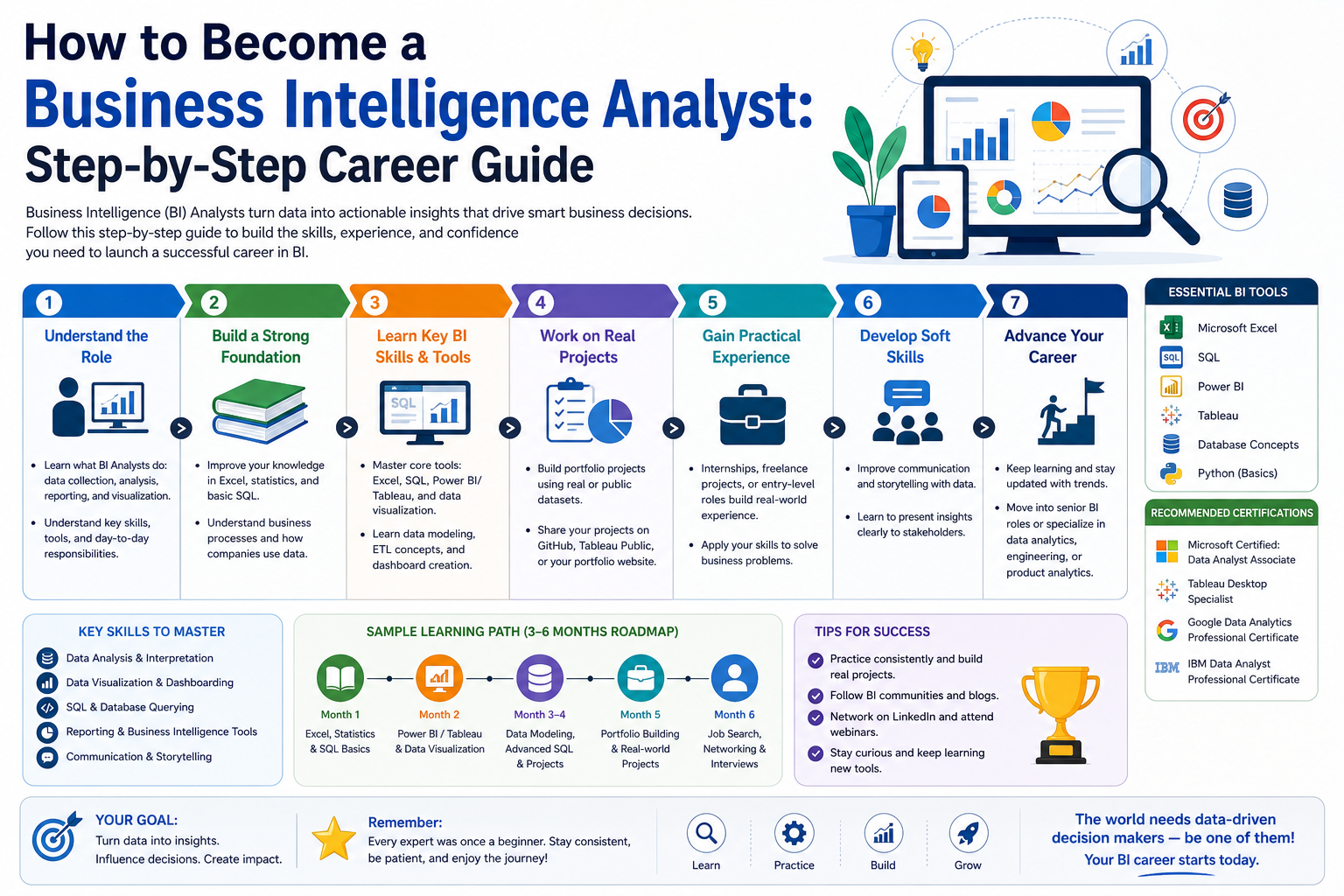
Business intelligence is one of the most important capabilities shaping how organizations operate today. At its core, it refers to the process of collecting, organizing, analyzing, and transforming raw data into meaningful insights that support decision-making. While the term might sound highly technical, its purpose is very practical: helping businesses understand what is happening, why it is happening, and what should be done next.
In modern organizations, data is generated at an enormous scale. Every customer interaction, financial transaction, website visit, and internal process produces information. On its own, this data has limited value. It becomes useful only when it is structured, analyzed, and interpreted in a way that reveals patterns and trends. Business intelligence focuses on this transformation, turning scattered information into a clear narrative that supports strategic and operational decisions.
Unlike traditional reporting, which often focuses on describing what has already happened, business intelligence goes further. It helps organizations explore relationships within data and identify opportunities for improvement. This makes it a forward-looking discipline that supports planning, forecasting, and optimization across various departments.
The Evolution of Data-Driven Decision Making
The rise of business intelligence is closely connected to the evolution of data-driven decision-making. In earlier decades, many business decisions were based largely on experience, intuition, and limited reporting. Managers relied on small datasets and manual reports that were often outdated by the time they were analyzed. While this approach worked in simpler business environments, it is no longer sufficient in today’s fast-moving, highly competitive markets.
As technology advanced, organizations began storing more data than ever before. The introduction of digital systems for sales, finance, supply chain, and customer management created vast data repositories. However, having data is not the same as understanding it. Many companies found themselves “data rich but insight poor,” meaning they had access to large volumes of information but lacked the tools and expertise to interpret it effectively.
Business intelligence emerged as a solution to this challenge. It introduced structured processes and analytical methods that allowed organizations to extract meaningful insights from complex datasets. Over time, BI evolved from simple reporting tools into sophisticated platforms capable of real-time analytics, predictive modeling, and interactive dashboards.
Today, data-driven decision-making is no longer optional. It is a fundamental requirement for organizations that want to remain competitive. Business intelligence plays a central role in enabling this shift by ensuring that decisions are based on evidence rather than assumptions.
Why Business Intelligence Matters in Competitive Industries
In highly competitive industries, even small improvements in efficiency, customer satisfaction, or cost management can make a significant difference. Business intelligence helps organizations achieve these improvements by providing visibility into every aspect of their operations.
For example, in retail, BI can help identify which products are performing well, which locations are underperforming, and how customer preferences are changing over time. In healthcare, it can improve patient outcomes by analyzing treatment effectiveness and resource allocation. In finance, it can detect fraud patterns and optimize investment strategies. Across all industries, the goal remains the same: use data to make smarter and faster decisions.
One of the key advantages of business intelligence is its ability to reduce uncertainty. Instead of relying on guesswork, organizations can base their strategies on concrete evidence. This leads to more accurate forecasting, better resource allocation, and improved risk management.
Another important aspect is speed. In today’s digital environment, timing is critical. Businesses that can quickly interpret data and respond to changes in the market often gain a significant advantage. Business intelligence systems allow for real-time or near-real-time analysis, enabling organizations to react quickly to emerging trends.
The Business Intelligence Analyst as a Bridge Between Data and Strategy
At the center of the business intelligence ecosystem is the BI analyst. This role acts as a bridge between raw data and business strategy. A BI analyst is responsible for gathering data from various sources, organizing it into usable formats, analyzing it for patterns, and presenting findings in a way that decision-makers can understand.
This position is unique because it combines technical expertise with business understanding. A BI analyst must be comfortable working with databases, analytical tools, and programming languages, but they must also understand business goals, challenges, and priorities. Without this combination, data insights may remain disconnected from real-world decision-making.
The role is not limited to generating reports. Instead, BI analysts are expected to interpret data and explain what it means in a business context. For example, if sales are declining, the analyst must identify potential reasons such as changes in customer behavior, pricing issues, or market conditions. They must then communicate these insights clearly so that leadership can take appropriate action.
This makes communication an essential part of the job. A BI analyst must be able to translate complex data findings into simple, actionable insights. This often involves working closely with managers, executives, and other departments to ensure that data-driven recommendations are understood and implemented effectively.
Why IT Professionals Are Well Positioned for Business Intelligence
Many people transitioning into business intelligence come from IT backgrounds, and this shift is often a natural progression. IT professionals already possess many of the foundational skills required for BI, such as working with systems, managing data, and understanding how technology supports business operations.
One of the main advantages IT professionals have is familiarity with data structures and systems. Whether working in network administration, database management, or software development, they are already exposed to how data flows within an organization. This makes it easier to understand how to extract and analyze that data for business purposes.
Additionally, IT professionals are typically comfortable with problem-solving and technical troubleshooting. These skills are highly valuable in business intelligence, where analysts often need to clean, validate, and interpret complex datasets. The ability to identify issues within data systems and resolve them efficiently is a key part of the BI workflow.
Another important factor is adaptability. The field of IT evolves rapidly, requiring continuous learning and skill development. This mindset aligns closely with business intelligence, where tools, technologies, and analytical methods are constantly changing. Professionals who are already used to learning new systems are better prepared for a BI career transition.
The Growing Demand for Business Intelligence Professionals
The demand for business intelligence professionals has been steadily increasing across industries. As organizations continue to digitize their operations, the amount of data they generate continues to grow exponentially. However, without skilled professionals to interpret this data, its value remains limited.
Companies are now recognizing that data alone is not enough. They need individuals who can transform that data into actionable insights. This has created a strong demand for BI analysts who can help bridge the gap between raw information and strategic decision-making.
Industries such as finance, healthcare, insurance, manufacturing, and technology are particularly active in hiring BI professionals. These sectors rely heavily on data to manage risk, optimize operations, and improve customer experiences. However, business intelligence is not limited to these fields. Retail, education, logistics, and even government organizations are increasingly adopting BI practices.
Another reason for this growing demand is the increasing complexity of business environments. Organizations are no longer operating in isolated markets. They are part of global ecosystems where competition, customer behavior, and economic conditions change rapidly. In such environments, the ability to analyze data quickly and accurately becomes a critical advantage.
The Shift from Traditional IT Roles to Analytical Thinking
Transitioning from IT to business intelligence is not just about learning new tools. It also involves a shift in mindset. Traditional IT roles often focus on system stability, performance, and infrastructure management. While these are essential responsibilities, business intelligence requires a more analytical and strategic approach.
Instead of focusing solely on systems, BI professionals focus on outcomes. They ask questions such as what the data is showing, why certain patterns exist, and how these insights can be used to improve business performance. This requires curiosity and a willingness to explore beyond technical execution.
Analytical thinking plays a central role in this transition. BI analysts must be able to break down complex problems into smaller components, identify relationships between variables, and draw logical conclusions based on evidence. This type of thinking is different from purely technical troubleshooting, as it involves interpretation rather than just resolution.
At the same time, business awareness becomes increasingly important. Understanding how different departments operate, what their goals are, and what challenges they face allows BI professionals to provide more relevant and impactful insights. Without this context, even accurate data analysis may fail to deliver meaningful business value.
How Organizations Use Business Intelligence in Practice
In practice, business intelligence is integrated into nearly every part of an organization. It supports decision-making at both strategic and operational levels. At the executive level, BI helps leadership teams understand overall performance, market trends, and long-term opportunities. At the operational level, it helps managers monitor daily activities, track performance metrics, and identify inefficiencies.
One common use of business intelligence is performance tracking. Organizations define key performance indicators and use BI tools to monitor progress over time. This allows them to quickly identify whether they are meeting their goals or falling behind.
Another important use is customer analysis. By studying customer behavior, preferences, and feedback, organizations can improve their products and services. This leads to better customer satisfaction and increased loyalty.
Business intelligence is also widely used in risk management. By analyzing historical data and identifying patterns, organizations can anticipate potential risks and take preventive actions. This is particularly important in industries where financial or operational risks can have significant consequences.
Supply chain optimization is another area where BI plays a critical role. By analyzing inventory levels, supplier performance, and demand trends, organizations can improve efficiency and reduce costs.
Across all these applications, the common theme is the same: using data to make better decisions.
Building the Core Skill Set for a Business Intelligence Career Transition
Moving into a business intelligence role requires more than a surface-level understanding of data. It involves building a structured skill set that combines technical abilities, analytical thinking, and business awareness. For professionals coming from IT backgrounds, many of these skills already exist in partial form, but they need to be refined and redirected toward data analysis and decision support.
A strong BI analyst is not defined by a single tool or technology. Instead, they are defined by their ability to connect data with meaning. This means understanding how information flows through systems, how it can be transformed, and how it ultimately influences business decisions. Developing this capability takes time, practice, and exposure to real-world datasets.
One of the most important shifts in skill development is moving from system maintenance to insight generation. In traditional IT roles, success is often measured by system uptime, performance stability, or successful deployments. In business intelligence, success is measured by how effectively data supports decision-making and improves business outcomes.
Strengthening Data Literacy and Analytical Thinking
Data literacy is the foundation of business intelligence. It refers to the ability to read, understand, interpret, and communicate data effectively. Without strong data literacy, even advanced technical tools lose their value. BI professionals must be comfortable working with numbers, patterns, trends, and statistical relationships.
Analytical thinking is closely tied to data literacy. It involves breaking down complex problems into smaller parts and identifying relationships between different data points. Instead of accepting data at face value, a BI analyst asks questions such as what is happening, why it is happening, and what might happen next.
This mindset is essential in business intelligence because data rarely provides clear answers on its own. It must be interpreted in context. For example, a sudden drop in sales could be caused by seasonal changes, pricing issues, supply chain disruptions, or shifts in customer behavior. An analyst must be able to investigate these possibilities using data.
Developing analytical thinking often involves practice with real datasets. The more exposure a professional has to different types of data problems, the more intuitive their analysis becomes. Over time, patterns begin to emerge more naturally, and decision-making becomes faster and more accurate.
Understanding Data Sources and Data Flow in Organizations
Before analyzing data, it is important to understand where it comes from and how it moves within an organization. Businesses typically collect data from multiple sources, including customer interactions, sales systems, financial records, marketing platforms, and operational tools.
This data does not usually exist in a single, unified format. Instead, it is spread across different systems that may not naturally communicate with each other. One of the key responsibilities in business intelligence is to bring this data together in a consistent and usable form.
Understanding data flow helps BI professionals identify where information is generated, how it is stored, and how it can be accessed. This includes knowledge of databases, data warehouses, and data pipelines. Each of these components plays a role in ensuring that data is available for analysis.
In many organizations, data is continuously updated. This means BI systems must be designed to handle both historical and real-time information. Analysts need to understand how data freshness impacts decision-making. For example, real-time data may be critical for fraud detection, while historical data may be more useful for trend analysis.
The Role of SQL in Business Intelligence Work
Structured Query Language is one of the most important technical skills for any BI analyst. It is used to retrieve, manipulate, and manage data stored in relational databases. Even though many modern BI tools offer visual interfaces, SQL remains the backbone of data extraction.
In business intelligence, SQL is used to query large datasets, combine information from multiple tables, filter results, and perform aggregations. It allows analysts to transform raw data into structured outputs that can be used for reporting and visualization.
One of the key advantages of SQL is its ability to handle large volumes of data efficiently. Instead of manually processing information, analysts can write queries that extract exactly what they need. This makes data analysis faster and more scalable.
Beyond basic queries, BI professionals often use more advanced SQL techniques such as joins, subqueries, and window functions. These techniques allow for deeper analysis and more complex data relationships.
For IT professionals, especially those with database experience, SQL is often a familiar starting point. However, in business intelligence, the focus shifts from database administration to insight generation. This means using SQL not just to manage data, but to answer business questions.
Introduction to Data Modeling and Structured Data Design
Data modeling is another essential concept in business intelligence. It refers to the process of organizing data in a way that makes it easier to analyze. A well-designed data model ensures that information is structured logically and consistently across different systems.
In BI environments, data modeling often involves designing tables, defining relationships between datasets, and ensuring data integrity. The goal is to create a structure that supports efficient querying and reporting.
One common approach is dimensional modeling, which organizes data into facts and dimensions. Fact tables contain measurable data such as sales or revenue, while dimension tables contain descriptive information such as customers, products, or time periods.
Understanding data modeling helps BI analysts interpret datasets more effectively. Instead of viewing data as isolated records, they can understand how different pieces of information are connected. This leads to more accurate analysis and better insights.
Data modeling also plays a role in performance optimization. Poorly structured data can slow down queries and make analysis inefficient. A strong understanding of modeling principles allows analysts to design systems that are both functional and efficient.
The Importance of Data Cleaning and Preparation
One of the most time-consuming aspects of business intelligence work is data preparation. Raw data is often incomplete, inconsistent, or poorly structured. Before analysis can begin, it must be cleaned and transformed into a usable format.
Data cleaning involves identifying and correcting errors, removing duplicates, handling missing values, and standardizing formats. This process is essential because inaccurate data leads to unreliable insights.
For example, if customer records contain inconsistent naming formats or missing values, it becomes difficult to analyze customer behavior accurately. Similarly, inconsistent date formats can disrupt time-based analysis.
Data preparation also includes transforming data into a structure suitable for analysis. This may involve aggregating values, creating calculated fields, or merging datasets from different sources.
Although data cleaning is often repetitive, it is one of the most important parts of the BI workflow. High-quality analysis depends on high-quality data. Without proper preparation, even the most advanced analytical tools cannot produce meaningful results.
Working with Data Visualization and Reporting Tools
Once data has been cleaned and structured, it must be presented in a way that is easy to understand. This is where data visualization becomes essential. Visualization tools help transform complex datasets into charts, graphs, and dashboards that communicate insights clearly.
Business intelligence professionals use visualization not just for presentation, but for exploration. By visualizing data, patterns and trends become easier to identify. This allows analysts to quickly spot anomalies, correlations, and opportunities.
Dashboards are a common output of BI work. They provide a centralized view of key metrics and allow users to monitor performance in real time. A well-designed dashboard focuses on clarity and usability, ensuring that decision-makers can quickly understand the information presented.
Effective visualization requires more than technical skill. It also requires an understanding of human perception and communication. The goal is not to display as much data as possible, but to highlight the most important insights.
Different types of visualizations are used for different purposes. Line charts are useful for trends over time, bar charts for comparisons, and scatter plots for relationships between variables. Choosing the right visualization is an important part of effective communication.
Business Understanding and Domain Knowledge Development
While technical skills are important, business intelligence is ultimately about solving business problems. This requires a strong understanding of how organizations operate and what they are trying to achieve.
Domain knowledge refers to understanding the specific industry or business area in which data is being analyzed. For example, BI work in healthcare differs significantly from BI work in retail or finance. Each industry has its own metrics, challenges, and priorities.
Developing business understanding allows analysts to ask better questions. Instead of simply analyzing data, they can focus on what matters most to the organization. This leads to more relevant and impactful insights.
For example, in a retail environment, understanding concepts like inventory turnover, customer lifetime value, and sales conversion rates is essential. In finance, knowledge of risk exposure, portfolio performance, and market trends becomes more important.
Business understanding also helps in communication. BI analysts often need to explain findings to non-technical stakeholders. Having domain knowledge makes it easier to translate data insights into business language.
Transitioning from Technical Execution to Insight Delivery
One of the biggest changes when moving into business intelligence is the shift from execution-focused work to insight-focused work. In many IT roles, success is measured by completing technical tasks efficiently and accurately. In BI, success is measured by how well data supports decision-making.
This shift requires a change in perspective. Instead of focusing on how to build a system or fix an issue, BI professionals focus on what the data means and how it can be used. This involves interpreting results, identifying patterns, and making recommendations.
Insight delivery is not just about producing reports. It is about telling a story with data. This means structuring information in a way that highlights key findings and explains their significance.
Strong BI professionals are able to connect technical analysis with business outcomes. They do not just show what the data says; they explain why it matters and what actions should be taken.
Preparing for Real-World Business Intelligence Challenges
In real-world environments, business intelligence work is rarely straightforward. Data is often messy, systems are complex, and business requirements can change frequently. BI professionals must be able to adapt to these challenges.
One common challenge is working with incomplete or inconsistent data. In such cases, analysts must decide how to handle missing information without compromising the integrity of their analysis.
Another challenge is balancing speed and accuracy. Businesses often need insights quickly, but rushed analysis can lead to errors. BI professionals must find a balance between delivering timely insights and maintaining data quality.
Communication challenges are also common. Different stakeholders may have different expectations or interpretations of data. BI analysts must be able to manage these expectations and ensure that insights are clearly understood.
As organizations become more data-driven, the role of business intelligence continues to grow in complexity. This makes adaptability, continuous learning, and problem-solving essential traits for long-term success in the field.
Advanced Tools and Technologies Shaping Modern Business Intelligence
Business intelligence today is powered by a wide ecosystem of tools and technologies that enable organizations to process, analyze, and visualize data at scale. While earlier BI systems were often limited to static reporting, modern environments are dynamic, interactive, and deeply integrated with business operations. Understanding these tools is essential for anyone transitioning into a BI analyst role, especially those coming from IT backgrounds.
At the center of this ecosystem are platforms designed for data visualization, reporting, and dashboard creation. These tools allow analysts to transform raw datasets into visual insights that decision-makers can easily interpret. Instead of reading rows of numbers, stakeholders can explore trends through interactive charts, graphs, and performance indicators.
Alongside visualization tools, database systems and data warehouses remain critical. They store structured and historical data that forms the backbone of analysis. These systems are designed to handle large volumes of information efficiently, ensuring that BI professionals can access reliable data when needed.
In addition to storage and visualization, modern business intelligence relies heavily on data integration tools. These tools help combine data from multiple sources into a unified format. Since organizations often use different systems for sales, finance, marketing, and operations, integration ensures that all relevant information can be analyzed together.
Another growing area is cloud-based BI infrastructure. Cloud platforms allow organizations to scale their data systems quickly without investing heavily in physical hardware. This flexibility is particularly important in environments where data volumes are constantly increasing.
The Expanding Role of Data Visualization in Decision-Making
Data visualization has become one of the most powerful components of business intelligence. It transforms complex datasets into visual formats that are easier to understand and interpret. This is especially important in organizations where decision-makers may not have technical backgrounds but still need to understand data insights.
Visualization is not just about creating attractive charts. It is about communicating meaning. A well-designed visualization highlights patterns, trends, and relationships that might not be obvious in raw data. It allows users to quickly grasp key insights without needing to analyze large datasets manually.
In business intelligence, dashboards play a central role in visualization. A dashboard is a collection of visual elements that provide a real-time overview of important metrics. These can include sales performance, customer behavior, operational efficiency, or financial indicators.
Effective dashboards are designed with clarity and focus in mind. They avoid unnecessary complexity and emphasize the most important information. This ensures that users can quickly identify changes, anomalies, or opportunities.
Visualization also supports exploratory analysis. BI professionals often use visual tools to investigate data and discover hidden patterns. By interacting with visual elements, they can drill down into specific details and refine their analysis.
Understanding Modern BI Architecture and Data Flow Systems
Behind every business intelligence system is a structured architecture that defines how data is collected, processed, stored, and delivered. Understanding this architecture is essential for BI analysts because it helps them know where data comes from and how it can be used effectively.
At a high level, BI architecture consists of several layers. The first layer involves data sources, which include operational systems, external platforms, and real-time data streams. These sources generate raw data that must be processed before analysis.
The next layer involves data integration and transformation. This is where data is cleaned, standardized, and combined from different sources. The goal is to create a consistent dataset that can be used for reporting and analysis.
After transformation, data is stored in centralized repositories such as data warehouses or data lakes. These systems are optimized for querying and analysis rather than transaction processing. They allow BI tools to access large volumes of structured data efficiently.
The final layer is the presentation layer, where data is accessed through dashboards, reports, and visualization tools. This is the layer most visible to business users and decision-makers.
Understanding this flow helps BI professionals troubleshoot issues, optimize performance, and design better analytical solutions. It also provides context for how data moves through an organization, which is essential for accurate analysis.
The Importance of Data Governance and Data Quality Management
As organizations rely more heavily on data, ensuring its accuracy and consistency becomes increasingly important. Data governance refers to the policies, processes, and standards that ensure data is managed properly throughout its lifecycle.
Data quality management is a key part of governance. It focuses on ensuring that data is accurate, complete, consistent, and reliable. Poor data quality can lead to incorrect insights, which in turn can result in poor business decisions.
BI professionals often play a role in maintaining data quality. This includes identifying inconsistencies, validating datasets, and working with IT teams to resolve data issues. Without proper governance, even the most advanced analytics systems can produce misleading results.
One of the challenges in data governance is maintaining consistency across multiple systems. Since organizations often use different platforms for different functions, data can become fragmented. Governance frameworks help ensure that data definitions and standards are aligned across the organization.
Another important aspect is data security and compliance. Organizations must ensure that sensitive information is protected and used in accordance with legal and regulatory requirements. BI systems must therefore balance accessibility with security.
The Growing Influence of Artificial Intelligence in Business Intelligence
Artificial intelligence is increasingly being integrated into business intelligence systems. While traditional BI focuses on describing what has happened, AI-enhanced BI can also predict what is likely to happen in the future.
Machine learning algorithms can analyze large datasets and identify patterns that are not immediately visible to human analysts. These models can be used for forecasting, customer segmentation, anomaly detection, and recommendation systems.
For example, predictive analytics can help businesses forecast sales trends based on historical data. Similarly, classification models can help identify customer groups with similar behaviors or preferences.
AI also enhances automation in business intelligence. Routine tasks such as data cleaning, report generation, and anomaly detection can be automated, allowing analysts to focus on higher-level analysis and interpretation.
However, AI does not replace the role of BI analysts. Instead, it enhances their capabilities. Human judgment is still required to interpret results, validate models, and ensure that insights align with business context.
Understanding AI concepts is becoming increasingly important for BI professionals. While deep expertise in machine learning is not always required, familiarity with basic concepts such as regression, clustering, and classification can be highly beneficial.
Communication and Storytelling with Data
One of the most overlooked but critical skills in business intelligence is communication. BI analysts must be able to explain complex data insights in a way that is understandable to non-technical audiences.
Data storytelling is the process of combining data, visuals, and narrative to communicate insights effectively. It goes beyond simply presenting charts or numbers. Instead, it creates a structured explanation of what the data means and why it matters.
A strong data story typically includes context, analysis, and interpretation. It begins by explaining the problem or question being addressed. It then presents the data analysis and highlights key findings. Finally, it explains the implications of those findings for business decisions.
Effective communication also involves tailoring the message to the audience. Executives may be interested in high-level summaries, while operational teams may require more detailed analysis. BI professionals must adjust their communication style accordingly.
Visualization plays an important role in storytelling. Well-designed visuals help reinforce the narrative and make insights more memorable. However, visuals alone are not enough. They must be supported by clear explanations.
Collaboration Between BI Analysts and Business Teams
Business intelligence is inherently collaborative. BI analysts do not work in isolation; they work closely with business stakeholders across different departments. This includes marketing teams, finance departments, operations managers, and executive leadership.
Collaboration begins with understanding business requirements. Analysts must work with stakeholders to define what questions need to be answered and what metrics are most important. This ensures that analysis is aligned with business goals.
Throughout the analysis process, communication remains essential. Stakeholders may provide feedback, clarify requirements, or request additional insights. BI professionals must be able to adapt to these changing needs while maintaining analytical accuracy.
Collaboration also involves educating business users about data. Not all stakeholders are familiar with analytical concepts, so BI analysts often play a role in helping teams understand how to interpret data correctly.
In many organizations, BI acts as a bridge between technical teams and business teams. This requires strong interpersonal skills and the ability to translate between technical language and business terminology.
Challenges Faced in Business Intelligence Roles
While business intelligence offers many opportunities, it also comes with challenges. One common challenge is dealing with complex and inconsistent data environments. Organizations often have multiple systems that store data in different formats, making integration difficult.
Another challenge is managing expectations. Business stakeholders may expect immediate answers, but data analysis often requires time, especially when dealing with large or incomplete datasets.
BI professionals also face challenges related to data accuracy. If underlying data is flawed, it can lead to incorrect conclusions. Ensuring data quality is therefore an ongoing responsibility.
Technical challenges are also common. BI systems must handle large volumes of data efficiently, which requires optimization and careful system design. Performance issues can arise when queries are poorly structured or datasets are too large.
Additionally, keeping up with rapidly evolving tools and technologies can be demanding. The BI landscape changes frequently, and professionals must continuously update their skills to remain effective.
Career Growth and Long-Term Opportunities in Business Intelligence
Business intelligence offers a wide range of career growth opportunities. As professionals gain experience, they can move into more specialized or senior roles. These may include senior BI analyst, data analyst, analytics manager, or data strategist positions.
With further development, BI professionals may transition into related fields such as data science, data engineering, or business analytics leadership. Each of these paths builds on core BI skills but focuses on different aspects of data work.
Career progression in BI is often driven by a combination of technical expertise and business understanding. Professionals who can demonstrate both strong analytical skills and strategic thinking are particularly valuable to organizations.
Over time, BI analysts may also take on more leadership responsibilities. This includes guiding data strategy, managing teams, and influencing organizational decision-making at a higher level.
The long-term outlook for business intelligence remains strong as organizations continue to rely on data for competitive advantage. As data volumes grow and analytical technologies advance, the demand for skilled BI professionals is expected to remain consistently high.
Emerging Trends Transforming the Future of Business Intelligence
Business intelligence is no longer a static discipline built around fixed reports and historical analysis. It is evolving into a dynamic, real-time ecosystem that continuously adapts to business needs. One of the most important trends shaping this evolution is the shift toward real-time analytics. Organizations are increasingly demanding immediate insights rather than waiting for scheduled reports. This allows decision-makers to respond instantly to market changes, customer behavior shifts, or operational issues.
Real-time BI systems rely on streaming data pipelines that process information as it is generated. This is particularly important in industries such as e-commerce, logistics, and financial services, where delays in decision-making can lead to missed opportunities or increased risk. As a result, BI analysts must now understand not only static datasets but also continuously flowing data environments.
Another major trend is the increased use of self-service analytics. Traditionally, data analysis was handled exclusively by technical teams. However, modern BI tools now allow business users to explore data independently without needing deep technical knowledge. This shift empowers organizations to make faster decisions but also places new responsibilities on BI professionals.
Instead of simply generating reports, BI analysts are now responsible for designing systems that are intuitive, reliable, and accessible to non-technical users. This includes creating dashboards that are easy to navigate, defining clear metrics, and ensuring that data definitions are consistent across the organization. In this environment, BI professionals act more like enablers of data access rather than gatekeepers.
The Expanding Impact of Cloud-Based Business Intelligence
Cloud computing has fundamentally changed how business intelligence systems are built and deployed. In traditional environments, BI infrastructure required significant investment in physical servers, storage systems, and maintenance. Today, cloud-based BI platforms offer scalable, flexible, and cost-effective alternatives.
One of the key advantages of cloud-based BI is scalability. Organizations can easily expand their data storage and processing capabilities as their data grows. This is particularly important in a world where data volumes are increasing rapidly due to digital transformation, IoT devices, and online platforms.
Cloud environments also improve collaboration. Since data and BI tools are accessible from anywhere, teams across different locations can work together more effectively. This supports global organizations that rely on distributed teams and remote work environments.
Another important benefit is faster deployment. Cloud-based BI solutions can be implemented much more quickly than traditional systems. This allows organizations to start analyzing data sooner and respond more quickly to business needs.
For BI professionals, cloud computing introduces new skills and responsibilities. They must understand cloud architecture, data storage models, and security considerations. While the core principles of business intelligence remain the same, the technical environment continues to evolve.
Increasing Importance of Data Ethics and Responsible Analytics
As business intelligence becomes more powerful, the importance of ethical data use is also growing. Organizations now collect vast amounts of personal and behavioral data, which raises concerns about privacy, transparency, and fairness.
Data ethics refers to the responsible collection, storage, and use of data. BI professionals must ensure that data is used in ways that respect user privacy and comply with regulations. This includes being transparent about how data is collected and how it is used in decision-making processes.
Bias in data analysis is another important issue. If datasets contain biases, the insights generated from them may also be biased. This can lead to unfair or inaccurate conclusions. BI analysts must be aware of these risks and take steps to minimize them by carefully evaluating data sources and methodologies.
Responsible analytics also involves ensuring that data-driven decisions do not harm individuals or communities. As organizations increasingly rely on automated insights, the human responsibility behind interpretation and decision-making becomes even more important.
Conclusion
Business intelligence has become one of the most important disciplines in the modern data-driven world. As organizations continue to generate vast amounts of information from digital systems, the ability to transform that data into meaningful insights has shifted from a competitive advantage to a business necessity. BI professionals sit at the center of this transformation, bridging the gap between raw data and strategic decision-making.
For professionals coming from IT backgrounds, the transition into business intelligence is both practical and rewarding. Many foundational skills such as working with databases, understanding systems, and solving technical problems already provide a strong starting point. What changes is the focus—from maintaining systems to interpreting data and influencing business outcomes.
Throughout this field, success depends on a balanced combination of technical ability and business understanding. Skills such as SQL, data modeling, and visualization tools are essential, but they must be paired with analytical thinking, communication, and awareness of organizational goals. Without this balance, data remains isolated and fails to create value.
As business intelligence continues to evolve, it is being shaped by real-time analytics, cloud technologies, artificial intelligence, and self-service tools. These advancements are making data more accessible and insights faster, but they are also increasing the expectations placed on BI professionals. The role is becoming more strategic, more collaborative, and more integrated into business decision-making processes.
At its core, business intelligence is about clarity. It helps organizations move beyond assumptions and make decisions based on evidence. Whether improving customer experience, optimizing operations, or identifying new opportunities, BI ensures that decisions are informed and purposeful.
As industries continue to grow more competitive and data-rich, the demand for skilled BI professionals will remain strong. Those who develop both technical expertise and business insight will be well-positioned to shape the future of data-driven organizations.