Learning has never been a fixed concept. It evolves alongside how people live, work, and interact with information. In earlier decades, learning was largely structured, formal, and separated from daily tasks. People were expected to absorb knowledge first and apply it later. This separation created a clear boundary between training time and working time.
In traditional environments, learning often meant sitting in classrooms, attending scheduled sessions, or reading long manuals before being allowed to perform tasks independently. The assumption behind this model was simple: once people are trained, they are ready to work. However, in practice, the gap between training and application often created challenges. Knowledge that was not immediately used tended to fade, and workers frequently found themselves struggling to recall what they had learned when they actually needed it.
As work environments became more digital, fast-paced, and information-heavy, this separation between learning and doing started to feel increasingly inefficient. Employees needed answers faster. Tasks became more complex. Systems changed more frequently. In this environment, waiting for scheduled training was no longer practical.
This shift in workplace reality set the stage for a new learning approach—one where learning becomes embedded directly into the work process itself rather than existing as a separate activity.
What Learning in the Flow of Work Really Means
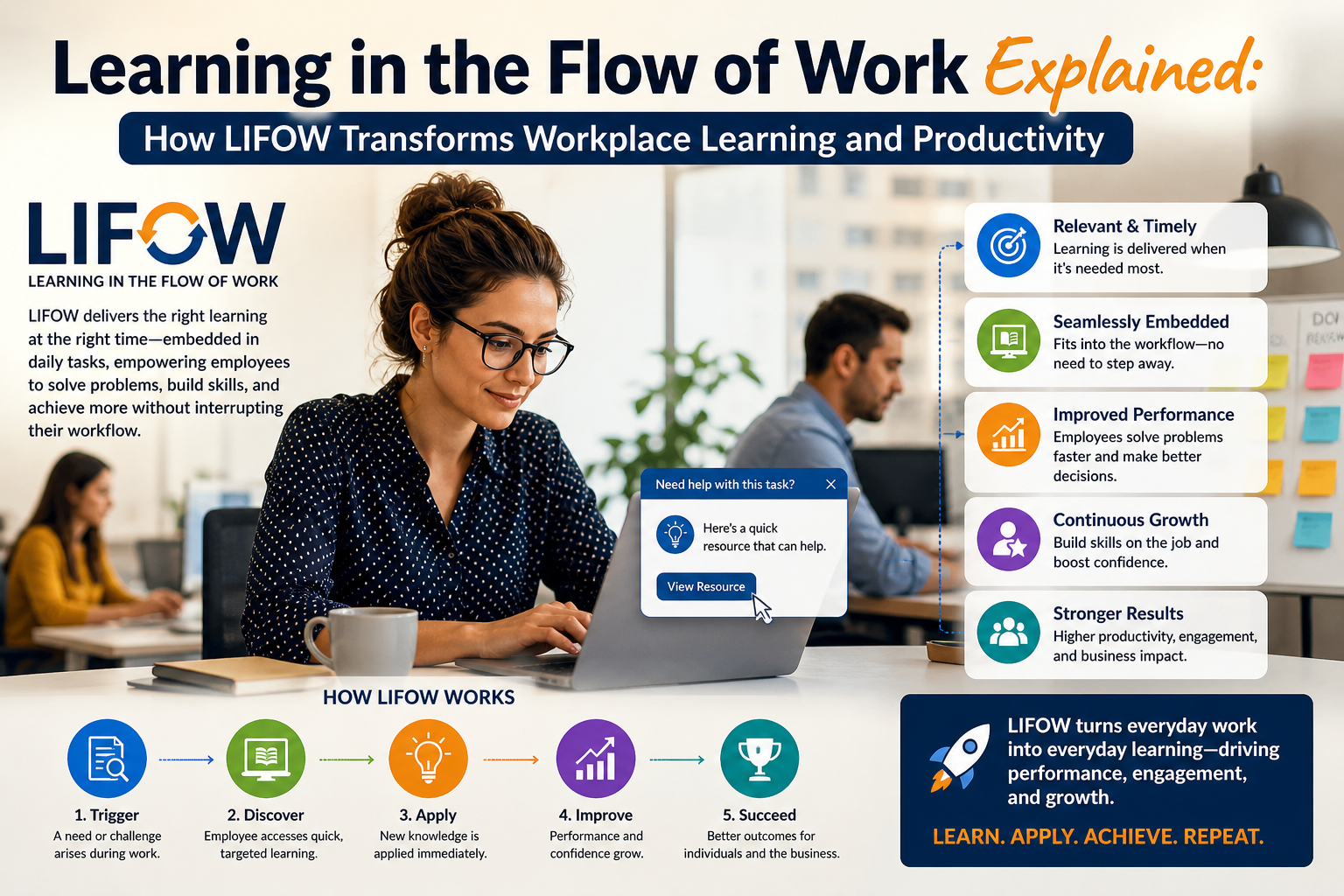
Learning in the flow of work is an approach where individuals acquire knowledge and skills while actively performing their tasks. Instead of stepping away from work to learn something new, learning happens at the exact moment a need arises.
This approach treats learning as a continuous, integrated process rather than a separate event. It is not about replacing structured training completely but about complementing it with real-time support and contextual knowledge.
At its core, this learning model is based on a simple idea: people learn best when the information is directly relevant to what they are doing right now. When someone encounters a challenge during work, they can immediately access the guidance they need, apply it instantly, and continue their task without interruption.
This can take many forms. It may be a short instructional prompt that appears within a tool, a quick search that provides a precise answer, or a brief explanation embedded within a workflow system. The key characteristic is immediacy—learning happens in the moment of need.
This model transforms learning from something scheduled and abstract into something practical and situational. It aligns knowledge acquisition directly with action, creating a seamless connection between understanding and execution.
Why Traditional Learning Models Fall Short in Modern Work Environments
Traditional learning models were designed for a different era of work. In those environments, tasks were more predictable, job roles were more stable, and changes in tools or processes occurred less frequently. Under those conditions, structured learning sessions made sense.
However, modern workplaces are defined by constant change. Tools are updated regularly, industries evolve quickly, and employees are often required to adapt to new processes on the fly. In such environments, learning that is disconnected from immediate tasks becomes less effective.
One of the key limitations of traditional learning is the delay between learning and application. When knowledge is acquired but not used immediately, it begins to fade. Human memory is not designed for long-term retention without reinforcement. Without practical application, much of what is learned in structured settings is lost over time.
Another limitation is the lack of context. Traditional training often presents information in a generalized form, without the specific conditions in which it will be used. As a result, learners may understand concepts theoretically but struggle to apply them in real-world situations.
Additionally, scheduled learning requires time away from productive work. This creates a tension between learning and performance. Employees must pause their tasks to attend training sessions, which can disrupt workflow and reduce efficiency.
These limitations highlight the need for a more integrated approach, where learning and work are not separate but interconnected.
The Core Idea Behind Contextual Learning
Contextual learning is the foundation of learning in the flow of work. It emphasizes the importance of learning within the environment where knowledge will be applied.
Instead of learning abstract concepts in isolation, individuals learn in direct relation to the task they are performing. This means that the context of the task shapes the learning experience.
For example, rather than studying a general guide on how to solve a problem, a worker encounters the problem during their task and accesses specific instructions tailored to that exact situation. The learning is not hypothetical—it is directly tied to real action.
This approach improves relevance significantly. When information is delivered in context, it becomes easier to understand and remember. The brain naturally connects new knowledge to existing experiences, especially when those experiences are active and meaningful.
Contextual learning also reduces cognitive overload. Instead of absorbing large amounts of information at once, individuals receive smaller, targeted pieces of knowledge exactly when needed. This makes learning more manageable and less overwhelming.
The Role of Cognitive Science in Flow-Based Learning
The effectiveness of learning in the flow of work is closely connected to how human memory functions. Cognitive science has shown that information retention is strongly influenced by timing, relevance, and repetition.
One well-known concept is the forgetting curve, which demonstrates how quickly newly learned information fades without reinforcement. In many cases, a significant portion of new knowledge is lost within a short period if it is not used.
This is where immediate application becomes crucial. When learning is applied right after it is acquired, the brain forms stronger memory connections. The act of using knowledge reinforces it, making it more likely to be retained over time.
Another important principle is cognitive load. The human brain has a limited capacity for processing new information at any given moment. When too much information is presented at once, comprehension decreases.
Learning in the flow of work reduces this burden by delivering information in small, relevant portions. Instead of overwhelming learners with large volumes of content, it provides targeted guidance that aligns with the current task.
Attention also plays a significant role. People are more likely to pay attention to information that is directly relevant to what they are doing. When learning is embedded within a task, attention is naturally focused, improving understanding and retention.
How Work Environments Influence Learning Behavior
Modern work environments are highly dynamic. Employees frequently switch between tasks, tools, and communication channels throughout the day. This constant movement creates fragmented attention and reduces the effectiveness of long, uninterrupted training sessions.
In such environments, learning must be flexible and adaptive. It must fit into the natural rhythm of work rather than requiring dedicated blocks of time.
Digital tools have significantly changed how work is performed. Many tasks now involve software platforms, online systems, and collaborative tools. This creates opportunities for learning to be integrated directly into these systems.
For example, guidance can appear within the interface of a tool, eliminating the need to search for external instructions. This reduces interruptions and allows learning to happen seamlessly within the workflow.
Another important factor is the increasing complexity of roles. Employees are often expected to perform a wider range of tasks than before. This requires continuous learning rather than one-time training sessions.
Learning in the flow of work supports this need by providing ongoing access to knowledge. Instead of learning everything in advance, individuals acquire knowledge as new challenges arise.
The Principle of Just-in-Time Learning
Just-in-time learning is a key concept within the flow-based learning model. It refers to the delivery of information exactly when it is needed, rather than beforehand.
This approach mirrors how people naturally solve problems. When faced with a challenge, individuals often seek immediate answers rather than relying on previously memorized information.
Just-in-time learning improves efficiency because it eliminates unnecessary preparation. Instead of learning everything in advance, individuals focus only on what is relevant to their current situation.
It also enhances motivation. When learning is directly tied to immediate needs, it feels more meaningful. People are more engaged when they can see the direct impact of what they are learning.
This model also reduces wasted effort. In traditional systems, individuals may spend time learning material that they may never use. In contrast, just-in-time learning ensures that effort is focused only on relevant knowledge.
Integration of Learning into Daily Workflow Systems
One of the defining features of learning in the flow of work is its integration into everyday tools and systems. Rather than existing as a separate platform, learning becomes part of the work environment itself.
This integration can occur in multiple ways. It may involve embedded guidance within software applications, contextual prompts that appear during tasks, or searchable knowledge bases that are accessible without leaving the workflow.
The goal is to minimize disruption. When learning is integrated into tools that people already use, there is no need to switch contexts or pause work for extended periods.
This approach also supports consistency. When knowledge is embedded within systems, it becomes standardized and accessible to everyone in the same way. This reduces variation in how tasks are performed and improves overall alignment across teams.
Another advantage is scalability. As organizations grow, maintaining consistent training becomes more challenging. Integrated learning systems allow knowledge to be distributed more efficiently across large groups of people.
Microlearning and Its Relationship with Flow-Based Learning
Microlearning is closely connected to learning in the flow of work. It involves breaking down complex information into small, focused segments that can be consumed quickly.
These short learning units are easier to absorb and retain. They align well with the natural attention patterns of individuals working in fast-paced environments.
Microlearning works effectively within workflow systems because it provides just enough information to solve a specific problem without overwhelming the learner.
When combined with contextual delivery, microlearning becomes even more powerful. Instead of studying a full course, individuals access small pieces of information exactly when they need them.
This combination supports continuous learning without interrupting productivity. It allows knowledge to be built gradually over time through repeated exposure and application.
The Psychological Shift from Learning Before Work to Learning During Work
One of the most significant changes introduced by learning in the flow of work is psychological. It changes how people perceive learning itself.
In traditional models, learning is often seen as something that must be completed before work can begin. This creates a mental separation between being a learner and being a worker.
Flow-based learning removes this separation. It frames learning as an ongoing part of work itself rather than a prerequisite.
This shift reduces pressure on individuals to memorize large amounts of information in advance. Instead, they can rely on accessible support during tasks.
It also encourages curiosity. When information is readily available, individuals are more likely to explore and learn in response to real challenges.
Over time, this creates a culture where learning becomes a natural and continuous part of work rather than a separate obligation.
Early Examples of Embedded Learning in Digital Workspaces
Even before the term learning in the flow of work became widely used, many digital systems began incorporating elements of this approach.
Software applications started introducing tooltips, guided instructions, and contextual help features. These small elements provided immediate support without requiring users to leave the application.
Search functions within platforms also evolved to deliver more precise and contextual answers. Instead of broad documentation, users could access specific guidance related to their current task.
Collaboration tools began enabling informal knowledge sharing through conversations and shared documentation. This allowed learning to happen organically during work interactions.
Over time, these features became more sophisticated, laying the foundation for fully integrated learning experiences within workflows.
These early developments demonstrate a clear trend: learning is gradually moving closer to where work actually happens.
The Technological Backbone of Learning in the Flow of Work
The shift toward learning in the flow of work is not driven by a single tool or platform. It is the result of a broader technological ecosystem that has gradually evolved to support real-time access to knowledge. Modern work environments are now shaped by interconnected systems that allow information to move quickly, appear contextually, and adapt to user needs without disrupting ongoing tasks.
At the center of this ecosystem are digital work platforms that combine communication, documentation, automation, and knowledge access in a single environment. These systems reduce the distance between work and learning by embedding knowledge directly into operational tools. Instead of separating learning into a distinct environment, information becomes part of the same interface where work is performed.
Cloud-based infrastructure has also played a critical role in this transformation. Because data is no longer confined to local systems, knowledge can be updated continuously and accessed from anywhere. This enables organizations to maintain living knowledge systems that evolve in real time rather than static repositories that become outdated.
Another key component is integration technology. Modern systems are increasingly connected through APIs and automated workflows. This connectivity allows information to flow between platforms, ensuring that relevant knowledge appears in the right place at the right time. As a result, learning becomes less about searching for information and more about receiving it automatically within the flow of activity.
Together, these technological foundations create an environment where learning is no longer separate from work but embedded within it at every stage.
AI as a Real-Time Knowledge Layer
Artificial intelligence has become one of the most influential forces enabling learning in the flow of work. It functions as a dynamic knowledge layer that sits on top of existing systems and interprets user needs in real time.
Unlike traditional information systems that require users to actively search for answers, AI systems can anticipate needs based on context. They analyze patterns in behavior, task structure, and workflow history to provide relevant information without explicit requests. This transforms learning from a reactive process into a proactive one.
One of the most important capabilities of AI in this context is natural language understanding. Instead of requiring users to navigate complex menus or search through documentation, AI allows them to ask questions in everyday language. This reduces friction and makes knowledge more accessible, especially in high-pressure situations where speed matters.
AI also plays a significant role in summarizing complex information. In many work environments, the volume of available data is overwhelming. AI systems can distill large documents, technical instructions, or procedural guidelines into concise, actionable insights. This supports faster decision-making and reduces cognitive overload.
Another important function is real-time guidance. AI can observe user actions within a workflow and provide immediate suggestions or corrections. This turns everyday tasks into interactive learning experiences, where feedback is continuous and contextual.
Over time, these capabilities create a learning environment that adapts to the user rather than requiring the user to adapt to the system.
Knowledge Management Systems as Living Ecosystems
Traditional knowledge management systems were often static, relying on manually updated documents stored in centralized repositories. While useful, these systems frequently struggled with outdated information and limited accessibility.
In contrast, modern knowledge ecosystems are dynamic and continuously evolving. They are designed to capture insights as work happens and distribute them instantly across teams and tools.
In a flow-based learning environment, knowledge is not treated as a fixed asset but as a living resource. It is constantly updated through real-world application. When employees solve problems, document processes, or refine workflows, that information becomes part of the shared knowledge base.
This creates a feedback loop between work and learning. As people perform tasks, they generate knowledge. As that knowledge is shared, it improves how future tasks are performed.
Search functionality within these systems has also evolved significantly. Instead of returning long lists of documents, modern systems prioritize relevance and context. They aim to provide precise answers rather than broad information sources.
Another important development is the use of structured and unstructured data together. While traditional systems relied heavily on structured documentation, modern systems can interpret conversations, notes, and informal communication as valuable knowledge sources.
This expansion of what counts as knowledge makes learning more comprehensive and reflective of real workplace behavior.
Designing Workflows That Teach as They Operate
One of the most transformative aspects of learning in the flow of work is the idea that workflows themselves can be designed to teach. Instead of separating instruction from execution, learning becomes an inherent part of how tasks are structured.
This begins with breaking down complex processes into smaller, guided steps. Each step can include embedded explanations, prompts, or examples that help the user understand not only what to do but why it matters.
As users progress through tasks, they receive contextual cues that support decision-making. These cues are not generic instructions but specific guidance based on the current situation. This ensures that learning is always relevant to the task at hand.
Workflows can also be designed to encourage reflection. After completing a task, systems may prompt users to review outcomes, compare alternatives, or identify improvements. This reinforces learning by encouraging deeper engagement with the process.
Another important aspect is progressive complexity. Instead of exposing users to the full complexity of a task immediately, systems can gradually introduce more advanced concepts as users gain experience. This mirrors natural learning progression and reduces overwhelm.
When workflows are designed in this way, every interaction becomes an opportunity for skill development.
Personalization and Adaptive Learning Paths in Real Time
Personalization plays a central role in making learning in the flow of work effective. Different individuals have different levels of experience, learning styles, and job responsibilities. A one-size-fits-all approach is not sufficient in dynamic work environments.
Adaptive systems address this by tailoring information delivery based on user behavior and performance. Over time, these systems learn how individuals interact with tasks and adjust the level of support accordingly.
For beginners, systems may provide more detailed explanations and step-by-step guidance. For experienced users, the same system may offer concise prompts or advanced suggestions.
This adaptive approach ensures that learning remains relevant without becoming redundant or overwhelming. It also supports continuous growth by gradually increasing complexity as users become more proficient.
Personalization also extends to timing. Some users may benefit from more frequent prompts, while others may prefer minimal interruptions. Adaptive systems can adjust accordingly, optimizing the balance between support and autonomy.
By aligning learning experiences with individual needs, organizations can create more efficient and engaging learning environments.
Role of Data and Learning Analytics in Continuous Improvement
Data plays a critical role in refining learning in the flow of work. Every interaction within a system generates information about how users learn, where they struggle, and which resources are most effective.
Learning analytics uses this data to identify patterns and improve the overall learning experience. For example, if multiple users struggle with a specific task, it may indicate that additional guidance is needed within that workflow.
Analytics can also reveal which types of content are most effective in different contexts. Short prompts, visual aids, or step-by-step instructions may perform differently depending on the task environment.
Another important application of data is measuring learning progression. Instead of relying solely on formal assessments, organizations can observe how performance improves over time within real tasks.
This creates a more accurate picture of learning because it is based on actual behavior rather than isolated evaluations.
Feedback loops are also strengthened through analytics. When systems detect recurring challenges, they can automatically adjust guidance or suggest improvements to workflows.
In this way, data becomes not just a measurement tool but an active driver of learning optimization.
Organizational Culture and Behavioral Shifts Required
The successful adoption of learning in the flow of work depends heavily on organizational culture. Technology alone is not enough to create meaningful change. The way people think about learning, collaboration, and knowledge sharing must also evolve.
In traditional environments, learning is often viewed as a separate responsibility handled by specific departments or scheduled programs. In contrast, flow-based learning requires everyone to participate actively in knowledge creation and sharing.
This shift encourages a more collaborative mindset. Employees are not just consumers of knowledge but contributors to it. Their experiences, solutions, and insights become valuable resources for others.
Another cultural shift involves redefining expertise. In dynamic environments, expertise is no longer static. It is continuously updated through experience and shared across networks of people.
Organizations must also encourage openness to continuous learning. Instead of treating learning as something that ends after onboarding or formal training, it becomes an ongoing expectation embedded in daily work.
Leadership plays a key role in reinforcing these behaviors. When leaders actively participate in knowledge sharing and model learning behavior, it strengthens the overall culture.
Barriers to Implementation and How They Appear in Practice
Despite its benefits, implementing learning in the flow of work is not without challenges. One of the most common barriers is resistance to change. Employees who are accustomed to traditional training methods may initially find embedded learning unfamiliar or intrusive.
Another challenge is information overload. If not carefully designed, real-time learning systems can overwhelm users with too many prompts or suggestions. This can reduce productivity rather than enhance it.
Technical fragmentation is also a significant issue. When tools are not properly integrated, knowledge may become scattered across multiple platforms, making it difficult to access at the right time.
There is also the challenge of maintaining content quality. Because flow-based learning relies heavily on real-time information, outdated or inaccurate content can quickly lead to poor outcomes.
Additionally, organizations may struggle with defining ownership of knowledge systems. Without clear responsibility for maintaining and updating content, systems can degrade over time.
Addressing these barriers requires careful planning, strong governance, and ongoing refinement of systems based on user feedback.
Balancing Autonomy and Guidance in Embedded Learning
One of the most important design considerations in flow-based learning is the balance between autonomy and guidance. Too much guidance can create dependency, while too little can leave users unsupported.
Effective systems aim to provide support without removing decision-making responsibility. This means offering suggestions rather than instructions and allowing users to choose how to proceed.
Gradual reduction of support is also important. As users become more experienced, systems should reduce the level of guidance they provide, encouraging independent problem-solving.
At the same time, support should remain available when needed. Users should be able to access deeper explanations or assistance when facing unfamiliar challenges.
This balance ensures that learning remains empowering rather than restrictive.
Security, Accuracy, and Trust in Flow-Based Knowledge
As learning becomes more integrated into work systems, issues of security and trust become increasingly important. Users must be confident that the information they receive is accurate, relevant, and safe to use.
Data security is a key concern, especially when systems access sensitive organizational information. Proper safeguards must ensure that knowledge delivery does not compromise confidentiality.
Accuracy is equally critical. Since decisions may be made based on real-time guidance, incorrect information can have significant consequences. Continuous validation and updating of knowledge sources are essential.
Trust is built over time through consistency. When users repeatedly receive reliable and helpful information, their confidence in the system grows. Conversely, inconsistent or irrelevant guidance can quickly undermine trust.
Ensuring transparency in how information is generated and delivered also contributes to trust. Users are more likely to rely on systems when they understand how recommendations are produced.
The Evolution of Workplace Roles in Learning-Centric Systems
As learning becomes embedded in daily work, the nature of workplace roles begins to evolve. Employees are no longer defined solely by their ability to perform tasks but also by their engagement in continuous learning.
Roles become more fluid as individuals take on responsibilities that include both execution and knowledge contribution. This creates a more dynamic workforce where learning and doing are inseparable.
Managers also shift from being primarily supervisors to facilitators of learning environments. Their role includes ensuring that teams have access to the right tools, information, and support systems.
Specialized roles focused on knowledge curation and system optimization become increasingly important. These individuals help maintain the quality and relevance of embedded learning systems.
Over time, organizations become less hierarchical in terms of knowledge flow. Information moves more freely across teams, reducing silos and increasing collective capability.
The Long-Term Direction of Work-Integrated Learning
The evolution of learning in the flow of work is not a temporary trend. It represents a structural shift in how knowledge is created, distributed, and applied within modern organizations. As workplaces continue to change, the boundary between learning and working becomes increasingly indistinct.
In earlier phases of workplace development, learning was treated as preparation. Employees were trained before they were allowed to fully participate in tasks. Over time, this approach began to show limitations, particularly in environments where information changes rapidly and roles evolve continuously.
The emerging model is fundamentally different. Instead of preparing for work in advance, individuals learn through engagement with work itself. This means that learning is no longer a stage that precedes performance but an ongoing process that exists within performance.
In the long term, this shift leads to a redefinition of what it means to be skilled. Skills are no longer static achievements acquired at a single point in time. They become dynamic capabilities that are continuously refined through experience and contextual feedback.
As this model matures, organizations begin to operate more like adaptive systems. Knowledge flows continuously, adjusts in real time, and evolves based on collective experience. Learning becomes less about accumulation and more about responsiveness.
Human Cognitive Adaptation to Continuous Learning Environments
One of the most significant aspects of this transformation is how human cognition adapts to continuous learning environments. The brain is highly responsive to patterns, repetition, and contextual relevance, all of which are central to flow-based learning.
When learning is embedded into daily tasks, individuals begin to develop stronger associative memory structures. Instead of memorizing isolated facts, they build networks of understanding that connect actions, outcomes, and feedback.
Over time, this leads to improved intuition in decision-making. Individuals no longer need to consciously recall instructions for every task. Instead, they develop a sense of what to do based on accumulated contextual exposure.
This form of learning also enhances problem-solving ability. Because knowledge is continuously applied in real situations, individuals become more adept at recognizing patterns and identifying solutions quickly.
However, continuous exposure to learning stimuli also requires cognitive adaptation. The brain must learn to filter relevant information from background noise. This makes attention management a critical skill in modern work environments.
People naturally develop strategies for managing this cognitive load, such as prioritizing certain types of information, relying on trusted systems, and building mental shortcuts based on experience.
In this way, learning in the flow of work does not just change how people learn—it changes how they think.
The Increasing Role of Ambient Intelligence in Workspaces
A key development shaping the future of learning in the flow of work is the rise of ambient intelligence. This refers to systems that are embedded into the environment and respond dynamically to user behavior without requiring explicit input.
In practical terms, this means that work environments become increasingly responsive. Systems observe actions, interpret intent, and provide relevant information without interrupting workflow.
This creates a form of invisible learning support. Instead of actively seeking information, individuals receive guidance naturally as they work.
Ambient intelligence reduces friction in the learning process. It eliminates the need to switch between tools or search for information manually. This allows individuals to remain focused on tasks while still receiving continuous support.
As these systems evolve, they become more predictive. Rather than reacting to user actions, they anticipate needs based on historical patterns and contextual signals.
For example, if a user is performing a complex task that typically requires multiple steps, the system may proactively surface relevant guidance before the user encounters difficulty.
This level of integration creates a seamless learning experience where support is always present but never intrusive.
The Evolution of Knowledge from Static Content to Dynamic Systems
Traditional knowledge systems were built around static content. Documents, manuals, and training materials were created once and updated periodically. While effective in stable environments, this model struggles to keep up with rapidly changing information.
In contrast, modern knowledge systems are dynamic. They are continuously updated based on real-time input from users, systems, and workflows.
Knowledge is no longer treated as a fixed artifact. Instead, it is seen as an evolving process that reflects current organizational understanding.
This shift has profound implications for how information is structured. Rather than long, static documents, knowledge is increasingly broken into modular components that can be recombined and updated independently.
These components can be embedded directly into workflows, ensuring that users always access the most relevant and up-to-date information.
Another important change is the democratization of knowledge creation. In dynamic systems, anyone within an organization can contribute insights based on their experience.
This creates a more distributed model of knowledge ownership. Instead of relying on centralized documentation teams, knowledge emerges organically from everyday work.
Over time, this leads to richer and more accurate knowledge systems that reflect real-world practice rather than theoretical assumptions.
The Increasing Importance of Contextual Sensitivity
As learning becomes more integrated into work, contextual sensitivity becomes one of the most important design principles. Information must not only be accurate but also appropriate for the specific situation in which it is delivered.
Context includes multiple dimensions, such as task type, user experience level, timing, and environmental conditions. Effective learning systems take all of these factors into account when delivering guidance.
For example, the same piece of information may be presented differently depending on whether a user is performing a task for the first time or has completed it multiple times before.
Contextual sensitivity also ensures that learning does not interrupt critical workflows unnecessarily. Timing becomes just as important as content.
Systems must understand when to intervene and when to remain silent. Poorly timed guidance can be disruptive, while well-timed support can significantly enhance performance.
This level of precision requires sophisticated interpretation of user behavior and workflow patterns. As systems become more advanced, they are increasingly capable of making these distinctions automatically.
The Shift from Knowledge Ownership to Knowledge Flow
In traditional organizations, knowledge was often viewed as something that needed to be stored, controlled, and protected. This created silos where information was accessible only to certain groups.
The emergence of flow-based learning challenges this model. Knowledge is no longer something to be owned but something to be shared continuously.
In this new model, the value of knowledge lies in its movement rather than its storage. The faster and more effectively knowledge flows through an organization, the more valuable it becomes.
This shift encourages transparency and openness. Information is made available across teams and systems, reducing barriers to collaboration.
It also changes how expertise is perceived. Instead of being concentrated in specific individuals or departments, expertise becomes distributed across networks of people and systems.
As knowledge flows more freely, organizations become more adaptable. They are able to respond to changes more quickly because information is not trapped in isolated structures.
Learning as a Continuous Feedback Loop
One of the defining characteristics of learning in the flow of work is its feedback-driven nature. Unlike traditional models where feedback is periodic and formal, flow-based learning incorporates feedback continuously.
Every interaction becomes a source of learning. When a task is completed, the outcome provides information about effectiveness. When a decision is made, the result informs future behavior.
This creates a continuous loop where action generates feedback, and feedback informs future action.
In digital environments, this loop is amplified by data collection and analysis. Systems can observe outcomes at scale and identify patterns that may not be visible to individuals.
This allows for rapid iteration and improvement. Processes can be refined continuously based on real-world performance rather than theoretical expectations.
Feedback loops also support personalization. As systems learn more about individual behavior, they can adjust guidance to better match user needs.
Over time, this creates a highly adaptive learning environment where both systems and users evolve together.
The Expanding Role of Human Judgment in Automated Learning Systems
As automated systems take on a greater role in delivering real-time knowledge, human judgment becomes even more important.
While systems can process large amounts of data and identify patterns, they do not possess full contextual understanding of human intentions, emotions, or organizational nuance.
This means that humans remain essential in interpreting and validating information. They provide the ethical, strategic, and situational awareness that automated systems cannot fully replicate.
In many cases, the most effective learning environments combine automated guidance with human oversight. Systems provide real-time suggestions, while humans evaluate and refine decisions.
This collaboration creates a balance between speed and accuracy. Automation handles scale and efficiency, while human judgment ensures relevance and appropriateness.
As these systems become more advanced, the role of humans shifts from information retrieval to interpretation and decision-making.
Emerging Risks in Highly Automated Learning Environments
While learning in the flow of work offers many advantages, it also introduces new risks that must be carefully managed.
One potential risk is over-reliance on automated guidance. If individuals depend too heavily on systems for answers, their ability to think independently may weaken over time.
Another risk is information homogenization. When everyone relies on the same systems for guidance, there is a possibility that diverse approaches to problem-solving may decrease.
There is also the challenge of system bias. If underlying data or algorithms are flawed, they may produce incorrect or skewed guidance that affects decision-making.
Privacy concerns are also important. Systems that analyze user behavior must be designed with strong safeguards to ensure that sensitive information is protected.
Finally, there is the risk of cognitive overload if systems provide too many suggestions or interruptions. Poorly designed systems can overwhelm users rather than support them.
Addressing these risks requires careful design, ongoing monitoring, and a balanced approach to automation.
The Future Relationship Between Learning, Identity, and Work
As learning becomes embedded in daily work, it begins to influence how individuals perceive their professional identity.
Instead of defining themselves by static job titles or qualifications, individuals increasingly define themselves by their ability to adapt, learn, and apply knowledge in real time.
This creates a more fluid sense of professional identity. People are no longer fixed in specific roles but evolve continuously as their skills and experiences expand.
Learning becomes a core part of identity rather than a separate activity. The ability to learn quickly and effectively becomes one of the most valuable professional attributes.
Work itself also becomes more meaningful when it is directly connected to learning. Each task becomes an opportunity for growth, not just execution.
This shift has implications for motivation as well. When individuals see learning as part of their daily work, engagement tends to increase.
Conclusion
Learning in the flow of work represents a fundamental shift in how knowledge is accessed, applied, and retained in modern workplaces. Instead of treating learning as a separate activity that happens before or after work, it integrates learning directly into everyday tasks. This makes knowledge more immediate, more relevant, and far more actionable.
As organizations continue to evolve in fast-changing environments, the need for timely and contextual learning becomes increasingly important. Traditional training methods, while still valuable for foundational understanding, often struggle to keep pace with rapid technological and operational changes. Learning in the flow of work addresses this gap by ensuring that information is available at the exact moment it is needed, reducing delays and improving performance.
This approach also aligns more closely with how people naturally learn. Human memory strengthens through repetition, relevance, and real-world application. When learning is embedded within actual work tasks, retention improves and skills develop more organically. Employees are no longer required to separate theory from practice; instead, both occur simultaneously.
Technology plays a central role in enabling this transformation. AI-driven systems, integrated platforms, and real-time knowledge tools help deliver information seamlessly within workflows. These tools reduce friction, support decision-making, and create continuous learning opportunities without disrupting productivity.
However, successful adoption depends not only on technology but also on culture. Organizations must encourage knowledge sharing, continuous improvement, and openness to learning in everyday work. When both systems and culture align, learning becomes a natural part of how work gets done.
Ultimately, learning in the flow of work is not just a method—it is a mindset shift. It redefines learning as an ongoing, embedded process that evolves alongside work itself, helping individuals and organizations stay adaptable, efficient, and future-ready.