Cloud computing has moved from being a specialized technical trend to becoming one of the central pillars of modern business operations. Organizations of every size now rely on cloud platforms to host websites, run applications, store data, improve collaboration, secure workloads, and scale services across regions. This shift has changed the type of skills employers seek when hiring technology professionals. Instead of focusing only on traditional server administration or on-premises networking, many companies now look for candidates who understand virtualization, automation, distributed systems, identity management, and cloud architecture.
Among the major cloud platforms available today, Microsoft Azure holds a particularly strong position. Businesses that already use Microsoft products often find Azure a natural extension of their existing ecosystem. It integrates with Windows Server environments, Active Directory, enterprise productivity tools, analytics platforms, and hybrid infrastructure. Because of that, Azure knowledge has become highly valuable across many industries, including healthcare, finance, education, logistics, manufacturing, retail, and public sector organizations.
As demand for Azure skills has increased, certification paths have gained attention. Certifications help professionals demonstrate structured knowledge of a platform and show employers that they understand core services, deployment models, and best practices. They can also help learners create a roadmap when the cloud landscape feels too broad or complex to approach without guidance.
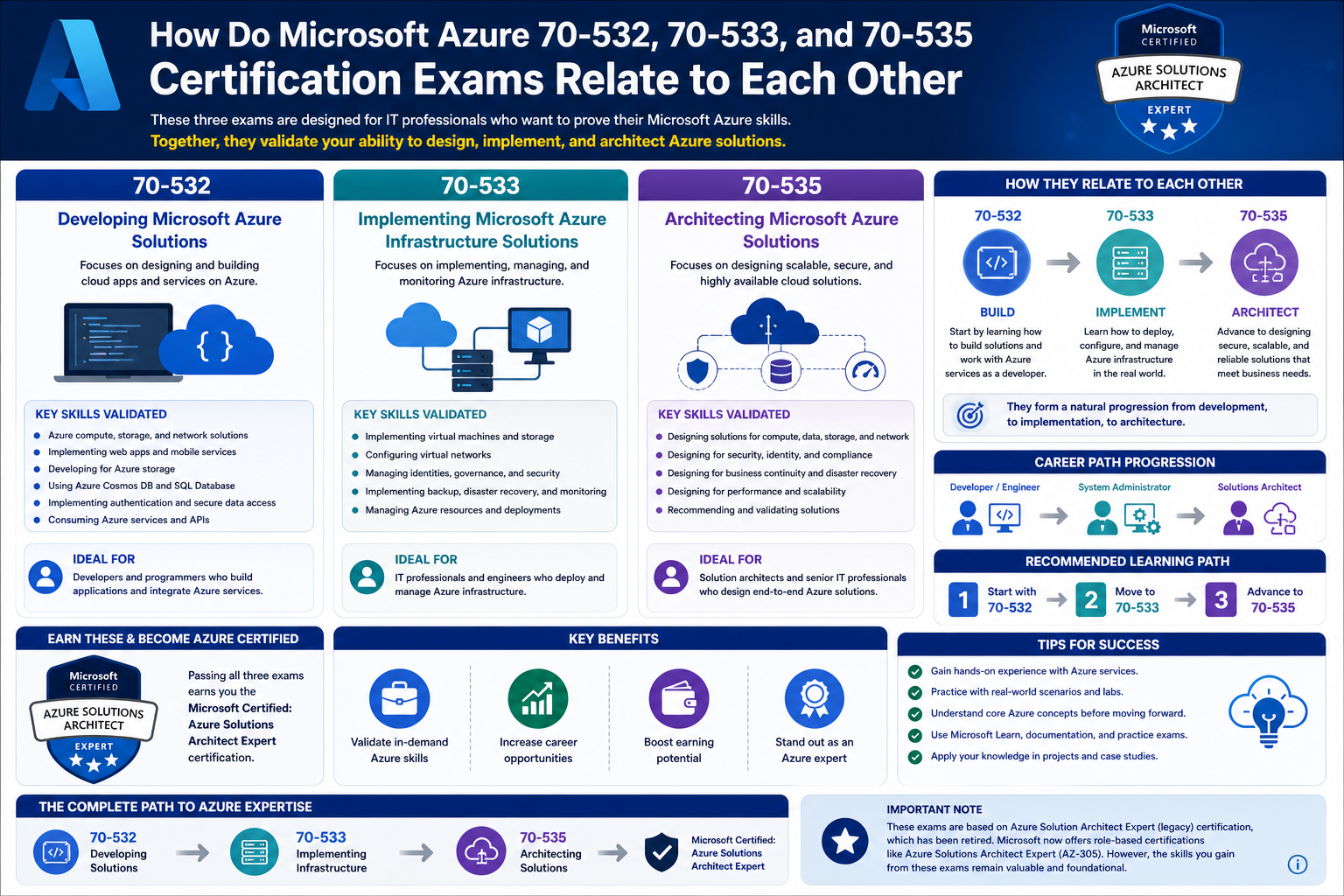
For professionals exploring historical Azure certification tracks, exams such as 70-532, 70-533, and 70-535 became notable because they reflected different job roles within cloud technology. Rather than treating Azure as one broad subject, these exams divided responsibilities into development, infrastructure implementation, and architecture. That distinction is important because cloud work is rarely handled by a single type of professional. A developer, a systems engineer, and a solutions architect may all work with the same platform while using very different skills.
Understanding how these role-based paths differ can help learners make smarter decisions about where to focus their time and energy. Someone who builds software applications in the cloud should not prepare in the same way as someone who manages secure networking or someone who designs enterprise migration strategies. When people choose the wrong learning path, they often waste time studying material that does not match their career direction.
The Azure exams associated with these tracks offered a practical lesson that remains relevant today: cloud expertise is multidimensional. Knowing how to deploy a virtual machine does not automatically mean you can design a resilient enterprise architecture. Writing application code does not necessarily prepare you to secure identity systems or govern cloud resources at scale. Likewise, understanding business transformation goals does not mean you can debug an API integration issue.
That is why many professionals became interested in comparing these Azure exams. They wanted to know which path aligned with their strengths, which credential supported their goals, and which exam topics matched real workplace responsibilities. Some were software developers transitioning into cloud-native application design. Others were network engineers expanding into hybrid cloud operations. Some were consultants helping organizations choose the right technical direction.
This broader conversation matters because cloud careers are not one-size-fits-all. The best path depends on experience, interests, and long-term ambitions. A person with years of coding experience may thrive in development-focused certification topics. A professional with infrastructure experience may naturally fit implementation and operations. Someone with a mix of business and technical communication skills may excel in architecture and planning roles.
Azure itself also encourages cross-functional thinking. Its services cover compute, storage, networking, databases, identity, monitoring, security, AI workloads, analytics, automation, and application delivery. No single professional masters everything at once. Most people begin in one discipline and gradually expand into others. Certifications often serve as milestones in that journey.
For newcomers, the existence of multiple Azure exams can feel confusing at first. The titles may sound similar, and many cloud concepts overlap. Virtual machines, networking, storage, automation, and security can appear in different contexts across multiple roles. However, the depth and perspective of each exam area differ significantly. One may focus on building with services, another on operating them, and another on choosing the right combination for business outcomes.
That role distinction mirrors how modern IT teams operate. Development teams care about deployment pipelines, APIs, managed services, and application performance. Infrastructure teams focus on reliability, governance, networking, identity, and cost control. Architects evaluate trade-offs, scalability, migration strategy, resilience, and long-term maintainability. Successful organizations need all three perspectives working together.
Because of this, Azure certification discussions are often less about passing an exam and more about professional identity. People ask themselves whether they want to build systems, run systems, or design systems. While those categories can overlap, they remain useful starting points.
Another reason these Azure exams gained attention was timing. As businesses accelerated digital transformation, many professionals recognized that traditional roles were evolving. System administrators became cloud engineers. Developers became platform-aware application builders. Consultants became transformation advisors. Certifications helped people signal that they were keeping pace with industry change.
There is also a confidence factor. Cloud platforms can appear overwhelming because they include hundreds of services and continuous updates. Structured certification objectives narrow the scope and give learners a manageable framework. Instead of trying to learn everything randomly, candidates can focus on core competencies tied to real responsibilities.
Even when exam versions eventually change, retire, or get replaced, the underlying role concepts remain useful. Development-focused cloud skills still matter. Infrastructure and operations expertise still matter. Architecture and strategic planning still matter. The names of exams may evolve, but the professional paths continue.
That is why examining Azure exams like 70-532, 70-533, and 70-535 remains valuable beyond historical curiosity. They reveal how cloud skills are segmented and how organizations think about talent needs. They also show learners that success in cloud computing comes from choosing depth in the right area rather than chasing every topic at once.
Why Azure Skills Continue to Matter Across Industries
Cloud platforms are now embedded into everyday business functions in ways many people do not immediately notice. A retailer managing inventory in real time, a bank analyzing fraud patterns, a hospital storing records securely, a university supporting online learning, or a manufacturer tracking devices across facilities may all depend on cloud services behind the scenes. Azure has become one of the platforms powering these operations.
This widespread adoption creates a consistent demand for people who know how to build, manage, and improve cloud systems. Unlike some technical trends that affect only niche sectors, cloud computing influences nearly every industry. That means Azure skills are relevant to both large enterprises and growing organizations.
In many workplaces, technology leaders want teams that can modernize legacy systems while maintaining stability. Azure often becomes the bridge between old and new environments because it supports hybrid models. Companies may still run local servers while moving selected workloads to the cloud. They may retain compliance-sensitive systems internally while using Azure for analytics, backups, disaster recovery, or customer-facing applications.
This hybrid reality creates opportunities for professionals with mixed experience. Someone who understands traditional infrastructure and cloud services can be especially valuable. Azure certifications historically appealed to such professionals because they connected familiar Microsoft enterprise technologies with modern cloud operations.
Another reason Azure expertise remains important is automation. Manual server management has gradually given way to scripted deployments, infrastructure as code, and policy-driven governance. Businesses want environments that can be replicated quickly, scaled reliably, and managed consistently. Professionals who understand Azure tools for automation and orchestration can help organizations reduce errors and improve speed.
Security is another major driver. As organizations move data and services online, identity protection, encryption, network segmentation, threat monitoring, and compliance become business priorities. Azure includes many services for these areas, but tools alone do not guarantee safety. Skilled professionals must configure them correctly and align them with policy requirements.
Data growth also plays a role. Companies generate enormous volumes of structured and unstructured information. Azure services for databases, storage, analytics, and integration help organizations turn that data into insight. Professionals who understand how to choose and manage those services are increasingly valuable.
The rise of remote and distributed work has further strengthened cloud demand. Teams need secure access to systems from multiple locations, reliable collaboration tools, scalable application access, and centralized management. Cloud platforms make these goals easier to achieve when implemented properly.
For individuals planning careers, Azure skills can open multiple directions rather than locking someone into a single job title. A person may begin in support, move into cloud administration, transition into DevOps, specialize in security, or later become an architect. Cloud knowledge often acts as a transferable foundation.
This flexibility explains why certification pathways attract attention. They help people understand where to start and how to progress. Instead of guessing what employers value, learners can map their growth to recognized skill domains.
However, certifications are most effective when paired with genuine practice. Cloud environments involve real decisions about cost, performance, availability, permissions, and design trade-offs. Memorizing terminology without hands-on understanding rarely leads to lasting success. The strongest candidates usually combine structured study with experimentation and real-world problem solving.
Another benefit of Azure learning is perspective. Even if someone later works with another platform, many core concepts transfer. Identity management, networking, containers, monitoring, automation, storage tiers, disaster recovery, and governance exist across cloud ecosystems. Learning Azure can therefore strengthen broader cloud literacy.
Employers often value that broader mindset. They want people who understand principles, not just menus or dashboards. Certifications tied to role-based knowledge can help signal this maturity when approached seriously.
Understanding the Three Distinct Career Paths Behind the Exams
The most useful way to understand Azure exams like 70-532, 70-533, and 70-535 is not to view them simply as tests, but as reflections of three professional identities within cloud computing.
The first identity is the builder. This is the developer who creates applications, integrates services, writes code, deploys APIs, and improves user experiences. Builders care about performance, scalability, deployment speed, and how cloud resources support software delivery. They often work closely with databases, messaging systems, identity integration, monitoring tools, and development pipelines.
The second identity is the operator. This is the infrastructure or systems professional who ensures services run securely and reliably. Operators focus on networking, virtual machines, permissions, backups, automation, resilience, and governance. They often manage the environments that developers depend on.
The third identity is the designer. This is the architect or strategist who translates business needs into technical plans. Designers assess workloads, estimate growth, reduce risk, choose service models, and balance cost against performance. They often coordinate across technical teams and business stakeholders.
These identities overlap in practice. A startup engineer may perform all three roles in one week. A large enterprise may split them across multiple departments. Still, the distinctions help explain why separate Azure certification paths existed.
Someone drawn to problem solving through code usually gains the most value from development-focused learning. Someone who enjoys stability, systems thinking, and operational excellence often fits infrastructure paths. Someone who likes seeing the bigger picture, connecting technical options to business goals, and guiding decisions may prefer architecture.
Career stage also matters. Early-career professionals often begin with operational responsibilities because they expose learners to many core systems. Developers may begin by focusing narrowly on application tasks, then expand into cloud architecture later. Experienced engineers with broad exposure may naturally transition into design leadership roles.
One common mistake is choosing a path based only on salary headlines or market buzz. Long-term success usually comes from aligning skills with genuine interest. People who enjoy coding tend to progress faster when deepening engineering expertise. Those who enjoy troubleshooting complex environments often excel in infrastructure. Strong communicators with analytical instincts may thrive in architecture.
Another mistake is assuming architecture is automatically the “highest” path. In reality, organizations need excellence at every layer. A great architect depends on strong engineers and operators. A brilliant developer may have more impact than a mediocre architect. Titles matter less than capability.
These Azure exams highlighted an important truth about cloud careers: specialization creates value, but collaboration creates outcomes. Developers, operators, and architects succeed most when they understand each other’s priorities. Developers benefit from security awareness. Operators benefit from understanding application needs. Architects benefit from empathy for implementation realities.
That cross-functional awareness often becomes the difference between average and exceptional professionals. It reduces friction, improves planning, and helps teams deliver reliable systems faster.
For learners evaluating their own direction, the best starting question is simple: what type of problems do you most enjoy solving? If you enjoy creating features and writing logic, lean toward development. If you enjoy reliability, control, and systems management, lean toward infrastructure. If you enjoy planning, evaluating options, and guiding transformation, lean toward architecture.
The exams may change over time, but these role categories remain deeply relevant. Cloud technology will continue evolving, yet organizations will always need people who can build, run, and design systems effectively.
The Developer Path: Understanding Azure Skills for Builders and Application Creators
Cloud platforms changed software development by removing many of the limitations that once slowed teams down. In the past, developers often depended heavily on infrastructure teams to provision servers, configure environments, request databases, and prepare deployment targets. That process could take days or weeks. With cloud services, development teams gained access to scalable resources, managed services, and automation tools that allow faster experimentation and delivery. This shift created a new type of professional: the cloud-aware developer.
Within the older Azure certification paths, Exam 70-532 represented this direction. It focused on developing Microsoft Azure solutions and highlighted how programmers could use Azure services as building blocks for applications. While specific exam versions have changed over time, the underlying skills remain highly relevant. Modern cloud developers still need to understand how to build software that uses identity systems, storage platforms, compute services, databases, monitoring tools, and automated deployment workflows.
The developer path is often misunderstood. Some assume cloud development is simply traditional programming hosted online. In reality, building for the cloud requires a different mindset. Instead of designing software for a single server or static environment, developers must think about elasticity, resilience, distributed communication, fault tolerance, security boundaries, and usage-based cost models.
This means the cloud developer role combines coding ability with platform awareness. Strong developers not only write clean application logic but also understand how infrastructure choices affect performance and user experience. They know when to use managed services instead of building custom systems from scratch. They recognize that architecture decisions made early in development can significantly impact scalability later.
Azure became popular with developers partly because it offered a natural environment for organizations already invested in Microsoft technologies. Teams using .NET frameworks, Windows ecosystems, enterprise identity systems, and Microsoft data platforms often found Azure a convenient extension of their workflow. However, Azure development skills are not limited to one programming language or one technology stack. Over time, the platform has expanded to support open-source tools, containers, APIs, Linux workloads, and many modern development patterns.
For aspiring cloud developers, the most important lesson is that code no longer exists in isolation. Every application interacts with services around it. Authentication systems validate users. Databases store business data. Queues process workloads asynchronously. Monitoring platforms capture errors and performance metrics. Storage systems hold files and media. Networking rules protect traffic. A developer who understands these relationships becomes far more effective than one who focuses only on syntax.
Building Applications with Cloud-Native Thinking
Traditional software was often designed around fixed assumptions. A company might deploy an application to one server with a known number of users. Scaling meant buying larger hardware or manually adding more machines. Releases were less frequent because updates carried operational risk.
Cloud-native development changed those assumptions. Applications now need to handle unpredictable traffic, global users, rapid releases, and integration with many services. Developers must think in modular ways. Instead of relying on one monolithic system, they may break functionality into smaller components or services that can scale independently.
Azure supports this model through app hosting platforms, containers, serverless functions, API management tools, messaging systems, and managed databases. A developer working in this environment decides how different components communicate and where logic should run.
For example, an online booking platform may need a public website, payment processing, email notifications, analytics dashboards, and fraud checks. Rather than placing everything inside one application, a cloud-aware developer may separate workloads into specialized services. The customer-facing site handles requests, a background processor manages confirmation emails, a database stores reservations, and a queue absorbs spikes in demand.
This design improves flexibility. If email traffic increases, only that component needs more capacity. If analytics workloads grow, they can scale independently. If one component fails, the entire platform may continue operating.
These patterns require developers to think differently about software boundaries. Good cloud developers ask where state should live, how services recover from failure, how workloads scale, and how systems communicate securely.
They also understand that cloud convenience can create complexity if used carelessly. Connecting too many services without clear design principles can make debugging difficult. Strong developers balance modularity with maintainability.
Why Developers Need to Understand Infrastructure
One of the most useful aspects of development-focused Azure learning was its overlap with infrastructure topics. Even though developers are not always full-time system administrators, they benefit greatly from understanding the environments where their software runs.
For instance, application performance may be affected by network latency, storage throughput, database connection limits, or memory constraints. If a developer has no awareness of these factors, they may misdiagnose problems or write inefficient solutions. By contrast, a developer who understands virtual machines, containers, load balancing, scaling rules, and network security can collaborate more effectively with operations teams.
This does not mean every developer must become an infrastructure specialist. It means modern software professionals gain an advantage when they can see beyond the code editor. They know why an application slows under load. They understand why firewall rules block integrations. They recognize why regional deployments matter for users in different geographies.
Azure development paths historically emphasized this blend because real-world cloud work demands it. Developers often need to configure application services, connect storage accounts, manage secrets, tune database usage, and read telemetry dashboards. These are not purely coding tasks, yet they are central to successful software delivery.
The strongest engineering teams reduce the divide between development and operations. Developers write software with operational realities in mind, while infrastructure teams create platforms that make development easier. This cooperative mindset became widely known through DevOps practices, but its deeper purpose is alignment rather than tools.
Data Skills Matter More Than Many Developers Expect
Many people enter software development focused primarily on front-end interfaces or business logic. Once they begin working with cloud systems, they quickly discover that data decisions shape nearly every application.
Azure environments often involve relational databases, distributed data stores, object storage, analytics pipelines, caching systems, and backup strategies. Developers need to know which model suits each use case.
A transactional system processing orders may need a structured relational database with strong consistency. A content platform storing media files may depend on object storage. A globally distributed app might benefit from a database optimized for low-latency reads across regions. A high-traffic application may use caching layers to reduce database load.
Poor data decisions can become expensive. An application designed without indexing awareness may slow dramatically as records grow. A service using the wrong storage tier may create unnecessary costs. An app that writes synchronously to a distant region may introduce avoidable latency.
Cloud developers do not need to become database administrators, but they should understand how application design affects data performance and reliability. They should know when to normalize data, when to cache responses, when to batch writes, and when to archive older information.
They must also consider privacy and governance. Applications frequently process personal data, financial details, logs, or sensitive documents. Developers should understand access controls, encryption, retention policies, and least-privilege access models.
This is one reason development-focused Azure learning often included database and storage topics. In modern systems, software and data strategy are inseparable.
Identity, Security, and Responsible Development
Security was once viewed by some teams as a separate department concern. That approach no longer works. In cloud environments, developers regularly influence security outcomes through design choices.
Authentication flows determine how users sign in. Authorization logic controls what users can access. Secret handling affects whether credentials remain protected. Logging choices influence incident investigation. Dependency management affects exposure to vulnerabilities.
Azure ecosystems commonly integrate with centralized identity services, managed secrets platforms, certificate management, and role-based access controls. Developers who understand these capabilities can build safer applications with less friction.
For example, instead of storing passwords or keys inside source code, a mature developer uses secure identity-based access patterns. Instead of giving every component broad permissions, they limit access by role. Instead of exposing internal services publicly, they design segmented communication paths.
Security-aware developers also think about user trust. They design sensible session handling, input validation, error responses that do not leak internal details, and monitoring that detects suspicious behavior.
This mindset is increasingly valuable because security incidents are costly not only financially but reputationally. Organizations want developers who see protection as part of craftsmanship rather than an obstacle.
Monitoring, Diagnostics, and Performance Ownership
Many developers enjoy creating features but pay less attention to what happens after deployment. In cloud environments, that gap can be dangerous. Applications run continuously under changing conditions. Performance bottlenecks, integration failures, memory leaks, and traffic spikes can emerge at any time.
Modern developers need observability skills. They should understand logs, metrics, tracing, alerts, dashboards, and incident response workflows. Azure environments provide tools to collect and analyze operational signals, but tools only help when developers know what to measure.
Good developers instrument applications intentionally. They log meaningful events rather than random noise. They track response times, failure rates, queue depth, and dependency latency. They create alerts for real issues instead of overwhelming teams with false alarms.
This operational awareness changes behavior during development. Engineers write code that is easier to diagnose. They include correlation identifiers for tracing distributed requests. They expose health endpoints. They design retries carefully rather than causing cascading failures.
Performance ownership also becomes shared. Instead of blaming infrastructure whenever systems slow down, mature developers investigate application efficiency, query behavior, serialization overhead, and dependency calls.
Organizations increasingly value developers who can support what they build. The ability to ship features matters, but the ability to maintain healthy production systems often matters even more.
Automation and Delivery Pipelines
Cloud platforms accelerated expectations around release speed. Businesses want improvements delivered continuously rather than through large infrequent projects. This shift made automation essential.
Developers on Azure paths often encounter concepts related to build pipelines, testing automation, deployment workflows, environment promotion, rollback planning, and infrastructure consistency. These practices reduce manual errors and improve delivery confidence.
A modern team may automatically run tests when code changes are submitted, package applications, deploy to staging environments, verify health checks, and then release gradually to production. This process enables smaller and safer changes.
Developers benefit from understanding pipeline design because it affects productivity directly. Slow unreliable pipelines create frustration. Well-designed pipelines free developers to focus on meaningful engineering.
Automation also supports repeatability. If environments are defined consistently, teams spend less time fixing configuration drift or mysterious differences between test and production systems.
For career growth, developers who combine coding skills with delivery automation often stand out. They help teams move faster without sacrificing quality.
Who Thrives in the Developer-Oriented Azure Path
Not every technology professional enjoys the same type of work. The Azure development path tends to suit people who enjoy creating things, solving logical problems, and iterating rapidly.
These professionals often like turning ideas into usable products. They enjoy debugging complex behavior, improving performance, and designing elegant systems. They may feel energized by learning new frameworks or integrating services into practical solutions.
Curiosity is especially valuable. Cloud platforms evolve quickly, so successful developers keep learning. They experiment with new hosting models, architecture patterns, and tools while maintaining sound engineering judgment.
Communication skills matter too. Developers rarely work alone. They coordinate with designers, testers, security teams, product managers, infrastructure engineers, and stakeholders. Clear communication prevents many technical problems before they begin.
Patience is another underrated trait. Distributed systems sometimes fail in subtle ways. Reproducing bugs across environments can take persistence. Strong developers stay methodical rather than reactive.
Common Mistakes New Cloud Developers Make
Many newcomers to cloud development assume the platform will automatically solve design problems. While managed services simplify operations, poor architecture can still create instability, security risk, or excessive cost.
One common mistake is overengineering too early. Some teams adopt highly complex distributed designs before they need them. Simpler systems are often easier to operate and evolve.
Another mistake is ignoring cost visibility. Cloud resources are convenient to create, which can encourage waste. Developers should understand how design decisions affect usage charges.
Some developers also neglect failure scenarios. They assume services are always available, networks never slow down, and dependencies always respond quickly. Resilient applications expect occasional failure and handle it gracefully.
Security shortcuts are another risk. Hardcoded credentials, overly broad permissions, and weak validation can create serious exposure.
Finally, some developers focus entirely on shipping new features while neglecting maintainability. Over time, technical debt slows progress and increases risk.
Recognizing these pitfalls early helps developers mature faster.
Career Growth After the Developer Foundation
The developer-oriented Azure path can lead to many future roles. Some professionals deepen into senior engineering positions, specializing in scalable systems, APIs, distributed architecture, or performance engineering. Others move toward DevOps and platform engineering, helping many teams deploy efficiently. Some shift into security engineering with an application focus. Others eventually become architects who design broader enterprise solutions.
This flexibility is one reason development-centered cloud skills remain valuable. Building software teaches problem decomposition, system thinking, and product delivery discipline. Those abilities transfer widely.
Developers who broaden beyond code often accelerate their careers. Learning infrastructure basics, cost optimization, security principles, and communication skills can transform a strong coder into a high-impact technical leader.
Why the Developer Perspective Still Matters Today
Even though certification names and versions evolve, the principles behind older Azure development paths remain current. Organizations still need professionals who can build reliable applications on modern platforms. They still need engineers who understand identity, automation, data design, scalability, and observability.
Cloud platforms continue to introduce new services, but the real differentiator is not memorizing every feature. It is knowing how to use technology thoughtfully to solve business and user problems.
The developer perspective matters because every digital transformation eventually becomes real only when software is built, deployed, and used successfully. Strategies and infrastructure plans create possibility, but developers turn possibility into working systems.
That is why the builder role remains central in cloud careers. Whether creating internal tools, customer platforms, analytics solutions, or global services, developers shape the practical outcomes organizations experience from their cloud investments.
The Architect and Infrastructure Paths: Choosing the Right Azure Direction for Long-Term Growth
As cloud platforms matured, organizations realized that successful adoption required more than developers alone. Building applications is important, but companies also need professionals who can manage secure environments, maintain operational stability, design scalable systems, and align technical choices with business goals. This is where the infrastructure and architecture paths became especially valuable.
Within older Azure certification structures, Exam 70-533 focused on implementing Azure infrastructure solutions, while Exams 70-534 and later 70-535 emphasized architecting Azure solutions. Although these exam numbers belong to an earlier certification era, the career paths they represented are still highly relevant today. Businesses continue to need experts who can run cloud systems efficiently and leaders who can design future-ready cloud strategies.
Understanding these two directions helps professionals decide where their strengths fit best. Some people enjoy hands-on system management, troubleshooting, automation, and security operations. Others are more interested in high-level planning, technology selection, cost modeling, resilience strategy, and enterprise transformation. Both roles are essential, and in many organizations they work closely together.
The Infrastructure Specialist: Running Cloud Environments with Confidence
The infrastructure path is ideal for professionals who like stability, systems thinking, and operational control. These individuals often come from backgrounds in server administration, networking, virtualization, technical support, or cybersecurity. Cloud computing did not eliminate these skills. Instead, it transformed them.
In traditional data centers, infrastructure professionals managed physical servers, local storage arrays, network switches, firewalls, and backup systems. In Azure environments, many of these responsibilities shift into software-defined services. Instead of racking hardware, engineers provision virtual machines, configure network security groups, build virtual networks, manage identity access, and automate resource deployment.
This role requires precision. A single configuration error can expose systems, create downtime, or increase costs. That is why infrastructure professionals are often trusted guardians of production environments.
Azure infrastructure work typically includes managing compute resources, storage systems, DNS settings, secure connectivity, disaster recovery plans, monitoring alerts, and access permissions. It also includes lifecycle tasks such as patching, upgrades, capacity planning, and policy enforcement.
People who enjoy solving real-time operational problems often thrive here. When a service slows unexpectedly, a network route fails, storage latency rises, or user access breaks, infrastructure professionals investigate and restore stability. Their success is measured not by flashy launches but by consistency and reliability.
Security as a Core Strength in Infrastructure Roles
One of the most valuable aspects of the infrastructure path is its close connection to security. Cloud platforms create enormous flexibility, but flexibility without governance can become dangerous.
Infrastructure professionals help protect organizations by controlling who can access resources, how networks are segmented, where sensitive data is stored, and how systems are monitored. They often manage identity integration, privileged access models, certificate handling, encryption settings, and compliance controls.
Because cyber risks continue to grow globally, organizations strongly value engineers who can combine operational expertise with security awareness. This makes the infrastructure path especially attractive for professionals interested in long-term demand and meaningful responsibility.
Strong cloud security does not come only from tools. It comes from disciplined processes, clear policies, and consistent execution. Infrastructure specialists often lead these efforts.
Automation and the Modern Operations Mindset
The cloud changed operations work by making automation essential. Repetitive manual configuration no longer scales well in dynamic environments. Infrastructure professionals increasingly rely on scripting, templates, policy engines, and repeatable deployment methods.
This means the modern infrastructure engineer is not simply an administrator clicking through settings. They are often an automation-minded builder who creates reliable systems at scale.
For example, instead of manually configuring ten servers one by one, a skilled engineer may define a reusable deployment template. Instead of checking settings manually, they may enforce standards automatically. Instead of waiting for outages, they may create alerts that detect risk early.
Professionals who enjoy structure, efficiency, and measurable improvement often find this work deeply satisfying.
The Architect Path: Turning Business Goals into Cloud Strategy
While infrastructure teams focus on operating environments, architects focus on designing the bigger picture. They evaluate needs, compare options, assess trade-offs, and guide organizations toward effective technical decisions.
The architect role often appeals to experienced professionals who understand multiple domains such as networking, development, security, data systems, and stakeholder communication. Architects do not always perform every hands-on task themselves, but they need enough knowledge to make sound recommendations.
For example, a company planning to modernize an aging internal application may need answers to several questions. Should the system be rehosted quickly or redesigned gradually? Which services improve resilience? How should identity be integrated? What costs will growth create? How can downtime risk be minimized? What governance model supports expansion?
These are architecture questions.
Azure architects typically work across teams. They speak with executives about priorities, with finance teams about budgets, with security teams about controls, with developers about delivery models, and with operations teams about supportability. Their role is part technical expert, part planner, part translator.
Why Communication Matters More Than Pure Technical Depth
Many people assume the architect path is simply the most advanced technical route. In reality, communication and judgment are just as important as technical expertise.
Architects must explain complex ideas clearly to people with different backgrounds. They often need to justify decisions, present alternatives, and build consensus among teams with competing priorities.
For example, one department may want rapid delivery, another may demand strict compliance, and finance leaders may focus heavily on cost control. An architect must design solutions that balance these realities rather than optimize only one factor.
This requires maturity, listening ability, and business awareness. Technical brilliance without communication skill often limits effectiveness in architecture roles.
Cost, Scale, and Long-Term Thinking
One of the most important differences between engineers and architects is time horizon. Engineers may focus on immediate delivery and operational excellence. Architects must also think about what happens next year, in three years, or during major growth.
They consider whether a solution can scale globally, whether vendor choices create lock-in, whether operational complexity will overwhelm teams later, and whether governance models support expansion.
Cloud platforms make it easy to launch resources quickly, but long-term sustainability requires planning. Poor early decisions can create spiraling costs, fragmented environments, security gaps, or difficult migrations later.
Strong Azure architects help organizations avoid these traps by designing with future needs in mind.
Choosing Between Infrastructure and Architecture
Many professionals wonder which path is better. The truth is neither is universally better. They suit different strengths and career stages.
Choose infrastructure if you enjoy hands-on systems work, troubleshooting, automation, reliability, networking, and security execution. This path is excellent for people who like seeing immediate operational impact.
Choose architecture if you enjoy planning, evaluating options, guiding teams, communicating strategy, and connecting technology to business outcomes. This path often suits professionals with broader experience across multiple technical areas.
It is also common to move from infrastructure into architecture over time. Many strong architects began as engineers because operational experience teaches realism. People who have supported production systems usually design more practical solutions later.
Likewise, some architects remain highly hands-on and continue working deeply with engineering teams. Career paths are flexible rather than fixed.
How These Paths Work Together
Organizations succeed when infrastructure professionals and architects collaborate effectively. Architects may define the target operating model, network strategy, resilience standards, or migration roadmap. Infrastructure teams then implement, optimize, and maintain those designs in real environments.
Feedback must flow both ways. Engineers often discover practical constraints architects need to understand. Architects often identify strategic improvements engineers may not see while focused on daily operations.
When these roles operate in partnership, cloud adoption becomes faster, safer, and more sustainable.
Conclusion
The relationship between Microsoft Azure exams 70-532, 70-533, and 70-535 reflects a broader truth about cloud careers: success in the cloud is built through specialized skills that support different business needs. Each exam represented a distinct professional direction, helping candidates focus on the area most aligned with their strengths and career goals. Rather than competing paths, they were complementary routes into the growing world of cloud computing.
The development-focused path emphasized building applications, integrating services, and creating scalable software solutions. It appealed to professionals who enjoy coding, innovation, and transforming ideas into functional digital products. The infrastructure route centered on deployment, operations, networking, security, and maintaining stable environments. It suited those who thrive on reliability, problem-solving, and system performance. The architecture path focused on planning, design, and aligning technology with business outcomes, making it ideal for professionals who enjoy strategy, communication, and long-term thinking.
Although certification models continue to evolve, the core roles behind these exams remain highly relevant in today’s technology landscape. Organizations still need developers who can build modern applications, engineers who can secure and manage cloud environments, and architects who can design efficient solutions for growth. These responsibilities continue to shape hiring decisions across industries.
Choosing the right path has always been more valuable than simply choosing the most popular one. A professional who aligns learning with genuine interests and existing strengths often progresses faster and builds deeper expertise. Someone passionate about systems may flourish in infrastructure, while a natural planner may excel in architecture. Likewise, a builder at heart may find the greatest satisfaction in development.
Ultimately, these Azure certifications highlighted how cloud computing creates multiple opportunities rather than one fixed destination. Whether your future lies in software engineering, operations, security, consulting, or enterprise strategy, the most important step is selecting a direction that matches your talents and continuing to grow from there. Cloud technology will keep changing, but skilled professionals who can build, run, and design great systems will always remain in demand.