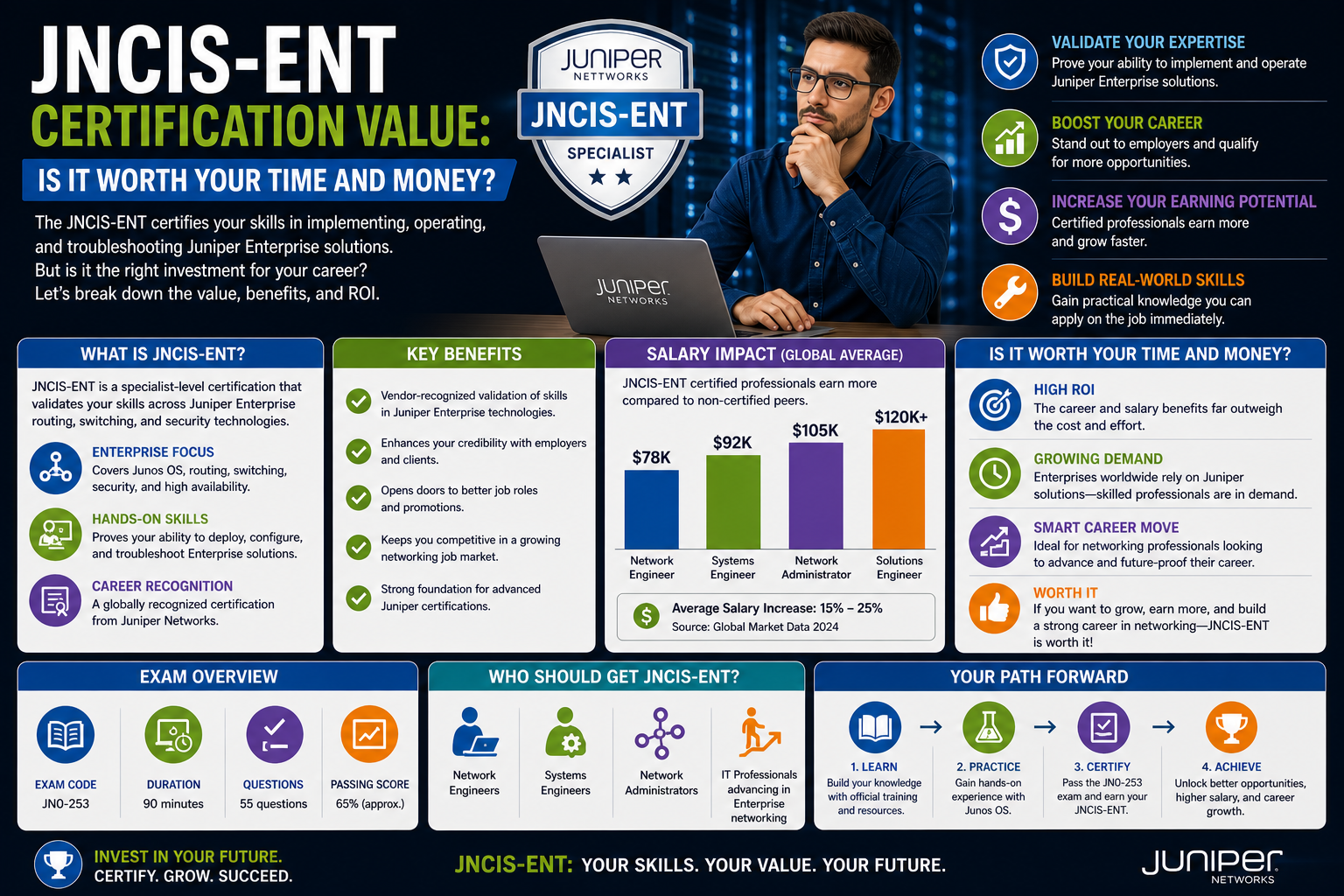
In the world of networking, certifications often serve as a bridge between knowledge and opportunity. They help professionals prove that they understand important technologies, can work with real systems, and are serious about career growth. Among networking certifications, vendor-specific credentials hold a unique place because they focus on the platforms companies actually use in production environments. One of the most respected examples in enterprise networking is the JNCIS-ENT certification.
JNCIS-ENT stands for Juniper Networks Certified Internet Specialist – Enterprise Routing and Switching. It is designed for professionals who want to demonstrate practical knowledge of enterprise networking using Juniper technologies. This certification sits above the entry-level Junos certification and represents a stronger understanding of routing, switching, configuration, troubleshooting, and network operations in business environments.
Many people considering this certification ask a simple question: is it worth the time, effort, and money? The answer depends on career goals, current experience, and the type of network environments a person wants to work in. For many network engineers and administrators, the JNCIS-ENT can be a highly valuable credential because it combines technical credibility with specialized vendor knowledge.
Why Vendor Certifications Still Matter
Technology changes quickly, and some professionals wonder whether certifications are still relevant. While experience is always important, certifications remain useful because they provide measurable proof of skills. Employers often receive many applications for a single networking role. A certification can help one candidate stand out by showing dedication and verified technical competence.
Vendor certifications matter even more because network devices are not identical across manufacturers. Routing principles may be universal, but commands, operating systems, troubleshooting methods, design philosophies, and feature implementation vary significantly. A professional who understands one platform may still need time to adapt to another.
That is where JNCIS-ENT becomes valuable. It shows that the holder understands networking concepts specifically in the Juniper ecosystem. Organizations using Juniper equipment often prefer professionals who already know how to operate their infrastructure rather than hiring someone who must learn everything from the beginning.
Juniper’s Position in the Networking Industry
Juniper has long been recognized as a major force in networking. While some companies dominate through brand recognition and broad market visibility, Juniper has built its reputation through strong engineering, carrier-grade reliability, and efficient network design. Many enterprises, internet service providers, educational institutions, and large organizations rely on Juniper hardware and software.
Because of this market presence, Juniper certifications carry genuine value. They are not niche credentials with little recognition. Instead, they represent expertise in systems used by real businesses with demanding networking needs.
For job seekers, this creates opportunity. Many professionals pursue only the most common certification paths, which means fewer people invest in Juniper expertise. That smaller talent pool can make certified Juniper professionals more attractive in environments where those skills are needed.
What the JNCIS-ENT Represents
The JNCIS-ENT is more than an exam title. It represents a transition from beginner knowledge into professional capability. At the associate level, candidates usually focus on learning the Junos operating system, basic navigation, foundational networking ideas, and simple configurations. At the specialist level, the expectations rise.
This certification indicates that a candidate can understand enterprise switching environments, routing protocols, traffic flow, network resilience, and operational troubleshooting. It suggests readiness for real-world responsibilities rather than only academic familiarity.
Hiring managers often look for evidence that a person can move beyond memorized commands and understand how networks behave under changing conditions. That is one reason specialist-level certifications often receive more respect than entry-level credentials.
The Meaning of Enterprise Routing and Switching
Enterprise networking differs from basic home or small office networking. In a business environment, networks must support many users, departments, applications, and security requirements. They must remain stable, scalable, and available.
Routing is the process of directing traffic between networks. Switching focuses on forwarding traffic within local networks efficiently. Together, routing and switching form the foundation of modern connectivity.
An enterprise specialist must understand how devices communicate, how traffic chooses paths, how redundancy prevents outages, and how policies protect business operations. The JNCIS-ENT focuses on these realities, making it especially relevant for professionals who manage corporate networks.
Why Many Professionals Choose This Certification
There are several reasons professionals pursue JNCIS-ENT. Some already work in environments that use Juniper hardware. For them, the certification validates skills they use every day and can support promotions or internal advancement.
Others pursue it because they want to expand beyond one vendor. A network engineer who only knows one platform may eventually face career limitations. Learning Juniper broadens adaptability and shows the ability to work across multiple technologies.
Some candidates choose JNCIS-ENT because they want to move toward higher certifications later. Specialist-level credentials often serve as stepping stones to professional and expert certifications. Building that foundation early can make future progress smoother.
There are also professionals who choose it simply because they enjoy networking and want to challenge themselves. For technically curious people, studying a second vendor often sharpens overall understanding of networking principles.
The Advantage of Learning Junos
One of the strongest reasons to consider JNCIS-ENT is the Junos operating system. Junos has a reputation for consistency, clean structure, and logical configuration design. Many engineers appreciate its organized hierarchy and predictable behavior.
Learning a new network operating system changes the way professionals think. It encourages comparison between platforms and deepens understanding of why features exist, not just how to type commands. That broader mindset is valuable in interviews and real operations work.
Engineers who understand Junos often report that it improves their troubleshooting discipline. Because the platform emphasizes clarity and structure, it can help users become more methodical in diagnosing issues.
How Employers View Specialist-Level Certifications
Entry-level certifications can show potential. Specialist-level certifications often show readiness. That distinction matters.
An employer hiring for a production network role may prefer someone who can contribute sooner rather than later. JNCIS-ENT suggests the candidate has studied more advanced networking topics and can handle practical scenarios involving routing protocols, switching behavior, and service continuity.
Even when a job description does not specifically require Juniper certification, holding one can strengthen a resume. It demonstrates commitment to technical growth and willingness to master complex systems.
For consultants or contract engineers, certifications can be especially useful because clients often want visible proof of expertise before assigning responsibility.
Technical Depth Behind the Credential
One reason JNCIS-ENT is respected is that it covers technologies central to enterprise networking. Candidates are expected to understand switching concepts such as VLAN behavior and spanning tree operations. They must also know routing protocols like OSPF, BGP, and IS-IS, depending on the exam blueprint.
These are not trivial subjects. They are core technologies that power modern networks. Learning them in the context of Juniper implementation creates practical value.
High availability concepts are also important. Businesses depend on uptime, and engineers must know how networks recover from failures. Certifications that include resiliency topics are more aligned with real operational needs.
Is It Only Useful for Juniper Jobs?
A common misconception is that vendor certifications only matter if someone uses that exact vendor every day. In reality, the value is broader.
Studying for JNCIS-ENT teaches routing logic, switching architecture, redundancy principles, and operational thinking. These concepts apply across networking as a whole. Even if someone later works on another platform, the knowledge still transfers.
The certification also signals that the person can learn complex systems. That adaptability is valuable to employers. Many hiring managers care less about exact command syntax and more about whether a candidate can understand network behavior quickly.
So while JNCIS-ENT is especially valuable in Juniper environments, it can benefit careers more widely than many people assume.
The Career Paths That Benefit Most
Network administrators often gain strong value from JNCIS-ENT because they manage switching environments, device configuration, and daily operations. The certification aligns closely with those responsibilities.
Network engineers benefit because the certification strengthens routing knowledge, design awareness, and troubleshooting depth. It can also support movement into more senior engineering roles.
Support engineers, operations center staff, and infrastructure specialists can also benefit, especially in companies where Juniper devices are part of production systems.
For professionals aiming toward architecture or consulting roles, specialist-level certifications often form an important mid-stage milestone before advanced expert-level credentials.
Comparing General Knowledge to Vendor Expertise
Many professionals learn networking through vendor-neutral study. That is useful because it builds core theory. However, real jobs usually require interaction with specific platforms.
Knowing how OSPF works in theory is good. Knowing how to verify adjacencies, inspect routes, identify configuration mistakes, and restore service on Juniper devices is more directly valuable to an employer using Juniper equipment.
JNCIS-ENT helps bridge that gap. It converts general networking knowledge into platform-specific operational skill.
This distinction matters during interviews. Candidates who can discuss real implementation details often appear more prepared than those who only know textbook definitions.
Confidence and Professional Identity
Certifications can also influence confidence. Many IT professionals know more than they realize but hesitate to pursue new opportunities because they lack formal proof of competence.
Preparing for JNCIS-ENT forces structured study. Candidates revisit weak areas, clarify misunderstood concepts, and develop stronger command of enterprise networking. Passing the exam often creates a noticeable increase in confidence.
That confidence can lead to better interview performance, stronger communication with peers, and willingness to accept larger responsibilities.
Professional identity matters too. Being recognized as someone certified in enterprise networking can shape how managers and colleagues view your capabilities.
Is the Investment Reasonable?
Compared with many professional development options, certifications can be cost-effective. A single credential may support higher earnings, broader job access, or faster advancement.
The real investment is usually time rather than exam fees. Candidates must study protocols, practice configurations, and understand troubleshooting logic. For busy professionals, time management becomes the main challenge.
Still, compared with long academic programs or expensive training pathways, a focused certification often offers efficient career value when aligned with real goals.
The Challenge Level
JNCIS-ENT is not designed as an impossible exam, but it is not superficial. Candidates need more than memorization. They must understand why technologies are used, how protocols behave, and what outcomes result from specific configurations.
That practical emphasis is a strength. Certifications that reward understanding usually carry more long-term value than those based purely on recall.
Professionals with hands-on experience often find study easier because many concepts connect directly to real incidents they have already seen. Those without production experience may need extra lab practice and repetition.
Why Timing Matters
The right time to pursue JNCIS-ENT depends on career stage. Someone new to networking may first need stronger fundamentals. Someone already working with routers and switches may benefit immediately.
For professionals in stagnant roles, certification can help restart momentum. For those seeking promotion, it can strengthen internal credibility. For job seekers, it can make resumes more competitive.
Timing also matters in market demand cycles. Organizations modernizing infrastructure or expanding branch networks may suddenly need people with relevant vendor skills.
Long-Term Value Beyond the Exam
The strongest value of JNCIS-ENT often appears after the exam. Study creates habits of disciplined troubleshooting, structured thinking, and deeper protocol awareness. Those benefits continue daily in operational work.
Professionals who pursue specialist certifications often become more comfortable reading documentation, planning changes, and analyzing traffic flow. They communicate technical issues more clearly because they understand systems more completely.
Even years later, many certified engineers remember concepts they first learned while preparing for a credential. The exam becomes temporary, but the knowledge can become permanent.
Why It Continues to Be Relevant
Networking remains essential to nearly every modern business. Cloud services, branch offices, remote workers, data centers, voice systems, security tools, and business applications all depend on reliable connectivity.
As long as networks matter, professionals who understand enterprise routing and switching will remain valuable. Vendor platforms may evolve, interfaces may improve, automation may expand, but the need for strong network fundamentals does not disappear.
JNCIS-ENT stays relevant because it focuses on those fundamentals in a practical vendor environment. It validates not only knowledge of commands but understanding of how enterprise networks function in the real world.
What You Learn While Preparing for JNCIS-ENT and Why Those Skills Matter
Preparing for the JNCIS-ENT certification is about much more than passing an exam. It is a process that develops practical networking ability, improves technical judgment, and strengthens the kind of thinking required in real production environments. Many certifications are valuable because of the title they provide, but specialist-level networking certifications often deliver their greatest value through the learning journey itself. That is especially true for JNCIS-ENT.
The certification focuses on enterprise routing and switching using Juniper technologies, which means candidates spend time studying the systems, protocols, and behaviors that keep modern organizations connected. During preparation, many professionals discover gaps in their knowledge that were hidden during routine daily work. Others realize they understand tasks well enough to complete them, but not deeply enough to explain why those tasks work. JNCIS-ENT study helps close those gaps.
A strong networking career is built on understanding how devices make decisions, how traffic moves, how failures occur, and how recovery happens. This certification path encourages that level of understanding. Rather than relying on surface-level familiarity, candidates are pushed to think like engineers who must maintain uptime, solve problems under pressure, and make smart design choices.
Building a Stronger Foundation in Switching
Many people entering certification study underestimate switching because it appears simpler than routing. In reality, switching is one of the most important areas of enterprise networking. Most users, devices, phones, printers, wireless access points, and servers connect through switching infrastructure. If switching is unstable, business operations suffer immediately.
JNCIS-ENT preparation often begins by deepening knowledge of how switches forward frames, learn addresses, separate traffic, and maintain efficient communication inside local networks. Candidates move beyond basic definitions and start understanding how switching decisions affect performance, segmentation, and fault isolation.
This matters because many real network incidents begin at Layer 2. Duplicate paths, loops, broadcast storms, poor segmentation, and access misconfiguration can disrupt an entire office. Engineers who understand switching thoroughly can identify root causes faster and restore service with confidence.
Many professionals discover that once they study switching in depth, they become better troubleshooters overall. They stop guessing and begin analyzing traffic behavior logically.
Understanding VLAN Design in Real Environments
Virtual LANs are common in enterprise networks, but many people only interact with them at a simple level. They know how to assign ports or create IDs, yet may not fully understand how VLAN design influences security, scalability, and operational simplicity.
During JNCIS-ENT study, VLANs become more meaningful. Candidates learn how traffic segmentation reduces unnecessary broadcast domains, separates departments, supports voice deployments, and simplifies policy enforcement.
This knowledge matters in everyday business environments. A poorly designed VLAN structure can create confusion, increase troubleshooting time, and expose systems that should be isolated. A well-designed VLAN strategy can make networks cleaner, safer, and easier to manage.
Professionals who gain confidence in VLAN planning often become more valuable during office expansions, migrations, or infrastructure refresh projects because segmentation decisions are central to those changes.
The Real Importance of Spanning Tree Knowledge
Spanning tree is sometimes viewed as an old concept, but it remains highly relevant anywhere redundant Layer 2 paths exist. Redundancy is necessary for resilience, yet without loop prevention, it can also create severe outages.
JNCIS-ENT candidates learn how spanning tree prevents loops, selects forwarding paths, blocks unnecessary links, and reconverges when failures occur. This type of knowledge is essential because loops can overwhelm a network rapidly.
Understanding spanning tree also changes how engineers approach cabling and switch deployment. Instead of connecting devices blindly for redundancy, they begin thinking about topology behavior and failover logic.
In practical operations, engineers who understand spanning tree can quickly diagnose unstable access networks, blocked uplinks, or unexpected traffic patterns. That skill can save hours of downtime in busy environments.
Layer 2 Security Becomes a Daily Skill
Security is often associated with firewalls and endpoint tools, but local network security is equally important. Many threats begin internally through unauthorized devices, rogue systems, accidental misconfiguration, or malicious activity inside the network boundary.
JNCIS-ENT preparation introduces protective mechanisms that help secure access layers and switching domains. Candidates study how networks can limit unwanted behavior, validate legitimate use, and prevent common attack methods.
This knowledge is valuable because many organizations have devices constantly joining and leaving the network. Laptops, phones, printers, cameras, and temporary systems create a dynamic environment. Without access-layer protections, trust is often too broad.
Professionals who understand Layer 2 security can contribute meaningfully to internal risk reduction. They become useful partners to security teams, not just infrastructure operators.
Learning to Think in Terms of Routing Logic
Routing is often where networking becomes truly strategic. Switches forward traffic locally, but routers decide how different networks communicate across buildings, branches, data centers, and internet connections.
JNCIS-ENT study forces candidates to understand path selection, route preference, metrics, convergence, redistribution concepts, and topology awareness. These topics are foundational to enterprise connectivity.
Once routing logic becomes clear, many networking tasks make more sense. Application slowness, unreachable services, asymmetric traffic, and intermittent branch issues often trace back to routing behavior.
Candidates frequently experience a turning point during study when routing stops feeling abstract and starts feeling intuitive. They begin visualizing how traffic moves through networks rather than memorizing commands.
That mindset is one of the most valuable outcomes of certification preparation.
OSPF Knowledge That Helps in Production
Open Shortest Path First is widely used in enterprise environments. It supports scalable internal routing and adapts to topology changes. Many professionals know the name OSPF, but fewer understand its behavior deeply.
Preparing for JNCIS-ENT helps candidates understand neighbor relationships, areas, link-state databases, route calculation, and operational troubleshooting. These concepts are extremely useful in real networks.
When OSPF fails, symptoms may appear as unreachable subnets, unstable routes, or partial connectivity. Engineers who truly understand the protocol can diagnose whether the issue is adjacency related, area related, timer related, or configuration related.
This ability creates trust. Teams value engineers who can approach routing incidents calmly and methodically instead of escalating every issue.
Why IS-IS Study Expands Technical Perspective
Some engineers encounter IS-IS less often than OSPF, yet learning it can be highly beneficial. Exposure to multiple routing protocols broadens understanding of how network control planes function.
Studying IS-IS through JNCIS-ENT teaches that there are different design philosophies for solving similar problems. It helps candidates appreciate how networks evolved and why certain organizations prefer one protocol over another.
Even if a professional rarely uses IS-IS directly, the process of learning it sharpens protocol literacy. Engineers become better at reading technical documentation, comparing technologies, and adapting to unfamiliar environments.
That adaptability is often more valuable than any single protocol itself.
BGP Skills Open Career Doors
Border Gateway Protocol is one of the most respected topics in networking because it powers large-scale route exchange and complex policy control. While many associate BGP only with internet providers, it is also used in enterprise, data center, and hybrid environments.
JNCIS-ENT preparation introduces candidates to BGP fundamentals, neighbor relationships, path attributes, route control, and policy concepts. Even basic competence with BGP can strengthen a networking profile significantly.
Why does this matter? Because BGP is often seen as a dividing line between basic networking knowledge and more advanced operational capability. Professionals who understand BGP are frequently viewed as more technically mature.
Studying BGP also teaches disciplined thinking. Route advertisement mistakes can have wide impact, so engineers learn caution, validation, and policy awareness.
Tunnel Technologies and Modern Connectivity
Enterprise networks are no longer confined to a single office. Remote branches, hybrid cloud environments, partner integrations, and segmented services often require encapsulation or secure transport methods.
JNCIS-ENT includes tunnel-related concepts that reflect this reality. Candidates study how networks extend connectivity logically across underlying infrastructure.
This is useful because many modern business projects involve connecting separate locations or services in controlled ways. Professionals who understand tunneling concepts are better prepared for migrations, remote expansion, and multi-site design work.
Even when automation tools handle deployment, engineers still need conceptual understanding to troubleshoot failures and verify expected behavior.
High Availability as a Core Mindset
One of the biggest differences between hobby networking and enterprise networking is the importance of uptime. In businesses, network interruptions can halt communication, stop transactions, delay support teams, and reduce productivity immediately.
That is why high availability knowledge matters so much. JNCIS-ENT preparation exposes candidates to redundancy thinking, failover behavior, resilient topology planning, and service continuity.
This changes how professionals view infrastructure. Instead of asking only whether something works, they begin asking what happens when it fails.
That question is central to mature engineering. Networks eventually experience outages, maintenance windows, hardware issues, and human mistakes. Resilient design reduces the damage.
Employers value people who think this way because it protects operations.
Troubleshooting Becomes More Structured
One of the greatest benefits of specialist certification study is improved troubleshooting discipline. Many junior professionals troubleshoot reactively. They restart devices, change random settings, or try guesses without evidence.
JNCIS-ENT study encourages a better approach. Candidates learn to isolate layers, verify assumptions, examine protocol states, compare expected behavior with actual behavior, and narrow fault domains.
This method saves time and reduces risk. In production networks, random changes can worsen incidents. Structured troubleshooting creates safer and faster recovery.
Professionals who adopt this mindset often become known as reliable problem solvers, which can influence promotions and trust within teams.
Reading Documentation With Confidence
Another underrated skill gained during preparation is the ability to read technical documentation effectively. Certifications expose candidates to standards, feature explanations, command references, and implementation details.
At first, documentation may feel dense or intimidating. Over time, candidates learn how to extract useful information quickly.
This matters because real engineering work constantly requires reading release notes, compatibility guidance, configuration examples, and best practices. No one memorizes everything. Strong professionals know how to learn efficiently from authoritative sources.
JNCIS-ENT study often strengthens this ability naturally.
Learning to Communicate Technical Issues Clearly
Networking expertise is not only technical. It also involves explaining problems and solutions clearly to others. Engineers must speak with managers, help desk teams, vendors, security staff, and peers.
As candidates prepare for JNCIS-ENT, they learn terminology more accurately. They stop saying vague things like “the network is broken” and begin describing specific issues such as adjacency failure, path selection problem, access segmentation issue, or loop condition.
Precise language improves teamwork. Others can understand the problem faster and respond appropriately.
Communication skill often separates technically capable engineers from those who advance into leadership or senior roles.
Confidence in Change Management
Production networks require planned changes. These may include adding switches, modifying VLANs, adjusting routing policy, migrating uplinks, or replacing hardware.
Many professionals fear changes because they do not fully understand the consequences. Certification study helps reduce that fear by building mental models of how networks behave.
When engineers understand protocol reactions, failover logic, and verification methods, they can approach change windows more confidently.
This does not remove caution. Instead, it replaces uncertainty with informed caution, which is exactly what organizations need.
Better Interview Performance
Even before passing the certification, the preparation process can improve interviews. Candidates who study deeply often speak more clearly about routing, switching, resiliency, and troubleshooting.
Interviewers notice when someone understands principles rather than repeating memorized phrases. They may ask scenario questions involving outages, design tradeoffs, or protocol behavior. Candidates who prepared seriously usually perform better in these conversations.
That means the value of JNCIS-ENT study can appear before the credential itself is officially earned.
Broadening Beyond a Single Vendor Mindset
Many professionals begin their careers in environments dominated by one vendor. Over time, this can create tunnel vision. People assume one command style or one design philosophy is the standard.
Studying JNCIS-ENT broadens perspective. Candidates learn that multiple valid approaches exist. Different platforms solve similar problems in different ways.
This flexibility is powerful. It helps engineers adapt during mergers, consulting work, new jobs, or mixed-vendor environments.
Employers often appreciate professionals who can learn new systems quickly rather than insisting everything must look familiar.
Discipline and Career Momentum
Preparing for a serious certification also builds personal discipline. Busy professionals must manage time, review topics consistently, and continue learning even when progress feels slow.
That habit of sustained effort can carry into the rest of a career. People who successfully prepare for one specialist certification often become more confident pursuing future goals.
Sometimes the greatest gain is not technical knowledge alone, but proof to yourself that you can commit to a challenging objective and complete it.
Practical Value After the Exam
Once certification is complete, the learning continues to pay off. Engineers make cleaner designs, diagnose incidents faster, and communicate more effectively. They understand not just how to configure, but why certain approaches are better.
This often becomes visible in subtle ways. They ask stronger questions in meetings. They spot risky proposals earlier. They mentor junior staff more effectively. They contribute during outages instead of waiting silently.
Those outcomes matter more than a badge on a resume.
Why the Study Journey Is Worth It
Some people focus only on whether passing JNCIS-ENT will immediately increase salary or guarantee a new job. While career outcomes matter, the more reliable return often comes from skill growth.
Knowledge compounds over time. The routing logic, switching depth, troubleshooting discipline, and design awareness developed during preparation can influence years of future work.
That is why many respected engineers continue pursuing certifications throughout their careers. The process keeps them sharp, curious, and professionally relevant.
For anyone serious about enterprise networking, preparing for JNCIS-ENT can be one of the most useful learning experiences in a professional journey.
Career Impact, Real-World Applications, and Long-Term Value of JNCIS-ENT
The JNCIS-ENT certification is often discussed in terms of exam topics, study effort, and technical scope, but its real importance becomes clearer when viewed through the lens of long-term career development. In enterprise networking, knowledge alone is not enough; professionals must demonstrate applied skill, decision-making ability, and adaptability in complex environments. This certification sits at a point where theory begins to merge with real operational expectations.
For many engineers, the transition from foundational networking knowledge to specialist-level capability marks a turning point. It is where day-to-day configuration tasks evolve into responsibility for stability, performance, and reliability across business networks. JNCIS-ENT plays a role in shaping that transition by reinforcing structured thinking and vendor-specific expertise that can be applied in real systems.
How JNCIS-ENT Aligns With Real Network Environments
Enterprise networks are rarely simple. They consist of interconnected switches, routers, security devices, wireless systems, and sometimes hybrid cloud infrastructure. These components must function together without interruption. Even small configuration mistakes can create widespread impact.
JNCIS-ENT preparation reflects this reality by focusing on integrated networking concepts rather than isolated theory. Routing and switching are not treated as separate disciplines in practice; they interact continuously. A change in VLAN structure can affect routing behavior, and a routing policy adjustment can influence switching performance indirectly.
In real environments, engineers must constantly interpret how one change affects multiple layers of the network. This certification encourages that type of thinking by exposing candidates to interdependent systems rather than standalone topics.
Transitioning From Junior to Intermediate Engineering Roles
Many professionals begin their careers in support roles or entry-level network administration positions. In these environments, tasks are often reactive. Engineers respond to alerts, perform basic troubleshooting, and follow predefined procedures.
As experience grows, expectations shift. Intermediate engineers are expected to understand not only how to fix problems, but why those problems occur. They are also expected to prevent issues through better design and proactive monitoring.
JNCIS-ENT aligns closely with this transition. It represents a stage where engineers are no longer just executing instructions but are beginning to make design and troubleshooting decisions independently. This shift in responsibility is a key milestone in most networking careers.
Employers often recognize this certification level as evidence that an individual is ready for more complex tasks, including participation in infrastructure projects, network upgrades, and cross-team collaboration.
Practical Value in Day-to-Day Operations
One of the most significant benefits of JNCIS-ENT is its direct relevance to daily network operations. Engineers who work with enterprise routing and switching regularly encounter issues that align with the certification topics.
Switching problems such as VLAN misconfiguration, spanning tree instability, or port security violations are common in enterprise environments. Routing issues involving OSPF adjacency failures, BGP policy misalignment, or route selection conflicts also occur frequently.
Professionals who have studied these topics in depth are better equipped to identify root causes quickly. Instead of relying on trial-and-error methods, they approach incidents systematically. They verify interface states, check protocol neighbors, analyze routing tables, and isolate failure points logically.
This structured approach reduces downtime and improves operational efficiency. In environments where network availability is critical, this skill is highly valuable.
Improving Incident Response and Troubleshooting Speed
In real-world networking, speed and accuracy in troubleshooting are essential. Network outages or performance issues can affect entire organizations. Delays in identifying root causes can lead to financial losses, productivity reduction, and user frustration.
JNCIS-ENT preparation strengthens troubleshooting methodology by teaching engineers how to break problems into layers. Instead of treating a network issue as a single problem, certified professionals learn to evaluate whether the issue is physical, data link, routing, or policy-related.
This layered thinking reduces confusion during incidents. It also prevents unnecessary changes that might worsen the situation.
Over time, engineers trained in this approach often become the first point of escalation in their teams. Their ability to diagnose problems efficiently increases trust from colleagues and management.
Influence on Network Design Decisions
Beyond troubleshooting, JNCIS-ENT knowledge influences how engineers approach network design. Design decisions determine how scalable, resilient, and manageable a network will be over time.
Engineers with a strong understanding of enterprise routing and switching are more likely to design networks that avoid unnecessary complexity. They understand the impact of redundant links, routing protocols, VLAN segmentation, and failover mechanisms.
For example, when designing a multi-site enterprise network, decisions about routing protocol selection and traffic distribution must be made carefully. Poor design can result in routing loops, inefficient traffic paths, or difficulty in future expansion.
JNCIS-ENT helps engineers think about these issues before they become problems. It builds awareness of how design choices affect long-term operational stability.
Role in Multi-Vendor Network Environments
Modern enterprise networks rarely rely on a single vendor. Many organizations use a combination of Cisco, Juniper, Arista, Huawei, and cloud-based networking systems. This creates environments where interoperability is important.
Professionals who understand Juniper systems through JNCIS-ENT often find it easier to adapt to multi-vendor environments. The certification builds strong conceptual understanding of routing and switching, which transfers across platforms.
While command syntax may differ between vendors, underlying principles remain consistent. Packet forwarding, routing decisions, and switching behavior follow universal networking rules. Engineers who understand these principles can transition between systems more smoothly.
This adaptability is especially valuable in consulting roles or large enterprises undergoing infrastructure modernization.
Career Mobility and Job Opportunities
Holding a specialist-level certification can increase career mobility. Many job descriptions for network engineers, infrastructure specialists, and systems engineers include vendor-specific requirements or preferences.
Even when not explicitly required, certifications can strengthen a candidate’s profile. Employers often interpret them as indicators of dedication and technical maturity.
JNCIS-ENT is particularly relevant in organizations that use Juniper infrastructure for routing, switching, or service provider environments. These companies often prefer candidates who can begin contributing with minimal onboarding time.
In competitive job markets, having specialized certifications can differentiate candidates with similar experience levels. It signals that the individual has invested time in developing targeted expertise rather than only general knowledge.
Value in Service Provider and Enterprise Networks
Juniper technologies are widely used in both enterprise and service provider environments. In service provider networks, reliability, scalability, and performance are critical. Routing protocols must handle large-scale traffic, and switching systems must support high throughput.
In enterprise environments, flexibility, security, and operational simplicity are often priorities. Networks must support employees, applications, remote access, and internal services efficiently.
JNCIS-ENT covers concepts relevant to both environments. While it focuses on enterprise routing and switching, many of the underlying principles apply in broader networking contexts.
This dual relevance increases its long-term value, especially for professionals who may transition between enterprise IT roles and service provider roles during their careers.
Strengthening Understanding of Network Behavior
One of the most important outcomes of studying for JNCIS-ENT is improved understanding of network behavior. Instead of focusing only on configuration commands, candidates learn how networks behave under different conditions.
This includes understanding how routing tables change when links fail, how switches react to topology changes, and how protocols converge after disruptions.
This behavioral understanding is critical because real-world networking is dynamic. Conditions change constantly due to traffic load, hardware issues, configuration updates, or external events.
Engineers who understand behavior can predict outcomes more accurately. This reduces uncertainty and improves decision-making.
Impact on Professional Confidence
Technical confidence is often overlooked, but it plays a major role in career progression. Engineers who are unsure of their knowledge may hesitate during troubleshooting, avoid complex tasks, or rely heavily on others for validation.
Preparation for JNCIS-ENT builds confidence by reinforcing knowledge through structured learning. As candidates work through routing protocols, switching concepts, and troubleshooting scenarios, they gain familiarity with core networking principles.
This familiarity translates into confidence when working on live systems. Engineers become more willing to take responsibility for changes and incidents because they understand the consequences of their actions.
Confidence also improves communication. Professionals can explain issues more clearly and contribute more effectively in team discussions.
Realistic Expectations About Certification Impact
While certifications can improve career prospects, they are not standalone guarantees of success. Real-world experience, communication skills, and adaptability also play important roles.
However, certifications like JNCIS-ENT can significantly enhance a professional profile when combined with experience. They act as validation of knowledge and commitment to the field.
Employers often look for a balance between practical experience and theoretical understanding. This certification helps provide that balance.
Conclusion
The JNCIS-ENT certification represents more than just another credential in the networking field; it reflects a meaningful step forward in professional development for anyone working with enterprise routing and switching technologies. In a landscape where networks are becoming increasingly complex and business operations rely heavily on stable connectivity, having a strong foundation in vendor-specific systems like Juniper can significantly enhance both technical ability and career opportunities.
What makes JNCIS-ENT particularly valuable is its focus on real-world networking concepts rather than purely theoretical knowledge. It pushes professionals to understand how routing protocols behave in practice, how switching environments are structured, and how enterprise networks maintain reliability under changing conditions. This practical emphasis ensures that the skills gained during preparation are directly applicable in operational environments, not just exam scenarios.
For network engineers and administrators, the certification helps bridge the gap between basic understanding and intermediate-level expertise. It encourages structured thinking, improves troubleshooting discipline, and strengthens confidence when dealing with live network issues. These improvements often translate into better performance at work, faster incident resolution, and more informed decision-making during network design and maintenance tasks.
From a career perspective, JNCIS-ENT can also serve as a strong differentiator. While many professionals may have general networking experience, fewer invest time in vendor-specific specialization. This makes certified individuals more noticeable in competitive job markets, especially in organizations that rely on Juniper infrastructure. It also signals a commitment to professional growth and a willingness to engage with complex technical systems.
Beyond immediate job benefits, the certification contributes to long-term skill development. The concepts learned—such as routing logic, VLAN design, high availability, and protocol behavior—remain relevant throughout a networking career, regardless of future technology changes. This lasting value makes the effort invested in studying worthwhile even years after certification.
Ultimately, JNCIS-ENT is not just about passing an exam; it is about building a stronger, more capable networking mindset. It helps professionals think more clearly about how networks function, how problems arise, and how systems can be designed for stability and scalability. For anyone serious about advancing in enterprise networking, it represents a meaningful and practical step toward long-term success in the field.