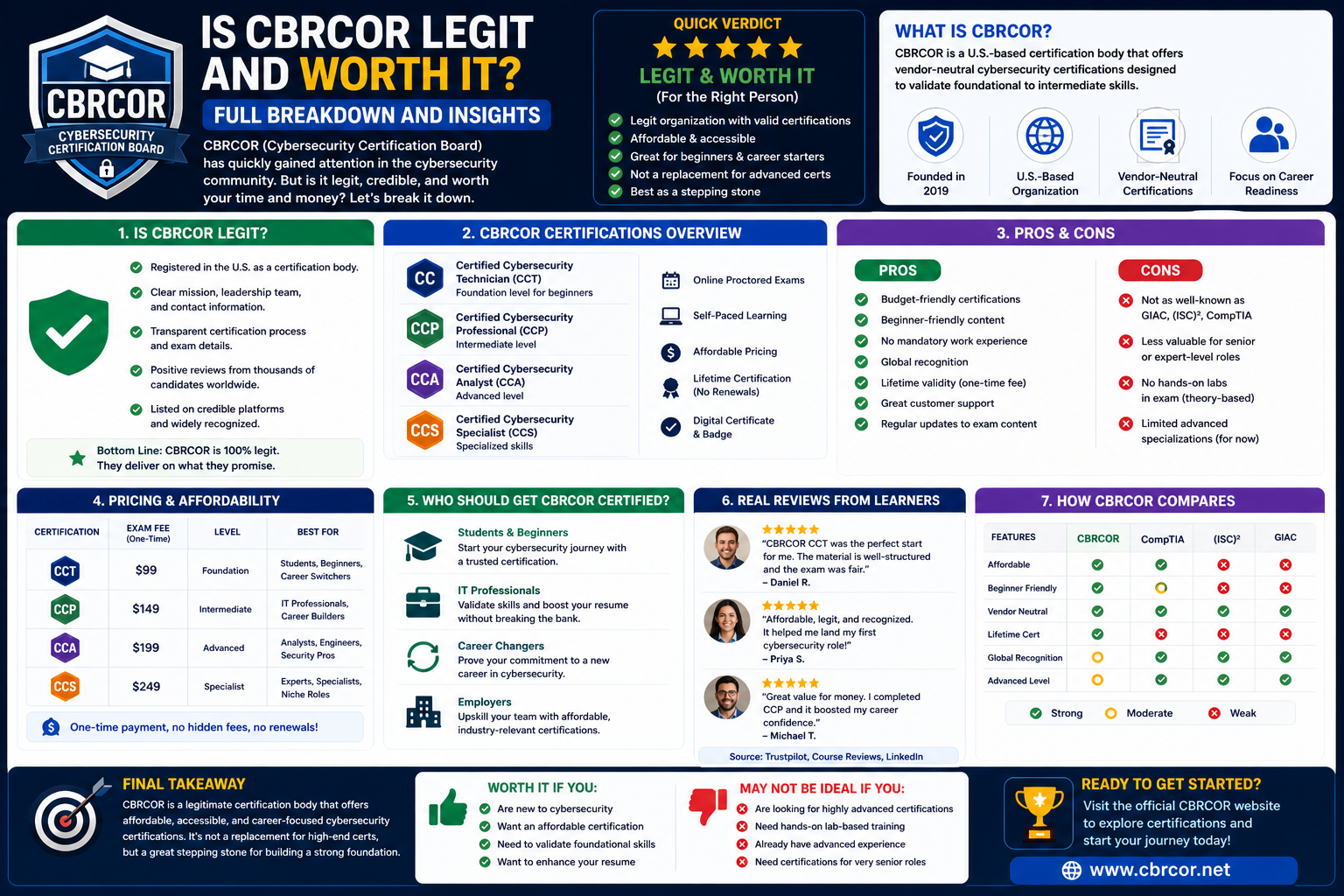
The CBRCOR exam, formally known as Performing CyberOps Using Cisco Security Technologies, is designed to assess how well a cybersecurity professional can operate in real-world security operations environments. It is positioned at a senior analytical level, meaning it goes beyond basic awareness of cybersecurity concepts and moves into applied decision-making, threat response, and operational security thinking.
In modern organizations, cybersecurity is no longer limited to isolated tools or simple monitoring dashboards. Instead, it is a layered ecosystem involving cloud environments, distributed networks, automated detection systems, and continuously evolving attack methods. The CBRCOR exam reflects this complexity by focusing on how security professionals interpret threats, respond to incidents, and work with enterprise-grade security technologies.
Unlike entry-level certifications that focus primarily on foundational theory, CBRCOR emphasizes applied cybersecurity in operational environments. This includes security monitoring, incident response coordination, threat analysis, and the use of security tools within structured workflows. The exam is built to simulate how a security analyst or engineer would function in a Security Operations Center (SOC), where rapid analysis and accurate decision-making are critical.
The exam is also notable for its alignment with real-world enterprise security frameworks. Rather than testing memorization alone, it evaluates how candidates approach security problems in dynamic environments where context, prioritization, and technical understanding must all work together.
The Role of CBRCOR in Security Operations Centers
Security Operations Centers serve as the central command hubs for cybersecurity monitoring and response. In these environments, analysts continuously monitor network traffic, endpoint activity, cloud services, and system logs to identify suspicious behavior. The CBRCOR exam is structured around the types of responsibilities commonly found in these environments.
A SOC analyst or senior cybersecurity professional is expected to recognize abnormal patterns quickly. These could include unusual login attempts, data exfiltration indicators, privilege escalation attempts, or distributed denial-of-service patterns. The CBRCOR exam tests whether a candidate can not only identify these events but also understand their significance in a broader security context.
In a real SOC environment, alerts are often high in volume but vary in severity. One of the key skills evaluated in CBRCOR is the ability to prioritize threats based on potential impact. For example, a low-level scan might not require immediate action, but signs of lateral movement within a network could indicate a serious breach in progress. The exam emphasizes this decision-making ability because it reflects real operational pressures.
Another important aspect of SOC work is collaboration. Analysts rarely work in isolation. They communicate with incident response teams, network engineers, cloud administrators, and management stakeholders. CBRCOR indirectly reflects this collaborative environment by requiring understanding of processes and workflows that extend beyond individual technical tasks.
The exam also emphasizes structured response procedures. In a SOC, incident response is not random or reactive in a chaotic sense; it follows defined playbooks and escalation paths. CBRCOR evaluates whether candidates understand how such processes are applied in real environments, ensuring consistency and accuracy in response actions.
Core Cybersecurity Knowledge Expected in CBRCOR
Although CBRCOR is strongly focused on applied skills, it still requires a solid foundation of cybersecurity principles. Without this foundation, it becomes difficult to interpret threats or apply correct mitigation strategies.
One of the key areas is threat classification. Cyber threats come in many forms, including malware infections, phishing attacks, denial-of-service attempts, insider threats, and advanced persistent threats. Each type behaves differently and requires different detection and response strategies. The exam expects candidates to distinguish between these categories and understand their typical behaviors.
Another essential area is understanding system vulnerabilities. Modern IT systems are complex and often include multiple layers such as operating systems, applications, APIs, and cloud services. Each layer introduces potential weaknesses. CBRCOR evaluates whether candidates understand how vulnerabilities can be exploited and how attackers move through systems once access is gained.
Network security fundamentals also play a major role. This includes understanding how traffic flows through networks, how segmentation improves security, and how monitoring tools detect anomalies. While deep protocol analysis may not always be required, a strong conceptual understanding of network behavior is essential.
Additionally, the exam requires familiarity with security policies and compliance frameworks. Organizations operate under various regulatory requirements depending on industry and geography. These may include data protection laws, financial compliance standards, or international security guidelines. CBRCOR expects candidates to recognize the purpose of these frameworks and how they influence security practices.
Cloud security awareness is another critical component. As organizations move workloads to cloud environments, traditional security boundaries become less defined. CBRCOR includes scenarios that reflect cloud-based threats and requires understanding of how security responsibilities are shared between service providers and organizations.
Analytical Thinking in Cyber Threat Environments
One of the most important skills tested in CBRCOR is analytical thinking. Cybersecurity professionals must interpret large volumes of data, identify meaningful patterns, and make decisions based on incomplete or evolving information.
In real-world environments, security alerts rarely provide a complete picture. Instead, they offer fragments of information that must be pieced together. For example, a single failed login attempt may not indicate a threat, but a pattern of repeated attempts across multiple accounts and locations could signal a brute-force attack or credential stuffing attempt.
CBRCOR evaluates how candidates interpret these fragmented signals. It is not enough to recognize that something is unusual; it is necessary to understand what it implies within a broader attack scenario. This requires both technical knowledge and logical reasoning.
Another important aspect is correlation. Security systems generate logs from different sources such as firewalls, intrusion detection systems, endpoint protection tools, and cloud platforms. Analysts must correlate these logs to build a complete picture of an event. CBRCOR reflects this need by presenting situations where multiple indicators must be combined to identify the correct conclusion.
Context awareness is also critical. The same event may have different implications depending on where it occurs in a system. For example, administrative activity on a production server may be normal if performed by authorized personnel, but suspicious if it occurs outside scheduled maintenance windows or from unexpected locations.
Analytical thinking in cybersecurity also involves understanding attacker behavior. Modern cyberattacks are often staged in phases, beginning with reconnaissance, followed by initial access, privilege escalation, lateral movement, and finally data exfiltration or disruption. CBRCOR assesses whether candidates understand these stages and can identify where a given scenario fits within the attack lifecycle.
Security Technologies and Their Operational Use
CBRCOR places strong emphasis on how security technologies are used in practice rather than just theoretical knowledge of what they do. In enterprise environments, security tools are integrated into workflows and continuously generate data that must be interpreted correctly.
Endpoint security tools, for example, monitor individual devices for malicious behavior. These tools can detect suspicious file execution, unauthorized changes to system configurations, or abnormal process activity. However, they often produce alerts that require human interpretation. CBRCOR evaluates how well candidates understand these outputs and how they translate into actionable responses.
Network monitoring systems are another key area. These systems analyze traffic patterns to detect anomalies such as unusual data transfers, communication with suspicious external servers, or unexpected internal connections. Understanding how to interpret these signals is essential for identifying potential breaches.
Cloud security tools introduce additional complexity. Unlike traditional infrastructure, cloud environments are highly dynamic and scalable. Resources can be created and destroyed rapidly, making monitoring more challenging. CBRCOR includes scenarios where candidates must consider how cloud architecture impacts security visibility and control.
Security orchestration and automation concepts are also relevant. In modern environments, many security tasks are partially automated to reduce response time. However, automation must be carefully designed to avoid false positives or missed threats. CBRCOR evaluates whether candidates understand how automation supports security operations without replacing human judgment.
Incident Response and Structured Security Processes
Incident response is one of the most important components of cybersecurity operations, and CBRCOR places significant focus on it. When a security incident occurs, organizations follow structured processes to identify, contain, eradicate, and recover from threats.
The first stage of incident response involves detection and validation. Not every alert represents a true security incident, so analysts must determine whether an alert is legitimate. This requires evaluating evidence and ruling out false positives.
Once an incident is confirmed, containment becomes the priority. The goal is to limit the spread of the threat and prevent further damage. This might involve isolating affected systems, disabling compromised accounts, or blocking malicious traffic.
After containment, the focus shifts to eradication. This involves removing the root cause of the incident, such as malware, unauthorized access, or misconfigurations. It is important to ensure that attackers no longer have access to the system.
Finally, recovery involves restoring normal operations. Systems are brought back online, data is restored if necessary, and monitoring is increased to ensure no residual threats remain.
CBRCOR evaluates understanding of these stages and how they are applied in different scenarios. Candidates are expected to recognize which actions are appropriate at each stage and how decisions impact overall incident outcomes.
Threat Intelligence and Indicator Analysis
Threat intelligence plays a crucial role in modern cybersecurity operations. It involves collecting and analyzing information about potential threats, attackers, and vulnerabilities. This intelligence helps organizations anticipate attacks and strengthen defenses.
One key component of threat intelligence is Indicators of Compromise (IOCs). These are pieces of evidence that suggest a system may have been breached. Examples include unusual IP addresses, suspicious file hashes, or abnormal network traffic patterns.
CBRCOR assesses how well candidates understand IOCs and how they are used in investigation processes. Analysts must be able to interpret these indicators and determine whether they represent active threats or benign activity.
Another aspect of threat intelligence is understanding attack patterns. Cyber attackers often reuse techniques, tools, and infrastructure across multiple attacks. By recognizing these patterns, security professionals can anticipate future behavior and strengthen defenses accordingly.
Threat intelligence also involves prioritization. Not all threats are equally dangerous, and organizations must focus their resources on the most significant risks. CBRCOR evaluates whether candidates can assess threat severity and recommend appropriate responses.
Introduction to Automation in Cybersecurity Operations
Automation is becoming increasingly important in cybersecurity environments. As the volume of security data grows, manual analysis alone is no longer sufficient. Automation helps streamline detection, response, and reporting processes.
In cybersecurity operations, automation is often used to filter alerts, correlate events, and trigger predefined responses. For example, if a known malicious IP address is detected, an automated system may immediately block it without human intervention.
However, automation is not without challenges. Poorly configured automation can lead to false positives or unintended disruptions. CBRCOR evaluates whether candidates understand the balance between automation and human oversight.
Basic scripting and data interpretation skills are also relevant. While deep programming knowledge is not required, understanding how scripts function and how data flows through automated systems is important.
Automation also plays a role in DevOps environments, where security is integrated into software development pipelines. Continuous integration and continuous deployment processes often include automated security checks to ensure vulnerabilities are identified early.
Practical Mindset Required for CBRCOR-Level Thinking
Beyond technical knowledge, CBRCOR emphasizes a practical mindset. Cybersecurity professionals must think like attackers while acting like defenders. This dual perspective helps them anticipate threats and design stronger defenses.
Practical cybersecurity thinking involves curiosity, attention to detail, and skepticism. Analysts must question unusual behavior rather than assuming it is harmless. At the same time, they must avoid jumping to conclusions without sufficient evidence.
Another important mindset is adaptability. Cyber threats evolve constantly, and security professionals must stay flexible in their approach. What works against one type of attack may not be effective against another.
CBRCOR reflects this need for adaptability by presenting scenarios that require interpretation rather than fixed answers. Candidates must evaluate context, consider multiple possibilities, and choose the most appropriate response based on available information.
Finally, resilience is essential. Cybersecurity work often involves high-pressure situations where quick decisions must be made with incomplete data. CBRCOR evaluates whether candidates can maintain structured thinking even under complex conditions.
Operational Security Techniques in Enterprise Cyber Environments
Modern cybersecurity operations rely heavily on practical techniques that can be applied in real-time environments where threats evolve continuously. The CBRCOR exam reflects this reality by focusing on how security professionals apply defensive measures using structured methods rather than theoretical knowledge alone.
Operational security techniques involve a combination of system hardening, monitoring, detection, and response strategies. These techniques are not isolated actions but part of a continuous cycle of improvement. In enterprise environments, attackers constantly search for weak points, and defenders must ensure systems are consistently reinforced against exploitation.
One of the foundational operational techniques is system hardening. This refers to the process of reducing vulnerabilities in systems by removing unnecessary services, applying secure configurations, and enforcing strict access controls. Hardening is especially important in environments where systems are exposed to external networks or cloud infrastructure.
Another critical technique is continuous monitoring. Security professionals must ensure that systems are monitored at all times for unusual behavior. This includes monitoring login patterns, file modifications, network traffic, and application behavior. The CBRCOR exam emphasizes how these monitoring systems generate alerts and how analysts interpret them in real time.
Detection techniques also play a major role in operational security. These techniques are designed to identify malicious behavior as early as possible. Detection systems rely on signatures, behavioral analysis, and anomaly detection. Each approach has strengths and weaknesses, and CBRCOR evaluates understanding of when each method is most effective.
Response techniques complete the operational cycle. Once a threat is detected, security teams must act quickly to contain and neutralize it. This may involve isolating systems, blocking network traffic, disabling accounts, or deploying patches. The effectiveness of response actions often determines the overall impact of a security incident.
Machine Behavior and Anomaly Detection in Security Systems
One of the most important developments in cybersecurity operations is the use of machine behavior analysis. Instead of relying solely on known threat signatures, modern systems analyze behavior patterns to detect anomalies that may indicate malicious activity.
Anomaly detection works by establishing a baseline of normal behavior. This baseline includes typical network traffic patterns, user login times, system resource usage, and application interactions. Once this baseline is established, any deviation from normal behavior is flagged for further investigation.
For example, if a user typically logs in during business hours from a specific location, a login attempt from a different country at an unusual time may be flagged as suspicious. Similarly, a server that suddenly begins sending large volumes of data to an external IP address may indicate data exfiltration.
CBRCOR evaluates understanding of how these anomaly detection systems operate and how analysts interpret their outputs. Not every anomaly represents a threat, so analysts must distinguish between benign irregularities and actual security incidents.
Another important aspect of behavior analysis is lateral movement detection. Attackers who gain initial access to a system often attempt to move through the network to reach sensitive data. This movement can sometimes be subtle and difficult to detect without behavioral analysis tools.
Machine behavior analysis also extends to endpoint devices. Workstations, laptops, and servers all generate behavioral data that can be analyzed for suspicious activity. This includes process creation, file access patterns, and memory usage behavior.
The challenge in anomaly detection lies in balancing sensitivity and accuracy. Highly sensitive systems may generate too many false positives, while less sensitive systems may miss real threats. CBRCOR expects candidates to understand this trade-off and how it impacts operational security decisions.
Threat Mitigation Strategies in Complex Environments
Threat mitigation is a core responsibility of cybersecurity professionals. It involves reducing the impact of threats by implementing preventative and reactive measures. CBRCOR places strong emphasis on understanding how mitigation strategies are applied in enterprise environments.
One of the most common mitigation strategies is access control enforcement. This ensures that only authorized users can access specific systems or data. Access control can be role-based, attribute-based, or policy-driven depending on organizational requirements.
Another key strategy is network segmentation. By dividing networks into isolated segments, organizations can limit the spread of attacks. If one segment is compromised, segmentation prevents attackers from easily accessing other parts of the network.
Patch management is also a critical mitigation strategy. Many cyberattacks exploit known vulnerabilities in software or operating systems. Regular patching reduces the attack surface and helps prevent exploitation of these weaknesses.
Encryption is another important mitigation technique. By encrypting sensitive data both in transit and at rest, organizations ensure that even if data is intercepted, it cannot be easily read or used by attackers.
CBRCOR also emphasizes mitigation through monitoring and rapid response. Even if preventive measures fail, effective detection and response can significantly reduce damage. This layered approach to security is essential in modern cybersecurity environments.
Understanding Security Tool Ecosystems in Enterprise Networks
Enterprise cybersecurity relies on a wide range of tools that work together to provide visibility and protection across systems. These tools form an ecosystem that must be properly configured and managed to be effective.
Endpoint protection tools are designed to secure individual devices. They monitor for malicious activity such as unauthorized file execution, registry changes, or suspicious process behavior. These tools often generate alerts that must be analyzed by security teams.
Network security tools focus on monitoring traffic between systems. They can detect unusual communication patterns, unauthorized connections, and potential data exfiltration attempts. These tools are essential for identifying threats that move across network boundaries.
Security information and event management systems collect data from multiple sources and aggregate it into a centralized platform. This allows analysts to correlate events and identify patterns that may not be visible in isolated logs.
Cloud security tools are increasingly important as organizations move infrastructure to cloud environments. These tools provide visibility into cloud workloads, configurations, and access controls.
CBRCOR expects candidates to understand how these tools interact and how data flows between them. Security operations are most effective when these tools are integrated and work together rather than functioning in isolation.
Data Protection Techniques and Information Security
Protecting sensitive data is one of the most important objectives in cybersecurity. Data breaches can result in financial loss, reputational damage, and legal consequences. CBRCOR evaluates understanding of how data protection techniques are applied in real environments.
One of the primary methods of data protection is classification. Data is categorized based on sensitivity levels, such as public, internal, confidential, or restricted. Each category has different security requirements.
Data loss prevention technologies help ensure that sensitive information does not leave the organization without authorization. These systems monitor data transfers and block suspicious activity.
Access logging is another important technique. By tracking who accesses data and when, organizations can detect unauthorized usage patterns and investigate incidents more effectively.
Secure data storage practices are also critical. This includes encryption, access controls, and redundancy measures to ensure data remains safe even in the event of system failure or attack.
CBRCOR highlights the importance of combining multiple data protection techniques rather than relying on a single method. Effective security requires layered defenses.
Cloud Security Challenges and Operational Considerations
Cloud computing has transformed how organizations manage infrastructure, but it has also introduced new security challenges. CBRCOR includes cloud-related scenarios to reflect this shift in modern IT environments.
One of the main challenges in cloud security is shared responsibility. Cloud service providers manage certain aspects of security, while organizations are responsible for others. Understanding this division is essential for proper security management.
Another challenge is visibility. In traditional environments, organizations have full control over infrastructure. In cloud environments, visibility depends on provider tools and configurations.
Identity and access management becomes especially important in cloud systems. Since cloud resources are accessed remotely, strong authentication and authorization mechanisms are required.
Misconfigurations are a common source of cloud security issues. Incorrectly configured storage buckets, overly permissive access policies, and exposed services can lead to data breaches.
CBRCOR evaluates understanding of how these risks are managed and how cloud environments differ from traditional infrastructure in terms of security operations.
Incident Escalation and Decision-Making Processes
In cybersecurity operations, not all incidents are handled at the same level. Some issues require immediate escalation to senior analysts or specialized response teams. CBRCOR evaluates understanding of escalation processes and decision-making frameworks.
Escalation is typically based on severity and impact. Low-risk incidents may be handled by junior analysts, while high-risk incidents involving active breaches require immediate escalation.
Decision-making in incident response requires balancing speed and accuracy. Delayed response can allow attackers to cause more damage, while rushed decisions can lead to unnecessary disruptions.
Analysts must also consider business impact when making decisions. Some systems may be more critical than others, and downtime can have different consequences depending on the environment.
Clear communication is essential during escalation. Analysts must provide accurate and concise information to ensure that higher-level teams can take appropriate action.
CBRCOR reflects these real-world challenges by presenting scenarios where candidates must determine appropriate escalation paths and response strategies.
Security Automation in Modern Defense Systems
Automation plays an increasingly important role in cybersecurity operations. As threats become more complex and frequent, automation helps organizations respond faster and more efficiently.
One of the key uses of automation is alert filtering. Security systems generate large volumes of alerts, many of which are not critical. Automation helps filter out noise and highlight important events.
Another use is automated response. In some cases, predefined actions can be triggered automatically when specific conditions are met. For example, blocking an IP address after repeated failed login attempts.
Automation also supports vulnerability management. Systems can automatically scan for vulnerabilities and generate reports for remediation teams.
However, automation must be carefully managed. Poorly designed automation rules can lead to false positives or unintended disruptions in services.
CBRCOR evaluates understanding of how automation fits into security operations and how it complements human decision-making.
Threat Intelligence Integration in Security Operations
Threat intelligence provides valuable context for security operations. It involves gathering information about known threats, attacker behavior, and emerging vulnerabilities.
In operational environments, threat intelligence is integrated into monitoring systems to improve detection accuracy. For example, known malicious IP addresses or domains can be automatically flagged.
Threat intelligence also helps prioritize alerts. If a detected activity matches known attack patterns, it may be treated as higher priority.
Another important aspect is intelligence sharing. Organizations often share threat information to improve collective defense.
CBRCOR emphasizes understanding how threat intelligence supports operational decision-making and enhances overall security effectiveness.
Behavioral Decision Patterns in Cybersecurity Analysts
Cybersecurity analysts must make decisions under pressure, often with incomplete information. These decisions are influenced by experience, training, and structured processes.
One common decision pattern is pattern recognition. Experienced analysts can quickly identify familiar attack behaviors based on past incidents.
Another pattern is hypothesis testing. Analysts form theories about what may be happening and then test those theories using available data.
Risk-based decision-making is also important. Analysts must weigh the potential impact of different actions and choose the most appropriate response.
CBRCOR evaluates whether candidates understand these decision-making patterns and can apply them in realistic scenarios.
Continuous Improvement in Security Operations
Cybersecurity is not a static field. Threats evolve continuously, and security practices must evolve as well. Continuous improvement is a core principle in modern security operations.
This involves analyzing past incidents to identify weaknesses and improve defenses. It also includes updating tools, processes, and policies based on new threats.
Training and skill development are also part of continuous improvement. Security teams must stay updated on emerging technologies and attack methods.
CBRCOR reflects this principle by emphasizing adaptability and ongoing learning in cybersecurity operations.
Security Processes in High-Pressure Cyber Operations Environments
Security operations in enterprise environments depend heavily on well-defined processes. Without structured processes, even highly skilled cybersecurity professionals would struggle to respond effectively to incidents. The CBRCOR exam places strong emphasis on how these processes are understood, interpreted, and applied in real-world scenarios.
In a Security Operations Center, processes act as the backbone of daily operations. They define how alerts are handled, how incidents are escalated, how threats are analyzed, and how responses are coordinated. These processes ensure consistency, reduce human error, and allow teams to operate efficiently under pressure.
One of the most important aspects of security processes is standardization. When every analyst follows the same structured approach, it becomes easier to identify issues, track progress, and maintain accountability. Standardization also ensures that critical steps are not missed during incident response.
CBRCOR evaluates understanding of these structured workflows by presenting scenarios where candidates must determine the correct procedural steps. This includes identifying when to escalate an issue, how to classify a threat, and what mitigation steps should be prioritized.
Another key component of security processes is documentation. Every action taken during an incident must be recorded for future analysis. This documentation helps organizations learn from past incidents and improve their security posture over time.
Incident Lifecycle Management in Cybersecurity Operations
Incident lifecycle management is a structured approach to handling security events from detection to resolution. It ensures that incidents are managed efficiently and consistently across the organization.
The lifecycle typically begins with identification. During this phase, potential security events are detected through monitoring systems, alerts, or user reports. Not every event is a true incident, so analysts must validate whether further investigation is required.
Once an incident is confirmed, classification occurs. This involves determining the type of incident, its severity, and its potential impact on systems and data. Classification helps prioritize response efforts and allocate resources effectively.
The next phase is containment. The goal of containment is to prevent the incident from spreading or causing additional damage. This may involve isolating affected systems, blocking malicious traffic, or disabling compromised accounts.
After containment, eradication begins. This phase focuses on removing the root cause of the incident, such as malware, unauthorized access, or vulnerable configurations. Proper eradication ensures that the threat cannot reappear.
Recovery is the next step, where systems are restored to normal operation. This may involve restoring data from backups, reconfiguring systems, or verifying system integrity.
Finally, post-incident analysis is conducted. This phase is critical for learning from the incident and improving future response strategies. It involves reviewing what happened, how it was handled, and what could be improved.
CBRCOR evaluates understanding of this lifecycle by testing how candidates apply each stage in different scenarios.
Indicators of Compromise and Evidence-Based Investigation
Indicators of Compromise (IOCs) are critical pieces of evidence used in cybersecurity investigations. They help analysts identify whether a system has been breached or is under attack.
IOCs can take many forms, including suspicious IP addresses, unusual domain names, file hashes, or abnormal system behavior. These indicators are often discovered through monitoring tools, threat intelligence feeds, or forensic analysis.
One of the key challenges in working with IOCs is determining their relevance. Not every indicator represents an active threat. Some may be false positives or benign anomalies.
CBRCOR evaluates whether candidates can interpret IOCs correctly and use them to guide investigation decisions. This requires both technical knowledge and contextual awareness.
Evidence-based investigation involves collecting multiple indicators and correlating them to build a complete picture of an incident. For example, a suspicious login combined with unusual data transfer activity may indicate a compromised account.
Analysts must also consider the reliability of evidence sources. Some sources may be more trustworthy than others, and this must be factored into decision-making.
Vulnerability Assessment and Risk Prioritization
Vulnerability assessment is a systematic process used to identify weaknesses in systems, applications, and networks. Once vulnerabilities are identified, they must be evaluated and prioritized based on risk.
Not all vulnerabilities pose the same level of threat. Some may be critical and easily exploitable, while others may have limited impact or require complex exploitation methods.
Risk prioritization involves assessing both the likelihood of exploitation and the potential impact on the organization. This helps security teams focus on the most dangerous vulnerabilities first.
CBRCOR evaluates understanding of how vulnerabilities are assessed and prioritized in real-world environments. Candidates must be able to interpret risk levels and recommend appropriate mitigation strategies.
One commonly used method for vulnerability assessment is scoring systems. These systems assign numerical values to vulnerabilities based on severity. However, scores alone are not enough; context must also be considered.
For example, a vulnerability in a non-critical system may be less urgent than a lower-scoring vulnerability in a mission-critical system.
Security Playbooks and Automated Response Strategies
Security playbooks are predefined sets of instructions that guide analysts during incident response. They ensure that responses are consistent, efficient, and aligned with organizational policies.
Playbooks typically include step-by-step actions for handling specific types of incidents. For example, there may be separate playbooks for malware infections, phishing attacks, or data breaches.
One of the key advantages of playbooks is speed. During a security incident, time is critical. Playbooks allow analysts to respond quickly without needing to determine every step from scratch.
CBRCOR evaluates understanding of how playbooks are used in operational environments. Candidates must know how to interpret and follow structured response procedures.
Automation is often integrated into playbooks to improve efficiency. Certain actions, such as isolating a system or blocking an IP address, can be automated to reduce response time.
However, automation must be carefully controlled. Over-reliance on automation can lead to unintended consequences if not properly configured.
Security Automation and Workflow Optimization
Security automation is increasingly important in modern cybersecurity environments due to the large volume of data and alerts generated daily.
Automation helps reduce manual workload by handling repetitive tasks such as log analysis, alert filtering, and basic incident response actions.
Workflow optimization involves designing security processes that integrate automation effectively while maintaining human oversight.
For example, automated systems may handle low-level alerts, while high-priority incidents are escalated to human analysts.
CBRCOR evaluates understanding of how automation fits into broader security workflows and how it improves operational efficiency.
Another important aspect is orchestration. Security orchestration involves coordinating multiple tools and systems to work together during incident response.
This ensures that different security components communicate effectively and respond in a coordinated manner.
Cybersecurity Metrics and Performance Evaluation
Measuring the effectiveness of security operations is essential for continuous improvement. Cybersecurity metrics provide insight into how well security processes are performing.
Common metrics include detection time, response time, incident resolution time, and false positive rates.
Detection time measures how quickly threats are identified after they occur. Faster detection reduces the potential impact of attacks.
Response time measures how quickly analysts begin addressing an incident after detection.
Resolution time measures how long it takes to fully resolve an incident.
False positive rates indicate how often alerts are incorrectly classified as threats. High false positive rates can reduce efficiency and increase workload.
CBRCOR evaluates understanding of how these metrics are used to assess and improve security operations.
Advanced Threat Modeling Techniques
Threat modeling is a structured approach used to identify potential threats and vulnerabilities in systems before they are exploited.
It involves analyzing system architecture, identifying potential attack vectors, and evaluating security controls.
One common method of threat modeling is breaking systems into components and analyzing how each component could be attacked.
Another approach involves simulating attacker behavior to identify weak points in the system.
CBRCOR evaluates understanding of how threat modeling is applied in practical environments.
Threat modeling also helps organizations prioritize security investments by identifying the most critical risks.
Digital Forensics in Cyber Incident Investigation
Digital forensics is the process of collecting and analyzing digital evidence to investigate security incidents.
This may involve analyzing system logs, memory dumps, file systems, and network traffic.
One of the key principles of digital forensics is evidence preservation. Investigators must ensure that evidence is not altered during collection.
Another important principle is chain of custody. This ensures that evidence is properly documented and tracked throughout the investigation process.
CBRCOR evaluates understanding of how forensic techniques support incident investigation and threat analysis.
Digital forensics also plays a role in identifying attack methods and understanding how breaches occurred.
Security Governance and Policy Enforcement
Security governance refers to the policies, procedures, and standards that guide cybersecurity operations within an organization.
It ensures that security practices align with organizational goals and regulatory requirements.
Policy enforcement involves ensuring that users and systems comply with established security rules.
For example, access control policies define who can access specific systems and under what conditions.
CBRCOR evaluates understanding of how governance structures influence security operations.
Governance also plays a role in risk management, ensuring that security decisions align with business objectives.
Behavioral Analysis in Advanced Cyber Threat Detection
Behavioral analysis is a technique used to detect threats based on how systems and users behave rather than relying solely on known signatures.
This approach is particularly useful for detecting unknown or emerging threats.
For example, if a user suddenly begins accessing large volumes of sensitive data, this may indicate compromised credentials.
CBRCOR evaluates understanding of how behavioral analysis is used in modern security systems.
Behavioral detection systems continuously learn from data to improve accuracy over time.
Security Architecture and Defense in Depth Strategies
Security architecture refers to the overall design of an organization’s security infrastructure.
One of the most important principles in security architecture is defense in depth.
This approach involves implementing multiple layers of security controls so that if one layer fails, others still provide protection.
For example, a system may include firewalls, intrusion detection systems, endpoint protection, and access controls.
CBRCOR evaluates understanding of how layered security strategies reduce overall risk.
Defense in depth ensures that attackers must overcome multiple barriers, making successful attacks more difficult.
Real-World Cybersecurity Decision Frameworks
Cybersecurity professionals must make decisions based on structured frameworks that guide response actions.
These frameworks help ensure consistency and reduce subjective decision-making.
One common approach is risk-based decision-making, where actions are prioritized based on potential impact.
Another approach is playbook-driven decision-making, where predefined procedures guide responses.
CBRCOR evaluates whether candidates understand how these frameworks are applied in operational environments.
Decision frameworks also help reduce uncertainty during high-pressure incidents.
Continuous Monitoring and Adaptive Defense Systems
Continuous monitoring is essential for maintaining security in dynamic environments.
It involves real-time analysis of system activity, network traffic, and user behavior.
Adaptive defense systems use monitoring data to adjust security controls dynamically.
For example, if suspicious activity is detected, access controls may be temporarily tightened.
CBRCOR evaluates understanding of how continuous monitoring supports proactive security.
Adaptive systems improve resilience by responding to threats in real time rather than relying on static configurations.
Evolving Role of Cybersecurity Professionals in Modern Enterprises
The role of cybersecurity professionals has evolved significantly as technology has advanced.
Today’s security professionals must understand not only technical systems but also business processes, cloud environments, and automation technologies.
They must also be able to interpret complex data and make informed decisions under pressure.
CBRCOR reflects this evolution by focusing on practical skills and real-world scenarios rather than theoretical knowledge alone.
Cybersecurity is now a dynamic field requiring continuous learning, adaptability, and analytical thinking.
Conclusion
The CBRCOR exam represents a practical benchmark for cybersecurity professionals who want to demonstrate their ability to operate in real-world security environments. Unlike certifications that focus mainly on theoretical knowledge, it emphasizes applied skills such as incident response, threat analysis, operational security techniques, and structured decision-making within Security Operations Centers.
Across modern enterprise systems, cybersecurity is no longer limited to monitoring logs or reacting to isolated alerts. It now involves managing complex environments that include cloud infrastructure, distributed networks, automated detection systems, and constantly evolving attack methods. The CBRCOR framework reflects this reality by testing how well candidates can interpret security data, identify meaningful threats, and respond effectively under pressure.
One of the key strengths of the CBRCOR exam is its focus on structured processes. Security operations depend heavily on consistency, and professionals must follow defined workflows for detection, escalation, containment, and recovery. Understanding these processes ensures that incidents are handled efficiently and that risks are minimized.
Another important aspect highlighted throughout CBRCOR is analytical thinking. Cybersecurity professionals must evaluate incomplete information, correlate multiple indicators, and make decisions that balance speed and accuracy. This ability to think critically in dynamic environments is essential for effective defense against modern threats.
Overall, CBRCOR aligns closely with the real demands of cybersecurity roles such as SOC analyst, incident responder, and security engineer. It helps validate not only technical understanding but also operational readiness. In a field where threats continue to evolve rapidly, such practical competence remains a valuable asset for any cybersecurity professional aiming to grow in their career.