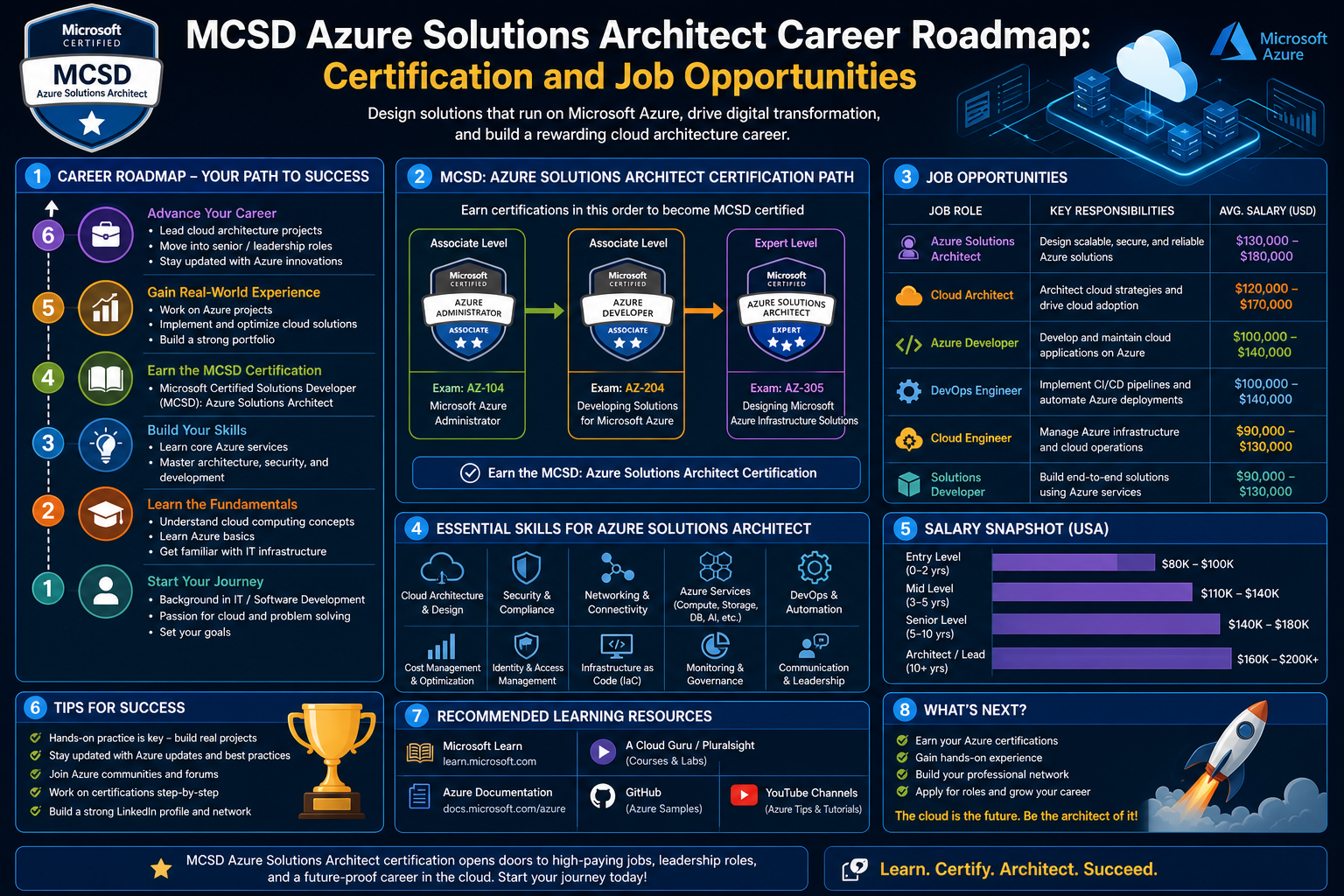
The world of information technology has changed dramatically over the last decade, and one of the biggest drivers of that change has been cloud computing. Organizations of every size now rely on cloud platforms to host applications, store data, improve security, and scale services quickly. Among the major cloud providers, Microsoft Azure has become one of the most widely adopted platforms in enterprise environments. As businesses move their operations into the cloud, the need for professionals who can design and manage reliable cloud systems has grown at an impressive pace.
Within this evolving landscape, the MCSD Azure Solutions Architect certification became an important credential for individuals who wanted to validate their expertise in building and managing Azure-based solutions. It represented a professional path for learners interested in combining software development knowledge with infrastructure design, cloud architecture, and operational planning. Rather than focusing only on coding or only on system administration, this certification recognized the broad skill set required to create complete cloud solutions.
For many learners, understanding where this certification fits into the larger Microsoft ecosystem can feel confusing. Microsoft certifications have changed several times over the years, and titles, exam structures, and pathways have been updated to reflect changing technologies. To appreciate the value of the MCSD Azure Solutions Architect certification, it helps to understand the certification environment in which it existed and the role it played for aspiring cloud professionals.
Why Azure Skills Became So Valuable
Cloud computing changed how companies think about technology. In the past, businesses often purchased expensive physical servers, maintained their own data centers, and handled upgrades manually. This approach required significant investment, ongoing maintenance, and dedicated teams to keep systems running efficiently.
Azure introduced a more flexible model. Instead of buying hardware upfront, organizations could rent computing resources as needed. They could deploy virtual machines, databases, networking tools, identity services, analytics systems, and development environments within minutes. This made it easier to launch products faster, support remote teams, and respond to changing market conditions.
Because Azure became especially popular with companies already using Microsoft products such as Windows Server, Active Directory, SQL Server, and .NET technologies, demand for Azure professionals increased rapidly. Businesses wanted people who understood both traditional Microsoft systems and modern cloud platforms.
That demand created opportunities for developers, network engineers, system administrators, database specialists, security professionals, and project managers who were willing to learn Azure. Certifications became one way to demonstrate readiness for these opportunities.
The MCSD Azure Solutions Architect certification appealed to professionals because it aligned with real business needs. Employers were not simply looking for someone who could click buttons in a cloud portal. They needed individuals who could make informed design decisions, build dependable systems, secure resources, optimize costs, and support business goals through technology.
What the Certification Represented
The title itself reveals much about the certification’s purpose. MCSD stood for Microsoft Certified Solutions Developer. Traditionally, MCSD credentials focused on software development and application-building expertise. However, the Azure Solutions Architect pathway extended beyond conventional programming responsibilities.
A solutions architect is expected to look at the bigger picture. Instead of focusing only on one application or one server, architects evaluate how multiple components work together. They think about scalability, resilience, compliance, integration, user needs, and long-term maintainability.
That meant the MCSD Azure Solutions Architect certification covered a wider professional scope than many other development-oriented certifications. Candidates were expected to understand how software applications interact with cloud infrastructure, how networking affects application performance, how identity systems secure access, and how deployment pipelines support rapid releases.
This broader expectation made the credential especially attractive to professionals who wanted to move into leadership or design-focused technical roles. It signaled that the holder could bridge the gap between development teams and operations teams while also understanding business priorities.
The Transition in Microsoft Certifications
Microsoft has historically refreshed its certification structure to match industry trends. As technologies evolve, certification programs must also evolve. During the time this certification existed, Microsoft reorganized several credentials to align more closely with modern job roles and cloud-first strategies.
The MCSD Azure Solutions Architect certification was eventually retired and replaced by newer cloud-focused certifications. This change did not erase the importance of the credential. Instead, it reflected how quickly cloud technology was advancing. Microsoft recognized that employers increasingly needed professionals with platform-wide expertise rather than narrow product-specific knowledge.
For learners at the time, earning the certification showed they were adapting to the future of IT. For professionals today, studying the path still provides useful insight into the core skills required for Azure architecture roles, even though certification names and exam codes have changed.
Many of the competencies measured under the old certification remain relevant now: cloud design, identity management, networking, application deployment, security planning, monitoring, automation, and business continuity.
The Three-Exam Structure
The certification was composed of three separate exams. Each exam focused on a different area of Azure expertise. Together, they formed a complete pathway that blended development, infrastructure, and architecture knowledge.
One exam focused on developing Azure solutions. This area tested the ability to build applications that use Azure services effectively. Candidates needed to understand how applications interact with storage, messaging systems, databases, authentication services, and deployment tools.
Another exam focused on implementing Azure infrastructure solutions. This covered the operational side of cloud computing. Learners needed to understand networking, virtual machines, storage accounts, identity systems, and resource management.
The final exam focused on architecting Azure solutions. This was where candidates demonstrated higher-level design thinking. Instead of only knowing how to deploy resources, they needed to know when and why to use them. They had to evaluate scenarios and recommend appropriate architectures based on performance, cost, security, and scalability.
This three-part structure was significant because it mirrored real workplace demands. In actual organizations, successful cloud professionals often need all three skill areas. They must understand how software is built, how systems are operated, and how enterprise solutions are designed.
Who the Certification Was Designed For
Although the credential was open to many learners, it was especially suitable for people with some prior technical experience. Those entering the pathway often came from backgrounds such as software development, system administration, database management, networking, or web development.
Developers found value in learning infrastructure concepts because modern applications depend heavily on cloud environments. Knowing how APIs, containers, identity systems, and storage services function within Azure improved their effectiveness.
System administrators benefited because traditional server management was shifting toward automation and cloud resource orchestration. Understanding Azure helped them transition from managing hardware to managing services.
Network professionals discovered that cloud networking required new thinking. Virtual networks, traffic routing, private connectivity, firewalls, and hybrid environments all became central to enterprise design.
Project leads and technical managers also found the certification useful because it provided structured understanding of how cloud systems are planned and delivered.
Even though experience helped, the pathway also motivated ambitious learners who wanted to build multidisciplinary expertise and move into higher-value technical roles.
Core Skills Behind the Credential
While exam objectives can change over time, the deeper skills measured by this certification remain timeless. At its heart, the credential rewarded professionals who could combine technical depth with practical judgment.
One major skill area was solution design. Candidates needed to know how to choose the right services for a given business need. For example, selecting between different storage options, database models, hosting methods, or authentication approaches required more than memorization.
Another core skill was scalability. Cloud systems must often handle unpredictable growth. Professionals needed to understand load balancing, elastic resources, distributed systems, and traffic management.
Security was another essential competency. Azure environments contain identities, applications, and data that must be protected. Candidates needed familiarity with permissions, encryption, access control, and governance practices.
Reliability also mattered. Businesses expect services to remain available even during failures. This meant understanding backups, redundancy, failover strategies, monitoring, and disaster recovery planning.
Cost awareness was equally important. Unlike fixed on-premises systems, cloud spending can grow quickly if poorly managed. Architects needed to balance performance goals with budget constraints.
Automation and deployment processes were also central. Repeating tasks manually becomes inefficient at scale. Candidates benefited from understanding scripting, templates, continuous deployment, and lifecycle management.
Why Employers Valued This Path
Employers often struggle to find professionals who understand both technology details and business impact. Many candidates specialize deeply in one area but have limited visibility into how entire systems function. The MCSD Azure Solutions Architect certification helped signal a more rounded capability.
A hiring manager seeing this credential could reasonably assume the candidate had engaged with development principles, infrastructure planning, and architecture decision-making. That combination reduced risk in hiring because modern IT roles frequently involve cross-functional collaboration.
For example, a company launching a customer-facing web platform may need someone who can discuss application requirements with developers, security requirements with compliance teams, budget expectations with leadership, and deployment processes with operations teams. Professionals with broad cloud architecture training are often better prepared for these conversations.
The certification also showed commitment to continuous learning. Cloud platforms evolve rapidly, and staying current requires discipline. Employers value candidates who actively update their skills rather than relying only on older experience.
The Broader Career Impact
One of the strongest benefits of pursuing a certification like this was not just the certificate itself, but the transformation in professional thinking that often happened during preparation.
Learners who previously focused only on coding began to think about uptime, security, and infrastructure dependencies. Those who previously focused only on servers began to appreciate development workflows and application design patterns.
This broader perspective often opened doors to new roles. Titles that aligned with such skills included cloud engineer, solutions architect, DevOps engineer, infrastructure consultant, technical lead, and systems designer.
Even when a learner did not immediately change jobs, the new knowledge could increase value within an existing role. Someone already employed might begin leading migration projects, advising teams on cloud strategy, or managing modernization efforts.
The certification path also encouraged confidence. Many professionals hesitate to pursue advanced roles because they feel their experience is too narrow. Structured learning across architecture topics can help bridge that gap.
Azure Architecture as a Mindset
A common misunderstanding is that architecture is simply drawing diagrams or choosing products. In reality, architecture is a mindset centered on balancing competing priorities.
Every technical decision involves trade-offs. Higher performance may increase cost. Stronger security may add complexity. Faster delivery may reduce flexibility. Simplified operations may limit customization.
The Azure Solutions Architect pathway encouraged candidates to think in terms of these trade-offs. Instead of asking only “Can this be built?” candidates learned to ask “Should it be built this way?”
That shift is valuable in every modern technology career. Whether someone becomes an engineer, consultant, manager, or entrepreneur, the ability to evaluate options thoughtfully is a major advantage.
How Learners Approached Preparation
Preparing for a certification of this level typically required more than reading definitions. Successful candidates often combined theory with practical experimentation.
They explored Azure services directly, learning how resources are created and connected. They studied networking concepts, identity management, storage behavior, and deployment models. They reviewed scenario-based problems requiring design choices.
Many learners also discovered gaps in their existing knowledge during preparation. A strong developer might need deeper networking understanding. A seasoned administrator might need stronger software lifecycle awareness. A database specialist might need broader security knowledge.
This process of discovering and closing skill gaps often became one of the most valuable outcomes of the journey.
Lasting Relevance in Today’s Market
Although the original certification has been retired, the professional value behind it remains highly relevant. Cloud roles today still demand the same blend of abilities: technical depth, system-wide thinking, adaptability, and communication.
Modern Azure certifications now use updated names and structures, but employers continue seeking people who can design secure, scalable, cost-effective solutions. Anyone studying the older pathway can still gain useful perspective on what enterprise cloud work requires.
The technologies may evolve from virtual machines to containers, from manual scripts to infrastructure as code, from isolated apps to distributed services, but the underlying need remains constant: organizations require professionals who can turn business goals into dependable technical systems.
Building a Strong Foundation Before Advancing
For learners considering any architecture-level path, foundational knowledge remains critical. Jumping directly into advanced topics without understanding core concepts can create frustration.
Networking fundamentals help explain connectivity, routing, firewalls, and hybrid cloud design. Operating system knowledge supports troubleshooting and performance tuning. Programming concepts help learners understand APIs, automation, and application behavior. Security basics provide context for identity and data protection. Database knowledge helps with storage and analytics decisions.
The MCSD Azure Solutions Architect path rewarded those who built this foundation first. Rather than treating architecture as a shortcut to prestige, it framed architecture as the result of accumulated technical understanding.
That lesson remains valuable for modern learners. The strongest architects are usually people who first became strong practitioners in one or more technical domains and then expanded outward into broader system design.
Mastering the Skills Required for an Azure Solutions Architect Career
Earning recognition in the cloud industry has never been only about passing exams or collecting credentials. The real value of a solutions architect path comes from developing the ability to solve business problems using technology. For anyone pursuing an Azure-focused architecture career, success depends on mastering a broad set of technical and professional skills that work together in practical environments. A true architect does not simply know features or memorize services. Instead, this professional understands how systems behave, how organizations operate, and how technology decisions affect long-term growth.
The role of an Azure Solutions Architect grew in importance because companies increasingly needed people who could guide their move to cloud environments with confidence. Many organizations adopted cloud services quickly, but speed often created challenges. Costs became unpredictable, security gaps emerged, systems were poorly connected, and teams lacked clear governance. Businesses then realized that they needed experts who could bring structure to cloud adoption.
That is where the solutions architect role became highly respected. This professional could evaluate business goals, choose the right Azure services, build resilient systems, and help teams avoid costly mistakes. The knowledge required to do this effectively covers many domains, which is why architecture-focused certification paths were considered demanding. They required more than surface-level understanding.
Thinking Like an Architect Instead of a Technician
One of the biggest shifts for learners moving toward architecture roles is changing how they think. A technician often focuses on completing a specific task. For example, creating a virtual machine, deploying an application, or fixing a network issue. These tasks are important, but architecture requires a wider lens.
An architect asks different questions. How will this system scale when user demand increases? What happens if a region becomes unavailable? How can costs be controlled over the next three years? Does the design meet security and compliance requirements? Can another team maintain this solution easily in the future?
This broader thinking transforms technical decision-making. Two people may know how to deploy the same resource, but the architect considers lifecycle impact, integration complexity, performance behavior, operational burden, and strategic alignment.
Developing this mindset is often more valuable than memorizing any individual service. Cloud platforms change frequently, but the ability to reason through design choices remains valuable throughout a career.
Understanding Azure Core Services
To work effectively in architecture roles, learners need strong familiarity with the major building blocks of Azure. These include compute, storage, networking, databases, identity, analytics, monitoring, and automation services.
Compute services are central because almost every solution needs processing power. Professionals should understand when to use virtual machines, container platforms, managed application hosting, and serverless execution models. Each has strengths depending on workload type, management preferences, and scaling needs.
Storage knowledge is equally important. Azure offers multiple storage approaches for files, objects, disks, archives, and structured data. Choosing the wrong model can increase costs or reduce performance. Architects must know which storage type best fits application behavior, access patterns, and retention requirements.
Database services support many modern applications. Some workloads need relational databases with strong consistency, while others benefit from globally distributed or schema-flexible models. Architects need to understand how data requirements shape design decisions.
Identity services form the security backbone of enterprise environments. Azure’s identity capabilities allow authentication, access control, and integration with business directories. Poor identity planning can create serious risk, so architects must treat identity as foundational rather than optional.
Monitoring tools are also critical. Every solution needs visibility into performance, errors, resource consumption, and user behavior. Without monitoring, organizations often discover issues only after customers are affected.
Networking Knowledge as a Core Strength
Many learners underestimate how important networking is for cloud architecture. Yet networking is involved in nearly every cloud deployment. If applications cannot communicate securely and efficiently, the solution fails regardless of how advanced the rest of the design may be.
Architects need to understand virtual networks, subnets, traffic routing, load balancing, name resolution, hybrid connectivity, private endpoints, segmentation, and firewall strategies. They should know how traffic flows between users, services, applications, and on-premises environments.
Hybrid networking became especially important because many businesses did not move everything to the cloud at once. They often kept legacy systems on-premises while moving newer workloads into Azure. This required secure connectivity between environments and careful latency planning.
Global organizations also needed multi-region designs. Serving users across continents required attention to traffic optimization, redundancy, and regional resilience.
Strong networking knowledge separates average cloud professionals from highly effective architects. It allows them to anticipate issues before they affect production systems.
Security as a Design Principle
Security is not something added after deployment. In architecture work, it must be built into every layer of the solution. Companies trust architects to protect customer data, internal systems, intellectual property, and business continuity.
That responsibility begins with identity and access management. Users and services should receive only the permissions they need. Overly broad access creates risk, while poorly planned permissions slow productivity.
Data protection is another major area. Architects need to consider encryption at rest, encryption in transit, backup strategies, retention requirements, and recovery procedures.
Network security must also be addressed through segmentation, filtering, and private communication paths where appropriate. Public exposure should be minimized unless intentionally required.
Monitoring and alerting support security operations by helping teams detect suspicious behavior quickly. Logging systems must provide enough visibility for investigations and compliance needs.
Security also includes governance. Organizations often need policies controlling where resources can be deployed, how they are tagged, what configurations are allowed, and who may approve changes.
Architects who treat security as a default mindset rather than a checklist are far more valuable in enterprise environments.
Designing for Reliability and High Availability
Modern businesses depend heavily on digital services. Outages can damage revenue, customer trust, and brand reputation. Because of this, reliability is one of the most important responsibilities of a cloud architect.
Reliability starts with eliminating single points of failure. If one server, one database node, or one network path can stop the service entirely, the design is fragile. Architects use redundancy to reduce this risk.
Availability planning often includes multiple instances of applications, load balancing, replicated data, backup systems, and regional failover strategies. The correct approach depends on business priorities. A small internal tool may tolerate occasional downtime, while a public financial platform may require very high availability.
Disaster recovery planning goes beyond routine uptime. Architects must consider rare but serious events such as data corruption, region-wide outages, cyber incidents, or accidental deletion.
Recovery objectives matter greatly. Businesses need clarity on how quickly systems must return and how much data loss is acceptable. These expectations shape architecture decisions.
Reliability also depends on operational readiness. Even well-designed systems fail if teams lack documentation, alerting, testing procedures, or incident response processes.
Cost Optimization in the Cloud Era
One of the most misunderstood aspects of cloud adoption is cost management. Some organizations assumed cloud computing would always reduce spending automatically. In reality, cloud platforms offer flexibility, but unmanaged usage can become expensive.
Architects play a major role in controlling costs. They choose efficient service models, size resources appropriately, automate shutdown of unused environments, and align spending with actual demand.
For example, workloads with variable traffic may benefit from elastic scaling rather than permanently oversized servers. Development environments may not need to run continuously. Storage data may be moved to lower-cost tiers based on usage patterns.
Architects also help organizations understand pricing trade-offs. A fully managed service may cost more directly than self-managed infrastructure, but it can reduce staffing burden, downtime risk, and maintenance effort.
Cost transparency is equally important. Proper tagging, reporting, and ownership models help teams understand where spending occurs and why.
Businesses increasingly value architects who can balance innovation with financial discipline.
Application Architecture in Azure
Because the certification path included development-oriented expectations, application architecture remained a major focus. Many cloud failures occur not because infrastructure is weak, but because applications are poorly designed for distributed environments.
Architects should understand stateless application design, caching strategies, asynchronous messaging, API management, and microservice trade-offs. They should know when monolithic systems remain practical and when decomposition into smaller services offers benefits.
Scalability often requires rethinking traditional application assumptions. Sessions tied to a single server, tightly coupled components, or blocking workflows can limit growth.
Cloud-native patterns help applications use platform strengths. Managed databases, messaging queues, identity providers, and autoscaling systems can improve resilience and reduce operational complexity.
However, architecture maturity includes restraint. Not every project needs the newest pattern or the most complex service model. Sometimes a simpler design is more maintainable and more aligned with business needs.
The best architects choose approaches based on context rather than trends.
Automation and Infrastructure as Code
Manual cloud management may work for a few resources, but it becomes inefficient and risky at scale. Architecture professionals need strong appreciation for automation.
Infrastructure as code allows environments to be defined through templates or declarative models. This improves consistency, repeatability, and version control. Instead of manually recreating environments, teams can deploy standardized configurations quickly.
Automation also supports governance. Required settings, naming standards, network structures, and security controls can be embedded into deployment processes.
Release pipelines are another major area. Applications and infrastructure often need coordinated updates. Automated testing and deployment reduce human error and accelerate delivery.
Architects do not always write every automation script themselves, but they should understand how automation influences design choices, team workflows, and operational maturity.
Organizations moving toward DevOps cultures especially value architects who can bridge design planning with automated execution.
Data Strategy and Information Flow
Many business systems revolve around data more than infrastructure. Customer transactions, analytics, operational records, logs, and reporting pipelines all require careful planning.
Architects need to understand how data enters systems, where it is stored, how it is transformed, and who needs access to it. They should know the strengths of transactional databases, data warehouses, event streams, file storage, and archival systems.
Performance considerations matter. Some applications require millisecond responses, while others prioritize large-scale analytics. These needs influence database selection and storage design.
Data governance also matters. Sensitive information may require classification, retention rules, regional controls, or restricted access.
Backup and recovery planning must include data consistency, not just infrastructure restoration.
A strong architect sees data as a strategic asset rather than merely application output.
Communication Skills That Set Experts Apart
Technical skill alone rarely creates top-tier architects. Communication is often the trait that determines long-term success.
Architects regularly explain complex ideas to different audiences. Engineers may want implementation detail. Executives may care about risk, cost, and timelines. Compliance teams may focus on controls. End users may simply want reliability and usability.
The ability to adjust communication style for each audience is invaluable. Strong architects simplify without oversimplifying. They create clarity without creating confusion.
Listening is equally important. Many technical failures begin when teams design solutions without fully understanding stakeholder needs. Architects who ask thoughtful questions often avoid expensive rework later.
Documentation is another key skill. Clear diagrams, standards, decision records, and operational guides help organizations scale knowledge beyond individuals.
Professionals who combine deep technical understanding with excellent communication often rise quickly into leadership roles.
Problem Solving Under Real Constraints
Training materials often present ideal scenarios. Real businesses rarely operate under ideal conditions. Budgets are limited, timelines are tight, legacy systems remain in place, teams have skill gaps, and competing priorities create pressure.
Architects must solve problems within these realities. Sometimes the perfect technical design is not practical. A transitional design may be more valuable if it enables progress safely.
For example, a complete application rewrite may sound attractive, but phased modernization could better suit the organization’s risk tolerance. A highly advanced distributed platform may be excessive for a modest workload.
Good architects understand compromise without sacrificing core principles like security and reliability. They know how to sequence improvements over time.
This pragmatic problem-solving mindset is one reason architecture professionals are highly valued.
Career Growth Through Broad Expertise
Professionals who master these skills often discover many career options beyond a single job title. Some move into enterprise architecture, shaping technology strategy across large organizations. Others become cloud consultants, helping multiple businesses modernize systems. Some transition into engineering leadership or product strategy roles.
Even specialized professionals benefit. A developer with architecture skills can design stronger applications. A security engineer with architecture awareness can influence broader controls. A network expert with cloud architecture skills becomes more strategic and adaptable.
The common advantage is breadth combined with depth. Employers consistently value people who understand multiple domains and can connect them effectively.
Building Experience While Learning
Many learners worry that they need years of formal architect experience before pursuing architecture-level knowledge. In practice, experience can be built progressively.
A system administrator can begin by redesigning backup processes. A developer can lead improvements in deployment pipelines. A database professional can optimize cloud migration planning. A support engineer can analyze recurring incidents and recommend structural fixes.
These experiences develop architecture thinking even before someone holds the official title.
Hands-on experimentation also matters. Building test environments, deploying applications, designing identity models, and simulating recovery scenarios create confidence that theory alone cannot provide.
Progress often comes from stacking many practical lessons over time rather than waiting for one dramatic career change.
Why This Skill Set Remains Valuable Today
Technology brands, service names, and certification labels may evolve, but the underlying demands of modern organizations remain stable. Businesses still need secure systems, reliable services, scalable platforms, efficient spending, clear governance, and fast delivery.
That means the skills traditionally associated with an Azure Solutions Architect continue to matter greatly. Whether a company uses Azure heavily, combines multiple cloud platforms, or operates hybrid environments, it still needs professionals who can design systems intelligently.
The strongest candidates are not those who memorize every service update. They are the ones who understand principles deeply enough to adapt as platforms change.
Moving From Knowledge to Professional Credibility
Professional credibility develops when others trust your judgment. In architecture careers, that trust comes from repeatedly making sound decisions, communicating clearly, and taking ownership of outcomes.
Certifications can support credibility, but lasting reputation comes from behavior and results. Teams remember the architect who prevented outages, simplified deployments, reduced costs, improved security, or guided difficult migrations successfully.
For learners pursuing this path, technical study should always be paired with practical decision-making habits. Ask why a design works, not just how to configure it. Evaluate trade-offs. Consider future maintenance. Think about users, budgets, and operations.
That approach transforms knowledge into professional authority and opens the door to long-term success in cloud architecture careers.
Turning Certification Knowledge Into Long-Term Career Success
Earning knowledge in cloud architecture is an important milestone, but long-term success depends on how that knowledge is applied in the real world. Many professionals focus heavily on exams, technical study, and passing scores, yet the most successful individuals understand that certification is only the beginning. What matters next is transforming technical understanding into measurable workplace value, stronger leadership ability, and continuous career growth.
An Azure Solutions Architect path teaches valuable concepts such as infrastructure planning, security design, scalability, networking, governance, and application integration. These subjects become truly meaningful when they are used to solve business challenges. Companies are not simply searching for professionals who know cloud terminology. They need people who can reduce downtime, improve efficiency, secure sensitive data, modernize outdated systems, and guide teams through change.
This shift from academic learning to business impact is where many careers accelerate. A professional who understands architecture principles and can apply them practically often becomes highly valuable within any organization.
Building a Reputation Through Real Results
Career growth is strongly tied to reputation. Reputation in technology is built when colleagues and leaders trust someone to handle important responsibilities. That trust usually comes from delivering consistent results rather than holding a specific credential alone.
For example, a professional may earn recognition by helping migrate workloads smoothly to the cloud, reducing infrastructure costs through better design, improving disaster recovery readiness, or introducing automation that saves time for multiple teams. These achievements demonstrate capability in ways that certificates cannot fully express.
Professionals who want to grow should look for opportunities to contribute beyond their formal job description. This might involve documenting better processes, identifying recurring technical issues, improving deployment workflows, or helping other teams understand cloud best practices.
Small improvements often lead to larger responsibilities. Over time, trusted contributors are more likely to be invited into planning discussions, leadership meetings, and high-visibility projects.
Staying Relevant in a Fast-Changing Industry
Cloud technology evolves constantly. New services appear, existing tools improve, pricing models change, and security expectations become more demanding. Because of this, success in architecture careers depends on continuous learning.
Professionals who stop learning after one certification often find their skills outdated surprisingly quickly. In contrast, those who remain curious and adaptable continue to grow in value. This does not mean studying endlessly without direction. It means maintaining awareness of industry trends, learning practical new tools, and refreshing core knowledge regularly.
Strong professionals often build habits such as reading technical updates, exploring new features in test environments, reviewing real case studies, and reflecting on lessons learned from projects. These habits help maintain confidence and adaptability.
Continuous learning also includes learning from mistakes. Every production issue, migration challenge, or performance bottleneck can become a powerful teacher when analyzed honestly.
Expanding Beyond Technical Depth
Many people assume cloud careers advance only through deeper technical specialization. While expertise matters greatly, long-term growth usually requires broader business and interpersonal capabilities as well.
Architecture roles frequently involve budgeting discussions, vendor decisions, timeline planning, stakeholder management, and risk communication. A professional who can explain technical choices in business language becomes far more influential than someone who speaks only in technical detail.
Leadership skills are especially valuable. This includes mentoring junior staff, guiding meetings productively, resolving disagreements, prioritizing work, and encouraging collaboration across teams.
Empathy is another overlooked advantage. Understanding the pressures faced by developers, security teams, executives, support staff, and end users allows architects to design solutions that truly work for the whole organization.
Professionals who combine technical excellence with communication and leadership often move into senior architecture, management, consulting, or strategic advisory positions.
Creating a Personal Growth Strategy
Long careers are rarely built through chance. They improve when professionals make intentional decisions about direction and development.
A useful strategy begins by identifying a target path. Some may want to become enterprise architects shaping large-scale technology strategy. Others may prefer hands-on engineering leadership, independent consulting, cybersecurity specialization, or product-focused cloud roles.
Once direction is clearer, development becomes easier to plan. Someone aiming for leadership may focus on communication, budgeting, and stakeholder influence. Someone pursuing advanced architecture may deepen skills in security, networking, or large-scale system design.
Tracking achievements is also helpful. Many professionals underestimate how much they accomplish because they fail to document outcomes. Keeping records of migrations completed, costs reduced, systems improved, incidents resolved, or teams mentored creates stronger resumes and better confidence.
Growth strategies should remain flexible. Career goals often evolve as experience expands.
Networking and Professional Visibility
Technical ability alone does not always create opportunity. Many strong professionals remain unnoticed because few people know their strengths. Building healthy professional visibility can open valuable doors.
This does not require self-promotion in an artificial way. It can be as simple as sharing useful ideas internally, contributing thoughtfully during meetings, helping colleagues solve problems, writing clear documentation, or participating in professional communities.
Relationships matter because many opportunities arise through trust and familiarity. A former colleague may recommend someone for a new role. A manager may remember a dependable contributor for promotion. A client may request a professional again after a successful project.
Professional networking works best when based on genuine helpfulness and credibility rather than image alone.
Adapting to the Future of Cloud Careers
The future of cloud careers will likely include greater automation, stronger security expectations, wider use of artificial intelligence, and increasing integration across multiple platforms. Roles may evolve, but the need for sound judgment will remain.
Organizations will continue needing people who can evaluate trade-offs, manage risk, align technology with goals, and guide change responsibly. These are timeless architecture strengths.
Professionals who stay adaptable, learn continuously, communicate clearly, and focus on business outcomes will remain valuable regardless of how tools evolve.
The certification journey can begin with learning Azure services and passing exams, but lasting success comes from becoming the kind of professional others trust to solve important problems, lead responsibly, and keep growing as technology changes.
Conclusion
The journey toward success in cloud architecture is about far more than earning a certification or learning the names of modern technologies. It is a path built on continuous development, practical experience, and the ability to connect technical knowledge with real business needs. The MCSD Azure Solutions Architect pathway represented this idea clearly by encouraging professionals to build expertise across development, infrastructure, design, security, and operations. Even though certification programs evolve over time, the principles behind that pathway remain highly valuable in today’s technology landscape.
Cloud computing has transformed how organizations operate. Businesses now expect systems to be faster, more flexible, more secure, and more scalable than ever before. They rely on professionals who can design environments that support growth while controlling costs and reducing risk. This is why architecture-focused skills continue to be in high demand. Employers are not only looking for individuals who can configure services or troubleshoot isolated issues. They need people who can see the bigger picture, make informed decisions, and create systems that serve long-term goals.
For learners and professionals alike, one of the most important lessons is that broad knowledge creates opportunity. Understanding networking, security, automation, data management, application design, and governance gives individuals the ability to work across departments and contribute at a higher level. This kind of versatility often leads to stronger career progression because organizations value professionals who can bridge gaps between teams and solve complex problems with confidence.
It is also important to remember that technical expertise alone is not enough. Communication, teamwork, leadership, and business awareness often determine who advances into the most influential roles. A professional who can explain complex ideas clearly, guide teams through change, and align technical decisions with organizational priorities becomes exceptionally valuable. These human skills amplify technical knowledge and turn capable engineers into trusted leaders.
The broader message behind the Azure Solutions Architect path is empowerment. It shows that professionals can expand beyond narrow specialties and build careers that combine creativity, logic, strategy, and innovation. Someone who begins as a developer, administrator, analyst, or support engineer can grow into an architect role by steadily building knowledge and experience. Career growth is rarely instant, but consistent effort compounds over time.
For anyone considering a future in cloud computing, architecture remains one of the most rewarding directions to pursue. It offers the chance to shape systems that matter, solve meaningful challenges, and influence how organizations use technology to succeed. While certification names may change and new platforms may emerge, the value of thoughtful design, strong judgment, and continuous learning will always endure.
Those who commit to mastering these qualities do more than advance their careers. They position themselves as professionals who can lead confidently in a world where technology continues to reshape every industry.