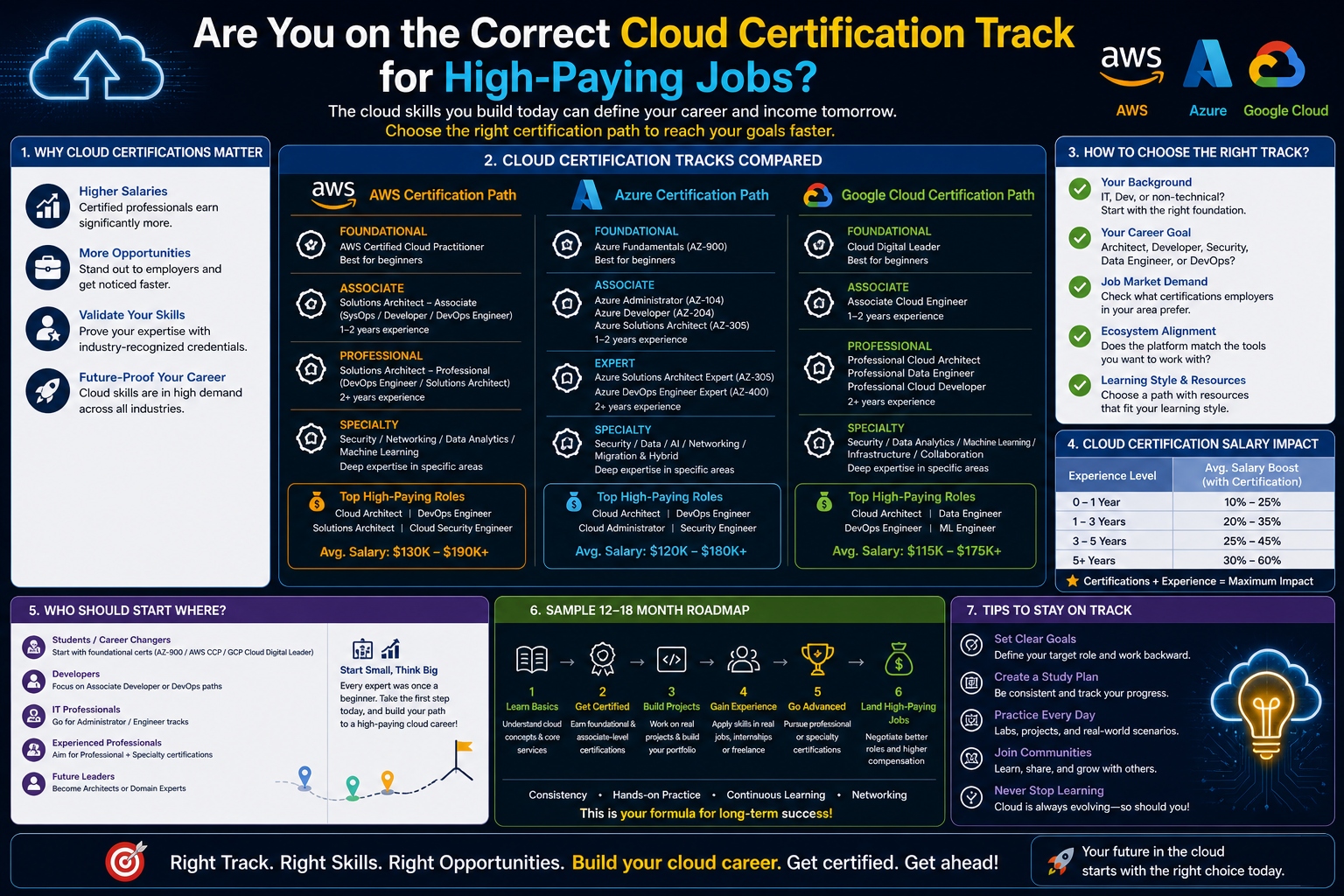
Cloud computing has shifted from being a niche technical concept to becoming the backbone of modern digital infrastructure. Almost every organization today, regardless of size or industry, relies on cloud services in some form. Whether it is storing data, hosting applications, managing communication systems, or running large-scale analytics, cloud platforms now sit at the center of IT operations.
This rapid adoption is driven by one major factor: flexibility. Traditional on-premises infrastructure required heavy upfront investment, physical hardware maintenance, and limited scalability. Cloud computing changed this by allowing businesses to access computing power on demand. As a result, companies can scale faster, reduce operational costs, and deploy services globally without building physical data centers in every location.
For professionals in the IT industry, this transformation has created a long-term shift in required skills. Instead of focusing only on hardware management or traditional server administration, there is now a growing demand for cloud architecture, cloud security, automation, orchestration, and DevOps practices. These changes are not temporary trends—they represent a permanent evolution in how technology is delivered and managed.
The job market reflects this shift clearly. Organizations are actively seeking professionals who understand cloud environments, can design scalable systems, and can manage distributed infrastructure. This demand continues to expand as more businesses migrate workloads from legacy systems to cloud platforms. Even industries that were traditionally slow to adopt new technology, such as government and healthcare, are now accelerating their cloud adoption strategies.
Because of this widespread shift, cloud skills have become one of the most valuable assets in IT careers today. Individuals entering the field or looking to advance their careers are increasingly expected to understand cloud fundamentals, even if their job role is not directly related to cloud engineering.
Why Cloud Certifications Matter in Modern IT Careers
As cloud computing becomes central to IT operations, certifications have emerged as a structured way to validate skills and knowledge. Unlike informal learning or self-study alone, certifications provide a standardized benchmark that employers can recognize and trust.
One of the main reasons cloud certifications are important is consistency. Cloud platforms are complex and constantly evolving. Without structured learning, it becomes difficult to understand best practices, architectural patterns, and security principles in a coherent way. Certifications help organize this knowledge into defined learning paths, making it easier to progress from beginner to advanced levels.
Another important factor is credibility. In competitive job markets, employers often receive applications from candidates with varying levels of experience. Certifications help demonstrate that a candidate has been evaluated against a known standard. This does not replace real-world experience, but it strengthens a professional profile by showing commitment and structured learning.
Cloud certifications also encourage hands-on learning. Most certification paths are designed to include practical skills such as configuring services, deploying applications, managing virtual networks, and understanding security controls. These skills are essential in real-world environments where theoretical knowledge alone is not enough.
Beyond job acquisition, certifications also help with career direction. Many professionals struggle to decide which specialization to pursue in cloud computing. Certification paths provide structured options, helping individuals choose between roles such as cloud architect, developer, systems engineer, or DevOps specialist.
The importance of certifications is also reinforced by the rapid pace of technological change. Cloud platforms frequently introduce new services and update existing features. Certification programs are updated accordingly, ensuring that learners stay aligned with current industry practices rather than outdated knowledge.
Ultimately, cloud certifications serve as both a learning framework and a career development tool. They guide professionals through increasingly complex topics while also improving employability and career mobility.
Understanding the Major Cloud Ecosystems
The cloud computing landscape is dominated by several major platforms, each with its own ecosystem, tools, and learning paths. While they share common principles, they differ in implementation, services, and career opportunities.
One of the most widely adopted platforms is Amazon Web Services. It is known for its broad range of services and early leadership in the cloud industry. AWS provides tools for computing, storage, databases, machine learning, networking, and application deployment. Its certification paths are structured around roles such as solutions architect, developer, and systems operations. These roles reflect real-world responsibilities and help learners specialize based on career interests.
Another major ecosystem is Microsoft Azure. Azure is deeply integrated with enterprise environments, especially organizations that rely on Microsoft technologies. It offers strong support for hybrid cloud models, allowing businesses to connect on-premises systems with cloud infrastructure. Azure certification paths often focus on administration, development, and architecture roles, making it a strong choice for IT professionals transitioning from traditional Microsoft server environments.
Google Cloud Platform is another significant player, known for its strengths in data analytics, machine learning, and containerized applications. GCP emphasizes modern application development practices and scalable infrastructure design. Its learning paths typically include system operations, application development, and cloud architecture roles. Many professionals are drawn to GCP for its focus on innovation and advanced computing capabilities.
While these three platforms dominate the market, they all operate on similar foundational principles. They provide virtual machines, storage systems, networking capabilities, identity management, and security controls. Once a professional understands one platform deeply, transitioning to another becomes significantly easier because the underlying concepts remain consistent.
However, each platform has its own ecosystem of tools, interfaces, and best practices. This means that choosing a certification path is not just about learning cloud computing in general, but also about aligning with a specific technological environment that matches career goals.
How Cloud Skills Are Reshaping IT Roles
The rise of cloud computing has not only created new job roles but also transformed existing ones. Traditional IT positions such as system administrators, network engineers, and database administrators now require cloud-related knowledge to remain relevant.
System administrators, for example, are no longer limited to managing physical servers. They are now expected to work with virtual machines, automate infrastructure tasks, and manage cloud-based services. Similarly, network engineers must understand virtual networking, load balancing, and distributed system architecture.
Developers are also impacted by this shift. Modern application development increasingly relies on cloud services for deployment, scaling, and integration. Developers are expected to understand how their applications interact with cloud infrastructure, including storage systems, APIs, and serverless computing models.
Security professionals have experienced one of the most significant transformations. Cloud environments introduce new security challenges, such as identity management across distributed systems, data encryption in transit and at rest, and compliance across multiple regions. As a result, cloud security has become a specialized and highly demanded field.
DevOps practices have further accelerated this transformation. Automation, continuous integration, and continuous deployment are now standard in many organizations. Cloud platforms provide the infrastructure needed to support these workflows, making cloud knowledge essential for DevOps engineers.
This evolution means that cloud skills are no longer optional for IT professionals. Instead, they are becoming a foundational requirement across multiple roles. Professionals who fail to adapt risk falling behind in a rapidly changing job market.
Early Considerations Before Choosing a Certification Path
Before committing to a specific cloud certification path, it is important to understand personal career goals and technical interests. Cloud computing is a broad field, and each specialization offers different opportunities and challenges.
Some professionals may prefer infrastructure-focused roles, where they work on designing and managing cloud systems. Others may be more interested in application development, focusing on building and deploying software in cloud environments. There are also those who are drawn to data engineering, machine learning, or cloud security.
Understanding these preferences early helps in selecting the right certification path. For example, someone interested in infrastructure design may benefit from architecture-focused certifications, while someone interested in programming may choose developer-oriented paths.
It is also important to consider existing experience. Professionals with backgrounds in traditional IT infrastructure may find it easier to transition into cloud administration or systems engineering roles. On the other hand, those with software development experience may adapt more quickly to cloud-based application development.
Another factor is long-term career direction. Cloud computing is not a single skill but a broad ecosystem. Choosing a certification path should align with where a professional wants to be in the next five to ten years, not just immediate job opportunities.
Finally, consistency in learning plays a critical role. Cloud technologies are complex and require continuous practice. Structured learning paths help maintain focus and ensure steady progress through increasingly advanced topics.
By understanding these early considerations, professionals can make more informed decisions about which cloud certification path aligns best with their goals and long-term career development.
The Structure Behind Cloud Certification Progression
Cloud certification paths are designed to follow a structured learning progression that mirrors real-world job roles. Instead of presenting random technical topics, each ecosystem organizes certifications in layers that gradually move from foundational knowledge to advanced architectural and specialized expertise.
At the beginning level, certifications focus on understanding core cloud concepts. These include basic infrastructure principles, cloud service models, security fundamentals, and introductory networking. The goal at this stage is not deep specialization but familiarity with how cloud environments function as a whole.
As learners progress, the focus shifts toward role-based skills. This is where certification paths begin to diverge into different career directions. For example, some paths emphasize system administration and operations, while others focus on software development or solution architecture. These role-based certifications are designed to simulate real job responsibilities in cloud environments.
At advanced levels, certifications move into complex system design, large-scale architecture, security engineering, and multi-cloud integration. Professionals at this stage are expected to design systems that are resilient, scalable, and secure under real-world conditions. This includes understanding trade-offs between performance, cost, and reliability.
Each major cloud provider follows this layered structure, but the way they implement it varies slightly based on platform philosophy and ecosystem strengths.
AWS Certification Path and Its Skill Progression
The AWS ecosystem is known for its broad service coverage and strong emphasis on practical cloud infrastructure skills. Its certification structure is often considered one of the most comprehensive in the industry because it spans multiple job roles and technical domains.
At the foundational level, AWS introduces learners to cloud concepts such as compute services, storage systems, identity management, and basic security principles. This stage helps professionals understand how cloud infrastructure differs from traditional on-premises environments.
As learners move forward, AWS offers associate-level certifications that align with specific job roles. These roles typically include solutions architecture, development, and system operations. Each of these paths focuses on different aspects of cloud computing.
The solutions architecture path emphasizes designing scalable and highly available systems. Professionals in this track learn how to choose appropriate AWS services for different workloads, design fault-tolerant systems, and optimize cost efficiency. This role requires a strong understanding of system design principles and cloud service integration.
The development path focuses on building applications that run in cloud environments. This includes working with APIs, serverless computing models, and cloud-based databases. Developers in this track learn how to write applications that are scalable, secure, and optimized for cloud deployment.
The operations path focuses on managing and maintaining cloud infrastructure. This includes monitoring system health, automating deployments, managing identity and access controls, and ensuring system reliability. This role is often closer to traditional system administration but expanded into cloud-native environments.
At more advanced levels, AWS certifications focus on solution architecture at scale. Professionals are expected to design complex systems that span multiple regions, incorporate advanced networking configurations, and integrate security at every layer. These roles often require deep understanding of distributed systems and enterprise-level architecture.
AWS also places strong emphasis on hands-on experience. Many certification paths assume that learners have worked with real cloud environments, deploying applications, configuring services, and troubleshooting issues. This practical focus makes AWS certifications highly aligned with real-world job expectations.
Microsoft Azure Certification Path and Enterprise Integration
Microsoft Azure certification paths are closely tied to enterprise environments. Many organizations adopting Azure already use Microsoft technologies such as Windows Server, Active Directory, and Microsoft 365. As a result, Azure certifications often emphasize hybrid cloud environments where on-premises and cloud systems work together.
At the foundational level, Azure introduces cloud computing concepts along with Microsoft-specific infrastructure services. Learners gain understanding of virtual machines, storage accounts, networking components, and identity management systems.
As learners progress, Azure certification paths split into administration, development, and architecture roles. The administration path focuses heavily on managing cloud infrastructure, including virtual networks, security policies, and system monitoring. Professionals in this role often work closely with enterprise IT teams to ensure cloud systems integrate smoothly with existing infrastructure.
The development path focuses on building cloud applications using Microsoft development tools and frameworks. This includes working with APIs, cloud databases, and application deployment pipelines. Developers in this path often focus on enterprise software solutions and business applications.
The architecture path represents the most advanced level of Azure certification. Professionals in this track are expected to design large-scale cloud solutions that integrate multiple services, ensure security compliance, and support business-critical operations. This role requires deep understanding of both cloud and enterprise IT systems.
One of Azure’s unique strengths is its focus on hybrid cloud environments. Many organizations do not fully migrate to the cloud but instead maintain a combination of on-premises systems and cloud services. Azure certifications reflect this reality by emphasizing integration between traditional IT infrastructure and modern cloud platforms.
This makes Azure particularly valuable for professionals who already have experience in enterprise IT environments and want to transition into cloud computing without abandoning existing systems knowledge.
Google Cloud Platform Certification Path and Modern Application Focus
Google Cloud Platform takes a slightly different approach compared to AWS and Azure. Its certification paths emphasize modern application development, data-driven systems, and scalable infrastructure design.
At the foundational level, GCP introduces cloud computing concepts along with its unique service architecture. Learners explore virtual machines, storage systems, networking, and identity management. However, GCP places a stronger emphasis on simplicity and automation compared to other platforms.
As learners progress, GCP certification paths typically focus on system operations, application development, and cloud architecture. The system operations path emphasizes managing cloud infrastructure, monitoring performance, and ensuring system reliability. This role is similar to traditional system administration but adapted for cloud-native environments.
The development path focuses on building scalable applications using cloud-native tools and services. This includes working with containerized applications, microservices architectures, and serverless computing models. GCP strongly emphasizes modern application design patterns, making it attractive for developers working on innovative software systems.
The architecture path focuses on designing large-scale cloud solutions that leverage GCP’s strengths in data processing, machine learning, and distributed computing. Professionals in this role are expected to build systems that handle large datasets, real-time analytics, and complex computational workloads.
One of GCP’s key strengths is its integration with data analytics and machine learning services. This makes it particularly popular among organizations working with big data, artificial intelligence, and advanced analytics platforms. As a result, GCP certification paths often include exposure to data engineering concepts and scalable processing systems.
GCP also places strong emphasis on containerization technologies. This includes understanding how to deploy and manage containerized applications at scale. Modern application architectures increasingly rely on containers, making this skill highly relevant for cloud professionals.
Core Skills That Appear Across All Cloud Platforms
While AWS, Azure, and GCP differ in implementation, they share several core skill areas that are essential for all cloud professionals. Understanding these shared concepts helps learners transition between platforms more easily.
One of the most important shared skills is cloud networking. This includes understanding virtual networks, subnets, routing, load balancing, and secure communication between services. Networking is a foundational component of all cloud systems, and professionals must understand how data flows between distributed components.
Another critical skill is identity and access management. Cloud environments require strict control over who can access resources and under what conditions. This includes managing users, roles, permissions, and authentication systems. Security is deeply integrated into cloud architecture, making this skill essential.
Storage systems are another key area. Cloud platforms offer multiple types of storage, including object storage, block storage, and file storage. Understanding when and how to use each type is important for designing efficient systems.
Compute services form the backbone of cloud infrastructure. This includes virtual machines, containers, and serverless computing. Professionals must understand how to deploy and manage workloads across different compute environments.
Automation is also a critical skill in cloud computing. Manual infrastructure management is no longer scalable, so professionals must learn how to automate deployments, scaling, and configuration management. This is often achieved through infrastructure-as-code practices and scripting tools.
Monitoring and optimization are equally important. Cloud systems must be continuously monitored for performance, cost efficiency, and reliability. Professionals must learn how to interpret metrics, set up alerts, and optimize system performance based on real-time data.
The Role of DevOps in Cloud Certification Paths
DevOps practices play a major role in modern cloud environments. Instead of treating development and operations as separate functions, DevOps integrates them into a continuous workflow. This approach emphasizes automation, collaboration, and continuous improvement.
Cloud platforms provide the infrastructure needed to support DevOps workflows. This includes automated deployment pipelines, continuous integration systems, and scalable infrastructure management tools.
In certification paths, DevOps concepts appear across multiple levels. At intermediate levels, learners are introduced to automation tools and deployment strategies. At advanced levels, they are expected to design full-scale DevOps pipelines that support large applications.
DevOps professionals working in cloud environments must understand how to manage infrastructure as code, automate testing and deployment, and monitor system performance continuously. This requires both development and operations knowledge.
The integration of DevOps into cloud certification paths reflects the modern reality of software development. Applications are no longer deployed manually; instead, they are continuously updated, tested, and deployed through automated systems.
Containers and Serverless Computing in Modern Cloud Learning
Containerization has become one of the most important trends in cloud computing. Containers allow applications to run consistently across different environments by packaging code and dependencies together.
Cloud platforms support container orchestration systems that manage large-scale container deployments. This allows organizations to run distributed applications efficiently and reliably.
Serverless computing is another major advancement in cloud technology. Instead of managing servers directly, developers can run code in response to events without worrying about infrastructure management. This allows for highly scalable and cost-efficient application design.
Both containers and serverless computing represent a shift toward abstraction in cloud computing. Instead of managing infrastructure directly, professionals focus more on application logic and system design.
Certification paths increasingly include these technologies because they represent the future of cloud application development. Professionals who understand containers and serverless architectures are better prepared for modern cloud roles.
Data, Security, and Automation as Advanced Cloud Domains
As professionals move into advanced certification levels, they encounter more specialized domains such as data engineering, cloud security, and automation at scale.
Data engineering focuses on processing large datasets, building data pipelines, and enabling analytics systems. Cloud platforms provide tools for handling structured and unstructured data at scale.
Security becomes more complex at advanced levels because it involves protecting distributed systems, managing compliance requirements, and securing data across multiple environments. Cloud security professionals must understand encryption, identity management, threat detection, and risk mitigation strategies.
Automation at scale involves designing systems that can manage themselves with minimal human intervention. This includes self-healing systems, automated scaling, and intelligent resource management.
These advanced domains represent the highest level of cloud expertise and are often required for senior engineering and architecture roles.
Aligning Cloud Certification Choices With Real Career Outcomes
Selecting a cloud certification path is not simply a matter of picking a popular technology. It is a strategic decision that influences long-term career direction, job opportunities, and specialization depth. While cloud platforms share similar foundations, the roles built around them differ significantly in scope, responsibility, and required expertise.
One of the most common mistakes professionals make is choosing a certification based purely on market popularity rather than personal alignment. While market demand is important, it is not the only factor. A certification path should reflect both current skills and long-term professional interests. Without this alignment, learners often struggle to maintain motivation or apply their knowledge effectively in real-world environments.
Cloud careers are not linear. They evolve through stages of exposure, specialization, and deep technical mastery. At early stages, professionals typically explore general cloud concepts. As they gain experience, they begin to gravitate toward specific domains such as infrastructure design, application development, data engineering, or security architecture.
Understanding this progression is essential when selecting a certification path. Instead of treating certifications as isolated achievements, they should be viewed as stepping stones that build toward a larger career identity.
For example, someone interested in system reliability and infrastructure design may naturally progress toward architecture-focused roles. Another individual with a software development background may find greater value in application-centric cloud paths. Similarly, professionals with strong analytical interests may move toward data-intensive cloud roles.
Each of these directions exists within all major cloud ecosystems, but the emphasis and tools differ slightly depending on the platform. The key is not choosing the “best” platform universally, but identifying the platform that best supports a specific career trajectory.
Mapping Cloud Certifications to Real Job Roles
Cloud certifications are most valuable when they align closely with real job responsibilities. Understanding how certifications translate into actual roles helps clarify which path is most appropriate for different career goals.
One of the most common entry-level roles is cloud support or cloud operations. Professionals in these roles focus on maintaining cloud infrastructure, resolving system issues, and ensuring service availability. They work closely with monitoring tools, access management systems, and basic networking configurations. Certification paths aligned with this role typically emphasize operational understanding and hands-on system management.
Another major role is cloud developer. This role focuses on building applications that run in cloud environments. Developers in this space must understand how to integrate cloud services into software applications, optimize performance, and manage deployment pipelines. They often work with APIs, serverless functions, and containerized environments.
Cloud solutions architects represent a more advanced role. These professionals design entire systems rather than focusing on individual components. They must understand scalability, fault tolerance, cost optimization, and security at a system-wide level. Their work involves making architectural decisions that affect entire organizations.
Cloud security specialists focus on protecting cloud environments from threats and vulnerabilities. This includes identity management, encryption, compliance, and threat detection. Security roles have become increasingly important as organizations store more sensitive data in cloud systems.
Data engineers and cloud data specialists focus on managing large-scale data systems. This includes building data pipelines, processing large datasets, and enabling analytics platforms. These roles often require understanding both cloud infrastructure and data processing frameworks.
DevOps engineers operate at the intersection of development and operations. They are responsible for automating infrastructure, managing deployment pipelines, and ensuring continuous integration and delivery. Their work is highly technical and requires knowledge of both coding and system administration.
Each of these roles corresponds to different certification paths, but they often overlap in practice. Many professionals eventually acquire skills across multiple domains as they advance in their careers.
Choosing Between Specialization and Generalization
One of the most important decisions in cloud career planning is whether to specialize in a specific domain or maintain a broader skill set across multiple areas. Both approaches have advantages depending on career stage and goals.
Specialization allows professionals to develop deep expertise in a specific area. For example, a cloud security specialist may focus exclusively on securing cloud environments, studying advanced threat detection techniques and compliance frameworks. This level of depth often leads to higher-level roles and niche expertise positions.
However, specialization also comes with limitations. Highly specialized professionals may find fewer opportunities outside their domain. Additionally, cloud technologies evolve rapidly, and narrow specialization may require constant updating to remain relevant.
Generalization, on the other hand, involves developing a broad understanding of multiple cloud domains. Generalists may not have extreme depth in one area but are capable of working across different functions such as development, operations, and architecture.
Generalists are often more flexible in job markets and can transition between roles more easily. They are particularly valuable in smaller organizations where professionals are expected to handle multiple responsibilities.
Many successful cloud professionals start as generalists and gradually move toward specialization after gaining experience. This approach allows them to understand how different cloud components interact before focusing deeply on one area.
The decision between specialization and generalization should be based on career goals, industry demands, and personal interests rather than trends alone.
Industry Demand and Evolving Skill Requirements
The demand for cloud professionals continues to grow across industries, but the nature of this demand is becoming more specialized over time. Early cloud adoption focused primarily on infrastructure migration, but modern cloud usage now involves advanced architecture, automation, and intelligent systems.
Organizations are increasingly looking for professionals who can design scalable, secure, and cost-efficient systems. This requires more than basic cloud knowledge. It requires understanding how distributed systems behave under load, how data flows across services, and how to optimize performance in real time.
Security remains one of the fastest-growing areas in cloud computing. As more critical systems move to the cloud, the importance of securing data and infrastructure increases. This has created strong demand for professionals who understand cloud security principles and can implement robust protection strategies.
Automation is another area of growing importance. Manual infrastructure management is no longer practical in large-scale cloud environments. Organizations rely heavily on automated systems to deploy applications, manage scaling, and monitor performance.
Data-driven decision-making is also shaping cloud skill requirements. Companies increasingly rely on real-time analytics and machine learning systems to guide business decisions. This has created demand for professionals who understand both cloud infrastructure and data processing systems.
Another emerging trend is multi-cloud adoption. Many organizations are no longer relying on a single cloud provider. Instead, they use multiple platforms to distribute workloads, reduce risk, and optimize performance. This requires professionals who understand how different cloud systems interact and how to design cross-platform solutions.
These evolving demands highlight the importance of continuous learning in cloud careers. Certifications alone are not enough; professionals must continuously update their skills to remain competitive.
Building Practical Experience Alongside Certification Learning
One of the most critical aspects of cloud career development is practical experience. While certifications provide structured knowledge, real-world application is what transforms theoretical understanding into usable skill.
Hands-on experience helps professionals understand how cloud systems behave under real conditions. This includes dealing with configuration errors, performance issues, scaling challenges, and security concerns. These situations are often not fully captured in theoretical learning materials.
Practical experience can be built through experimentation, personal projects, or simulated environments. Working directly with cloud services helps reinforce concepts such as networking, storage configuration, identity management, and automation.
Another important aspect of practical learning is troubleshooting. Cloud environments are complex, and issues often arise from unexpected interactions between services. Learning how to diagnose and resolve these issues is a key part of professional development.
Automation practice is also essential. Writing scripts, configuring deployment pipelines, and managing infrastructure as code are all critical skills in modern cloud environments.
Professionals who combine certification knowledge with hands-on experience tend to perform significantly better in job roles. Employers often value practical problem-solving ability more than theoretical knowledge alone.
Common Mistakes in Cloud Certification Journeys
Many learners encounter challenges during their cloud certification journey due to common mistakes in approach and strategy. One of the most frequent issues is focusing too heavily on memorization rather than understanding. Cloud environments are dynamic, and memorized knowledge quickly becomes outdated if not supported by conceptual understanding.
Another common mistake is skipping foundational knowledge. Many learners rush into advanced certifications without fully understanding basic cloud concepts such as networking, storage, and security. This often leads to confusion when dealing with complex system designs later on.
A third mistake is switching between certification paths too frequently. While exploring different platforms is useful, constantly changing direction can prevent deep learning and skill mastery. Consistency is important in building long-term expertise.
Some learners also underestimate the importance of hands-on practice. Reading or watching material alone is not sufficient for developing cloud skills. Without practical application, knowledge remains abstract and difficult to apply in real environments.
Another issue is ignoring system design thinking. Cloud computing is not just about individual services but about how systems work together. Professionals who focus only on isolated components often struggle when dealing with large-scale architectures.
Avoiding these mistakes requires discipline, structured learning, and consistent practice over time.
The Role of Multi-Cloud and Hybrid Strategies
Modern organizations rarely rely on a single cloud provider. Instead, many adopt multi-cloud or hybrid cloud strategies to improve flexibility, reduce dependency, and optimize performance.
Multi-cloud environments involve using services from multiple cloud providers simultaneously. This approach allows organizations to choose the best services from each platform rather than relying on a single ecosystem. However, it also increases complexity, as professionals must understand how different systems interact.
Hybrid cloud environments combine on-premises infrastructure with cloud services. This is particularly common in enterprises that cannot fully migrate legacy systems to the cloud. Hybrid setups require strong integration skills and understanding of both traditional IT systems and cloud architecture.
Professionals working in these environments must be adaptable and familiar with multiple platforms. This does not necessarily mean mastering every cloud provider in depth, but rather understanding core concepts that apply across systems.
As multi-cloud adoption continues to grow, professionals who can navigate multiple ecosystems will be increasingly valuable.
Emerging Trends Shaping the Future of Cloud Careers
Cloud computing continues to evolve rapidly, and several emerging trends are shaping the future of cloud careers.
Artificial intelligence integration is one of the most significant developments. Cloud platforms are increasingly offering AI and machine learning services that allow organizations to build intelligent systems. This is creating demand for professionals who understand both cloud infrastructure and AI workflows.
Serverless computing is also becoming more prominent. This model allows developers to run applications without managing servers directly. As adoption grows, professionals will need to understand event-driven architectures and scalable function-based systems.
Edge computing is another emerging trend. Instead of processing all data in centralized cloud locations, edge computing brings computation closer to where data is generated. This is particularly important for applications requiring low latency and real-time processing.
Security automation is also evolving. As cloud environments become more complex, automated security systems are being used to detect and respond to threats in real time.
Sustainability is becoming a consideration in cloud design. Organizations are increasingly focused on reducing energy consumption and optimizing resource usage within cloud environments.
These trends indicate that cloud careers will continue to evolve beyond traditional infrastructure roles into more dynamic and interdisciplinary fields.
Deepening Cloud Career Strategy and Long-Term Adaptability
Beyond certifications and platform choices, one of the most important realities in cloud computing careers is adaptability. Cloud technology does not remain static for long periods. Services evolve, pricing models change, new architectural patterns emerge, and entire categories of tools can rise in importance within a few years. Because of this, long-term success in cloud careers depends less on mastering a single certification path and more on developing the ability to continuously learn and adjust.
A strong example of this is how infrastructure management has changed over time. Earlier IT environments required manual server configuration, physical hardware maintenance, and fixed deployment models. In modern cloud environments, infrastructure is dynamic, often automated, and heavily abstracted. Professionals who relied only on older operational models have had to either reskill or transition into adjacent roles. This pattern continues as new technologies are introduced.
Another important dimension is problem-solving mindset. Cloud environments are distributed systems by nature, which means issues rarely come from a single isolated source. A performance bottleneck, for example, may involve network latency, database configuration, service limits, or incorrect scaling policies all at once. Professionals who succeed in cloud careers tend to develop strong analytical thinking skills that allow them to break down complex systems into smaller interacting components.
Communication skills also play a much larger role than many expect. Cloud professionals often work in cross-functional teams that include developers, security specialists, business analysts, and product managers. Being able to explain technical decisions in clear, non-technical language becomes essential when designing systems that support business objectives. Certification knowledge alone is not enough if it cannot be translated into practical decisions that others understand and implement.
Another important factor is cost awareness. Cloud computing introduces a pay-as-you-go model, which means resource usage directly affects financial outcomes. Unlike traditional IT environments where infrastructure costs are mostly fixed, cloud systems require ongoing optimization. Professionals are expected to understand not only how to build systems, but also how to design them efficiently. This includes selecting appropriate service tiers, managing resource allocation, and avoiding unnecessary consumption.
In addition, governance and compliance considerations are becoming more central in cloud roles. Organizations must adhere to regulatory requirements depending on industry and geography. Cloud professionals often need to design systems that comply with data protection rules, audit requirements, and security frameworks. This adds another layer of responsibility beyond technical implementation.
It is also important to recognize the growing importance of interdisciplinary knowledge. Cloud computing now intersects with fields such as artificial intelligence, cybersecurity, software engineering, and data science. Professionals who understand multiple domains are better positioned to work on complex systems that combine these disciplines. For example, a cloud engineer working on machine learning infrastructure must understand both deployment architecture and data processing workflows.
Continuous experimentation is another key factor in long-term growth. Cloud platforms are designed to support experimentation through scalable resources and flexible configurations. Professionals who actively test new services, explore alternative architectures, and simulate real-world scenarios tend to develop stronger intuition about system behavior. This hands-on exploration builds confidence and reduces dependency on documentation alone.
Mentorship and peer learning also play an important role in career development. Cloud technologies are too broad and fast-moving for any individual to master alone. Engaging with experienced professionals, reviewing architectural decisions, and participating in collaborative problem-solving helps accelerate learning. This collaborative approach mirrors real-world work environments where decisions are rarely made in isolation.
Finally, resilience in learning is essential. Cloud careers involve a continuous cycle of learning, unlearning, and relearning. Technologies that were considered standard a few years ago may be replaced or significantly updated. Professionals who embrace this constant change rather than resist it are more likely to remain relevant and successful over time.
Overall, the cloud industry rewards adaptability, curiosity, and practical problem-solving more than static knowledge. Certifications provide structure and direction, but long-term success depends on how effectively professionals apply, expand, and evolve that knowledge in real-world environments.
Conclusion
Cloud computing has become a defining force in modern IT, reshaping how organizations build, deploy, and manage technology systems. As businesses continue to shift toward scalable and flexible infrastructure, the demand for skilled cloud professionals grows steadily across industries. In this environment, cloud certifications serve as structured pathways that help individuals develop relevant skills, validate their expertise, and align themselves with real-world job roles.
Choosing the right certification path is not about following trends alone, but about understanding personal strengths, career interests, and long-term goals. Whether the focus is on infrastructure, development, security, or data systems, each cloud ecosystem offers structured learning paths that guide professionals from foundational concepts to advanced architectural thinking. AWS, Microsoft Azure, and Google Cloud Platform each provide unique strengths, yet they all share a common foundation in core cloud principles such as networking, security, automation, and scalability.
However, certification alone is not enough. Practical experience, continuous learning, and adaptability play an equally important role in career growth. Cloud environments evolve rapidly, and professionals must be prepared to update their knowledge, explore new technologies, and apply their skills in dynamic, real-world situations. The ability to think critically, solve complex problems, and work across interdisciplinary teams further strengthens long-term success.
Ultimately, a cloud certification path should be seen as a journey rather than a destination. It is a structured way to build expertise while staying aligned with an industry that continues to expand and transform. Those who approach it with consistency, curiosity, and a willingness to grow will find themselves well-positioned in an increasingly cloud-driven world.