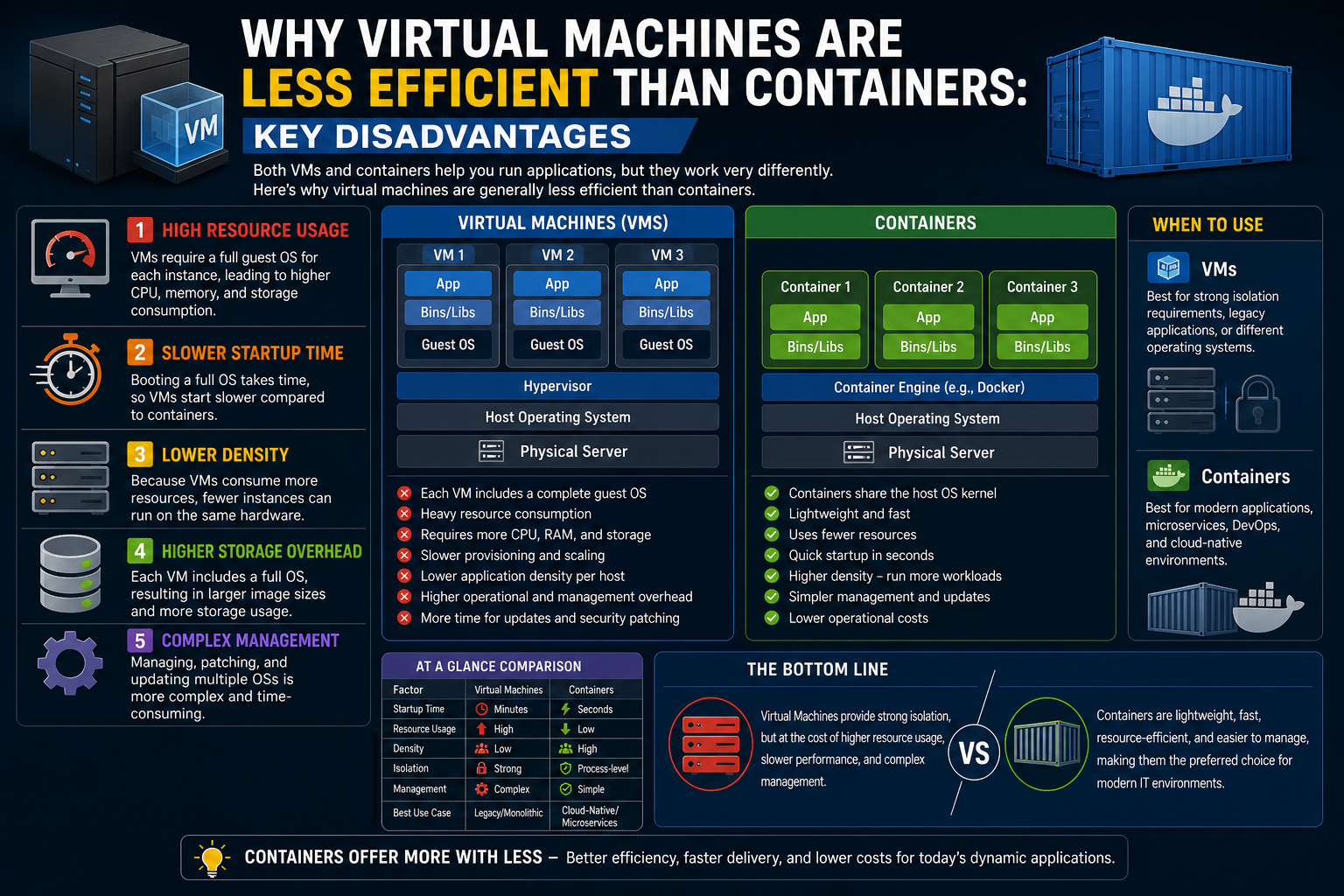
Modern computing environments have shifted dramatically over the last decade, largely due to the rise of cloud platforms, automation, and distributed applications. To understand why containers gained so much popularity, it helps to first look at how virtualization evolved and why virtual machines became such an important foundation in the first place.
Virtual machines emerged as a way to maximize the usage of physical hardware. In traditional computing environments, a single operating system would run directly on a physical server. This often led to underutilization because many applications did not fully consume available CPU, memory, or storage resources. Virtualization solved this by allowing multiple isolated systems to run on a single physical machine.
Each virtual machine behaves like a complete computer. It has its own operating system, its own virtualized hardware components, and its own set of drivers. This design made it possible to run multiple workloads independently on the same physical infrastructure without interference.
Containers, on the other hand, took a different approach. Instead of simulating an entire machine, containers package an application along with its dependencies while sharing the host operating system. This difference in architecture fundamentally changed how applications are deployed and managed.
The shift from virtual machines to containers did not happen because virtual machines became obsolete. Instead, it happened because containers introduced a lighter, faster, and more efficient way to achieve many of the same goals, especially in application deployment environments where speed and scalability matter more than full system isolation.
Understanding the disadvantages of virtual machines compared to containers requires examining how this architectural difference impacts performance, resource usage, and operational complexity.
How Virtual Machines Work Internally
A virtual machine is built on top of a hypervisor, which is a specialized layer of software responsible for creating and managing virtualized environments. The hypervisor sits between the physical hardware and the virtual machines, allocating resources like CPU, memory, and storage to each instance.
There are two primary types of hypervisors. Type 1 hypervisors run directly on hardware, while Type 2 hypervisors run on top of a host operating system. Regardless of the type, the fundamental idea remains the same: each virtual machine behaves as though it has dedicated hardware, even though it is sharing resources with other virtual machines.
Inside each virtual machine is a full operating system installation. This means that even if ten virtual machines are running on a single physical server, each one contains its own OS kernel, system libraries, background services, and device drivers.
This design creates strong isolation, which is one of the biggest strengths of virtual machines. However, it also introduces significant inefficiencies when compared to containers. Every virtual machine duplicates components that could otherwise be shared.
Containers eliminate much of this duplication by sharing the host operating system kernel. Instead of virtualizing hardware, containers virtualize at the operating system level. This difference is the foundation for most of the disadvantages associated with virtual machines in modern application environments.
Resource Overhead and Inefficiency
One of the most significant disadvantages of virtual machines compared to containers is resource overhead. Because each virtual machine runs a full operating system, it requires a dedicated allocation of CPU cycles, memory, and storage space.
Even when a virtual machine is idle, its operating system continues running background processes. These processes consume memory and CPU resources that could otherwise be used for application workloads. In contrast, containers only include the essential components required to run an application, which significantly reduces overhead.
Memory usage is particularly impacted. A single virtual machine may require hundreds of megabytes or even several gigabytes of RAM just to run its operating system. When multiple virtual machines are deployed, this overhead multiplies quickly. Containers, however, can run with a fraction of that memory requirement because they rely on the host operating system.
CPU scheduling also becomes more complex in virtual machine environments. The hypervisor must constantly manage how CPU resources are distributed across multiple full operating systems, each with its own internal scheduling system. This layered scheduling can introduce inefficiencies that do not exist in containerized environments.
Storage overhead is another factor. Each virtual machine requires a full disk image that includes an operating system installation, system files, and application dependencies. These images can become large and consume significant storage resources, especially when multiple virtual machines are used for similar tasks.
Containers, by comparison, share base images and layers, making storage usage more efficient and reducing duplication.
Boot Time and Lifecycle Limitations
Another major disadvantage of virtual machines is slow startup time. Because a virtual machine must boot an entire operating system, the initialization process can take anywhere from seconds to several minutes depending on system complexity and resource allocation.
This delay becomes a critical limitation in dynamic environments where rapid scaling is required. For example, in systems that need to handle sudden spikes in traffic, the time it takes to start a new virtual machine can create performance bottlenecks.
Containers, however, start almost instantly because they do not need to boot a full operating system. Instead, they launch application processes on top of an already running host system. This makes them far more suitable for environments where workloads need to scale quickly.
Lifecycle management is also more complex with virtual machines. Each virtual machine must go through a full boot cycle, shutdown process, and potentially system updates that require restarts. This introduces delays and operational overhead that can slow down deployment pipelines.
In container-based systems, lifecycle operations are much simpler. Containers can be created, destroyed, and replaced rapidly without the need to manage full system states.
Infrastructure Density and Hardware Utilization
Infrastructure density refers to how efficiently hardware resources are utilized. Virtual machines generally have lower density compared to containers because of their higher resource requirements.
Since each virtual machine requires its own operating system and reserved hardware allocation, fewer virtual machines can run on a single physical machine compared to containers. This leads to lower overall hardware efficiency.
For organizations managing large-scale environments, this inefficiency translates into higher infrastructure costs. More physical servers may be required to support the same workload that could be handled by fewer machines running containerized applications.
Containers improve density by sharing the host operating system kernel and reducing redundant system components. This allows more workloads to run on the same hardware without compromising performance.
The difference becomes especially noticeable in cloud environments, where resource usage directly impacts operational costs. Virtual machines tend to consume more baseline resources even when underutilized, whereas containers scale more efficiently based on actual demand.
Operating System Duplication Problem
One of the structural disadvantages of virtual machines is operating system duplication. Every virtual machine requires its own OS installation, which leads to repeated duplication of system-level components across multiple instances.
This duplication includes system libraries, background services, kernel modules, and administrative tools. While this design enhances isolation, it also creates redundancy that wastes system resources.
Containers avoid this issue by sharing the host operating system kernel. Instead of duplicating system-level components, containers isolate only the application layer. This significantly reduces redundancy and improves efficiency.
The duplication problem also affects updates and patch management. Each virtual machine must be individually updated and maintained, which increases administrative workload. If an organization runs hundreds or thousands of virtual machines, keeping all systems updated becomes a major operational challenge.
Containers simplify this process because updates can often be applied at the image level and propagated across multiple instances more consistently.
Hypervisor Dependency and System Complexity
Virtual machines rely heavily on hypervisors, which introduce an additional layer of complexity between hardware and workloads. This extra layer must manage resource allocation, hardware emulation, and isolation between virtual machines.
While hypervisors are highly advanced and optimized, they still introduce overhead. Every request from a virtual machine must pass through the hypervisor before reaching physical hardware. This creates additional processing steps that do not exist in containerized environments.
System complexity also increases because administrators must manage both the host operating system and the hypervisor layer, in addition to each individual virtual machine. This multi-layered structure can make troubleshooting more difficult and time-consuming.
Containers simplify this architecture by running directly on the host operating system. Without a hypervisor layer, resource access becomes more direct and efficient.
Storage Requirements and Image Size Challenges
Virtual machines require full disk images that contain an entire operating system, application files, and configuration data. These images are often large and consume significant storage space.
As environments scale, storage requirements increase rapidly. Organizations may need to store multiple versions of virtual machine images for backups, testing, and deployment purposes.
This creates challenges in storage management, backup strategies, and image distribution. Moving virtual machine images between systems can also be slow due to their size.
Containers use layered file systems, which allow shared components to be reused across multiple images. This reduces redundancy and makes container images significantly smaller and more efficient to store and transfer.
The difference in storage efficiency becomes especially important in distributed systems where images must be frequently pulled and deployed across multiple nodes.
Performance Variability in Real Workloads
Although modern virtual machines have become highly optimized, performance variability remains a concern. Because multiple virtual machines share underlying physical resources, performance can fluctuate depending on how the hypervisor schedules workloads.
Resource contention can occur when multiple virtual machines compete for CPU or memory. Even with advanced scheduling algorithms, this can lead to inconsistent performance under heavy load.
Containers typically experience less overhead in this area because they share the host operating system and avoid full hardware virtualization. This allows for more consistent performance in many application-level scenarios.
However, it is important to note that performance depends heavily on workload type. Virtual machines may still perform better in scenarios requiring strong isolation or full system emulation.
Operational Overhead and Maintenance Burden
Managing virtual machine environments requires significant operational effort. Each virtual machine must be individually configured, monitored, patched, and secured.
System administrators must maintain not only the virtual machines but also the underlying hypervisor infrastructure. This increases the number of components that require ongoing maintenance.
Backup and recovery processes are also more complex. Since each virtual machine is a full system image, backups are larger and take longer to process.
Containers reduce this burden by centralizing application deployment and simplifying system-level dependencies. Instead of managing full systems, administrators focus on application containers and orchestration layers.
Security Model Trade-offs and Management Complexity
Virtual machines are often considered more secure in terms of isolation because each instance runs a complete operating system. This strong separation reduces the risk of cross-environment interference.
However, this does not eliminate security challenges. Each virtual machine must be independently secured, patched, and monitored. This increases the total attack surface across the environment.
Security management becomes more complex because vulnerabilities may exist across multiple operating systems, each requiring separate updates and configurations.
Containers reduce some of this complexity but introduce their own security considerations due to shared kernel usage. While this creates efficiency, it also means that kernel-level vulnerabilities can potentially impact multiple containers.
From a management perspective, virtual machines require more effort to maintain consistent security policies across environments.
Development Workflow and Deployment Friction
In traditional virtual machine environments, development workflows can be slower and more rigid. Creating a new virtual machine often involves provisioning resources, installing an operating system, configuring dependencies, and applying updates.
This process can take significant time, especially in large-scale environments. As a result, development and testing cycles may become slower.
Containers streamline this process by allowing applications to be packaged and deployed quickly in lightweight environments. Developers can create consistent runtime environments that behave the same across different systems.
Virtual machines, while powerful, introduce friction in fast-paced development environments due to their heavier setup requirements and slower lifecycle operations.
Portability and Environment Consistency Challenges
Virtual machines offer portability in the sense that entire systems can be moved between hosts. However, this portability comes with limitations due to image size and system complexity.
Moving virtual machines between environments often requires significant bandwidth and time. Differences in hypervisor configurations can also lead to compatibility issues.
Containers are generally more portable because they rely on standardized runtime environments and smaller image sizes. This makes them easier to distribute across different systems without extensive modification.
Virtual machines still play an important role in environments requiring full system replication, but they are less efficient when rapid portability is required.
Scaling Complexity and Elasticity Limits in Virtual Machine Environments
Scalability is one of the most important requirements in modern computing systems, especially for cloud-native applications and services that experience unpredictable workloads. Virtual machines provide a foundation for scaling infrastructure, but they introduce structural limitations that make elasticity more complex compared to container-based systems.
When scaling virtual machine-based workloads, each new instance requires the provisioning of an entire operating system. This includes booting the system, initializing services, applying configurations, and joining it to the existing network and monitoring infrastructure. Even when automation tools are used, this process still involves multiple heavyweight steps that take time to complete.
In contrast, container-based systems can scale by launching lightweight instances of pre-built application images almost instantly. This difference in startup behavior creates a significant gap in responsiveness when dealing with sudden spikes in demand.
Virtual machine scaling is also constrained by resource allocation policies defined at the hypervisor level. Administrators often need to pre-allocate CPU, memory, and storage to ensure stable performance. This leads to a situation where resources are reserved but not always fully utilized, reducing overall efficiency.
Elastic scaling in virtual machine environments is therefore less dynamic and more resource-intensive, requiring careful planning and slower response times compared to containerized environments.
Cost Inefficiencies in Cloud and Virtualized Infrastructure
Cost efficiency is another area where virtual machines present clear disadvantages compared to containers. In cloud environments, billing is typically based on resource consumption, including CPU usage, memory allocation, and storage capacity.
Virtual machines inherently consume more baseline resources due to their full operating system footprint. Even when idle, a virtual machine continues to consume memory and processing power for system services, background processes, and kernel operations. This leads to higher costs even when workloads are not fully active.
Organizations running large-scale virtual machine deployments often face significant infrastructure costs because each instance requires dedicated resource allocation. Over-provisioning becomes common practice to ensure performance stability, which further increases expenses.
Containers allow for much higher density on the same physical or virtual infrastructure. Because they share the host operating system, they reduce redundant resource consumption. This leads to improved utilization rates and lower overall costs.
The cost disparity becomes even more pronounced in environments where workloads fluctuate frequently. Virtual machines cannot scale down as efficiently as containers, leading to wasted resources during low-demand periods.
Networking Complexity and Virtual Machine Communication Overhead
Networking in virtual machine environments introduces additional layers of complexity compared to container-based systems. Each virtual machine operates as a fully independent system with its own network stack, routing tables, and firewall configurations.
This independence provides strong isolation but also makes network management more complex. Virtual machines often require virtual network interfaces, bridges, and overlays to communicate effectively within a distributed system.
As the number of virtual machines increases, managing network configurations becomes increasingly difficult. Each instance must be properly connected to load balancers, firewalls, and monitoring systems, which adds administrative overhead.
Containers simplify networking by using shared network namespaces and lightweight abstraction layers. This allows for more consistent and scalable communication patterns between services.
In virtual machine environments, network latency can also be slightly higher due to the additional abstraction layers introduced by hypervisors. While modern systems have minimized this overhead, it still exists in complex configurations.
Service discovery and inter-service communication are therefore more cumbersome in virtual machine-based architectures, especially at scale.
Deployment Pipelines and Continuous Integration Challenges
Modern software development relies heavily on continuous integration and continuous deployment pipelines. These pipelines are designed to automate the process of building, testing, and deploying applications.
Virtual machines introduce friction into these pipelines due to their heavy initialization requirements. Building a virtual machine image often involves multiple steps, including operating system installation, configuration management, and dependency resolution.
Each update to a virtual machine image can take significant time to propagate through the deployment pipeline. Testing environments may also take longer to spin up, slowing down development cycles.
Containers are better suited to continuous integration workflows because they can be built, tested, and deployed rapidly. Their lightweight nature allows developers to iterate faster and deploy changes more frequently.
Virtual machines, while stable, are less agile in fast-moving development environments where rapid iteration is required.
Observability and Monitoring Challenges in Virtual Machine Systems
Monitoring and observability are essential components of modern infrastructure management. Virtual machines provide access to system-level metrics such as CPU usage, memory consumption, disk I/O, and network traffic.
However, monitoring large-scale virtual machine environments becomes complex due to the number of individual systems involved. Each virtual machine must be monitored separately, and aggregating data across hundreds or thousands of instances requires sophisticated tooling.
Additionally, because each virtual machine runs its own operating system, monitoring tools must be installed and configured individually. This increases operational overhead and can lead to inconsistencies in monitoring coverage.
Containers simplify observability by standardizing runtime environments and allowing centralized monitoring of application-level metrics. Since containers share the host system, telemetry data can often be collected more efficiently.
Virtual machine monitoring also tends to generate higher data volumes due to duplicated system-level metrics across multiple operating systems, which can increase storage and processing requirements.
Storage Snapshots, Backups, and Disaster Recovery Overhead
Virtual machines rely heavily on disk images and snapshots for backup and recovery operations. While this provides strong recovery capabilities, it also introduces significant storage overhead.
Each virtual machine snapshot captures the entire system state, including the operating system, applications, and configuration data. As a result, snapshots can become large and consume substantial storage resources.
Managing multiple snapshots across different environments can quickly become complex. Organizations must balance storage costs with recovery requirements, often leading to trade-offs in snapshot frequency and retention policies.
Disaster recovery processes in virtual machine environments can also be slow due to the size of virtual machine images. Restoring a full system from backup may take considerable time, especially in large-scale deployments.
Containers simplify recovery by focusing on stateless or minimally stateful application components. Instead of restoring entire operating systems, container-based systems often rely on redeploying standardized images.
Hardware Acceleration and I/O Performance Limitations
Virtual machines introduce overhead when dealing with hardware acceleration and input/output operations. While modern hypervisors support GPU passthrough and hardware virtualization, these features are not always as efficient as direct hardware access.
Applications requiring high-performance computing, machine learning workloads, or real-time data processing may experience limitations in virtual machine environments due to abstraction layers between software and hardware.
Input/output operations, especially disk and network I/O, can also be impacted by virtualization overhead. Although improvements in virtualization technology have reduced these inefficiencies, containers still generally offer more direct access to system resources.
In environments where performance is highly dependent on low-latency hardware access, virtual machines may not provide optimal efficiency compared to containerized workloads.
Multi-Tenancy Isolation Tradeoffs and Resource Sharing
Virtual machines are often used in multi-tenant environments because of their strong isolation capabilities. Each virtual machine runs its own operating system, which provides a clear separation between workloads.
However, this isolation comes at the cost of efficiency. Resource duplication and overhead reduce overall system density, making it more expensive to support multiple tenants.
Containers offer a different model of isolation that is lighter but less strict at the kernel level. While this improves efficiency, it introduces trade-offs in terms of security boundaries and isolation strength.
Virtual machines therefore prioritize isolation over efficiency, which can be a disadvantage in environments where resource optimization is more important than strict separation.
Configuration Drift and Environment Consistency Issues
Maintaining consistent configurations across multiple virtual machines is a significant challenge. Over time, individual virtual machines may diverge due to manual changes, updates, or patching inconsistencies.
This phenomenon, known as configuration drift, can lead to unpredictable behavior in production environments. Identifying and correcting drift requires continuous monitoring and configuration management tools.
Because each virtual machine is a fully independent system, ensuring consistency across large fleets becomes increasingly complex.
Containers reduce this issue by promoting immutable infrastructure practices. Application environments are defined in standardized images, reducing the likelihood of drift between instances.
Virtual machine environments, however, require more active management to maintain consistency across deployments.
Orchestration Challenges in Large Virtual Machine Deployments
Orchestrating large numbers of virtual machines requires sophisticated management systems. While tools exist to automate provisioning, scaling, and monitoring, the complexity of managing full operating systems remains a challenge.
Each virtual machine must be integrated into the broader infrastructure, including networking, security policies, monitoring systems, and backup strategies.
Scaling orchestration systems for virtual machines often requires significant computational and administrative overhead. The slower lifecycle of virtual machines also limits how quickly orchestration systems can respond to changes in demand.
Containers, by contrast, are designed to integrate seamlessly with orchestration platforms, enabling more dynamic and responsive infrastructure management.
Migration and Portability Constraints Across Environments
Although virtual machines are often considered portable, migrating them between environments can be challenging. Differences in hypervisors, hardware configurations, and system dependencies can create compatibility issues.
Large virtual machine images also take significant time to transfer across networks, making migration slower and more resource-intensive.
Containers are generally more portable due to their standardized runtime environment and smaller image sizes. This makes them easier to move between development, testing, and production systems.
Virtual machines, while flexible in theory, often require careful planning and infrastructure compatibility checks during migration processes.
Security Patching Lifecycle Burden in Virtual Machine Environments
Security patching is a critical aspect of maintaining virtual machine infrastructure. Because each virtual machine runs its own operating system, patches must be applied individually or through centralized automation tools.
This increases the complexity of maintaining consistent security standards across all systems. Delays in patching can expose parts of the infrastructure to vulnerabilities.
Even with automation, the patching process for virtual machines is heavier compared to container-based systems, where updates can be applied at the image level and redeployed quickly.
The lifecycle management of patches, updates, and system upgrades therefore represents a significant operational burden in virtual machine environments.
Resource Fragmentation and Underutilization of Infrastructure
Virtual machines often lead to resource fragmentation, where available hardware capacity is divided into fixed allocations that are not fully utilized.
Because each virtual machine reserves dedicated resources, unused capacity within those allocations cannot always be reallocated dynamically. This leads to inefficiencies in hardware utilization.
Containers improve resource utilization by allowing more flexible sharing of system resources. This enables higher density and more efficient use of underlying hardware.
Fragmentation in virtual machine environments contributes to increased infrastructure costs and reduced overall efficiency.
Edge Computing Limitations in Virtual Machine Deployments
Edge computing environments require lightweight, fast, and efficient deployment models due to limited hardware resources and distributed locations.
Virtual machines are often too resource-heavy for edge deployments because they require full operating systems and significant system resources.
Startup times and storage requirements also make virtual machines less suitable for edge environments where rapid deployment and minimal footprint are essential.
Containers are better suited for edge computing scenarios because of their lightweight nature and faster startup times.
Licensing and Operational Overhead in Virtual Machine Infrastructure
Virtual machine environments often involve additional licensing considerations for operating systems and hypervisors. Each instance may require separate licensing depending on the software used.
This can increase operational costs and add complexity to infrastructure planning.
Managing licenses across large virtual machine deployments also introduces administrative overhead, particularly in environments with mixed operating systems.
Containers reduce some of this complexity by abstracting away operating system licensing at the application level, though underlying host licensing may still apply.
Fault Recovery and System Resilience in Virtual Machine Architectures
Fault recovery in virtual machine environments relies heavily on system-level restoration processes. When a virtual machine fails, recovery often involves restarting the entire operating system or restoring from a snapshot.
This process can take time and may temporarily impact service availability.
While virtual machines provide strong isolation that limits failure impact, recovery mechanisms are generally slower compared to container-based systems.
Containers can be restarted or replaced rapidly, allowing for faster recovery in many application scenarios.
Virtual machine resilience is strong in terms of isolation but slower in terms of recovery speed and responsiveness.
Deep Dive into Security Models and Isolation Philosophy
Security is often the most cited reason organizations continue using virtual machines even in container-heavy environments. The fundamental difference lies in how isolation is achieved. Virtual machines rely on hardware-level abstraction through a hypervisor, while containers rely on operating system-level isolation using kernel features such as namespaces and control groups.
This architectural distinction shapes how security boundaries are enforced. In a virtual machine environment, each instance runs a separate operating system kernel. This creates a strong isolation boundary because even if one virtual machine is compromised, the attacker must still break through the hypervisor layer to affect other virtual machines or the host system.
This design significantly reduces the risk of cross-environment contamination. It is one of the reasons virtual machines are still widely used in industries that handle sensitive workloads, such as finance, healthcare, and government infrastructure.
However, this strong isolation comes at a cost. Each virtual machine must independently manage its own security posture. This includes patching the operating system, configuring firewalls, monitoring system logs, and maintaining user access controls. When scaled across large infrastructures, this becomes a complex and resource-intensive responsibility.
Containers operate differently. They share the host operating system kernel, which means security boundaries are enforced within a shared environment. This makes containers more lightweight but also introduces a different risk profile. A vulnerability in the kernel can potentially affect multiple containers simultaneously.
Because of this shared model, container security depends heavily on strict configuration discipline, runtime security tools, and orchestration policies. While containers can be made secure, they require more careful architectural design to achieve isolation levels comparable to virtual machines.
The disadvantage of virtual machines in this context is not weaker security, but operational overhead. Security is stronger by default, but maintaining that security across many virtual machines requires significantly more effort.
Kernel Duplication and Its Hidden Cost in Virtual Machines
One of the less obvious disadvantages of virtual machines is kernel duplication. Every virtual machine runs its own operating system kernel, even if multiple virtual machines are using the same OS distribution.
This duplication leads to redundant system processes, duplicated memory usage, and repeated execution of background services. While this improves isolation, it also creates inefficiency at scale.
Each kernel instance consumes memory and CPU cycles independently. Over time, this overhead accumulates across large infrastructures, reducing overall hardware efficiency.
Containers eliminate this duplication by sharing the host kernel. Instead of multiple operating system instances, containers rely on a single kernel that serves all workloads. This reduces memory footprint and improves system density.
Kernel duplication also affects update cycles. Each virtual machine must independently apply kernel updates, security patches, and system upgrades. This increases maintenance complexity and introduces the risk of inconsistent system states across environments.
DevOps Integration and Workflow Friction in Virtual Machine Systems
Modern software development practices emphasize automation, continuous delivery, and rapid iteration. Virtual machines were not originally designed with these workflows in mind, which creates friction when integrating them into DevOps pipelines.
Provisioning a virtual machine typically involves multiple stages, including image creation, system installation, configuration management, and network setup. Even when automation tools are used, the underlying process remains relatively heavy compared to container-based workflows.
This complexity slows down feedback loops in development cycles. Developers may need to wait longer to test changes, deploy updates, or validate new configurations.
Containers align more naturally with DevOps principles because they are designed around immutability and rapid deployment. A container image can be built once and deployed consistently across multiple environments without modification.
Virtual machines, in contrast, often require environment-specific adjustments. Differences in hypervisor configurations, operating system versions, and installed dependencies can lead to inconsistencies between development, staging, and production systems.
This mismatch increases the risk of deployment issues and makes troubleshooting more difficult.
Microservices Architecture and Virtual Machine Limitations
Microservices architecture relies on breaking applications into small, independent services that can be deployed and scaled individually. This approach benefits significantly from lightweight deployment models.
Virtual machines are not inherently incompatible with microservices, but they introduce inefficiencies. Each microservice running in a virtual machine requires its own operating system, which increases resource consumption and reduces deployment density.
As the number of services increases, managing individual virtual machines becomes increasingly complex. Each service must be monitored, updated, and scaled independently at the operating system level.
Containers are more naturally suited for microservices because they allow multiple services to run on shared infrastructure with minimal overhead. This enables faster scaling and more efficient resource usage.
The disadvantage of virtual machines in microservices environments is therefore structural. They are too heavy for fine-grained service decomposition at scale.
Cloud-Native Ecosystem Alignment Challenges
Cloud-native systems are designed around elasticity, automation, and distributed computing. Virtual machines predate many of these design principles, which creates alignment challenges in modern cloud environments.
Cloud providers still offer virtual machines as a foundational service, but most advanced cloud-native tooling is optimized for containerized workloads.
Virtual machines require more explicit configuration for scaling, networking, and orchestration. This makes them less responsive to dynamic workloads compared to container-based systems that integrate directly with orchestration platforms.
While virtual machines can be used in cloud-native environments, they often act as supporting infrastructure rather than primary application runtimes.
The disadvantage here is not capability, but compatibility with modern operational paradigms that prioritize agility and automation.
State Management and Persistence Challenges
State management is handled differently in virtual machines and containers. Virtual machines often rely on persistent disk storage attached to each instance. This means state is tightly coupled to the lifecycle of the virtual machine.
If a virtual machine fails or is terminated, its state may need to be restored from backups or snapshots. This process can be slow and resource-intensive.
Containers typically encourage stateless design principles, where application state is stored externally in databases or distributed storage systems. This allows containers to be replaced or restarted without losing critical data.
Virtual machines can support both stateful and stateless applications, but managing stateful systems introduces additional complexity. Backup strategies, replication mechanisms, and recovery processes must all be carefully managed at the system level.
Resource Scheduling Inefficiencies in Virtualized Environments
Resource scheduling in virtual machine environments is handled by the hypervisor, which allocates CPU, memory, and I/O resources to each virtual machine.
This additional scheduling layer introduces complexity because the hypervisor must manage multiple independent operating systems, each with its own internal scheduler.
This dual-layer scheduling can lead to inefficiencies, especially under heavy load. Resource contention may occur when multiple virtual machines compete for the same physical hardware resources.
Containers avoid this issue by operating closer to the host operating system scheduler. This allows for more efficient and predictable resource allocation.
While modern hypervisors are highly optimized, the additional abstraction layer still introduces overhead compared to containerized execution models.
Enterprise Legacy System Constraints
Many enterprises still rely heavily on virtual machines due to legacy systems that were designed before containerization became mainstream.
These systems often require full operating system environments with specific configurations that are tightly integrated into business workflows.
Migrating such systems to containers can be challenging due to compatibility issues, dependencies on system-level components, and long-standing operational processes.
Virtual machines therefore remain essential in environments where legacy compatibility is a requirement. However, this also means organizations may be locked into less efficient infrastructure models.
The disadvantage is not technical inferiority but the difficulty of transitioning away from established virtual machine-based architectures.
Observability at Scale and Data Overhead Challenges
Observability in large virtual machine environments generates significant data overhead. Each virtual machine produces its own system logs, performance metrics, and diagnostic data.
When scaled across hundreds or thousands of instances, this results in massive data streams that must be collected, stored, and analyzed.
This increases both storage costs and processing requirements for monitoring systems.
Containers reduce some of this overhead by standardizing application-level telemetry and reducing duplication of system-level metrics.
Virtual machines therefore require more robust observability infrastructure to maintain visibility across distributed systems.
Hybrid Infrastructure Complexity
Many modern environments use a hybrid approach that combines virtual machines and containers. While this provides flexibility, it also introduces complexity.
Virtual machines are often used as hosts for container runtimes, which adds another layer of abstraction. This nested architecture can complicate troubleshooting, performance tuning, and resource allocation.
Managing hybrid environments requires understanding both virtualization and containerization principles, which increases the skill requirements for system administrators and DevOps engineers.
The disadvantage here is not incompatibility but operational complexity introduced by combining multiple infrastructure paradigms.
Migration Strategies and Transition Overhead
Migrating from virtual machines to containers is not a simple process. Applications designed for virtual machine environments often rely on specific operating system configurations, file system structures, and system-level dependencies.
Rewriting or refactoring these applications to run in containers can require significant engineering effort.
During migration, organizations must also maintain parallel infrastructure systems, which increases operational costs and complexity.
Virtual machines therefore create transition overhead when organizations attempt to modernize their infrastructure.
Performance Predictability Under Variable Loads
Performance predictability is an important factor in production systems. Virtual machines provide relatively stable performance, but variability can still occur due to shared resource contention at the hypervisor level.
When multiple virtual machines compete for resources, performance may fluctuate depending on workload distribution.
Containers generally offer more predictable performance characteristics because they operate closer to the host system and have lower overhead.
However, virtual machines still provide strong performance isolation, which can be beneficial in certain scenarios where workloads must not interfere with each other.
The disadvantage is that maintaining consistent performance across large virtual machine fleets requires careful tuning and resource management.
Future Infrastructure Trends and Virtual Machine Relevance
As infrastructure continues to evolve toward cloud-native, serverless, and containerized architectures, the role of virtual machines is shifting.
Virtual machines remain essential for certain workloads, particularly those requiring strong isolation, full operating system control, or legacy compatibility.
However, their role in application deployment pipelines is becoming more limited as containerization and orchestration technologies become more dominant.
The disadvantage of virtual machines in this context is their slower adaptation to emerging infrastructure trends.
Developer Experience and Environment Replication Challenges
Developer experience is an important factor in modern software engineering. Virtual machines can replicate full production environments, which is useful for testing complex systems.
However, creating and maintaining these environments can be time-consuming. Differences between virtual machine configurations can also lead to inconsistencies between developer environments.
Containers provide a more standardized approach to environment replication. A single container image can be used consistently across development, testing, and production.
Virtual machines offer flexibility but require more effort to maintain consistency across environments.
Conclusion
Virtual machines have played a foundational role in modern computing for many years, enabling organizations to maximize hardware utilization, improve isolation, and run multiple operating systems on a single physical machine. Their importance in enterprise environments, cloud infrastructure, and legacy system support remains significant. However, as computing demands have evolved toward faster deployment cycles, higher scalability, and more efficient resource usage, the limitations of virtual machines have become more apparent when compared to container-based architectures.
The major disadvantages of virtual machines stem primarily from their heavyweight nature. Each instance requires a full operating system, dedicated resources, and a complete system lifecycle, which leads to higher memory consumption, slower startup times, and increased storage requirements. These characteristics reduce infrastructure density and make virtual machines less efficient in environments where rapid scaling and elasticity are essential.
Operational complexity is another key limitation. Managing virtual machines at scale involves continuous patching, monitoring, configuration management, and security maintenance for each individual system. This increases administrative overhead and introduces the risk of configuration drift and inconsistent system states across large deployments. In contrast, modern containerized environments simplify many of these tasks by standardizing application packaging and reducing system-level duplication.
Despite these disadvantages, virtual machines still offer strong isolation and compatibility benefits, making them suitable for workloads that require full operating system control or strict separation between environments. They continue to serve an important role in hybrid infrastructures and enterprise systems where stability and compatibility are prioritized.
Ultimately, the comparison between virtual machines and containers is not about replacing one with the other, but about understanding their trade-offs. Virtual machines provide robustness and isolation, while containers deliver speed, efficiency, and scalability. The choice depends on workload requirements, operational goals, and the level of flexibility needed in modern IT environments.