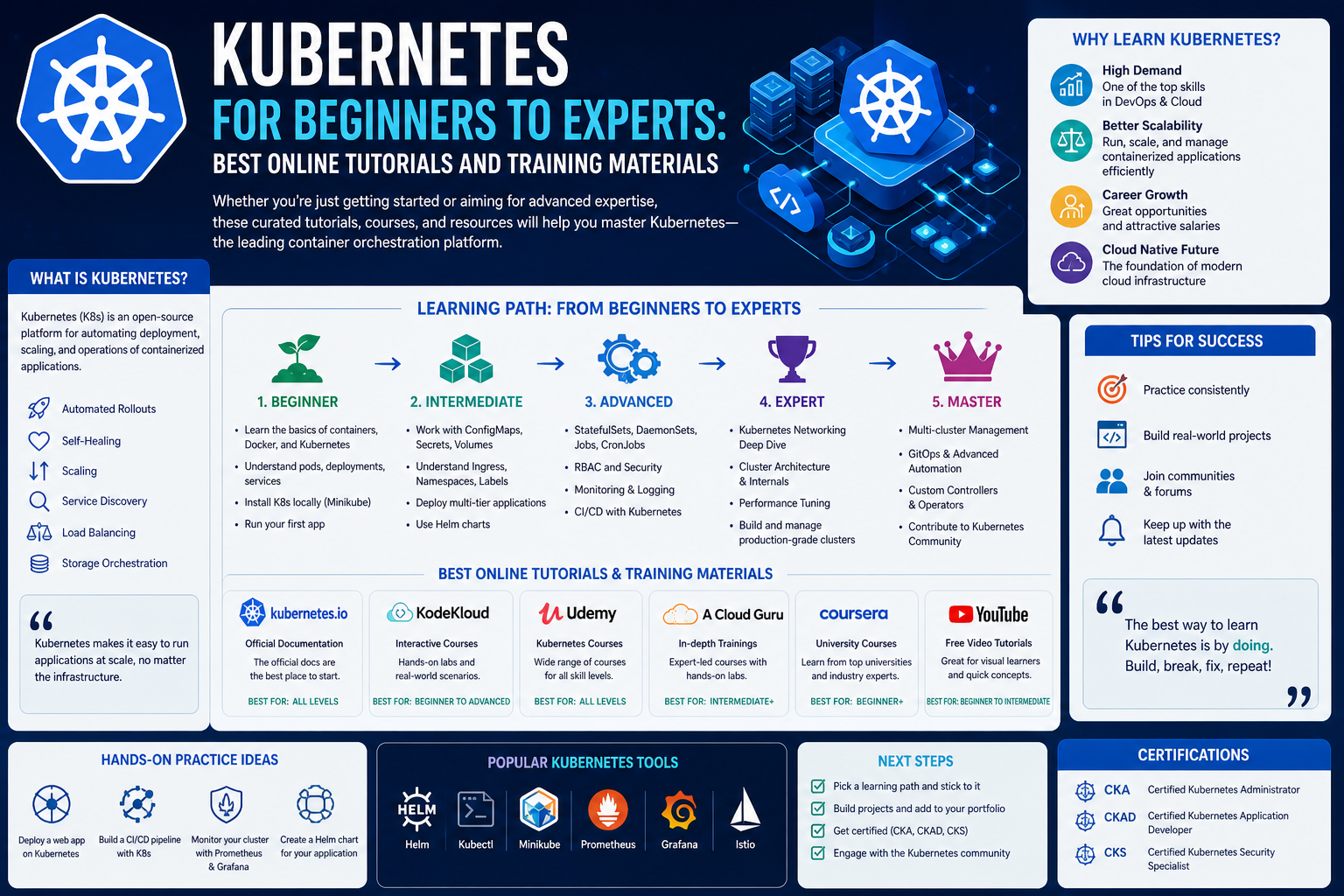
Kubernetes is best understood as a system designed to manage modern applications that are built using containers. In simple terms, it helps organize, run, and maintain applications that are split into many small, independent parts instead of being deployed as one large unit. This approach is especially important in today’s cloud-based environments, where applications need to run reliably across many machines and handle changing levels of demand.
Modern software is rarely static. Applications are constantly updated, scaled, and moved between environments. Without a management system, keeping track of these changes would be extremely difficult. Kubernetes acts like a coordination layer that ensures all parts of an application work together smoothly, even when conditions change.
At its core, Kubernetes focuses on three main goals: keeping applications running, making them scalable, and ensuring they can recover automatically from failures. These goals are essential for businesses that depend on digital services. Whether it is an e-commerce platform, a banking system, or a streaming service, downtime or instability can lead to serious problems.
One of the key ideas behind Kubernetes is abstraction. Instead of worrying about individual machines, developers and system administrators think in terms of clusters, services, and workloads. This abstraction simplifies infrastructure management and allows teams to focus more on application development rather than system maintenance.
Another important aspect is portability. Applications managed by Kubernetes can run in different environments without major changes. This means they can move from local development systems to private data centers or cloud platforms with minimal effort. This flexibility has made Kubernetes a central part of modern software infrastructure.
As organizations adopt cloud computing at a larger scale, Kubernetes becomes even more relevant. It provides a standardized way to manage complex systems that might otherwise require custom solutions. This standardization is one of the reasons it has become widely adopted across industries.
Why Container Orchestration Became Necessary
Before container orchestration systems existed, managing applications in containers was still challenging. Containers themselves made software deployment easier by packaging applications with their dependencies. However, when applications began to scale across dozens or hundreds of containers, new problems emerged.
One of the biggest challenges was coordination. Running a few containers on a single machine is simple, but managing thousands across multiple machines introduces complexity. Developers needed a way to ensure that containers could communicate, restart if they failed, and distribute workloads efficiently.
Another challenge was resource management. Without orchestration, it is difficult to determine where each container should run or how much computing power it should use. This often led to inefficient use of infrastructure or system instability when resources were overloaded.
There was also the issue of reliability. In a distributed system, failures are inevitable. Machines can go offline, networks can fail, and applications can crash. Without automation, handling these failures manually becomes impractical. Container orchestration systems solve this by continuously monitoring the state of applications and making adjustments automatically.
Kubernetes emerged as a solution to these challenges by providing a unified system for managing containerized applications. It introduced the idea that infrastructure should be self-healing, meaning it can detect problems and fix them without human intervention.
Another important factor was scalability. Modern applications need to handle unpredictable traffic. For example, a website might experience a sudden surge in users. Without orchestration, scaling such systems would require manual intervention. Kubernetes automates this process, allowing systems to grow or shrink based on demand.
The rise of microservices architecture also contributed to the need for orchestration. Instead of building a single large application, developers began breaking applications into smaller services. While this improves flexibility and development speed, it also increases complexity. Kubernetes helps manage this complexity by coordinating how these services interact and run.
Understanding the Kubernetes Architecture
Kubernetes has a well-structured architecture that allows it to manage complex systems efficiently. This architecture is divided into two main parts: the control plane and the worker nodes. Each part plays a specific role in managing applications.
The control plane is responsible for making decisions about the cluster. It acts as the brain of the system, ensuring that the desired state of applications matches the actual state. If something goes wrong, the control plane identifies the issue and takes corrective action.
Worker nodes, on the other hand, are responsible for running the actual applications. These nodes host containers and execute workloads based on instructions from the control plane. Together, the control plane and worker nodes form a cluster.
This separation of responsibilities is important because it allows Kubernetes to scale efficiently. The control plane manages logic and decision-making, while worker nodes focus on execution. This division ensures that the system remains stable even as it grows.
Communication between these components is continuous. The control plane monitors the health of nodes and workloads, while nodes report their status back to the control plane. This constant feedback loop ensures that the system remains aligned with its desired configuration.
Another important concept in Kubernetes architecture is declarative configuration. Instead of telling the system exactly how to perform tasks, users define what they want the system to achieve. Kubernetes then determines how to reach that state. This approach simplifies management and reduces human error.
The architecture is also designed for fault tolerance. If a component fails, Kubernetes can replace it or redistribute workloads to maintain system stability. This resilience is one of the reasons it is widely used in critical production environments.
The Role of the Control Plane
The control plane is the central decision-making component of Kubernetes. It manages the overall state of the cluster and ensures that everything runs according to the defined configuration. It does not run application workloads directly but instead oversees the system.
One of its primary responsibilities is scheduling. When a new container needs to run, the control plane decides which worker node is best suited for it. This decision is based on factors such as available resources, current load, and system policies.
Another key responsibility is maintaining desired state. Users define how many instances of an application should run, and the control plane ensures that this number is always maintained. If a container fails or a node goes offline, the control plane automatically creates replacements.
The control plane also handles cluster-wide communication. It ensures that all parts of the system are aware of each other and can interact properly. This is essential for maintaining consistency across a distributed environment.
In addition, the control plane manages updates and changes. When applications are updated, it gradually rolls out changes to avoid disruptions. This process ensures that systems remain available even during upgrades.
Security and access control are also managed at this level. The control plane enforces policies that determine who can access the cluster and what actions they can perform. This helps maintain a secure environment, especially in large organizations.
Overall, the control plane acts as the intelligence layer of Kubernetes, making decisions that keep the system running smoothly and efficiently.
Worker Nodes and Application Execution
Worker nodes are where the actual application workloads run. These nodes are machines that host containers and execute tasks assigned by the control plane. Each node contains several components that help manage and run workloads.
One of the most important elements inside a worker node is the container runtime. This is the software responsible for running containers. It ensures that applications are executed in isolated environments, preventing conflicts between different workloads.
Worker nodes also include an agent that communicates with the control plane. This agent receives instructions and reports back on the status of running containers. This constant communication ensures that the cluster remains synchronized.
Each node can run multiple containers, depending on its available resources. Kubernetes carefully distributes workloads across nodes to ensure that no single machine becomes overloaded. This balancing act is essential for maintaining performance and stability.
Nodes are designed to be replaceable. If a node fails, Kubernetes can shift workloads to other nodes without disrupting the application. This makes the system highly resilient to hardware or software failures.
Another important aspect is resource management. Nodes allocate CPU, memory, and storage to containers based on defined requirements. This prevents conflicts and ensures that applications have the resources they need to function properly.
Worker nodes are also responsible for network communication between containers. Kubernetes sets up networking rules that allow containers to communicate securely and efficiently, even if they are running on different machines.
Together, worker nodes form the execution layer of Kubernetes, handling the day-to-day running of applications while the control plane manages overall coordination.
Scheduling, Self-Healing, and System Reliability
One of the most powerful features of Kubernetes is its ability to automatically manage workloads through scheduling and self-healing mechanisms. These features are essential for maintaining reliability in large-scale systems.
Scheduling refers to the process of assigning workloads to specific worker nodes. Kubernetes evaluates available resources and determines the best placement for each container. This ensures efficient use of infrastructure and prevents resource bottlenecks.
Self-healing is the system’s ability to detect and recover from failures. If a container crashes, Kubernetes automatically restarts it. If a node becomes unavailable, workloads are moved to healthy nodes. This automatic recovery reduces downtime and improves system stability.
Health monitoring plays a key role in this process. Kubernetes continuously checks the status of containers and nodes. If something behaves unexpectedly, the system takes corrective action without requiring human intervention.
This reliability is especially important in environments where uptime is critical. Systems that rely on Kubernetes can continue operating even in the face of hardware failures or software errors.
The combination of scheduling and self-healing creates a dynamic environment where applications can run continuously with minimal manual oversight. This automation is one of the main reasons Kubernetes is widely used in production environments.
Scaling and Load Distribution in Kubernetes
Scalability is one of the defining strengths of Kubernetes. Modern applications often experience unpredictable traffic patterns, and the system must adapt quickly to these changes.
Kubernetes supports both manual and automatic scaling. In automatic scaling, the system monitors resource usage and adjusts the number of running containers based on demand. When traffic increases, new instances are created. When demand decreases, unnecessary instances are removed.
Load distribution ensures that traffic is evenly spread across available containers. This prevents any single instance from becoming overwhelmed and improves overall performance.
Scaling is not limited to application containers. It also applies to the underlying infrastructure. Kubernetes can manage clusters that grow or shrink depending on workload requirements.
This flexibility allows organizations to optimize resource usage and reduce operational costs. Instead of maintaining large fixed infrastructure, systems can adjust dynamically.
Scaling also improves user experience. Applications remain responsive even during peak usage because additional resources are allocated automatically.
Through these mechanisms, Kubernetes ensures that systems remain efficient, responsive, and capable of handling changing demands.
Kubernetes Networking Model and How Communication Works
Networking in Kubernetes is one of the most important foundations of the entire system because it determines how applications communicate with each other and how they are accessed from outside the cluster. Unlike traditional systems where networking is tightly tied to physical machines, Kubernetes introduces a flat networking model that simplifies communication between containers.
In this model, every container is able to communicate with every other container without needing complex routing rules or network address translation. This design removes many of the complications that usually appear in distributed systems. Instead of worrying about where a container is running, applications can simply use stable identifiers to connect to each other.
Each workload in Kubernetes is typically grouped into a logical unit that receives its own network identity. This means that even if containers are moved between nodes, their communication patterns remain consistent. This abstraction is essential for maintaining reliability in dynamic environments where workloads frequently shift.
Service discovery is another essential part of Kubernetes networking. Since containers are ephemeral and can be created or destroyed at any time, applications cannot rely on fixed IP addresses. Instead, Kubernetes provides a mechanism for automatically discovering services using internal naming systems. This allows applications to locate each other without manual configuration.
Traffic routing inside the cluster is handled intelligently. Requests are distributed across available instances of an application, ensuring balanced load and consistent performance. This reduces the risk of overload on individual containers and improves responsiveness.
External communication is managed separately from internal networking. Kubernetes provides controlled pathways for allowing outside users to access services running inside the cluster. This separation ensures that internal systems remain secure while still being accessible when needed.
Networking also supports resilience. If a container fails or is replaced, the networking layer ensures that communication continues without disruption. This is achieved through dynamic updates that reflect the current state of the system.
Overall, Kubernetes networking creates a seamless communication layer that hides infrastructure complexity and allows developers to focus on application logic instead of low-level networking concerns.
Service Discovery and Internal Load Balancing
Service discovery in Kubernetes is a mechanism that allows applications to automatically locate and communicate with each other without requiring hardcoded addresses. This is essential in environments where services are constantly changing.
Instead of relying on static IP addresses, Kubernetes assigns logical names to services. These names remain stable even when the underlying containers change. This ensures that applications can always find the resources they depend on.
When a service receives a request, Kubernetes distributes it across multiple running instances. This process is known as internal load balancing. It ensures that no single instance becomes overloaded while others remain idle.
The system continuously monitors the health of service instances. If an instance becomes unhealthy or unresponsive, it is automatically removed from the routing pool. This ensures that only healthy containers receive traffic.
Service discovery also supports scaling. When new instances are added, they are automatically included in the service pool. This allows applications to scale seamlessly without manual configuration changes.
This dynamic behavior is essential for modern cloud applications that need to adapt quickly to changing conditions. It eliminates the need for manual network updates and reduces the risk of misconfiguration.
By combining service discovery with load balancing, Kubernetes creates a flexible communication system that adapts automatically to the state of the cluster.
Kubernetes Storage and Persistent Data Management
Managing data in a dynamic container environment is challenging because containers are designed to be temporary. When a container is removed or restarted, any data stored inside it is lost. Kubernetes addresses this problem through persistent storage mechanisms.
Persistent storage allows data to exist independently of containers. This means that even if a container is destroyed, the data it was using remains intact and can be reattached to a new container.
Storage in Kubernetes is abstracted in a way that separates physical infrastructure from logical storage needs. Instead of directly managing disks or storage devices, users define storage requirements, and Kubernetes handles the underlying implementation.
This abstraction allows applications to use storage consistently across different environments. Whether running on local infrastructure or cloud platforms, storage behaves in a predictable way.
Kubernetes supports multiple types of storage systems, including network-based storage and cloud-based solutions. These systems can be dynamically provisioned based on application requirements.
Data persistence is essential for applications that require reliability, such as databases or file storage systems. Kubernetes ensures that these workloads can maintain continuity even when containers are rescheduled.
Another important aspect is storage binding. Kubernetes connects storage resources to specific workloads based on defined rules. This ensures that applications always have access to the data they need.
Storage management also includes lifecycle control. When storage is no longer needed, it can be safely released without affecting other parts of the system. This helps optimize resource usage.
Overall, Kubernetes storage systems provide a flexible and reliable way to manage persistent data in a highly dynamic environment.
Configuration Management and Application Customization
Applications running in Kubernetes often require different configurations depending on the environment they are deployed in. Managing these configurations manually can become complex and error-prone.
Kubernetes provides structured ways to manage configuration data separately from application code. This allows applications to remain flexible and adaptable without requiring code changes.
Configuration data can include environment-specific settings, connection details, or feature toggles. By separating this data from application logic, systems become easier to maintain and update.
This separation also improves security. Sensitive information can be managed independently and accessed only by authorized components. This reduces the risk of exposing critical data.
Applications can dynamically load configuration data at runtime. This means changes can be applied without restarting entire systems, improving efficiency and reducing downtime.
Configuration management also supports consistency across environments. The same application can behave differently depending on the configuration applied, making it easier to move between development, testing, and production environments.
This flexibility is particularly useful in large organizations where applications must operate across multiple environments with different requirements.
By centralizing configuration management, Kubernetes reduces complexity and improves control over application behavior.
Kubernetes Security Architecture
Security is a critical aspect of Kubernetes because it often manages sensitive workloads across distributed systems. The security model is designed to protect both the cluster and the applications running inside it.
One of the core principles of Kubernetes security is access control. Not all users or systems should have the same level of access. Kubernetes enforces strict rules that determine who can perform specific actions within the cluster.
Authentication ensures that only verified users or systems can interact with the cluster. Once authenticated, authorization rules determine what actions they are allowed to perform.
Another important layer is network security. Kubernetes can isolate workloads from each other, preventing unauthorized communication between different parts of the system.
Security policies also control how containers behave. For example, certain containers may be restricted from accessing sensitive system resources. This helps prevent misuse or accidental damage.
Image security is another consideration. Kubernetes can enforce rules about which container images are allowed to run, ensuring that only trusted software is deployed.
Secrets management is used to handle sensitive information such as passwords or tokens. These secrets are stored securely and accessed only when needed.
Security monitoring is continuous. The system tracks activity within the cluster to detect unusual behavior. If a potential threat is identified, corrective actions can be taken automatically or manually.
Overall, Kubernetes security is built around multiple layers of protection that work together to safeguard both infrastructure and applications.
Deployment Strategies and Application Updates
Deploying applications in Kubernetes is designed to be flexible and reliable. Instead of replacing entire systems at once, updates are applied gradually to minimize disruption.
One common approach is rolling updates. In this method, new versions of an application are introduced gradually while older versions are phased out. This ensures that the system remains available during updates.
If a problem occurs during deployment, Kubernetes can automatically roll back to a previous stable version. This reduces the risk of downtime or service disruption.
Another strategy is controlled scaling during updates. New instances are added before old ones are removed, ensuring continuous availability.
Deployment strategies are designed to support modern development practices where applications are updated frequently. This allows teams to release new features without interrupting users.
Kubernetes also supports version control of application states. This means different versions of an application can coexist temporarily, allowing for testing and validation before full rollout.
These deployment mechanisms make Kubernetes particularly suitable for environments where reliability and uptime are critical.
Observability, Monitoring, and System Insight
Understanding what is happening inside a Kubernetes cluster is essential for maintaining performance and reliability. Observability refers to the ability to monitor, analyze, and understand system behavior.
Logs provide detailed information about application activity. They help identify errors, track performance, and understand system behavior over time.
Metrics provide numerical data about system performance, such as resource usage, response times, and workload distribution. These metrics help identify trends and potential issues.
Tracing allows developers to follow the path of requests as they move through different services. This is especially useful in microservices architectures where a single request may pass through multiple components.
Monitoring tools continuously collect and analyze data from the cluster. This helps detect problems early and ensures that systems remain healthy.
Observability also supports decision-making. By analyzing system data, teams can optimize performance, improve resource usage, and plan for scaling.
Without observability, managing large distributed systems would be extremely difficult. Kubernetes provides a structured way to gain visibility into complex environments.
Kubernetes Ecosystem and Extensibility
Kubernetes is not just a standalone system; it is part of a larger ecosystem of tools and extensions that enhance its functionality. This ecosystem allows users to customize and extend Kubernetes to meet specific needs.
Extensions can add new capabilities such as advanced networking, storage integration, or security enhancements. This flexibility makes Kubernetes adaptable to a wide range of use cases.
Custom resources allow users to define their own types of objects within Kubernetes. This enables the system to manage specialized workloads beyond its default capabilities.
Automation tools integrate with Kubernetes to streamline operations. These tools can manage deployments, scaling, and configuration automatically based on predefined rules.
The ecosystem also includes tools for monitoring, logging, and security. These tools enhance the core functionality of Kubernetes and provide deeper insights into system behavior.
This extensibility is one of the reasons Kubernetes has become widely adopted. It allows organizations to build customized solutions without modifying the core system.
Troubleshooting and Managing Complexity in Clusters
As Kubernetes environments grow, complexity increases. Troubleshooting becomes an important skill for maintaining system health.
One of the key challenges is identifying the root cause of issues. Problems can originate from applications, networking, storage, or configuration errors. Kubernetes provides tools to help isolate these issues.
Logs and metrics are essential for troubleshooting. They provide detailed information that helps diagnose problems and understand system behavior.
Another important aspect is understanding cluster state. Kubernetes continuously tracks the desired and actual state of the system. Comparing these states helps identify inconsistencies.
Resource limitations can also cause issues. If applications do not have enough CPU or memory, they may become unstable. Monitoring resource usage helps prevent such problems.
Network issues are another common source of problems. Misconfigurations or connectivity issues can disrupt communication between services.
Effective troubleshooting requires a structured approach that combines monitoring, analysis, and system understanding. Kubernetes provides the tools needed, but interpreting the data correctly is key to resolving issues efficiently.
Managing complexity also involves designing systems carefully. Breaking applications into smaller components and organizing workloads properly helps reduce operational difficulties.
Through careful monitoring and structured management, Kubernetes environments can remain stable even as they grow in size and complexity.
Advanced Scaling Strategies in Dynamic Environments
As applications grow in complexity and user demand becomes unpredictable, Kubernetes provides more advanced scaling mechanisms beyond basic resource adjustments. These strategies are designed to ensure that applications not only scale when needed but do so intelligently based on real-time conditions and multiple performance signals.
One of the most important ideas in advanced scaling is that scaling is not only about adding more instances of an application. It also involves understanding when scaling is actually necessary and how much capacity should be added or removed. This requires continuous observation of system behavior, including CPU usage, memory consumption, request rates, and even custom metrics defined by the application itself.
Kubernetes allows applications to scale horizontally, which means increasing or decreasing the number of running instances. This approach is particularly effective for stateless applications, where any instance can handle any request. Horizontal scaling ensures that traffic is distributed evenly and that no single instance becomes a bottleneck.
In more advanced scenarios, scaling can be triggered by external signals. For example, applications can scale based on message queue length, database load, or API request frequency. This allows systems to respond more precisely to real-world conditions instead of relying on simple resource thresholds.
Another dimension of scaling involves predictive behavior. Instead of reacting to increased load after it happens, some systems anticipate demand based on historical patterns. This can be especially useful for applications with predictable usage cycles, such as business applications or media platforms with peak hours.
Scaling decisions are also influenced by stabilization mechanisms. Without proper control, systems can scale up and down too frequently, causing instability. Kubernetes introduces smoothing techniques that prevent rapid fluctuations and ensure that scaling actions are meaningful and sustainable.
Together, these advanced scaling strategies create systems that are not only reactive but also intelligent and efficient in managing resources under changing conditions.
Intelligent Scheduling and Workload Optimization
Scheduling in Kubernetes goes beyond simply placing workloads on available machines. In advanced environments, scheduling becomes a complex decision-making process that considers multiple factors to optimize performance, cost, and reliability.
Each workload may have specific requirements such as high memory, low latency, or specialized hardware needs. Kubernetes evaluates these requirements and matches workloads to the most suitable nodes. This ensures that applications run in environments where they perform best.
Workload optimization also involves balancing competing demands. Some nodes may be underutilized while others are overloaded. The scheduling system continuously adjusts placement decisions to improve overall cluster efficiency.
Affinity and anti-affinity rules play an important role in scheduling decisions. These rules define whether certain workloads should be placed together or separated. For example, critical services may be distributed across different nodes to reduce the risk of simultaneous failure.
Taints and tolerations add another layer of control by allowing certain nodes to repel specific workloads unless explicitly allowed. This is useful for isolating specialized workloads or ensuring that sensitive applications run only on secure infrastructure.
Advanced scheduling also considers topology awareness. This means workloads can be placed based on physical or logical location, such as data center zones or geographic regions. This improves performance by reducing latency and increasing resilience.
Overall, intelligent scheduling ensures that workloads are placed in the most efficient and reliable way possible, improving both performance and resource utilization.
Custom Resources and Extending Kubernetes Behavior
One of the most powerful features of Kubernetes is its ability to be extended beyond its default capabilities. This is achieved through custom resources, which allow users to define new types of objects that Kubernetes can manage.
Custom resources enable Kubernetes to handle specialized workloads that are not part of its core functionality. Instead of modifying the system itself, users can extend it in a structured and consistent way.
These extensions behave like native components within the system. They can be created, updated, and deleted using the same mechanisms as built-in resources. This makes them easy to integrate into existing workflows.
Custom resources are often used to represent complex application components or infrastructure elements. For example, they can define database clusters, machine learning workflows, or multi-step deployment pipelines.
By introducing custom resources, Kubernetes becomes a platform for building higher-level systems. This transforms it from a container orchestration tool into a general-purpose infrastructure management system.
The flexibility of custom resources allows organizations to tailor Kubernetes to their specific needs without altering its core architecture. This ensures stability while enabling innovation.
Operators and Automation of Complex Systems
Operators are a powerful concept built on top of custom resources. They represent automated controllers that manage complex application lifecycles inside Kubernetes.
Instead of manually managing applications, operators encode operational knowledge into software. This means they can automatically handle tasks such as deployment, scaling, backup, and recovery.
Operators continuously monitor the state of applications and take corrective actions when necessary. This reduces the need for human intervention and ensures consistent operation.
They are particularly useful for stateful applications such as databases or messaging systems, which require careful management of data consistency and availability.
By automating operational tasks, operators reduce complexity and improve reliability. They also make it easier to run advanced systems in distributed environments.
Operators effectively extend Kubernetes into a self-managing platform where applications can maintain their own operational logic.
GitOps and Declarative Infrastructure Management
Modern infrastructure management has shifted toward declarative approaches, where the desired state of systems is defined in version-controlled files. GitOps is a methodology that applies this concept to Kubernetes environments.
In GitOps, all configuration and infrastructure definitions are stored in a version control system. Changes to the system are made by updating these definitions rather than directly modifying the live environment.
This approach provides several advantages. It creates a clear history of changes, improves collaboration, and ensures consistency across environments.
Kubernetes naturally supports declarative management, making it well-suited for GitOps workflows. The system continuously reconciles the actual state with the desired state defined in configuration files.
If there is a difference between the two, Kubernetes automatically makes adjustments to align them. This ensures that systems remain consistent and predictable.
GitOps also improves reliability by enabling easy rollback to previous configurations. If a change causes issues, reverting to a stable version is straightforward.
This methodology enhances control, transparency, and automation in infrastructure management.
CI/CD Integration for Continuous Delivery Workflows
Continuous integration and continuous delivery workflows are essential for modern software development. Kubernetes integrates deeply with these workflows to enable fast and reliable application delivery.
In continuous integration, code changes are frequently tested and validated. Kubernetes environments can be used to create isolated testing environments where new changes are deployed automatically.
Continuous delivery extends this process by automating the deployment of validated changes into production environments. Kubernetes enables controlled and gradual rollouts of new versions.
This integration ensures that applications can be updated frequently without disrupting users. It also reduces the risk associated with large, infrequent releases.
Automation plays a key role in this process. Build pipelines, testing frameworks, and deployment systems work together to ensure smooth transitions from development to production.
Kubernetes supports this by providing consistent environments across all stages of the delivery pipeline.
Multi-Cluster Management and Federation Approaches
As organizations grow, they often deploy multiple Kubernetes clusters across different environments or geographic regions. Managing these clusters individually can become complex, leading to the need for multi-cluster strategies.
Multi-cluster management allows organizations to coordinate multiple clusters as part of a unified system. This improves scalability, resilience, and flexibility.
Federation approaches enable workloads to be distributed across clusters based on policies and requirements. This allows applications to operate closer to users or data sources.
Multi-cluster setups also improve fault tolerance. If one cluster fails, workloads can be shifted to another cluster, ensuring continuity of service.
Managing multiple clusters requires careful coordination of configuration, security, and networking. Kubernetes provides mechanisms to help maintain consistency across environments.
This approach is especially useful for global applications that require low latency and high availability across regions.
Edge Computing and Distributed Kubernetes Deployments
Edge computing extends Kubernetes beyond centralized data centers into distributed environments closer to end users. This is increasingly important for applications that require low latency or operate in remote locations.
In edge deployments, smaller Kubernetes clusters are deployed on devices or local infrastructure. These clusters handle local processing while communicating with central systems when needed.
This distributed approach reduces latency and improves responsiveness for time-sensitive applications.
Edge environments often operate with limited resources, so Kubernetes must be optimized for lightweight operation. This includes efficient resource usage and minimal overhead.
Despite these constraints, edge clusters still maintain core Kubernetes functionality, including scheduling, scaling, and self-healing.
This allows organizations to extend cloud-native principles into physical environments such as factories, retail stores, or remote installations.
Policy Enforcement and Governance at Scale
As Kubernetes environments grow, maintaining control and consistency becomes increasingly important. Policy enforcement ensures that systems operate within defined rules and standards.
Policies can govern security, resource usage, access control, and operational behavior. They ensure that workloads comply with organizational requirements.
Governance mechanisms help enforce these policies across large clusters or multiple environments. This ensures consistency and reduces the risk of misconfiguration.
Policies can be automatically applied and enforced, preventing non-compliant workloads from being deployed.
This structured approach to governance is essential for maintaining order in large and complex systems.
Performance Tuning and Resource Efficiency
Optimizing performance in Kubernetes requires careful management of resources and workloads. Performance tuning focuses on ensuring that applications run efficiently without wasting infrastructure capacity.
Resource requests and limits help define how much CPU and memory each workload can use. Proper configuration ensures that applications have enough resources while preventing overconsumption.
Node selection and workload distribution also play a role in performance optimization. Placing workloads strategically can reduce latency and improve throughput.
Caching, batching, and efficient communication patterns further enhance performance at the application level.
Continuous monitoring helps identify bottlenecks and inefficiencies. Adjustments can then be made to improve overall system behavior.
Disaster Recovery and High Availability Strategies
Ensuring system resilience is a key requirement for production environments. Disaster recovery strategies in Kubernetes focus on maintaining availability even in the event of major failures.
High availability is achieved by distributing workloads across multiple nodes and zones. This ensures that failure in one area does not affect the entire system.
Backup and restoration mechanisms allow systems to recover from data loss or corruption.
Replication ensures that critical workloads have multiple active instances running at all times.
These strategies work together to ensure that systems remain operational under adverse conditions.
Cluster Upgrades and Lifecycle Management
Kubernetes clusters require regular updates to maintain security and performance. Upgrades must be handled carefully to avoid disruption.
Rolling upgrades allow clusters to be updated gradually, ensuring that workloads remain available during the process.
Lifecycle management also includes monitoring system health, removing outdated components, and maintaining compatibility across versions.
Proper upgrade strategies ensure that systems evolve without introducing instability.
Real-World Architecture Patterns in Enterprise Systems
Enterprise Kubernetes systems often follow established architecture patterns designed to improve scalability and maintainability.
Microservices architectures break applications into smaller components that can be managed independently.
Event-driven architectures allow systems to respond dynamically to changes in state.
Layered architectures separate concerns between application logic, infrastructure, and data management.
These patterns help organizations build scalable and maintainable systems using Kubernetes as the underlying platform.
Evolving Role of Kubernetes in Future Cloud Infrastructure
Kubernetes continues to evolve as a central platform for managing modern infrastructure. Its role is expanding beyond container orchestration into broader areas of system management.
Future developments are likely to focus on greater automation, improved intelligence, and deeper integration with cloud-native technologies.
As systems become more complex and distributed, Kubernetes will continue to serve as a foundational layer for managing applications across diverse environments.
Its flexibility and extensibility ensure that it remains relevant as technology landscapes continue to evolve.
Conclusion
Kubernetes has become one of the most important technologies in modern computing because it solves a fundamental challenge: how to reliably run and manage applications at scale in highly dynamic environments. As organizations move toward cloud-native architectures, the need for systems that can automatically handle deployment, scaling, recovery, and coordination becomes essential rather than optional. Kubernetes addresses this need by acting as a powerful orchestration layer that removes much of the manual effort traditionally required in infrastructure management.
What makes Kubernetes especially valuable is its ability to abstract complexity. Instead of requiring teams to manage individual servers or containers, it introduces a higher-level model based on clusters, workloads, and services. This shift allows developers and engineers to focus more on building applications rather than worrying about infrastructure details. At the same time, the system maintains strong control over performance, reliability, and resource usage behind the scenes.
Another defining strength of Kubernetes is its resilience. Modern applications cannot afford long downtime or unpredictable failures. Kubernetes is designed to continuously monitor system health and automatically correct issues when they arise. Whether it is restarting failed containers, redistributing workloads, or scaling applications based on demand, the system ensures that services remain available and stable under changing conditions.
The flexibility of Kubernetes also plays a major role in its widespread adoption. It supports a wide range of use cases, from simple web applications to large-scale enterprise systems and distributed cloud platforms. Its ability to integrate with different tools, environments, and infrastructures makes it suitable for organizations of all sizes. This adaptability ensures that Kubernetes remains relevant even as technology continues to evolve.
In addition, Kubernetes has reshaped how teams approach software development and deployment. It has encouraged the adoption of microservices, continuous delivery, and declarative infrastructure practices. These modern approaches improve development speed, system reliability, and operational efficiency. As a result, organizations can deliver updates more frequently while maintaining stability.
However, Kubernetes is not just a technical tool; it represents a shift in mindset. It encourages automation, scalability, and resilience as core principles of system design. Learning and mastering it requires time and hands-on experience, but the benefits are significant for those working in cloud computing, DevOps, and software engineering.
Ultimately, Kubernetes stands as a foundation of modern infrastructure. It enables systems that are not only powerful and scalable but also intelligent and self-managing. As digital systems continue to grow in complexity, Kubernetes will remain a key technology that supports the future of cloud-native computing and distributed application design.