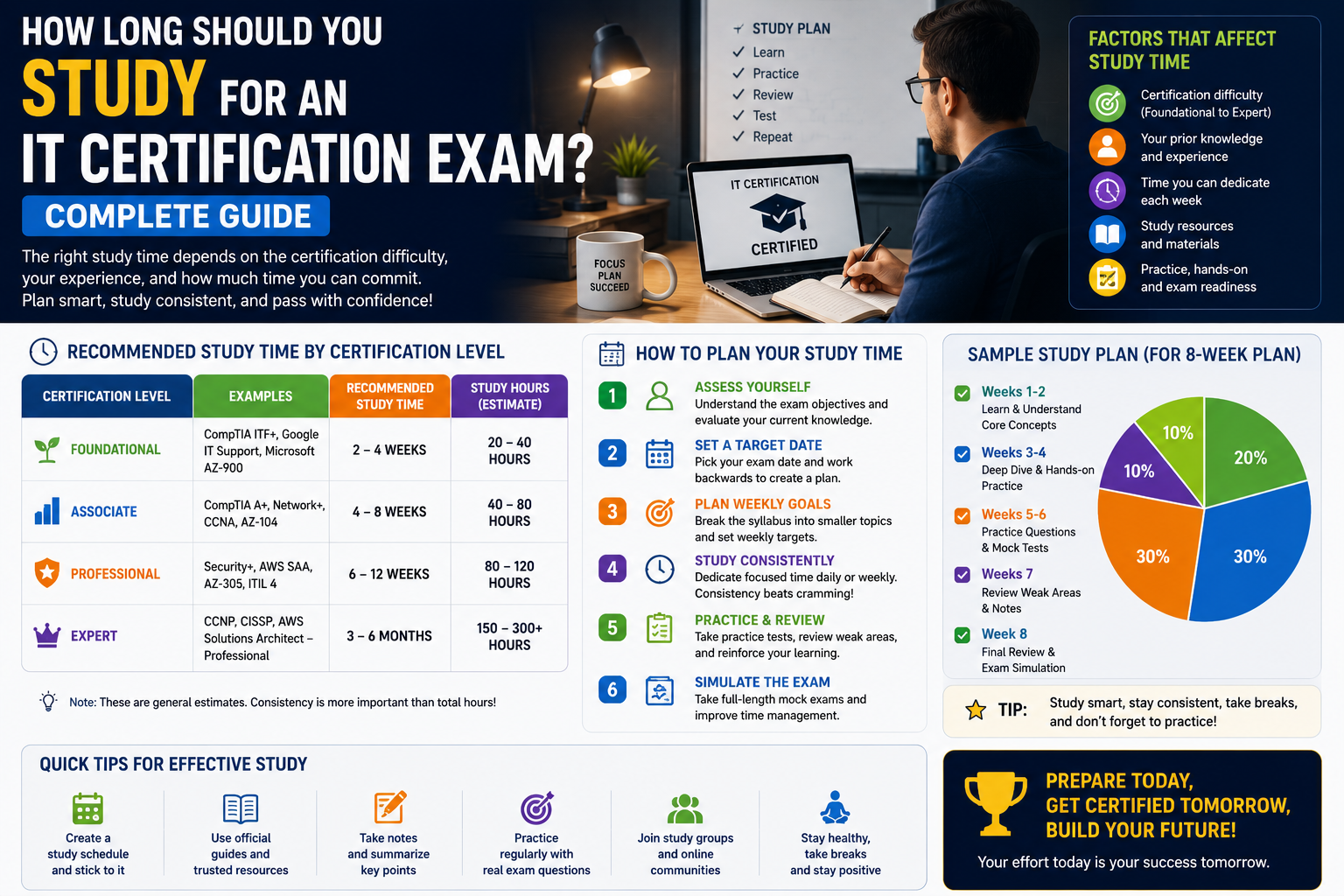
Preparing for an IT certification is one of the most important steps in building a strong technical career. However, one of the biggest challenges learners face is figuring out how much time they should actually dedicate to studying. Some people pass exams in a few weeks, while others need several months. This difference often creates confusion and uncertainty for beginners and even experienced professionals.
The truth is that there is no single fixed timeline that works for everyone. The ideal study duration depends on several factors such as your experience level, familiarity with the exam topics, learning speed, and daily study consistency. Understanding these elements can help you create a more realistic and effective preparation plan.
Understanding IT Certification Study Timelines
The amount of time needed to prepare for an IT certification varies widely because each exam tests different levels of knowledge and practical skills. Entry-level certifications often focus on foundational concepts such as basic networking, hardware components, operating systems, and simple troubleshooting. These exams may require longer study time for beginners who are encountering these topics for the first time.
On the other hand, professionals who already work in IT environments may find the same material easier to understand. Their real-world experience helps them connect theoretical concepts with practical situations, reducing overall preparation time. For example, someone who has been working in a help desk role for several years might only need to revise key concepts and focus on exam patterns rather than learning everything from scratch.
Intermediate and advanced certifications usually demand deeper technical understanding. These exams often cover complex topics such as network design, system administration, cloud computing, security architecture, or infrastructure management. Even experienced professionals may need structured preparation because these exams test not only knowledge but also problem-solving ability under exam conditions.
Another important factor influencing study timelines is the format of the exam itself. Some certifications rely heavily on memorization of terms and concepts, while others require hands-on skills or scenario-based thinking. Memorization-heavy exams may take longer for those unfamiliar with technical vocabulary, while practical exams require consistent lab practice.
Additionally, the way individuals study plays a major role in determining how long preparation takes. Someone who studies consistently for short periods each day may progress more effectively than someone who studies in irregular, long sessions. Consistency helps reinforce learning and improves long-term memory retention, which is essential for passing certification exams.
Factors That Influence How Long You Should Study
Several key factors determine how long it takes to prepare for an IT certification. One of the most important is prior experience. If you already work in an IT-related role, you likely encounter many of the exam topics in your daily tasks. This familiarity reduces the need for extensive study and allows you to focus more on revision and exam practice.
Another major factor is the difficulty level of the certification. Entry-level exams are designed for beginners, but they can still be challenging because they cover a broad range of topics. These exams require learners to understand fundamental concepts clearly before moving on to more advanced material. As a result, beginners often need more time to absorb the information properly.
Intermediate certifications require deeper understanding and practical application of knowledge. These exams may involve troubleshooting scenarios, system configurations, or interpreting complex network structures. Preparing for such exams often requires both theoretical study and hands-on practice, which naturally extends the preparation period.
Learning style also plays a significant role. Some individuals learn quickly through reading and watching instructional content, while others need hands-on experience to fully understand concepts. Visual learners may prefer diagrams and demonstrations, while practical learners benefit from setting up labs and practicing real-world scenarios. Understanding your learning style can help you estimate a more accurate study timeline.
Daily study commitment is another crucial factor. Someone who studies for one hour a day will naturally take longer to prepare than someone who dedicates several hours daily. However, longer study sessions are not always better. Short, focused, and consistent study sessions are often more effective than long, exhausting ones that lead to burnout.
The complexity of the subject matter also affects preparation time. Topics like subnetting, virtualization, cloud architecture, and cybersecurity require deeper understanding and practice. These areas may take longer to master, especially for beginners who are encountering them for the first time.
Finally, access to practice environments can influence study duration. Hands-on experience is extremely valuable for IT certifications. Those who regularly practice in simulated environments or real systems tend to learn faster and retain information more effectively.
Study Duration Expectations by Experience Level
Experience level is one of the strongest indicators of how long you should study for an IT certification. Beginners, intermediate learners, and experienced professionals all approach exam preparation differently.
For beginners entering the IT field, study timelines are usually longer. Since they are learning most of the concepts for the first time, they need time to understand foundational topics such as networking basics, operating systems, hardware components, and troubleshooting methods. Without prior exposure, even simple concepts may require repeated study sessions to fully grasp. Beginners often benefit from spreading their preparation over several months to build confidence and understanding gradually.
Intermediate learners, such as those with some IT support or networking experience, typically require less time. They already understand many core concepts and can focus more on filling knowledge gaps. For them, preparation often involves structured revision, practice tests, and hands-on exercises. Their study time may be shorter, but it is usually more focused and goal-oriented.
Experienced IT professionals often have the shortest preparation time, depending on the certification. Since they regularly work with relevant technologies, they already understand real-world applications of many exam topics. Their study process is often centered around refreshing knowledge, reviewing exam objectives, and practicing test scenarios. However, even experienced professionals may need additional time if the certification covers unfamiliar technologies or advanced concepts outside their usual work environment.
Another important consideration is career specialization. For example, someone working in networking will find networking certifications easier to prepare for compared to cloud or security certifications outside their expertise. Similarly, system administrators may find infrastructure-related exams more familiar than programming-heavy certifications.
It is also important to consider exam changes and updates. Even experienced professionals may need additional time when certification exams introduce new technologies, updated frameworks, or revised objectives. Staying current with industry trends becomes essential in such cases.
Overall, experience significantly reduces study time, but it does not eliminate the need for preparation. Every certification requires structured learning, review, and practice to ensure success.
Building a Realistic Study Plan
Creating a realistic study plan is one of the most effective ways to manage preparation time for IT certifications. A well-structured plan helps you stay consistent, track progress, and avoid last-minute stress.
The first step in building a study plan is understanding the exam objectives. Every certification has a defined list of topics that will be tested. Breaking these topics into smaller sections makes the learning process more manageable. Instead of trying to study everything at once, you can focus on one area at a time.
Next, it is important to set a clear timeline based on your daily availability. A realistic schedule should fit into your routine without causing burnout. For example, studying for short periods every day is often more effective than cramming long hours on weekends. Consistency helps reinforce learning and improves long-term retention.
Practice is another essential part of preparation. IT certifications are not just about memorizing information; they also test your ability to apply knowledge in real situations. Practicing scenarios, troubleshooting problems, and simulating tasks can significantly improve your understanding and confidence.
Regular self-assessment is also important. Taking practice tests or reviewing your knowledge periodically helps identify weak areas. This allows you to adjust your study plan and focus more on topics that need improvement.
Time management plays a key role in preparation success. Allocating more time to difficult topics and less time to familiar ones ensures balanced learning. It is also important to leave time for revision before the exam, as reviewing material helps strengthen memory.
Finally, maintaining motivation throughout the study period is crucial. Setting small milestones and tracking progress can help you stay focused. A structured approach not only improves efficiency but also reduces stress and increases the chances of passing the exam on the first attempt.
Conclusion
The time required to study for an IT certification depends on multiple factors, including experience level, exam difficulty, learning style, and daily study consistency. There is no universal answer because every learner approaches preparation differently. Beginners may need several months to build foundational knowledge, while experienced professionals may require only a few weeks of focused revision.
What matters most is not how long you study, but how effectively you use your study time. A well-structured plan, consistent effort, and regular practice can significantly improve your chances of success. Understanding your strengths and weaknesses allows you to create a realistic timeline that fits your personal situation rather than following a fixed standard.
Instead of rushing through material or delaying preparation unnecessarily, it is better to focus on steady progress. IT certifications are designed to test both knowledge and practical understanding, so balanced preparation is essential.
Ultimately, the right study duration is the one that helps you feel confident and fully prepared on exam day.