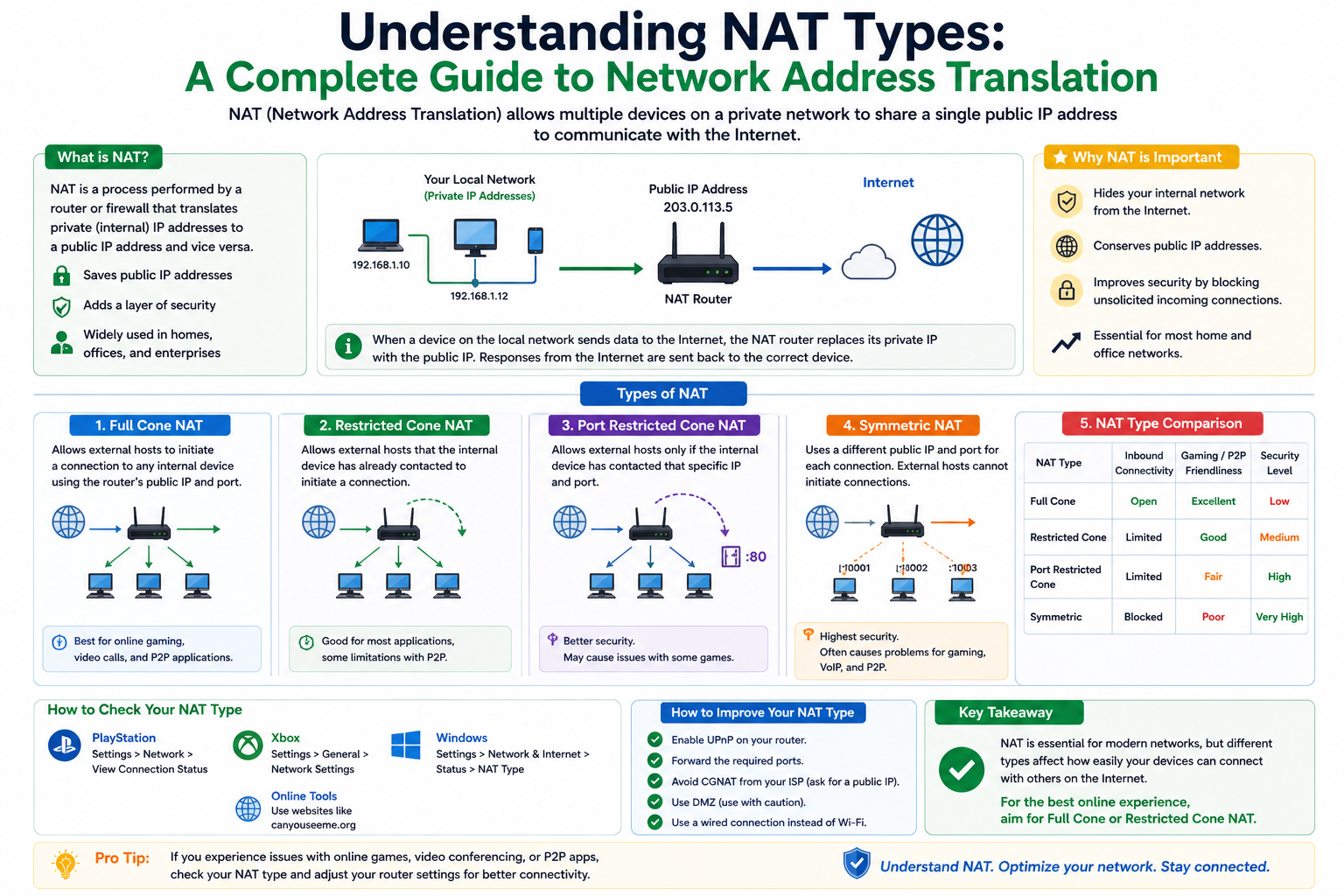
Network Address Translation, commonly known as NAT, is one of the most important mechanisms that keeps modern internet communication functional, especially in environments where multiple devices share a single internet connection. To understand why NAT exists, it is necessary to look at how devices communicate over networks and how the limitation of IP addresses shaped the evolution of networking.
Every device that connects to a network requires an IP address, which acts like a digital identifier. There are two main categories of IP addresses: public and private. A public IP address is globally unique and is used on the internet to identify a network or device externally. In contrast, private IP addresses are used within local networks such as homes, offices, schools, and organizations. These private addresses cannot directly communicate with the internet without some form of translation.
This is where NAT becomes essential. NAT allows multiple devices within a local network to share a single public IP address when accessing the internet. Instead of requiring every device to have its own public IP—which is impossible due to the limited number of IPv4 addresses—NAT enables efficient reuse of addresses.
When a device such as a laptop or smartphone sends a request to access a website, that request contains its private IP address and a source port number. The router receives this request and performs NAT by replacing the private IP with its own public IP address. It also tracks the connection using port numbers so that when the response returns from the internet, it knows exactly which internal device should receive the data.
This process happens extremely quickly and continuously for every online activity, whether browsing websites, streaming videos, or playing online games. The router maintains a translation table that keeps track of active connections, ensuring that responses from external servers are correctly delivered back to the originating device inside the network.
Without NAT, the internet would require an enormous number of public IP addresses—far more than are available. NAT not only solves this limitation but also adds a layer of security by hiding internal network structures from external systems. External servers only see the router’s public IP, not the individual devices behind it.
In modern networking, NAT is a fundamental component of routers and is automatically enabled in most setups. However, the way NAT behaves can vary depending on configuration, which leads to different NAT types. These types influence how easily devices can communicate with external servers and other users, especially in real-time applications like gaming or video communication.
Understanding NAT types requires a closer look at how restrictive or open the translation process is between private networks and the internet. Each type represents a different balance between accessibility, performance, and security.
The Three NAT Types Explained in Detail
NAT types define how a network handles incoming and outgoing connections between private devices and the internet. While NAT itself performs the translation process, the “type” refers to how permissive or restrictive the router configuration is when managing these connections. The three main NAT types are Open NAT, Moderate NAT, and Strict NAT.
Open NAT is the least restrictive configuration. In this setup, the network allows a wide range of incoming and outgoing connections with minimal filtering. Devices behind an Open NAT can communicate more freely with external servers and other users. This type is often preferred in environments where real-time communication is critical, such as online gaming or peer-to-peer applications.
In an Open NAT setup, routers may use techniques like port forwarding or even place a device in a demilitarized zone (DMZ). Port forwarding allows specific external traffic to be directed to a particular internal device. This ensures that certain applications can receive incoming data without interference. A DMZ configuration goes further by exposing a device more directly to the internet, reducing restrictions but also lowering security.
While Open NAT provides excellent connectivity, it also reduces protective barriers. Because more incoming traffic is allowed, devices may become more exposed to unsolicited or potentially harmful connections. For this reason, Open NAT is typically used only when necessary for performance-sensitive applications.
Moderate NAT is the most commonly used configuration in home and office networks. It strikes a balance between connectivity and security. In this setup, devices can initiate outbound connections freely, but incoming connections are only allowed if they match an existing communication session or rule created by the router.
This means that when a device connects to a server, NAT allows the response traffic back through. However, external systems cannot freely initiate new connections to internal devices unless specific permissions are configured. This makes Moderate NAT secure enough for everyday use while still supporting most online activities without issues.
Most routers are set to Moderate NAT by default because it provides a stable and safe networking environment. It works well for browsing, streaming, downloading, and most online services. However, in some cases—particularly with certain multiplayer games or peer-to-peer services—Moderate NAT may limit connectivity between users.
Strict NAT is the most restrictive configuration. It heavily limits incoming connections and only allows communication through specific, predefined ports. This type of NAT is designed with security as the highest priority. It blocks almost all unsolicited incoming traffic and only permits tightly controlled communication paths.
In Strict NAT environments, devices may experience difficulty connecting to external peers, especially in applications that rely on direct device-to-device communication. While this improves security by reducing exposure to external threats, it can also lead to limited functionality in certain online services.
Strict NAT is often used in highly secure environments such as enterprise networks or systems that require strict control over communication channels. It ensures that only authorized traffic is allowed, reducing the risk of intrusion or unauthorized access.
Each NAT type reflects a different design philosophy. Open NAT prioritizes accessibility, Moderate NAT balances usability and security, and Strict NAT prioritizes protection above all else. Understanding these differences helps users and administrators choose the right configuration for their needs.
Practical Impacts of NAT Types in Real-World Networking
The choice of NAT type has a direct impact on how smoothly devices communicate with external services. One of the most noticeable areas where NAT behavior becomes important is online gaming. Many multiplayer games rely on real-time communication between players, which requires stable and efficient network connections.
With Open NAT, players typically experience fewer connectivity issues. Matchmaking is faster, voice communication is more stable, and connections to other players are less likely to fail. This is because Open NAT allows easier peer-to-peer connections and reduces restrictions on incoming traffic.
Moderate NAT still supports most gaming experiences effectively, but occasional limitations may occur. For example, matchmaking might take longer, or certain players may not be able to connect directly. However, most modern games are designed to function well under Moderate NAT conditions by using centralized servers to manage communication.
Strict NAT can create noticeable limitations in gaming environments. Players may struggle to join multiplayer sessions, experience frequent disconnections, or be unable to communicate with others. This is because Strict NAT blocks many types of incoming connections required for peer-to-peer interaction.
Beyond gaming, NAT types also influence other applications such as video conferencing, file sharing, and remote access tools. Applications that require direct communication between devices often perform better under Open or Moderate NAT conditions. Strict NAT may restrict these interactions unless specific configurations are applied.
From a security perspective, NAT types also play an important role. Open NAT reduces barriers between internal devices and external networks, which can increase exposure to unwanted traffic. Moderate NAT provides a balanced level of protection suitable for general use. Strict NAT offers the highest level of control, making it ideal for environments where security policies must be tightly enforced.
Network administrators often choose NAT configurations based on the needs of their environment. Home users typically rely on Moderate NAT because it offers convenience and stability without requiring complex setup. Businesses may adjust NAT settings depending on whether they prioritize secure communication or external accessibility for certain services.
Conclusion
NAT types play a crucial role in shaping how devices communicate across modern networks. By controlling how internal systems interact with the internet, they help balance connectivity, performance, and security in different environments. Open NAT provides the most freedom, allowing smooth and direct communication that is especially useful for real-time applications. Moderate NAT offers a balanced approach that supports most everyday online activities while maintaining a reasonable level of protection. Strict NAT prioritizes security by limiting incoming connections and enforcing tighter control over network traffic.
Understanding these differences is important because NAT settings directly affect user experience. Whether it is online gaming, video calls, or general browsing, the NAT type can influence speed, stability, and connectivity. While most users operate comfortably under Moderate NAT, specific scenarios may require adjustments to achieve better performance or stronger security.
As networks continue to evolve and more devices connect to the internet, NAT remains a fundamental technology that ensures efficient use of limited IP resources. It also continues to serve as an invisible but essential layer of protection and management within digital communication systems. Knowing how NAT types function allows users to better understand their network behavior and make informed decisions when configuring or troubleshooting connectivity issues.