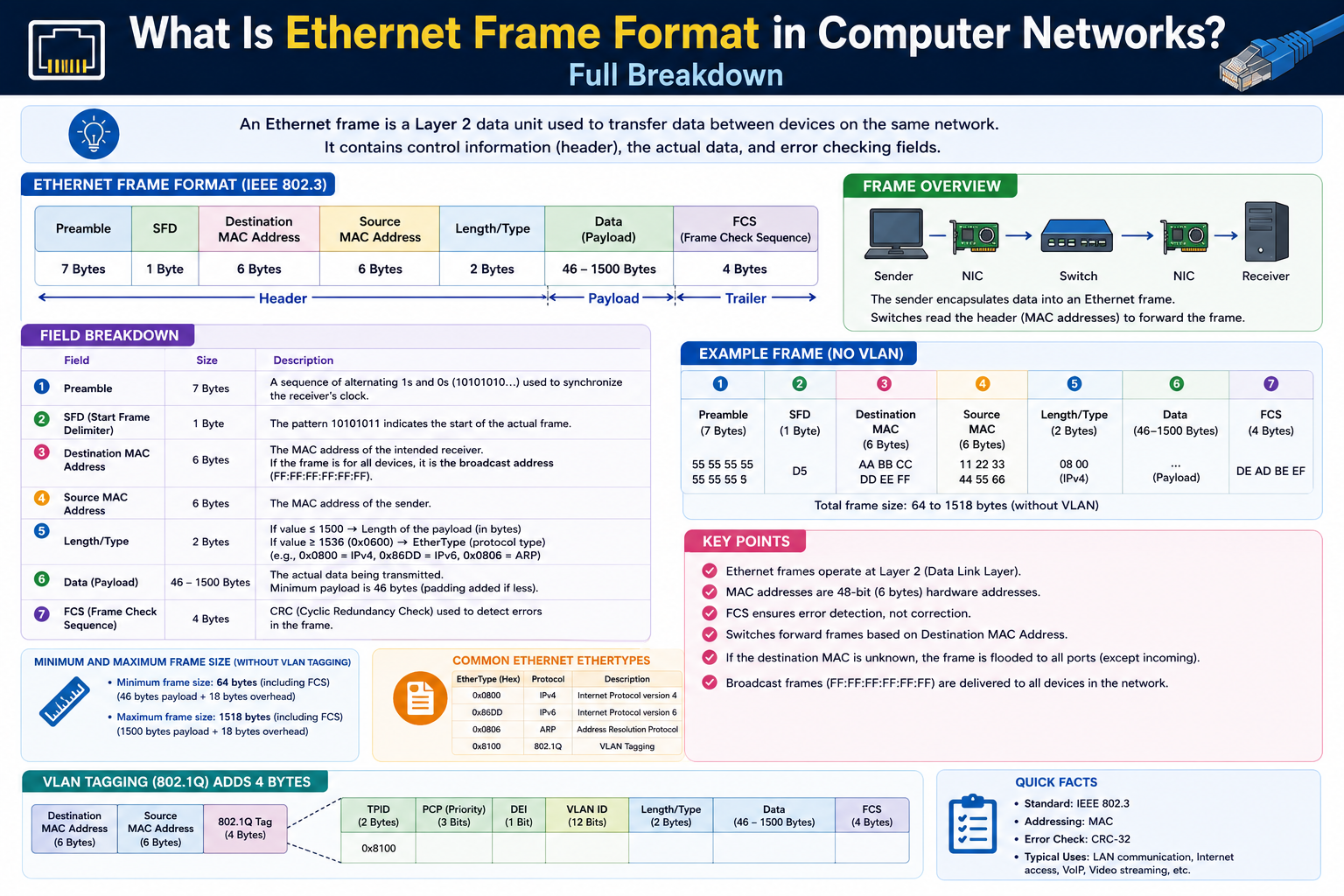
The Ethernet frame format is the standardized structure used to package and transmit data across Ethernet-based networks. In simple terms, it is the “rulebook” that defines how digital information is organized before it travels from one device to another within a local network. Without this structure, communication between computers, servers, routers, and switches would be chaotic and unreliable because devices would not agree on how to interpret incoming data.
At its core, Ethernet operates at the Data Link Layer of the OSI model, which is responsible for node-to-node communication. This means Ethernet does not deal with end-to-end delivery across the internet; instead, it focuses on delivering data correctly between directly connected devices within the same network segment. The Ethernet frame format ensures that every piece of transmitted data contains essential identification and verification information, allowing devices to understand where the data came from, where it is going, and whether it arrived intact.
Every Ethernet frame follows a strict structure. This structure includes multiple fields, each serving a specific purpose such as synchronization, addressing, protocol identification, data carrying, and error checking. These fields work together like a coordinated system, ensuring smooth and accurate communication.
The Concept of Ethernet Frames and Their Real-World Analogy
To better understand Ethernet frames, it helps to think of them as structured containers that carry information across a network. Imagine sending a physical letter through the postal system. The letter itself represents the actual message or data, but it cannot be delivered without an envelope that contains addressing information and other necessary details. In the same way, Ethernet frames act as digital envelopes for network communication.
Each Ethernet frame wraps around the data being transmitted, adding important metadata that helps the network deliver it correctly. This metadata includes addresses that identify the sender and receiver, along with control information that ensures the data is handled properly during transmission.
When a device sends data over a network, the information is first broken into smaller pieces. Each piece is then placed inside an Ethernet frame. This process is known as encapsulation. Once encapsulated, the frame travels across network devices such as switches, which use the addressing information to forward it to the correct destination.
Upon reaching its destination, the receiving device performs the reverse process called de-encapsulation. It removes the Ethernet frame structure and extracts the original data so it can be processed by higher layers of the system.
Another important concept is that Ethernet frames rely on MAC addresses instead of IP addresses. MAC addresses are physical identifiers assigned to network interfaces. This makes Ethernet a hardware-level communication method within local networks. IP addresses, on the other hand, operate at a higher layer and are used for routing data across different networks.
The structured nature of Ethernet frames ensures that communication remains organized, predictable, and error-resistant. Without this standardized approach, devices would struggle to interpret incoming signals, leading to data loss and communication failures.
Key Components of an Ethernet Frame and Their Roles
An Ethernet frame is composed of several essential components, each contributing to the successful delivery of data. These components work together like parts of a system, ensuring synchronization, identification, and error detection.
The first component is the preamble, which consists of a repeating pattern of bits. Its purpose is to prepare the receiving device for incoming data by synchronizing its internal clock with the signal. This ensures that both sender and receiver are aligned before actual data transmission begins.
Following the preamble is the Start Frame Delimiter (SFD). This marks the official beginning of the Ethernet frame. It signals to the receiving device that the meaningful data is about to start and separates synchronization bits from actual frame content.
Next are the destination and source MAC addresses. These fields are crucial because they identify the sender and intended recipient of the frame. The destination MAC address ensures that the frame reaches the correct device, while the source MAC address allows the receiver to know where the data originated.
After addressing information comes the Type or Length field. This field serves two possible purposes depending on the Ethernet standard being used. It either identifies the type of protocol contained in the payload or indicates the size of the data being transmitted.
The payload is the main part of the frame and contains the actual data being sent. This could include anything from a portion of a file, a web request, or application data. The payload size is flexible but must remain within defined limits to ensure proper transmission.
Finally, the frame includes the Frame Check Sequence (FCS). This is used for error detection. It allows the receiving device to verify whether the data was corrupted during transmission. If errors are detected, the frame can be discarded, and retransmission can occur.
Each of these components plays a vital role in ensuring that Ethernet communication is accurate, reliable, and efficient. Without them, network communication would lack structure and integrity.
Structure, Data Flow, and VLAN Integration in Ethernet Frames
The structure of an Ethernet frame is carefully designed to ensure that data flows smoothly through a network. Each frame follows a predictable sequence, which allows networking devices to quickly process and forward information without confusion.
When data is transmitted, it first enters the frame as payload. As it moves through the network, devices such as switches examine the destination MAC address to determine where to send it next. This process happens at high speed, enabling efficient communication even in large networks.
One important aspect of Ethernet structure is its size limitation. Frames must remain within specific boundaries to ensure compatibility and performance. If data exceeds these limits, it is broken into multiple frames, each transmitted separately and reassembled at the destination.
In more advanced networks, Ethernet frames may also include VLAN tagging. VLAN, or Virtual Local Area Network, allows a single physical network to be divided into multiple logical networks. This improves security, organization, and traffic management.
When VLAN tagging is applied, an additional field is inserted into the Ethernet frame. This tag identifies which virtual network the frame belongs to. Switches use this information to separate traffic and ensure it is delivered only within the correct VLAN group.
This capability is especially important in large organizations where different departments need isolated network communication while still sharing the same physical infrastructure.
The structured nature of Ethernet frames, combined with VLAN support, makes Ethernet highly scalable. It can support simple home networks as well as complex enterprise environments without losing efficiency or reliability.
Importance of Ethernet Frame Format in Modern Networking
Ethernet frame format plays a foundational role in modern networking systems. Almost every digital communication within local networks relies on it to function correctly. Its importance lies in its ability to standardize communication between devices, regardless of manufacturer or operating system.
One of the key benefits of Ethernet framing is reliability. Because each frame includes error-checking mechanisms, corrupted data can be identified and retransmitted. This significantly reduces the chances of data loss during transmission.
Another important advantage is compatibility. Since Ethernet is globally standardized, devices from different vendors can communicate seamlessly. This interoperability is essential for building scalable and flexible networks.
Ethernet frame format also contributes to performance efficiency. By breaking data into smaller, manageable frames, networks can handle multiple transmissions simultaneously without overwhelming system resources. This improves overall speed and responsiveness.
In addition, Ethernet framing supports troubleshooting and diagnostics. Network engineers can analyze frame structure to identify issues such as incorrect addressing, transmission errors, or protocol mismatches. This makes it easier to maintain stable network environments.
Overall, Ethernet frame format acts as the backbone of local network communication. It ensures that data is transmitted in a structured, reliable, and efficient manner, supporting everything from basic file sharing to complex enterprise applications.
Conclusion
Ethernet frame format is a fundamental concept that underpins all modern local network communication. It defines how data is structured, transmitted, and verified between devices, ensuring that information flows in a consistent and reliable manner. By organizing data into standardized frames, Ethernet allows devices to communicate seamlessly, regardless of manufacturer differences or network complexity.
Each Ethernet frame contains essential components such as addressing information, control fields, payload data, and error-checking mechanisms. These elements work together to ensure that data reaches the correct destination accurately and without corruption. The inclusion of MAC addresses enables precise device identification, while the Frame Check Sequence ensures integrity during transmission.
The structured nature of Ethernet frames also supports scalability and efficiency. Whether used in small home networks or large enterprise systems, the same fundamental format applies, making Ethernet one of the most widely adopted networking technologies in the world. Additionally, features like VLAN tagging extend its functionality by enabling logical network segmentation within physical infrastructure.
Understanding Ethernet frame format is crucial for anyone involved in networking, as it provides insight into how data moves at the foundational level of communication systems. It not only explains how devices interact but also forms the basis for troubleshooting and optimizing network performance in real-world environments.