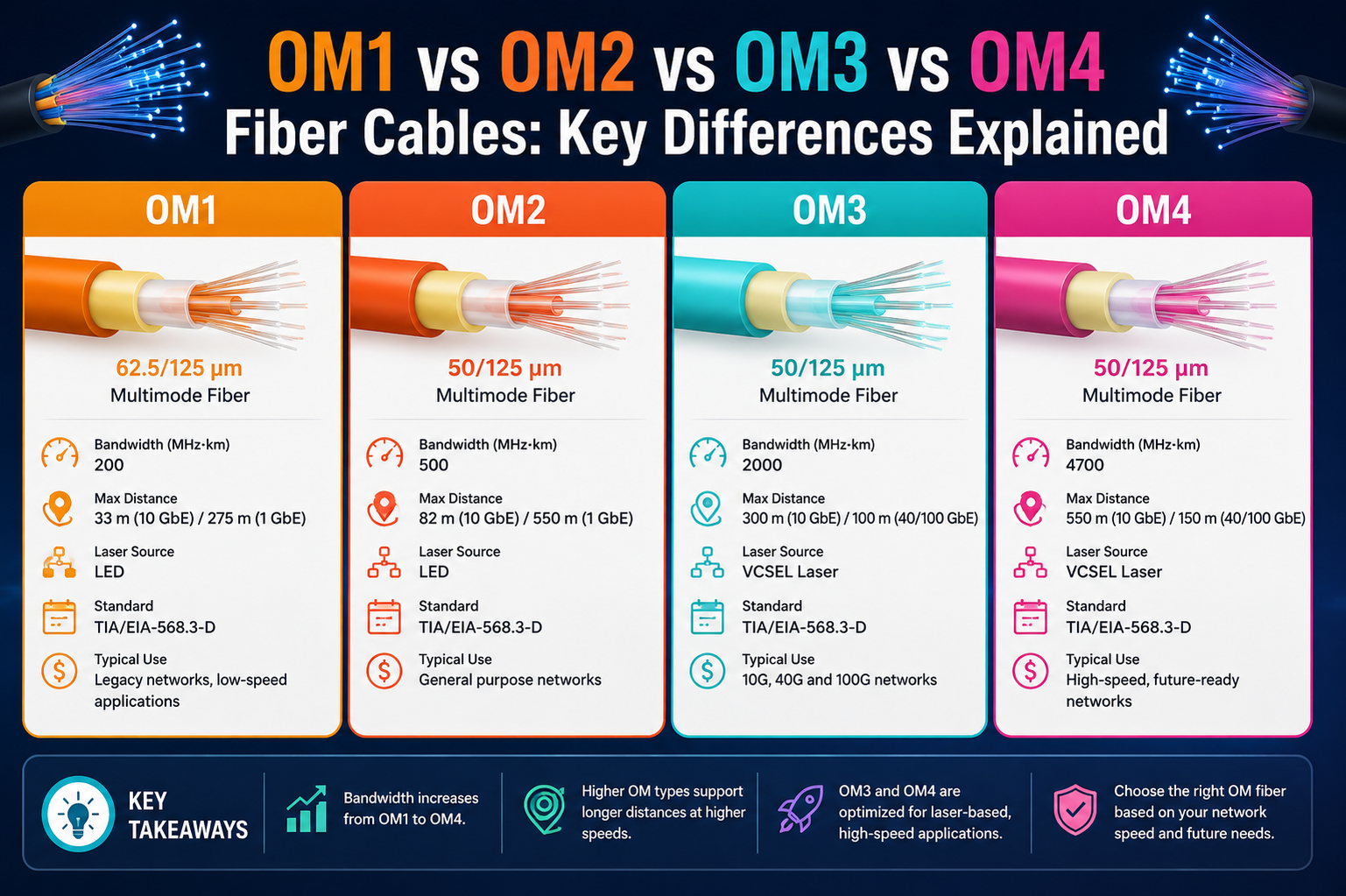
The modern world depends heavily on fast and reliable communication systems. Every online activity, from streaming videos and participating in virtual meetings to managing cloud storage and operating smart devices, relies on networks capable of transferring enormous amounts of data quickly and efficiently. As internet usage and digital infrastructure continue expanding, traditional copper networking solutions have struggled to keep pace with rising bandwidth demands. This challenge led to the widespread adoption of fiber optic technology, which has become the backbone of modern communication systems.
Fiber optic cables transmit data using pulses of light instead of electrical signals. This approach allows information to travel at extremely high speeds while maintaining excellent signal quality over long distances. Compared to copper cabling, fiber optics offers significantly greater bandwidth, lower latency, improved resistance to electromagnetic interference, and better long-distance performance. These advantages have made fiber optic infrastructure essential for businesses, telecommunications providers, educational institutions, healthcare systems, and data centers around the world.
At first glance, many people assume that all fiber optic cables are essentially the same. In reality, fiber networking includes several categories and subcategories designed for different applications. One of the most important distinctions involves single-mode and multi-mode fiber. Multi-mode fiber, in particular, includes several classifications known as OM1, OM2, OM3, and OM4. Each version represents a stage in the development of fiber optic technology, offering different levels of speed, bandwidth, and transmission distance.
To understand these cable types properly, it helps to first explore how multi-mode fiber functions. Multi-mode fiber contains a larger core than single-mode fiber, allowing multiple light paths, or modes, to travel through the cable simultaneously. This design makes multi-mode fiber more affordable and easier to work with than single-mode fiber in many environments. However, the presence of multiple light paths also creates challenges related to signal dispersion and transmission distance.
When light travels through multi-mode fiber, different light signals may take slightly different paths and arrive at the receiving end at different times. This phenomenon, known as modal dispersion, limits the maximum distance and bandwidth that the cable can support effectively. Over time, improvements in fiber design and manufacturing reduced these limitations, leading to the development of newer and more capable cable categories.
OM1 and OM2 represent earlier generations of multi-mode fiber technology. These cable types played a major role in the expansion of networking infrastructure during the 1990s and early 2000s. At the time, internet usage patterns were very different from today. Most networks handled basic file transfers, email communication, and relatively modest internet traffic. The bandwidth provided by OM1 and OM2 was considered more than adequate for many organizations.
OM1 fiber cables typically use an orange outer jacket, which remains one of the easiest ways to identify them in older installations. These cables were commonly used for lower-speed applications and shorter network runs. While OM1 was capable of supporting gigabit networking, its performance limitations became increasingly apparent as businesses began demanding higher speeds and greater reliability.
One of the primary weaknesses of OM1 involved its limited bandwidth capacity. As network traffic increased, organizations required infrastructure capable of handling larger volumes of data without significant performance degradation. OM1 struggled to support the rapidly evolving networking standards introduced during the growth of digital communication.
Transmission distance also presented challenges. While OM1 performed reasonably well for short-distance connections, it became less effective as cable runs increased. Signal quality declined more quickly compared to later fiber standards, limiting its usefulness in larger campuses and enterprise environments.
OM2 fiber emerged as an improvement over OM1, offering better bandwidth and slightly longer transmission distances. Like OM1, OM2 typically used an orange jacket and remained widely deployed during the early years of fiber networking expansion. Organizations upgrading from older infrastructure often adopted OM2 because it provided greater flexibility while remaining relatively affordable.
The improved performance of OM2 resulted from refinements in fiber manufacturing and core design. These changes reduced some of the modal dispersion issues present in OM1, allowing data signals to travel more efficiently through the cable. As a result, OM2 supported faster speeds and somewhat longer distances.
Despite these improvements, OM2 eventually faced many of the same challenges as OM1. The explosive growth of internet usage, cloud computing, multimedia applications, and enterprise networking placed increasing pressure on infrastructure. Organizations needed higher bandwidth connections capable of supporting data-intensive workloads.
As networking requirements evolved, OM1 and OM2 gradually became outdated. Although these cable types can still be found in older buildings and legacy systems, they are no longer considered ideal for modern high-performance networks. Many current industry standards focus instead on newer cable categories such as OM3 and OM4.
Even though OM1 and OM2 are considered legacy technologies, understanding them remains important for several reasons. Many organizations continue operating older infrastructure that still relies on these cable types. During renovation projects or network upgrades, technicians may encounter existing OM1 or OM2 installations that influence planning decisions.
Backward compatibility considerations also matter when expanding older networks. Organizations may need to balance modernization efforts with budget limitations, sometimes requiring integration between old and new infrastructure. Understanding the capabilities and limitations of OM1 and OM2 helps ensure compatibility and realistic performance expectations.
Another reason to study these older standards involves the broader history of networking technology. The progression from OM1 to OM4 reflects the rapid pace of digital transformation over the past few decades. Each generation of fiber optic technology addressed emerging challenges while enabling new forms of communication and computing.
The development of OM3 marked a major turning point in multi-mode fiber networking. Unlike OM1 and OM2, which were designed for earlier networking environments, OM3 was engineered specifically to support significantly higher bandwidth applications. Advances in manufacturing processes and fiber core quality dramatically improved performance.
One of the key improvements in OM3 involved optimized laser transmission. Earlier multi-mode fiber standards were originally designed for use with light-emitting diode technology. OM3, however, was optimized for laser-based communication systems, which provide more precise and efficient signal transmission.
The enhanced core design of OM3 reduced modal dispersion far more effectively than previous cable types. This allowed signals to maintain integrity over longer distances while supporting substantially higher data rates. As a result, OM3 became highly attractive for enterprise networking, data centers, and campus infrastructure.
The shift toward cloud computing and virtualization further accelerated demand for high-performance fiber infrastructure. Data centers, in particular, required networks capable of handling massive amounts of traffic between servers, storage systems, and networking equipment. OM3 provided the bandwidth and scalability necessary to support these rapidly growing environments.
Another major factor driving OM3 adoption involved the expansion of wireless networking. Large public venues such as airports, stadiums, and convention centers needed strong wired backbones to support dense wireless deployments. OM3 allowed access points and networking equipment to communicate efficiently across large facilities.
Color coding also changed with newer fiber standards. OM3 cables are typically identified by aqua-colored jackets, helping technicians distinguish them from older orange OM1 and OM2 installations. This visual distinction simplifies infrastructure management and reduces confusion during installation and maintenance.
As digital technology continued advancing, even OM3 eventually encountered increasing performance demands. High-definition video streaming, large-scale virtualization, cloud services, and real-time analytics required even greater bandwidth capacity. This led to the development of OM4 fiber.
OM4 represented another major advancement in multi-mode fiber performance. Improvements in fiber purity, manufacturing precision, and transmission efficiency allowed OM4 to support even higher speeds and longer distances than OM3. Although more expensive, OM4 quickly became attractive for organizations planning long-term infrastructure investments.
One of the defining strengths of OM4 is its ability to support extremely high-speed networking environments. As enterprise applications became more data-intensive, organizations increasingly adopted 40-gigabit and 100-gigabit networking standards. OM4 provided the performance needed to support these advanced systems while maintaining reliable transmission quality.
Future scalability became another major reason for OM4 adoption. Network infrastructure projects often involve significant expense and disruption. Organizations prefer solutions capable of supporting future technologies rather than requiring frequent replacement. OM4’s higher performance ceiling made it an appealing choice for businesses planning long-term growth.
Modern digital transformation initiatives continue driving demand for advanced fiber infrastructure. Artificial intelligence platforms, edge computing systems, smart manufacturing technologies, and cloud-based services all depend on fast and stable communication networks. Fiber optics remains one of the few technologies capable of supporting these expanding requirements efficiently.
Data growth trends show no signs of slowing. Streaming media quality continues increasing, remote work remains common, and connected devices generate constant network traffic. Multi-mode fiber infrastructure must evolve alongside these demands to maintain performance and reliability.
Another important factor influencing fiber adoption involves energy efficiency. Fiber optic systems often consume less power than equivalent copper-based high-speed networking solutions. Lower power consumption helps organizations reduce operational costs while supporting sustainability goals.
Security also contributes to the appeal of fiber optic networking. Because fiber cables transmit light rather than electrical signals, they are generally more difficult to tap or intercept without detection. This characteristic makes fiber particularly valuable in environments handling sensitive data.
Installation considerations play a significant role in infrastructure planning as well. Fiber optic systems require specialized handling and expertise, particularly during termination and testing. However, advances in connector technology and installation tools have made fiber deployment more accessible over time.
Maintenance practices have also evolved alongside fiber technology. Modern testing equipment allows technicians to diagnose signal loss, contamination, and transmission issues more accurately than ever before. Proper maintenance helps ensure long-term reliability and protects infrastructure investments.
As organizations modernize their networks, many face important decisions regarding infrastructure upgrades. Some may continue using legacy OM1 or OM2 systems temporarily, while others transition fully to OM3 or OM4. Budget constraints, performance requirements, and long-term scalability goals all influence these decisions.
Understanding the differences between OM1, OM2, OM3, and OM4 is essential because these cable types continue shaping modern communication infrastructure. Each generation reflects technological advancements designed to meet changing networking demands. From the modest data requirements of early business networks to the massive bandwidth needs of today’s digital economy, multi-mode fiber evolution tells the story of how communication technology has transformed modern society.
Comparing OM1, OM2, OM3, and OM4 Performance in Modern Networking Environments
Selecting the right fiber optic cable involves far more than choosing the newest or fastest option available. Network infrastructure decisions require careful evaluation of speed requirements, transmission distance, scalability, environmental conditions, and overall budget. OM1, OM2, OM3, and OM4 each serve distinct purposes within the evolution of multi-mode fiber networking. Understanding their practical differences helps organizations design systems that meet both current and future demands.
Performance is one of the most important factors when comparing fiber cable types. Modern networks must support enormous amounts of data moving continuously between devices, servers, cloud platforms, and applications. The ability of a fiber cable to maintain stable, high-speed communication over distance directly influences overall network efficiency.
OM1 was originally developed during a period when network demands were relatively modest. Typical business applications involved email communication, basic file sharing, and limited internet access. Under these conditions, OM1 provided sufficient performance for many organizations.
The larger core size of OM1 allowed light signals to travel through the cable relatively easily, but the technology also introduced higher levels of modal dispersion. Because multiple light paths traveled at slightly different speeds, signals became less synchronized over distance. This limited both bandwidth and transmission range.
In smaller office environments with shorter cable runs, OM1 performed adequately for many years. Organizations often used it for local area networks connecting desktop computers, printers, and servers. At the time, the available bandwidth exceeded the needs of most users.
However, as digital applications became more sophisticated, OM1 quickly began showing its limitations. Video conferencing, multimedia content, virtualization, and cloud services required significantly greater data throughput. Networks built on OM1 infrastructure struggled to keep pace with these expanding demands.
OM2 addressed some of these issues by improving bandwidth capacity and transmission performance. Advances in manufacturing techniques allowed OM2 cables to reduce modal dispersion more effectively than OM1. This provided better signal quality and supported faster networking standards.
The improvements introduced by OM2 made it more attractive for organizations beginning to expand their digital operations. Businesses deploying larger file servers, internet-based applications, and internal communication platforms benefited from the added performance.
Despite these advancements, OM2 eventually encountered similar challenges as data requirements continued rising. High-definition media, large-scale data transfers, and enterprise virtualization placed increasing pressure on network infrastructure. OM2 could not provide the long-term scalability required for many modern environments.
OM3 represented a substantial leap forward in multi-mode fiber performance. Unlike OM1 and OM2, which were designed around earlier communication technologies, OM3 was optimized specifically for laser-based transmission systems. This shift dramatically improved bandwidth capabilities and transmission efficiency.
One of the defining characteristics of OM3 is its ability to support much higher speeds over greater distances. This improvement came from refinements in fiber core quality and manufacturing precision. Signals traveling through OM3 experience less modal dispersion, allowing data to maintain integrity more effectively.
The impact of these improvements became especially important in enterprise environments. Data centers, for example, rely on extremely fast communication between servers, storage devices, and networking equipment. Even small delays or bottlenecks can affect application performance and operational efficiency.
OM3 allowed organizations to deploy 10-gigabit networking over much longer distances than earlier cable types. This capability made it suitable for connecting equipment across large facilities and campuses. Universities, healthcare institutions, and corporate offices increasingly adopted OM3 because it balanced performance with manageable costs.
Another important advantage of OM3 involved support for high-density networking environments. Modern facilities often contain hundreds or thousands of connected devices generating constant traffic. OM3 provided the bandwidth needed to support these demanding workloads without excessive signal degradation.
Wireless infrastructure also benefited from OM3 deployment. Although wireless communication appears cable-free from the user perspective, access points still depend heavily on wired backbones for power and data connectivity. Large venues with dense wireless usage require strong fiber infrastructure to maintain stable service.
OM4 expanded these capabilities even further. Designed to support increasingly advanced networking standards, OM4 offers greater bandwidth and longer transmission distances than OM3. Improvements in fiber manufacturing and signal optimization allow OM4 to handle extremely high-speed communication more effectively.
The rise of cloud computing significantly increased interest in OM4 infrastructure. Cloud environments require constant movement of large volumes of data between distributed systems. Faster and more reliable communication became essential for maintaining application responsiveness and service availability.
OM4 gained popularity in large-scale data centers because it supports higher-speed networking standards with greater reliability. As organizations adopted 40-gigabit and 100-gigabit networking technologies, OM4 provided a practical solution capable of meeting these demands.
Transmission distance is another critical factor when comparing fiber cable types. Every cable experiences some level of signal degradation over distance, but newer standards manage these effects far more effectively.
OM1 supports relatively short distances at higher speeds, making it less practical for large facilities or distributed environments. OM2 extends these distances somewhat but still falls short compared to modern standards.
OM3 greatly improves long-distance performance, allowing organizations to connect equipment across larger campuses and buildings without sacrificing speed. This flexibility makes OM3 attractive for medium-sized enterprise deployments.
OM4 extends these capabilities even further, supporting high-bandwidth communication across longer distances. In backbone infrastructure and campus networking projects, these extended ranges reduce the need for additional signal regeneration equipment.
Cost considerations remain important when selecting fiber infrastructure. OM1 and OM2 were initially popular partly because they provided affordable access to fiber networking technology. However, maintaining outdated infrastructure can eventually become more expensive than upgrading.
OM3 generally costs more than older cable types because of its improved manufacturing quality and performance capabilities. Nevertheless, many organizations view OM3 as a cost-effective balance between affordability and scalability.
OM4 is typically more expensive than OM3, but the additional investment often provides long-term value. Organizations planning future upgrades may prefer OM4 because it reduces the likelihood of needing another infrastructure replacement within a short period.
Future-proofing has become one of the most important concepts in network planning. Technology evolves rapidly, and infrastructure projects often require significant financial and operational investment. Installing cabling that cannot support future bandwidth demands may create expensive upgrade requirements later.
Many organizations therefore prioritize scalable infrastructure even if they do not currently require maximum performance. OM4 is often selected for this reason because it provides greater flexibility for future networking standards.
Compatibility is another important consideration during infrastructure upgrades. Organizations rarely replace entire networks at once. Instead, upgrades often occur gradually over time. Understanding how different fiber standards interact helps avoid compatibility problems.
Technicians working with older facilities frequently encounter mixed infrastructure environments containing combinations of OM1, OM2, OM3, and OM4. Proper planning and testing are essential to ensure stable communication across these systems.
Connector compatibility also influences performance. Fiber optic connectors must align optical fibers precisely to minimize signal loss. Poor termination or contamination can reduce performance regardless of cable quality.
Environmental conditions can affect fiber infrastructure as well. Industrial environments may expose cables to vibration, temperature fluctuations, moisture, or chemical exposure. Protective jackets and proper routing practices help preserve cable integrity.
Data center design increasingly depends on advanced fiber infrastructure. Modern facilities contain densely packed networking equipment generating enormous amounts of traffic continuously. High-performance fiber cabling supports the low-latency communication required for virtualization, cloud computing, and artificial intelligence applications.
Educational institutions also rely heavily on scalable fiber networks. Universities often operate across large campuses with extensive wireless deployments, online learning systems, and research infrastructure. Fiber optic backbones provide the capacity needed to support these diverse operations.
Healthcare environments require reliable communication systems for patient records, imaging equipment, telemedicine platforms, and operational management. Fiber infrastructure supports the fast and stable data transfer necessary in these critical settings.
Manufacturing and industrial automation systems increasingly depend on fiber networking as well. Smart factories generate constant streams of operational data that must move quickly between sensors, controllers, and monitoring platforms.
As remote work and cloud-based collaboration continue growing, organizations must maintain networks capable of supporting distributed users and high-bandwidth applications. Fiber infrastructure helps ensure reliable communication between offices, data centers, and cloud environments.
Sustainability goals are influencing infrastructure decisions too. Fiber networks can support higher data rates with lower energy consumption compared to some traditional networking approaches. Improved efficiency helps reduce operational costs and environmental impact.
Security remains another important advantage of fiber optic communication. Because fiber transmits light rather than electrical signals, unauthorized interception is more difficult and easier to detect. This characteristic makes fiber attractive for organizations handling sensitive information.
Testing and certification procedures help ensure that installed fiber infrastructure meets required performance standards. Specialized equipment measures signal loss, continuity, and transmission quality. Thorough testing reduces the likelihood of future network problems.
Maintenance practices also contribute to long-term reliability. Clean connectors, organized routing, and accurate documentation help preserve performance and simplify troubleshooting.
The decision between OM1, OM2, OM3, and OM4 ultimately depends on balancing performance needs, budget limitations, and long-term goals. Older standards may still function adequately in certain legacy environments, but modern applications increasingly demand the capabilities provided by OM3 and OM4.
As digital transformation continues accelerating across industries, network infrastructure will remain central to organizational success. Choosing the right fiber cable type helps ensure stable communication, scalable performance, and readiness for future technological developments.
Real-World Applications, Infrastructure Planning, and the Future of Multi-Mode Fiber
Fiber optic technology has become deeply integrated into modern infrastructure, supporting nearly every aspect of digital communication. Businesses, governments, healthcare systems, educational institutions, and telecommunications providers all rely on fiber networks to deliver fast and reliable connectivity. Multi-mode fiber standards such as OM1, OM2, OM3, and OM4 each reflect different stages in the growth of networking technology and continue influencing infrastructure decisions today.
Understanding real-world applications of these cable types helps explain why fiber selection matters so much. Every networking environment has unique performance requirements, physical limitations, and budget considerations. The correct choice depends not only on current demands but also on how the network may evolve over time.
One of the most common environments for multi-mode fiber deployment is the enterprise office. Modern businesses depend on stable communication systems for email, cloud applications, video conferencing, collaboration platforms, and file sharing. As organizations grow, the amount of data flowing through their networks increases dramatically.
Older office buildings sometimes still contain OM1 or OM2 infrastructure installed decades ago. At the time of installation, these systems often exceeded operational requirements. However, modern applications place far greater strain on network resources.
Employees now frequently work with high-definition video, cloud storage systems, and large digital files. Virtual collaboration platforms require continuous real-time communication with minimal latency. Legacy OM1 and OM2 systems may struggle to support these demands efficiently.
Organizations upgrading office infrastructure often transition toward OM3 or OM4 to improve scalability and long-term performance. These newer standards support higher bandwidth and better accommodate future growth.
Campus environments present another important use case for multi-mode fiber. Universities, corporate campuses, and healthcare facilities often span multiple buildings connected through centralized network infrastructure. Fiber backbones link these structures together while supporting thousands of users simultaneously.
In large campuses, transmission distance becomes especially important. Copper cabling cannot effectively support high-speed communication across long outdoor runs. Multi-mode fiber offers a practical solution capable of maintaining stable performance between buildings.
OM3 became especially popular in campus networking because it provided strong performance at manageable cost levels. Many institutions adopted OM3 to support expanding wireless infrastructure, online learning platforms, and centralized data services.
As campuses continue modernizing, OM4 is becoming increasingly attractive for backbone deployments. The higher bandwidth capacity of OM4 supports future expansion while reducing the likelihood of requiring another major infrastructure upgrade.
Data centers represent one of the most demanding networking environments in existence. These facilities contain massive collections of servers, storage systems, and networking hardware operating continuously. Every application request, cloud transaction, and digital service depends on rapid communication within these systems.
High-speed fiber infrastructure is essential in data centers because even minor communication delays can affect performance significantly. Virtualization, artificial intelligence, machine learning, and large-scale analytics all generate enormous data traffic.
OM3 initially became the preferred multi-mode fiber standard for many data centers because it supported higher-speed networking standards efficiently. Its ability to handle 10-gigabit and later 40-gigabit communication made it well suited for server environments.
However, as cloud computing expanded rapidly, many facilities began transitioning toward OM4. The improved bandwidth and transmission distance capabilities of OM4 allowed operators to support increasingly advanced networking technologies.
Modern hyperscale data centers often prioritize infrastructure designed for long-term scalability. Although OM4 may involve higher upfront costs, the reduced need for future recabling projects often justifies the investment.
Telecommunications providers also rely heavily on fiber infrastructure. Internet service providers use fiber optic networks to move enormous amounts of traffic between cities, neighborhoods, and customer locations.
While single-mode fiber dominates extremely long-distance telecommunications links, multi-mode fiber still plays an important role within facilities and local distribution systems. Telecommunications equipment rooms, switching centers, and regional data facilities frequently use OM3 or OM4 connections internally.
Healthcare facilities have unique networking demands because many critical systems depend on stable communication. Electronic medical records, diagnostic imaging equipment, patient monitoring systems, and telemedicine platforms all require reliable high-speed connectivity.
Hospitals also face increasing data storage demands as medical imaging technologies generate larger and more complex files. Fiber infrastructure helps healthcare organizations maintain fast and dependable access to critical information.
Educational institutions continue expanding digital learning initiatives, which increases pressure on network infrastructure. Online classrooms, streaming lectures, cloud-based assignments, and research computing systems all require strong connectivity.
Large student populations create dense wireless networking environments where access points depend on powerful wired backbones. Fiber optic infrastructure supports these systems by providing stable high-bandwidth connections across campus facilities.
Industrial and manufacturing environments increasingly depend on connected systems as well. Automation technologies generate continuous streams of operational data from sensors, robotics, and monitoring equipment.
Fiber optic cabling offers several advantages in industrial settings. Unlike copper, fiber is immune to electromagnetic interference generated by heavy machinery and electrical systems. This makes it particularly useful in factories and processing plants.
Industrial environments may also involve harsh conditions such as vibration, temperature extremes, dust, or chemical exposure. Properly protected fiber infrastructure can maintain reliable performance even in demanding operational settings.
Smart city initiatives are creating new opportunities for fiber deployment. Traffic management systems, surveillance networks, environmental monitoring platforms, and public connectivity services all depend on fast communication infrastructure.
As urban populations grow, cities require increasingly sophisticated networking systems capable of supporting connected technologies. Fiber optic backbones provide the scalability needed for these large-scale projects.
Infrastructure planning requires careful assessment of current and future requirements. Organizations must evaluate bandwidth needs, expected growth, physical layout constraints, and financial limitations before selecting fiber cable types.
Budget considerations remain important even in large infrastructure projects. While OM4 offers excellent performance, some organizations may determine that OM3 provides sufficient capability for their operational requirements.
Balancing performance with cost requires realistic forecasting. Underestimating future bandwidth needs can lead to expensive upgrades later, while overbuilding infrastructure unnecessarily may strain project budgets.
Scalability planning has therefore become a central component of modern network design. Infrastructure installed today should ideally support future technologies without requiring complete replacement.
Documentation is another essential aspect of fiber infrastructure management. Accurate records of cable routes, connector types, port assignments, and testing results simplify troubleshooting and maintenance.
Testing procedures are especially important in fiber environments because optical communication depends heavily on precise signal transmission. Technicians use specialized equipment to measure insertion loss, reflectance, and continuity.
Cleanliness also plays a major role in fiber reliability. Dust or contamination on connectors can significantly reduce performance. Proper cleaning procedures help preserve signal quality and prevent unnecessary outages.
Cable management practices influence long-term reliability as well. Organized routing systems reduce physical stress on cables, improve airflow within equipment rooms, and simplify future expansion.
Environmental sustainability is becoming increasingly important in infrastructure planning. Fiber networks can support large amounts of data traffic while consuming relatively low amounts of power. Improved efficiency helps organizations reduce energy costs and environmental impact.
Artificial intelligence and machine learning technologies are expected to place even greater demands on network infrastructure in the coming years. These systems process enormous volumes of data and require fast communication between distributed computing resources.
Edge computing is another growing trend shaping network design. Instead of processing all data within centralized cloud facilities, edge computing places processing resources closer to users and devices. This approach reduces latency and improves responsiveness.
Fiber infrastructure will play a major role in supporting edge computing because large amounts of data must move efficiently between distributed locations. High-bandwidth multi-mode fiber standards such as OM3 and OM4 are well suited for these environments.
Virtual reality, augmented reality, and immersive digital experiences are also increasing bandwidth requirements. These technologies depend on fast and stable communication systems capable of handling real-time data transmission.
As internet-connected devices continue multiplying, network traffic will keep rising. Smart homes, industrial automation systems, autonomous vehicles, and connected public infrastructure all contribute to growing data demand.
Future networking standards will likely continue pushing performance requirements higher. Multi-mode fiber technology may evolve further to support these developments while maintaining affordability and flexibility.
Despite rapid technological change, the core purpose of fiber optic networking remains consistent: delivering reliable, high-speed communication capable of supporting modern digital life. OM1 and OM2 helped establish the early foundation of fiber networking, while OM3 and OM4 continue driving the expansion of advanced communication infrastructure.
Organizations choosing between these cable types must consider far more than immediate technical specifications. They must think about scalability, maintenance, compatibility, energy efficiency, operational demands, and long-term growth.
Fiber optic infrastructure is no longer limited to specialized technical environments. It has become an essential part of everyday communication, enabling everything from remote work and online education to healthcare systems and global commerce. Understanding the differences between OM1, OM2, OM3, and OM4 provides valuable insight into how modern networks operate and why fiber technology continues shaping the future of digital communication.
Installation Challenges, Maintenance Practices, and Emerging Trends in Fiber Optic Infrastructure
As fiber optic networking continues expanding across industries, the importance of proper installation and long-term maintenance has become more significant than ever. High-performance fiber infrastructure can deliver exceptional speed and reliability, but only when it is installed and maintained correctly. Even the most advanced fiber cable types, including OM3 and OM4, can experience performance issues if technicians overlook critical installation details or fail to follow proper maintenance procedures. Understanding these challenges helps organizations maximize the lifespan and efficiency of their networking systems.
Fiber optic cables are very different from traditional copper cables in both construction and handling requirements. While copper cabling can tolerate a certain amount of bending, twisting, and physical stress, fiber cables contain delicate strands of glass or plastic that require much greater care. Improper handling during installation may lead to microfractures, signal degradation, or complete communication failure.
One of the most common installation challenges involves cable bending. Every fiber optic cable has a minimum bend radius that must be respected during routing and deployment. Bending a fiber cable too sharply can distort the path of light traveling through the core, resulting in signal loss and reduced network performance. In severe cases, excessive bending may permanently damage the internal fiber.
Technicians therefore pay close attention to routing practices when installing fiber infrastructure. Cable trays, conduits, and protective raceways help maintain smooth pathways that reduce physical stress on the cables. Proper routing becomes especially important in crowded data centers and telecommunications rooms where large numbers of cables must coexist within limited space.
Cable pulling tension is another critical consideration during installation. Fiber cables are designed to withstand only limited pulling force. Excessive tension can stretch or damage the internal fibers, reducing signal integrity. To prevent this, installers often use lubricants, cable rollers, and carefully planned pathways during deployment.
Environmental conditions also influence fiber installation methods. Outdoor fiber deployments face exposure to temperature fluctuations, moisture, sunlight, and physical hazards. Specialized outdoor-rated jackets help protect cables from ultraviolet radiation and water intrusion. Underground installations may require armored protection to prevent damage from soil pressure or accidental excavation.
Industrial environments create additional installation challenges. Factories and manufacturing facilities may expose fiber cables to vibration, chemicals, dust, or extreme temperatures. Ruggedized fiber solutions designed for industrial use provide additional durability and environmental resistance.
Connector installation is another area where precision matters greatly. Fiber connectors must align optical fibers with extremely high accuracy to ensure efficient signal transmission. Even microscopic imperfections can reduce performance significantly.
Dust contamination is one of the leading causes of fiber network issues. Tiny particles invisible to the naked eye can obstruct or scatter light signals at connector interfaces. For this reason, technicians follow strict cleaning procedures before making fiber connections.
Specialized cleaning tools are commonly used to remove contamination from connectors and ports. Lint-free wipes, cleaning pens, and optical-grade solutions help maintain signal quality. Many technicians inspect connectors using fiber microscopes before finalizing installations.
Splicing is another important aspect of fiber infrastructure deployment. Fiber splicing joins two separate fiber strands together to create a continuous communication path. This process is commonly required in long-distance networks, backbone installations, and repair projects.
Fusion splicing is widely considered the preferred method because it creates a highly reliable connection with minimal signal loss. During fusion splicing, technicians use specialized equipment to align and melt fiber ends together precisely.
Mechanical splicing provides an alternative approach that does not require heat. Instead, fibers are aligned within a mechanical sleeve using index-matching materials. While mechanical splices are generally easier and faster to perform, they may produce slightly higher signal loss compared to fusion splices.
Testing fiber installations is essential before placing networks into operation. Fiber optic testing verifies that cables, connectors, and splices meet required performance standards. Without proper testing, hidden problems may remain undetected until they disrupt network operations.
One of the most common testing methods involves measuring insertion loss. This process evaluates how much signal strength is lost as light travels through the cable and associated connectors. Excessive loss may indicate poor splices, dirty connectors, or damaged fibers.
Optical Time Domain Reflectometers are advanced diagnostic tools frequently used in fiber networking. These devices send pulses of light through the cable and analyze reflections to identify faults, breaks, and signal loss locations. OTDR testing is especially valuable for troubleshooting long-distance fiber infrastructure.
Certification testing has become increasingly important in enterprise and commercial projects. Organizations often require documented proof that installed infrastructure meets industry standards before accepting completed work. Certification helps ensure reliability and reduces the likelihood of future disputes.
Maintenance practices play a major role in preserving fiber network performance over time. Unlike some older networking technologies, fiber systems can operate reliably for many years when maintained properly. However, neglecting maintenance may gradually reduce efficiency and increase failure risks.
Routine inspections help identify potential issues before they become serious problems. Technicians may check for cable damage, overcrowded pathways, connector contamination, or environmental hazards during scheduled maintenance visits.
Cable organization also contributes significantly to long-term reliability. Poorly managed fiber cables may become tangled, compressed, or difficult to trace during troubleshooting. Structured cable management systems improve accessibility and reduce accidental damage.
Color coding remains a valuable organizational strategy in fiber environments. Different cable colors help technicians quickly identify cable types and performance categories. OM1 and OM2 commonly use orange jackets, while OM3 and OM4 typically use aqua-colored jackets.
Labeling is equally important in large installations. Every cable, patch panel, and connector should include clear identification to simplify troubleshooting and maintenance. In complex facilities such as data centers, accurate labeling can save significant time during network repairs.
Data center environments place unique demands on fiber infrastructure. High-density equipment layouts require careful cable management to maintain airflow and accessibility. Poor cable organization can restrict cooling efficiency, leading to overheating and increased equipment failure risk.
As cloud computing continues expanding, data centers are handling larger amounts of traffic than ever before. Fiber infrastructure capable of supporting extremely high bandwidth is therefore essential. OM3 and OM4 remain popular choices because they provide the performance needed for virtualization, storage networking, and high-speed server communication.
Artificial intelligence and machine learning workloads are creating even greater demands on fiber infrastructure. These technologies require rapid movement of massive datasets between processing systems and storage resources. High-speed fiber networks help support the low-latency communication necessary for AI operations.
Edge computing is another trend influencing fiber deployment strategies. Instead of processing all data within centralized facilities, edge computing distributes processing resources closer to users and connected devices. This reduces latency and improves application responsiveness.
As edge infrastructure grows, organizations require reliable high-speed communication between distributed locations. Fiber optic networks provide the bandwidth and stability necessary to support these architectures.
The growth of smart cities is also increasing demand for advanced fiber infrastructure. Connected traffic systems, surveillance networks, environmental monitoring sensors, and public wireless services all depend on fast communication backbones.
Fiber optics offers several advantages for smart city projects. Its ability to handle large amounts of data while resisting electromagnetic interference makes it well suited for dense urban environments.
Healthcare systems are increasingly adopting advanced digital technologies that depend heavily on fiber networking. Medical imaging systems, telemedicine platforms, robotic surgical equipment, and electronic records all generate substantial network traffic.
Conclusion
Fiber optic technology has transformed the way modern networks operate, providing the speed, reliability, and scalability required in today’s data-driven world. As digital communication continues expanding across businesses, educational institutions, healthcare systems, industrial facilities, and cloud environments, the role of fiber infrastructure becomes even more critical. Multi-mode fiber standards such as OM1, OM2, OM3, and OM4 each represent different stages in the evolution of networking technology, reflecting the growing demand for faster and more efficient communication systems.
While OM1 and OM2 played an important role in the early development of fiber networking, modern bandwidth requirements have shifted attention toward OM3 and OM4. These newer standards provide the performance necessary to support high-speed data transmission, large-scale virtualization, cloud computing, streaming services, and advanced enterprise applications. Their ability to deliver greater bandwidth across longer distances makes them ideal for modern data centers, campus networks, and large organizational infrastructures.
Choosing the correct fiber cable type involves balancing several important factors, including network performance, transmission distance, future scalability, installation complexity, and overall budget. Organizations that carefully evaluate these requirements can build infrastructure capable of supporting both current operations and future technological growth. Investing in scalable fiber solutions today can reduce the need for expensive upgrades later as networking demands continue increasing.
Proper installation, testing, and maintenance are equally important in ensuring long-term reliability. Even the most advanced fiber systems require careful handling, organized cable management, and regular inspections to maintain optimal performance. Clean connectors, accurate documentation, and structured routing practices all contribute to stable and efficient network operation.