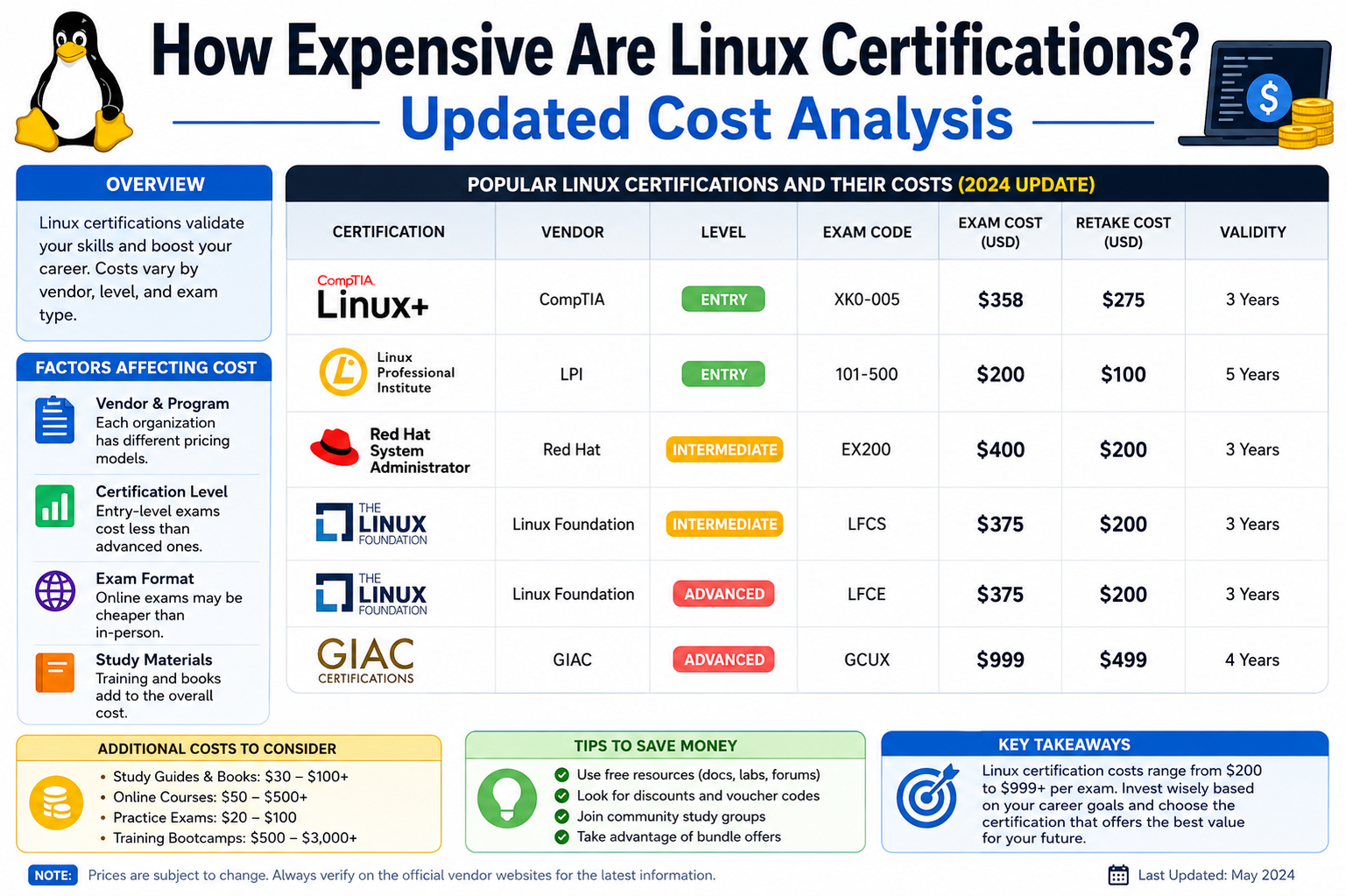
Linux certifications have become an important checkpoint for anyone entering system administration, cloud engineering, cybersecurity, or DevOps-related roles. Before looking at individual exams, it helps to understand why costs vary so widely and what you are actually paying for when you pursue an entry-level certification.
At the most basic level, Linux certifications are designed to validate practical skills in managing, configuring, and troubleshooting Linux systems. Since Linux is open-source and used in everything from personal servers to large-scale enterprise infrastructure, certification bodies have created structured exams to measure competency in real-world environments. These exams are rarely just about memorization; they often test applied knowledge, which is one reason the overall investment is not limited to a single exam fee.
One of the most recognized entry points into this ecosystem is the CompTIA Linux+ certification. It is often chosen by learners who are still exploring which Linux distribution or career specialization they want to pursue. This certification is designed to provide broad coverage rather than deep specialization, focusing on foundational system administration tasks, security basics, file management, user control, networking concepts, and automation fundamentals.
The direct exam fee for Linux+ is typically positioned in the mid-range compared to other IT certifications. However, this number only represents the surface-level cost. What many candidates overlook is that certification bodies often assume prior knowledge or experience. In the case of Linux+, candidates are expected to already have a foundational understanding of networking and general IT systems, which means additional learning may be required before even attempting the exam.
This introduces the first hidden cost category: preparation time and learning resources. Unlike short-term assessments, Linux certification preparation can take weeks or months depending on prior experience. During this time, learners often engage with structured study materials, practice environments, and simulation tools that replicate Linux system behavior. While some resources may be freely available, many candidates choose paid structured content to ensure exam readiness.
Another factor influencing early certification cost is hands-on practice infrastructure. Linux is a practical operating system, meaning theoretical understanding alone is rarely sufficient. Candidates often set up virtual environments to simulate real-world tasks such as configuring users, managing processes, writing basic shell scripts, or troubleshooting network issues. While virtualization tools can be free, the time investment and hardware requirements indirectly contribute to the overall cost of certification preparation.
It is also important to consider exam logistics. Most entry-level Linux certifications are delivered through standardized testing centers or remote proctoring systems. While this reduces travel burden compared to older certification models, it still introduces scheduling constraints, identification requirements, and strict exam conditions. These logistical elements are not financial costs in the traditional sense, but they influence how candidates prepare and perform, which can lead to retake expenses if unsuccessful.
Retake probability is another overlooked cost factor. Entry-level Linux exams are designed to test real-world problem-solving rather than simple recall. Candidates who underestimate the practical nature of the exam often need multiple attempts. Each retake adds financial and time costs, increasing the total investment significantly beyond the initial registration fee.
Beyond Linux+, the early certification landscape also includes foundational credentials that are even more introductory in nature. These are often designed for absolute beginners who may not yet have professional IT experience. While the exam fees for these certifications are generally lower, they still require preparation time and structured learning. Interestingly, for many learners, these foundational certifications act as stepping stones rather than final career credentials, meaning they are often followed by more advanced and expensive certifications later.
What makes early Linux certification costs particularly dynamic is the relationship between knowledge gaps and learning investment. Someone already working in IT may only need minimal preparation, while someone transitioning from a non-technical field may require significantly more time and practice. This creates a wide cost range that cannot be accurately represented by exam fees alone.
Another subtle cost factor is the opportunity cost of time. Preparing for Linux certifications often competes with work, study, or other professional development activities. Even if no direct money is spent on training materials, the time dedicated to preparation represents a meaningful investment. For many professionals, this time investment is justified by long-term salary growth and job opportunities, but it remains an important part of the overall cost equation.
At the entry level, Linux certification is less about specialization and more about building confidence in system operations. This stage is where learners develop familiarity with command-line interfaces, system structure, and administrative logic. Because of this foundational role, early certifications often attract individuals who are still exploring career direction, which also influences how much they are willing to invest financially.
As candidates move beyond entry-level certifications, costs begin to shift significantly due to specialization, vendor-specific ecosystems, and advanced performance-based testing models. Understanding this early stage provides a baseline for evaluating how certification expenses escalate in later stages of a Linux career path.
Intermediate Certifications, Specialization Paths, and How Pricing Reflects Skill Depth
Once professionals move beyond entry-level Linux knowledge, certification costs begin to reflect not only exam difficulty but also the depth of specialization required. At this stage, certifications are less about general system familiarity and more about demonstrating real operational capability in specific environments or distributions.
One of the most structured certification pathways at this level comes from the Linux Professional Institute. Unlike entry-level certifications that broadly test foundational knowledge, this pathway is divided into progressive tiers. Each tier builds on the previous one, meaning candidates must advance sequentially rather than jumping directly to higher levels.
The structure itself has a direct impact on total cost. Instead of paying for a single certification, candidates often invest in multiple exams over time. Each exam represents a checkpoint in a longer professional development journey. While the individual exam fees may appear moderate, the cumulative cost increases as candidates progress through multiple levels.
At this stage, preparation also becomes more intensive. Intermediate certifications assume that candidates are already comfortable working in Linux environments without guidance. As a result, exam preparation shifts toward advanced system administration tasks, scripting logic, process optimization, and system troubleshooting under complex conditions. This increased difficulty naturally leads to longer preparation cycles, which in turn increases indirect costs such as study time and practice infrastructure.
A defining characteristic of intermediate Linux certification costs is the concept of layered progression. Rather than paying once and achieving a standalone credential, candidates invest in a sequence of certifications that collectively form a professional profile. This layered structure means that total cost is distributed over time, but the final investment can be significantly higher than entry-level certifications.
At the same time, specialization begins to play a major role in pricing perception. Certain Linux certification paths focus on system administration, while others extend into areas such as DevOps tooling, security hardening, or enterprise infrastructure management. Each specialization requires additional study focus, and in some cases, additional exam attempts if candidates decide to branch into multiple domains.
As candidates progress further, vendor-specific certifications begin to dominate the landscape. These certifications are tied to specific enterprise Linux distributions and are often considered industry benchmarks. Unlike vendor-neutral certifications, these exams are designed around real-world enterprise environments and are often performance-based rather than purely theoretical.
This shift significantly changes the cost structure. Vendor-specific certifications tend to have higher exam fees, but they also carry higher perceived value in enterprise hiring markets. Employers often associate these certifications with proven ability to manage production-level systems, which increases their career impact.
At the intermediate level, preparation environments also become more complex. Instead of simple virtual machines or isolated practice setups, candidates often simulate enterprise-level architectures involving multiple servers, networking configurations, security policies, and automated deployment systems. Building and maintaining such environments adds indirect cost through hardware requirements, cloud usage, or dedicated lab time.
Another important factor influencing cost at this stage is exam retake pressure. Intermediate and vendor-specific certifications are typically more difficult than entry-level exams. They require not only conceptual understanding but also the ability to perform tasks under time constraints. As a result, candidates who do not adequately prepare may face multiple attempts, increasing total expenditure.
What differentiates this stage from earlier certifications is the growing alignment between cost and career value. While entry-level certifications are often used for skill validation, intermediate certifications are frequently tied to career advancement, salary increases, and job role transitions. This means that candidates are more likely to view the cost as an investment rather than an expense.
Time investment also becomes more strategic at this stage. Professionals pursuing intermediate certifications are often already employed in IT roles. As a result, preparation must be balanced with work responsibilities. This creates a different type of cost pressure, where time scarcity becomes as important as financial expenditure.
Another subtle but important cost factor is specialization branching. Many professionals at this stage choose to pursue multiple certification tracks, such as system administration and security or DevOps and infrastructure automation. Each additional track introduces new exams and preparation requirements, which can multiply total cost significantly over time.
In essence, intermediate Linux certifications represent a transition point where cost is no longer just about exam fees. Instead, it becomes a combination of structured progression, specialization choices, preparation complexity, and career planning decisions. This stage is where Linux certification begins to function less as a learning milestone and more as a professional positioning tool.
Advanced Certifications, Enterprise-Level Investment, and the Full Lifecycle Cost of Linux Expertise
At the advanced stage of Linux certification, costs expand far beyond exam fees and begin to reflect enterprise-level skill validation. These certifications are designed for professionals who already manage production systems, oversee infrastructure reliability, or architect large-scale environments. As a result, the financial and time investment required at this stage is significantly higher than earlier levels.
Advanced Linux certifications are typically associated with enterprise distributions and specialized architectures. These certifications often require candidates to demonstrate not only theoretical knowledge but also the ability to solve real-world operational problems under strict conditions. The exam format itself is usually performance-based, meaning candidates must complete tasks in simulated environments that closely mirror enterprise infrastructure.
This shift in exam design has a direct impact on cost. Performance-based exams are more resource-intensive to administer, which contributes to higher fees. However, the cost also reflects the level of expertise being validated. At this stage, certification is not about learning Linux fundamentals; it is about proving mastery in managing complex systems under pressure.
One of the most significant cost factors at this level is certification stacking. Advanced certifications often require prerequisite credentials, meaning candidates must already hold multiple earlier certifications before attempting higher-level exams. This creates a cascading cost structure where each new certification builds on previous investments.
In addition to exam fees, preparation costs increase substantially. Advanced Linux certifications require deep hands-on experience in enterprise environments. Candidates often build sophisticated lab setups that simulate production systems, including clustered servers, automated deployment pipelines, security enforcement mechanisms, and high-availability configurations. Maintaining such environments requires time, technical resources, and sometimes paid infrastructure services.
Another major cost component is failure risk. At the advanced level, exam difficulty increases significantly. Candidates are expected to troubleshoot complex system failures, optimize performance under constraints, and complete multi-step tasks without external guidance. Because of this complexity, retake rates are often higher, and each attempt adds additional cost.
Enterprise certifications also introduce structured training ecosystems in some cases. These ecosystems are designed to ensure candidates meet a consistent skill standard before attempting certification. While this improves skill quality, it also increases the overall investment required, as candidates may need access to guided labs, structured environments, or formalized preparation paths.
Beyond direct certification costs, advanced Linux credentials are closely tied to professional role expectations. Individuals pursuing these certifications are often already working in senior engineering or architecture roles. This means that preparation time competes directly with high-responsibility job functions. The opportunity cost at this level is therefore significantly higher than at earlier stages.
Another important dimension of advanced certification cost is long-term maintenance. In many enterprise environments, certifications are not permanent achievements. They may require periodic renewal or continuing education to remain valid. This introduces recurring costs over time, making certification a continuous investment rather than a one-time expense.
At the highest levels, Linux certification becomes less about individual skills and more about demonstrating architectural thinking and system design capability. Professionals at this stage are expected to understand how large-scale systems behave under load, how failures propagate across infrastructure, and how to design resilient environments that meet enterprise demands.
Because of this, the cost of certification is often justified through career outcomes. Advanced Linux certifications are commonly associated with senior roles in infrastructure engineering, cloud architecture, and systems design. These roles typically offer significantly higher compensation, which is why the investment is often viewed through a long-term financial lens rather than a short-term expense perspective.
Another subtle but important factor is professional credibility. In enterprise environments, certifications serve as standardized validation of skill. They help organizations reduce hiring risk by ensuring candidates meet a known benchmark. This adds indirect value to certification costs, as it increases employability in competitive markets.
When considering the full lifecycle of Linux certification costs, it becomes clear that the journey is not linear. It begins with foundational learning, progresses through structured specialization, and ultimately leads to enterprise-level validation. Each stage introduces new financial, temporal, and experiential investments.
What makes Linux certifications unique is that they are deeply tied to practical skill development. Unlike purely theoretical credentials, they require continuous engagement with real systems. This means that the cost of certification is not just about passing exams, but about building and maintaining operational competence over time.
At the advanced stage, the total investment reflects years of accumulated learning, practice, and professional experience. While the financial costs may appear significant in isolation, they are distributed across a long career trajectory where each certification contributes to greater technical authority and professional opportunity.
The Hidden Economics of Linux Certification — What Candidates Don’t Usually Calculate
When people try to understand the cost of Linux certifications, they often focus on the obvious numbers: exam fees, training materials, and maybe a few practice resources. But in reality, the financial structure of certification is far more layered. There is an entire category of indirect expenses and long-term trade-offs that shape the true cost of becoming certified. These are not always visible at the beginning of the journey, yet they strongly influence both short-term budgets and long-term career outcomes.
One of the most underestimated aspects of Linux certification is the “invisible learning economy.” This refers to all the effort, time, and supplementary tools required to reach exam readiness. Unlike structured academic programs where everything is bundled into tuition, certification paths are modular. Candidates are responsible for assembling their own learning environment. This includes building practice labs, setting up virtual machines, testing system configurations, breaking and fixing systems, and repeating these cycles until concepts become second nature.
Even when software tools are free, the infrastructure behind them is not entirely without cost. A capable computer, sufficient memory, and stable storage are often required to run multiple virtual environments simultaneously. For more advanced practice, some learners replicate enterprise-style environments that require multiple interconnected systems. In many cases, cloud-based resources are used for flexibility, but these can introduce variable costs depending on usage patterns. The more realistic the environment becomes, the more expensive it can be to maintain over time.
Beyond infrastructure, there is also the cost of inefficiency. Many learners underestimate how long it takes to reach exam readiness. Unlike theoretical subjects, Linux requires muscle memory built through repetition. Commands, system behaviors, and troubleshooting patterns must be practiced until they become instinctive. This learning curve creates a hidden time cost that often exceeds financial expenses. In professional environments, time is not neutral; it has direct economic value, especially for individuals already employed in technical roles.
Another major hidden cost is what can be described as “knowledge fragmentation.” Linux certifications often cover a wide range of topics: system administration, networking, security, storage management, automation, and sometimes containerization concepts. Learners frequently move between topics without fully mastering one area before shifting to another. This leads to inefficiencies in preparation, requiring repeated review cycles and reinforcement. Each cycle consumes additional time and sometimes additional resources, extending the overall cost timeline.
The financial impact of repeated attempts is also significant. Many candidates do not pass certification exams on their first attempt. This is not necessarily due to lack of intelligence or effort, but rather the practical nature of the exams themselves. These tests often simulate real-world system failures, requiring candidates to diagnose and resolve issues under time constraints. The pressure of performing in a controlled environment adds complexity beyond normal practice scenarios. Each retake introduces not only an additional exam fee but also additional preparation time, effectively doubling or tripling the investment for some individuals.
While financial cost is easy to measure, opportunity cost is more abstract but often more impactful. For working professionals, time spent preparing for certification is time not spent advancing current job responsibilities, learning other technologies, or pursuing alternative career opportunities. In fast-moving fields like cloud infrastructure and cybersecurity, delayed progression can influence salary growth and job mobility. This creates a subtle tension between short-term certification goals and broader career strategy.
Another layer of hidden economics comes from skill overlap and redundancy. Many Linux certifications share overlapping knowledge domains. For example, system administration concepts often appear in multiple certification tracks with slight variations in complexity or focus. Candidates who pursue multiple certifications may find themselves relearning similar material in different contexts. While this reinforcement can be beneficial for mastery, it also increases total preparation time without proportionally increasing new knowledge acquisition.
Despite these costs, Linux certifications often provide strong returns in the job market. However, the relationship between cost and value is not linear. Instead, it behaves more like a threshold system. Entry-level certifications may provide limited salary impact on their own, while intermediate and advanced certifications often produce more noticeable changes in job opportunities and compensation levels. The return on investment becomes more significant as candidates move into higher-level roles where certified expertise is directly tied to operational responsibility.
From an employer’s perspective, Linux certifications serve as risk reduction tools. Hiring managers often use certifications as indicators of baseline competency, especially in environments where system reliability is critical. However, employers are also aware that certification alone does not guarantee real-world performance. As a result, certifications are typically evaluated alongside practical experience, problem-solving ability, and prior work history. This means that the value of certification is often amplified or diminished depending on how it aligns with demonstrated skills.
Interestingly, some organizations treat certifications as a form of structured onboarding validation. In such environments, employees are sometimes encouraged or even required to obtain certifications as part of professional development. In these cases, the cost burden may shift from the individual to the employer, changing the economic dynamics entirely. When companies fund certification, the decision is usually justified by increased internal capability and reduced dependency on external hiring.
Another important dimension of Linux certification economics is geographic variation. Salary outcomes associated with certifications differ significantly across regions. In high-demand technology markets, certifications can contribute to substantial salary increases and faster career progression. In emerging or developing markets, the financial impact may be more modest, even if the technical value remains the same. This creates a global imbalance in perceived certification value, where the same credential may yield very different economic outcomes depending on location.
This geographic variation also influences certification demand. In regions where advanced Linux expertise is scarce, certifications tend to carry more weight in hiring decisions. In contrast, in highly saturated markets, employers may place greater emphasis on hands-on experience and portfolio-based evaluation. This directly affects whether the cost of certification is seen as justified by potential career benefits.
Another overlooked factor is psychological cost. Preparing for Linux certifications requires sustained focus over extended periods. Unlike short courses or workshops, certification preparation often spans weeks or months of consistent study. Maintaining motivation over this period can be challenging, especially when progress is not immediately visible. This mental effort is part of the overall cost structure, even though it is rarely acknowledged explicitly.
The psychological dimension also includes performance pressure. Many candidates experience stress during exam situations due to the hands-on and time-sensitive nature of Linux certification tests. Unlike multiple-choice exams that rely on recognition, Linux exams often require active problem-solving under constraints. This increases cognitive load and can affect performance, leading to additional retake costs.
There is also a strategic financial aspect to how individuals choose certification paths. Some candidates attempt to minimize costs by selecting lower-priced certifications or skipping intermediate levels. However, this approach can sometimes backfire if foundational gaps lead to difficulty in advanced certifications later. In contrast, others invest heavily in structured progression, accepting higher upfront costs in exchange for smoother long-term advancement. Both strategies reflect different risk tolerance levels rather than purely financial decisions.
One of the most complex elements of certification economics is compounding value. Unlike one-time purchases, certifications can accumulate value over time as professionals gain experience. A certification obtained early in a career may initially provide modest benefits but can become significantly more valuable as it supports higher-level roles later. This compounding effect makes it difficult to evaluate cost purely at the moment of purchase, since long-term outcomes depend on career trajectory rather than immediate results.
However, compounding value only applies when certifications are actively leveraged. An unused certification, or one that is not aligned with current job roles, may have limited impact regardless of its difficulty or cost. This creates a strategic dimension to certification planning where timing and relevance are just as important as technical content.
Another subtle economic factor is the difference between perceived cost and actual cost. Many learners mentally anchor their expectations on exam fees alone, which can lead to underestimating total investment. When additional preparation expenses, time commitments, and potential retake costs are factored in, the actual cost can be significantly higher. This gap between expectation and reality often shapes how individuals perceive the value of certification after completion.
Despite these complexities, Linux certifications remain one of the most structured ways to enter or advance in technical infrastructure careers. Their value lies not only in the credential itself but in the disciplined learning process they enforce. Even when costs are higher than initially expected, the structured skill development often results in long-term professional benefits that extend beyond immediate financial return.
Ultimately, the economics of Linux certification are not defined by a single price point. They are shaped by an interconnected system of learning effort, infrastructure requirements, career strategy, geographic context, and psychological endurance. Understanding these layers provides a more realistic view of what certification truly demands and why its value cannot be measured solely through exam fees or training expenses alone.
Strategic Planning, Career Alignment, and Long-Term Value of Linux Certification Investment
By the time learners reach the decision stage of pursuing Linux certifications, the conversation is no longer just about cost. It becomes a question of strategy. At this point, most individuals are not simply asking “How much does it cost?” but rather “How should I invest in it so that it pays off in my career?” This shift in mindset is important because Linux certification is not a single purchase—it is a staged investment that interacts with career direction, job market demand, and long-term skill development.
One of the most important strategic considerations is career alignment. Linux certifications are not universally valuable in the same way for every role. Their impact depends heavily on where they fit within a professional trajectory. For example, someone aiming to become a system administrator may benefit from a different certification path than someone targeting cloud engineering or cybersecurity. Even though the underlying Linux knowledge overlaps, the emphasis and application differ significantly across roles.
This means that cost efficiency is not just about choosing the cheapest certification option, but about selecting the path that minimizes unnecessary detours. A poorly aligned certification journey can lead to redundant learning, repeated exams, and additional preparation cycles that increase total expenditure without delivering proportional career value. In contrast, a well-aligned path reduces wasted effort and accelerates progression into higher-value roles.
Another key element of strategic planning is sequencing. Linux certifications are typically structured in levels, but the order in which they are pursued still requires careful consideration. Many learners make the mistake of accelerating too quickly into advanced certifications without fully consolidating foundational skills. This often results in higher failure rates and repeated exam attempts, which increases both financial and time costs.
A more efficient approach involves building depth before moving upward. This does not mean staying at the entry level longer than necessary, but rather ensuring that each stage is fully internalized before progressing. The cost advantage of this approach is not immediately visible, but it becomes clear over time when fewer retakes are needed and advanced concepts are easier to grasp.
Budget planning also plays a central role in certification strategy. Unlike fixed academic programs, Linux certification costs are spread across multiple components that may occur at different times. Exam fees, preparation resources, lab environments, and retake costs can all occur unpredictably depending on performance and study progression. This makes it important to think in terms of annual or multi-stage budgeting rather than single-payment planning.
Some learners adopt a phased investment approach, where they allocate resources gradually as they progress. This reduces financial pressure and allows for adjustment based on learning pace. Others prefer to invest heavily upfront in preparation materials and structured environments to minimize uncertainty during exam attempts. Both approaches are valid, but they reflect different risk tolerance levels and learning styles.
A major factor that influences certification planning is employer involvement. In many organizations, Linux certifications are partially or fully funded as part of professional development programs. This significantly changes the personal cost equation. When employers cover exam fees or training expenses, the financial barrier to certification decreases, but expectations around performance and application often increase.
In employer-funded scenarios, certifications are typically tied to job responsibilities or role advancement. This means that the value of certification is not just individual, but organizational. Employees are expected to apply certified skills directly to improve system reliability, operational efficiency, or infrastructure scalability. As a result, the return on investment is measured not only in salary growth but also in workplace impact.
However, relying solely on employer funding can introduce limitations. Certification opportunities may be tied to specific technologies or job functions that align with organizational needs rather than personal career goals. This can narrow the scope of learning and reduce flexibility in exploring alternative Linux specializations. Therefore, some professionals choose a hybrid approach, where they pursue certain certifications independently while leveraging employer support for others.
Another strategic consideration is timing. The value of Linux certifications can vary depending on when they are obtained in a career cycle. Early-stage certifications often help secure entry-level positions or transition into IT roles. Mid-career certifications tend to support promotions or role changes, while advanced certifications are typically associated with senior technical or architectural positions.
Timing also affects cost efficiency. Pursuing certifications too early may result in limited practical understanding, leading to higher failure rates. Pursuing them too late may reduce their competitive advantage if similar skills have already been acquired through experience. The optimal timing usually aligns certification efforts with moments of career transition or skill expansion.
A less obvious but important factor in certification planning is skill stacking. Linux certifications rarely exist in isolation. They are often combined with other technical domains such as cloud computing, networking, cybersecurity, or automation. This creates a layered skill profile that increases employability. However, stacking certifications also increases overall cost and preparation complexity.
The strategic question becomes not how many certifications to obtain, but which combinations produce the highest return. For example, pairing Linux system administration skills with cloud infrastructure knowledge can significantly increase job opportunities in modern IT environments. On the other hand, pursuing unrelated certification tracks may dilute focus and increase unnecessary expenditure.
Another dimension of strategic planning is market awareness. The demand for Linux skills is not static. It evolves with technological trends such as cloud adoption, containerization, infrastructure automation, and DevOps practices. As these trends shift, the value of specific certifications can also change. This means that certification planning should be informed by current and emerging industry needs rather than fixed assumptions.
For instance, as organizations move toward cloud-native architectures, Linux skills are increasingly integrated into broader infrastructure roles rather than standalone system administration positions. This affects how certifications are valued in hiring decisions. Candidates who understand this shift can position themselves more effectively and avoid investing in outdated or less relevant certification paths.
There is also a strategic element related to learning efficiency. Some learners focus heavily on passing exams, while others focus on deeply understanding the underlying systems. Although both approaches can lead to certification success, the second approach tends to produce longer-lasting career benefits. Deep understanding reduces the need for repeated study cycles in future certifications and improves real-world problem-solving ability.
Efficiency also extends to practice methods. Traditional reading-based preparation is often less effective for Linux certification than hands-on experimentation. Candidates who build active learning environments tend to progress faster and retain knowledge longer. While this may require more initial setup effort, it often reduces total preparation time and lowers the risk of exam failure.
Another important consideration is psychological pacing. Certification journeys that are rushed often lead to burnout, especially when learners attempt multiple certifications in quick succession. Sustainable pacing allows knowledge to consolidate naturally, reducing stress and improving retention. From a cost perspective, this also reduces the likelihood of retakes and unnecessary repetition.
Long-term value realization is another key aspect of certification strategy. The benefits of Linux certification do not always appear immediately after exam completion. In many cases, the value emerges gradually as professionals apply their skills in real environments. This delayed return means that certification should be viewed as a long-term investment rather than an immediate financial gain.
Career transitions are one of the most significant points where certification value becomes visible. Individuals moving from general IT roles into specialized infrastructure or cloud positions often find that Linux certifications act as catalysts for change. They provide structured validation of skills that might otherwise be difficult to demonstrate through experience alone.
At the same time, certifications also help professionals differentiate themselves in competitive job markets. When multiple candidates have similar experience levels, certifications can serve as additional evidence of technical capability. This can influence hiring decisions, especially in roles where system reliability and technical precision are critical.
Despite these advantages, it is important to recognize that certifications are not standalone guarantees of success. Their value is maximized when combined with practical experience. Employers typically prioritize candidates who can demonstrate both theoretical understanding and real-world application. This reinforces the idea that certification cost should be viewed in relation to broader skill development rather than as an isolated metric.
Another emerging trend in certification strategy is continuous learning. Linux and related technologies evolve rapidly, which means that static certification achievement may not be sufficient for long-term career stability. Professionals increasingly need to update their skills regularly to remain relevant. This introduces an ongoing cost dimension that extends beyond initial certification.
Finally, long-term sustainability in certification strategy requires balancing ambition with practicality. Over-investment in certifications without corresponding real-world application can lead to burnout or diminishing returns. Conversely, under-investment can limit career mobility and skill development. The most effective approach tends to lie between these extremes, where certification is used as a structured tool for progression rather than an end goal in itself.
As Linux continues to underpin modern computing infrastructure across cloud systems, enterprise servers, and security frameworks, the value of structured skill validation remains significant. However, the way professionals approach certification is becoming increasingly strategic, with greater emphasis on alignment, timing, and long-term integration rather than isolated achievement.
The evolving nature of this ecosystem ensures that certification costs cannot be understood in isolation from broader professional development patterns. Each decision interacts with experience, market demand, technological change, and personal career direction, creating a complex but navigable landscape of investment and opportunity.
Continuous learning can take many forms, including advanced certifications, specialized training, or practical experimentation with new technologies. While this increases long-term investment, it also ensures that skills remain aligned with industry developments. In fast-moving technical fields, this adaptability often becomes more valuable than any single certification.
Finally, there is the question of personal motivation and career satisfaction. While financial return is an important factor, many individuals pursue Linux certifications because they enjoy working with systems, solving technical problems, or building infrastructure solutions. In such cases, the cost of certification is partially offset by intrinsic motivation and professional interest.
This emotional and intellectual engagement often improves learning efficiency and reduces perceived cost. When learners are genuinely interested in the subject matter, they tend to spend more time exploring concepts deeply, which leads to better outcomes with fewer wasted attempts.
Ultimately, Linux certification strategy is not about minimizing cost alone. It is about maximizing alignment between investment, skill development, and career direction. Every decision—from timing and sequencing to specialization and preparation methods—affects both the financial and professional outcome of the certification journey.
Conclusion
When examining Linux certification costs in detail, it becomes clear that there is no single fixed number that defines the investment. The price of an exam is only one part of a much larger structure that includes preparation time, learning resources, hands-on practice environments, and the effort required to build real operational understanding. What initially appears to be a simple financial decision is, in reality, a layered commitment involving time, skill development, and long-term career planning.
Across all certification levels, from entry-level credentials to advanced enterprise certifications, the cost structure evolves alongside skill requirements. Early-stage certifications focus on foundational knowledge and are generally more accessible, but they still require significant learning effort and practice. As professionals move into intermediate and advanced stages, costs increase not only because exam fees may rise, but because the depth of knowledge, preparation intensity, and specialization requirements also grow.
One of the most important insights is that Linux certification cost cannot be separated from its career impact. In many cases, the true value of certification is realized not at the moment of passing the exam, but later when it contributes to job opportunities, salary growth, or career transitions. This delayed return means that certification should be viewed as a long-term investment rather than an immediate expense.
It is also clear that indirect costs often exceed direct exam fees. Time spent learning, building lab environments, and preparing for performance-based assessments plays a major role in the overall investment. For working professionals, this time has real economic value, making opportunity cost an important part of the equation. Additionally, the possibility of exam retakes, repeated study cycles, and skill reinforcement further adds to the total commitment required.
Despite these complexities, Linux certifications remain highly valuable in the technology industry. They provide structured validation of skills that are widely used in enterprise environments, cloud infrastructure, cybersecurity, and system administration. Employers often rely on certifications as indicators of baseline competence, especially when evaluating candidates for technical roles where reliability and precision are critical.
However, certifications alone are not enough. Their true strength comes when combined with practical experience and continuous learning. The Linux ecosystem evolves constantly, and professionals who maintain their skills over time tend to benefit the most from their certification investments. This ongoing development ensures that knowledge remains relevant and applicable in real-world scenarios.
Ultimately, the cost of Linux certification should be understood as part of a broader professional journey. It is not just a payment for an exam, but an investment in capability, adaptability, and long-term career growth. When approached strategically, with clear alignment between goals, timing, and skill development, the value gained from certification can far outweigh its financial and time-related costs.