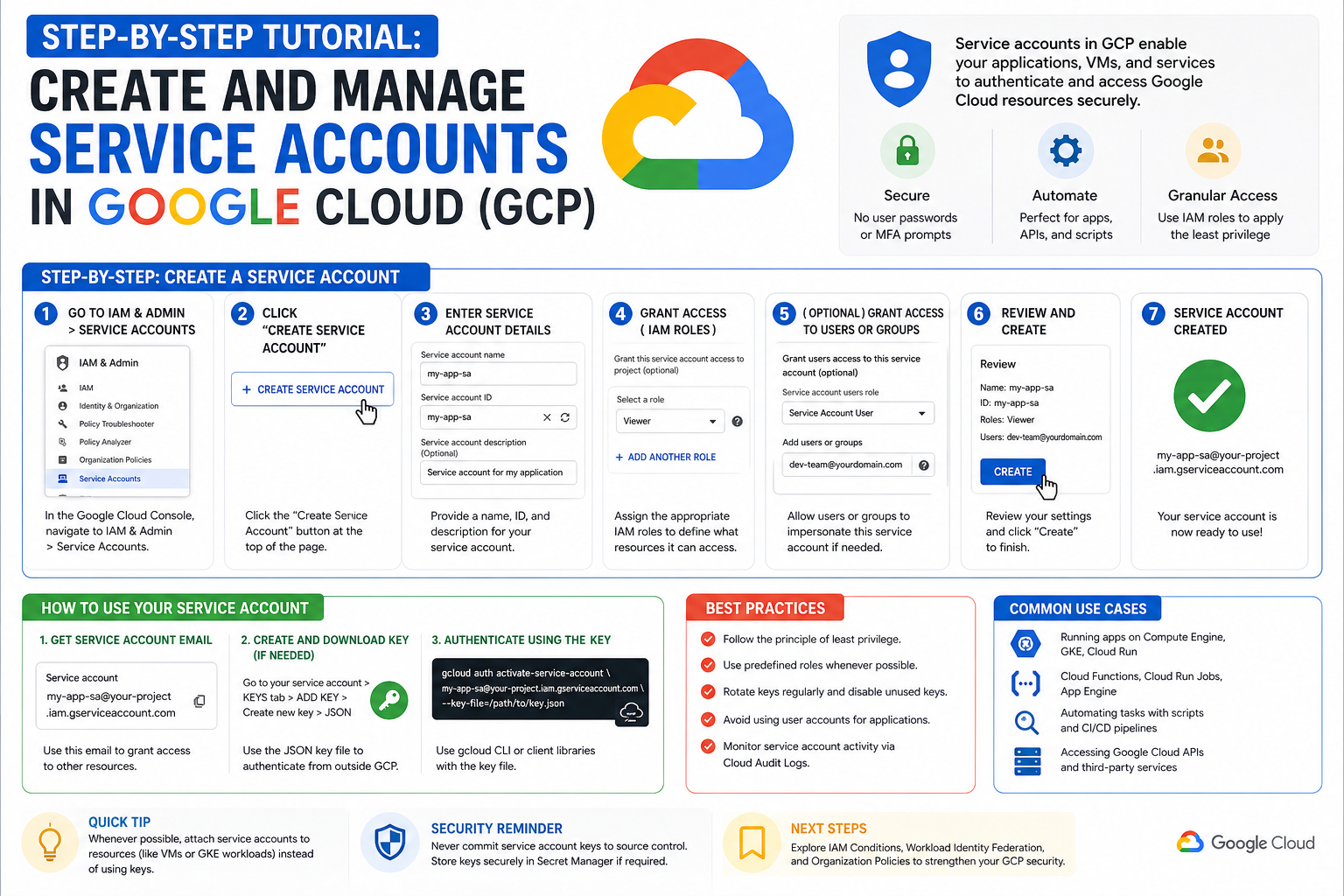
Google Cloud service accounts are a foundational part of how applications and services interact securely within the Google Cloud ecosystem. They are designed to provide identity for non-human users such as applications, virtual machines, and automated workloads. Instead of tying access permissions to a person, service accounts allow machines and software processes to authenticate and communicate with Google Cloud resources in a controlled and secure manner.
In traditional systems, user accounts represent individuals who log in with credentials like usernames and passwords. However, in cloud environments, many interactions happen automatically between services without any human involvement. This is where service accounts become essential. They act as identity carriers for these automated systems, ensuring that each process has only the permissions it needs to perform its task and nothing more.
A service account is fundamentally a special type of identity that exists within a Google Cloud project. It is associated with that project and can be granted specific roles that determine what resources it can access and what actions it can perform. This structure allows organizations to enforce strict access control policies while maintaining operational flexibility for applications.
One of the most important aspects of service accounts is that they follow the principle of least privilege. This means that instead of giving broad access to all resources, you assign only the minimum permissions required for a specific task. This significantly reduces security risks because even if a service account is misused or compromised, the potential damage is limited by its restricted permissions.
Service accounts are widely used across different Google Cloud services. For example, a virtual machine running in a compute environment might use a service account to access storage, databases, or messaging systems. Similarly, a data processing pipeline might use a service account to read input data from a storage bucket and write processed results into another resource. Each of these interactions is authenticated through the service account rather than a human user.
How Identity Works in Google Cloud Environments
To understand service accounts properly, it is important to first understand how identity is managed in cloud environments. Google Cloud uses an identity and access management system that controls who can do what across different resources. Every request made to a Google Cloud service must be authenticated and authorized.
Authentication verifies the identity of the entity making the request, while authorization determines whether that entity is allowed to perform the requested action. Service accounts play a key role in this process by acting as the identity used for authentication when applications or services interact with cloud resources.
Each service account is associated with a unique identity that includes an email-like format. This identity is used internally to represent the service account when it requests access to a resource. However, unlike human user accounts, service accounts are not meant for direct login through a browser or interactive interface. Instead, they are used programmatically by systems and applications.
The identity of a service account is tied to credentials that allow it to authenticate securely. These credentials are typically managed internally by Google Cloud when the service account is attached to certain compute services. In other cases, key-based authentication may be used, where a private key is generated and used by an application to prove its identity.
This identity-based model ensures that every automated process in the cloud has a clearly defined and traceable origin. It also allows administrators to audit activity based on service account usage, which is critical for monitoring and security compliance.
The Role of Service Accounts in Application Security
Service accounts are not just about access; they are also a major component of cloud security architecture. By isolating permissions into dedicated identities, organizations can ensure that each application or service operates within a controlled security boundary.
For example, consider a web application hosted in a cloud environment that needs to retrieve images stored in a cloud storage system. Instead of giving the application full administrative access to the storage system, a service account can be created specifically for read-only access. This service account is then assigned to the application, allowing it to retrieve files but preventing it from modifying or deleting them.
This separation of duties significantly improves security posture. Even if the application is compromised, the attacker would only gain access to the limited permissions assigned to the service account, rather than gaining unrestricted control over the entire storage system.
Service accounts also help in reducing credential sharing. In traditional systems, multiple developers or services might share the same credentials, which increases the risk of unauthorized access. With service accounts, each system or workload can have its own identity, eliminating the need for shared credentials and improving accountability.
Types of Service Accounts in Google Cloud
Google Cloud provides different types of service accounts depending on how they are created and used. Each type serves a specific purpose within the ecosystem.
User-managed service accounts are created by administrators or developers within a project. These are the most commonly used types and are fully customizable. Users can assign roles, manage keys, and configure access policies based on application requirements.
Default service accounts are automatically created when certain Google Cloud services are enabled. For example, when a compute instance is created, a default service account may be assigned to it. These accounts are convenient for quick setup but often require additional configuration to ensure proper security controls are in place.
Google-managed service accounts are created and maintained by Google Cloud itself. These accounts are used internally by Google services to perform operations on behalf of the user. They are not meant to be modified directly and are managed entirely by the platform.
Understanding these distinctions is important because each type of service account behaves differently in terms of permissions, control, and lifecycle management. Organizations typically rely heavily on user-managed service accounts for production workloads due to their flexibility and transparency.
Creating a Service Account Conceptually
Before creating a service account in a cloud environment, it is important to understand the logical steps involved in its creation. The process begins with defining the purpose of the service account. This includes identifying what application or service will use it and what resources it needs to access.
Once the purpose is clear, the next step is to determine the appropriate permissions. This involves selecting roles that align with the principle of least privilege. Instead of assigning broad administrative roles, specific roles should be chosen that grant only the necessary access.
After defining permissions, the service account is created within a specific project. This ensures that the account is scoped to the correct environment and can only interact with resources within that project unless explicitly granted cross-project access.
The final step involves associating the service account with the relevant workload or application. This could be a virtual machine, a container, or an application running in a serverless environment. Once associated, the workload automatically uses the service account to authenticate and access resources.
Service Account Authentication Mechanisms
Authentication for service accounts can be handled in multiple ways depending on the environment in which they are used. One common method is automatic credential provisioning, where Google Cloud assigns temporary credentials to workloads such as virtual machines or container instances. These credentials are rotated automatically and do not require manual management.
Another method involves the use of service account keys. These are cryptographic keys that allow external applications or systems to authenticate as the service account. While powerful, this method requires careful handling because improperly managed keys can become a security risk.
In modern cloud architectures, there is a strong preference for avoiding long-lived keys whenever possible. Instead, identity-based authentication methods are encouraged, where the cloud platform manages credential rotation and security automatically. This reduces the risk of credential leakage and simplifies management.
Service account authentication is also tightly integrated with Google Cloud’s identity framework, ensuring that every request is verified and logged. This allows administrators to trace activity back to specific service accounts and understand how resources are being accessed across the environment.
Assigning Roles and Permissions to Service Accounts
Roles define what actions a service account is allowed to perform. These roles are assigned through an access management system that categorizes permissions into predefined sets. Each role contains a collection of permissions that determine access to specific resources.
When assigning roles to a service account, it is important to consider the principle of minimal access. Instead of assigning broad roles that grant full control over a resource, more specific roles should be selected that align with the intended function of the service account.
For example, a service account used by a data processing application may only need read access to a storage system and write access to a database. It should not have permissions to delete resources or modify infrastructure settings unless necessary.
This granular approach to permission management ensures that each service account operates within a tightly controlled boundary, reducing the risk of accidental or malicious misuse.
Service Accounts in Compute and Application Workloads
Service accounts are commonly used in compute environments where applications run without direct human interaction. Virtual machines, containerized applications, and serverless functions all rely on service accounts to interact with other cloud services.
In a virtual machine environment, a service account can be attached to the instance at creation time. This allows any application running on that machine to automatically use the service account’s identity when accessing cloud resources.
In container environments, service accounts are often associated with workloads or pods. This ensures that each container has its own identity and can only access the resources it is permitted to use.
Serverless environments also rely heavily on service accounts. Functions triggered by events or API calls use service accounts to access databases, storage systems, and external services securely.
This integration between service accounts and compute services ensures that authentication is seamless and does not require manual intervention during runtime.
Managing Lifecycle and Usage of Service Accounts
Service account management involves more than just creation. It also includes monitoring, updating, and eventually retiring accounts when they are no longer needed.
Over time, organizations may accumulate many service accounts, some of which may become outdated or unused. Regular auditing is important to ensure that inactive service accounts are identified and removed to reduce security risks.
Monitoring service account activity is also essential. By tracking how and when service accounts are used, administrators can detect unusual behavior that may indicate security issues or misconfigurations.
Updating service account permissions is another important aspect of lifecycle management. As applications evolve, their access requirements may change. It is important to adjust roles accordingly to ensure that permissions remain aligned with current needs.
Proper lifecycle management ensures that service accounts remain secure, efficient, and relevant throughout their usage.
Security Considerations for Service Accounts
Security is a central concern when working with service accounts. Because they represent automated access to cloud resources, any misconfiguration can have significant consequences.
One important security practice is minimizing the number of service accounts used within an environment. Creating too many service accounts can lead to complexity and increased risk of mismanagement.
Another important consideration is avoiding unnecessary permissions. Overly permissive service accounts can be exploited if compromised, leading to broader access than intended.
Credential management is also critical. If service account keys are used, they must be stored securely and rotated regularly. However, modern best practices encourage reducing reliance on static keys altogether.
Finally, continuous monitoring and auditing help ensure that service accounts are used appropriately and that any anomalies are detected early.
Managing Google Cloud Service Accounts in Real-World Environments
Managing service accounts in Google Cloud becomes increasingly important as environments grow in size and complexity. While creating a service account is a relatively straightforward task, maintaining control over how it is used across multiple applications, teams, and projects requires a structured and disciplined approach. In real-world cloud architectures, service accounts are not isolated objects; they are deeply integrated into identity management, security policies, automation workflows, and operational governance.
Effective management begins with understanding that service accounts are long-lived identities that often outlast the applications they were created for. Without proper oversight, they can accumulate unnecessary permissions, remain active after their use has ended, or be unintentionally shared across systems. This creates potential security and operational risks that need to be addressed through consistent management practices.
Structuring Service Accounts Across Projects and Organizations
In larger cloud environments, service accounts are rarely confined to a single project. Instead, they are often distributed across multiple projects that represent different applications, environments, or business units. Structuring service accounts properly across these boundaries is essential for maintaining clarity and control.
A common approach is to align service accounts with organizational structure. For example, development environments may use separate service accounts from production environments. This separation ensures that experimental workloads do not accidentally impact critical systems.
Within this structure, naming conventions play a key role. Consistent naming helps administrators quickly identify the purpose of a service account without needing to inspect its configuration. Names often reflect the application, environment, and function of the account, making it easier to manage at scale.
Service accounts may also be centralized within specific projects that act as identity hubs. In such cases, multiple applications across different projects may reference the same service account, allowing for centralized control over permissions and policies.
IAM Integration and Role Binding Strategy
Service accounts are tightly integrated with identity and access management systems that define how permissions are assigned and enforced. The relationship between service accounts and roles is established through role bindings, which connect an identity to a set of permissions within a specific scope.
Managing these bindings effectively requires a clear understanding of how permissions propagate across resources. In Google Cloud, permissions can be granted at different levels, including project, folder, and organizational levels. This hierarchical structure allows administrators to control access in a flexible yet structured manner.
When designing role bindings for service accounts, it is important to avoid overly broad assignments. Instead of granting full project-level access, it is more secure to assign permissions at the resource level where possible. This reduces the potential impact of accidental misuse or compromise.
Role binding management also involves periodic review. Over time, applications may change, and the permissions they require may no longer match the original configuration. Regular audits help ensure that service accounts retain only the permissions they actually need.
Service Account Impersonation and Delegated Access
One of the more advanced features of service account management is impersonation. This mechanism allows one identity, such as a user or another service account, to temporarily assume the identity of a service account without directly using its credentials.
Impersonation is particularly useful in scenarios where centralized control is required. For example, a deployment system may need to perform actions on behalf of multiple service accounts across different environments. Instead of storing multiple sets of credentials, it can impersonate the appropriate service account as needed.
This approach significantly improves security by reducing the need for long-lived credentials. It also simplifies credential management because access is controlled through identity permissions rather than static keys.
Delegated access is closely related to impersonation. It allows one service account to act on behalf of another under controlled conditions. This is often used in multi-tier application architectures where different services need to interact securely without sharing credentials directly.
Service Account Key Management and Security Practices
Although modern cloud architectures encourage keyless authentication where possible, service account keys still exist in many environments. These keys are sensitive credentials that must be managed carefully to prevent unauthorized access.
A service account key is essentially a private cryptographic credential that can be used to authenticate as the service account from outside the Google Cloud environment. Because these keys provide direct access, they represent a significant security risk if exposed or mishandled.
Proper key management involves limiting their creation to only when necessary. In many cases, built-in authentication mechanisms provided by cloud services eliminate the need for keys. When keys are required, they should be stored securely and rotated regularly.
Key rotation is an important practice that reduces the risk of long-term exposure. By periodically replacing keys, organizations can limit the usefulness of any compromised credentials. Old keys should be deleted once they are no longer in use to prevent unauthorized access.
Monitoring key usage is also critical. Unused or forgotten keys can become security vulnerabilities if they remain active in the system. Regular audits help identify such keys and ensure they are properly managed.
Workload Identity and Modern Authentication Models
Modern cloud environments increasingly rely on workload identity mechanisms that eliminate the need for manually managed service account keys. Instead of using static credentials, workloads are assigned identities that are automatically managed by the platform.
This approach is particularly common in containerized environments where applications run in dynamically created and destroyed instances. In such cases, assigning static credentials would be impractical and insecure.
Workload identity systems allow applications to authenticate seamlessly using short-lived credentials that are automatically generated and rotated. This significantly reduces the risk of credential leakage and simplifies operational management.
In addition to improving security, workload identity also enhances scalability. As applications scale up or down, identity management is handled automatically without requiring manual intervention.
Service Account Usage in Automated Pipelines
Service accounts play a critical role in automated deployment and integration pipelines. These pipelines often need to interact with multiple cloud resources, such as storage systems, compute services, and configuration management tools.
By assigning service accounts to these pipelines, organizations can ensure that automation processes operate within defined security boundaries. Each pipeline stage can use a specific service account with permissions tailored to its function.
For example, a build stage may only require read access to source repositories, while a deployment stage may require permissions to create and update compute resources. By separating these responsibilities into different service accounts, organizations reduce the risk of unintended changes.
Automation also benefits from impersonation capabilities, allowing pipelines to assume different identities depending on the task being performed. This adds a layer of control and flexibility.
Monitoring and Logging Service Account Activity
Monitoring service account activity is essential for maintaining visibility into how resources are being accessed. Every action performed by a service account is logged, providing a detailed record of interactions with cloud services.
These logs are valuable for both operational and security purposes. From an operational perspective, they help administrators understand how applications are behaving and identify potential performance issues. From a security perspective, they provide traceability in the event of suspicious activity.
Analyzing service account logs can reveal patterns such as unexpected access attempts, unusual resource usage, or changes in behavior over time. These insights can be used to detect potential security incidents early.
Monitoring also includes tracking authentication events. By observing when and where service accounts are used, administrators can ensure that they are being accessed only by authorized systems.
Common Challenges in Service Account Management
As environments grow, managing service accounts becomes increasingly complex. One common challenge is service account sprawl, where too many accounts are created without proper organization or lifecycle management. This can lead to confusion and difficulty in tracking usage.
Another challenge is permission creep. Over time, service accounts may accumulate more permissions than they actually need. This often happens when roles are added for temporary purposes but never removed.
Credential mismanagement is also a frequent issue. In environments where service account keys are used, improper storage or sharing of keys can create significant security risks.
Additionally, a lack of visibility into service account usage can make it difficult to detect misuse. Without proper monitoring, unauthorized access may go unnoticed for extended periods.
Addressing these challenges requires a combination of governance policies, automation, and regular audits.
Automation of Service Account Administration
Automation plays a key role in managing service accounts efficiently at scale. Instead of manually creating and configuring accounts, organizations often use automated scripts or infrastructure management systems to handle these tasks.
Automated provisioning ensures that service accounts are created consistently with predefined configurations. This reduces the risk of human error and ensures that security policies are applied uniformly.
Automation can also be used for lifecycle management. For example, service accounts that are no longer in use can be automatically identified and deactivated based on predefined criteria.
In addition, automated monitoring systems can continuously analyze service account activity and trigger alerts when unusual behavior is detected. This improves response times and enhances overall security posture.
Policy Enforcement and Organizational Control
Service account management is often governed by organizational policies that define how identities should be created, used, and maintained. These policies help ensure consistency across different teams and projects.
Policy enforcement mechanisms can restrict certain actions, such as preventing the creation of overly permissive service accounts or blocking the use of long-lived credentials. These controls help maintain security standards across the entire environment.
Organizations may also enforce restrictions on where service accounts can be used. For example, a service account created for production workloads may not be allowed to operate in development environments.
Centralized policy control ensures that service account usage aligns with organizational security and compliance requirements.
Troubleshooting Service Account Issues in Cloud Systems
Despite careful configuration, issues with service accounts can still arise. Common problems include permission errors, authentication failures, and misconfigured role bindings.
When troubleshooting these issues, the first step is often to verify that the service account has the correct roles assigned. Missing or incorrect permissions are a frequent cause of access problems.
Another common issue is incorrect association between service accounts and workloads. If a service account is not properly attached to a compute resource, the application may fail to authenticate.
Authentication failures can also occur due to expired or invalid credentials, especially in environments where service account keys are used. Ensuring that credentials are up to date is essential for maintaining smooth operation.
Logs play a crucial role in troubleshooting, as they provide detailed information about failed authentication attempts and permission denials.
Evolving Practices in Service Account Management
As cloud environments continue to evolve, so do the practices around service account management. There is a clear shift toward more automated, identity-driven systems that reduce the need for manual credential handling.
Modern architectures emphasize short-lived credentials, dynamic identity assignment, and reduced reliance on static keys. These practices improve both security and scalability.
There is also a growing emphasis on fine-grained access control, where permissions are defined at a more granular level to minimize risk exposure. This allows organizations to build highly secure systems without sacrificing flexibility.
In addition, integration between identity systems and workload orchestration platforms continues to improve, making service account management more seamless and automated than ever before.
Advanced Service Account Architectures in Large-Scale Google Cloud Environments
As Google Cloud environments expand into enterprise-scale systems, service account design evolves from simple identity assignment into a structured architecture layer that supports security, scalability, and operational governance. At this level, service accounts are no longer just credentials attached to applications—they become building blocks of identity architecture across multiple projects, teams, and workloads.
Large organizations typically operate hundreds or even thousands of service accounts, each serving different purposes such as data processing, API access, automation, monitoring, and infrastructure provisioning. Managing this scale requires architectural discipline, where service accounts are treated as first-class security objects with defined lifecycles, ownership, and boundaries.
One of the most important architectural principles is the separation of concerns. Instead of using a single service account for multiple applications, each workload is assigned a dedicated identity. This ensures that access is tightly scoped and reduces the risk of cross-service interference. It also simplifies auditing, since each service account maps directly to a specific function or system.
Multi-Project Identity Design and Cross-Project Access
In complex cloud environments, resources are rarely confined to a single project. Applications often span multiple projects that represent different environments such as development, testing, staging, and production. Service accounts play a key role in enabling secure communication across these boundaries.
Cross-project access is typically implemented by granting a service account in one project permission to access resources in another project. This allows systems to remain logically separated while still interacting securely. For example, a data processing service in one project may need to access storage resources located in another project dedicated to data warehousing.
This architecture requires careful planning because cross-project permissions can easily become overly complex if not managed properly. A structured approach involves defining clear trust relationships between projects and limiting cross-project access to only essential interactions.
Service account naming conventions and documentation become especially important in multi-project environments. Without clear identification, it becomes difficult to understand which service account is responsible for which cross-project interaction.
Service Account Federation and External Identity Integration
Modern cloud systems increasingly interact with external platforms, services, and identity providers. Service account federation allows identities from outside Google Cloud to securely access cloud resources without requiring static credentials.
Federation works by establishing trust between Google Cloud and an external identity provider. Instead of relying on long-lived service account keys, external identities are dynamically mapped to Google Cloud service accounts during authentication. This allows external systems to act on behalf of a service account securely and temporarily.
This model is particularly useful in hybrid and multi-cloud environments where workloads are distributed across different platforms. It eliminates the need to manage multiple sets of credentials and reduces the risk associated with credential duplication.
Federation also supports modern identity standards that enable secure token exchange between systems. This allows external applications to request access to Google Cloud resources in a controlled and auditable manner.
Identity Boundaries and Workload Isolation Strategies
One of the most critical aspects of service account architecture is defining identity boundaries. These boundaries determine how far a service account’s permissions extend and what systems it can interact with.
Workload isolation is achieved by assigning each application or service its own dedicated service account. This ensures that even if one workload is compromised, the impact is contained within that identity boundary.
Isolation strategies often extend beyond individual applications to entire environments. For example, production workloads may use completely separate service accounts from development workloads, even if they run similar applications.
This separation reduces the risk of accidental access to sensitive production resources from non-production environments. It also simplifies compliance requirements by ensuring that sensitive systems are clearly segmented.
Service Account Governance and Organizational Policies
Governance plays a central role in maintaining control over service account usage across large organizations. Without governance, service accounts can quickly become unmanaged, leading to security risks and operational inefficiencies.
Governance policies define how service accounts are created, named, used, and retired. These policies often include restrictions on who can create service accounts and what types of permissions can be assigned.
Centralized governance ensures that all service accounts adhere to consistent standards across the organization. This reduces fragmentation and improves visibility into identity usage.
Governance frameworks also include periodic reviews of service accounts to ensure they are still necessary. Unused or outdated service accounts are often disabled or deleted to reduce security exposure.
Lifecycle Automation for Service Accounts
At scale, manual management of service accounts becomes impractical. Lifecycle automation addresses this challenge by automatically handling the creation, updates, and decommissioning of service accounts based on predefined rules.
Automation systems can generate service accounts when new applications are deployed, assign appropriate roles based on templates, and associate them with the correct workloads. This ensures consistency and reduces human error.
Similarly, when applications are retired, automation systems can identify and deactivate associated service accounts. This prevents orphaned identities from lingering in the environment.
Lifecycle automation also extends to permission updates. When application requirements change, automated systems can adjust service account roles accordingly, ensuring that permissions remain aligned with current needs.
Advanced IAM Patterns for Service Accounts
Service accounts interact closely with identity and access management systems, which define how permissions are structured and enforced. Advanced IAM patterns allow organizations to build more flexible and secure access models.
One such pattern is role decomposition, where broad roles are broken down into smaller, more specific permission sets. This allows service accounts to be granted only the exact permissions they need.
Another pattern is hierarchical permission inheritance, where service accounts inherit permissions based on their position within an organizational structure. This simplifies management by reducing the need for explicit role assignments at every level.
Conditional access policies also play an important role in advanced IAM configurations. These policies allow access to be granted based on specific conditions such as time, location, or resource state. This adds a layer of security to service account usage.
Secure Communication Between Service Accounts
Service accounts often need to communicate with each other, especially in distributed systems where multiple services work together to complete a task. Secure communication between service accounts is essential to prevent unauthorized data access.
One common approach is token-based delegation, where one service account generates a temporary token that another service account can use to access a resource. This ensures that access is time-limited and context-specific.
Another approach involves service-to-service authentication, where each service account independently authenticates itself before communicating with another service. This ensures that both sides of the communication are verified.
These communication patterns help maintain strong security boundaries while allowing complex workflows to function seamlessly across distributed systems.
Observability and Behavioral Analysis of Service Accounts
Observability is a critical aspect of managing service accounts in modern cloud environments. It involves collecting and analyzing data about how service accounts are used across the system.
Behavioral analysis focuses on identifying patterns in service account activity. For example, if a service account suddenly begins accessing resources it has never used before, this may indicate a potential security issue.
By continuously monitoring behavior, organizations can detect anomalies early and respond before they escalate into serious incidents.
Observability also supports operational insights. By analyzing service account usage patterns, administrators can identify inefficient configurations or optimize resource access strategies.
Service Account Dependencies in Microservices Architectures
In microservices-based architectures, service accounts often represent individual services that interact with each other. Each microservice may have its own service account, which defines its identity and access permissions.
These service accounts form a dependency network where services rely on each other to perform tasks. Managing these dependencies is critical for ensuring system stability and security.
If one service account has excessive permissions, it can potentially affect multiple downstream services. Therefore, dependency mapping is used to understand how service accounts interact within the system.
This mapping helps administrators identify critical paths and potential risk areas within the architecture.
Resource-Level Access Control Using Service Accounts
Service accounts can be used to enforce fine-grained access control at the resource level. Instead of granting access to entire services, permissions can be restricted to specific resources such as individual storage buckets, database tables, or compute instances.
This level of granularity allows organizations to implement highly secure architectures where each service account has access only to the exact resources it needs.
Resource-level access control is particularly important in environments that handle sensitive data. By limiting exposure, organizations reduce the risk of data leaks or unauthorized modifications.
This approach also simplifies auditing because access logs can be traced directly to specific resources and service accounts.
Service Account Portability Across Environments
Portability refers to the ability to use service account configurations across different environments such as development, staging, and production. Maintaining consistency across these environments is important for reducing configuration drift.
Service accounts can be designed in a way that allows them to be replicated across environments with minimal changes. This ensures that applications behave consistently regardless of where they are deployed.
However, while structure may remain consistent, permissions are often adjusted to reflect the security requirements of each environment. For example, production service accounts may have stricter access controls compared to development environments.
This balance between consistency and security is essential for maintaining both operational efficiency and risk management.
Handling Identity Conflicts and Misconfigurations
In large environments, identity conflicts can occur when multiple service accounts are assigned overlapping or conflicting permissions. These conflicts can lead to unexpected behavior or access issues.
Misconfigurations are another common problem, where service accounts are incorrectly assigned roles or associated with the wrong workloads. This can result in either excessive access or insufficient permissions.
Detecting and resolving these issues requires systematic review processes and automated validation tools. These tools help identify inconsistencies in service account configurations before they impact production systems.
Regular audits and configuration reviews are essential for maintaining a stable and secure identity environment.
Evolution of Service Account Models in Cloud Infrastructure
Service account models continue to evolve as cloud infrastructure becomes more dynamic and distributed. Traditional static identity models are gradually being replaced by adaptive identity systems that respond to workload behavior in real time.
These modern models emphasize automation, short-lived credentials, and context-aware access control. Instead of relying on fixed identities, systems dynamically assign permissions based on current workload requirements.
This evolution reflects a broader shift toward zero-trust security models, where no identity is inherently trusted, and every access request must be continuously verified.
Service accounts remain central to this evolution, but their role is expanding from static identity carriers to dynamic components of intelligent security systems.
Ongoing Refinement of Service Account Practices
As cloud environments continue to evolve, service account management is not a one-time design effort but an ongoing process of refinement. Organizations frequently revisit their identity structures to align with new workloads, updated security requirements, and changes in application architecture. This often involves tightening permissions, removing unused accounts, and restructuring role assignments to better reflect current operational needs. Over time, even well-designed systems can accumulate unnecessary complexity, making periodic optimization essential. Continuous improvement also includes adopting newer authentication methods, reducing reliance on legacy key-based access, and integrating more automated governance controls. By consistently refining service account practices, organizations maintain stronger security boundaries, improve operational clarity, and ensure that identity management scales effectively alongside growing cloud infrastructure demands.
Conclusion
Google Cloud service accounts form a critical foundation for secure and scalable cloud operations, especially in environments where automation, distributed systems, and microservices architectures are heavily used. They provide a structured way to assign identity to non-human entities such as applications, virtual machines, containers, and automated pipelines, ensuring that every interaction with cloud resources is authenticated and controlled.
At their core, service accounts solve a fundamental problem in modern computing: how to securely allow machines to communicate with other systems without relying on human credentials. By separating human identities from machine identities, they reduce the risk of credential sharing, improve accountability, and enable precise control over access permissions. This separation is essential in environments where workloads are constantly evolving and scaling dynamically.
As cloud infrastructures grow, the importance of properly managing service accounts becomes even more significant. Poorly configured or unmanaged service accounts can introduce serious security risks, including excessive permissions, orphaned identities, and unauthorized access pathways. On the other hand, well-structured service account strategies contribute to a strong security posture by enforcing the principle of least privilege, ensuring that each identity only has access to what it truly needs.
Modern service account management also extends far beyond simple creation and assignment. It involves lifecycle management, continuous monitoring, automated provisioning, and integration with identity federation systems. These capabilities allow organizations to maintain control even in highly complex and distributed environments. Automation plays a particularly important role, helping reduce human error while ensuring consistency across large-scale deployments.
Another key aspect is the shift toward keyless authentication and workload identity systems. These approaches reduce reliance on static credentials and instead use dynamically managed identities that are automatically rotated and secured by the platform. This evolution significantly improves security while simplifying operational overhead.
Service accounts also play an essential role in enabling secure collaboration across systems, projects, and even external platforms. Through mechanisms such as impersonation, federation, and delegated access, they support flexible yet controlled identity relationships that are suitable for modern hybrid and multi-cloud architectures.
Ultimately, service accounts are not just a technical feature but a core element of cloud governance and security design. When properly implemented, they provide a scalable and secure identity framework that supports both operational efficiency and strong access control. As cloud technologies continue to evolve, service accounts will remain central to how organizations build, secure, and manage their digital infrastructure.