Managing a co-located server introduces a very different experience compared to handling systems within a company’s own building. When equipment sits inside an organization’s office or private server room, IT staff have immediate physical access. They can reboot systems, replace components, inspect cabling, or troubleshoot hardware issues in real time. In a co-location environment, that immediacy disappears.
A co-located server is housed in a remote data center facility that may be in another city, region, or even country. While this setup provides major advantages in terms of infrastructure quality, power reliability, cooling efficiency, and physical security, it also introduces a distance barrier that complicates day-to-day management.
One of the biggest challenges is response time. When a hardware issue arises, organizations cannot simply send a technician down the hallway. Instead, they must rely on communication channels such as tickets, emails, or phone calls to request physical intervention. This delay can be critical, especially when dealing with system outages or performance degradation.
Another challenge is visibility. In an on-premises setup, IT teams can directly observe blinking LEDs, listen for unusual hardware sounds, or inspect environmental conditions. With co-located equipment, this visibility is removed unless someone is physically present in the data center and acts as the eyes and ears of the organization.
There is also the issue of operational coordination. Simple tasks such as swapping a failed drive or checking cable connections now require scheduling, authorization, and coordination with on-site personnel. This adds a layer of procedural complexity that does not exist in local environments.
Security considerations also become more structured. While data centers are highly secure environments, organizations must carefully define who is allowed to physically interact with their servers. This includes access permissions, identity verification, and strict documentation of any changes made to equipment.
All of these factors combine to make co-located server management a disciplined, process-driven activity. Instead of direct physical intervention, organizations must rely on structured remote support mechanisms that can act on their behalf inside the data center.
Understanding the Data Center Co-location Environment
A co-location data center is a specialized facility designed to house servers and networking equipment for multiple organizations under one roof. These environments are engineered for reliability, performance, and security, offering far more robust infrastructure than most businesses could maintain independently.
At the core of a co-location facility is its physical infrastructure. This includes redundant power systems, backup generators, advanced cooling systems, and high-speed network connectivity. These systems are designed to minimize downtime and ensure that servers remain operational even during external disruptions such as power outages or network failures.
Unlike traditional office environments, co-location facilities operate under strict environmental controls. Temperature and humidity are carefully regulated to ensure optimal hardware performance. Dust and other airborne contaminants are minimized to reduce hardware wear and tear. These controlled conditions significantly extend the lifespan of equipment.
Security is another defining feature of these environments. Access to the facility is tightly controlled through multiple layers of authentication, including biometric systems, security badges, and surveillance monitoring. Only authorized personnel are allowed to enter server rooms, and every action is logged for accountability.
Within this shared infrastructure, each customer is allocated a secure physical space. This may take the form of a locked cabinet, cage, or even a dedicated room, depending on the service level. While infrastructure is shared at the facility level, customer equipment remains physically isolated and protected.
Communication between customers and facility staff is typically managed through structured service requests. Since direct access is limited, all physical operations must be coordinated through authorized processes. This is where remote assistance services become essential, acting as the operational bridge between the customer and their hardware.
The Role of Remote Hands in Modern Infrastructure Operations
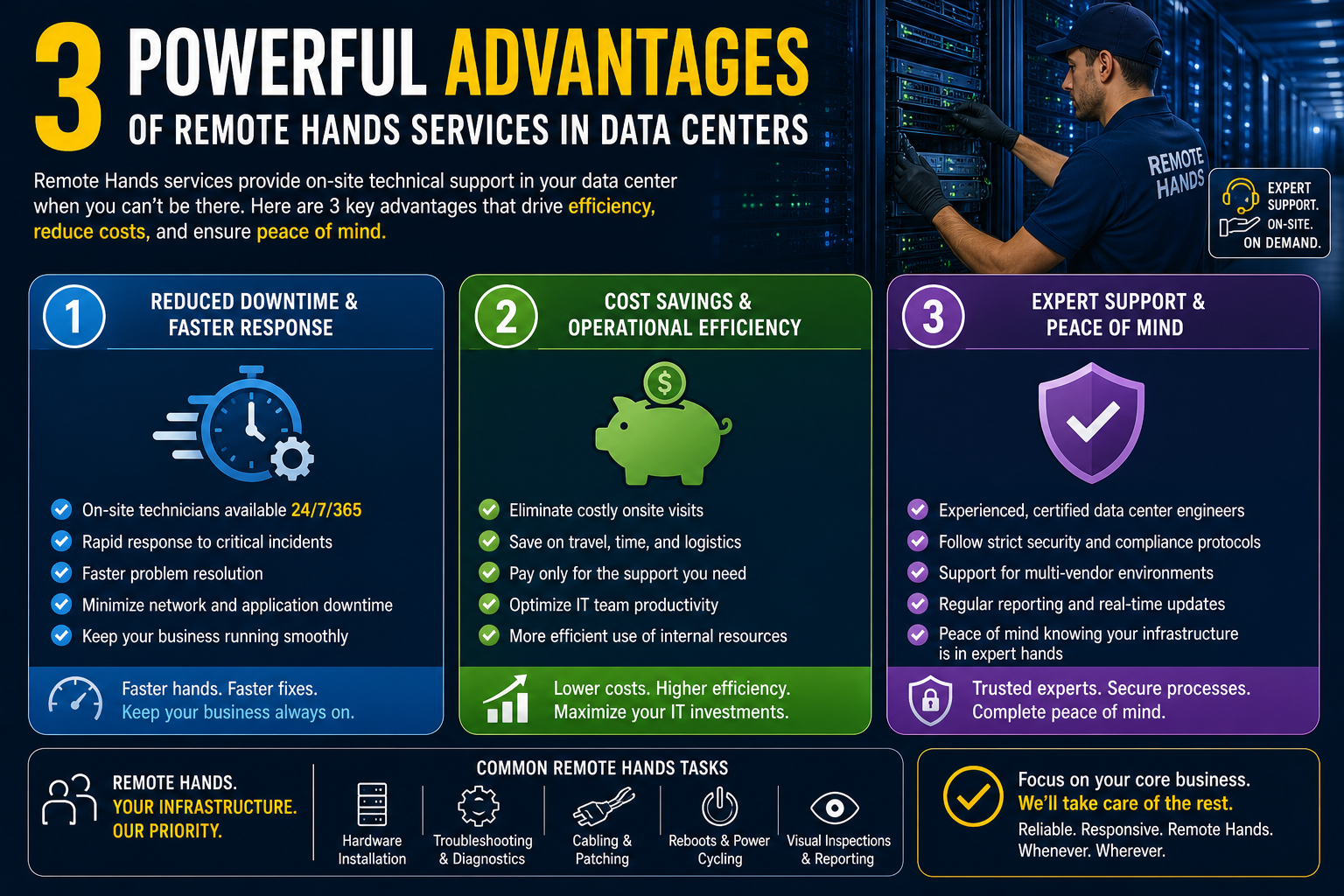
Remote hands services play a critical role in bridging the gap between IT teams and their physically distant infrastructure. These services provide on-site technical support personnel who act on behalf of organizations to perform physical tasks inside the data center.
At a fundamental level, remote hands technicians function as extensions of a company’s IT department. When a server requires physical attention, instead of dispatching internal staff, organizations can request assistance from trained technicians already present within the facility. These technicians are familiar with the environment, procedures, and safety protocols required to operate within a high-security data center.
This model significantly improves operational efficiency. Since technicians are already on-site, response times are typically much faster than if external personnel were required to travel to the facility. This is particularly important during emergencies where downtime must be minimized.
Remote hands services are also highly structured. Requests are submitted through predefined channels and categorized based on urgency and complexity. Tasks are then assigned to available technicians who carry out the work according to documented instructions provided by the client.
One of the key strengths of this service model is scalability. Organizations do not need to maintain a permanent physical presence at each data center location. Instead, they can rely on a shared pool of technical resources that can be accessed as needed.
Another important aspect is consistency. Data center technicians are trained to follow strict procedures when handling customer equipment. This reduces the risk of human error and ensures that all tasks are performed in accordance with industry standards and facility policies.
Remote hands services also contribute to operational continuity. Even outside of standard business hours, technicians are available to perform essential tasks, ensuring that systems remain functional around the clock.
Day-to-Day Tasks Handled by Remote Hands Technicians
The responsibilities of remote hands technicians cover a wide range of physical and operational tasks that support the maintenance of co-located servers. These tasks are generally routine in nature but are essential for keeping systems operational and resolving hardware-related issues.
One of the most common tasks involves basic hardware checks. This may include verifying server status lights, checking cable connections, or confirming that equipment is powered on and functioning correctly. These simple inspections often provide valuable insights into system health.
Hardware replacement is another frequent responsibility. If a component, such as a hard drive, memory module, or power supply, fails, technicians can physically replace the faulty part with a new one provided by the customer or facility inventory, depending on the arrangement.
Cable management and patching are also typical duties. Proper cabling is critical in data center environments to ensure network stability and reduce the risk of disconnections. Technicians may be asked to trace cables, reroute connections, or verify network links between devices.
In addition to hardware tasks, remote hands personnel often assist with equipment installation. When new servers or networking devices are shipped to the facility, technicians receive, unpack, and install them in the appropriate racks according to client specifications.
Reboots and power cycling are simple but essential functions. When systems become unresponsive, a controlled reboot can often restore functionality without requiring more invasive troubleshooting.
Environmental checks also fall within their scope. Technicians may monitor rack temperatures, ensure proper airflow, or verify that cooling systems are operating effectively in specific areas.
In more complex situations, they may assist with diagnostic procedures under the guidance of remote IT teams. This can include reading system logs, checking BIOS settings, or running basic hardware diagnostics.
Each of these tasks is performed according to strict instructions provided by the client, ensuring that even without direct physical presence, organizations maintain control over their infrastructure.
How Remote Hands Bridges the Gap Between Teams and Hardware
One of the most significant advantages of remote hands services is their ability to bridge the physical gap between IT teams and their infrastructure. In modern IT environments, teams are often distributed across multiple locations, and infrastructure is rarely centralized.
This separation creates a challenge: how can technical teams effectively manage hardware they cannot physically access? Remote hands services solve this problem by providing a physical interface within the data center that responds directly to the instructions of remote teams.
Communication plays a central role in this process. IT teams provide detailed instructions outlining the required actions, while technicians execute those instructions precisely. This structured communication ensures clarity and reduces the risk of misinterpretation.
Documentation is another critical element. Every action performed by remote hands personnel is typically logged and reported back to the client. This creates a clear audit trail that helps organizations track changes, diagnose issues, and maintain accountability.
Time zone differences are also less of an obstacle thanks to this model. Since data centers operate continuously, remote teams can schedule tasks at any time, knowing that on-site technicians are available to carry them out.
This bridging function also supports collaboration across different IT disciplines. Network engineers, system administrators, and security teams can all coordinate through remote hands services to manage infrastructure without needing physical presence.
In practice, this means that even highly complex environments can be managed efficiently from afar. Tasks that once required on-site visits can now be delegated, scheduled, and completed remotely with minimal disruption.
Differences in Service Levels and What They Mean Operationally
Remote hands services are not uniform across all data centers. Instead, they are typically offered in different levels or tiers, each defining the scope and complexity of tasks that can be performed.
Basic service levels generally cover simple physical tasks such as rebooting servers, checking equipment status, or performing visual inspections. These tasks require minimal technical decision-making and are executed strictly according to instructions.
More advanced service levels expand this scope to include troubleshooting assistance, hardware replacement, and more involved diagnostic procedures. These services require technicians with deeper technical knowledge and familiarity with system architectures.
Some facilities also differentiate between standard remote hands and enhanced support services. Enhanced services may include more proactive monitoring, faster response times, or access to specialized technical expertise.
Operationally, these distinctions matter because they influence how organizations structure their support strategies. Companies with more complex infrastructure may require higher service tiers to ensure adequate support coverage.
Cost is another factor influenced by service level. Basic support is generally more affordable, while advanced services come at a premium due to the increased skill and responsibility involved.
Understanding these differences helps organizations align their operational needs with the appropriate level of support. Choosing the right balance ensures both efficiency and cost-effectiveness without compromising system reliability.
Early Considerations When Adopting Remote Hands Support
Before relying on remote hands services, organizations must carefully evaluate their operational requirements and expectations. This begins with understanding the nature of their infrastructure and the level of support it will require in a remote environment.
One important consideration is the complexity of the hardware being deployed. Highly specialized systems may require technicians with advanced knowledge or specific training, which may not be available under basic service agreements.
Another factor is communication clarity. Since all instructions must be conveyed remotely, organizations need to establish precise documentation standards to ensure tasks are executed correctly.
Security requirements also play a major role. Businesses must assess whether the data center’s access controls and operational procedures align with their internal compliance obligations.
Response time expectations should also be evaluated. Different facilities may offer varying service level agreements, and organizations must determine whether those timelines align with their operational needs.
Cost structure is another key consideration. While remote hands services eliminate the need for on-site staffing, they introduce variable operational costs that must be factored into budgeting.
Finally, organizations must consider how remote hands services will integrate into their broader IT strategy. This includes determining when to use remote intervention versus automated systems or internal escalation processes.
By carefully evaluating these factors early on, businesses can build a more effective and reliable approach to managing co-located infrastructure through remote support services.
The Operational Workflow Behind Remote Hands Data Center Services
Managing co-located infrastructure through remote hands services relies on a structured operational workflow that ensures clarity, accountability, and precision. Unlike traditional IT support models, where technicians can physically assess systems in real time, remote hands operations depend entirely on documented instructions and controlled execution inside the data center environment.
The workflow begins when an organization identifies a need for physical intervention. This could stem from a hardware failure, a planned maintenance activity, or a routine inspection requirement. Once the need is identified, the IT team prepares a formal request that outlines the task in detail. The quality of this request is critical, as it directly influences how accurately the task will be executed.
Requests typically include specific information such as rack location, server identification, port numbers, cable labels, and step-by-step instructions. In well-managed environments, these instructions are standardized to avoid ambiguity. Clear communication reduces the likelihood of misinterpretation and ensures that technicians can act efficiently without requiring additional clarification.
Once submitted, the request enters the data center’s ticketing system. Here, it is categorized based on priority, complexity, and required skill level. Routine tasks such as rebooting a server may be assigned immediately, while more complex interventions may require scheduling or approval.
The assignment phase is where technicians are allocated to the task. Since remote hands personnel are physically present in the facility, they can respond quickly compared to external engineers who would need to travel. This proximity is one of the key operational advantages of the service model.
Execution begins once the technician reviews the instructions and accesses the relevant equipment. Every action taken is typically logged in real time or documented immediately afterward. This ensures traceability and provides the requesting organization with a clear record of what was done, when it was done, and how it was completed.
After completion, a report is generated and sent back to the client. This report may include observations, outcomes, and any issues encountered during execution. In more advanced setups, photographic evidence or system status confirmations may also be included.
This structured workflow ensures that even though IT teams are physically separated from their infrastructure, they retain full operational control through a highly organized and transparent process.
Communication, Precision, and Instruction Management in Remote Hands Operations
Communication is the foundation of effective remote hands service delivery. Since technicians operate without direct interaction with client IT teams, every instruction must be clear, precise, and unambiguous. The absence of real-time clarification means that poorly written instructions can lead to delays or incorrect execution.
Organizations that successfully use remote hands services invest heavily in instruction management practices. These practices often include standardized templates for common tasks such as server reboots, hardware replacements, or network troubleshooting steps. By using consistent formats, teams reduce variability and improve execution accuracy.
Precision in communication extends beyond written instructions. It also includes proper labeling of infrastructure components. Servers, cables, and network ports are often labeled systematically to ensure technicians can identify them quickly and accurately. Without proper labeling, even simple tasks can become time-consuming and error-prone.
In many environments, diagrams and reference maps are used to supplement written instructions. These visual aids help technicians understand physical layouts and relationships between devices within racks or cabinets. This becomes especially important in large-scale deployments where hundreds of servers may be located within a single facility.
Another important aspect of communication is escalation handling. If a technician encounters an unexpected situation, there must be a clear protocol for seeking clarification. This may involve contacting the requesting engineer, referring to documented procedures, or escalating to senior data center staff.
Time sensitivity also influences communication structure. In urgent scenarios, instructions must be concise and prioritized to ensure rapid execution. In contrast, planned maintenance tasks may allow for more detailed documentation and review.
The overall effectiveness of remote hands services depends heavily on how well organizations manage this communication layer. Even highly skilled technicians cannot compensate for unclear or incomplete instructions.
Hardware Lifecycle Management Through Remote Hands Support
Co-located servers undergo a continuous lifecycle that includes installation, maintenance, upgrades, and eventual decommissioning. Remote hands services play a key role in managing each stage of this lifecycle without requiring physical presence from the organization’s IT team.
The lifecycle begins with deployment. When new hardware arrives at the data center, remote hands technicians receive, inspect, and install the equipment into designated racks. This includes mounting servers, connecting power and network cables, and verifying initial system boot status.
Once operational, the focus shifts to maintenance. Routine checks are performed to ensure systems remain functional and stable. This may include verifying disk health indicators, checking system logs, or inspecting physical connections.
As systems evolve, upgrades become necessary. Remote hands technicians can assist with hardware upgrades such as adding memory modules, replacing storage devices, or installing additional network interface cards. These tasks are performed under strict guidance from IT teams to ensure compatibility and correctness.
In some cases, performance issues may require physical troubleshooting. Technicians may be instructed to reseat components, inspect for overheating, or replace failing parts. These interventions help extend the operational life of hardware and prevent unexpected downtime.
Eventually, systems reach the end of their lifecycle. At this stage, decommissioning tasks are carried out. This involves safely removing hardware, disconnecting cables, and preparing equipment for shipment or disposal. Remote hands services ensure that this process is handled securely and in accordance with organizational policies.
Throughout this lifecycle, documentation remains critical. Every change made to hardware must be recorded to maintain an accurate history of system modifications. This helps organizations track asset usage and plan future infrastructure investments more effectively.
The Role of Remote Hands in Emergency Response Scenarios
Emergencies in data center environments require immediate action to minimize downtime and prevent data loss. Remote hands services are particularly valuable in these scenarios because they provide instant physical access to infrastructure without requiring external intervention.
Common emergency scenarios include hardware failures, network outages, power disruptions, and system crashes. In such cases, time is a critical factor, and delays can have significant operational or financial consequences.
When an emergency occurs, IT teams submit high-priority requests to the data center. These requests are immediately flagged for urgent attention and assigned to available technicians. In many facilities, emergency response protocols are in place to ensure that critical issues are addressed within strict timeframes.
Technicians may be required to perform rapid diagnostics to identify the source of the problem. This could involve checking system indicators, verifying power status, or testing network connectivity. Once the issue is identified, corrective actions are taken according to predefined procedures.
In some cases, simple interventions such as rebooting a server or reseating a component can restore functionality. In more complex situations, hardware replacement or deeper troubleshooting may be necessary.
Communication during emergencies is highly dynamic. IT teams may provide real-time updates or adjust instructions based on evolving conditions. Technicians must be able to adapt quickly while maintaining accuracy in execution.
The ability to respond rapidly to emergencies is one of the key reasons organizations rely on remote hands services. Without on-site support, resolving critical issues would take significantly longer and increase system downtime.
Security Protocols Governing Remote Physical Access
Security is one of the most important aspects of co-located infrastructure management. Since multiple organizations share the same physical facility, strict controls are necessary to ensure that each client’s equipment remains protected.
Remote hands technicians operate within a highly controlled environment. Access to server racks is restricted and monitored at all times. Before performing any task, technicians must verify authorization through the facility’s internal systems.
Physical security measures include biometric access controls, security badges, surveillance cameras, and escorted access in sensitive areas. These measures ensure that only approved personnel can interact with equipment.
Every action performed by the remote hands staff is logged for audit purposes. This includes entry and exit times, equipment accessed, and tasks completed. These logs provide a detailed record that can be reviewed if needed.
Data protection is another critical concern. While remote hands technicians may physically interact with servers, they do not typically access stored data. Their role is limited to hardware-level operations unless explicitly authorized under strict conditions.
Organizations operating in regulated industries often require additional compliance measures. These may include restricted access policies, encrypted communication channels, and mandatory reporting procedures.
Security protocols also extend to handling physical media. If storage devices are removed or replaced, they must be handled according to strict chain-of-custody procedures to prevent unauthorized access.
These layered security practices ensure that while physical access is granted for operational purposes, data integrity and confidentiality remain fully protected.
Smart Hands vs Remote Hands in Practical Infrastructure Management
While remote hands services focus on basic physical support, smart hands services extend this capability into more advanced technical assistance. The distinction between the two is important for understanding how different levels of support are applied in real-world environments.
Remote hands typically handle tasks such as rebooting servers, replacing hardware, and performing visual inspections. These tasks require limited decision-making and are executed strictly according to instructions.
Smart hands services, on the other hand, involve more complex technical operations. This may include configuring network devices, assisting with software-level troubleshooting, or performing advanced diagnostics under remote guidance.
The availability of smart hands services varies depending on the data center. Some facilities integrate both services under a unified support model, while others separate them into distinct offerings.
From an operational perspective, smart hands services reduce the need for highly specialized engineers to be physically present at the data center. This allows organizations to centralize expertise while still maintaining on-site execution capability.
Cost considerations also differ between the two models. Smart hands services generally involve higher charges due to the increased technical skill required.
Choosing between remote hands and smart hands depends on the complexity of the infrastructure and the level of control required. Organizations with simple server deployments may rely primarily on remote hands, while those with complex networks and systems may require both.
Scaling Infrastructure Operations with Remote Hands Support Models
As organizations grow, their infrastructure requirements expand in complexity and scale. Managing this growth efficiently requires scalable operational models, and remote hands services play a crucial role in enabling this scalability.
Without remote hands support, scaling infrastructure would require proportional increases in on-site staffing or frequent travel to data centers. This becomes impractical as deployments spread across multiple geographic locations.
Remote hands services eliminate this constraint by providing a distributed operational layer that can support infrastructure regardless of location. This allows organizations to expand server deployments without increasing physical operational overhead.
Scalability also applies to workload management. As infrastructure grows, the number of maintenance tasks increases. Remote hands services absorb this operational load, allowing internal IT teams to focus on higher-level responsibilities such as architecture design and performance optimization.
Another aspect of scalability is consistency. Regardless of where servers are located, organizations can rely on standardized remote hands procedures to ensure uniform handling of equipment.
This consistency is particularly valuable in multi-site deployments where maintaining operational uniformity is critical for performance and reliability.
As infrastructure continues to evolve, remote hands services remain a foundational component of scalable data center operations, enabling organizations to manage complexity without sacrificing control or efficiency.
Cost Structures and Financial Planning for Remote Hands Services
Managing co-located infrastructure is not only a technical decision but also a financial one. Remote hands services introduce a flexible cost model that differs significantly from traditional on-premises staffing or fully automated cloud operations. Understanding how these costs are structured helps organizations plan long-term infrastructure budgets more effectively.
Unlike fixed salary-based staffing models, remote hands services are typically consumption-based. This means organizations pay for specific tasks or time spent rather than maintaining a permanent physical workforce at the data center. This structure allows companies to scale support costs in proportion to actual usage rather than projected staffing needs.
This flexibility is particularly valuable for organizations with fluctuating workloads. During periods of high activity, such as system migrations or large-scale deployments, remote hands usage may increase. During stable operational periods, usage tends to decrease, resulting in lower costs.
However, while this model provides flexibility, it also requires careful planning. Without proper monitoring, operational costs can become unpredictable. Organizations must therefore establish clear guidelines on when and how remote hands services should be used.
Many companies categorize remote hands tasks into operational tiers. Routine maintenance tasks are expected and budgeted as part of standard operations, while emergency interventions are treated as variable costs. This distinction helps finance teams forecast expenses more accurately.
Another financial consideration is response time priority. Some data centers offer tiered service levels where faster response times come at higher costs. Organizations must balance the need for rapid intervention with budget constraints.
Over time, remote hands services often prove more cost-effective than maintaining dedicated on-site staff at multiple data center locations. This is especially true for organizations with geographically distributed infrastructure, where staffing each site would be inefficient.
The financial advantage becomes even more significant when considering indirect costs such as travel expenses, training, and equipment required for on-site teams. Remote hands services eliminate many of these overheads by centralizing physical operations within the data center itself.
Risk Management and Operational Reliability in Remote Infrastructure
Operating infrastructure remotely introduces both advantages and risks. While remote hands services improve accessibility and efficiency, they also require organizations to rethink how they manage operational risk.
One of the primary risks in remote infrastructure management is dependency on third-party execution. Since physical tasks are performed by data center personnel, organizations must rely on accurate communication and proper execution of instructions.
To mitigate this risk, many organizations implement strict documentation standards. Every remote hands request is structured in a way that minimizes ambiguity. This includes detailed step-by-step instructions, clear identification of equipment, and defined expected outcomes.
Another risk factor is misconfiguration or human error during physical intervention. Even simple tasks like cable reconnection or hardware replacement can lead to system issues if not executed correctly. To reduce this risk, data centers train technicians extensively and enforce standardized operating procedures.
Redundancy also plays a role in risk management. Many co-located environments are designed with redundant systems such as dual power feeds, multiple network paths, and failover mechanisms. This reduces the impact of any single point of failure.
From an organizational perspective, risk is further reduced by maintaining detailed change logs. Every action performed through remote hands services is recorded, allowing IT teams to trace changes and identify potential sources of issues.
Security risks are also carefully managed. Since technicians physically interact with infrastructure, strict access controls and monitoring systems ensure that only authorized actions are performed.
Overall, remote hands services contribute to operational reliability by combining structured processes, trained personnel, and controlled environments that collectively reduce the likelihood of critical failures.
Integration of Remote Hands into Modern Hybrid Infrastructure
Modern IT environments rarely rely on a single infrastructure model. Instead, organizations use hybrid setups that combine on-premises systems, co-located servers, and cloud-based services. Within this hybrid landscape, remote hands services act as a critical operational link.
In hybrid environments, workloads are distributed based on performance, cost, and compliance requirements. Some applications remain on-premises due to latency or regulatory constraints, while others are deployed in cloud environments for scalability. Co-located infrastructure often sits between these two extremes, offering a balance of control and efficiency.
Remote hands services enable organizations to manage the physical layer of this hybrid setup without needing direct presence at each location. This allows IT teams to maintain consistent operational control across all environments.
For example, a company may run its core databases in a co-located facility while hosting application layers in the cloud. If a hardware issue occurs in the co-located environment, remote hands technicians can intervene without affecting cloud-based systems.
This integration also supports workload migration. When systems are moved between environments, remote hands technicians assist with physical hardware transitions, ensuring smooth migration processes.
Another important aspect is synchronization. Hybrid environments often require consistent configuration across multiple platforms. Remote hands services help ensure that physical infrastructure aligns with virtual configurations managed by IT teams.
As hybrid architectures continue to evolve, the role of remote hands becomes increasingly important in maintaining operational consistency across distributed systems.
The Human Element in Remote Data Center Operations
Although remote hands services are highly structured and process-driven, they still rely heavily on human expertise. Technicians working inside data centers play a crucial role in ensuring that physical infrastructure operates correctly and efficiently.
These professionals are trained to handle a wide range of technical scenarios, from simple hardware replacements to complex diagnostic procedures. Their experience within controlled data center environments allows them to respond effectively to diverse operational requirements.
One of the key strengths of human technicians is adaptability. While automated systems can handle predictable tasks, real-world infrastructure often presents unexpected challenges. Human judgment is essential for interpreting unusual situations and applying appropriate solutions.
Communication skills are also important. Technicians must be able to interpret written instructions accurately and sometimes clarify ambiguous details through structured communication channels.
Attention to detail is another critical trait. Even minor mistakes in cable placement or hardware configuration can have significant consequences in tightly interconnected systems.
Despite the increasing role of automation in IT operations, the human element remains indispensable in physical infrastructure management. Remote hands services represent a balance between automation efficiency and human adaptability.
Maintenance Strategies Supported by Remote Hands Services
Effective infrastructure maintenance requires a combination of proactive planning and reactive intervention. Remote hands services support both approaches by providing physical execution capabilities for maintenance tasks.
Preventive maintenance involves regularly scheduled inspections and updates designed to prevent system failures. Remote hands technicians may be tasked with checking hardware health indicators, replacing aging components, or verifying system performance metrics.
This proactive approach helps reduce unexpected downtime and extends the operational lifespan of equipment. By identifying potential issues early, organizations can address them before they escalate into critical failures.
Corrective maintenance occurs when systems experience issues that require immediate attention. In these cases, remote hands technicians perform targeted interventions to restore functionality.
Predictive maintenance is an emerging approach that uses system monitoring data to anticipate failures before they occur. While the analysis is typically performed by software systems, remote hands technicians execute the physical actions required based on predictive insights.
Another important aspect of maintenance is firmware and hardware updates. Remote hands services enable organizations to perform physical upgrades without requiring on-site engineering teams.
Together, these maintenance strategies ensure that co-located infrastructure remains stable, efficient, and resilient over time.
Troubleshooting Methodologies in Remote Hands Environments
Troubleshooting in a remote hands context differs significantly from traditional IT troubleshooting. Since engineers are not physically present, problem-solving must be broken down into structured, executable steps.
The process typically begins with remote diagnosis. IT teams analyze logs, monitoring data, and system alerts to identify potential issues. Based on this analysis, they formulate a hypothesis about the root cause.
Once the issue is narrowed down, specific instructions are sent to remote hands technicians. These instructions guide physical verification or intervention steps that help confirm or resolve the issue.
For example, if a server is suspected to have a faulty memory module, technicians may be instructed to reseat or replace the module and observe system behavior afterward.
Troubleshooting often follows an iterative cycle. After each action, results are reviewed remotely, and additional instructions are issued if necessary. This collaborative process continues until the issue is resolved.
Clear documentation is essential throughout this process. Each step must be recorded to ensure that all actions are traceable and repeatable if needed.
This structured troubleshooting methodology allows organizations to resolve complex infrastructure issues without requiring physical presence from engineering teams.
Future Evolution of Remote Hands and Physical Data Center Support
As technology continues to evolve, remote hands services are also expected to undergo significant transformation. While the core function of providing physical support will remain unchanged, the methods and tools used are likely to become more advanced.
Automation will play a growing role in data center operations. Routine tasks such as monitoring, diagnostics, and basic reboots may increasingly be handled by automated systems. However, physical intervention will still require human technicians, especially for complex or sensitive tasks.
Artificial intelligence may also enhance remote hands operations by improving instruction interpretation and task prioritization. Intelligent systems could help translate complex IT instructions into optimized technician workflows.
Augmented reality tools may further improve efficiency by guiding technicians visually through tasks. This could reduce errors and improve execution speed in complex environments.
Despite these advancements, the need for physical human presence in data centers will not disappear. Hardware replacement, physical installation, and emergency interventions will continue to require skilled technicians on-site.
As infrastructure becomes more distributed and complex, remote hands services will remain a foundational component of IT operations, adapting alongside technological advancements while maintaining their core purpose of bridging the gap between remote teams and physical systems.
Conclusion
Managing co-located infrastructure is fundamentally different from managing systems that sit within direct physical reach. Once servers move into a co-location facility, organizations gain access to highly resilient environments, but they also give up immediate physical control. That shift is exactly where remote hands services become essential, transforming distance from a limitation into a manageable operational layer.
At its core, the value of remote hands services lies in enabling continuity. IT systems do not wait for convenient hours or scheduled maintenance windows. Hardware can fail unexpectedly, network issues can arise without warning, and urgent interventions may be required at any moment. Remote hands services ensure that a trained professional is always available inside the data center to respond quickly, reducing downtime and maintaining service availability.
Another important aspect is operational efficiency. Without remote hands support, organizations would need to send their own engineers to data center sites for even minor physical tasks. This would introduce delays, travel costs, and logistical challenges that scale poorly as infrastructure grows. By relying on on-site technicians, companies eliminate unnecessary travel and allow internal teams to focus on higher-level engineering, architecture, and optimization work.
The structured nature of remote hands services also brings consistency to infrastructure management. Every action is performed according to documented instructions, logged for accountability, and verified through established procedures. This level of structure reduces uncertainty and ensures that physical operations align with organizational standards and compliance requirements.
Security and compliance further reinforce the importance of these services. In regulated industries, controlling physical access to servers is not optional; it is a requirement. Remote hands technicians operate within strict security frameworks that govern who can access equipment, how tasks are performed, and how actions are recorded. This controlled environment helps organizations meet regulatory obligations while still maintaining operational flexibility.
As infrastructure environments become increasingly hybrid, combining cloud platforms, on-premises systems, and co-located servers, the role of remote hands services becomes even more significant. They act as the physical execution layer within distributed IT ecosystems. While cloud services handle virtual scalability and automation, co-located infrastructure still requires human intervention for physical operations, and remote hands services fill that gap seamlessly.
Financially, the model offers scalability that traditional staffing cannot match. Instead of maintaining full-time technicians at every location, organizations can access support on demand. This consumption-based approach aligns costs directly with usage, making it easier to manage budgets while still maintaining high levels of operational readiness.
From a risk perspective, remote hands services reduce exposure to downtime and operational disruption. By ensuring rapid response to incidents and maintaining strict procedural controls, they help stabilize environments that might otherwise be vulnerable to extended outages. The combination of trained personnel, controlled environments, and documented processes creates a reliable foundation for infrastructure operations.
Looking at the broader picture, remote hands services represent more than just technical assistance. They are an enabling function that supports modern IT strategy. As businesses scale, distribute workloads globally, and adopt increasingly complex architectures, the need for reliable physical infrastructure support grows alongside them.
Even as automation, artificial intelligence, and advanced monitoring systems continue to evolve, the need for human presence inside data centers remains irreplaceable. Physical hardware will always require installation, inspection, and maintenance. Remote hands services ensure that this physical layer remains aligned with the speed and complexity of modern digital systems.
Ultimately, organizations that understand and effectively integrate remote hands support into their operational strategy gain a significant advantage. They achieve greater agility, improved uptime, and more efficient use of internal resources. Instead of being constrained by physical distance, they are empowered to manage infrastructure anywhere with confidence and control.