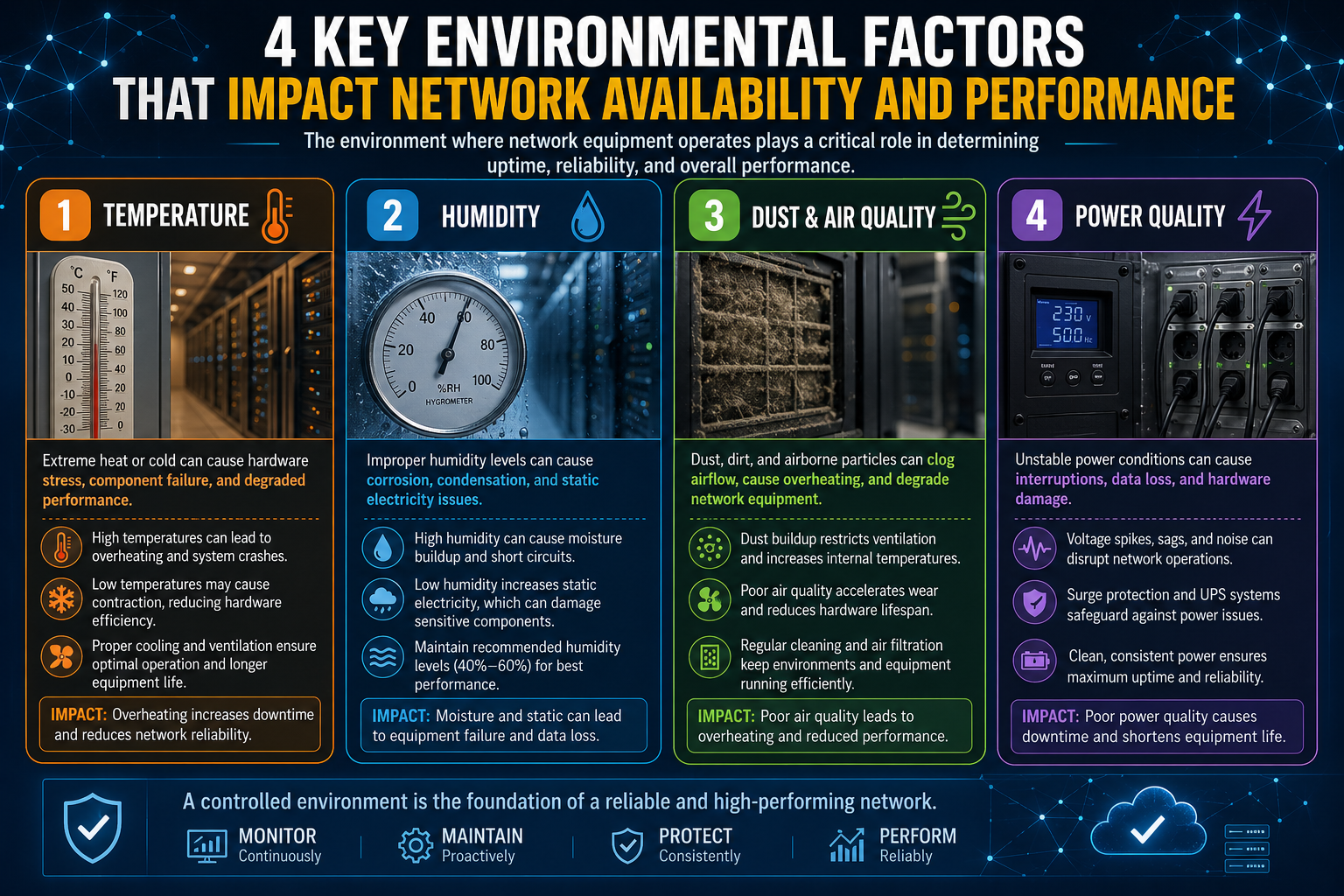
Modern IT environments depend heavily on continuous connectivity and stable infrastructure performance. Every application, transaction, and communication within an organization is supported by an underlying network that must remain consistently available. While most discussions around network reliability focus on software configuration, cybersecurity, or hardware redundancy, there is another foundational element that often receives less attention: the physical environment in which IT systems operate. Environmental conditions silently shape how well infrastructure performs and how long it lasts, influencing everything from processing efficiency to the likelihood of unexpected outages.
Environmental conditions in IT refer to the physical surroundings of network devices, servers, storage systems, and supporting infrastructure. These conditions include temperature levels, moisture in the air, electrical stability, and exposure to physical threats such as water intrusion. When these conditions fall outside acceptable ranges, even highly advanced systems can begin to degrade or fail. This makes environmental awareness a core responsibility in maintaining network availability rather than a secondary consideration.
Unlike software errors that often provide alerts or logs, environmental issues can escalate gradually and silently. A slightly overheated server room, for example, may not trigger immediate alarms but can slowly reduce hardware lifespan and performance efficiency. Similarly, inconsistent humidity levels may not produce instant failures but can contribute to long-term corrosion or static-related damage. Because of this silent progression, environmental conditions are often considered hidden risks in IT infrastructure management.
The physical environment becomes even more critical as organizations increase their reliance on cloud-connected systems, edge computing, and distributed networks. Even though services may appear virtual to end users, the infrastructure supporting them remains physically grounded in data centers, server rooms, and network closets. These physical locations are directly influenced by environmental stability, making their maintenance essential to overall system reliability.
Understanding environmental influence is not just about preventing catastrophic failure. It is also about optimizing performance and efficiency. Equipment that operates within ideal environmental ranges tends to consume less energy, generate less heat stress, and maintain consistent processing speeds. Over time, this contributes to more predictable system behavior and reduced operational costs, which are both important for enterprise-level IT operations.
Environmental monitoring also plays a role in risk management strategies. Organizations that integrate environmental awareness into their infrastructure planning are better positioned to respond proactively to potential threats. Instead of reacting to outages after they occur, IT teams can identify early warning signs and take preventive action. This shift from reactive to proactive management significantly strengthens network availability.
In addition, environmental conditions are closely linked to equipment longevity. Servers, switches, routers, and storage devices are all designed to operate within specific physical tolerances. When those tolerances are exceeded repeatedly, components degrade faster than expected. This leads to increased maintenance costs and more frequent hardware replacement cycles, both of which can disrupt business continuity.
Ultimately, environmental awareness forms a foundational layer of IT infrastructure resilience. It supports every other aspect of network design, from redundancy planning to disaster recovery strategies. Without stable environmental conditions, even the most advanced network architecture cannot guarantee consistent availability. This makes environmental monitoring a critical discipline for any organization that depends on reliable digital operations.
Understanding Environmental Factors in IT Infrastructure
Environmental factors in IT infrastructure refer to the measurable physical conditions surrounding computing and networking equipment. These factors directly influence how hardware behaves under operational stress and how long it can function without degradation. Unlike logical or software-based issues, environmental conditions originate from the physical world, yet their impact extends deeply into digital systems.
At the core of environmental influence is the interaction between electronic components and their surrounding atmosphere. IT equipment generates heat during operation, and this heat must be effectively managed to maintain performance stability. At the same time, external conditions such as room temperature, airflow, and humidity affect how efficiently this heat is dissipated. When these external conditions are not properly controlled, equipment begins to operate outside its optimal range.
Another important aspect of environmental factors is their cumulative effect. While a single instance of slightly elevated temperature or minor humidity fluctuation may not cause immediate failure, repeated exposure over time can weaken hardware resilience. This gradual deterioration is often overlooked until performance issues or outages begin to appear. Understanding this long-term impact is essential for maintaining consistent network availability.
Environmental conditions also interact with each other in complex ways. For example, temperature and humidity are closely linked, as warmer air can hold more moisture. Similarly, airflow affects both temperature distribution and moisture regulation within enclosed spaces. Because of these interdependencies, managing environmental stability requires a holistic approach rather than isolated control of individual factors.
In IT infrastructure environments such as data centers or server rooms, environmental control systems are typically implemented to maintain stable conditions. These systems regulate air conditioning, ventilation, and filtration to ensure that equipment operates within safe thresholds. However, even with advanced systems in place, continuous monitoring is necessary because external influences or system failures can quickly disrupt equilibrium.
Environmental factors are also important from a design perspective. When planning IT infrastructure, engineers must consider not only the number of devices but also the physical space required to maintain proper environmental conditions. Rack placement, airflow design, and cooling distribution all depend on understanding how environmental variables behave in enclosed technical spaces.
In addition to operational stability, environmental factors influence security and risk management. For instance, excessive heat or moisture can increase the likelihood of hardware malfunction, which may lead to unexpected downtime. In mission-critical environments, even short periods of downtime can result in significant operational disruption. Therefore, environmental control becomes a part of broader business continuity planning.
Monitoring environmental factors is increasingly supported by sensor-based technologies. These systems provide continuous data on conditions such as temperature variations, humidity levels, and power stability. By analyzing this data, IT teams can detect anomalies early and respond before they escalate into system failures. This capability transforms environmental management into a proactive function rather than a reactive one.
Ultimately, environmental factors represent the physical foundation upon which IT infrastructure operates. Without stable conditions, even the most advanced networking systems cannot maintain consistent performance. Recognizing and managing these factors is essential for ensuring long-term reliability and uninterrupted network availability.
Why Environmental Stability is Essential for Network Availability
Network availability refers to the ability of systems and services to remain accessible and operational whenever they are needed. While redundancy, failover systems, and cloud architectures are often used to improve availability, these solutions still rely on underlying physical infrastructure. Environmental stability plays a critical role in ensuring that this foundation remains strong and reliable.
One of the primary reasons environmental stability is essential is its direct impact on hardware reliability. Networking devices such as routers, switches, and servers are sensitive to changes in their physical surroundings. When exposed to unstable conditions, these devices may experience performance degradation, unexpected shutdowns, or permanent damage. Maintaining stable environmental conditions helps reduce these risks and ensures continuous operation.
Environmental stability also contributes to predictable system behavior. In stable conditions, hardware operates within defined performance parameters, allowing IT teams to anticipate system load and response times more accurately. This predictability is especially important in environments where uptime is critical, such as financial systems, healthcare networks, or cloud service platforms.
Another important factor is the reduction of unplanned downtime. Many network outages are not caused by software failures or cyberattacks but by physical environmental disruptions. Overheating equipment, condensation damage, or power instability can all lead to sudden service interruptions. By maintaining environmental stability, organizations significantly reduce the likelihood of these unexpected disruptions.
Energy efficiency is another indirect benefit of environmental stability. When systems operate in controlled conditions, they require less corrective cooling or compensatory energy consumption. This leads to more efficient resource utilization and can reduce operational costs over time. Stable environments also reduce the workload on cooling systems, extending their operational lifespan.
Environmental stability also supports equipment longevity. IT hardware is designed to operate within specific environmental ranges, and consistent adherence to these ranges reduces wear and tear. Over time, this leads to fewer hardware replacements and lower maintenance requirements. This is particularly important in large-scale data center environments where equipment replacement can be costly and disruptive.
In addition, environmental stability enhances disaster resilience. While organizations often focus on external threats such as cyberattacks or power outages, internal environmental risks can be equally damaging. Stable environmental conditions reduce the likelihood of cascading failures, where one issue triggers multiple system disruptions. This helps maintain operational continuity even under stress conditions.
From a strategic perspective, environmental stability also supports long-term infrastructure planning. When organizations can rely on consistent physical conditions, they can design more efficient and scalable systems. This reduces the need for constant reactive adjustments and allows IT teams to focus on optimization and innovation rather than emergency recovery.
Ultimately, environmental stability is not just a supporting factor in network availability; it is a foundational requirement. Without it, even the most advanced networking strategies cannot guarantee consistent uptime or performance reliability.
Temperature as a Critical Environmental Factor in IT Systems
Temperature is one of the most influential environmental variables affecting IT infrastructure performance. Every electronic component generates heat during operation, and this heat must be managed effectively to ensure stable functionality. When temperature levels rise beyond acceptable thresholds, hardware begins to experience stress that can significantly impact performance and reliability.
High temperatures are particularly dangerous because they directly affect processing efficiency. When internal components become too hot, systems may automatically reduce processing speed to prevent damage, a process known as thermal regulation. While this protects hardware from immediate failure, it also results in reduced performance and slower response times, which can negatively impact network availability.
Sustained exposure to elevated temperatures can also shorten hardware lifespan. Electronic components degrade faster when consistently exposed to heat stress. This degradation may not be immediately visible but accumulates over time, leading to increased failure rates and unexpected downtime. In large IT environments, even small increases in failure rates can translate into significant operational disruption.
On the other end of the spectrum, extremely low temperatures can also create challenges. While cooler environments are generally beneficial for electronics, excessively cold conditions can lead to condensation when equipment warms up during operation. This moisture can damage internal components and contribute to corrosion or short circuits. Therefore, temperature balance is essential rather than simply maintaining low temperatures.
Temperature also influences the effectiveness of cooling systems. Cooling infrastructure is designed to operate within specific environmental assumptions. When external temperatures fall outside these assumptions, cooling systems may become less efficient or consume more energy than necessary. This can increase operational costs and place additional strain on supporting infrastructure.
In data center environments, temperature distribution is just as important as overall temperature levels. Uneven heat distribution can create hotspots where certain equipment operates under higher stress than others. These localized temperature variations can lead to inconsistent performance and uneven hardware wear across systems.
Airflow management plays a crucial role in maintaining temperature stability. Proper airflow ensures that heat generated by equipment is effectively removed and replaced with cooler air. Without proper airflow design, heat can accumulate in enclosed spaces, increasing the risk of overheating even when overall ambient temperatures appear acceptable.
Temperature also affects system reliability during peak workloads. As processing demand increases, heat generation rises accordingly. Without adequate thermal management, systems may struggle to maintain performance consistency during high-demand periods, increasing the risk of temporary slowdowns or failures.
Overall, temperature is a central factor in maintaining IT infrastructure health. It influences performance, reliability, energy efficiency, and hardware longevity. Proper temperature management is essential for ensuring that network systems remain stable, responsive, and continuously available under varying operational conditions.
Temperature Control and Operational Risks in IT Environments
Effective temperature control is a critical requirement in maintaining stable IT environments. Controlling temperature is not simply about keeping equipment cool; it is about maintaining consistent thermal conditions that support optimal hardware performance and prevent unnecessary stress on components. When temperature control is inadequate, a range of operational risks can emerge that directly impact network availability.
One of the primary risks associated with poor temperature control is thermal instability. When temperatures fluctuate frequently, hardware is forced to continuously adjust its internal processing behavior. This repeated adjustment can reduce system efficiency and increase the likelihood of performance inconsistencies. Over time, thermal instability can also contribute to accelerated hardware wear.
Another significant risk is heat concentration in specific areas of the IT infrastructure. In environments where airflow is not properly managed, certain zones may become significantly hotter than others. These hotspots can create uneven hardware stress, where some devices degrade faster than others. This imbalance can lead to unpredictable system failures and complicate maintenance planning.
Temperature control failures can also affect system redundancy. In high-availability environments, redundant systems are often used to ensure continuity during failures. However, if both primary and backup systems are located in the same thermally unstable environment, they may be equally affected by temperature-related issues, reducing the effectiveness of redundancy strategies.
Energy consumption is another area impacted by poor temperature control. When cooling systems must work harder to compensate for unstable conditions, overall energy usage increases. This not only raises operational costs but can also place additional strain on electrical infrastructure, creating secondary risks related to power stability.
Environmental temperature inconsistencies can also interfere with monitoring accuracy. In some cases, sensors may report localized readings that do not accurately reflect overall system conditions. This can lead to delayed responses or incorrect assumptions about infrastructure health, increasing the risk of unnoticed system stress.
Temperature control also plays a role in maintenance efficiency. In poorly regulated environments, IT teams may need to perform more frequent hardware inspections and replacements. This increases operational workload and reduces the time available for strategic infrastructure improvements.
Ultimately, temperature control is a foundational aspect of IT environmental management. Without consistent and well-regulated thermal conditions, network systems are exposed to a wide range of risks that can compromise performance, reliability, and long-term availability.
Role of Humidity in IT Infrastructure Stability
Humidity is a critical but often underestimated environmental factor in IT environments. It refers to the amount of moisture present in the air surrounding computing equipment, and it plays a significant role in maintaining both the physical safety and operational reliability of network infrastructure. While temperature often receives more attention, humidity directly influences electrical behavior, material durability, and the risk of hardware failure over time.
In controlled IT environments, humidity must be carefully balanced because both excessive and insufficient moisture levels can create operational risks. When humidity levels are too high, the air contains excess moisture that can condense on cooler surfaces inside servers and networking devices. This condensation can introduce unwanted electrical pathways, potentially leading to short circuits or corrosion of sensitive internal components. Over time, this type of damage can reduce hardware reliability and increase the likelihood of unexpected failures.
On the other hand, extremely low humidity creates a different type of risk that is equally important. Dry air increases the likelihood of electrostatic discharge, a phenomenon where static electricity builds up on surfaces or human skin and is suddenly released upon contact with electronic equipment. Even a small static discharge can damage delicate microelectronic components, sometimes without immediate visible symptoms. These micro-level failures can accumulate and eventually lead to degraded system performance or complete hardware malfunction.
Humidity also interacts closely with dust particles in the air. In environments where moisture levels are too high, dust can combine with condensation to form sticky residues that accumulate inside equipment enclosures. This buildup can obstruct airflow, reduce cooling efficiency, and increase internal operating temperatures. Over time, this indirect effect of humidity can contribute to thermal stress and reduced hardware lifespan.
In IT infrastructure environments such as server rooms and data centers, maintaining stable humidity levels is essential for ensuring consistent hardware behavior. Even slight fluctuations can influence how components expand, contract, or interact electrically. Because of this sensitivity, humidity control systems are often designed to maintain narrow operational ranges rather than broad tolerances.
Humidity stability also plays a role in preventing long-term material degradation. Many components within IT systems are made from materials that can react negatively to prolonged exposure to moisture. Metal connectors may oxidize, circuit boards may degrade, and insulation materials may weaken over time. These effects do not always produce immediate failures but can significantly reduce the overall durability of infrastructure systems.
Beyond hardware protection, humidity stability contributes to operational predictability. When environmental conditions remain consistent, IT systems tend to behave more reliably under load. This consistency allows network administrators to better anticipate system performance and reduce unexpected disruptions caused by environmental fluctuations.
Electrical Stability and Power Quality in Network Systems
Electrical stability is one of the most critical foundations of IT infrastructure reliability. Every component within a network environment depends on a continuous and stable power supply to function correctly. When electrical conditions become unstable, the effects can range from minor performance issues to complete system outages, making power quality a key environmental factor in maintaining network availability.
A stable electrical supply involves more than simply having uninterrupted power. It also includes maintaining consistent voltage levels, minimizing electrical noise, and ensuring proper grounding across all connected systems. When these conditions are not met, IT equipment may experience irregular behavior that affects both performance and longevity.
Voltage fluctuations are among the most common electrical risks in IT environments. Sudden increases or decreases in voltage can place stress on internal power supplies and electronic components. While modern equipment often includes protective mechanisms, repeated exposure to unstable voltage conditions can still lead to gradual degradation. In severe cases, voltage spikes can cause immediate hardware failure, resulting in unexpected downtime.
Electrical noise is another factor that affects system stability. This refers to unwanted variations in electrical signals that can interfere with data transmission or processing accuracy. In sensitive networking environments, electrical noise can introduce errors in communication between devices, leading to packet loss, retransmissions, or degraded network performance.
Grounding plays an essential role in maintaining electrical stability. Proper grounding ensures that excess electrical energy is safely dissipated, reducing the risk of static buildup and electrical surges. Without adequate grounding, equipment becomes more vulnerable to unpredictable electrical behavior, which can compromise both safety and reliability.
Electrical systems in IT environments are often supported by backup power solutions designed to maintain continuity during outages. These systems help bridge the gap between power loss and restoration, ensuring that critical infrastructure remains operational. However, backup systems are not a substitute for stable primary power; they are intended as temporary safeguards rather than permanent solutions.
Power quality also affects energy efficiency within IT environments. Poor electrical conditions can cause equipment to draw more power than necessary, increasing operational costs and placing additional strain on supporting infrastructure. Over time, this inefficiency can become a significant financial and operational burden.
Electrical instability can also have cascading effects on other environmental factors. For example, fluctuations in power supply can affect cooling systems, leading to temperature inconsistencies. This interconnection highlights the importance of treating electrical stability as part of a broader environmental management strategy rather than an isolated concern.
In high-density computing environments, electrical planning becomes even more critical. As more devices are added to a system, the demand for power distribution increases, making stability more difficult to maintain. Careful distribution and monitoring of electrical loads are essential to prevent overload conditions and maintain consistent performance across all systems.
Water Exposure and Flooding Risks in IT Environments
Water exposure represents one of the most physically destructive environmental threats to IT infrastructure. Unlike gradual factors such as temperature or humidity, water-related incidents can cause immediate and irreversible damage to electronic systems. Even small amounts of moisture can disrupt electrical pathways, leading to short circuits and permanent hardware failure.
Flooding in IT environments can occur in various ways, not just through large-scale water intrusion. Leaks from plumbing systems, condensation from cooling equipment, or even minor roof seepage can introduce moisture into sensitive areas. Once water enters network infrastructure zones, it can quickly spread across multiple systems, increasing the scale of potential damage.
One of the primary risks associated with water exposure is electrical short-circuiting. When water comes into contact with energized components, it can create unintended conductive paths. This can result in immediate system shutdowns or permanent destruction of hardware components. Because of the speed at which electrical systems react to water intrusion, damage often occurs before corrective action can be taken.
Water exposure also contributes to corrosion over time. Even if equipment is not immediately destroyed, residual moisture can begin to degrade metal contacts and circuit pathways. This corrosion weakens electrical connections and can lead to intermittent failures that are difficult to diagnose. These types of failures are particularly problematic in network environments because they can appear sporadically and unpredictably.
Cooling systems can sometimes unintentionally contribute to water-related risks. In environments where air conditioning is used extensively, condensation can form if temperature differences are not properly managed. If this condensation is not adequately controlled, it can drip or accumulate in areas where sensitive equipment is located, increasing the risk of moisture-related damage.
Water-related risks also have a cascading effect on infrastructure systems. When primary network equipment is damaged, supporting systems such as power distribution units, storage arrays, and cooling infrastructure may also be affected. This interconnected failure pattern can lead to widespread operational disruption.
The unpredictability of water exposure makes it especially dangerous. Unlike electrical or temperature issues, which often show gradual warning signs, water-related incidents can escalate rapidly. This makes early detection and environmental awareness essential for minimizing potential damage.
In resilient IT environments, physical design considerations are often used to reduce exposure risk. Equipment placement, raised flooring, and controlled airflow pathways are all part of strategies designed to minimize the impact of potential water intrusion. However, even with these precautions, ongoing environmental awareness remains essential.
Environmental Monitoring Systems and Continuous Infrastructure Awareness
Environmental monitoring systems are essential tools for maintaining stable IT infrastructure conditions. These systems provide continuous visibility into physical environmental factors that influence network availability. By collecting real-time data on temperature, humidity, electrical conditions, and other variables, they enable IT teams to respond quickly to potential risks before they escalate.
At the core of environmental monitoring is continuous data collection. Sensors placed throughout IT environments gather information about surrounding conditions and transmit it to centralized management systems. This data allows administrators to observe trends, detect anomalies, and identify conditions that may indicate emerging problems.
One of the key advantages of environmental monitoring systems is early warning capability. Instead of waiting for equipment failure or performance degradation, IT teams can identify warning signs such as gradual temperature increases or unexpected humidity shifts. This proactive visibility allows for timely intervention and reduces the likelihood of system downtime.
Environmental monitoring also supports operational consistency. By maintaining detailed records of environmental conditions over time, organizations can better understand how their infrastructure responds to different stress levels. This historical data can be used to refine environmental controls and improve overall system stability.
Integration is another important aspect of modern monitoring systems. Environmental data is often combined with broader network management tools, allowing for centralized visibility across both physical and digital infrastructure layers. This integration ensures that environmental conditions are considered alongside system performance metrics when making operational decisions.
Continuous monitoring also improves incident response efficiency. When environmental thresholds are exceeded, alerts can be generated automatically, allowing IT teams to respond quickly even when they are not physically present. This reduces response time and limits the potential impact of environmental disruptions.
Over time, environmental monitoring contributes to more informed infrastructure planning. By analyzing long-term environmental trends, organizations can identify recurring patterns that may indicate inefficiencies or risks. This information can then be used to improve system design and optimize resource allocation.
Interaction Between Environmental Factors in IT Environments
Environmental factors in IT infrastructure do not operate independently. Instead, they interact with one another in complex and often unpredictable ways. Understanding these interactions is essential for maintaining stable network availability because changes in one factor can influence multiple others simultaneously.
Temperature and humidity, for example, are closely interconnected. As temperature increases, the air’s ability to hold moisture changes, which can affect humidity levels within an enclosed space. This interaction means that controlling one factor often requires consideration of the other to maintain overall environmental stability.
Electrical conditions can also influence temperature behavior. Unstable power supply can affect cooling systems, leading to uneven temperature distribution within IT environments. This demonstrates how electrical instability can indirectly contribute to thermal stress on hardware systems.
Humidity and electrical conditions are also linked through the behavior of static electricity. Low humidity increases the likelihood of static buildup, which can affect electrical stability and increase the risk of component damage. Conversely, excessively high humidity can introduce unwanted conductivity risks that also affect electrical behavior.
Water exposure can amplify the effects of both temperature and electrical instability. Moist environments can accelerate corrosion in electrical systems and disrupt thermal regulation by interfering with airflow or cooling systems. This creates a compounding effect where multiple environmental risks reinforce one another.
These interdependencies highlight the importance of viewing environmental management as a unified discipline. Isolating individual factors without considering their interactions can lead to incomplete or ineffective control strategies. In contrast, a holistic approach allows for more accurate prediction and prevention of infrastructure risks.
Environmental interactions also influence system resilience. When multiple factors remain stable, systems tend to operate within predictable parameters. However, when multiple environmental variables fluctuate simultaneously, the likelihood of unexpected behavior increases significantly. This makes integrated monitoring and management essential for maintaining long-term network availability.
Power Conditioning and Long-Term Electrical Health in IT Environments
Power conditioning plays a central role in maintaining the long-term health of IT infrastructure. While basic electrical supply ensures that systems remain operational, power conditioning focuses on refining that supply to ensure it remains clean, stable, and consistent over time. This distinction is important because IT equipment is highly sensitive not only to interruptions in power but also to subtle variations in electrical quality.
One of the primary goals of power conditioning is to eliminate irregularities in electrical flow. These irregularities may include minor voltage fluctuations, electrical noise, and transient spikes that occur due to external grid instability or internal load changes. Even when these variations are not severe enough to cause immediate outages, they can gradually stress internal components and reduce system reliability.
Over time, inconsistent power quality can lead to cumulative damage. Components such as power supplies, capacitors, and circuit boards are particularly vulnerable to repeated exposure to unstable electrical conditions. While these components are designed to tolerate a range of operating conditions, prolonged exposure to instability increases the likelihood of premature failure.
Power conditioning systems help mitigate these risks by regulating incoming electricity before it reaches sensitive equipment. By smoothing out fluctuations and filtering electrical disturbances, they create a more controlled environment for IT systems to operate within. This not only improves reliability but also helps maintain consistent performance under varying load conditions.
Another important aspect of electrical health is load distribution. In complex IT environments, multiple devices draw power simultaneously, creating dynamic shifts in electrical demand. Without proper distribution, certain circuits may become overloaded while others remain underutilized. This imbalance can lead to overheating, tripped circuits, or localized instability within infrastructure systems.
Long-term electrical health also depends on infrastructure design. Proper planning of power pathways, circuit segmentation, and redundancy ensures that no single point of failure can disrupt the entire system. This structural approach to electrical stability is essential for maintaining continuous availability in high-demand environments.
Electrical health is closely tied to operational predictability. When power conditions remain stable over time, IT systems behave more consistently, making it easier to anticipate performance patterns and resource needs. This predictability is especially valuable in environments where uptime is critical and unexpected disruptions can have significant consequences.
In addition, power conditioning contributes indirectly to energy efficiency. Stable electrical flow reduces the need for corrective energy usage by cooling systems and power supplies. This leads to smoother system operation and helps minimize unnecessary energy waste across infrastructure components.
Airflow Management and Thermal Distribution in Server Environments
Airflow management is a fundamental aspect of maintaining stable environmental conditions in IT infrastructure. It directly influences how effectively heat is removed from equipment and how evenly the temperature is distributed across server environments. Without proper airflow design, even well-cooled systems can develop localized heat buildup that compromises performance and reliability.
The primary purpose of airflow management is to ensure that cool air reaches all critical components while warm air is efficiently removed from the environment. This continuous circulation prevents heat accumulation and helps maintain stable operating temperatures across all devices. When airflow is disrupted, certain areas may experience higher temperatures than others, leading to uneven hardware stress.
One of the key challenges in airflow management is maintaining separation between hot and cold air streams. When these air streams mix, cooling efficiency decreases significantly. This can result in higher overall temperatures and increased strain on cooling systems, even if the total cooling capacity remains unchanged.
Airflow patterns also influence equipment longevity. Devices that consistently operate in areas with poor airflow are more likely to experience thermal stress over time. This can accelerate component wear and increase the likelihood of unexpected failures. In contrast, systems that benefit from balanced airflow tend to maintain more stable performance over extended periods.
Another important consideration is airflow obstruction. Physical barriers such as poorly arranged cabling, improperly placed equipment, or dust accumulation can restrict air movement. These obstructions reduce cooling efficiency and can create localized hotspots that are difficult to detect without monitoring systems.
Airflow distribution is also affected by infrastructure layout. The positioning of racks, servers, and networking equipment determines how air moves through the environment. Poor layout design can lead to uneven cooling and reduce the effectiveness of even advanced cooling systems.
In addition to temperature control, airflow also plays a role in humidity regulation. Proper circulation helps distribute moisture evenly throughout the environment, preventing localized areas of high humidity or dryness. This contributes to overall environmental stability and reduces the risk of moisture-related damage.
Airflow management becomes increasingly important as infrastructure density increases. In high-density environments, large amounts of heat are generated in confined spaces, making efficient air movement essential for maintaining safe operating conditions. Without proper airflow design, these environments can quickly become thermally unstable.
Ultimately, airflow management is not just a cooling strategy but a foundational element of environmental control. It ensures that thermal energy is distributed and removed effectively, supporting both hardware performance and long-term infrastructure reliability.
Sensor Integration and Real-Time Environmental Visibility
Sensor integration is a critical component of modern environmental management in IT systems. It provides continuous visibility into physical conditions that affect infrastructure performance and enables proactive responses to potential risks. By collecting real-time data from multiple environmental points, sensors help create a comprehensive understanding of system conditions.
Environmental sensors are designed to measure specific variables such as temperature, humidity, electrical activity, and water presence. Each type of sensor contributes unique information that helps IT teams assess the overall stability of their infrastructure environment. When combined, these data points create a detailed picture of operational conditions.
One of the most important advantages of sensor integration is real-time awareness. Instead of relying on manual inspections or periodic checks, IT teams can continuously monitor environmental conditions as they change. This allows for immediate detection of abnormal patterns that may indicate emerging problems.
Sensor data also enables trend analysis. By observing changes over time, IT teams can identify gradual shifts in environmental conditions that may not be immediately noticeable. For example, a slow increase in average temperature or humidity fluctuations over time may indicate underlying cooling inefficiencies or airflow issues.
Another key benefit of sensor integration is alert automation. When environmental conditions exceed predefined thresholds, sensors can trigger alerts that notify administrators of potential risks. This reduces response time and ensures that corrective action can be taken before issues escalate into system failures.
Integration with centralized management systems enhances the value of sensor data. When environmental information is combined with system performance metrics, it becomes easier to correlate physical conditions with operational behavior. This integrated view supports more informed decision-making and improves overall infrastructure management.
Sensor placement also plays a critical role in effectiveness. Strategic placement ensures that data accurately reflects real environmental conditions rather than isolated or misleading readings. Proper distribution of sensors across infrastructure environments improves monitoring accuracy and reliability.
Over time, sensor integration contributes to predictive capabilities. By analyzing historical environmental data, systems can identify patterns that precede failures or performance degradation. This enables predictive maintenance strategies that reduce downtime and extend equipment lifespan.
Environmental Stress Accumulation and Hardware Degradation Patterns
Environmental stress accumulation refers to the gradual impact of physical conditions on IT hardware over time. Unlike sudden failures caused by extreme events, environmental stress builds slowly through repeated exposure to suboptimal conditions. This accumulation eventually leads to reduced performance, increased failure rates, and shortened equipment lifespan.
One of the most common forms of environmental stress is thermal cycling. This occurs when hardware repeatedly heats up during operation and cools down during idle periods. Over time, this expansion and contraction can weaken internal components and solder connections, increasing the likelihood of hardware faults.
Humidity-related stress also contributes to long-term degradation. Even when moisture levels remain within acceptable ranges, small fluctuations can still affect sensitive materials. Over time, this can lead to corrosion, oxidation, or insulation breakdown, particularly in environments where humidity is not consistently controlled.
Electrical stress is another important factor in long-term degradation. Repeated exposure to minor voltage fluctuations or electrical noise can gradually weaken power-related components. While these effects may not cause immediate failure, they reduce overall system resilience and increase susceptibility to future issues.
Airflow inconsistencies contribute to uneven stress distribution across infrastructure systems. Devices located in poorly ventilated areas experience higher thermal stress than those in well-cooled zones. This uneven stress distribution leads to inconsistent hardware aging patterns across the same environment.
Water-related stress, even in small amounts, can also accumulate over time. Minor leaks or condensation exposure may not cause immediate failure, but repeated exposure can weaken materials and increase the risk of eventual breakdown.
Environmental stress accumulation is particularly important in large-scale IT environments where equipment is expected to operate continuously over long periods. In such environments, small inefficiencies or inconsistencies can compound significantly, leading to noticeable differences in system reliability across infrastructure components.
Understanding stress accumulation allows IT teams to make more informed decisions about maintenance and replacement cycles. By identifying patterns of environmental impact, organizations can better predict when equipment is likely to fail and take preventive action before disruptions occur.
Conclusion
Environmental conditions form the silent foundation of every IT infrastructure, yet their influence on network availability is both constant and significant. While much attention is often given to software optimization, cybersecurity defenses, and hardware performance, the physical environment in which systems operate ultimately determines how reliably all of these elements function together. Temperature, humidity, electrical stability, airflow, and water exposure each play a direct role in shaping system behavior, and when even one of these factors falls outside safe operating ranges, the effects can quickly spread across the entire infrastructure.
What makes environmental factors particularly important is their ability to impact systems gradually as well as suddenly. Some issues, such as overheating or power fluctuations, can trigger immediate disruptions, while others, like humidity imbalance or airflow inefficiency, may slowly degrade hardware over time. This combination of short-term and long-term risks makes environmental monitoring a critical part of maintaining operational stability.
Modern IT environments rely heavily on continuous monitoring systems and sensor technologies to maintain visibility into these conditions. By collecting real-time data and identifying early warning signs, organizations can move from reactive problem-solving to proactive infrastructure management. This shift significantly reduces downtime, improves system reliability, and extends the operational lifespan of critical hardware.
Understanding environmental interdependencies is also essential. No single factor operates in isolation; instead, temperature, humidity, power quality, and airflow continuously influence one another. Recognizing these relationships allows IT teams to build more resilient environments that can withstand fluctuations without compromising performance.
Ultimately, maintaining network availability is not just about managing digital systems but also about controlling the physical conditions that support them. A stable environment ensures predictable performance, reduced risk of failure, and greater efficiency across all layers of IT infrastructure. By prioritizing environmental awareness and proactive management, organizations strengthen the reliability and longevity of their entire network ecosystem.