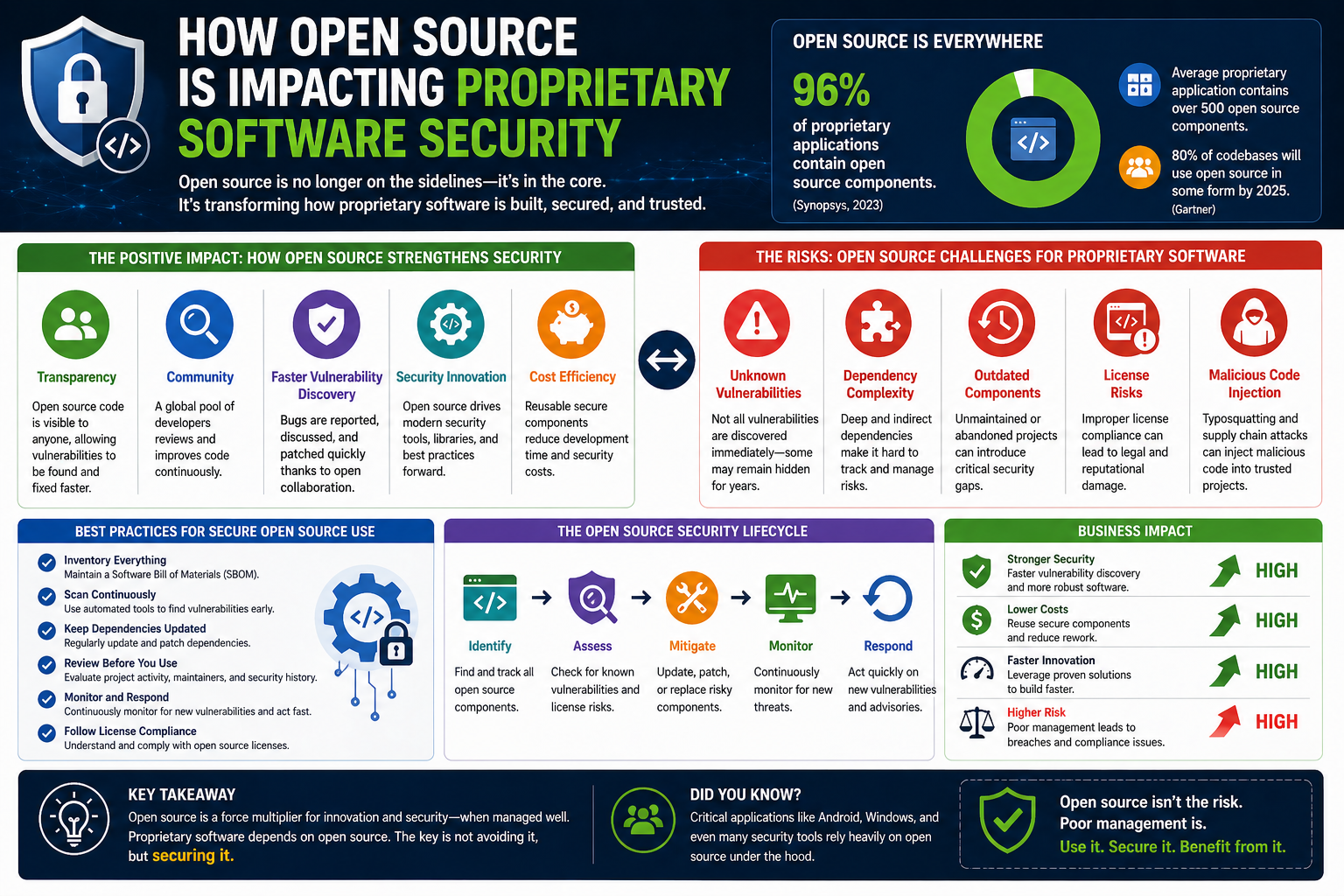
For a long time, software development was defined by a clear separation between two philosophies. On one side stood open source software, built on the idea that code should be accessible, inspectable, and modifiable by anyone with the skills and interest to contribute. On the other side stood proprietary software, built around controlled access, restricted source code visibility, and ownership-driven development.
This divide was not only technical but also cultural. Open source communities emphasized collaboration and transparency, while proprietary vendors emphasized control, monetization, and structured release cycles. These differences naturally extended into how each side viewed security.
Open source supporters often argue that visibility leads to stronger security because more people can inspect the code. Proprietary advocates countered that limiting access reduces exposure to malicious actors. Over time, both positions hardened into assumptions that influenced how software security was understood, even when real-world evidence suggested a more complex reality.
Why Security Was Never Truly About Openness or Closure
The idea that one model is inherently more secure than the other has always been overly simplistic. Security is not determined solely by whether code is visible or hidden. Instead, it depends on how software is designed, tested, maintained, and updated over time.
In practice, both open source and proprietary systems have experienced major vulnerabilities. Some were discovered quickly due to community scrutiny, while others remained hidden for years despite being in widely used commercial products. This inconsistency reveals that visibility alone does not guarantee protection, nor does secrecy guarantee safety.
Security is better understood as a process rather than a property. It evolves with development practices, response times, patch management, and the discipline applied to maintaining code over its lifecycle.
The Rise of Security Through Obscurity and Its Limitations
Proprietary software traditionally relied on a concept often described as security through obscurity. The assumption was that if source code is not publicly accessible, attackers would find it harder to identify weaknesses.
While this approach can add a layer of difficulty for casual attackers, it is not a reliable security strategy on its own. Skilled adversaries do not need access to source code to exploit vulnerabilities. They can analyze compiled binaries, monitor system behavior, or reverse engineer applications to uncover weaknesses.
Over time, this limitation has become increasingly evident. As attack techniques have evolved, relying on hidden code as a primary defense has proven insufficient. Modern security thinking now recognizes that obscurity can slow attackers but cannot stop determined exploitation.
Transparency as a Double-Edged Sword in Open Source Security
Open source software introduces a different dynamic. Because the code is publicly available, it can be examined by a wide range of developers, security researchers, and organizations. This transparency allows vulnerabilities to be identified and reported quickly in many cases.
However, openness does not guarantee constant scrutiny. Many open source projects are maintained by small groups or even individual contributors. In such cases, critical areas of code may receive limited attention, allowing vulnerabilities to remain unnoticed for extended periods.
This creates an uneven security landscape where some components are heavily reviewed while others are rarely examined. The effectiveness of open source security depends less on openness itself and more on the size, activity, and expertise of the contributing community.
The Growing Reality of Software Interdependence
Modern software rarely exists as a fully independent system. Instead, most applications are built using a combination of internally developed code and externally sourced components. These components often include open source libraries, frameworks, and modules that accelerate development and reduce costs.
This approach has fundamentally changed how software is constructed. Developers no longer build every function from scratch. Instead, they assemble systems using pre-existing building blocks that may originate from a wide range of independent contributors.
As a result, the boundaries between open and closed software have become increasingly blurred. Proprietary systems frequently contain open source elements, and open source projects often depend on proprietary infrastructure or tools.
The Expansion of Open Source Within Proprietary Systems
In modern development environments, it is now common for proprietary software to include significant portions of open source code. This can range from small utility libraries to core functional components that drive critical operations.
This shift has been driven by practical considerations. Open source components reduce development time, lower costs, and allow teams to focus on unique features rather than reinventing foundational technologies.
However, this integration introduces complexity. Once open source components are embedded within proprietary systems, they become part of the security landscape of that system. Any vulnerability in a third-party component can potentially affect the entire application, regardless of who originally wrote the code.
Understanding the Software Supply Chain
The increasing use of external components has given rise to the concept of the software supply chain. This refers to the entire ecosystem of dependencies, libraries, frameworks, and tools that contribute to a final software product.
Just like physical supply chains, software supply chains can introduce risk at multiple stages. A vulnerability in a single dependency can propagate through multiple layers of applications that rely on it. This interconnectedness means that security is no longer confined to a single codebase.
Instead, it extends across every component that contributes to the final product. This includes not only direct dependencies but also indirect ones, which may be deeply nested and less visible to developers.
How Hidden Dependencies Increase Security Complexity
One of the most challenging aspects of modern software development is the presence of hidden or indirect dependencies. These are components that are not explicitly added by developers but are included through other libraries.
As a result, a single application may depend on hundreds or even thousands of external components, many of which are not immediately visible in the main codebase.
This complexity makes it difficult to fully understand the security posture of an application. Developers may assume they are using a small number of dependencies, while in reality, their software relies on a much larger ecosystem.
The Role of Community Review in Open Source Security
One of the key arguments in favor of open source security is the concept of collective review. The idea is that when code is publicly available, more eyes can inspect it, increasing the likelihood that vulnerabilities will be discovered.
In practice, however, this effect varies significantly. Popular open source projects with large user bases tend to benefit from frequent audits, contributions, and security reviews. These projects often evolve rapidly and respond quickly to discovered issues.
Less popular projects, however, may not receive the same level of attention. In some cases, critical vulnerabilities can remain unnoticed simply because there are not enough contributors actively reviewing the code.
Corporate Development and Structured Security Practices
Proprietary software development typically takes place within structured organizational environments. These environments often include formal processes for testing, quality assurance, and security review.
Unlike open source projects, which rely heavily on voluntary contributions, proprietary systems are maintained by dedicated teams with defined responsibilities. This can lead to more consistent application of internal security policies.
However, this structure does not eliminate risk. Organizational pressure, release deadlines, and resource constraints can influence how thoroughly security practices are applied. In some cases, vulnerabilities may be introduced or overlooked due to time constraints or prioritization decisions.
The Lifecycle of Vulnerabilities in Modern Systems
Security vulnerabilities rarely appear in isolation. They often emerge during the normal evolution of software as new features are added, old components are updated, or dependencies change.
Once a vulnerability is introduced, its lifecycle typically involves discovery, disclosure, patching, and deployment. The speed at which each of these stages occurs can significantly influence the level of risk.
Open source systems may benefit from faster discovery due to community involvement, while proprietary systems may have more controlled patch distribution processes. However, the effectiveness of either approach depends heavily on how quickly updates are applied in real-world environments.
Patch Management as a Critical Security Factor
One of the most important but often overlooked aspects of software security is patch management. Regardless of whether software is open or closed source, vulnerabilities can only be mitigated if patches are applied promptly.
In many cases, delays in applying patches create greater risk than the vulnerabilities themselves. Technically secure systems can become exposed simply because updates are not implemented promptly.
This challenge is particularly significant in environments where software depends on multiple external components. Each dependency may have its own update cycle, requiring coordination to ensure that security fixes are consistently applied.
Early Signs of Convergence Between Open and Proprietary Models
As software ecosystems have evolved, the distinction between open source and proprietary development has become less pronounced. Many proprietary systems now rely heavily on open source foundations, while open source projects often incorporate structured governance and corporate sponsorship.
This convergence has led to a hybrid model of development where security depends less on licensing structure and more on process maturity. The effectiveness of security practices now depends on how well organizations manage dependencies, respond to vulnerabilities, and integrate updates across complex systems.
This blending of models has created new opportunities for innovation but also introduced new layers of complexity in maintaining secure software environments.
The Quiet Takeover of Open Source in Commercial Applications
Over the past decade, software development has undergone a structural transformation that many users never directly observe. While applications may still appear to be proprietary on the surface, the underlying reality is that a large portion of modern software is built on open source foundations.
This shift did not happen through sudden replacement but through gradual integration. Developers, under pressure to deliver faster and reduce costs, increasingly adopted open source libraries, frameworks, and tools to avoid rebuilding functionality that already existed. Over time, this practice became standard rather than exceptional.
Today, even highly commercial and closed-source systems frequently depend on open source components for essential operations such as data processing, encryption, networking, and user interface rendering. This quiet adoption has fundamentally changed how software ecosystems are structured.
The Efficiency Argument Behind Open Source Adoption
One of the strongest drivers behind open source adoption is efficiency. Development teams operate in competitive environments where speed of delivery can determine market success. Reusing existing code allows teams to focus on building unique features instead of spending time solving problems that have already been addressed elsewhere.
Open source libraries provide ready-made solutions for complex technical challenges. Instead of developing encryption systems, authentication mechanisms, or networking protocols from scratch, developers can integrate trusted components that already perform these functions.
This approach reduces both development time and cost. It also allows smaller teams to build sophisticated applications that would otherwise require significantly larger engineering resources. However, this efficiency introduces a dependency model that has important security implications.
The Expanding Dependency Web in Software Architecture
Modern applications are rarely built on a simple foundation. Instead, they rely on layered dependencies where one component depends on another, which in turn depends on several more.
This creates a dependency web that can extend far beyond what developers initially realize. A single high-level library may bring in dozens or even hundreds of additional components automatically. These nested dependencies are often not directly reviewed by the developers who use them.
As a result, software systems become deeply interconnected, and understanding the full structure of dependencies becomes increasingly difficult. This complexity introduces blind spots in security management, especially when organizations focus only on direct dependencies.
Why Visibility Does Not Guarantee Understanding
One of the common assumptions about open source software is that visibility leads to understanding. While it is true that source code is accessible, accessibility does not automatically translate into meaningful analysis.
Most developers do not have the time or resources to audit every component they use. Even when code is publicly available, reviewing it in depth requires specialized knowledge and significant effort.
As a result, many open source components are trusted based on reputation rather than thorough inspection. Developers often assume that widely used libraries are safe simply because they are popular, not because they have been independently verified for security.
The Illusion of Security in Widely Used Libraries
Popularity in open source ecosystems is often mistaken for security assurance. When a library is widely adopted, it tends to be perceived as reliable and well-maintained. However, widespread usage does not eliminate the possibility of vulnerabilities.
In fact, popular libraries can become high-value targets for attackers because compromising them can have a widespread impact across many systems. A single vulnerability in a widely used dependency can affect thousands of applications simultaneously.
This creates a paradox where the most trusted components may also represent the most attractive attack surfaces. The more integrated a library becomes, the more critical its security becomes for the entire ecosystem.
The Role of Maintenance in Open Source Security
Unlike proprietary software, which typically has dedicated internal teams responsible for maintenance, open source projects often rely on voluntary contributors. This means that the level of maintenance can vary significantly between projects.
Some open source projects are actively maintained with frequent updates, security patches, and community involvement. Others may become stagnant, with limited updates and declining contributor engagement.
When a widely used component is not actively maintained, vulnerabilities can persist for long periods. In some cases, developers continue using outdated versions of libraries without realizing that known security issues exist.
The Challenge of Version Fragmentation
Another security challenge in open source ecosystems is version fragmentation. Different applications may rely on different versions of the same dependency, each with its own set of features and vulnerabilities.
This fragmentation makes it difficult to maintain consistent security standards across systems. A vulnerability may be patched in a newer version of a library, but applications using older versions remain exposed.
Because dependencies are often embedded indirectly, developers may not even be aware of which versions are being used within their systems. This lack of visibility increases the difficulty of maintaining secure environments.
Security Risks Hidden in Transitive Dependencies
Transitive dependencies represent one of the most overlooked sources of security risk in modern software. These are dependencies that are not directly included by developers but are introduced through other libraries.
For example, a developer may include a logging library, which itself depends on several other libraries. Those secondary dependencies may introduce additional code into the application without the developer explicitly selecting them.
The challenge with transitive dependencies is that they are often hidden from direct view. Developers may not realize how many layers of dependencies exist beneath the components they actively use. This creates a security gap where vulnerabilities can enter systems without clear visibility.
The Complexity of Managing Open Source Risk in Enterprises
In large organizations, managing open source risk becomes a complex operational challenge. Applications are often built by multiple teams, each using different tools, libraries, and development practices.
Without centralized oversight, it becomes difficult to maintain a consistent understanding of which open source components are being used across the organization. This fragmentation increases the risk of inconsistent patching, outdated dependencies, and untracked vulnerabilities.
Organizations may also face challenges in maintaining accurate inventories of software components. Without clear visibility, security teams may struggle to assess exposure or prioritize remediation efforts effectively.
The Impact of Licensing on Security Decisions
Open source software is governed by a variety of licensing models, each with different requirements and implications. Some licenses impose minimal restrictions, while others require modifications to be shared publicly if the software is redistributed.
These licensing conditions can influence how organizations choose and manage open source components. In some cases, legal considerations may affect how quickly updates are adopted or how components are integrated into proprietary systems.
While licensing is not directly a security issue, it can indirectly influence security practices by shaping how organizations interact with open source code and how freely they can modify or distribute it.
The Role of Human Behavior in Security Weaknesses
Despite advances in tools and automation, human behavior remains one of the most significant factors in software security. Developers make decisions about which components to use, how to configure them, and when to apply updates.
In fast-paced development environments, convenience often takes priority over caution. Developers may prioritize functionality over security review, especially when deadlines are tight or when components appear to work as expected.
This behavior can lead to the adoption of outdated or insecure components simply because they are familiar or easy to integrate. Over time, these decisions accumulate and increase overall system risk.
Misconfiguration as a Hidden Security Threat
Security vulnerabilities are not always caused by flaws in code. In many cases, they result from the incorrect configuration of otherwise secure components.
Open source tools often provide a high degree of flexibility, allowing developers to customize behavior extensively. However, this flexibility also increases the risk of misconfiguration.
A system may be secure by design, but if it is configured improperly, it can still become vulnerable to attack. Misconfiguration is particularly dangerous because it may not be detected during standard testing processes.
The Influence of DevOps Practices on Security Outcomes
Modern development practices emphasize continuous integration and continuous deployment, allowing software to be updated rapidly and frequently. While this approach improves agility, it also increases the importance of automated security checks.
Without integrated security practices, rapid deployment cycles can lead to vulnerabilities being introduced and released into production environments without sufficient review.
In environments where security is not tightly integrated into the development process, open source components may be updated frequently without thorough validation, increasing the likelihood of introducing insecure dependencies.
The Growing Importance of Dependency Awareness
As software systems become more dependent on external components, awareness of dependencies becomes a critical aspect of security management. Developers need to understand not only what components they are using but also how those components interact with others.
This includes understanding version relationships, update cycles, and known vulnerabilities associated with each dependency. Without this awareness, systems can accumulate hidden risks over time.
Dependency awareness also requires ongoing monitoring, as new vulnerabilities may be discovered long after a component has been integrated into a system.
Security Implications of Rapid Innovation Cycles
The pace of software innovation has accelerated significantly, driven by competitive pressures and technological advancements. While this rapid evolution enables faster feature development, it also creates challenges for maintaining stable and secure systems.
Frequent updates to open source libraries can introduce both improvements and unintended risks. Each update must be carefully evaluated to ensure that it does not introduce new vulnerabilities or break existing functionality.
In fast-moving environments, this evaluation process is often compressed, increasing the likelihood that security considerations may be overlooked in favor of speed.
The Blurred Boundaries Between Software Models
In modern software development, the traditional boundary between open source and proprietary systems has become increasingly difficult to define. What was once a clear separation between two competing philosophies has evolved into a blended ecosystem where both models coexist within the same applications.
Most contemporary software products are no longer purely open or purely closed. Instead, they represent hybrid structures where proprietary code is built on top of open source foundations, and open source projects often rely on proprietary infrastructure, cloud services, or commercial tooling.
This blending of models has created a new security reality. Instead of evaluating systems based on a single development philosophy, security now depends on understanding how multiple software layers interact, overlap, and depend on each other.
The Hidden Interactions Between Code Layers
Modern applications are composed of multiple layers of abstraction. At the surface level, users interact with interfaces, APIs, and services that appear cohesive and unified. Beneath this surface, however, lies a complex stack of interdependent components.
Each layer may introduce its own dependencies, configuration rules, and potential vulnerabilities. When open source and proprietary components interact within this stack, their behaviors can influence each other in unexpected ways.
For example, a proprietary application may rely on an open source encryption library, which itself depends on other open source components. A vulnerability in any one of these layers can compromise the integrity of the entire system, even if the upper layers are well-secured.
The Security Risks of Composability in Software
One of the defining characteristics of modern software development is composability. Developers build applications by combining smaller, reusable components rather than writing everything from scratch.
While composability improves efficiency and scalability, it also introduces complex security dependencies. Each component carries its own assumptions, vulnerabilities, and update cycles.
When multiple components are combined, their individual risks do not simply remain isolated. Instead, they can interact in ways that amplify security weaknesses or create new attack surfaces that did not exist in any single component.
Dependency Chains and the Ripple Effect of Vulnerabilities
In interconnected software systems, vulnerabilities rarely remain confined to a single component. Instead, they can propagate through dependency chains, affecting multiple layers of applications that rely on the same underlying code.
A single vulnerability in a widely used open source library can ripple outward, impacting thousands of applications across different industries and environments. This ripple effect makes dependency management a critical aspect of modern cybersecurity.
The challenge is not only identifying vulnerable components but also understanding how deeply they are embedded within systems and how many other components depend on them.
The Security Paradox of Shared Foundations
Open source software creates a shared foundation that many applications rely on simultaneously. This shared foundation can be both a strength and a weakness.
On one hand, shared components allow for standardized solutions that benefit from collective improvement. On the other hand, they create concentrated points of failure where a single vulnerability can have widespread consequences.
This paradox means that improving security in one widely used component can significantly enhance global software security, while a flaw in the same component can have equally widespread negative effects.
Proprietary Enhancements Built on Open Source Foundations
Many proprietary systems are not built entirely from scratch. Instead, they extend open source foundations by adding proprietary features, interfaces, or optimizations on top of existing code.
This layered approach allows companies to differentiate their products while relying on proven open source technologies for core functionality. However, it also means that proprietary security depends heavily on the stability of underlying open source components.
If those foundational components contain vulnerabilities, the proprietary enhancements built on top of them may inherit those risks, regardless of how well the proprietary code itself is designed.
The Challenge of Attribution in Security Responsibility
When vulnerabilities are discovered in systems that combine open source and proprietary components, determining responsibility can be complex. It is often unclear whether the issue originates from the open source layer, the proprietary layer, or the interaction between the two.
This ambiguity can delay response times and complicate remediation efforts. Different stakeholders may be responsible for different parts of the system, making coordinated security responses more difficult to execute.
In practice, effective security management requires collaboration across organizational and community boundaries, rather than relying on isolated responsibility models.
Supply Chain Attacks and the Exploitation of Trust
As software ecosystems become more interconnected, attackers have increasingly shifted their focus from targeting individual applications to targeting the supply chain itself.
Instead of attacking a single system directly, adversaries may compromise a widely used open source component or a development tool used by multiple organizations. Once compromised, the malicious code can propagate downstream into many dependent systems.
These supply chain attacks exploit the inherent trust placed in shared components. Developers assume that widely used libraries and tools are safe, making them less likely to scrutinize updates or verify integrity thoroughly.
The Role of Trust in Software Security Models
Trust is a fundamental but often invisible component of software security. Developers trust open source communities to maintain code integrity, and they trust proprietary vendors to manage internal security processes responsibly.
However, trust without verification can create vulnerabilities. When systems rely heavily on external components, the strength of security depends not only on technical safeguards but also on the reliability of the entities responsible for maintaining those components.
As software ecosystems grow more complex, maintaining appropriate levels of trust while implementing verification mechanisms becomes increasingly important.
The Growing Importance of Software Integrity Verification
To address risks associated with complex dependency networks, organizations are increasingly adopting methods to verify the integrity of software components. This includes ensuring that code has not been tampered with and that updates originate from legitimate sources.
Integrity verification helps reduce the risk of malicious code being introduced into systems through compromised dependencies. It also provides a mechanism for validating that components have not been altered during distribution or integration.
However, implementing effective integrity verification across large and diverse software ecosystems remains a significant challenge.
The Role of Automation in Managing Security Complexity
Given the scale and complexity of modern software systems, manual security analysis is no longer sufficient. Automation has become essential for identifying vulnerabilities, tracking dependencies, and monitoring changes across systems.
Automated tools can scan codebases to detect known vulnerabilities, analyze dependency trees, and alert developers when updates are required. These tools help reduce the burden on developers and improve consistency in vulnerability detection.
However, automation is not a complete solution. It must be complemented by human judgment to interpret results, prioritize risks, and make informed security decisions.
The Limits of Detection in Rapid Development Environments
Even with advanced tools, detecting all vulnerabilities in complex systems remains difficult. Some vulnerabilities may only become apparent under specific conditions or after long periods of use.
In rapid development environments, where code is frequently updated and deployed, there is limited time for deep analysis of every change. This creates gaps in detection where vulnerabilities may be introduced and deployed before they are identified.
The challenge is not only detecting known issues but also anticipating potential risks introduced by new combinations of components and configurations.
Organizational Culture and Its Impact on Security Outcomes
Security is not solely a technical issue. It is also shaped by organizational culture, priorities, and decision-making processes.
Organizations that prioritize speed and feature delivery may unintentionally deprioritize security review processes. In contrast, organizations that embed security into every stage of development tend to achieve more consistent protection across their systems.
Cultural attitudes toward risk, responsibility, and accountability play a significant role in determining how effectively security practices are implemented.
The Human Factor in Dependency Management
Even with advanced tools and structured processes, humans remain central to dependency management. Developers decide which libraries to use, how to configure them, and when to update them.
These decisions are often influenced by experience, convenience, and perceived reliability. However, these factors do not always align with optimal security practices.
For example, developers may continue using outdated components because they are familiar with them or because updating them could introduce compatibility issues. These decisions, while practical, can increase long-term security risk.
The Evolution of Security Expectations in Software Systems
As software systems become more complex and interconnected, expectations around security have also evolved. Security is no longer viewed as a final stage in development but as an ongoing process that must be maintained throughout the lifecycle of an application.
This shift requires continuous monitoring, regular updates, and proactive identification of vulnerabilities. It also requires coordination across multiple teams and systems to ensure consistent security standards.
The increasing reliance on open source components within proprietary systems has further reinforced the need for continuous security management.
The Interdependence of Innovation and Risk
Modern software innovation is closely tied to the reuse of existing components. This interdependence allows for rapid advancement but also introduces shared risk across systems.
As more applications rely on common open source foundations, the impact of vulnerabilities becomes more widespread. At the same time, improvements in widely used components can enhance security across entire ecosystems.
This dual nature of shared infrastructure means that innovation and risk are tightly connected. Advances in one area can influence outcomes across many systems simultaneously.
Expanding Complexity in Modern Software Ecosystems
As software systems continue to evolve, one of the most important changes is not just the increase in scale, but the increase in structural complexity. Applications are no longer single, self-contained units of code. They are ecosystems composed of services, libraries, APIs, and external dependencies that interact continuously.
This complexity is further amplified by the combination of open source and proprietary components within the same system. Each brings its own development philosophy, update cycles, and security assumptions. When combined, these differences do not cancel each other out; instead, they layer on top of each other, creating a system that is harder to fully understand from a security standpoint.
In such environments, even small changes can have unintended consequences. Updating a single dependency may alter behavior in a distant part of the system, while modifying proprietary logic may expose hidden weaknesses in open source integrations.
The Invisible Spread of Risk Across Systems
One of the most challenging aspects of modern software security is the invisible spread of risk. Vulnerabilities are no longer isolated events; they propagate through dependency networks in ways that are not always immediately visible.
A single compromised library can affect multiple applications, and those applications may themselves be components of larger systems. This creates a chain reaction effect where one weakness can influence many layers of infrastructure.
What makes this particularly difficult is that the spread of risk is often indirect. Developers may not be aware that their system is affected because the vulnerable component is buried several layers deep in the dependency structure.
The Problem of Delayed Awareness in Vulnerability Discovery
In many cases, vulnerabilities are discovered long after the affected code has been widely deployed. By the time a flaw is publicly identified, it may already exist in numerous production systems across different industries.
This delay between introduction and discovery creates a window of exposure that attackers can exploit. During this period, organizations may unknowingly operate systems that contain known weaknesses.
Even after vulnerabilities are disclosed, awareness does not always translate into immediate action. Complex systems require careful testing before updates can be applied safely, which can further extend exposure time.
The Role of Configuration Drift in Security Weakening
Over time, systems tend to drift away from their original secure configurations. This phenomenon, often referred to as configuration drift, occurs when small changes accumulate gradually across environments.
In systems that combine open source and proprietary components, configuration drift can be particularly problematic. Different components may have different default settings, compatibility requirements, and update behaviors.
As teams modify systems to maintain functionality, security configurations may become inconsistent or outdated. These inconsistencies can create unexpected entry points for attackers, even in systems that were initially secure.
The Hidden Risk of Abandoned Dependencies
One of the less visible risks in modern software development is the use of abandoned or unmaintained dependencies. These are components that are still in use but are no longer actively supported by their original developers.
Abandoned dependencies may not receive security updates, even when vulnerabilities are discovered. As a result, they can become long-term security liabilities within otherwise modern systems.
Because these components often continue to function without immediate issues, they may remain in production environments for extended periods without being replaced or updated.
Cross-Project Vulnerability Amplification
In highly interconnected ecosystems, vulnerabilities can amplify across multiple projects that share common dependencies. This means that a single flaw can affect unrelated applications simply because they rely on the same underlying component.
This amplification effect is especially significant in open source ecosystems, where libraries are reused across a wide variety of projects. A vulnerability in a widely adopted tool can therefore have a systemic impact across entire industries.
Proprietary systems that rely on these shared components inherit the same exposure, even if their internal code is secure. This creates a situation where security depends not only on internal development practices but also on external ecosystem health.
The Influence of Build and Deployment Pipelines on Security
Modern software is not only defined by its code but also by the systems used to build, test, and deploy it. These pipelines often include multiple tools, scripts, and automated processes that introduce additional dependencies.
If any part of the build or deployment pipeline is compromised, it can affect the integrity of the final software product. This includes the possibility of injecting malicious code during compilation or packaging stages.
Because pipelines often integrate both open source and proprietary tools, they represent another layer where the boundaries between software models become blurred.
The Risk of Blind Trust in Automation
Automation plays a central role in modern development, but it also introduces a form of blind trust. When processes are automated, developers may assume that security checks are consistently applied without verifying their effectiveness.
Automated dependency updates, vulnerability scans, and deployment processes can improve efficiency, but they can also propagate errors quickly if not properly configured or monitored.
This reliance on automation can lead to situations where security issues are introduced and distributed at scale before being detected.
The Challenge of Maintaining Security Across Distributed Teams
In large organizations, software development is often distributed across multiple teams, sometimes spanning different regions or even different companies. Each team may follow slightly different practices for managing dependencies and security updates.
This distribution can create inconsistencies in how security is applied across systems. One team may update dependencies regularly, while another may prioritize stability over updates.
These differences can result in uneven security postures within the same organization, making it difficult to maintain a unified defense strategy.
The Long-Term Accumulation of Technical Debt
As systems evolve, shortcuts taken for speed or convenience can accumulate into what is known as technical debt. This includes outdated dependencies, inconsistent configurations, and legacy components that are no longer actively maintained.
Technical debt can significantly increase security risk over time. Older components may contain known vulnerabilities, and replacing them can become increasingly difficult as systems grow more complex.
In environments that combine open source and proprietary software, technical debt often spans both domains, making remediation more challenging.
Conclusion
The relationship between open source and proprietary software has shifted far beyond the simple comparisons that once defined them. What began as two distinct philosophies—one built on openness and collaboration, the other on control and ownership—has evolved into a deeply interconnected ecosystem where both models depend on each other in practical and unavoidable ways. In this blended environment, security is no longer determined by whether code is visible or hidden, but by how effectively it is developed, maintained, and managed across its entire lifecycle.
Modern software rarely exists in isolation. Applications today are assembled from extensive networks of dependencies, many of which originate from open source ecosystems. These components bring significant advantages, enabling faster development, reduced costs, and access to mature solutions. However, they also introduce complexity that reshapes how security must be understood. Vulnerabilities are no longer confined to a single application or team; they can originate in a shared library and propagate across thousands of systems, creating widespread exposure through dependency chains.
At the same time, proprietary systems are no longer closed in the traditional sense. They frequently incorporate open source components at their core, making them part of the same risk landscape. This convergence has blurred the boundaries of responsibility, making it harder to determine where one system ends and another begins. Security, in this context, becomes a shared obligation rather than an isolated function.
The most significant challenge is not the existence of open source or proprietary code, but the way they interact. Misconfigurations, outdated dependencies, hidden transitive libraries, and inconsistent patch management all contribute to vulnerabilities that can persist unnoticed. Even well-designed systems can become exposed when updates are delayed or dependencies are not properly tracked.
Ultimately, security in modern software environments depends less on the model of development and more on discipline, visibility, and continuous oversight. Strong development practices, proactive monitoring, and consistent vulnerability management are what determine resilience, not whether the underlying code is open or closed.
As software ecosystems continue to grow in complexity, the distinction between open source and proprietary software will matter less than the ability to manage them together effectively. In this combined landscape, security becomes an ongoing commitment shaped by awareness, coordination, and the willingness to treat every component—regardless of origin—as part of a shared and evolving system.