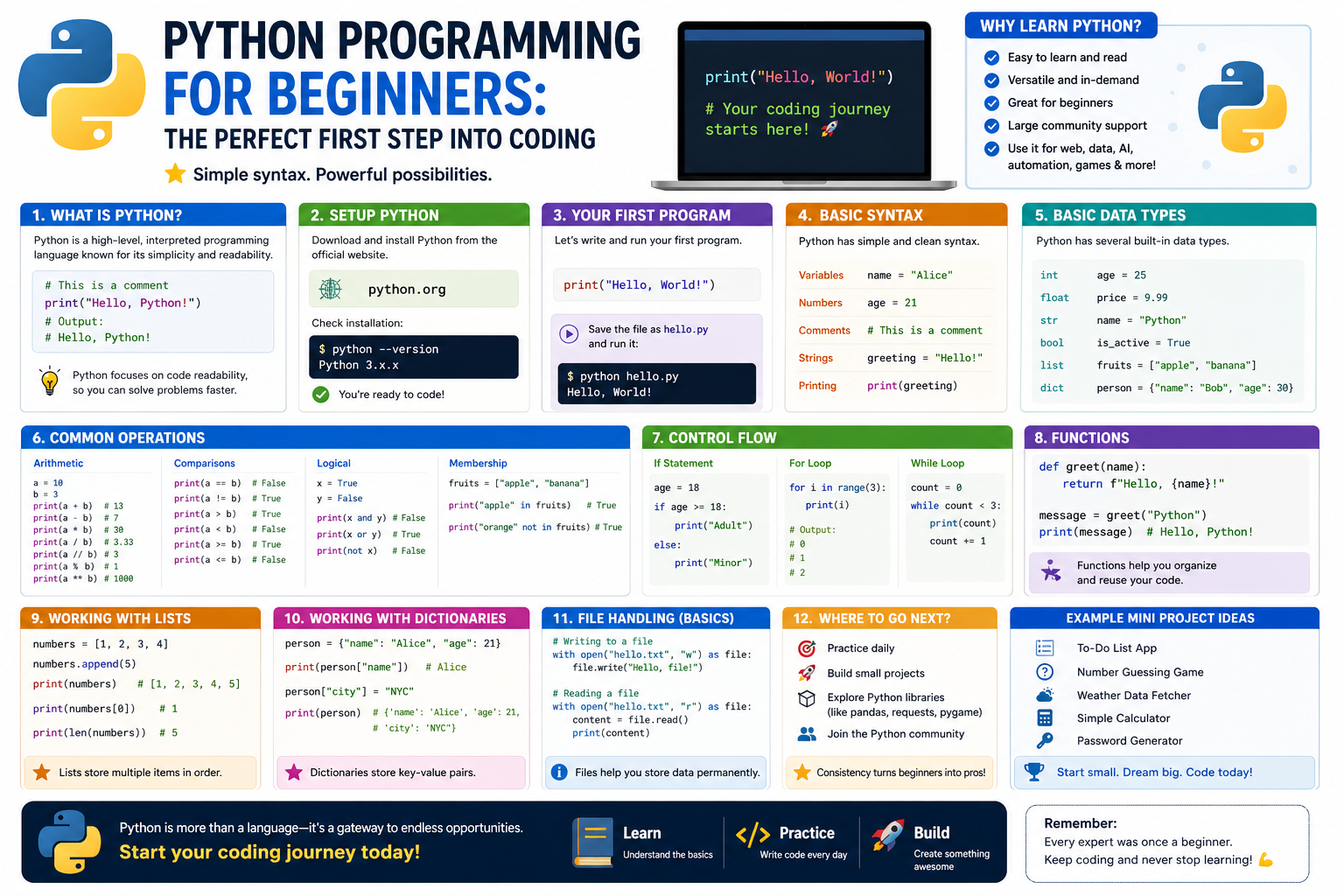
Python has become one of the most widely discussed programming languages for beginners, and for good reason. When someone first enters the world of coding, the sheer number of languages available can feel overwhelming. Each language has its own purpose, structure, and learning curve, which makes choosing a first step a critical decision. Among options like C, C++, Java, and others, Python consistently stands out because it focuses on clarity, simplicity, and practical usability.
Unlike many older programming languages that were designed with machines in mind first, Python was designed with humans in mind. This distinction changes everything about how a beginner experiences programming. Instead of spending most of their time struggling with complex syntax rules or strict structural requirements, learners can focus more on understanding logic, problem-solving, and computational thinking. This shift in focus is one of the key reasons Python is widely recommended as a first language.
What makes Python especially powerful for newcomers is that it does not overwhelm them with unnecessary complexity at the beginning. Instead, it gradually introduces programming concepts in a way that feels natural and readable. As a result, learners often find themselves able to understand and even write basic programs much earlier than they would with many other languages.
The Rising Popularity of Python in the Programming World
Over the past decade, Python has experienced a remarkable rise in popularity across nearly every area of software development. While languages like Java and C have long held dominant positions in the industry, Python has steadily gained ground and, in many contexts, surpassed them in usage and preference.
This rise is not accidental. Python has become deeply integrated into fields that define modern technology, including artificial intelligence, data analysis, automation, cybersecurity, and web development. As industries continue to evolve and rely more heavily on data-driven systems, Python’s role becomes even more significant.
One of the reasons for Python’s growing dominance is its adaptability. It is not limited to a single type of task. Instead, it can be used for building websites, analyzing large datasets, creating automation scripts, or developing machine learning models. This flexibility means that learners who start with Python are not limiting themselves to a narrow career path; instead, they are opening doors to multiple fields.
Another factor contributing to Python’s popularity is its large and active global community. This community continuously contributes tools, libraries, and improvements that make Python even more useful and accessible. For beginners, this means that help, documentation, and examples are widely available, making the learning process less isolating and more supportive.
Why Simplicity Matters in Learning Programming
One of the most challenging aspects of learning programming is understanding syntax—the set of rules that define how code must be written. In many programming languages, even a small mistake, such as a missing symbol or incorrect structure, can prevent a program from running entirely. This strictness can be discouraging for beginners who are still trying to understand basic concepts.
Python addresses this challenge by prioritizing readability and simplicity. Its syntax is designed to resemble plain English as closely as possible. This does not mean it lacks structure or power; rather, it means that its structure is more intuitive for human readers.
When beginners are not constantly distracted by complicated syntax rules, they can focus on the logic behind programming. They begin to understand how problems are broken down into smaller steps and how those steps can be translated into instructions that a computer can follow. This shift from memorizing rules to understanding logic is essential for long-term success in programming.
Simplicity also reduces frustration. Learning to program can already feel challenging, and when the language itself adds unnecessary difficulty, it can discourage learners from continuing. Python’s approach minimizes this barrier, allowing beginners to build confidence more quickly.
The Role of Readability in Building Strong Foundations
Readability is one of Python’s most defining characteristics. In programming, readability refers to how easily a human can understand the structure and purpose of code. While computers execute instructions, humans write, review, and maintain them. This makes readability extremely important in real-world software development.
Python emphasizes clean structure and logical flow, making it easier to understand what a program is doing even at a glance. This becomes especially valuable as programs grow in size and complexity. Beginners often start with small scripts, but as they progress, they encounter larger systems. Languages that lack readability can make this transition difficult.
In Python, the structure of the code often mirrors the logic of the problem being solved. This alignment helps beginners connect abstract concepts to practical implementation. Instead of struggling to interpret dense or confusing code blocks, learners can follow the flow of instructions more naturally.
Readability also plays a major role in collaboration. In real-world development environments, programmers frequently work in teams. Clear and readable code ensures that others can understand and contribute to a project without unnecessary confusion. By starting with Python, beginners develop habits that naturally align with professional coding standards.
How Python Reduces the Barrier to Entry for Beginners
Many traditional programming languages were originally designed for performance and system-level control. While powerful, they often require a strong understanding of computer architecture and strict syntax rules. This creates a steep learning curve for newcomers.
Python lowers this barrier by abstracting away many of the complexities that beginners do not need to worry about immediately. For example, memory management and low-level system operations are handled automatically. This allows learners to focus on learning programming logic rather than technical details that can be overwhelming at the start.
This abstraction does not reduce Python’s capability. Instead, it enhances accessibility. Beginners can start building functional programs much earlier in their learning journey. This early sense of achievement is important because it builds motivation and encourages continued learning.
Another way Python reduces barriers is through its interactive nature. Learners can test ideas quickly and see immediate results. This instant feedback loop helps reinforce understanding and makes experimentation less intimidating. It encourages curiosity, which is a key driver of learning in programming.
Understanding the Philosophy Behind Python’s Design
Python was created with a strong philosophical foundation that emphasizes simplicity, clarity, and practicality. This philosophy is not just a set of guidelines; it is deeply embedded in the way the language behaves and evolves.
At its core, Python encourages developers to write code that is easy to read and understand. This principle influences everything from syntax design to community standards. Instead of allowing multiple confusing ways to perform the same task, Python often promotes a clear and consistent approach.
This consistency is particularly beneficial for beginners. When there are fewer ways to accomplish a task, learners can focus more on understanding the concept rather than choosing between multiple confusing alternatives. This reduces cognitive load and helps reinforce learning.
Python’s philosophy also discourages unnecessary complexity. If a solution becomes too complicated to explain clearly, it is often considered less desirable. This mindset aligns well with educational goals, where clarity and understanding are more important than technical sophistication at the beginning stage.
Why Early Learning Habits Matter in Programming
The first programming language a person learns often shapes how they approach coding in the future. Early habits in syntax, structure, and problem-solving tend to carry over into more advanced languages later on.
Starting with a language that promotes clean structure and readability helps build strong foundational habits. Learners become accustomed to writing code that is easy to understand, which is a valuable skill in any programming environment.
Python encourages good practices from the beginning. Even simple programs are written in a way that reinforces logical thinking and structured problem-solving. This helps beginners avoid developing habits that may need to be unlearned later.
In contrast, languages with more complex syntax can sometimes lead beginners to focus more on memorization than understanding. While memorization has its place, programming ultimately depends on logic and reasoning. Python helps shift attention toward these core skills earlier in the learning process.
Python’s Role in Shaping Logical Thinking Skills
Programming is not just about writing code; it is about solving problems. Python supports this goal by allowing learners to focus on logic rather than syntax barriers.
When beginners write Python programs, they naturally begin to think in terms of steps and processes. They learn how to break down problems into smaller, manageable parts and how to express those parts in a structured way.
This type of thinking is valuable beyond programming. Logical reasoning, structured planning, and problem decomposition are skills that can be applied in many areas of life and work. Python acts as a bridge that introduces these skills in an accessible and practical way.
Because Python reduces unnecessary complexity, learners are more likely to stay engaged with the problem-solving process itself. This encourages deeper understanding rather than surface-level memorization.
Building Confidence Through Early Success
One of the most important aspects of learning programming is maintaining motivation. Early experiences play a major role in shaping whether a learner continues or gives up.
Python’s simplicity allows beginners to achieve meaningful results quickly. Even without extensive knowledge, learners can write small programs that produce visible outcomes. This early success builds confidence and reinforces the idea that programming is accessible.
Confidence is essential in learning any technical skill. When learners feel capable, they are more willing to experiment, explore, and challenge themselves. Python supports this growth by providing a learning environment that feels approachable rather than intimidating.
As learners progress, this confidence becomes a foundation for tackling more advanced topics and eventually transitioning to more complex programming languages if needed.
Python and the Shift Toward Practical Programming
As programming continues to evolve, one of the most noticeable trends is the shift from purely theoretical or system-focused languages toward more practical, application-oriented tools. Python plays a major role in this transition because it is designed to solve real-world problems straightforwardly. Instead of requiring beginners to spend months mastering complex syntax before building anything useful, Python allows them to start creating functional programs relatively early in their learning journey.
This practical approach changes how beginners perceive programming. Rather than seeing it as an abstract discipline filled with rules and symbols, they begin to understand it as a tool for solving problems. Whether it is automating repetitive tasks, organizing data, or analyzing simple inputs, Python provides a direct path from idea to implementation.
This immediate usefulness is one of the strongest motivators for learners. When beginners can see real results from their code, they are more likely to stay engaged and continue learning. Over time, this builds both technical skill and confidence, which are essential for long-term growth in programming.
How Python Supports a Smooth Learning Progression
One of the most important aspects of learning programming is progression. Beginners need a language that allows them to start simple but gradually build toward more advanced concepts without feeling overwhelmed. Python is particularly effective in this regard because its learning curve is naturally incremental.
At the beginning, learners are introduced to basic concepts such as variables, simple conditions, and basic data handling. These foundational ideas are easy to grasp because Python expresses them in a clear and readable form. As learners become more comfortable, they can move on to more complex topics such as loops, functions, and object-oriented thinking.
What makes Python effective is that it does not force learners to confront complexity too early. Instead, complexity is introduced gradually and in a way that builds on previously learned concepts. This layered approach helps ensure that learners are not just memorizing syntax but actually understanding how programming logic works.
This progression also mirrors how real-world software development evolves. Simple scripts often grow into more structured and modular systems. Python prepares learners for this natural evolution by encouraging clean structure from the very beginning.
The Importance of Community Support in Learning Python
No programming language exists in isolation. A strong community can significantly influence how easy or difficult it is to learn a language, and Python is widely recognized for having one of the most active and supportive communities in the programming world.
For beginners, this community support is invaluable. When learners encounter challenges, they are rarely alone in facing them. There is a vast amount of shared knowledge available through discussions, documentation, and examples created by other developers. This makes it easier to find explanations, understand errors, and discover alternative approaches to solving problems.
Community support also contributes to the continuous improvement of Python itself. Developers from around the world contribute ideas, improvements, and tools that expand the language’s capabilities. This collaborative environment ensures that Python remains relevant and adaptable to new technological trends.
For someone just starting, being part of such a large ecosystem creates a sense of connection. It reinforces the idea that programming is not a solitary activity but a shared discipline where knowledge is constantly exchanged and refined.
Python’s Versatility Across Different Fields
One of the most compelling reasons for learning Python as a first programming language is its versatility. Unlike some languages that are primarily focused on a specific domain, Python can be applied across a wide range of fields. This flexibility allows learners to explore different areas without needing to switch languages early in their journey.
In data-related fields, Python is widely used for processing and analyzing large datasets. Its structure makes it well-suited for handling information in a way that is both efficient and understandable. In web development, Python supports the creation of dynamic applications and services that power many modern platforms.
Python is also heavily used in automation. Many repetitive tasks that would otherwise require manual effort can be simplified through Python scripts. This includes file management, system operations, and even basic workflow automation in professional environments.
Beyond these areas, Python has also become central to fields like artificial intelligence and machine learning. These advanced domains rely heavily on Python due to its readability and the availability of specialized tools designed for complex computations and modeling.
This wide range of applications means that learners are not restricted to a single career path. Instead, Python provides a foundation that can lead to multiple opportunities depending on interest and specialization.
The Role of Libraries in Expanding Python’s Capabilities
One of the reasons Python is so powerful is its extensive collection of libraries. Libraries are pre-written collections of code that provide additional functionality without requiring users to build everything from scratch. This concept is particularly important for beginners because it allows them to focus on learning logic rather than reinventing solutions.
These libraries cover a vast range of functionalities. Some are designed for data analysis, others for web development, and many for scientific computing. This ecosystem significantly expands what can be achieved with relatively simple code.
For beginners, this means that even with limited knowledge, it is possible to work on meaningful projects. Instead of being restricted by their current skill level, learners can leverage libraries to explore more advanced concepts earlier in their journey.
Over time, as learners become more experienced, they begin to understand how these libraries work internally. This deeper understanding further strengthens their programming knowledge and helps them appreciate the structure and design of larger systems.
Why Python Encourages Experimentation
Learning programming is not just about reading concepts; it is about experimentation. Python naturally encourages experimentation because it provides quick feedback and allows code to be tested easily. This environment makes it less intimidating for beginners to try new ideas.
When learners can experiment freely, they begin to develop curiosity-driven learning habits. Instead of simply following instructions, they start asking questions such as what happens if a value is changed or how a process behaves under different conditions.
This kind of exploration is essential for developing strong problem-solving skills. Programming is not about memorizing fixed solutions but about adapting to different challenges. Python’s flexibility supports this mindset by allowing learners to modify and test their code without excessive setup or complexity.
The ability to experiment also reduces fear of failure. Beginners often hesitate to try new things because they worry about making mistakes. Python’s forgiving nature helps reduce this fear, making it easier for learners to explore and learn through trial and error.
Python in Educational Environments
Python has become increasingly popular in educational settings, and this is not accidental. Its simplicity and readability make it suitable for teaching fundamental programming concepts without overwhelming students.
Educators often prefer Python because it allows them to focus on teaching logic and problem-solving rather than spending excessive time explaining syntax rules. This makes the learning experience more focused and productive.
Students who learn programming through Python often develop a clearer understanding of computational thinking. They are able to grasp abstract concepts more easily because the language presents them in a straightforward and structured way.
Additionally, Python’s flexibility allows it to be used across different levels of education. It can be introduced at a beginner level and remain relevant as students progress to more advanced topics.
Comparison of Learning Complexity in Programming Languages
When comparing programming languages, one of the most important factors is complexity. Some languages require a deep understanding of technical details before meaningful progress can be made, while others are designed to be more accessible from the start.
Python belongs to the category of languages that prioritize accessibility. Its structure avoids unnecessary complexity, allowing beginners to focus on core ideas. In contrast, some traditional languages require learners to understand system-level concepts early on, which can be challenging without prior experience.
This difference in complexity affects motivation. When a language feels too difficult at the beginning, learners may struggle to stay engaged. On the other hand, when early success is achievable, motivation tends to increase.
Python’s approach helps bridge this gap by providing a balanced introduction to programming. It is simple enough for beginners but powerful enough to remain relevant as skills develop.
The Importance of Consistency in Python’s Design
One of the strengths of Python is its consistent design philosophy. Consistency in programming languages helps reduce confusion because learners do not need to constantly adapt to different rules or exceptions.
In Python, similar concepts are often expressed in similar ways. This predictability makes it easier to learn and remember how different parts of the language work. As a result, learners can focus more on understanding logic rather than memorizing exceptions.
Consistency also helps when reading other people’s code. Since Python encourages a standard style, code written by different developers tends to follow similar patterns. This makes collaboration easier and improves overall readability.
For beginners, this consistency reduces cognitive load. Instead of trying to understand multiple ways of doing the same thing, they can focus on mastering one clear approach.
How Python Builds Problem-Solving Confidence
Programming is fundamentally about solving problems, and confidence plays a major role in how effectively someone can develop this skill. Python supports confidence-building by providing a gentle introduction to problem-solving.
When learners write Python code, they often see immediate results. This immediate feedback helps them understand the relationship between their instructions and the outcome. Over time, this strengthens their ability to think logically and structure solutions effectively.
Confidence grows further as learners begin to solve more complex problems. Since Python does not introduce excessive barriers, learners can gradually take on more challenging tasks without feeling discouraged.
This steady progression helps reinforce a positive learning cycle. Success leads to confidence, and confidence encourages further exploration and learning.
Python as a Gateway to Real-World Career Paths
As learners progress beyond the basics of programming, one of the most important questions they begin to ask is how their skills translate into real-world opportunities. Python stands out in this regard because it is not limited to academic exercises or theoretical concepts. It is actively used across a wide range of industries, making it a practical entry point into professional development.
What makes Python particularly valuable is that it acts as a bridge between beginner-level programming and advanced technical careers. Instead of being confined to a single domain, learners can explore multiple directions depending on their interests. Some may move toward software development, others toward data-focused roles, and some toward automation or infrastructure-related fields.
This flexibility is one of Python’s strongest advantages. It allows beginners to experiment with different areas before committing to a specific path. As they gain experience, they can naturally identify where their strengths and interests align, whether that is building applications, analyzing data, or working with intelligent systems.
Python does not lock learners into a narrow trajectory. Instead, it opens multiple doors, making it easier to transition from learning to practical application in professional environments.
Python in Software Development and Application Building
One of the most common applications of Python is in software development. While it may not always be the primary language used for system-level software, it plays a crucial role in building applications, backend services, and supporting tools that power modern digital systems.
In software development, Python is often chosen for its speed of development. Developers can build functional applications more quickly compared to languages that require more complex setup and structure. This makes it especially useful for startups, prototypes, and rapidly evolving projects where time is an important factor.
Another advantage is readability. In collaborative environments, multiple developers often work on the same codebase. Python’s clean structure makes it easier for teams to understand each other’s work, reducing confusion and improving efficiency.
For beginners transitioning into development roles, Python offers a smoother entry point. It allows them to focus on understanding how applications are structured rather than being overwhelmed by low-level implementation details. Over time, this understanding becomes a foundation for learning more complex systems and architectures.
Python in Data-Centered Industries
One of the most significant areas where Python has gained dominance is in data-related industries. As organizations increasingly rely on data to make decisions, the need for tools that can efficiently process and analyze information has grown rapidly. Python has become a central tool in this transformation.
In data-focused environments, Python is used to clean, organize, and analyze large datasets. It allows professionals to extract meaningful insights from raw information, which can then be used for decision-making, forecasting, and strategic planning.
What makes Python especially effective in this area is its ability to handle both simple and complex data tasks. Beginners can start with basic data manipulation, while more advanced users can work with large-scale analytical systems.
This scalability ensures that learners who begin with Python are not limited to entry-level tasks. As their skills grow, they can take on increasingly sophisticated data challenges without needing to switch languages.
The growing importance of data in business, healthcare, finance, and technology means that Python skills are highly transferable across industries. This makes it a valuable foundation for long-term career development.
Python and the Rise of Artificial Intelligence Systems
Artificial intelligence has become one of the most influential technological fields of the modern era, and Python plays a central role in its development. Many AI systems, including machine learning models and intelligent applications, rely heavily on Python due to its simplicity and flexibility.
The reason Python is so widely used in AI development is that it allows researchers and developers to focus on building models rather than dealing with unnecessary technical complexity. AI systems involve complex mathematical and statistical processes, and Python provides an accessible way to implement these concepts.
For beginners, this means that learning Python opens the door to one of the most advanced areas of technology. While AI may seem intimidating at first, Python helps simplify the learning process by providing a structured and readable way to work with complex ideas.
As learners progress, they begin to understand how machines can learn from data, recognize patterns, and make predictions. These concepts form the foundation of modern intelligent systems, from recommendation engines to automated decision-making tools.
Python’s role in this field continues to grow as new technologies emerge. Its adaptability ensures that it remains relevant even as AI systems become more advanced and specialized.
Automation and the Power of Simplifying Repetitive Tasks
Another important application of Python is automation. In many professional and personal environments, there are repetitive tasks that consume time and effort. Python allows these tasks to be automated, freeing up time for more meaningful work.
Automation can include a wide range of activities, such as organizing files, processing information, managing system tasks, or handling routine digital operations. Python provides a simple way to write instructions that perform these actions automatically.
For beginners, automation is one of the most satisfying areas of programming because it delivers immediate practical value. Even small scripts can significantly improve efficiency in everyday tasks.
This practical usefulness helps reinforce learning. Instead of seeing programming as an abstract concept, learners begin to understand it as a tool that solves real problems. This shift in perspective strengthens motivation and encourages deeper exploration.
As skills develop, automation becomes more advanced. Complex workflows can be created that integrate multiple systems and processes, further demonstrating the power of programming in real-world environments.
Python in Web Development and Backend Systems
Python also plays a major role in web development, particularly in backend systems. These systems are responsible for handling the logic, data processing, and communication that power websites and web applications.
In this context, Python is used to manage requests, process information, and interact with databases. It ensures that web applications function smoothly behind the scenes, even if users do not directly interact with the code.
For beginners, web development offers a clear way to see how programming connects to real-world applications. When a user interacts with a website, Python-powered systems are often responsible for processing those interactions and delivering responses.
This connection between code and visible outcomes helps learners understand the practical impact of programming. It transforms abstract concepts into tangible results, making learning more engaging and meaningful.
Python’s role in web development continues to expand as digital services become more complex and interconnected. Its simplicity allows developers to build scalable systems while maintaining clarity in code structure.
The Importance of Python in Cybersecurity
Cybersecurity is another field where Python has become increasingly important. As digital systems grow, protecting information and ensuring system integrity has become a top priority for organizations.
Python is used in cybersecurity for tasks such as analyzing network activity, detecting vulnerabilities, and automating security processes. Its ability to handle data efficiently makes it well-suited for monitoring and analysis tasks.
For beginners interested in security, Python provides an accessible entry point into a complex field. Instead of dealing with low-level system details immediately, learners can focus on understanding patterns, risks, and protective strategies.
Python also allows security professionals to create tools that automate repetitive analysis tasks. This improves efficiency and helps identify threats more quickly.
As cybersecurity continues to evolve, Python remains a key tool due to its flexibility and ease of integration with other systems.
How Python Encourages Long-Term Skill Development
One of the most important aspects of learning programming is long-term growth. Python supports this by providing a foundation that remains useful even as skills advance.
Unlike languages that may require complete restructuring of knowledge as complexity increases, Python allows learners to build on what they already know. Basic concepts learned early on remain relevant even in advanced applications.
This continuity helps reduce the frustration that often comes with transitioning to more complex topics. Instead of starting over, learners expand their understanding step by step.
Over time, this creates a strong and adaptable skill set. Learners become comfortable moving between different areas of programming, from simple scripts to complex systems, without losing their foundational understanding.
The Role of Python in Modern Development Ecosystems
Modern software development rarely relies on a single language or tool. Instead, it involves ecosystems of technologies working together. Python plays an important role in these ecosystems due to its compatibility and integration capabilities.
It is often used alongside other languages and tools to handle specific tasks within larger systems. This makes it a valuable component in complex development environments.
For beginners, this demonstrates an important lesson: programming is not about mastering one isolated language, but about understanding how different tools interact to solve problems.
Python’s flexibility allows it to fit into many different workflows, making it a practical choice for learners who want to understand how modern systems are built.
Challenges Beginners May Encounter and How Python Addresses Them
Although Python is widely considered beginner-friendly, learning programming still involves challenges. Beginners may struggle with understanding logic, structuring solutions, or debugging errors.
Python helps reduce these challenges by providing clear error messages, readable syntax, and predictable behavior. These features make it easier to identify and correct mistakes.
Instead of being discouraged by technical complexity, learners can focus on understanding why something did not work and how to fix it. This process is an important part of developing problem-solving skills.
Over time, dealing with small challenges helps build resilience and confidence. Learners become more comfortable experimenting and less afraid of making mistakes.
Transitioning from Python to Other Programming Languages
While Python is an excellent starting point, many learners eventually explore other programming languages. One of Python’s strengths is that it prepares learners for this transition effectively.
Because Python emphasizes logic and structure rather than complex syntax, learners develop a strong conceptual foundation. This makes it easier to understand how other languages work when they are introduced later.
Although syntax may differ between languages, the core principles of programming remain the same. Python helps reinforce these principles early on, making future transitions smoother.
This adaptability ensures that learning Python is not a limitation but rather a stepping stone toward broader programming knowledge.
The Evolving Future of Python in Technology
As technology continues to evolve, Python’s role is expected to remain significant. Its adaptability, simplicity, and wide usage ensure that it stays relevant across emerging fields.
New areas such as advanced artificial intelligence, cloud computing, and data-driven systems continue to rely on Python for development and experimentation. Its ability to integrate with new technologies makes it a long-term asset in the programming world.
For learners, this means that investing time in Python provides lasting value. The skills gained are not limited to current technologies but extend into future developments as well.
Python’s continued evolution ensures that it remains aligned with modern technological needs while maintaining its core principles of simplicity and readability.
Python Ecosystem Tools and Development Workflow Practices
Beyond writing basic code, one of the most valuable aspects of Python is the structured ecosystem that surrounds it. As learners move forward, they begin interacting with tools that support professional-grade development workflows. These tools help manage projects, organize dependencies, and maintain consistent environments across different systems.
One important concept in Python development is environment management. Instead of installing every library globally on a system, developers often create isolated environments for each project. This approach ensures that different projects do not conflict with each other when they require different versions of the same library. It also makes projects more stable and easier to reproduce on other machines.
Another essential part of the workflow is package management. Python allows developers to easily install and manage external libraries that extend its capabilities. These libraries are shared across a global ecosystem and can be integrated into projects with minimal effort. This modular structure allows developers to build complex systems without writing everything from scratch.
As learners progress, they also encounter code formatting and style conventions that help maintain consistency. These conventions ensure that code remains readable and organized, especially in collaborative environments where multiple developers contribute to the same project. Over time, these practices become an integral part of writing professional-quality Python code.
Performance Considerations and How Python Handles Execution
While Python is widely appreciated for its simplicity, it also introduces learners to important performance concepts that become more relevant as applications grow in complexity. One key aspect is that Python is an interpreted language, meaning that code is executed line by line rather than compiled directly into machine-level instructions beforehand.
This execution model offers flexibility and ease of testing but can also influence performance in certain scenarios. As learners advance, they begin to understand how program efficiency can be improved through better logic design rather than relying solely on raw computational speed.
Another important concept is concurrency, which allows programs to handle multiple tasks at the same time. Python provides mechanisms that support concurrent execution, enabling applications to perform tasks such as data processing or network communication more efficiently.
Although beginners do not need to focus heavily on performance optimization early on, exposure to these ideas helps them develop a more complete understanding of how software behaves in real-world environments. This awareness becomes especially important when building larger or more demanding applications.
Software Engineering Practices and Code Quality Awareness
As learners progress beyond beginner-level programming, they begin to encounter broader software engineering practices that influence how code is written, tested, and maintained. Python naturally introduces many of these concepts due to its emphasis on clarity and structure.
One important practice is writing modular code, where programs are broken into smaller, reusable components. This approach makes it easier to manage complexity and allows developers to reuse functionality across different parts of a project. It also improves readability and simplifies debugging.
Testing is another essential aspect of software development. In Python, learners are encouraged to verify that their code behaves as expected through structured testing methods. This process helps identify errors early and ensures that changes to a program do not introduce unintended issues.
Documentation also plays a key role in maintaining code quality. Writing clear explanations within or alongside code helps others understand its purpose and functionality. Python’s readability makes it easier to document programs effectively, which is especially useful in collaborative environments.
Together, these practices form the foundation of professional software development and help learners transition from writing simple scripts to building reliable systems.
Conclusion
Python has established itself as one of the most practical and accessible entry points into the world of programming. Its design philosophy, centered on readability, simplicity, and clarity, makes it uniquely suitable for beginners who are taking their first steps into coding. Unlike many traditional programming languages that require learners to immediately deal with complex syntax rules and low-level technical details, Python allows newcomers to focus on understanding how programming actually works—how problems are broken down, how logic is structured, and how solutions are built step by step.
One of the most important strengths of Python is its ability to grow with the learner. It is not just a beginner-friendly language; it is also widely used in advanced fields such as data science, artificial intelligence, automation, web development, and cybersecurity. This means that the time invested in learning Python continues to pay off even as skills advance. A learner can start with simple programs and gradually move toward building complex systems without needing to switch languages early in their journey.
Python also encourages good programming habits from the beginning. Its emphasis on clean structure and readable code helps learners develop a mindset that values clarity and organization. These habits are essential in real-world development environments, where code is often read and maintained by multiple people. By learning Python first, beginners naturally adopt practices that align with professional standards.
Another key advantage is the strong global community that supports Python. This ecosystem provides extensive learning resources, tools, and libraries that make development easier and more efficient. As a result, learners are never isolated; they are part of a constantly growing network of developers contributing to and improving the language.
Perhaps most importantly, Python lowers the barrier to entry in programming. It reduces unnecessary complexity and allows beginners to experience success early in their learning journey. This early progress builds confidence, which is crucial for continued growth in any technical field. When learners see that they can create working programs quickly, they are more likely to stay motivated and explore further.
In a rapidly evolving digital world where programming skills are increasingly valuable, Python offers a balanced and sustainable starting point. It combines ease of learning with powerful capabilities, making it not only a beginner-friendly language but also a long-term tool for professional development and innovation.