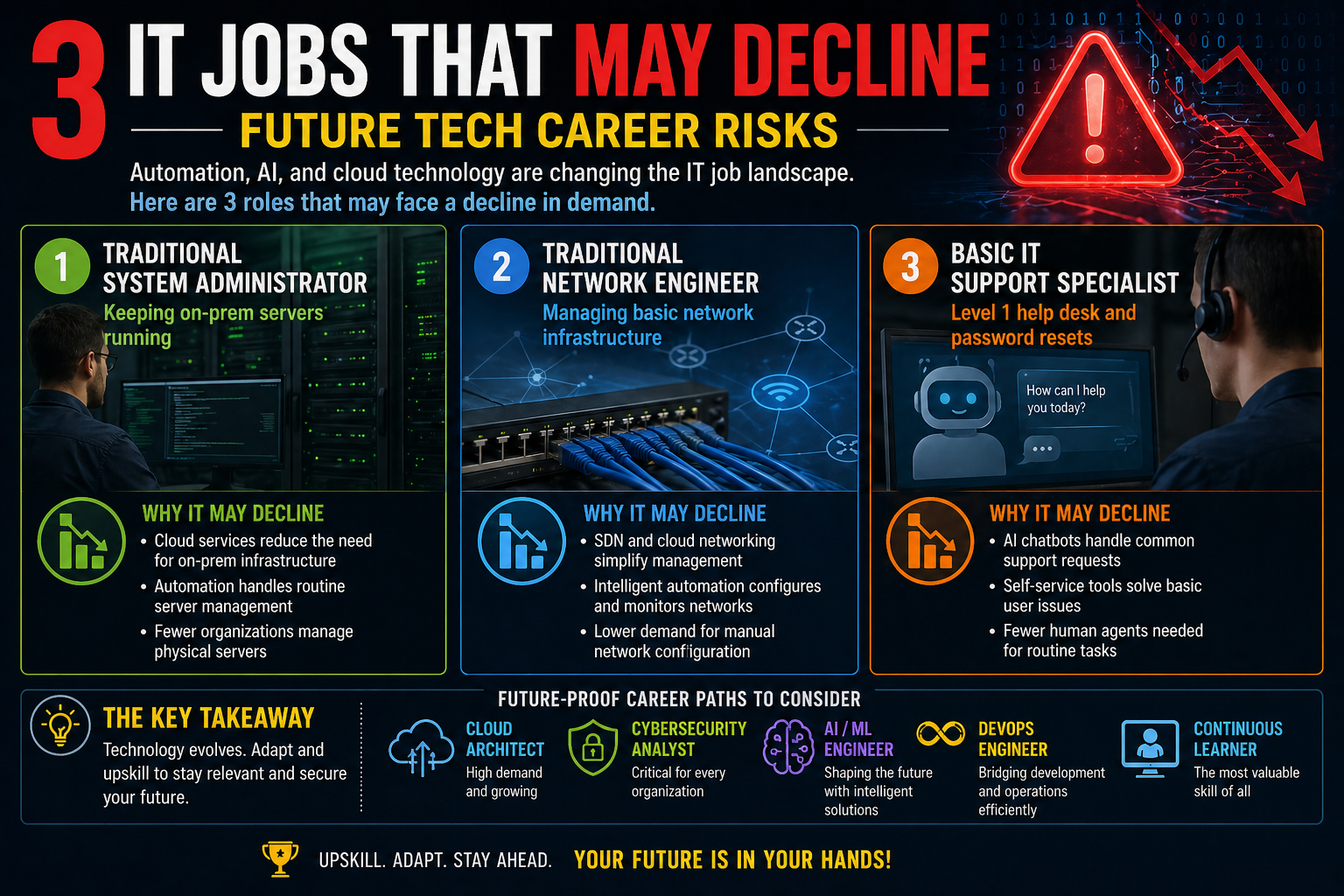
The IT industry has always been closely tied to technological change, but the speed of transformation in recent years is far greater than anything seen before. In earlier decades, changes happened gradually, giving professionals time to adapt their skills over long career cycles. Today, however, shifts driven by automation, artificial intelligence, and cloud computing are reshaping job roles in a matter of just a few years.
Organizations are no longer building their technology stacks around large internal server rooms or fully manual system management processes. Instead, they are adopting distributed cloud environments, automated infrastructure tools, and intelligent platforms that reduce the need for constant human intervention. As a result, the nature of IT employment is changing from hands-on maintenance work to strategic oversight and system optimization.
This shift does not eliminate the need for IT professionals. Instead, it changes the kind of work they perform. Routine tasks that once required specialized roles are now being handled by platforms designed to self-manage or self-heal. At the same time, demand is growing for professionals who can design, integrate, and govern these systems at a higher level.
One of the most noticeable impacts of this transformation is the gradual reduction of purely operational IT roles. Jobs focused heavily on repetitive maintenance tasks, physical infrastructure management, and manual configuration are becoming less central to modern IT departments. While these roles still exist, they are often combined with broader responsibilities or replaced by cloud-based alternatives.
This transition is also influenced by cost efficiency. Businesses are under constant pressure to reduce operational expenses while increasing system performance and scalability. Cloud providers now offer services that automatically handle tasks such as scaling, backups, monitoring, and updates. These services reduce the need for dedicated personnel to manage each component of a system.
At the same time, artificial intelligence is being introduced into IT operations. Systems can now detect anomalies, predict failures, and even resolve issues before they affect end users. This proactive approach reduces downtime but also reduces the need for traditional troubleshooting roles.
However, the shift is not simply about job reduction. It is also about role redefinition. Many IT professionals are moving into hybrid positions where they combine technical expertise with automation oversight, cloud architecture understanding, and security awareness. These evolving responsibilities require a broader skill set and a deeper understanding of how systems interact at scale.
In this changing environment, two areas experiencing significant transformation are system administration and database management. These roles have historically formed the backbone of IT operations in organizations of all sizes. They are now being restructured as cloud platforms take over much of the operational workload.
Why Automation and Cloud Computing Are Reshaping Roles
Automation has become one of the most influential forces in modern IT. It allows organizations to reduce manual work, minimize human error, and increase efficiency across systems. Tasks that once required constant human attention can now be scheduled, monitored, and executed automatically.
Cloud computing has amplified this transformation. Instead of maintaining physical servers and infrastructure internally, businesses are increasingly relying on cloud platforms that offer fully managed services. These platforms provide computing power, storage, networking, and database systems that scale dynamically based on demand.
This combination of automation and cloud services has reduced the need for traditional operational roles. Instead of manually configuring servers or maintaining physical hardware, IT teams now focus on configuring cloud environments through centralized dashboards or automation scripts. Even these tasks are becoming increasingly abstracted as cloud providers introduce more managed solutions.
Another key factor is standardization. Cloud platforms are designed with uniform architecture, meaning that many maintenance tasks are already optimized at the provider level. This reduces the need for in-house troubleshooting and system tuning, which were once major responsibilities for IT staff.
In addition, organizations are increasingly adopting DevOps practices, where development and operations are integrated into a continuous workflow. This approach emphasizes automation pipelines, continuous deployment, and infrastructure as code. As a result, the separate roles are now merged into broader engineering functions.
The rise of these technologies does not eliminate technical complexity. Instead, it shifts complexity from manual execution to system design. Professionals are now expected to understand how to build automated workflows, integrate cloud services, and ensure system reliability without direct hardware intervention.
This shift is particularly visible in traditional infrastructure roles, especially system administrators and database administrators. These roles have experienced some of the most significant changes in responsibilities due to cloud adoption.
Systems Administrators and the Shift from On-Prem to Cloud
System administrators have long been responsible for maintaining the core infrastructure of organizations. Their duties traditionally included managing physical servers, installing operating systems, configuring hardware, monitoring system performance, and ensuring uptime for business-critical applications.
In traditional IT environments, sysadmins were essential because organizations relied heavily on on-premise infrastructure. Every server, storage device, and network component requires manual setup and ongoing maintenance. This made system administration a central and highly skilled role.
However, the widespread adoption of cloud computing has significantly altered this landscape. Many organizations are no longer investing heavily in physical data centers. Instead, they are migrating workloads to cloud platforms where infrastructure is managed externally.
In this new environment, many traditional sysadmin tasks are either automated or handled by the cloud provider. Server provisioning, patch management, load balancing, and storage scaling are now often managed through automated services. This reduces the need for manual configuration and physical intervention.
As a result, the sysadmin role is evolving. Rather than focusing on hardware and direct system maintenance, professionals in this field are increasingly expected to manage virtual environments. This includes configuring cloud-based servers, managing access controls, and monitoring system performance through centralized dashboards.
Another important shift is the move toward infrastructure as code. Instead of manually configuring systems, administrators now define infrastructure using code-based templates. This allows entire environments to be deployed, modified, and replicated automatically. While this increases efficiency, it also requires sysadmins to develop programming and scripting skills that were not traditionally part of their role.
The modern sysadmin is also expected to understand virtualization technologies in depth. Virtual machines, containers, and orchestration platforms have replaced much of the physical hardware management that once defined the job. This requires familiarity with abstract computing environments rather than physical devices.
Security has also become a major component of system administration. As infrastructure becomes more distributed across cloud environments, securing access, managing identities, and monitoring potential threats have become essential responsibilities. This shift has expanded the scope of sysadmin work beyond traditional maintenance tasks.
In many organizations, sysadmins are transitioning into cloud operations engineers or DevOps-focused roles. These positions involve managing automated deployment pipelines, optimizing system performance, and ensuring reliability across distributed environments. The emphasis is less on maintaining hardware and more on ensuring seamless system integration.
Despite these changes, system administrators remain critical to IT operations. However, their role is no longer centered around physical infrastructure. Instead, it revolves around managing increasingly complex virtual systems that require a deeper understanding of automation and cloud architecture.
How Sysadmin Responsibilities Are Being Rewritten
The transformation of system administration is not simply a reduction of responsibilities but a restructuring of the entire role. Traditional tasks are being replaced with more abstract and strategic functions that require different technical capabilities.
One major change is the shift from reactive to proactive system management. In older environments, sysadmins often responded to issues after they occurred, such as server crashes or performance failures. Modern systems, however, are designed to detect and resolve issues automatically before they escalate.
Monitoring tools powered by artificial intelligence now analyze system behavior in real time. These tools can identify unusual patterns, predict potential failures, and automatically trigger corrective actions. This reduces downtime but also reduces the need for manual troubleshooting.
Another significant change is the increased reliance on cloud-native architectures. Applications are no longer deployed on single servers but distributed across multiple services. This requires sysadmins to understand how different components interact within a complex ecosystem.
Containerization has also changed how systems are managed. Instead of maintaining entire operating systems for each application, containers allow applications to run in isolated environments. This increases efficiency but requires administrators to manage container orchestration platforms that handle deployment and scaling automatically.
In addition, automation tools now handle many configuration tasks that were previously manual. Scripts and pipelines can deploy entire environments within minutes, reducing the need for repetitive setup work. This allows sysadmins to focus on higher-level planning and optimization.
The role also increasingly overlaps with software development practices. System administrators are now expected to understand version control systems, scripting languages, and deployment pipelines. This convergence of development and operations is one of the defining characteristics of modern IT environments.
Even hardware-related responsibilities are shifting. While physical servers still exist in some environments, they are often managed remotely or abstracted through cloud interfaces. This reduces the need for hands-on maintenance in data centers.
As responsibilities evolve, so do career expectations. Employers are looking for professionals who can adapt to hybrid roles that combine system administration, automation engineering, and cloud architecture knowledge. This makes continuous learning a critical aspect of career development in this field.
Database Administration in the Age of Managed Services
Database administration has traditionally been one of the most specialized roles in IT. Database administrators were responsible for installing, configuring, and maintaining database systems that stored critical organizational data. Their work included performance tuning, backup management, disaster recovery planning, and ensuring data security.
In traditional environments, databases were hosted on-premise, requiring constant attention from skilled administrators. Any downtime or performance issue could directly impact business operations, making DBAs essential for maintaining system reliability.
However, the rise of managed database services has significantly changed this landscape. Cloud providers now offer fully managed database solutions that handle much of the operational workload automatically. These services include automated backups, scaling, patching, and performance optimization.
As a result, many of the routine responsibilities once handled by DBAs are now automated. Organizations no longer need large teams dedicated solely to maintaining database infrastructure. Instead, they can rely on cloud services to handle these tasks efficiently.
This shift has led to a transformation in the DBA role. Rather than focusing on system maintenance, modern database professionals are increasingly involved in data strategy and optimization. They work on designing database architectures that support analytics, machine learning, and real-time processing.
Another major change is the rise of distributed databases. Instead of centralized systems, data is now often spread across multiple regions and services. This requires DBAs to understand replication, consistency models, and data synchronization in distributed environments.
Security has also become a more prominent responsibility. With increasing amounts of sensitive data being stored in cloud environments, ensuring proper access control and encryption is critical. DBAs now play a key role in implementing data governance policies and compliance standards.
Performance tuning has also evolved. Instead of manually optimizing queries on a single database server, professionals now focus on optimizing systems that operate across multiple services. This requires a deeper understanding of data flow, indexing strategies, and workload distribution.
The introduction of NoSQL and hybrid database systems has further expanded the role. DBAs must now work with a variety of database technologies, each designed for specific types of workloads. This diversity requires flexibility and continuous learning.
In many cases, traditional DBA responsibilities are being absorbed into broader data engineering roles. These positions focus not only on database management but also on building data pipelines, integrating analytics platforms, and supporting machine learning workflows.
Despite automation, the need for database expertise has not disappeared. Instead, it has shifted toward higher-level responsibilities that require a broader understanding of data systems and how they support business intelligence and decision-making.
Evolution of Network Engineering in the Cloud Era
Network engineering has always been one of the most foundational pillars of IT infrastructure. For decades, network engineers were responsible for designing and maintaining the physical and logical pathways that allowed data to move between systems. Their work included configuring routers, switches, and firewalls, and ensuring that local and wide area networks remained stable, fast, and secure.
In traditional environments, networks were heavily hardware-dependent. Organizations invested in physical networking equipment placed in dedicated server rooms or data centers. Network engineers spent a significant portion of their time configuring devices manually, troubleshooting connectivity issues, and optimizing traffic flow between internal systems.
However, as cloud computing has become the dominant architecture for modern organizations, the traditional responsibilities of network engineers have undergone significant transformation. Instead of managing isolated, on-premise networks, engineers are now dealing with highly distributed systems that span multiple cloud platforms, hybrid environments, and remote infrastructures.
This shift has changed the nature of networking itself. Rather than focusing purely on physical hardware, network engineers now work with virtualized environments where networks are defined through software. This means that routing, switching, and firewall configurations are often managed through cloud interfaces or automated tools rather than physical devices.
As organizations continue to migrate to cloud-first strategies, the demand for traditional hardware-focused network engineering has decreased. However, this does not mean networking as a discipline is becoming less important. Instead, it is becoming more complex and more abstract, requiring engineers to understand systems that operate at a higher level of automation and integration.
Modern network engineers are expected to understand how cloud networks are structured, how virtual private clouds operate, and how data flows between distributed systems. This requires a shift from physical configuration skills to architectural thinking and systems design.
Software-Defined Networking and Virtual Network Systems
One of the most important developments reshaping network engineering is the rise of software-defined networking. Instead of relying on physical hardware to control network behavior, software-defined networking allows engineers to manage traffic flow, routing, and security policies through centralized software platforms.
This approach separates the control layer of the network from the physical infrastructure. As a result, network behavior can be programmed, automated, and dynamically adjusted based on demand or system conditions. This has dramatically reduced the need for manual configuration of individual devices.
Virtual networks have also become a core component of modern IT systems. In cloud environments, networks are no longer tied to physical locations. Instead, they are created virtually and can span multiple regions or data centers. This allows organizations to scale their infrastructure globally without needing physical expansion.
For network engineers, this shift means that their work is no longer centered around physical connectivity. Instead, they must understand how to design, manage, and optimize virtual network architectures. This includes configuring virtual subnets, managing traffic routing policies, and ensuring secure communication between distributed systems.
Automation plays a major role in this transformation. Many networking tasks that once required manual intervention can now be executed through scripts or infrastructure templates. This allows networks to be deployed and modified quickly, but it also reduces the need for traditional hands-on configuration work.
As a result, network engineers are increasingly expected to develop programming and scripting skills. Understanding how to work with APIs, automation tools, and cloud networking frameworks has become essential for staying relevant in the field.
Security Integration and the Changing Role of Network Engineers
As networks become more distributed and software-driven, security has become deeply integrated into network engineering. In traditional environments, security was often handled separately from networking. Firewalls, intrusion detection systems, and access controls were configured as distinct components.
In modern cloud environments, however, security is built directly into the network architecture. This means that network engineers must now understand security principles as a core part of their role. They are responsible for designing networks that are secure by default rather than adding security as an additional layer.
This includes managing identity-based access controls, encrypting data traffic between systems, and ensuring that virtual networks are isolated from unauthorized access. It also involves monitoring network traffic for unusual behavior that could indicate potential security threats.
Another important development is the use of automated security systems. Artificial intelligence and machine learning tools can now analyze network traffic patterns and detect anomalies in real time. These systems can automatically respond to threats by isolating affected segments or blocking suspicious activity.
This level of automation reduces the need for manual monitoring but increases the importance of designing secure network architectures from the beginning. Network engineers must now think like security architects, ensuring that systems are resilient against both internal and external threats.
The convergence of networking and security has also created hybrid roles. Many professionals are now working in positions that combine network engineering with cybersecurity responsibilities. These roles require a deep understanding of both connectivity and protection mechanisms.
Help Desk Transformation Through Automation and AI Systems
Help desk support has traditionally been the first point of contact for users experiencing technical issues. Help desk technicians were responsible for troubleshooting hardware and software problems, resetting passwords, resolving connectivity issues, and guiding users through basic IT processes.
For many years, this role served as the entry point into the IT industry. It provided foundational experience in troubleshooting and user support, often leading to more advanced technical positions.
However, the rise of automation and artificial intelligence has significantly changed the structure of help desk operations. Many organizations now use AI-powered chatbots and self-service platforms to handle basic support requests. These systems can automatically resolve common issues without human intervention.
Tasks such as password resets, software installation guidance, and simple troubleshooting are increasingly handled through automated workflows. This reduces the volume of tickets that require direct human support and changes the nature of help desk work.
Instead of focusing on repetitive tasks, help desk professionals are now dealing with more complex issues that cannot be resolved through automation. This includes advanced troubleshooting, system integration problems, and user experience optimization.
The role is also becoming more proactive rather than reactive. Instead of waiting for users to report issues, support teams are increasingly involved in identifying potential problems before they impact users. This requires analyzing system data and understanding usage patterns.
Another important shift is the move toward omnichannel support. Users now expect assistance through multiple platforms, including chat systems, mobile applications, and integrated support dashboards. Help desk professionals must be able to manage support across all these channels efficiently.
As automation continues to evolve, the help desk role is becoming more analytical and less procedural. Professionals are expected to interpret system data, improve user experience, and contribute to the overall design of IT support systems.
Rise of IT Service Management and Experience-Focused Roles
IT service management has become a central framework for organizing and delivering IT support in modern organizations. Instead of treating support as a reactive function, IT service management focuses on structured processes that improve efficiency, consistency, and user satisfaction.
This approach has transformed how help desk teams operate. Ticketing systems are now highly automated, with intelligent routing systems that assign issues based on complexity and priority. This reduces response times and improves resolution efficiency.
At the same time, organizations are placing greater emphasis on user experience. Rather than simply resolving technical issues, IT teams are now focused on ensuring that users have a smooth and efficient interaction with technology systems.
This shift has led to the emergence of roles that focus specifically on end-user experience management. These professionals analyze how users interact with IT systems and identify areas where performance or usability can be improved.
Data plays a critical role in this process. IT service management systems collect large amounts of information about system usage, support requests, and resolution times. This data is used to identify patterns and improve service delivery over time.
Automation is also deeply integrated into IT service management. Routine tasks such as ticket classification, escalation, and resolution tracking are often handled automatically. This allows human technicians to focus on more complex or strategic issues.
As IT environments become more complex, service management roles are becoming increasingly important. They provide structure and consistency in environments where systems are highly distributed and constantly evolving.
Decline of Traditional Entry-Level IT Pathways
For many years, entry-level IT roles served as the starting point for individuals entering the technology industry. Positions such as help desk technician, junior network assistant, and basic system support roles provided hands-on experience with foundational IT concepts.
However, these traditional pathways are becoming less common due to automation and changes in hiring practices. Many organizations now expect entry-level candidates to already possess advanced technical skills that were previously learned on the job.
Automation has also reduced the number of simple tasks that new IT professionals would typically perform. As a result, fewer entry-level positions are available, and those that exist often require more specialized knowledge.
Cloud platforms and managed services have further reduced the need for large IT support teams. Many routine tasks are now handled by automated systems, reducing the demand for junior-level support staff.
This shift is encouraging new professionals to enter the field through more specialized pathways. Instead of starting with basic support roles, many are focusing on areas such as cloud computing, cybersecurity, and automation engineering from the beginning of their careers.
At the same time, organizations are restructuring their IT teams to include fewer hierarchical levels. This means that new employees are often expected to contribute at a higher level from the start, rather than progressing through traditional entry-level roles.
This change is reshaping how individuals prepare for IT careers. Foundational knowledge is no longer enough; practical, specialized skills are becoming essential even at early stages of employment.
Shifting Enterprise IT Architecture and Platform Consolidation
Modern enterprise IT environments are no longer built as collections of isolated systems managed independently by specialized teams. Instead, they are evolving into highly integrated platforms where infrastructure, applications, security, and data services operate as unified ecosystems. This consolidation is changing how organizations structure their IT departments and, consequently, how roles are defined and distributed.
In earlier IT models, companies often maintained separate environments for networking, databases, servers, and applications. Each layer had its own dedicated specialists who focused narrowly on specific components. While this structure provided depth of expertise, it also created silos that slowed down decision-making and system integration.
Today, organizations are moving toward consolidated platforms that unify these layers under centralized control systems. Cloud ecosystems, for example, combine computing, storage, networking, and security into a single management interface. This reduces fragmentation but also reduces the need for narrowly defined operational roles.
As platforms become more unified, the focus shifts from managing individual components to managing entire ecosystems. IT professionals are increasingly expected to understand how services interact across layers rather than how each component functions in isolation. This requires broader architectural thinking and a systems-level perspective.
Platform consolidation also leads to standardization. Instead of each department using different tools and configurations, organizations are adopting uniform environments. This makes systems easier to manage but reduces the demand for specialists who previously handled unique or custom configurations.
The impact of this consolidation is particularly visible in enterprise infrastructure teams. Many tasks that once required dedicated personnel are now embedded within cloud platforms or automated orchestration systems. This shift is redefining the boundaries of technical responsibility.
From Task-Based Roles to Platform-Oriented Responsibilities
A major transformation in IT employment is the shift from task-based roles to platform-oriented responsibilities. In traditional IT structures, roles were defined by specific tasks such as server maintenance, network configuration, or database tuning. Each professional was responsible for a clearly defined set of operational duties.
In modern environments, these boundaries are becoming less distinct. Instead of performing isolated tasks, IT professionals are expected to manage platforms that automate or abstract those tasks. This means their focus shifts from execution to governance, configuration, and optimization.
For example, instead of manually configuring servers, professionals now manage cloud environments where servers are automatically provisioned based on demand. Their responsibility lies in defining rules, policies, and architecture rather than executing individual operations.
This change requires a different mindset. Task-based roles emphasized precision and repetition, while platform-oriented roles emphasize adaptability and system awareness. Professionals must understand how multiple services interact and how changes in one area affect the entire environment.
This shift also increases reliance on abstraction layers. Many technical processes are hidden behind user-friendly interfaces or automation frameworks. While this improves efficiency, it also reduces visibility into underlying systems, requiring professionals to rely more on conceptual understanding than hands-on control.
As a result, IT careers are becoming more strategic. Professionals are less focused on “doing the work” and more focused on designing how the work is done. This includes defining workflows, managing automation pipelines, and ensuring system resilience.
Impact of Intelligent Automation on Operational Workforce Structures
Intelligent automation is reshaping how IT operations teams are structured. Unlike traditional automation, which follows predefined rules, intelligent automation uses data-driven decision-making to adapt to changing conditions. This has significantly reduced the need for constant human intervention in operational workflows.
In IT operations centers, many monitoring and troubleshooting tasks are now handled automatically. Systems can detect anomalies, analyze root causes, and initiate corrective actions without human involvement. This reduces the workload on operations teams but also changes the nature of their responsibilities.
Instead of reacting to system failures, professionals are increasingly responsible for configuring and supervising automated systems. Their role involves ensuring that automation behaves correctly and aligns with organizational goals.
This shift has led to smaller but more specialized operations teams. Rather than large groups of technicians handling routine tasks, organizations now employ fewer professionals with deeper expertise in automation platforms and system orchestration.
Intelligent automation also changes escalation patterns. In traditional environments, issues would move up a support hierarchy until they reached someone capable of resolving them. In modern environments, many issues are resolved before escalation occurs, reducing the volume of manual intervention.
However, this does not eliminate the need for human oversight. Automated systems still require monitoring, tuning, and validation. Professionals must ensure that automation decisions are accurate, efficient, and aligned with business priorities.
The workforce structure is therefore shifting toward supervision, optimization, and exception handling rather than continuous manual operation.
The Changing Economics of IT Staffing and Outsourcing Models
Economic factors play a significant role in the transformation of IT roles. Organizations are continuously seeking ways to reduce operational costs while improving efficiency and scalability. This has led to widespread adoption of outsourcing and cloud-based service models.
In traditional IT environments, companies maintained large in-house teams responsible for managing infrastructure, applications, and support services. These teams required significant investment in salaries, training, and physical infrastructure.
Cloud computing and managed services have changed this economic model. Instead of maintaining internal teams for every function, organizations can now outsource large portions of their IT operations to external providers. This reduces staffing requirements and shifts cost structures from fixed to variable models.
Outsourcing has particularly impacted roles that involve repetitive or standardized tasks. Help desk support, basic system administration, and infrastructure monitoring are often handled by third-party providers or automated platforms.
This does not eliminate IT employment but redistributes it across different organizational models. Internal teams are becoming smaller and more strategic, while external providers handle operational workloads at scale.
Another economic shift is the move toward outcome-based IT services. Instead of paying for individual employees or infrastructure components, organizations increasingly pay for performance-based services. This encourages automation and efficiency, further reducing the need for manual roles.
As a result, IT professionals are increasingly working in environments where their value is measured by strategic impact rather than task completion. This changes hiring practices, performance evaluation, and career progression pathways.
Evolution of Security Responsibilities Across All IT Layers
Security is no longer a separate function within IT organizations. Instead, it has become an integrated responsibility across all layers of infrastructure, applications, and data systems. This shift is significantly changing how IT roles are defined.
In earlier IT models, security teams were responsible for managing firewalls, intrusion detection systems, and access controls. Other teams focused on infrastructure, development, or operations with limited direct involvement in security.
In modern environments, this separation no longer exists. Every IT professional is expected to incorporate security principles into their daily responsibilities. This includes secure configuration, identity management, encryption practices, and threat awareness.
Cloud environments have intensified this requirement. Since systems are distributed across multiple platforms, security must be enforced consistently across all components. Misconfigurations in one area can expose entire systems to risk.
Automation has also changed how security is implemented. Intelligent systems can detect and respond to threats in real time, but they still require proper configuration and oversight. IT professionals must ensure that automated security policies are correctly defined and maintained.
Security responsibilities now extend into development pipelines as well. Code is expected to be secure by design, and vulnerabilities must be identified early in the development process. This has created a culture where security is embedded rather than added later.
As a result, traditional security roles are evolving into broader security engineering positions that span across infrastructure, development, and operations.
Integration of Data Platforms into Core Infrastructure
Data platforms are no longer separate systems operating alongside IT infrastructure. They are becoming deeply integrated into core enterprise environments. This integration is reshaping how IT systems are designed and managed.
Modern organizations rely heavily on real-time data processing, analytics, and machine learning. These capabilities require infrastructure that can handle continuous data flow and large-scale processing.
As a result, IT systems are being designed with data integration as a foundational requirement rather than an add-on feature. This affects how storage systems, networking layers, and compute resources are structured.
Data pipelines now run across multiple environments, connecting applications, cloud services, and analytics platforms. IT professionals must understand how data moves through these systems and how it is transformed at each stage.
This integration also increases the importance of data reliability and consistency. Systems must ensure that data remains accurate and synchronized across distributed environments. This requires careful design and monitoring.
Traditional IT roles are being expanded to include data awareness. Infrastructure professionals must now consider how their systems support data processing workloads and analytical applications.
This convergence of infrastructure and data is creating hybrid roles that combine systems engineering with data architecture responsibilities.
Human Oversight in Autonomous Systems Environments
As IT systems become more autonomous, the role of human oversight becomes increasingly important. Autonomous systems can perform many tasks without direct human intervention, but they still require supervision to ensure accuracy, reliability, and ethical operation.
In environments where systems make automated decisions, humans are responsible for defining boundaries, constraints, and operational rules. These guidelines determine how systems behave under different conditions.
Human oversight is particularly important in situations involving complex decision-making. While automation can handle routine tasks efficiently, it may not always interpret context correctly. Professionals must review system behavior and intervene when necessary.
This oversight role requires a deep understanding of both technology and business objectives. IT professionals must ensure that automated systems align with organizational goals and do not produce unintended consequences.
Autonomous environments also introduce accountability challenges. When systems make decisions independently, it becomes essential to track and understand how those decisions were made. IT professionals play a key role in maintaining transparency and traceability.
This evolving responsibility shifts the focus from execution to governance. Professionals are no longer just operators of systems but guardians of system behavior and integrity.
Reskilling Pressure and Capability Redesign in IT Teams
The rapid evolution of IT technologies is creating continuous pressure for reskilling within the workforce. As traditional roles evolve or decline, professionals must adapt by acquiring new capabilities that align with modern system requirements.
Organizations are increasingly redesigning their IT teams to reflect this shift. Instead of maintaining static role definitions, teams are structured around flexible skill sets that can adapt to changing technologies.
Reskilling is not limited to technical knowledge alone. It also involves developing an understanding of automation systems, cloud architectures, and data-driven decision-making processes.
This transformation affects both individual careers and organizational structures. Teams are becoming more interdisciplinary, with professionals contributing across multiple domains rather than specializing narrowly.
Capability redesign also influences hiring practices. Employers are prioritizing adaptability, problem-solving ability, and systems thinking over traditional experience in specific tools or platforms.
As IT continues to evolve, reskilling becomes an ongoing process rather than a one-time transition. Professionals are expected to continuously update their skills to remain aligned with emerging technologies and industry demands.
Conclusion
The IT industry is entering one of the most transformative periods in its history. What once felt like a stable and predictable career landscape has become a rapidly shifting environment shaped by automation, cloud computing, artificial intelligence, and data-driven decision-making. These forces are not simply improving how IT systems work—they are fundamentally redefining what IT roles look like, how they function, and what skills are required to succeed.
Across the changes discussed in the earlier sections, one clear pattern emerges: traditional, highly manual, and repetitive IT roles are gradually being reduced or absorbed into broader, more automated systems. This does not mean the disappearance of IT careers, but rather a redistribution of responsibilities. Tasks that once required full-time human effort are now handled by intelligent platforms that can execute them faster, more accurately, and on a larger scale.
Roles such as system administrators, traditional database administrators, network engineers focused on physical infrastructure, and entry-level help desk technicians are not vanishing overnight. Instead, they are evolving into hybrid positions that demand a wider range of competencies. These professionals are increasingly expected to understand cloud ecosystems, automation frameworks, cybersecurity principles, and data-driven operations. The core identity of these jobs is shifting from “manual execution” to “strategic oversight and system design.”
At the same time, the rise of cloud computing has changed the foundation of IT infrastructure. Physical data centers and on-premise systems are no longer the default choice for many organizations. Instead, cloud-based environments provide scalable, flexible, and cost-efficient alternatives. This shift reduces the need for constant hardware maintenance while increasing demand for professionals who can architect and manage distributed systems across multiple platforms. The focus is no longer on owning infrastructure but on orchestrating it effectively.
Artificial intelligence and machine learning add another layer of transformation. These technologies are not just supporting IT operations—they are actively participating in them. Systems can now monitor themselves, predict failures, optimize performance, and even execute corrective actions without human intervention. This reduces the burden of reactive problem-solving and pushes IT professionals toward more analytical and supervisory roles. However, it also introduces a new responsibility: ensuring that automated systems behave correctly, securely, and in alignment with business goals.
Despite concerns about job decline, the reality is more balanced. While certain tasks are becoming obsolete, new categories of work are emerging. These include cloud architecture, DevOps engineering, cybersecurity specialization, automation engineering, AI system management, and data engineering. Each of these areas requires a deeper understanding of modern systems and the ability to work across multiple disciplines. The IT professional of today is no longer defined by a single skill set but by the ability to integrate knowledge from various domains.
Cybersecurity, in particular, has become a universal requirement rather than a specialized function. As systems grow more interconnected and data flows across multiple platforms, the risk of threats increases. This has made security awareness essential for nearly every IT role. Whether managing networks, deploying applications, or handling data systems, professionals must now consider security as part of every decision they make.
Another major shift is the increasing importance of data. Modern IT environments are not just about maintaining systems—they are about enabling intelligent decision-making through data. Organizations rely on real-time analytics, machine learning models, and predictive insights to guide business strategies. This means IT professionals must understand how data is collected, processed, stored, and utilized. The ability to support data-driven systems is becoming just as important as traditional infrastructure knowledge.
Remote work and distributed systems have further expanded the complexity of IT environments. Supporting users, applications, and infrastructure across global networks requires more advanced coordination and automation than ever before. IT professionals must ensure that systems remain secure, accessible, and reliable regardless of location. This has reinforced the need for cloud-based solutions and centralized management tools.
One of the most important takeaways from this transformation is that adaptability has become the most valuable skill in IT. Technical knowledge alone is no longer enough. Professionals must be willing to continuously learn, update their skills, and adapt to emerging technologies. The speed of innovation means that what is relevant today may evolve significantly within a few years.