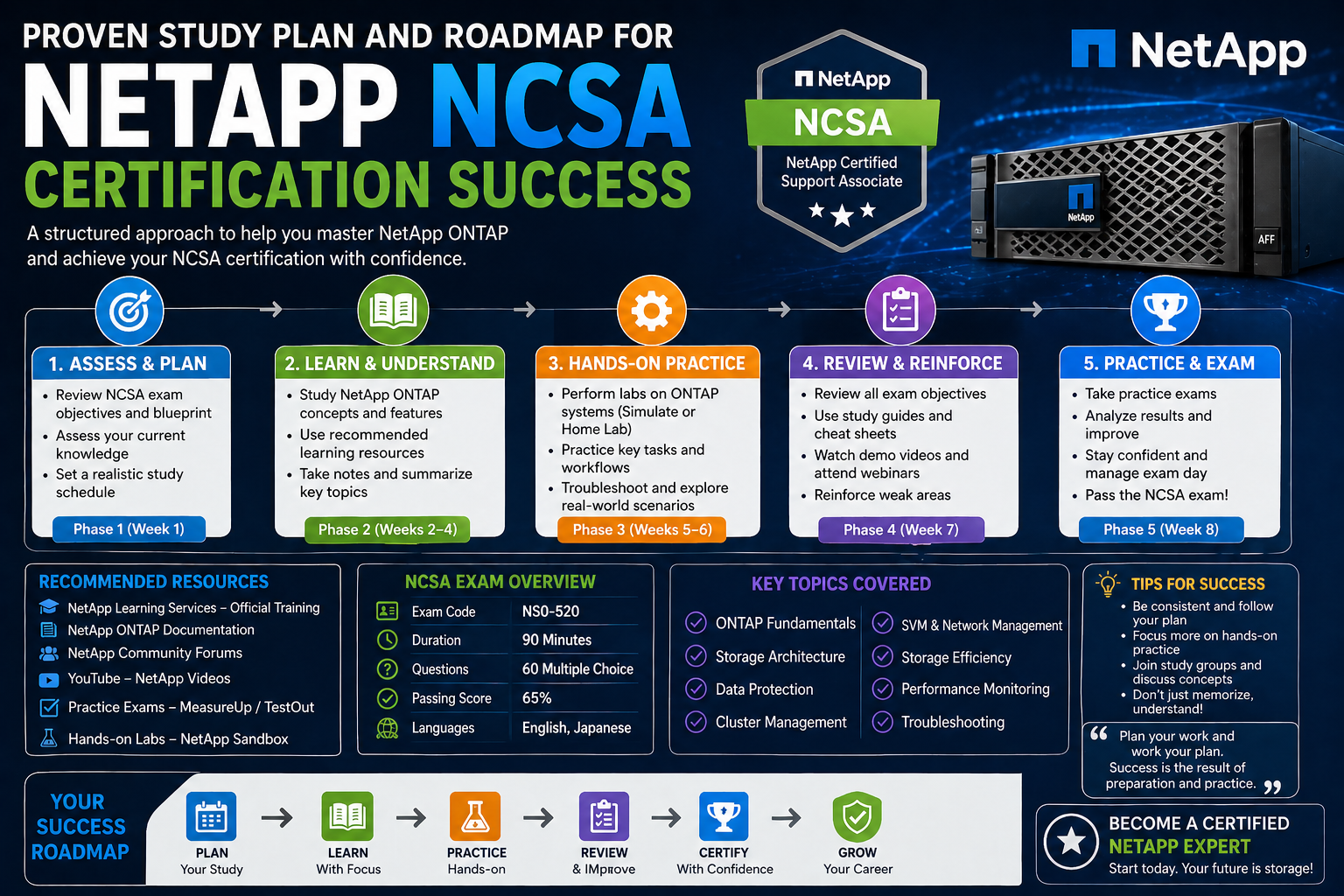
The concept of a structured certification roadmap is becoming increasingly important in modern information technology environments, particularly in areas where infrastructure reliability and data management play a central role. Storage technologies form the backbone of enterprise computing, and professionals working in this field are expected to understand not only theoretical principles but also practical system behavior. Within this context, NetApp certifications provide a structured learning progression designed to guide learners from foundational knowledge to advanced technical expertise.
The idea behind a certification roadmap is not limited to passing exams. It is centered on building a layered understanding of technologies that evolve in complexity. In the case of NetApp, this progression begins with fundamental storage concepts and gradually advances toward specialized administration and engineering capabilities. Each stage of this journey is designed to reinforce earlier knowledge while introducing more advanced operational and architectural concepts.
For many learners, entering the storage domain can feel overwhelming due to the depth of systems involved, including data protection, performance optimization, scalability considerations, and hybrid infrastructure integration. A structured roadmap helps simplify this complexity by dividing learning objectives into manageable stages. This approach allows professionals to build confidence while gradually increasing their technical responsibilities.
The NetApp certification framework is particularly focused on aligning technical knowledge with real-world enterprise requirements. Rather than emphasizing memorization, it focuses on practical understanding of storage environments, system behavior, and operational decision-making. This makes the roadmap relevant not only for certification preparation but also for long-term career development in IT infrastructure roles.
The Role of Storage Technologies in Modern IT Infrastructure
Storage systems are no longer passive repositories of data. They are active, dynamic components of enterprise architecture that directly influence application performance, business continuity, and data accessibility. Organizations rely heavily on storage platforms to support workloads ranging from simple file storage to complex database systems, virtualization environments, and cloud-based applications.
As digital transformation continues to accelerate, the importance of efficient data storage and management has increased significantly. Enterprises generate massive volumes of structured and unstructured data, requiring systems that can handle scalability, redundancy, and security without compromising performance. This has led to a growing demand for professionals who understand how storage systems operate at both hardware and software levels.
NetApp has established itself as a key player in this domain by providing storage solutions designed for flexibility, reliability, and integration with hybrid environments. These systems are widely used in enterprise data centers where uptime and performance are critical. Understanding how these systems function is essential for IT professionals who aim to work in infrastructure management or cloud-related roles.
Storage technologies also play a crucial role in disaster recovery strategies. Organizations must ensure that data remains accessible even during system failures or unexpected outages. This requires a deep understanding of replication methods, snapshot technologies, and backup strategies. Professionals working with storage systems are often responsible for implementing and maintaining these safeguards.
Another important aspect of modern storage environments is virtualization. Many enterprises now use virtualized infrastructure to improve efficiency and reduce hardware dependency. Storage systems must integrate seamlessly with virtual machines and hypervisors, ensuring that data access remains fast and reliable. This integration adds another layer of complexity that professionals must understand in order to manage systems effectively.
Introduction to the NetApp Ceto Structure
The NetApp certification framework is designed as a tiered system that reflects increasing levels of expertise and responsibility. It begins with entry-level certifications and progresses through intermediate and advanced stages. Each level is intended to build upon the knowledge gained in the previous stage, ensuring a continuous learning experience.
At the foundation of this structure is the Associate level, which introduces learners to essential storage concepts and basic system operations. This stage is focused on building familiarity with NetApp environments and understanding how storage systems are configured and managed at a basic level.
The next stage is the Administrator level, which represents an intermediate stage in the certification pathway. At this level, learners are expected to have a deeper understanding of system configuration, management tasks, and operational troubleshooting. This stage is critical for professionals who aim to take on more responsibility in enterprise environments.
The highest level in the certification structure is the Engineer level. This stage focuses on advanced implementation, architecture design, and specialized storage solutions. Professionals at this level are expected to design and deploy complex storage infrastructures that meet enterprise requirements.
This structured approach ensures that learners are not overwhelmed by advanced concepts too early in their learning journey. Instead, they are gradually introduced to more complex topics as their understanding grows. This progression also aligns with real-world career development, where professionals typically advance from support roles to administrative and engineering positions over time.
In addition to the core certification track, NetApp also offers specialized certifications that integrate with other technologies. These certifications are designed for professionals working in hybrid environments where storage systems interact with networking and cloud platforms. This reflects the growing importance of cross-domain expertise in modern IT roles.
Positioning of the NetApp Certified Storage Associate in the Certification Pathway
The NetApp Certified Storage Associate represents the entry point into the NetApp certification ecosystem. Although it is considered foundational, it is not purely introductory in terms of complexity. It is designed for individuals who already possess some familiarity with IT systems, particularly storage-related environments.
This certification focuses on core concepts such as storage architecture, system configuration, data management principles, and basic administrative functions. It is intended to ensure that learners understand how NetApp systems operate in enterprise environments and how they contribute to overall infrastructure performance.
One of the key aspects of this certification is its emphasis on practical understanding. Rather than focusing solely on theoretical definitions, it encourages learners to develop an operational mindset. This means understanding how storage systems behave under different conditions, how data flows through the system, and how administrators interact with storage platforms in real-world scenarios.
The certification also introduces learners to the fundamental concepts of Data ONTAP, which is the operating system used in NetApp storage environments. Understanding this system is essential because it governs how storage resources are managed, allocated, and optimized.
Another important aspect of this certification is its focus on industry relevance. Employers often look for candidates who not only understand general IT concepts but also have specific knowledge of storage technologies. The NetApp Certified Storage Associate helps bridge this gap by validating that a candidate has the foundational skills required to work in storage-focused roles.
This certification is often pursued by individuals who have already gained some experience in IT support, system administration, or network management. It acts as a stepping stone toward more advanced certifications and specialized roles within the storage domain.
Foundational Knowledge Areas Required for NCSA Readiness
Before pursuing this certification, learners are generally expected to have a basic understanding of operating systems and IT infrastructure concepts. Familiarity with environments such as Windows or UNIX-based systems provides a useful foundation for understanding storage interactions.
Understanding how file systems operate is also important. Storage systems rely heavily on file organization structures, permissions, and access control mechanisms. Learners who are already comfortable navigating file systems and understanding directory structures will find it easier to grasp storage concepts.
Networking knowledge also plays a role in preparing for this certification. Storage systems are often connected across networks, and data transfer between systems must be efficient and secure. Concepts such as IP addressing, routing, and basic network protocols help learners understand how storage systems communicate within an enterprise environment.
Another important area of knowledge is virtualization. Many modern storage systems are integrated into virtualized environments where multiple virtual machines share underlying physical resources. Understanding how virtualization works helps learners appreciate the role of storage in supporting dynamic workloads.
Basic troubleshooting skills are also valuable. Storage systems can encounter issues related to performance, connectivity, or configuration. Being able to identify and resolve basic issues is an important part of working with these systems.
While prior experience is helpful, it is not always mandatory to have deep expertise before beginning preparation. The certification is structured in a way that allows learners to build their understanding progressively as they study the material and explore system concepts.
Practical Relevance of NetApp Storage Knowledge in IT Environments
The skills associated with NetApp storage systems are widely applicable across different sectors of the IT industry. Organizations of all sizes rely on efficient data storage solutions to support their operations. This makes storage knowledge highly valuable in roles related to infrastructure management, system administration, and technical support.
In enterprise environments, storage administrators are responsible for ensuring that data is stored securely and accessed efficiently. This involves monitoring system performance, managing storage allocation, and ensuring that backup and recovery processes are functioning correctly.
NetApp systems are often used in environments where data availability is critical. This includes industries such as finance, healthcare, and telecommunications, where downtime or data loss can have significant consequences. Professionals working in these environments must be able to maintain system reliability under demanding conditions.
Another important application of storage knowledge is in cloud computing environments. As organizations move toward hybrid and multi-cloud architectures, storage systems must be able to integrate seamlessly with cloud platforms. Understanding how on-premises storage interacts with cloud-based systems is becoming an increasingly important skill.
Storage professionals also play a role in supporting application performance. Many enterprise applications rely heavily on fast and reliable data access. Storage configuration can directly impact how quickly applications respond to user requests. This makes storage optimization a critical part of overall system performance management.
Security is another key consideration in storage environments. Data must be protected from unauthorized access, corruption, and loss. Storage professionals are often involved in implementing encryption, access controls, and security policies to protect sensitive information.
Evolution of Skills Through the Certification Journey
As learners progress through the NetApp certification pathway, their skills evolve from basic understanding to advanced system design capabilities. The Associate level focuses on foundational concepts, while higher levels introduce more complex topics such as system architecture and enterprise-scale deployment.
This progression reflects the natural development of IT careers, where professionals gradually take on more responsibility as their experience grows. Early stages often involve support and operational tasks, while later stages focus on design, implementation, and strategic planning.
The structured nature of this progression ensures that learners are not exposed to advanced concepts before they are ready. Instead, each stage builds on the knowledge gained previously, creating a continuous learning experience that reinforces understanding over time.
As professionals advance, they begin to develop a more strategic perspective on storage systems. Instead of focusing only on individual components, they start to understand how entire systems work together to support business objectives. This shift in perspective is a key part of becoming an effective storage professional.
Advanced stages of the certification pathway also emphasize problem-solving and optimization. Professionals are expected to design systems that not only function correctly but also perform efficiently under varying workloads. This requires a deep understanding of system behavior and performance characteristics.
The evolution of skills through the certification pathway ultimately prepares professionals for roles that involve significant technical responsibility. These roles require not only technical knowledge but also the ability to make informed decisions that impact enterprise infrastructure.
Understanding NetApp Storage Architecture in Practical Environments
Modern enterprise storage environments are built on layered architectures that combine hardware resources, operating systems, and management interfaces into a unified system. NetApp storage solutions are designed around this principle, ensuring that data is stored, accessed, and managed in a way that supports scalability and performance. To understand how the NetApp Certified Storage Associate fits into real-world operations, it is important to explore how storage architecture is structured and how each component contributes to system behavior.
At the core of NetApp environments is a tightly integrated storage operating system that manages how data is written, stored, and retrieved. This system is responsible for coordinating hardware resources such as disks and controllers while also managing logical structures like volumes, aggregates, and storage pools. The abstraction of physical resources into logical components allows administrators to manage storage more efficiently without needing to interact directly with hardware at all times.
Storage architecture in enterprise environments is designed to support high availability. This means that systems are built in a way that minimizes downtime and ensures continuous access to data even in the event of hardware or software failure. Redundancy is a key principle in this design, where multiple components are configured to take over if one fails. This ensures that business operations remain uninterrupted.
Another important aspect of storage architecture is data efficiency. Enterprises often deal with large volumes of data, and storing this information efficiently is critical for cost control and performance optimization. Techniques such as deduplication, compression, and thin provisioning are commonly used to reduce storage consumption while maintaining data accessibility.
The NetApp storage model also emphasizes modularity. This means that storage systems can be expanded or modified without disrupting existing operations. Additional storage capacity can be added dynamically, allowing organizations to scale their infrastructure as data requirements grow. This flexibility is essential in environments where data growth is unpredictable.
Understanding this architecture is essential for learners preparing for the NetApp Certified Storage Associate certification because it forms the foundation for all administrative and operational tasks. Without a clear understanding of how storage components interact, it becomes difficult to manage systems effectively or troubleshoot issues when they arise.
Role of Data ONTAP in Storage Management
The operating system that powers NetApp storage environments plays a central role in defining how data is managed and processed. This system is responsible for handling everything from file system operations to network communication and storage allocation. It acts as the bridge between physical hardware and user-level storage operations.
One of the key functions of this operating system is to manage data access. When a user or application requests data, the system determines where that data is stored and retrieves it efficiently. This process must be optimized to ensure low latency and high throughput, especially in environments with heavy workloads.
Another important function is storage virtualization. Instead of exposing physical disks directly to users, the system abstracts these resources into logical units. This allows administrators to manage storage more flexibly and allocate resources based on application needs rather than hardware limitations.
The system also plays a critical role in data protection. Features such as snapshots allow administrators to capture point-in-time copies of data without impacting system performance. These snapshots can be used for backup, recovery, and testing purposes, making them an essential part of enterprise storage strategies.
Data consistency is another important responsibility of the operating system. In environments where multiple users and applications access the same data, it is essential to ensure that changes are tracked accurately and conflicts are avoided. The system manages this through locking mechanisms and transactional controls.
For learners pursuing certification, understanding how this operating system functions is essential. It provides the foundation for all storage operations and is central to both basic administration and advanced system management tasks.
Storage Management Tasks and Administrative Responsibilities
Storage administration involves a wide range of tasks that ensure systems operate efficiently and reliably. These tasks include configuration, monitoring, optimization, and troubleshooting. Each of these responsibilities requires a clear understanding of how storage systems behave under different conditions.
One of the primary responsibilities of a storage administrator is system configuration. This involves setting up storage volumes, defining access permissions, and configuring network connectivity. Proper configuration ensures that systems are aligned with organizational requirements and can support expected workloads.
Monitoring is another critical aspect of storage management. Administrators must continuously observe system performance to identify potential issues before they impact operations. This includes tracking metrics such as storage utilization, response time, and system health indicators.
Optimization is also an important responsibility. Over time, storage systems may become inefficient due to changes in usage patterns or data growth. Administrators must regularly review system performance and make adjustments to improve efficiency. This may involve reconfiguring storage layouts or adjusting resource allocation.
Troubleshooting is a key skill for any storage professional. When issues arise, administrators must quickly identify the root cause and implement corrective actions. This requires a deep understanding of system behavior and the ability to interpret diagnostic information.
Security management is another important responsibility. Administrators must ensure that data is protected from unauthorized access and that appropriate security policies are in place. This includes managing user permissions and implementing encryption where necessary.
These administrative tasks form the core of daily operations in storage environments and are an essential part of the knowledge required for certification.
Understanding Storage Virtualization and Resource Abstraction
Storage virtualization is a fundamental concept in modern data management systems. It refers to the process of abstracting physical storage resources into logical units that can be managed more efficiently. This abstraction allows administrators to allocate storage dynamically without being constrained by physical hardware structures.
In traditional storage systems, data is stored directly on physical disks, and management tasks are often tied to hardware configurations. In virtualized environments, however, storage resources are pooled together and presented as logical entities. This allows for greater flexibility and efficiency in resource utilization.
One of the main benefits of storage virtualization is improved scalability. Organizations can add or remove storage resources without disrupting existing systems. This makes it easier to respond to changing data requirements and workload demands.
Another advantage is simplified management. Instead of managing individual disks, administrators can work with logical units such as volumes and aggregates. This reduces complexity and makes it easier to configure and maintain storage systems.
Virtualization also improves performance by allowing data to be distributed across multiple physical devices. This helps balance workloads and prevents bottlenecks in high-demand environments.
In NetApp environments, storage virtualization is tightly integrated with the operating system, allowing for seamless management of both physical and logical resources. Understanding this integration is essential for professionals working with these systems.
Data Protection Mechanisms in Storage Systems
Data protection is one of the most critical aspects of storage management. Organizations rely on storage systems not only to store data but also to ensure that it remains safe and recoverable in the event of failure or corruption.
One of the most common data protection techniques is snapshot technology. Snapshots capture the state of data at a specific point in time, allowing administrators to restore previous versions if needed. This is particularly useful in scenarios where data is accidentally deleted or modified.
Replication is another important data protection mechanism. This involves copying data from one storage system to another, often in a different location. Replication ensures that data remains available even if the primary system fails.
Backup strategies are also essential in storage environments. Regular backups ensure that data can be recovered in the event of catastrophic failure. These backups may be stored on separate systems or in cloud environments.
Data integrity is another important consideration. Storage systems must ensure that data is not corrupted during storage or transmission. This is achieved through error-checking mechanisms and redundancy techniques.
Security also plays a role in data protection. Encryption ensures that data remains secure even if it is accessed by unauthorized users. Access controls restrict who can view or modify data, adding an additional layer of protection.
Understanding these mechanisms is essential for anyone working with storage systems, as they form the foundation of enterprise data management strategies.
Performance Optimization in Storage Environments
Performance is a critical factor in storage system design and management. Poor performance can lead to delays in application response times and reduced productivity across an organization. As a result, storage professionals must understand how to optimize system performance effectively.
One of the key factors influencing performance is storage layout. The way data is distributed across disks can have a significant impact on access speed. Proper configuration ensures that workloads are balanced and that no single component becomes a bottleneck.
Caching is another important performance enhancement technique. Frequently accessed data can be stored in faster memory locations, reducing the time required for retrieval. This improves overall system responsiveness.
Workload management is also essential for maintaining performance. Different applications have different storage requirements, and systems must be configured to handle these demands efficiently. Prioritizing critical workloads ensures that important applications receive the resources they need.
System monitoring plays a key role in performance optimization. By tracking performance metrics, administrators can identify trends and make adjustments before issues arise. This proactive approach helps maintain system stability.
Scalability also contributes to performance optimization. As data volumes increase, storage systems must be able to expand without degrading performance. Proper architecture design ensures that systems can handle growth effectively.
Introduction to FlexPod and Integrated Infrastructure Concepts
Integrated infrastructure solutions have become increasingly important in modern IT environments. These solutions combine computing, networking, and storage into a unified architecture that simplifies deployment and management.
FlexPod is an example of such an integrated approach, where storage systems are combined with networking and computing components to create a cohesive infrastructure platform. This integration allows organizations to deploy systems more quickly and manage them more efficiently.
One of the key advantages of integrated infrastructure is reduced complexity. Instead of managing separate systems for storage, networking, and computing, administrators can work within a unified environment. This simplifies configuration and reduces the potential for compatibility issues.
Another advantage is improved scalability. Integrated systems can be expanded more easily, allowing organizations to adapt to changing requirements without significant redesign efforts.
Performance is also enhanced through integration. Components are designed to work together, ensuring that data flows efficiently between systems. This reduces latency and improves overall responsiveness.
For learners in the storage domain, understanding integrated infrastructure concepts provides valuable insight into how modern data centers operate. It also helps prepare them for environments where storage systems are part of larger, interconnected architectures.
Preparing for Operational Roles in Storage Environments
As learners progress through their certification journey, they begin to transition from theoretical understanding to practical operational roles. These roles involve direct interaction with storage systems and responsibility for maintaining system performance and reliability.
Operational roles often include tasks such as system monitoring, configuration management, and troubleshooting. Professionals in these roles must be able to respond quickly to issues and ensure that systems remain stable under varying conditions.
Communication is also an important aspect of operational roles. Storage professionals often work with other IT teams, including network administrators and application developers. Effective communication ensures that issues are resolved efficiently and that systems are aligned with organizational needs.
Decision-making is another key skill in operational environments. Professionals must be able to assess situations quickly and determine the best course of action. This requires both technical knowledge and practical experience.
As professionals gain experience, they often move into more advanced roles that involve system design and architecture. These roles require a deeper understanding of storage systems and their interaction with other IT components.
The transition from operational to advanced roles reflects the natural progression of IT careers and highlights the importance of continuous learning in the storage domain.
Evolving Career Path After Entry Level Certification
The progression after achieving an entry-level certification is rarely linear, and it often reflects the structure of their IT infrastructure teams. In many enterprise environments, the initial certification serves as a gateway into roles that focus on operational stability and foundational system management. From there, professionals gradually expand their responsibilities as they gain exposure to more complex storage environments.
At this stage of a career, individuals typically begin to shift from learning theoretical concepts to applying those concepts in live systems. This transition is important because storage environments behave differently in practice than they do in documentation. Real systems involve unpredictable workloads, changing business requirements, and interconnected dependencies that require careful management.
As professionals gain experience, they begin to understand how storage systems influence broader IT operations. This includes how application performance depends on storage responsiveness, how backup strategies affect recovery times, and how infrastructure decisions impact long-term scalability. This broader perspective is essential for career advancement in storage-focused roles.
Career growth in this field is closely tied to the ability to interpret system behavior. Professionals who can analyze storage performance trends, identify inefficiencies, and propose improvements are often given more responsibility. This shift marks the beginning of a transition from operational support roles into more strategic positions.
Over time, individuals are expected to move beyond basic system maintenance and begin contributing to infrastructure planning. This includes participating in decisions about storage architecture, capacity planning, and system optimization. These responsibilities require both technical expertise and a strong understanding of organizational needs.
Transition from Storage Associate to Administration Expertise
Moving from an entry level certification stage into administration-focused responsibilities requires a deeper understanding of how storage systems are configured and maintained. At this stage, professionals are expected to work with greater independence and take ownership of specific system components.
Administration expertise involves managing storage resources in a way that ensures consistent performance and reliability. This includes tasks such as volume management, access control configuration, and system monitoring. These responsibilities require a balance between technical precision and operational awareness.
One of the key differences at this stage is the shift from reactive problem solving to proactive system management. Instead of respondingproblem-solvingr they occur, administrators are expected to anticipate potential problems and implement preventive measures. This approach helps maintain system stability and reduces downtime.
Another important aspect of administrative expertise is understanding system dependencies. Storage environments do not operate in isolation; they are connected to servers, applications, and network infrastructure. Administrators must understand how changes in one area can affect other parts of the system.
As professionals develop these skills, they become more valuable to organizations because they can ensure that storage systems remain aligned with business requirements. This alignment is critical in environments where data availability and performance directly impact organizational operations.
Expanding into Data Administration and Clustered Environments
As professionals progress further, they often move into more advanced certification stages that focus on data administration in clustered environments. These environments are designed to provide high availability and scalability by distributing workloads across multiple nodes.
Clustered storage systems introduce a higher level of complexity because they require coordination between multiple components. Data is not stored in a single location but is distributed across different nodes to ensure redundancy and performance optimization. Understanding how these systems interact is essential for effective management.
In clustered environments, administrators must understand how data is balanced across nodes. This involves monitoring system load and ensuring that no single node becomes overloaded. Proper load distribution improves performance and enhances system reliability.
Another important aspect of clustered environments is failover management. If one node becomes unavailable, the system must automatically redirect workloads to other nodes without disrupting operations. This requires careful configuration and ongoing monitoring.
Data administration in these environments also involves managing replication and synchronization processes. Ensuring that data remains consistent across all nodes is critical for maintaining system integrity. This requires a strong understanding of system behavior and timing.
Professionals working in clustered environments often develop a more holistic view of storage systems. Instead of focusing on individual components, they begin to understand how entire systems operate as unified entities. This perspective is essential for advanced infrastructure roles.
Advanced Engineering Pathways and Infrastructure Design
At higher levels of expertise, professionals transition into engineering roles where they are responsible for designing and implementing storage infrastructures. These roles require a deep understanding of system architecture, performance optimization, and scalability planning.
Infrastructure design involves creating storage systems that meet both current and future organizational needs. This requires careful analysis of data growth trends, workload patterns, and application requirements. Engineers must ensure that systems are designed to handle increasing demands without performance degradation.
One of the key responsibilities in engineering roles is capacity planning. This involves predicting how much storage will be required over time and designing systems that can scale accordingly. Accurate capacity planning helps prevent system bottlenecks and ensures long-term stability.
Another important aspect of engineering roles is system integration. Storage systems must work seamlessly with networking and computing infrastructure. Engineers must ensure that all components are compatible and configured correctly to support enterprise workloads.
Performance engineering is also a critical responsibility. Engineers must design systems that deliver consistent performance under varying workloads. This requires a deep understanding of how data flows through storage systems and how different configurations impact performance.
Professionals in these roles often work on large-scale projects that involve multiple teams and complex requirements. This makes communication and collaboration essential skills for success.
Integration with Cisco Ecosystem and Hybrid Infrastructure Skills
Modern IT environments are rarely built around a single technology provider. Instead, they consist of integrated systems that combine storage, networking, and computing solutions from different vendors. Understanding how these systems interact is essential for professionals working in storage-related roles.
In many enterprise environments, storage systems are integrated with networking solutions to create unified infrastructure platforms. This integration allows for more efficient data movement and simplified management.
Hybrid infrastructure models are also becoming increasingly common. These models combine on-premises storage systems with cloud-based resources, allowing organizations to balance performance, cost, and scalability. Understanding how data flows between these environments is critical for modern storage professionals.
Professionals who develop skills across multiple technology domains are often more competitive in the job market. Combining storage expertise with networking knowledge allows for greater flexibility in infrastructure design and management.
In integrated environments, professionals must understand how different systems communicate and share data. This includes understanding protocols, data transfer mechanisms, and system compatibility requirements.
Hybrid infrastructure also introduces new challenges related to data governance and control. Organizations must ensure that data remains secure and compliant regardless of where it is stored. This requires careful planning and coordination between different IT teams.
Real World Enterprise Storage Scenarios and Decision Making
Working in storage environments involves more than technical configuration. Professionals are often required to make decisions that directly impact business operations. These decisions must balance performance, cost, and reliability considerations.
One common scenario involves managing storage capacity under changing workload conditions. As data grows, administrators must decide how to allocate additional resources without disrupting existing systems. This requires careful planning and analysis.
Another scenario involves handling system failures or performance degradation. In these situations, professionals must quickly identify the root cause and implement corrective actions. Decision making under pressure is a critical skill in storage environments. Decision-making is another common scenario in enterprise environments. Organizations may need to move data between systems for performance, cost, or infrastructure upgrade reasons. This process must be carefully managed to avoid data loss or downtime.
Storage professionals also play a role in optimizing system performance based on usage patterns. This involves analyzing system behavior and making adjustments to improve efficiency.
Each of these scenarios requires a combination of technical knowledge and practical experience. Over time, professionals develop the ability to make informed decisions that support both technical and business objectives.
Role of Automation and Operational Efficiency in Storage Management
Automation has become an important part of modern storage management. As systems grow in complexity, manual administration becomes less efficient and more prone to errors. Automation helps streamline repetitive tasks and improve overall system reliability.
Operational efficiency is improved through the use of automated monitoring and alerting systems. These systems continuously track performance metrics and notify administrators when issues arise. This allows for faster response times and reduced downtime.
Automation also plays a role in configuration management. Instead of manually configuring each system component, administrators can use predefined templates and scripts to ensure consistency across environments.
Another benefit of automation is improved scalability. As systems grow, automated processes allow for easier expansion and resource management. This reduces the administrative burden and ensures that systems remain manageable even at large scale.
While automation improves efficiency, it also requires careful implementation. Poorly designed automation processes can lead to system instability or unexpected behavior. Professionals must therefore understand both the benefits and risks associated with automation.
Cloud Adoption and Hybrid Storage Models
The adoption of cloud technologies has significantly changed the way storage systems are designed and managed. Organizations are increasingly using hybrid models that combine on-premises infrastructure with cloud-based storage services.
Hybrid storage models provide flexibility by allowing organizations to store data in different environments based on performance, cost, and accessibility requirements. This approach enables more efficient resource utilization.
One of the key challenges in hybrid environments is data synchronization. Ensuring that data remains consistent across different platforms requires careful planning and configuration.
Latency is another important consideration. Data stored in cloud environments may have different access times compared to on-premises systems. Understanding these differences is important for performance optimization.
Hybrid models also introduce new security considerations. Data must be protected across multiple environments, each with its own security requirements and access controls.
Professionals working in storage environments must therefore develop an understanding of both traditional storage systems and cloud-based architectures.
Data Lifecycle Management and Governance in Enterprise Storage
Data lifecycle management refers to the process of managing data from creation to deletion. This includes storage, usage, archiving, and eventual disposal of data. Effective lifecycle management is essential for maintaining system efficiency and compliance.
Governance plays a key role in ensuring that data is managed according to organizational policies. This includes defining access controls, retention policies, and compliance requirements.
In storage environments, data must be classified based on its importance and usage patterns. This classification helps determine how data should be stored and managed.
Archiving is another important aspect of lifecycle management. Older data that is not frequently accessed may be moved to lower-cost storage systems to improve efficiency.
Proper lifecycle management ensures that storage systems remain optimized and that unnecessary data does not consume valuable resources.
Performance Engineering in Large Scale Storage Systems
Performance engineering involves designing and maintaining systems that can handle large workloads efficiently. In enterprise storage environments, performance is influenced by factors such as system architecture, workload distribution, and resource allocation.
Large-scale systems require careful balancing of workloads to prevent bottlenecks. This involves distributing data across multiple resources and ensuring that no single component becomes overloaded.
Monitoring plays a key role in performance engineering. By analyzing system metrics, professionals can identify areas that require optimization.
Caching strategies are also important in large-scale environments. Frequently accessed data is stored in faster locations to improve response times.
Performance engineering is an ongoing process that requires continuous monitoring and adjustment.
Security and Compliance Requirements in Storage Careers
Security is a critical aspect of storage management. Data must be protected from unauthorized access, corruption, and loss. This requires the implementation of security policies and technical safeguards.
Compliance requirements vary depending on industry and region. Organizations must ensure that their storage systems meet relevant regulatory standards.
Access control mechanisms are used to restrict who can view or modify data. Encryption is used to protect data both at rest and in transit.
Security monitoring is also important for detecting potential threats or vulnerabilities.
Professionals working in storage environments must understand both technical security measures and organizational compliance requirements.
Industry Demand and Job Roles for Storage Professionals
The demand for storage professionals continues to grow as organizations generate increasing amounts of data. Storage-related roles include system administrators, storage engineers, infrastructure specialists, and data management professionals.
These roles require a combination of technical knowledge and practical experience. Professionals must be able to manage complex systems and ensure data availability.
Industries such as finance, healthcare, and telecommunications rely heavily on storage systems, making these roles highly relevant across multiple sectors.
Conclusion
The NetApp Certified Storage Associate pathway represents more than an entry point into storage certification; it reflects a structured approach to understanding how modern data infrastructure operates in enterprise environments. As organizations continue to expand their reliance on digital systems, storage has become a central component of IT strategy, influencing performance, scalability, and business continuity.
Throughout this certification journey, learners develop a gradual but meaningful progression of skills. Beginning with foundational storage concepts, they move toward practical system understanding and eventually gain exposure to more complex administrative and architectural responsibilities. This layered development ensures that professionals are not only capable of handling technical tasks but also prepared to understand how storage systems support broader organizational goals.
The importance of storage knowledge continues to grow as data volumes increase and hybrid infrastructure models become more common. Professionals who build expertise in this area position themselves for long-term career relevance, particularly in environments where data availability and system reliability are critical.
Ultimately, the certification pathway serves as a roadmap for continuous learning and professional development. It encourages a mindset of progression, where each stage builds confidence and capability for the next. In a rapidly evolving IT landscape, this structured growth becomes a key advantage for those aiming to establish a strong and sustainable career in storage technologies.