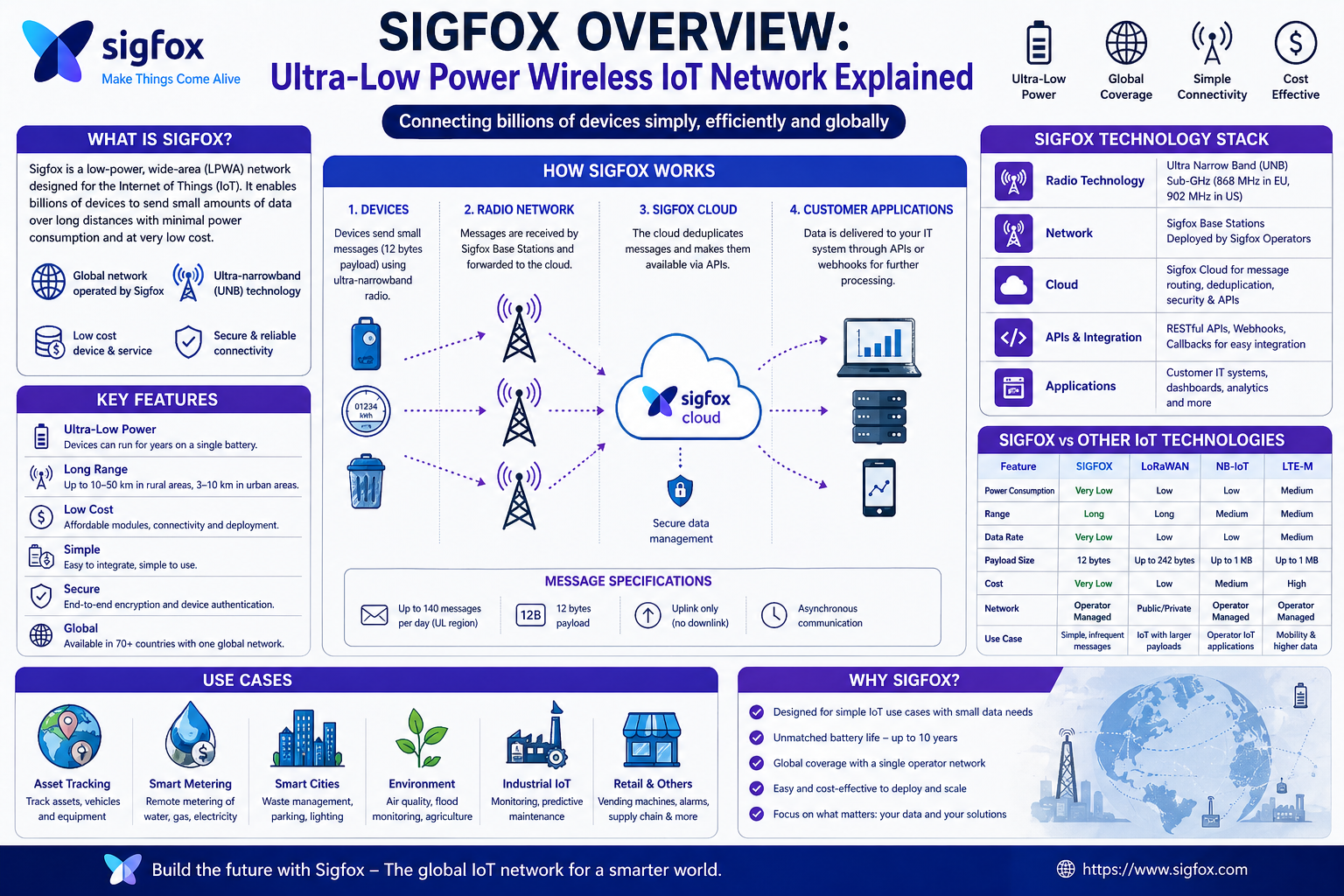
The Internet of Things has expanded rapidly over the past decade, introducing billions of connected devices into industries, cities, homes, and remote environments. As this ecosystem grows, one of the biggest challenges is not simply connecting devices, but choosing the right type of connection for the job. Different IoT applications have drastically different requirements. Some demand high-speed data transfer, while others prioritize energy efficiency, long-range communication, or extremely low operational cost.
SIGFOX emerges in this landscape as a specialized communication technology designed for a very specific set of needs. It is not a general-purpose networking solution, nor is it intended to replace traditional wireless technologies. Instead, it occupies a narrow but important space in what is often called Low-Power Wide-Area Networking (LPWAN). Its design philosophy is built around simplicity, minimal energy consumption, and long-distance communication using very small amounts of data.
To understand SIGFOX properly, it is important to step away from the idea that all networks behave similarly. Unlike Wi-Fi or Bluetooth, which focus on high data throughput over short distances, SIGFOX is designed for devices that transmit tiny bits of information over very large distances while consuming almost no energy.
The Concept of SIGFOX as a Communication Ecosystem
SIGFOX is often misunderstood as just another wireless protocol, but in practice, it is better described as a complete communication ecosystem. It includes both a physical layer technology and a global network infrastructure operated under a centralized model.
At its core, SIGFOX functions as both a technology and a managed service. The same name refers to the radio communication method used by devices and the company responsible for operating the global infrastructure. This dual nature is unusual compared to most wireless technologies, which are typically standardized and left for manufacturers or network operators to deploy independently.
Instead of allowing anyone to build compatible base stations and create independent networks, SIGFOX uses a tightly controlled structure. The infrastructure is owned and managed by regional operators who deploy base stations, maintain network coverage, and handle backend data routing. This means that individual organizations or users do not build or control the radio network itself. They simply connect devices to an existing infrastructure, much like subscribing to a mobile network.
This design choice simplifies deployment significantly for end users. Companies do not need to design or maintain complex wireless infrastructure. However, it also introduces a dependency on the network operator, making SIGFOX fundamentally different from open IoT protocols.
The Role of LPWAN and Why SIGFOX Exists
To understand why SIGFOX exists, it is helpful to look at the broader category it belongs to: Low-Power Wide-Area Networks. LPWAN technologies were developed to solve a very specific problem in IoT systems: how to connect devices that are spread across large geographic areas while consuming minimal energy.
Traditional wireless systems such as Wi-Fi or cellular networks are not always suitable for IoT sensors. Wi-Fi consumes too much power for battery-operated devices that may need to run for years without maintenance. Cellular networks, while powerful, often involve higher costs, more complex hardware, and greater energy consumption.
LPWAN technologies were introduced to fill this gap. They focus on:
- Extremely low power usage
- Long-range communication
- Small, infrequent data transmissions
- Low operational cost
SIGFOX is one of the earliest and most well-known LPWAN solutions. It takes these principles to an extreme by prioritizing energy efficiency and simplicity over everything else.
Rather than supporting continuous communication or large data transfers, SIGFOX is designed for devices that occasionally send small updates. These could include environmental readings, status updates, or simple alerts.
Architectural Philosophy Behind SIGFOX
One of the most defining characteristics of SIGFOX is its architectural philosophy. Unlike traditional wireless systems that allow flexible deployment of infrastructure, SIGFOX uses a centralized and operator-controlled model.
In most wireless technologies, organizations can install their own access points, routers, or base stations. For example, a company deploying Wi-Fi networks can design and manage its own infrastructure. Similarly, many industrial wireless protocols allow private network deployment.
SIGFOX takes a different approach. The radio infrastructure is not something users deploy themselves. Instead, SIGFOX base stations are installed and managed by licensed operators. These operators are responsible for providing network coverage across regions, much like mobile network providers in cellular systems.
The device transmits small radio messages that are picked up by nearby base stations. These base stations forward the data to a centralized system, where it is processed and delivered to the end application through secure interfaces.
This structure significantly reduces complexity for developers and organizations deploying IoT solutions. They do not need to worry about maintaining wireless infrastructure or managing radio frequency planning. However, it also means that SIGFOX is not a fully open or self-managed system.
How SIGFOX Devices Communicate
Communication in SIGFOX is intentionally minimalistic. Devices are designed to send very small packets of data using ultra-narrowband radio signals. These signals occupy extremely small portions of the radio spectrum, allowing many devices to operate simultaneously without significant interference.
A typical SIGFOX device does not maintain a continuous connection with the network. Instead, it wakes up, transmits a short message, and then returns to a low-power or sleep state. This approach dramatically reduces energy consumption, allowing devices to operate on small batteries for years.
The communication process is one-way in most cases. Devices primarily send data upward to the network (uplink communication). Downlink communication, where the network sends data back to the device, is extremely limited. This is a deliberate design choice to conserve energy and simplify the system.
Because of this structure, SIGFOX is best suited for applications where devices do not require constant interaction or real-time control. Instead, they are used for periodic reporting or event-based messaging.
Base Stations and Network Coverage Model
The SIGFOX network relies heavily on a distributed base station infrastructure. These base stations function similarly to cellular towers, but they are optimized for receiving very low-power signals from IoT devices.
Each base station continuously listens for incoming transmissions from nearby devices. Because SIGFOX operates using ultra-narrowband signals, even very weak transmissions can be detected over long distances, depending on environmental conditions.
Once a message is received, the base station forwards it to the central network infrastructure. This backend system handles message validation, duplication filtering, and routing to the appropriate application servers.
One of the interesting aspects of this architecture is redundancy. Devices often transmit the same message multiple times to increase the likelihood of successful delivery. Since the network is designed to handle duplicate messages efficiently, this redundancy improves reliability without requiring complex acknowledgments or retransmission mechanisms.
The base station network is typically managed at a national or regional level by licensed operators. This ensures consistent coverage and centralized management of infrastructure quality.
Data Transmission Constraints and Design Trade-offs
SIGFOX operates under strict constraints that define its behavior and capabilities. These constraints are not limitations in the traditional sense but intentional design decisions aimed at achieving ultra-low power consumption and long-range communication.
These restrictions mean that SIGFOX cannot be used for applications requiring large data transfers or continuous communication. Instead, it is optimized for short, occasional messages.
This design creates a unique trade-off. While SIGFOX cannot handle high-bandwidth applications, it excels in scenarios where energy efficiency and long-distance coverage are more important than speed.
For example, sending a small sensor reading once every few minutes or hours is ideal for SIGFOX. However, streaming data or supporting interactive applications is not feasible.
Signal Characteristics and Ultra-Narrowband Communication
One of the most distinctive technical features of SIGFOX is its use of ultra-narrowband communication. This approach involves transmitting signals using extremely narrow frequency channels, which reduces power consumption and improves signal reach.
Because the signal bandwidth is so small, SIGFOX transmissions can travel long distances with very low energy. This also makes the system highly resilient to noise, as narrowband signals can be detected even when they are close to the noise floor.
This is fundamentally different from technologies like Wi-Fi, which rely on broader bandwidths to achieve high data rates. In SIGFOX, the goal is not speed but reliability and efficiency.
The system also uses repetition as a reliability mechanism. Each message is transmitted multiple times on different frequencies to increase the probability that at least one copy will reach a base station successfully. This redundancy is crucial in maintaining communication integrity in challenging environments.
Device Behavior and Energy Efficiency Model
SIGFOX devices are designed with energy conservation as a primary goal. Most devices operate in a sleep state for the majority of the time, waking only when they need to transmit data.
This approach allows devices to operate for extremely long periods using small batteries. In many cases, devices can function for years without requiring maintenance or battery replacement.
The simplicity of the communication model also reduces the processing requirements on the device itself. There is no need for complex networking stacks, session management, or continuous synchronization with the network.
This minimalistic approach is one of the key reasons SIGFOX is widely used in remote sensing applications, where accessing devices frequently is impractical or expensive.
Early Perspective on SIGFOX’s Role in IoT Systems
Within IoT architectures, SIGFOX is typically used as a data collection layer rather than a control or management layer. It is not designed for real-time interaction or high-frequency communication. Instead, it serves as a bridge for transmitting small amounts of data from widely distributed devices back to centralized systems.
This makes it particularly useful in environments where devices are deployed in large numbers across wide geographic areas, such as environmental monitoring, infrastructure tracking, and utility metering.
At this stage of understanding, it becomes clear that SIGFOX is not trying to compete with general-purpose wireless technologies. Instead, it occupies a very specific niche where simplicity, energy efficiency, and long-range communication are the most important factors.
SIGFOX Physical Layer Design and Ultra-Narrowband Communication
The physical layer of SIGFOX is one of the most distinctive aspects of its entire system. Unlike conventional wireless technologies that attempt to maximize throughput, SIGFOX is engineered around the idea of minimizing energy usage while maximizing the probability that extremely small messages can survive transmission across long distances.
At the heart of this approach is ultra-narrowband (UNB) modulation. This technique uses extremely small slices of the radio frequency spectrum to transmit signals. By narrowing the bandwidth of each transmission, the system reduces the amount of noise captured during communication, allowing signals to remain detectable even at very low power levels.
In practical terms, this means SIGFOX devices can transmit signals at power levels that are often below what many other wireless systems would consider usable. Despite this, the signals can still be received over large distances because narrowband transmission reduces interference and improves sensitivity at the receiver side.
This design choice is not accidental. It reflects a deliberate engineering trade-off: instead of increasing power to overcome noise, SIGFOX reduces bandwidth to increase signal clarity. The result is a system optimized for long-range, low-energy communication rather than speed or data volume.
Frequency Use and Regional Variations in Deployment
SIGFOX does not operate on a single global frequency band. Instead, it adapts to regional regulatory environments by using different unlicensed frequency ranges depending on the country or region.
In Europe, SIGFOX typically operates in sub-GHz ISM bands, while in other regions such as North America or parts of Asia, different frequency allocations are used to comply with local regulations. These bands are chosen because they allow low-power devices to transmit without requiring individual licensing, making large-scale deployment more practical.
The use of sub-GHz frequencies is important for another reason: signal propagation. Lower frequency signals tend to travel further and penetrate obstacles more effectively than higher frequency signals. This makes them particularly suitable for IoT applications where devices may be located in remote or obstructed environments such as underground utilities, rural infrastructure, or industrial facilities.
However, operating in these bands also introduces challenges. Because they are unlicensed, they can be shared by multiple technologies, leading to potential interference. SIGFOX mitigates this through its ultra-narrowband approach and repeated transmissions, ensuring that even in noisy environments, at least one version of a message is likely to be received successfully.
Message Structure and Data Constraints in SIGFOX
One of the defining constraints of SIGFOX is its strict limitation on message size. Each transmission carries only a very small payload, typically measured in bytes rather than kilobytes or megabytes. This constraint fundamentally shapes how applications are designed for the network.
Instead of sending detailed datasets, SIGFOX devices are expected to transmit highly compressed or pre-processed information. For example, rather than sending continuous temperature readings, a device might send a single value at fixed intervals or only transmit when certain thresholds are reached.
This forces developers and system designers to rethink how data is generated and transmitted. Intelligence is pushed toward the edge, meaning devices must be capable of filtering and simplifying information before sending it.
In many cases, data is encoded in compact binary formats to maximize efficiency. Every byte is valuable, and unnecessary information is removed before transmission. This constraint is one of the reasons SIGFOX is often associated with simple sensor applications rather than complex computing tasks.
Uplink-Centric Communication Model
SIGFOX is fundamentally designed around uplink communication, where devices send data to the network rather than receiving it. This asymmetry is intentional and reflects the typical usage patterns of IoT devices in the environments SIGFOX targets.
Most devices in a SIGFOX network are sensors or monitoring units. They collect data and report it periodically without needing frequent instructions from a central system. As a result, the network is optimized for receiving large numbers of small incoming messages rather than maintaining two-way communication channels.
Downlink communication exists but is extremely limited. This limitation is not just a technical constraint but a design philosophy. Every downlink message consumes energy on the device side, as the device must actively listen for incoming transmissions. By minimizing downlink usage, SIGFOX significantly extends device battery life.
This communication imbalance also influences application design. Systems built on SIGFOX are typically event-driven rather than interactive. Devices report information, and backend systems handle processing and decision-making independently.
Redundancy Mechanisms and Message Reliability
Because SIGFOX operates in environments where interference and signal loss are possible, it uses redundancy as a core reliability mechanism. Instead of relying on acknowledgments or retransmission requests, the system uses repeated transmissions to increase the probability of successful delivery.
Each message is typically sent multiple times over slightly different frequencies and time intervals. These repetitions ensure that even if one transmission is lost due to interference or collision, others may still reach a base station successfully.
On the network side, duplicate messages are identified and filtered out. This deduplication process ensures that applications receive only a single logical message even if multiple copies were transmitted.
This approach eliminates the need for complex handshake protocols or continuous feedback loops. While it increases airtime usage slightly, it dramatically simplifies both device design and network management.
SIGFOX Backend Architecture and Data Processing Flow
Once a message is received by a base station, it enters the backend infrastructure of the SIGFOX network. This backend is responsible for handling large-scale message processing, validation, and routing.
The first step in this process is signal decoding. The raw radio transmission is converted into a digital message that can be processed by software systems. After decoding, messages are checked for integrity using built-in error detection mechanisms.
Next, the system performs deduplication. Since devices may transmit the same message multiple times, the backend ensures that only one instance of each message is forwarded to the application layer.
After deduplication, messages are routed to their intended destinations. This is typically done through secure application programming interfaces. Developers or system operators retrieve data from the network through these interfaces rather than interacting directly with radio infrastructure.
This separation between radio communication and application logic is one of the defining characteristics of SIGFOX. It creates a clear boundary between physical transmission and data processing, allowing each layer to operate independently.
Device Design Considerations for SIGFOX Networks
Designing devices for SIGFOX requires a fundamentally different mindset compared to traditional wireless systems. Because of the strict limitations on data size and transmission frequency, devices must be highly efficient in both energy usage and data handling.
Most SIGFOX devices are built around microcontrollers with very low power consumption profiles. These devices remain in sleep mode for extended periods and only activate when they need to send data.
The radio modules used in SIGFOX devices are also highly specialized. They are designed to transmit very short bursts of data using minimal energy. Unlike Wi-Fi or cellular modules, they do not support continuous communication or high-speed data transfer.
Another important consideration is antenna design. Because SIGFOX operates in sub-GHz frequencies, antennas must be optimized for longer wavelengths. This often results in physically larger antennas compared to higher-frequency systems, but it also improves signal propagation characteristics.
Overall, device design in SIGFOX is guided by the principle of simplicity. The fewer tasks a device performs, the longer it can operate without maintenance or power replacement.
Network Scalability and Capacity Management
One of the challenges in any wide-area communication system is scalability. As more devices are added to a network, the potential for congestion and interference increases.
SIGFOX addresses scalability through a combination of ultra-narrowband transmission, low data rates, and strict message limits. By ensuring that each device transmits only a small number of messages per day, the system reduces overall network load.
Additionally, the narrowband nature of transmissions allows many devices to share the same frequency spectrum with minimal overlap. Since signals occupy extremely small portions of the spectrum, multiple transmissions can coexist without significant interference.
However, this design also imposes inherent limits. The network is not suitable for high-density, high-frequency communication scenarios. Instead, it is optimized for distributed systems where each device communicates infrequently.
This makes SIGFOX particularly well-suited for large-scale sensor deployments where each device generates minimal data, but the total number of devices may be very large.
Comparison with Other LPWAN Approaches
Within the LPWAN ecosystem, SIGFOX is often compared with other technologies that aim to solve similar problems but use different architectural approaches. While many LPWAN systems allow private network deployment, SIGFOX is centrally managed and operates as a unified global infrastructure.
This centralized model simplifies deployment but reduces flexibility. In contrast, other LPWAN technologies may allow organizations to build and manage their own networks, giving them more control over infrastructure but also increasing complexity.
Another key difference lies in data handling. Some LPWAN systems support higher data rates and more flexible communication patterns, while SIGFOX prioritizes extreme efficiency and simplicity.
These differences highlight the fact that LPWAN is not a single unified technology but rather a category of solutions with varying design philosophies. SIGFOX represents one end of this spectrum, focusing heavily on minimalism and operational simplicity.
Operational Constraints and Environmental Suitability
SIGFOX performs best in environments where devices are geographically dispersed,d and data requirements are minimal. These environments often include rural infrastructure, industrial monitoring systems, environmental sensing networks, and utility tracking applications.
In dense urban environments, SIGFOX can still function effectively, but network planning becomes more important due to potential interference and device density. Even so, the system’s redundancy and ultra-narrowband design help maintain reliability in challenging conditions.
Environmental factors such as building density, terrain, and weather conditions can influence signal propagation, but the system is designed to tolerate a wide range of real-world conditions. Its reliance on low-frequency transmission helps it maintain connectivity even in less-than-ideal scenarios.
Evolving Role of SIGFOX in Modern IoT Ecosystems
As IoT ecosystems continue to evolve, SIGFOX occupies a specialized but stable role. It is not designed to compete with high-speed or interactive communication technologies but instead complements them by serving a different class of applications.
Its strengths lie in simplicity, energy efficiency, and long-range communication. These characteristics make it particularly valuable in scenarios where devices must operate independently for long periods without human intervention.
Over time, the role of SIGFOX has become more defined as part of a broader multi-technology IoT landscape. In many real-world deployments, it is used alongside other communication systems, each serving different layers of the overall architecture.
This layered approach reflects a growing recognition in IoT design: no single communication technology can meet all requirements. Instead, different systems are combined based on application needs, with SIGFOX occupying a niche focused on lightweight, low-frequency data transmission.
SIGFOX Security Model and Threat Landscape in IoT Deployments
Security in SIGFOX is often misunderstood because the system does not follow the same security model as traditional IP-based networks. Instead of relying heavily on complex device-side security stacks, SIGFOX distributes security responsibilities across multiple layers, including the device, the radio transmission, and the backend network infrastructure.
At the device level, security is intentionally lightweight. Devices are constrained by limited processing power and energy resources, which makes implementing heavy cryptographic protocols impractical in many cases. Instead, SIGFOX relies on a combination of message integrity checks, lightweight encryption options, and network-level protections to maintain security.
At the radio transmission level, the system benefits from its physical characteristics. The ultra-narrowband nature of SIGFOX signals makes them difficult to detect without specialized equipment. This does not provide absolute security, but it reduces exposure to casual interception attempts. However, it is important to understand that this form of obscurity is not sufficient protection against determined attackers.
The strongest security controls exist within the backend infrastructure. Once a message reaches the SIGFOX network, it passes through secure processing systems that handle authentication, encryption validation, and access control. Communication between the backend and application servers is typically secured using standard internet security protocols such as encrypted API communication.
This layered approach reflects a practical balance between device limitations and system-wide security requirements. However, it also means that security is not uniform across the entire communication path, and responsibility is shared between network operators and application developers.
Encryption, Integrity, and Data Protection Mechanisms
SIGFOX supports optional encryption mechanisms that allow sensitive data to be protected during transmission. However, encryption is not always enabled by default, which means the security level can vary depending on how the system is implemented.
When encryption is used, it typically occurs at the application layer before data is transmitted. This means that the device itself or the application logic is responsible for encrypting the payload before sending it over the SIGFOX network. Once transmitted, the encrypted data is treated as a standard message by the network infrastructure.
Integrity checking is handled through lightweight error detection mechanisms embedded in the transmission structure. These mechanisms ensure that messages are not corrupted during transmission and allow the network to discard invalid or incomplete data packets.
Because messages are extremely small, traditional heavy cryptographic methods are often avoided in favor of simpler techniques. This creates a trade-off between security strength and energy efficiency.
In environments where data sensitivity is high, additional encryption layers are typically implemented at the application or backend level. This ensures that even if a message is intercepted during transmission, its contents remain protected.
Security Risks in Ultra-Low Power IoT Networks
While SIGFOX provides a functional level of security for many use cases, it is not immune to risks. One of the primary challenges in ultra-low power IoT networks is the limited computational capacity of devices, which restricts the use of advanced security mechanisms.
One potential risk is message interception. Although SIGFOX signals are difficult to detect due to their low power and narrow bandwidth, they are not impossible to capture using specialized equipment. If messages are not encrypted, sensitive data could potentially be exposed.
Another risk involves replay attacks. Because devices often transmit simple, repetitive messages, attackers may attempt to capture and retransmit valid messages to manipulate system behavior. The network mitigates this risk through backend validation and deduplication, but it remains a consideration in system design.
Device spoofing is another concern. If an attacker is able to replicate device identifiers or transmission patterns, they may attempt to inject false data into the network. Proper authentication mechanisms and backend verification are essential to prevent this type of threat.
These risks highlight the importance of designing SIGFOX-based systems with security in mind at multiple layers rather than relying solely on the underlying communication protocol.
Power Efficiency and Long-Term Battery Operation
One of the most significant advantages of SIGFOX is its extremely low power consumption model. Devices operating on this network are designed to function for extended periods using minimal energy, often relying on small batteries that last several years.
This is achieved through a combination of design strategies. First, devices spend most of their time in a deep sleep state, consuming almost no power. They only activate when a transmission is required, which may occur only a few times per day or even less frequently.
Second, the transmission process itself is highly efficient. Because messages are very small and sent at low data rates, the energy required for each transmission is minimal. This allows devices to conserve energy even during communication events.
Third, the absence of continuous connectivity reduces energy drain significantly. Unlike systems that maintain constant network sessions, SIGFOX devices do not need to stay connected to the network at all times.
This power efficiency makes SIGFOX particularly suitable for remote or inaccessible environments where replacing batteries frequently would be impractical or costly.
Industrial Applications and Real-World Use Cases
SIGFOX has found adoption in a wide range of industrial and environmental applications where low data transmission requirements align with its capabilities. These use cases typically involve monitoring, tracking, or reporting simple data points over long periods.
One common application is utility metering. Devices installed in water, gas, or electricity meters can transmit usage data periodically without requiring wired infrastructure or frequent maintenance. This enables large-scale deployment across cities and rural areas.
Environmental monitoring is another important use case. Sensors measuring temperature, humidity, air quality, or soil conditions can operate in remote locations and transmit data at scheduled intervals. This is particularly useful in agriculture, forestry, and climate monitoring systems.
Asset tracking is also widely supported. Small devices attached to equipment, vehicles, or containers can periodically report location or status information. Because SIGFOX devices are energy-efficient, they can remain operational for long durations without battery replacement.
Infrastructure monitoring applications include tracking structural health in bridges, pipelines, or buildings. These systems rely on occasional data updates rather than continuous streaming, making SIGFOX an appropriate communication method.
Limitations in High-Performance IoT Scenarios
Despite its advantages, SIGFOX is not suitable for all IoT applications. Its design constraints introduce limitations that make it impractical for high-performance or data-intensive scenarios.
One of the most significant limitations is data throughput. The system is not designed to handle large volumes of information. Applications that require frequent updates or large data transfers must use alternative communication technologies.
Another limitation is latency. SIGFOX is not optimized for real-time communication. Messages may experience delays due to network scheduling, transmission repetition, and backend processing. This makes it unsuitable for time-critical applications such as industrial automation or real-time control systems.
Bidirectional communication is also limited. Because downlink capacity is extremely restricted, devices cannot rely on frequent instructions or feedback from the network. This reduces its suitability for interactive systems where continuous communication is required.
These limitations are not design flaws but intentional trade-offs. SIGFOX prioritizes energy efficiency and simplicity over performance and flexibility, which defines its role within the broader IoT ecosystem.
Network Ownership and Centralized Infrastructure Model
Unlike many wireless technologies that allow decentralized deployment, SIGFOX operates under a centralized infrastructure model. This means that the network is managed by licensed operators who control base station deployment, network maintenance, and backend services.
This centralized structure ensures consistency across regions and simplifies network management. However, it also means that users do not have the ability to deploy private SIGFOX networks independently. Instead, they must rely on existing infrastructure provided by operators.
This model is similar in some ways to cellular networks, where infrastructure is owned and managed by telecommunications companies. Devices connect to the network without requiring users to manage physical infrastructure.
The centralized approach also enables large-scale coverage without requiring individual organizations to invest in their own communication infrastructure. However, it introduces dependency on network availability and operator coverage.
Data Routing and Backend Communication Systems
Once data is transmitted from a device and received by a base station, it enters a backend processing system that handles routing and delivery to applications.
This backend system performs several key functions. First, it decodes the raw radio transmission into structured data. Second, it verifies message integrity to ensure that the data has not been corrupted during transmission. Third, it filters duplicate messages that may result from repeated transmissions by the device.
After processing, the data is forwarded to application servers through secure communication channels. These channels are typically based on standard internet protocols and include encryption to ensure data security during transfer.
This separation between radio communication and application logic is one of the defining features of SIGFOX. It allows developers to focus on application design without needing to manage low-level wireless communication details.
Scalability Challenges and Network Optimization Strategies
As IoT deployments grow in size, scalability becomes a critical factor. SIGFOX addresses scalability through a combination of design constraints and network optimization techniques.
The strict limitation on message frequency ensures that no single device can overwhelm the network with excessive traffic. This helps maintain stability even as the number of connected devices increases.
Ultra-narrowband communication allows multiple devices to transmit simultaneously without significant interference. Because each signal occupies a very small portion of the spectrum, the network can support a large number of devices within the same frequency range.
Additionally, redundancy mechanisms ensure reliability without requiring complex coordination between devices. This reduces overhead and simplifies network management.
However, scalability is still bounded by physical spectrum limitations and infrastructure capacity. In extremely dense deployments, careful planning is required to avoid congestion and maintain performance.
SIGFOX in the Broader Evolution of IoT Communication Systems
SIGFOX represents a specific stage in the evolution of IoT communication systems, where simplicity and efficiency were prioritized to enable early large-scale deployments of connected devices.
Over time, IoT requirements have diversified significantly. Some applications now require high bandwidth, low latency, or complex bidirectional communication. These needs have led to the development of alternative technologies that complement SIGFOX rather than replace it.
Within this evolving landscape, SIGFOX continues to serve applications that align with its core strengths: low data rate communication, long battery life, and wide-area coverage. It remains particularly relevant in environments where infrastructure simplicity and operational efficiency are more important than performance complexity.
Its design philosophy highlights an important principle in IoT system engineering: no single communication technology can satisfy all requirements. Instead, different technologies coexist, each optimized for specific use cases and operational constraints.
Extended Perspective on SIGFOX Deployment and System Evolution
Beyond its technical design, SIGFOX also represents a broader shift in how communication systems are conceptualized for large-scale IoT ecosystems. Traditional networking models often assume that connectivity must be continuous, high-capacity, and interactive. SIGFOX challenges this assumption by demonstrating that many real-world systems function effectively with extremely limited communication requirements.
In practice, this shift has encouraged engineers and system designers to rethink how data is generated and transmitted. Instead of continuously streaming information, devices are increasingly designed to operate in event-driven modes. This means data is only sent when meaningful changes occur, rather than at fixed high-frequency intervals. This approach not only reduces network load but also significantly extends device lifespan.
Another important aspect of SIGFOX’s evolution is its influence on system architecture design. Because communication is constrained, more intelligence must be placed at the edge of the network. Devices are expected to preprocess data, filter unnecessary information, and decide when transmission is actually required. This concept, often referred to as edge optimization, has become increasingly important across IoT systems in general, not just those using SIGFOX.
Practical Constraints Shaping Engineering Decisions
One of the most overlooked impacts of SIGFOX is how its constraints influence engineering behavior. Developers working with this system cannot rely on traditional assumptions about connectivity or data availability. Instead, they must design applications with strict awareness of communication limits.
This often leads to more efficient system design overall. Since every byte transmitted has value, data structures are simplified, and unnecessary complexity is removed early in the design process. In many cases, this constraint-driven design results in more stable and predictable systems compared to unconstrained communication models.
Additionally, engineers must carefully consider timing strategies. Because devices cannot transmit frequently, decisions about when to send data become critical. Many systems adopt threshold-based logic, where transmissions are triggered only when certain conditions are met. This ensures that only meaningful information is sent across the network.
These constraints also encourage better long-term planning. Instead of focusing on short-term performance optimization, systems are designed with durability and sustainability in mind. This is particularly important for large-scale deployments where maintenance costs and device accessibility are significant concerns.
Integration Challenges in Multi-Technology IoT Environments
In modern IoT ecosystems, it is rare for a single communication technology to be used in isolation. Instead, multiple systems are often integrated to meet different operational requirements. SIGFOX frequently plays a role within these hybrid environments, but its integration introduces specific challenges.
One of the primary challenges is data synchronization. Since SIGFOX devices transmit infrequently and without real-time guarantees, aligning their data with faster systems can be complex. Backend systems must account for delays and irregular reporting intervals when combining data streams.
Another challenge is protocol translation. SIGFOX data must often be converted into formats compatible with other networking systems or cloud platforms. This requires middleware components that can interpret, normalize, and route data appropriately.
Despite these challenges, integration is a common and necessary practice. Many organizations use SIGFOX alongside cellular, Wi-Fi, or other LPWAN technologies to build layered communication architectures. Each technology serves a different role, with SIGFOX typically handling low-frequency, low-bandwidth sensor data.
This layered approach allows systems to balance performance, cost, and energy efficiency more effectively than relying on a single communication method.
Environmental and Geographic Factors Affecting Performance
While SIGFOX is designed for wide-area coverage, its real-world performance is still influenced by environmental and geographic conditions. Terrain, building density, vegetation, and atmospheric conditions can all affect signal propagation.
In open rural environments, SIGFOX typically performs very well due to minimal obstructions and low interference. Signals can travel long distances, making them suitable for agricultural monitoring and remote infrastructure applications.
Conclusion
SIGFOX represents a very specific approach to IoT connectivity, built around the idea that not all connected devices require high-speed or continuous communication. Instead, many real-world applications only need to transmit small amounts of data occasionally over long distances while consuming minimal power. By focusing on these requirements, SIGFOX has carved out a distinct role within the broader Internet of Things ecosystem.
Its ultra-narrowband communication model, strict message limitations, and centralized network architecture all reflect a deliberate design philosophy that prioritizes efficiency over flexibility. This makes it especially suitable for applications such as environmental monitoring, utility metering, and remote asset tracking, where devices are expected to operate for long periods with little maintenance.
At the same time, SIGFOX is not a universal solution. Its limitations in data size, transmission frequency, and bidirectional communication mean it cannot support applications that require real-time control, high bandwidth, or complex interactions. Instead, it functions best as part of a larger IoT strategy where different communication technologies are combined based on specific needs.
From a security perspective, SIGFOX relies on a layered model that distributes responsibility between devices, transmission characteristics, and backend infrastructure. While it offers a practical level of protection for many use cases, stronger security often depends on additional encryption and application-level safeguards.
Ultimately, SIGFOX highlights an important principle in modern network design: efficiency and specialization can be just as valuable as speed and capacity. Embracing constraints rather than trying to eliminate them, it enables a class of IoT applications that would otherwise be difficult to support. As IoT continues to expand, technologies like SIGFOX will remain relevant wherever simplicity, low power consumption, and wide-area coverage are more important than high data throughput or interactive communication.