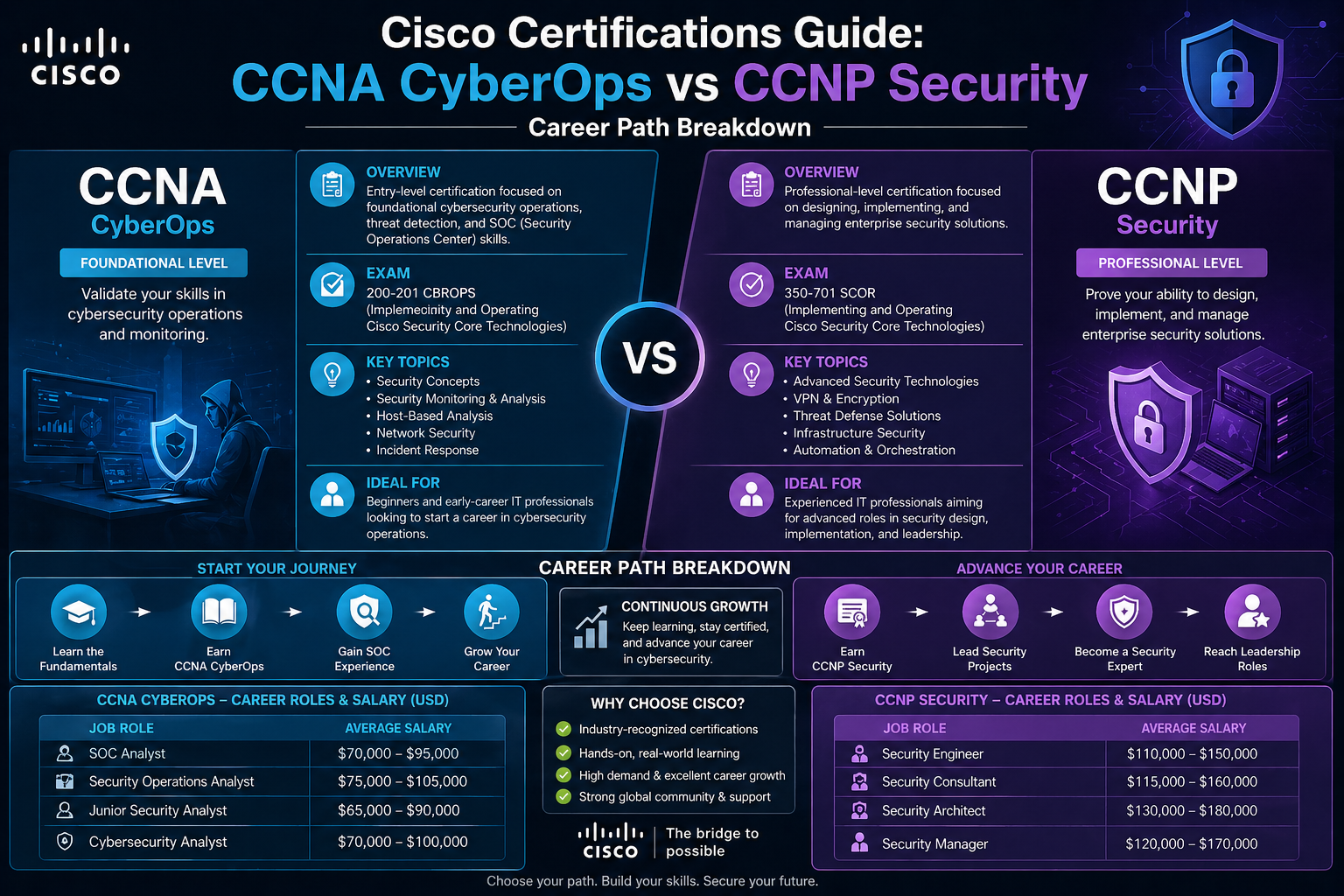
The field of cybersecurity has changed rapidly over the past decade as organizations have shifted from traditional on-premises infrastructure to highly distributed, cloud-connected environments. This transformation has increased the complexity of defending networks, applications, and data, creating a strong demand for professionals who understand both foundational networking principles and modern security operations. Cisco, as one of the major players in networking technology, has continuously evolved its certification framework to reflect these changes and align with real-world job requirements.
In earlier certification structures, Cisco focused heavily on tiered progressions where learners would start with entry-level certifications and gradually move toward more advanced roles through a series of structured steps. This model emphasized building a strong technical base before progressing into specialized domains. However, as the cybersecurity landscape matured, the need for more flexible and role-focused certification paths became increasingly clear. Employers began prioritizing practical skills over rigid certification ladders, especially in areas like security monitoring, threat detection, and incident response.
As a result, Cisco introduced certifications that align more closely with job functions rather than strictly hierarchical progression. This shift allowed candidates to enter cybersecurity more directly, even without extensive prior certifications, while still offering advanced paths for experienced professionals seeking deeper specialization. Within this evolving ecosystem, two certifications stand out for comparison due to their different positioning: the Cisco Certified CyberOps Associate and the CCNP Security track.
The CyberOps Associate certification emerged as a response to the growing need for entry-level security analysts who can operate within security operations centers. At the same time, the CCNP Security track evolved to serve professionals who aim to design, implement, and manage enterprise-level security solutions. These two certifications represent different ends of the cybersecurity career spectrum, reflecting both foundational operational skills and advanced architectural expertise.
Understanding this evolution is essential because it highlights why these certifications are often compared. They are not simply technical exams; they represent distinct philosophies in cybersecurity training. One emphasizes operational readiness at the analyst level, while the other focuses on advanced security engineering and strategic implementation. This distinction forms the basis for evaluating their relevance to different career goals.
Understanding the Cisco Certified CyberOps Associate Track
The Cisco Certified CyberOps Associate certification is designed to introduce learners to the operational side of cybersecurity. It is structured around the responsibilities typically found in security operations centers, where professionals continuously monitor systems, analyze alerts, and respond to potential security incidents. Unlike more advanced certifications that require deep architectural knowledge or extensive experience, this certification is positioned as an accessible entry point into the cybersecurity field.
One of the defining characteristics of the CyberOps Associate certification is its accessibility. It does not require any formal prerequisites, which means individuals from diverse technical backgrounds can begin their cybersecurity journey without first completing multiple lower-level certifications. This openness has made it particularly appealing to those transitioning from general IT roles or even from non-technical fields who are seeking to enter cybersecurity.
The certification focuses on building a strong conceptual understanding of how security operations function in practice. This includes recognizing different types of threats, understanding how security tools generate alerts, and learning how analysts interpret and prioritize these alerts. The emphasis is not just on theoretical knowledge but on developing the mindset required to work in a fast-paced, alert-driven environment where decisions must be made quickly and accurately.
Another important aspect of this certification is its alignment with real-world SOC workflows. Candidates are introduced to how security incidents are detected, escalated, and resolved within structured operational environments. This includes understanding how logs are analyzed, how suspicious behavior is identified, and how incident response procedures are initiated. These concepts are critical for anyone aiming to work in entry-level cybersecurity roles.
The certification also reflects modern cybersecurity challenges by emphasizing the importance of data analysis and correlation. Security analysts are expected to work with large volumes of data from multiple sources, identifying patterns that may indicate malicious activity. The CyberOps Associate framework introduces learners to this analytical thinking process, which is essential in today’s threat landscape, where attacks are often subtle and distributed across multiple systems.
By focusing on operational readiness, this certification helps bridge the gap between theoretical IT knowledge and practical cybersecurity work. It prepares individuals to function effectively in environments where continuous monitoring and rapid response are essential. This makes it particularly suitable for those aiming to begin their careers in security monitoring or SOC-based roles.
Core Knowledge Areas Within CyberOps Associate
The CyberOps Associate certification covers a range of foundational knowledge areas that collectively prepare candidates for entry-level security operations roles. These areas are carefully selected to reflect the day-to-day responsibilities of a security analyst working in a monitored environment where threats must be detected, analyzed, and responded to efficiently.
One of the primary knowledge areas is network security fundamentals. Understanding how data flows across networks is essential for identifying abnormal behavior. Security analysts must be able to distinguish between legitimate traffic and potentially malicious activity. This requires familiarity with basic networking concepts, including how devices communicate, how protocols function, and how data packets are structured and transmitted.
Another critical area is security monitoring. In a SOC environment, analysts constantly review logs and alerts generated by security tools. The certification introduces the concept of monitoring systems that detect unusual behavior, such as unauthorized access attempts or unexpected data transfers. Learners develop an understanding of how these systems generate alerts and how those alerts are interpreted within operational workflows.
Threat analysis is also a central component of the certification. This involves recognizing different types of cyber threats, including malware, phishing attempts, and intrusion activities. Candidates learn how these threats manifest in system logs and how they can be identified through behavioral patterns. The focus is on developing analytical thinking rather than memorizing specific attack types.
Incident response is another key area covered in the certification. Once a potential security incident is identified, it must be assessed and managed appropriately. This includes determining the severity of the incident, escalating it when necessary, and following established procedures to contain and mitigate the threat. Understanding these processes is essential for maintaining organizational security and minimizing damage.
The certification also introduces basic cryptography concepts. While not deeply technical at this level, it provides an understanding of how encryption supports data protection and secure communication. This foundational knowledge helps analysts understand how encrypted traffic may appear in monitoring systems and why certain data cannot be directly inspected.
In addition to these technical areas, the certification emphasizes analytical thinking and problem-solving. Security analysts must be able to interpret incomplete or ambiguous data and make informed decisions based on available evidence. This skill is critical in environments where threats may not be immediately obvious and require careful investigation.
Together, these knowledge areas form a comprehensive foundation for understanding cybersecurity operations. They are designed to prepare candidates for the realities of working in a SOC, where constant vigilance and structured analysis are essential for maintaining security.
Role of SOC Operations in Modern Cybersecurity Environments
Security Operations Centers, commonly referred to as SOCs, play a central role in modern cybersecurity strategies. These environments are responsible for monitoring an organization’s digital infrastructure around the clock, identifying potential threats, and coordinating responses to security incidents. The CyberOps Associate certification is closely aligned with these operational environments, making it particularly relevant for individuals aiming to enter SOC-based roles.
A SOC functions as a centralized hub where security data from across an organization is collected and analyzed. This includes logs from servers, network devices, applications, and security tools. The goal is to create a unified view of the organization’s security posture, allowing analysts to detect anomalies that might indicate malicious activity.
Within this environment, analysts are responsible for continuously reviewing alerts generated by monitoring systems. These alerts may indicate anything from unusual login attempts to potential malware infections. However, not all alerts represent genuine threats, which is why analysts must carefully evaluate each one to determine its significance. This process requires both technical understanding and critical thinking skills.
Another important function of SOC operations is incident triage. When a potential security event is identified, it must be assessed to determine its severity and impact. Low-risk events may be logged for further analysis, while high-risk incidents require immediate action. This prioritization process ensures that critical threats are addressed quickly and efficiently.
SOC environments also rely heavily on collaboration. Analysts often work as part of a team, sharing information and escalating issues when necessary. Communication plays a key role in ensuring that incidents are properly managed and resolved. This collaborative aspect is an important part of the CyberOps Associate framework, as it reflects real-world operational dynamics.
In addition to monitoring and response, SOCs are also involved in continuous improvement. This includes analyzing past incidents to identify patterns, refining detection rules, and improving response procedures. Over time, this helps organizations strengthen their overall security posture and reduce the likelihood of future incidents.
The CyberOps Associate certification prepares candidates for these responsibilities by introducing them to the operational mindset required in SOC environments. It emphasizes vigilance, structured analysis, and rapid decision-making, all of which are essential for effective security operations.
Skills Developed Through CyberOps Associate Preparation
Preparing for the CyberOps Associate certification helps develop a range of practical skills that are directly applicable to entry-level cybersecurity roles. These skills extend beyond theoretical knowledge and focus on how security professionals interact with systems, data, and operational workflows in real-world environments.
One of the most important skills developed is log analysis. Security analysts must be able to interpret logs generated by various systems and identify signs of suspicious activity. This requires attention to detail and the ability to recognize patterns that may indicate security incidents. Over time, this skill becomes essential for quickly identifying potential threats within large volumes of data.
Another key skill is threat identification. Candidates learn how to recognize indicators of compromise and distinguish between normal system behavior and potential malicious activity. This involves understanding common attack vectors and how they manifest in system data. While the certification does not require deep expertise in hacking techniques, it builds awareness of how attacks typically appear in monitored environments.
Incident evaluation is also a critical skill developed through this certification. Analysts must assess the severity of security events and determine appropriate responses. This involves considering factors such as potential impact, affected systems, and likelihood of escalation. The ability to make these judgments quickly and accurately is essential in fast-paced SOC environments.
Communication skills are another important component. Security analysts must be able to clearly document incidents and communicate findings to other team members. This includes writing concise reports that describe what was observed, what actions were taken, and what further steps may be required. Clear communication ensures that incidents are handled effectively and consistently.
Analytical thinking is perhaps the most broadly developed skill in this certification. Candidates are trained to approach problems methodically, breaking down complex data into manageable components. This helps in identifying root causes of security issues and understanding how different elements of a system interact.
Finally, the certification helps build situational awareness. Security professionals must constantly be aware of the broader environment in which systems operate. This includes understanding how different components of a network interact and how changes in one area can affect overall security.
These skills collectively prepare individuals for the demands of entry-level cybersecurity roles, particularly those focused on monitoring and analysis. They also provide a foundation for further specialization in more advanced security domains.
Typical Career Pathways Linked to Entry-Level Cybersecurity Roles
Entry-level cybersecurity roles serve as the foundation for long-term career development in the field. Individuals who begin with the CyberOps Associate certification often find themselves in positions that focus on monitoring, analysis, and initial incident response. These roles provide valuable hands-on experience and exposure to real-world security environments.
One common career pathway involves working as a security analyst within a SOC. In this role, professionals are responsible for monitoring security alerts, investigating potential threats, and escalating incidents when necessary. This position is often the first step into the cybersecurity industry and provides essential experience in handling live security events.
Another possible pathway is moving into roles focused on incident response. These positions involve a deeper investigation of security breaches and the coordination of remediation efforts. While entry-level analysts may not immediately take on these responsibilities, experience gained in SOC environments can lead to progression into these roles over time.
Some professionals may also transition into roles related to threat analysis. This involves studying attack patterns, identifying vulnerabilities, and helping organizations improve their defenses. This pathway often requires additional specialization but builds on the foundational skills developed through entry-level certifications.
There is also potential for growth into security engineering roles. While this typically requires more advanced certifications and experience, the foundational knowledge gained through entry-level certifications provides a starting point for understanding how security systems are designed and implemented.
Career progression in cybersecurity is often nonlinear, meaning individuals may move between different specializations based on their interests and organizational needs. The skills developed through entry-level certifications are highly transferable, allowing professionals to adapt to different roles over time.
The CyberOps Associate certification plays a key role in this journey by providing the initial exposure needed to enter the field. It helps individuals build confidence in handling security data and prepares them for more advanced challenges in the future.
Transition in Cisco Certification Structure and Exam Consolidation
Cisco’s certification structure has undergone significant changes to better align with industry needs and simplify the certification process. One of the most notable changes affecting the CyberOps Associate certification was the consolidation of multiple exams into a single streamlined assessment. This shift was designed to reduce complexity while maintaining the depth of knowledge required for cybersecurity roles.
Previously, candidates were required to complete separate exams covering different aspects of security operations. These exams focused individually on security fundamentals and operational procedures. However, as cybersecurity practices evolved, Cisco recognized that these areas were closely interconnected and could be more effectively assessed through a unified approach.
The introduction of a single consolidated exam reflects this understanding. By combining multiple knowledge areas into one assessment, the certification process became more efficient while still covering essential topics. This also allowed for a more integrated evaluation of a candidate’s ability to apply knowledge in practical scenarios.
This structural change also reflects broader trends in certification design. Modern certifications increasingly focus on real-world applicability rather than segmented theoretical knowledge. By evaluating candidates across multiple domains in a single exam, the certification better reflects the complexity of actual cybersecurity work.
The consolidation also emphasizes analytical skills and practical understanding over memorization. Candidates are expected to demonstrate their ability to interpret data, recognize threats, and respond appropriately within a unified framework. This approach aligns more closely with the responsibilities of entry-level cybersecurity roles.
In addition to simplifying the exam structure, these changes also reflect Cisco’s broader goal of making cybersecurity education more accessible. By reducing barriers to entry while maintaining rigorous standards, the certification continues to serve as a valuable starting point for individuals entering the field.
Initial Perspective on Advanced Cisco Security Certification Landscape
Beyond entry-level certifications, Cisco offers advanced pathways designed for professionals seeking deeper specialization in cybersecurity. These advanced certifications focus on complex security architectures, enterprise-level defense strategies, and the implementation of large-scale security solutions across organizations.
While entry-level certifications emphasize operational understanding and monitoring, advanced certifications shift toward design, configuration, and management of security systems. This includes working with firewalls, intrusion prevention systems, secure network architectures, and identity management solutions.
The transition from entry-level to advanced certifications represents a significant shift in focus. Professionals move from observing and analyzing security events to actively designing systems that prevent and mitigate those events. This requires a deeper understanding of network infrastructure and security frameworks.
Advanced certifications also place greater emphasis on strategic thinking. Security professionals must consider how different technologies integrate within an organization’s overall security posture. This includes balancing performance, scalability, and security requirements while ensuring compliance with organizational policies.
The skills required at this level build upon foundational knowledge but extend significantly into architectural and engineering domains. Professionals are expected to not only understand how systems work but also how to design and optimize them for maximum security effectiveness.
This progression highlights the broader ecosystem of Cisco security certifications, where entry-level and advanced tracks serve different but complementary purposes. The CyberOps Associate certification provides the foundation, while advanced certifications build upon that base to develop highly specialized expertise in enterprise security environments.
CCNP Security and the Shift Toward Advanced Cybersecurity Roles
The CCNP Security certification represents a significant step beyond entry-level cybersecurity knowledge, focusing on advanced security engineering, enterprise defense systems, and the implementation of complex network protection strategies. Unlike foundational certifications that introduce basic security operations and monitoring concepts, CCNP Security is designed for professionals who are expected to build, configure, and manage secure infrastructures at scale. This makes it a natural progression for individuals who already understand networking fundamentals and are ready to move into more specialized and technical security roles.
One of the most important aspects of CCNP Security is its alignment with real-world enterprise environments. Organizations today operate highly distributed networks that span data centers, cloud platforms, remote users, and hybrid infrastructures. Securing such environments requires more than basic monitoring skills; it requires a deep understanding of how security technologies interact across multiple layers of a network. The certification is structured to reflect these demands, emphasizing practical implementation and design principles.
Unlike entry-level certifications that focus on identifying and responding to threats, CCNP Security places a stronger emphasis on prevention and architecture. Professionals at this level are expected to design security solutions that minimize risk before incidents occur. This includes configuring firewalls, implementing secure access policies, managing identity systems, and deploying intrusion prevention technologies. These responsibilities require a more advanced technical foundation and a broader understanding of enterprise systems.
The flexibility introduced in the updated certification structure has made CCNP Security more accessible than in the past. Previously, candidates were required to follow a strict progression path through lower-level certifications before reaching CCNP-level exams. However, modern changes allow candidates to attempt core exams without mandatory prerequisites. This shift reflects the evolving nature of IT hiring practices, where practical skills and knowledge often matter more than formal certification sequences.
Despite this increased accessibility, CCNP Security remains a challenging certification. It requires not only theoretical understanding but also the ability to apply concepts in complex scenarios. Candidates must be comfortable working with advanced networking principles, security protocols, and enterprise-level technologies. This combination of depth and complexity is what distinguishes CCNP Security from entry-level certifications and positions it as a professional-level credential.
Core Focus Areas Within CCNP Security Certification
The CCNP Security certification covers a broad range of advanced topics that reflect the responsibilities of security engineers and architects in modern organizations. These topics are designed to prepare professionals for real-world challenges involving large-scale security deployments and complex infrastructure management.
One of the central focus areas is enterprise security architecture. This involves understanding how different security components work together to protect an organization’s digital assets. Professionals must be able to design secure network topologies that incorporate firewalls, VPNs, access control systems, and monitoring tools. This requires a deep understanding of how traffic flows through networks and how security policies can be applied effectively at different layers.
Another key area is secure network access. This involves managing how users and devices connect to organizational resources. In modern environments, where remote work and cloud services are common, controlling access is a critical security function. CCNP Security emphasizes the design and implementation of secure authentication systems, identity management solutions, and policy enforcement mechanisms.
Firewall technologies also play a major role in the certification. Professionals are expected to understand how to configure and manage next-generation firewalls, including rule creation, traffic inspection, and policy optimization. Firewalls are a fundamental component of enterprise security, and mastering their configuration is essential for protecting networks from external and internal threats.
Intrusion prevention systems are another important focus area. These systems are designed to detect and block malicious activity in real time. CCNP Security candidates learn how to configure these systems to identify known attack patterns as well as suspicious behavior. This requires a strong understanding of threat intelligence and network traffic analysis.
VPN technologies are also heavily emphasized. Virtual private networks are essential for securing communication between remote users and corporate networks. Professionals must understand how to configure secure tunnels, manage encryption protocols, and ensure data integrity across untrusted networks. This is especially important in environments where employees access systems from multiple locations.
In addition to these technical areas, CCNP Security also covers automation and programmability concepts. Modern security environments increasingly rely on automation to manage large-scale systems efficiently. Professionals are introduced to tools and techniques that allow them to automate repetitive tasks, monitor systems programmatically, and integrate security solutions with broader IT infrastructure.
These core focus areas collectively prepare candidates for advanced roles in cybersecurity. They reflect the shift from reactive security operations to proactive security design and management. This transition is essential for organizations that need to secure increasingly complex and dynamic environments.
Transition from Operational Security to Security Engineering
One of the most significant differences between entry-level cybersecurity certifications and CCNP Security is the shift in mindset from operational security to security engineering. While entry-level roles focus on monitoring systems and responding to incidents, security engineering roles are centered around designing and implementing systems that prevent those incidents from occurring in the first place.
This shift requires a deeper understanding of how networks are built and how security controls can be integrated into infrastructure from the ground up. Security engineers must consider not only how to detect threats but also how to design systems that are inherently resilient to attack. This involves making architectural decisions that balance security, performance, and usability.
In operational security environments, professionals typically work with predefined tools and processes. They monitor alerts, investigate incidents, and follow established response procedures. In contrast, security engineers are responsible for creating those tools and processes. They define how security systems are configured, how policies are enforced, and how different components interact within the network.
This difference in responsibility also affects the type of thinking required. Operational security relies heavily on analytical thinking and pattern recognition, while security engineering requires systems thinking and design-oriented problem solving. Professionals must be able to visualize how different components of a network interact and how changes in one area can impact overall security.
Another key distinction is the level of technical depth required. Security engineers must understand not only how security tools function but also how they are implemented at a technical level. This includes working with configuration interfaces, command-line tools, and integration frameworks. They must also be familiar with networking protocols, routing mechanisms, and system architectures.
The transition to security engineering also involves greater accountability. Engineers are often responsible for ensuring that security systems meet organizational requirements and comply with industry standards. This includes conducting risk assessments, evaluating security designs, and ensuring that implementations align with best practices.
CCNP Security is designed to support this transition by providing candidates with the knowledge and skills required to move from operational roles into engineering positions. It bridges the gap between understanding security concepts and applying them in complex, real-world environments.
Role of Enterprise Security in Modern Organizations
Enterprise security has become one of the most critical components of modern IT infrastructure. As organizations increasingly rely on digital systems to conduct business operations, the need to protect sensitive data, maintain system availability, and prevent cyberattacks has grown significantly. CCNP Security is closely aligned with the skills required to manage these enterprise security environments.
In large organizations, security is not a single function but a layered system of controls, policies, and technologies. These layers work together to create a comprehensive defense strategy that protects against a wide range of threats. Security professionals must understand how these layers interact and how to configure them effectively.
One of the key challenges in enterprise security is managing complexity. Modern networks often include a mix of on-premises systems, cloud services, and remote users. Each of these components introduces unique security considerations. Professionals must be able to design security architectures that account for this diversity while maintaining consistent protection across all environments.
Another important aspect is scalability. Enterprise security systems must be able to handle large volumes of traffic and support thousands of users without degrading performance. This requires careful planning and optimization of security policies and technologies. CCNP Security emphasizes the importance of designing scalable solutions that can grow with organizational needs.
Compliance is also a major factor in enterprise security. Organizations must adhere to industry regulations and standards that govern how data is stored, processed, and protected. Security professionals play a key role in ensuring that systems meet these requirements. This involves implementing controls, conducting audits, and maintaining documentation.
Risk management is another essential component of enterprise security. Professionals must be able to identify potential risks, assess their impact, and implement measures to mitigate them. This requires a strategic approach to security that goes beyond technical implementation and considers business objectives and operational constraints.
CCNP Security prepares professionals to work within this complex environment by providing the skills needed to design, implement, and manage enterprise security systems. It emphasizes both technical expertise and strategic thinking, making it suitable for roles that require a broad understanding of organizational security.
Technical Depth and Hands-On Implementation in CCNP Security
One of the defining characteristics of CCNP Security is its emphasis on technical depth and hands-on implementation. Unlike entry-level certifications that focus on conceptual understanding, CCNP Security requires candidates to engage directly with technologies and systems at a deeper level.
This includes working with advanced configuration settings for security devices such as firewalls and intrusion prevention systems. Candidates must understand how to fine-tune security policies to balance protection and performance. This often involves analyzing traffic patterns, identifying potential bottlenecks, and optimizing configurations accordingly.
Another important aspect of technical depth is troubleshooting. Security engineers must be able to diagnose and resolve issues within complex network environments. This requires a strong understanding of how different systems interact and how to identify the root cause of problems. Troubleshooting often involves analyzing logs, reviewing configurations, and testing system behavior under different conditions.
Integration is also a key technical skill covered in CCNP Security. Modern security environments often include multiple tools and platforms that must work together seamlessly. Professionals must understand how to integrate these systems to create unified security architectures. This includes working with APIs, automation tools, and centralized management platforms.
Policy management is another critical area of focus. Security policies define how systems behave and how access is controlled. Professionals must be able to design and implement policies that align with organizational requirements while maintaining security best practices. This requires careful planning and continuous refinement.
Encryption and secure communication protocols are also covered in greater depth at this level. Professionals must understand how encryption is implemented across different systems and how to ensure secure data transmission. This includes configuring VPNs, managing certificates, and understanding cryptographic standards.
The hands-on nature of CCNP Security ensures that candidates are not only familiar with theoretical concepts but also capable of applying them in real-world environments. This practical experience is essential for success in advanced cybersecurity roles.
Career Implications of CCNP Security Certification
CCNP Security certification has significant implications for career advancement in cybersecurity. It is widely recognized as a professional-level credential that demonstrates advanced technical expertise and the ability to manage complex security environments. Individuals who earn this certification are often considered for mid-level to senior roles within IT and cybersecurity teams.
One of the most common career paths for CCNP Security holders is security engineering. In this role, professionals are responsible for designing and implementing security solutions across enterprise networks. This includes configuring security devices, managing access controls, and ensuring compliance with organizational policies.
Another potential career path is network security architecture. This involves designing large-scale security frameworks that support organizational goals. Architects must consider factors such as scalability, performance, and risk management when developing security strategies. This role requires both technical expertise and strategic thinking.
CCNP Security can also lead to roles in security consulting. Consultants work with multiple organizations to assess security postures, identify vulnerabilities, and recommend improvements. This requires a broad understanding of security technologies and the ability to adapt solutions to different environments.
In some cases, professionals may move into leadership roles within security teams. These positions involve managing teams of analysts and engineers, coordinating security initiatives, and overseeing incident response efforts. Leadership roles require both technical knowledge and strong communication skills.
The certification also provides opportunities for specialization. Professionals can choose to focus on specific areas such as firewall management, identity security, or cloud security. This allows them to develop deep expertise in areas that align with their interests and career goals.
Overall, CCNP Security represents a significant step forward in cybersecurity careers. It opens doors to more advanced roles and provides the foundation for long-term professional growth in the field of enterprise security and network defense.
Comparing Career Entry Points Between CyberOps Associate and CCNP Security
When evaluating Cisco’s cybersecurity certification ecosystem, one of the most important considerations is where each certification leads in terms of career entry points. The Cisco Certified CyberOps Associate and CCNP Security are often discussed together because they sit at very different stages of the cybersecurity journey. One is designed to introduce learners to operational security roles, while the other prepares professionals for advanced engineering and architectural responsibilities.
The CyberOps Associate certification typically aligns with entry-level positions in security operations centers. These roles focus on monitoring systems, analyzing alerts, and responding to potential threats. Individuals in these positions are often referred to as junior security analysts or SOC analysts. Their primary responsibility is to observe security tools and identify suspicious activity based on predefined indicators and system behavior.
In contrast, CCNP Security is aligned with mid-level to advanced roles where professionals are expected to design and manage security infrastructure. Instead of simply responding to alerts, they are responsible for creating the systems that generate and manage those alerts. This includes configuring firewalls, implementing access control systems, and designing secure network architectures.
The difference in entry points reflects a broader difference in career trajectory. CyberOps Associate prepares individuals to enter the cybersecurity field quickly, even without prior certifications or extensive technical experience. It is often chosen by those transitioning from general IT support roles or from non-technical backgrounds. CCNP Security, on the other hand, assumes a stronger foundation in networking and IT systems, often requiring prior hands-on experience in enterprise environments.
This distinction is important because it shapes long-term career progression. CyberOps Associate serves as a gateway into operational cybersecurity roles, while CCNP Security serves as a pathway toward specialization and leadership in security engineering. Both certifications are valuable, but they serve different stages of professional development.
Depth of Knowledge: Operational Focus Versus Architectural Design
A key difference between CyberOps Associate and CCNP Security lies in the depth and nature of knowledge each certification develops. CyberOps Associate focuses on operational awareness and analytical skills, while CCNP Security emphasizes architectural design and technical implementation.
In CyberOps Associate, learners are primarily introduced to how security systems function from an operational perspective. This includes understanding how alerts are generated, how logs are interpreted, and how incidents are escalated. The emphasis is on recognizing patterns and responding to predefined scenarios. This type of knowledge is essential for working in environments where speed and accuracy are critical.
The knowledge gained at this level is broad but not deeply technical. Candidates are expected to understand how different security tools work together, but not necessarily how to configure them in detail. The goal is to develop situational awareness and the ability to make informed decisions based on available data.
CCNP Security, by contrast, requires a much deeper level of technical understanding. Professionals must know how to design and configure security systems from the ground up. This includes understanding how firewalls enforce policies, how VPNs establish secure connections, and how intrusion prevention systems detect and block threats.
At this level, knowledge is not just about recognizing threats but about preventing them through design. Professionals must be able to anticipate potential vulnerabilities and build systems that minimize risk. This requires a strong understanding of networking protocols, system architecture, and security frameworks.
Another important distinction is the level of abstraction. CyberOps Associate deals with higher-level concepts that are closer to day-to-day operational tasks. CCNP Security operates at a lower level of abstraction, focusing on how systems are built and how they interact internally. This makes it more technically demanding but also more powerful in terms of influence over organizational security posture.
The difference in depth of knowledge also affects how professionals interact with technology. CyberOps professionals typically use dashboards and monitoring tools to analyze system behavior. CCNP Security professionals often work directly with configuration interfaces, command-line tools, and system architectures.
Skill Development and Practical Application Differences
The skills developed through CyberOps Associate and CCNP Security differ significantly in both scope and application. CyberOps Associate focuses on analytical and operational skills, while CCNP Security develops engineering and design capabilities.
CyberOps Associate builds skills such as log analysis, alert interpretation, and incident response. These skills are essential for identifying potential security issues in real time. Professionals learn how to recognize patterns in system behavior and determine whether those patterns indicate normal activity or potential threats.
These skills are highly situational and depend on the ability to process large volumes of data quickly. Security analysts must be able to filter relevant information from noise and prioritize incidents based on severity. This requires strong attention to detail and the ability to remain focused under pressure.
CCNP Security develops a different set of skills that are more technical and design-oriented. These include configuring security devices, designing network architectures, and implementing security policies. Professionals must understand how to translate organizational requirements into technical solutions.
One of the most important skills at this level is system design. Security engineers must be able to create architectures that balance security, performance, and scalability. This involves making decisions about how different technologies are integrated and how data flows through the network.
Another key skill is troubleshooting complex systems. Unlike entry-level roles, where issues are often isolated, advanced security environments involve interconnected systems where a problem in one area can affect multiple components. Engineers must be able to trace issues across systems and identify root causes.
Automation is also an increasingly important skill in CCNP Security. Professionals are expected to use tools and scripts to manage repetitive tasks and improve efficiency. This allows them to focus on higher-level design and optimization tasks.
The practical application of these skills differs significantly. CyberOps professionals apply their skills in real-time monitoring environments, while CCNP Security professionals apply their skills in the design, deployment, and maintenance of security systems.
Conclusion
Both the Cisco Certified CyberOps Associate and CCNP Security certifications play important but distinctly different roles in the cybersecurity career landscape. CyberOps Associate is designed as an entry point into the field, focusing on security operations, threat detection, and incident response within SOC environments. It helps beginners develop the analytical mindset required to interpret logs, recognize suspicious activity, and respond to security alerts in real time. Its accessibility and lack of prerequisites make it a practical starting point for individuals transitioning into cybersecurity from other IT or non-technical backgrounds.
In contrast, CCNP Security targets professionals who are ready to move beyond monitoring and into the design and implementation of enterprise-level security solutions. It emphasizes advanced topics such as network security architecture, firewall configuration, identity management, and secure infrastructure design. This certification requires a deeper technical understanding and is better suited for those aiming for roles in security engineering or architecture.
Choosing between the two depends on experience level and career direction. CyberOps Associate builds foundational skills for operational roles, while CCNP Security supports long-term advancement into specialized and higher-responsibility positions. Together, they represent two complementary pathways within Cisco’s cybersecurity ecosystem, each essential for building a strong and scalable security workforce in modern organizations.