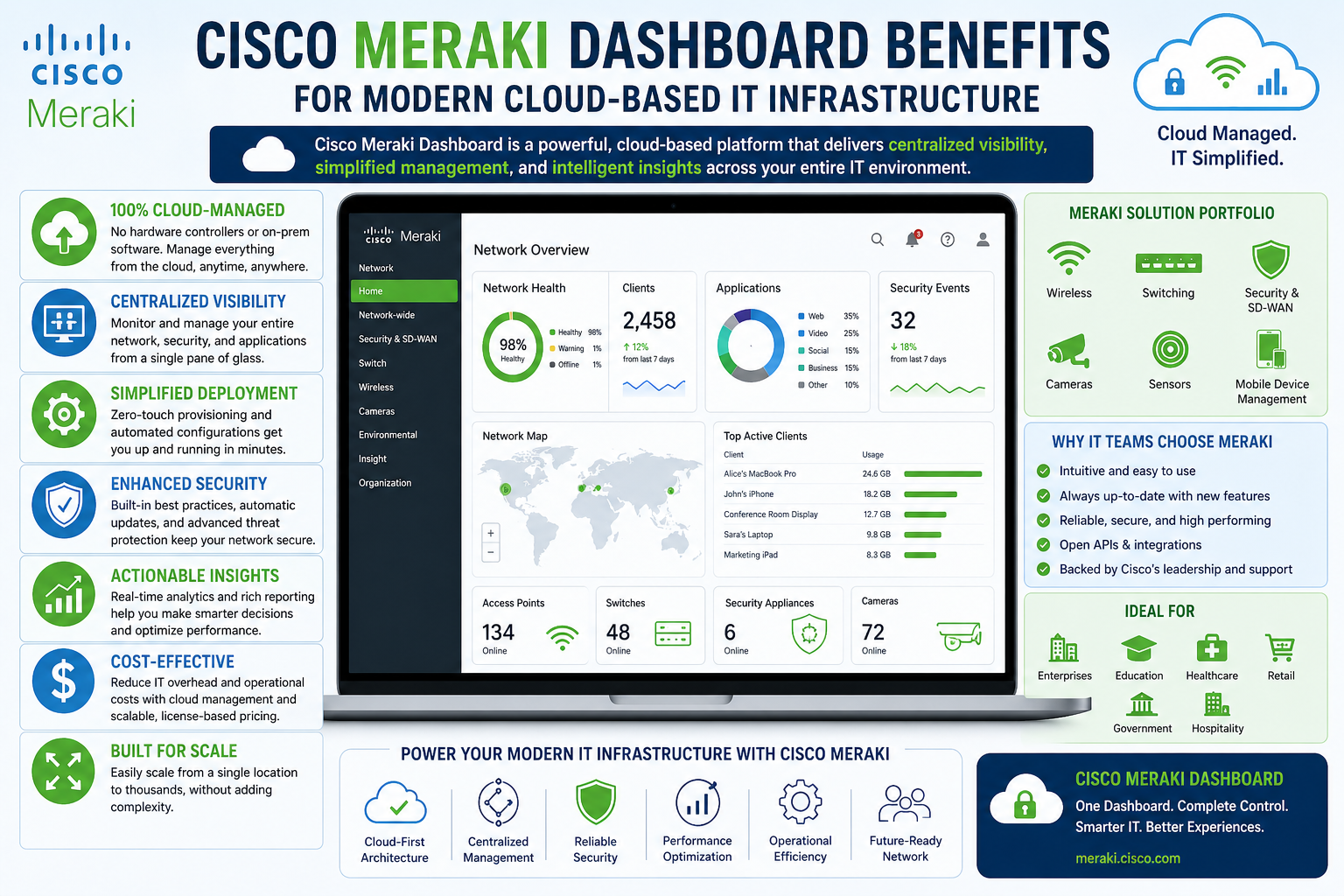
Modern network environments have changed dramatically as organizations increasingly depend on cloud services, remote access, and always-on digital systems to support daily operations. Traditional network management approaches that relied heavily on manual configuration, on-site troubleshooting, and isolated monitoring tools are no longer sufficient for environments that demand speed, consistency, and continuous availability. The Cisco Meraki Dashboard introduces a different operational philosophy where network visibility, control, and intelligence are centralized into a single cloud-managed interface, enabling IT teams to oversee complex infrastructures without being physically tied to the hardware or location of devices. This shift is not simply about convenience but about redefining how network operations are structured, moving away from fragmented control mechanisms toward a unified operational model that emphasizes clarity, automation, and real-time awareness. In this evolving landscape, IT professionals are expected to manage larger and more distributed environments while maintaining high performance and minimal downtime, which requires tools that can scale seamlessly and reduce operational friction. The Meraki approach integrates networking hardware with cloud-based control systems so that administrators can gain immediate insight into network behavior, identify emerging issues, and apply consistent policies across multiple environments without repetitive manual intervention. This transformation in network operations supports a more strategic role for IT teams, allowing them to focus less on routine troubleshooting and more on optimizing performance, improving security posture, and aligning network capabilities with business objectives.
From Reactive IT to Continuous Visibility
Traditional IT operations often function in a reactive mode where issues are addressed only after users experience disruptions or performance degradation becomes noticeable enough to generate complaints or support tickets. This reactive cycle leads to delays in problem resolution, reduced productivity, and increased pressure on IT teams who must diagnose issues without sufficient contextual data. The Meraki Dashboard introduces a continuous visibility model where network activity is constantly monitored and analyzed in real time, allowing potential issues to be detected before they escalate into user-facing problems. This shift changes the nature of IT operations by providing administrators with a live operational view of their entire network environment, including device status, traffic behavior, and connectivity health. Instead of relying on fragmented reports or manual checks, IT teams can observe network behavior as it happens and make informed decisions based on accurate and up-to-date information. Continuous visibility also reduces dependency on end-user reporting, which is often incomplete or delayed, and replaces it with system-generated insights that provide a clearer understanding of underlying technical conditions. This proactive visibility enables faster response times, improved resource allocation, and more effective planning for network maintenance and upgrades. Over time, the ability to monitor systems continuously helps organizations build a more stable and predictable network environment where disruptions are minimized, and operational efficiency becomes a consistent outcome rather than an occasional achievement.
Understanding the Meraki Dashboard Architecture
The Meraki Dashboard operates as a centralized cloud-based management interface that connects all network devices under a unified control system, enabling administrators to oversee routers, switches, wireless access points, and security appliances from a single location. This architecture removes the need for direct hardware-level access for routine configuration and monitoring tasks, replacing it with a structured and intuitive interface that reflects real-time device status and network performance metrics. Each connected device communicates with the cloud platform, continuously sending telemetry data that is processed and visualized within the dashboard, allowing administrators to interpret network conditions without requiring specialized command-line interactions or separate monitoring tools. The architecture is designed to support scalability, meaning that whether a network consists of a few devices or thousands spread across multiple geographic regions, the dashboard maintains consistent performance and visibility. This centralized structure also ensures configuration consistency, as changes made within the dashboard are automatically propagated to relevant devices, reducing the likelihood of misconfigurations and inconsistencies that often arise in manually managed environments. The architecture further supports role-based access and hierarchical organization, allowing large organizations to segment networks by location, department, or function while still maintaining centralized oversight. This design enables IT teams to balance local flexibility with global control, ensuring that each segment of the network operates according to defined standards while remaining visible within the broader operational framework.
Real-Time Network Health Monitoring at Scale
Real-time network health monitoring is a core capability of the Meraki Dashboard, enabling administrators to observe the status and performance of all connected devices as events occur rather than after the fact. This capability is particularly important in large-scale environments where networks span multiple locations and include diverse hardware components that must work together seamlessly. The dashboard provides a consolidated view of network health indicators such as device uptime, connectivity status, traffic flow, and error conditions, allowing IT teams to quickly identify abnormalities and determine their impact on overall performance. This real-time monitoring system eliminates the need for manual polling or external tools, replacing them with an integrated visualization layer that continuously updates based on live data. As a result, network administrators can detect patterns such as bandwidth congestion, hardware degradation, or connectivity instability before they escalate into widespread service disruptions. The ability to scale this monitoring across large infrastructures ensures that even complex environments remain manageable, as the dashboard aggregates data into meaningful summaries that highlight critical issues without overwhelming the user with unnecessary detail. This structured presentation of network health data allows IT teams to prioritize their response efforts effectively, focusing on high-impact issues while maintaining awareness of broader system behavior. Over time, this continuous monitoring approach contributes to improved reliability, reduced downtime, and a more predictable operational environment.
Centralized Visibility Across Distributed Environments
In modern organizations, network infrastructure is rarely confined to a single physical location, as branch offices, remote sites, and cloud-connected systems are now standard components of enterprise architecture. Managing such distributed environments presents significant challenges when visibility is fragmented across multiple tools or dependent on local access to individual systems. The Meraki Dashboard addresses this challenge by providing centralized visibility that consolidates all network activity into a single operational interface, regardless of geographic distribution. This means that administrators can observe the status of devices in different locations simultaneously, compare performance metrics across sites, and identify inconsistencies that may indicate localized issues or broader systemic problems. Centralized visibility also simplifies operational management by eliminating the need to switch between multiple platforms or rely on local administrators for basic diagnostic information. Instead, all relevant data is accessible in real time, enabling faster decision-making and more coordinated responses to network events. This approach is particularly valuable in organizations with rapidly expanding infrastructures, as it allows new locations and devices to be integrated into the existing monitoring framework without requiring significant reconfiguration. The unified visibility model ensures that IT teams maintain a consistent understanding of network performance across the entire organization, supporting better planning, more efficient troubleshooting, and improved alignment between technical operations and business requirements.
Alerting Systems and Event-Driven Awareness
Alerting systems within the Meraki Dashboard provide an event-driven approach to network awareness by notifying administrators when specific conditions or thresholds are met within the network environment. Instead of requiring constant manual observation, these alerts serve as automated signals that highlight potential issues such as device failures, connectivity loss, or unusual traffic patterns. Alerts can be configured to match the operational priorities of an organization, ensuring that critical events are escalated immediately while less urgent notifications are handled in a structured manner. This event-driven model improves response efficiency by ensuring that IT teams are only engaged when necessary, reducing unnecessary monitoring workload while maintaining high levels of situational awareness. The alerts are delivered through multiple channels, allowing integration into existing communication workflows so that relevant personnel can be informed regardless of their location or current activity. This flexibility ensures that important network events are not missed and that responses can be initiated promptly. By combining real-time monitoring with automated alerting, the system creates a dynamic awareness layer that continuously evaluates network conditions and communicates actionable insights when deviations occur. This approach not only improves operational responsiveness but also supports a more balanced workload for IT teams, allowing them to focus on strategic tasks while still maintaining oversight of critical infrastructure events.
How Data Telemetry Changes Decision Making
Data telemetry plays a central role in transforming how network decisions are made by providing continuous streams of information about device behavior, traffic patterns, and system performance. In traditional environments, decision-making often relies on historical logs or isolated snapshots of network activity, which can limit the accuracy and timeliness of insights. With the Meraki Dashboard, telemetry data is collected and analyzed in real time, offering a comprehensive view of network conditions that supports more informed and immediate decision-making processes. This constant flow of data allows administrators to identify trends, detect anomalies, and understand the root causes of performance issues with greater precision. As a result, decisions related to capacity planning, troubleshooting, and optimization can be made with a higher degree of confidence and relevance to current conditions. Telemetry also enables predictive insights by revealing patterns that may indicate future issues, such as gradual increases in latency or recurring connectivity fluctuations. This predictive capability shifts decision-making from reactive correction to proactive adjustment, allowing organizations to address potential problems before they impact users. The integration of telemetry into a centralized dashboard ensures that this information is accessible in a structured and interpretable format, reducing complexity while enhancing clarity. Over time, this data-driven approach contributes to a more intelligent and adaptive network management strategy.
Operational Efficiency Through Unified Interfaces
Operational efficiency in network management is significantly enhanced when all monitoring, configuration, and diagnostic functions are consolidated into a unified interface that eliminates the need for multiple disconnected tools. The Meraki Dashboard achieves this by integrating all essential network management capabilities into a single platform that is accessible from anywhere, reducing the time and effort required to perform routine administrative tasks. This unified interface allows IT teams to perform complex operations such as configuration changes, performance analysis, and device management without switching between different systems or relying on manual processes. The consistency of the interface also reduces the learning curve for administrators, enabling teams to become proficient more quickly and operate more effectively across different network environments. By centralizing control, the dashboard minimizes operational fragmentation and ensures that all actions are recorded and reflected across the entire network infrastructure. This improves accountability, reduces configuration errors, and enhances overall system reliability. The unified interface also supports faster troubleshooting by providing immediate access to relevant data and diagnostic tools within the same environment, eliminating delays caused by external dependencies. As a result, IT teams can resolve issues more efficiently and maintain higher levels of service continuity across the organization.
Zero-Touch Provisioning and Rapid Deployment in Modern Networks
Modern enterprise environments demand rapid deployment of network infrastructure without the delays and complexity traditionally associated with manual configuration. Zero-touch provisioning within the Meraki Dashboard enables devices to be deployed and operational with minimal on-site technical intervention. When new hardware is connected to the network, it automatically reaches out to the cloud management system, retrieves its configuration, and applies predefined settings based on its assigned network role or location. This eliminates the need for engineers to manually configure devices on-site, significantly reducing deployment time and operational overhead. In large organizations with distributed branch offices or rapidly expanding infrastructure, this capability becomes especially valuable as it allows new sites to become operational almost immediately after hardware installation. The consistency of configuration also ensures that every device adheres to organizational standards from the moment it becomes active, reducing the risk of configuration drift or human error during setup. Zero-touch provisioning also supports scalability, as adding new devices does not require additional configuration complexity. Instead, devices inherit their settings automatically, allowing IT teams to focus on planning and architecture rather than repetitive installation tasks. This approach transforms network expansion into a streamlined process that aligns with business growth, ensuring that infrastructure can scale efficiently without introducing operational bottlenecks or delays in service availability.
Automation and API-Driven Network Operations
Automation has become a foundational element of modern network management, particularly in environments where speed, consistency, and scalability are critical. The Meraki Dashboard supports automation through programmable interfaces that allow external systems and scripts to interact directly with network configurations and operational data. This API-driven model enables organizations to automate repetitive tasks such as device provisioning, configuration updates, and network monitoring without manual intervention. By integrating network operations into broader automation workflows, IT teams can reduce operational workload and improve response times for routine tasks. Automation also allows for dynamic adjustments to network behavior based on external triggers, such as changes in user demand or system performance metrics. This creates a more adaptive network environment where configurations can evolve in response to real-time conditions rather than static schedules. Additionally, automation reduces the likelihood of human error by standardizing processes and ensuring that changes are applied consistently across all relevant devices. The integration of APIs also allows network data to be shared with other systems, enabling cross-platform coordination and more comprehensive operational visibility. Over time, this approach transforms network management into a programmable environment where infrastructure behaves in alignment with defined policies and automated logic rather than manual intervention. This shift significantly enhances operational efficiency and allows IT teams to focus on strategic initiatives rather than routine maintenance tasks.
Lifecycle Management and Firmware Governance
Network infrastructure requires continuous maintenance throughout its lifecycle, including updates, upgrades, and performance optimization. The Meraki Dashboard simplifies lifecycle management by providing centralized control over firmware updates and device health monitoring. Instead of manually updating each device individually, administrators can schedule and deploy firmware updates across entire networks simultaneously. This ensures that all devices remain aligned with the latest performance improvements and security enhancements. Lifecycle management also includes monitoring device health over time to identify hardware that may be nearing end-of-life or experiencing performance degradation. By analyzing long-term operational data, the system can help organizations plan replacements before failures occur, reducing downtime and improving reliability. Firmware governance plays a critical role in maintaining system stability, as updates can be tested and staged before full deployment to minimize disruption. This structured approach ensures that updates are applied in a controlled manner, balancing the need for innovation with operational stability. Lifecycle management also supports version consistency across distributed environments, ensuring that all locations operate on compatible firmware versions. This reduces compatibility issues and simplifies troubleshooting when issues arise. By centralizing lifecycle control, the Meraki Dashboard allows IT teams to maintain a stable and secure infrastructure while minimizing the complexity traditionally associated with large-scale firmware and hardware management.
Change Management and Configuration Auditing
Managing change in network environments is essential for maintaining stability, security, and compliance. The Meraki Dashboard supports structured change management by providing visibility into configuration changes and enabling administrators to track modifications across the entire network. Every adjustment made within the system is recorded, creating a detailed audit trail that allows teams to review when changes were made, what was modified, and who initiated the update. This transparency is critical in environments where multiple administrators may be responsible for network management, as it ensures accountability and traceability. Configuration auditing also helps identify unintended changes or misconfigurations that could impact network performance or security. By maintaining a historical record of network configurations, organizations can compare current states with previous versions to detect inconsistencies or deviations from established standards. This capability also supports rollback functionality, allowing administrators to revert to earlier configurations if issues arise after a change. Structured change management reduces operational risk by ensuring that modifications are intentional, documented, and reversible. It also improves collaboration among IT teams by providing a shared understanding of network evolution over time. In regulated environments, configuration auditing plays a key role in compliance, as it demonstrates that network changes are controlled and monitored according to defined policies. This structured approach to change management enhances both operational stability and governance across complex network environments.
Multi-Site and Enterprise-Scale Organizational Design
Large organizations often operate across multiple sites, regions, or even global infrastructures, requiring a network management approach that can scale without losing visibility or control. The Meraki Dashboard supports multi-site organizational design by allowing networks to be logically grouped and managed under a unified administrative structure. Each site can operate independently while still being governed by centralized policies and oversight. This hierarchical structure enables IT teams to maintain consistency across all locations while accommodating local variations where necessary. Multi-site management simplifies the complexity of large-scale operations by providing aggregated views of network performance, allowing administrators to compare sites and identify discrepancies or performance gaps. This comparative visibility is especially useful for identifying underperforming locations or detecting systemic issues that affect multiple sites. The system also supports delegation of administrative responsibilities, enabling local teams to manage specific segments of the network while still adhering to global policies. This balance between central control and local autonomy ensures operational efficiency without sacrificing consistency. As organizations grow, the ability to manage networks at scale becomes increasingly important, and the Meraki Dashboard provides the structural foundation needed to support this expansion without introducing operational fragmentation or management overhead.
Integration with External IT Systems and Operational Workflows
Modern IT environments rely on a diverse ecosystem of tools for monitoring, ticketing, security analysis, and operational coordination. The Meraki Dashboard supports integration with external systems, enabling network data and events to flow seamlessly into broader IT workflows. This integration allows organizations to connect network management with incident response systems, service management platforms, and security information tools, creating a unified operational ecosystem. When network events occur, they can automatically trigger workflows in external systems, such as generating incident tickets or initiating diagnostic procedures. This reduces response time and ensures that network issues are addressed within established operational processes. Integration also enables correlation between network data and other infrastructure signals, improving the accuracy of root cause analysis and incident resolution. By sharing data across platforms, organizations gain a more holistic understanding of system behavior and can respond more effectively to complex issues that span multiple domains. This interconnected approach enhances operational coordination and reduces the fragmentation that often exists between different IT tools. It also improves efficiency by eliminating manual data transfer and ensuring that all systems operate with consistent and up-to-date information. Over time, integration transforms network management from an isolated function into a fully embedded component of broader IT operations.
Advanced Security Posture and Identity Alignment
Security in modern networks extends beyond perimeter defenses and requires continuous enforcement of identity-based controls and adaptive policies. The Meraki Dashboard supports advanced security posture management by enabling administrators to define access controls and security rules based on user identity, device type, and contextual conditions. This allows networks to enforce more granular policies that align with zero-trust principles, where access is granted based on verification rather than implicit trust. Identity alignment ensures that users only have access to the resources they are authorized to use, regardless of their location or device. This approach reduces the risk of unauthorized access and limits the potential impact of compromised credentials. Security policies can also adapt dynamically based on behavioral analysis, allowing the system to respond to anomalies such as unusual login patterns or unexpected traffic behavior. This adaptive security model enhances protection by continuously evaluating risk and adjusting controls accordingly. Centralized policy enforcement ensures that security standards remain consistent across all network segments, reducing vulnerabilities caused by configuration inconsistencies. By integrating identity awareness into network management, the Meraki Dashboard strengthens overall security posture and supports a more resilient and adaptive defense strategy.
Endpoint and IoT Visibility in Expanding Network Environments
As networks expand to include a wide range of connected devices beyond traditional computers, visibility into endpoint behavior becomes increasingly important. The Meraki Dashboard provides visibility into connected endpoints and IoT devices, allowing administrators to understand how different types of devices interact with the network. This includes monitoring device connectivity, traffic patterns, and communication behavior. In environments with large numbers of IoT devices, such as sensors or smart infrastructure components, this visibility is essential for maintaining control and ensuring proper network segmentation. Endpoint visibility helps identify unauthorized devices, unusual behavior, or potential security risks associated with unmanaged systems. It also supports capacity planning by revealing how different device types contribute to overall network usage. By analyzing endpoint behavior, administrators can optimize network design to accommodate emerging device categories and usage patterns. This visibility extends beyond simple connectivity status, providing insights into how devices consume resources and interact with applications. As networks become more heterogeneous, the ability to monitor and manage endpoints at scale becomes a critical component of operational control. The Meraki Dashboard enables this by integrating endpoint intelligence directly into the network management environment.
Resilience Engineering, Failover Design, and Continuity Planning
Network resilience is essential for maintaining uninterrupted operations in environments where downtime can have a significant business impact. The Meraki Dashboard supports resilience engineering by enabling redundant configurations, failover mechanisms, and continuous monitoring of network paths. When primary connections or devices fail, traffic can be automatically rerouted through backup systems, ensuring continuity of service. This failover capability reduces the impact of hardware failures or connectivity disruptions and helps maintain stable performance even under adverse conditions. Resilience planning also involves designing network architectures that can withstand localized failures without affecting overall system functionality. The dashboard provides visibility into redundancy configurations, allowing administrators to verify that backup systems are properly configured and operational. Continuous monitoring ensures that potential points of failure are identified early, allowing proactive remediation before disruptions occur. This proactive approach to resilience reduces downtime and improves reliability across distributed environments. It also supports business continuity planning by ensuring that critical services remain accessible even during infrastructure challenges. Over time, resilience engineering becomes an integral part of network design, enabling organizations to maintain stable operations in dynamic and unpredictable conditions.
Operational Cost Efficiency and Strategic Infrastructure Optimization
Efficient network management is not only about performance and reliability but also about optimizing operational costs and resource utilization. The Meraki Dashboard contributes to cost efficiency by reducing the need for manual configuration, minimizing downtime, and streamlining administrative workflows. By centralizing network management, organizations reduce the complexity associated with maintaining multiple tools and systems, which in turn lowers operational overhead. Automated processes such as provisioning, monitoring, and updates reduce the need for continuous manual intervention, allowing IT teams to focus on higher-value activities. Cost efficiency is also achieved through improved resource utilization, as visibility into network performance enables better allocation of bandwidth, hardware, and infrastructure investments. Organizations can identify underutilized resources and optimize their usage before investing in additional capacity. This data-driven approach ensures that infrastructure growth is aligned with actual demand rather than assumptions. Strategic optimization also includes reducing the cost of downtime by improving system reliability and response times. By enhancing visibility, automation, and control, the Meraki Dashboard enables organizations to operate more efficiently while maintaining high levels of performance and reliability across their network environments.
Cloud-Native Networking Integration and Hybrid Connectivity Models
Modern enterprise infrastructure is increasingly distributed across on-premises environments, multiple cloud providers, and edge locations, requiring a networking approach that can seamlessly bridge these domains. The Meraki Dashboard supports this evolution by enabling consistent network behavior across hybrid environments without requiring separate management systems for each infrastructure layer. Instead of treating cloud and on-premises networks as isolated domains, the system allows them to operate as part of a unified architecture where policies, connectivity rules, and visibility are maintained consistently. This becomes especially important as applications are no longer hosted in a single location but are distributed across different environments depending on performance, cost, and compliance requirements. The ability to maintain consistent networking behavior across these environments reduces complexity for IT teams and ensures that application performance remains stable regardless of where workloads are hosted. Hybrid connectivity also benefits from dynamic routing intelligence, which ensures that traffic between cloud services and local infrastructure follows optimized paths based on real-time conditions. This reduces latency and improves responsiveness for applications that rely on frequent cross-environment communication. As organizations continue to adopt cloud-first strategies, this unified approach to networking becomes essential for maintaining operational coherence across increasingly complex digital ecosystems.
Observability-Driven Operations and Deep Network Insight
Traditional network monitoring focuses primarily on identifying whether systems are up or down, but modern operational environments require a deeper level of insight that explains why behavior is occurring rather than simply reporting its status. Observability within the Meraki Dashboard extends beyond basic monitoring by combining metrics, logs, and contextual data into a unified analytical view that helps administrators understand the internal state of the network. This approach allows IT teams to move beyond surface-level indicators and examine the underlying factors contributing to performance changes or disruptions. For example, instead of only detecting that latency has increased, observability tools can help identify whether the cause is related to congestion, routing inefficiencies, or external connectivity issues. This deeper level of insight reduces troubleshooting time and improves decision accuracy by providing a more complete picture of system behavior. Observability also supports correlation across multiple layers of the network, allowing administrators to connect device-level data with application performance and user experience. This holistic understanding is essential in complex environments where issues often span multiple systems and cannot be attributed to a single point of failure. By integrating observability into network management, the platform enables a more intelligent and responsive operational model where decisions are based on comprehensive system understanding rather than isolated data points.
Intent-Based Networking and Policy Abstraction Models
Intent-based networking represents a shift from manual configuration toward defining desired outcomes that the system then translates into technical implementation automatically. Within the Meraki Dashboard, this concept is reflected in the ability to define high-level policies that describe what the network should achieve rather than how it should be configured at a granular level. This abstraction allows administrators to focus on business objectives such as ensuring application priority, maintaining security standards, or optimizing user experience, while the system handles the underlying configuration details. This model reduces complexity by eliminating the need for repetitive manual setup and ensuring that network behavior remains aligned with organizational intent even as infrastructure changes over time. When new devices are added or existing configurations are modified, intent-based policies ensure that the desired outcomes remain consistent across the entire environment. This reduces configuration drift and enhances operational stability, especially in large-scale deployments where manual oversight becomes increasingly difficult. Intent-based networking also improves agility by allowing changes to be implemented at a conceptual level without requiring extensive technical reconfiguration. As a result, organizations can respond more quickly to evolving business requirements while maintaining consistency and reliability in network operations. This abstraction layer effectively transforms network management into a more strategic function focused on outcomes rather than implementation details.
Network Compliance, Governance, and Audit Readiness
In regulated industries and large enterprises, maintaining compliance with internal policies and external regulations is a critical aspect of network operations. The Meraki Dashboard supports compliance and governance by providing structured visibility into network configurations, user activity, and policy enforcement across all managed devices. This allows organizations to demonstrate that their network environments adhere to defined security standards and operational guidelines. Audit readiness is enhanced through continuous tracking of configuration changes and system events, ensuring that historical data is always available for review when needed. This eliminates the need for manual reconstruction of network states during audits and reduces the administrative burden associated with compliance reporting. Governance is further strengthened by the ability to enforce standardized configurations across multiple locations, ensuring that all parts of the network operate under consistent rules and policies. This reduces variability and ensures that compliance requirements are met uniformly across the organization. The system also supports role-based access control, ensuring that only authorized personnel can modify critical network settings, which adds a layer of governance and accountability. Over time, this structured approach to compliance management reduces risk exposure and ensures that network operations remain aligned with both internal policies and external regulatory frameworks.
AI-Assisted Network Operations and Predictive Intelligence
As networks become more complex, the ability to manually interpret large volumes of operational data becomes increasingly challenging. AI-assisted operations introduce a layer of predictive intelligence that helps administrators identify patterns, anticipate issues, and optimize performance more effectively. Within the Meraki Dashboard, machine-driven analysis can detect anomalies in network behavior that may not be immediately visible through traditional monitoring methods. These insights allow IT teams to address potential issues before they escalate into service disruptions. Predictive intelligence also plays a role in capacity planning by analyzing historical trends and forecasting future network demands based on observed usage patterns. This enables organizations to make more informed infrastructure investments and avoid both under-provisioning and over-provisioning of resources. AI-assisted systems can also prioritize alerts based on severity and potential impact, helping teams focus on the most critical issues first. By reducing noise and highlighting meaningful signals, these systems improve operational efficiency and decision-making accuracy. Over time, the integration of AI into network operations supports a more adaptive and intelligent infrastructure where systems continuously learn from behavior and improve their ability to maintain stability and performance. This reduces manual workload and enhances the overall responsiveness of network management processes.
Sustainability and Energy-Aware Network Optimization
As organizations increasingly focus on environmental responsibility, energy efficiency has become an important consideration in network infrastructure design and management. The Meraki Dashboard supports sustainability initiatives by providing visibility into device utilization and operational efficiency, allowing organizations to optimize energy consumption across their network environments. By understanding how devices are used and when they experience peak or idle periods, administrators can make informed decisions about power management and infrastructure optimization. This may include consolidating workloads, optimizing device usage, or adjusting operational schedules to reduce unnecessary energy consumption. Energy-aware networking also involves ensuring that infrastructure is sized appropriately for actual demand, avoiding over-provisioning that leads to wasted resources. By analyzing long-term usage patterns, organizations can design networks that balance performance requirements with energy efficiency goals. This approach not only reduces operational costs but also supports broader sustainability objectives by minimizing the environmental impact of IT infrastructure. As energy efficiency becomes an increasingly important factor in technology strategy, the ability to integrate sustainability considerations into network management represents a significant advancement in operational design.
Experience-Centric Networking and End-User Quality Measurement
Modern network management is no longer focused solely on device uptime or infrastructure health; it increasingly prioritizes the actual experience of end users interacting with applications and services. Experience-centric networking emphasizes measuring how users perceive performance rather than only how systems behave technically. Within the Meraki Dashboard environment, this perspective is reflected through continuous evaluation of application responsiveness, connection stability, and session quality across different user groups and locations. Instead of treating network performance as a purely technical metric, it becomes directly tied to user satisfaction and productivity outcomes. This shift is important because many network issues are not immediately visible at the infrastructure level but are clearly felt by users in the form of delays, interruptions, or inconsistent application behavior. By focusing on experience-based metrics, administrators can identify issues that might otherwise remain hidden in traditional monitoring systems. This includes subtle degradation in performance that does not cause outages but still affects usability. The ability to quantify user experience allows IT teams to prioritize improvements based on actual impact rather than theoretical performance indicators. Over time, this approach creates a more human-centered network management model where infrastructure decisions are guided by how effectively the network supports real-world usage rather than just technical benchmarks.
Distributed Intelligence and Edge-Driven Decision Making
As networks expand to include more distributed environments and edge locations, centralized decision-making alone becomes insufficient for maintaining optimal performance. Distributed intelligence introduces the concept of enabling local network nodes to make context-aware decisions based on real-time conditions while still adhering to centralized policies. In a Meraki-managed environment, this means that devices at the edge of the network can respond dynamically to local changes such as traffic spikes, connectivity fluctuations, or hardware performance variations without waiting for centralized intervention. This reduces latency in decision-making and improves responsiveness in scenarios where immediate adjustments are necessary. At the same time, these local decisions remain aligned with overarching network policies, ensuring consistency across the entire infrastructure. Distributed intelligence is particularly valuable in environments with limited or intermittent connectivity to central systems, as it allows operations to continue smoothly even when communication with the central dashboard is temporarily constrained. This balance between local autonomy and centralized governance creates a more resilient and adaptive network structure. It also reduces dependency on constant centralized oversight, allowing the system to maintain stability even under dynamic or unpredictable conditions. Over time, this distributed approach contributes to a more robust and self-adjusting network environment capable of handling complexity at scale.
Conclusion
The Cisco Meraki Dashboard represents a significant shift in how network environments are designed, managed, and evolved in modern IT ecosystems. Rather than treating networking as a collection of isolated devices requiring constant manual oversight, it reframes the entire operational model into a unified, cloud-driven system where visibility, control, and intelligence are centralized. This transformation is particularly important in a world where networks are no longer confined to a single data center or office building but instead span across branch locations, remote users, cloud platforms, and increasingly complex hybrid environments. In such a landscape, traditional methods of configuration and troubleshooting quickly become inefficient, reactive, and difficult to scale.
One of the most impactful outcomes of this approach is the shift from reactive problem-solving to proactive and predictive operations. Instead of waiting for users to report issues or for systems to fail, IT teams gain continuous awareness of network behavior through real-time monitoring and data-driven insights. This allows potential problems to be identified early, often before they escalate into service disruptions. The result is a more stable and predictable network environment where downtime is minimized, and operational continuity is strengthened. This proactive capability also reduces pressure on IT teams by eliminating the constant urgency of firefighting issues after they occur.
Another key advantage lies in the simplification of complexity. As organizations grow, network infrastructures naturally become more complicated, involving multiple devices, policies, and connectivity paths. The Meraki Dashboard addresses this complexity by abstracting low-level configuration details into centralized policies and templates. This ensures that configurations remain consistent across all devices and locations without requiring repetitive manual effort. It also reduces the likelihood of human error, which is one of the most common causes of network instability in traditionally managed environments. By enforcing consistency through centralized control, organizations can maintain a more reliable and predictable operational state even as their infrastructure expands.
The platform also enhances strategic decision-making through improved visibility and analytics. Instead of relying on fragmented data sources or isolated monitoring tools, IT teams have access to a consolidated view of network performance, user behavior, and system health. This holistic perspective enables more informed decisions regarding capacity planning, performance optimization, and infrastructure investment. Over time, this data-driven approach allows organizations to align their network strategy more closely with actual usage patterns and business requirements, leading to better resource allocation and improved efficiency.
Security and governance are also strengthened through centralized policy enforcement and continuous monitoring. By applying consistent security rules across all devices and locations, organizations reduce vulnerabilities caused by configuration inconsistencies or oversight. At the same time, detailed audit trails and change tracking ensure accountability and support compliance requirements in regulated environments. This combination of visibility and control creates a more secure and transparent network infrastructure that can adapt to evolving threats and regulatory expectations.
Ultimately, the Meraki Dashboard enables IT teams to transition from operational maintenance roles into more strategic functions focused on optimization, innovation, and business alignment. Automating routine tasks, centralizing management, and enhancing visibility, it frees up valuable time and resources that can be redirected toward improving overall digital infrastructure and user experience. In doing so, it supports a broader transformation in IT operations where networks are no longer just technical backbones but intelligent, adaptive systems that actively contribute to organizational success.