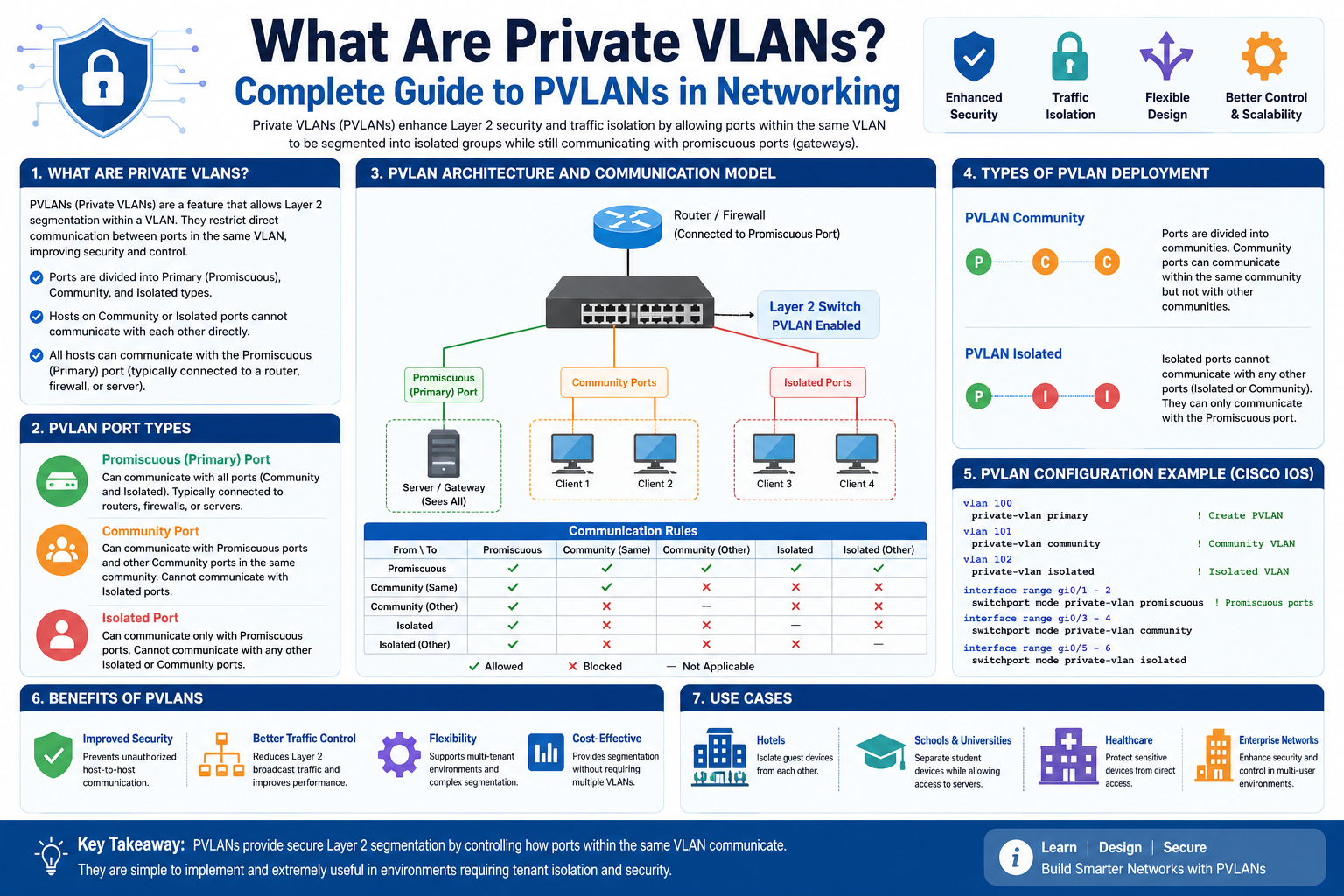
Private VLANs represent an advanced approach to network segmentation that operates at Layer 2 of the networking model, allowing a single VLAN to be divided into multiple logically isolated communication domains. In a traditional VLAN environment, devices that share the same VLAN can communicate freely with each other as long as they are within the same broadcast domain. While this model is effective for basic segmentation, it does not provide fine-grained control over device-to-device communication within that domain. Private VLANs address this limitation by introducing internal isolation within a single VLAN structure, enabling administrators to control which devices can communicate directly and which must communicate through a centralized point such as a router or server. This creates a more controlled and secure internal network environment without requiring additional IP subnetting or complex routing configurations.
At its core, the concept of Private VLANs is centered on controlled isolation while maintaining shared network identity at the IP level. Devices can still belong to the same IP subnet, which simplifies addressing and network design, but their ability to communicate at Layer 2 is restricted based on defined roles. This makes Private VLANs particularly useful in environments where multiple devices must access shared resources but should not interact directly with each other. The mechanism enhances security by reducing lateral movement opportunities within the network, ensuring that even if one device is compromised, it cannot easily communicate with or attack other devices in the same logical group. This structural separation within a single VLAN allows organizations to balance efficiency and security without increasing complexity at higher network layers.
Evolution of VLAN Segmentation and Need for PVLAN
The development of Private VLANs is closely tied to the limitations encountered in traditional VLAN architectures as networks grew more complex and densely populated. Initially, VLANs were introduced to reduce broadcast traffic and improve logical segmentation across physical networks. This allowed organizations to group devices based on function, department, or application needs. However, as enterprise networks expanded, a challenge emerged: devices within the same VLAN still had unrestricted communication with each other, which created potential security risks in environments such as data centers, hosting platforms, and shared service infrastructures. Administrators needed a way to isolate devices within the same VLAN without increasing the number of VLANs or complicating IP address management.
Private VLANs emerged as a solution to this problem by introducing sub-segmentation within existing VLAN structures. Instead of requiring separate VLANs for every isolated group, a single VLAN could be subdivided into smaller logical segments with specific communication rules. This evolution was particularly important in environments where large numbers of similar devices, such as servers or virtual machines, needed access to shared services but not direct interaction with each other. The introduction of Private VLANs allowed networks to scale more efficiently while maintaining strict control over internal communication patterns. It also reduced the administrative overhead associated with managing multiple VLANs and routing configurations, making it easier to enforce security policies consistently across large infrastructures.
Core Architecture of Private VLANs
The architecture of Private VLANs is built around a hierarchical structure that defines how devices interact within a single VLAN domain. This structure typically consists of a primary VLAN and multiple secondary VLANs, each serving a distinct communication role. The primary VLAN acts as the central communication backbone, allowing traffic to flow between different secondary VLAN types and external network resources. Secondary VLANs are further divided into isolated and community segments, each enforcing specific communication rules that determine how devices within them can interact with others in the same Private VLAN environment.
Isolated segments are designed to enforce strict one-way communication behavior, where devices can only communicate with designated upstream resources but not with each other. This ensures complete separation between endpoints, making it ideal for highly sensitive or untrusted device environments. Community segments, on the other hand, allow communication between devices within the same group while still restricting access to devices outside that community. This balance between isolation and controlled interaction provides flexibility in network design, enabling administrators to tailor communication patterns based on operational requirements. The architecture ensures that all traffic control decisions are enforced at the switch level, reducing reliance on higher-layer filtering mechanisms and improving overall efficiency.
Traffic Behavior Inside Private VLAN Domains
Traffic behavior within Private VLAN environments is governed by strict forwarding rules that determine how frames are processed and transmitted between ports. When a device sends data within a Private VLAN, the switch evaluates the source and destination port types to determine whether communication is permitted. If the traffic originates from an isolated port, it is only allowed to reach designated upstream resources such as a primary VLAN gateway or server interface. Any attempt to communicate directly with another isolated port is blocked at the switching layer, preventing direct peer-to-peer interaction. This behavior ensures that even though devices may share the same IP subnet, their Layer 2 communication paths are tightly controlled.
In community-based segments, traffic behavior is slightly more flexible but still regulated. Devices within the same community can exchange frames freely, allowing collaboration and shared access to services within that group. However, communication between different community groups or between the community and isolated segments is restricted unless explicitly permitted through the primary VLAN interface. This controlled traffic flow reduces unnecessary broadcast propagation and limits exposure to potential internal threats. The switch plays a critical role in enforcing these rules, ensuring that every frame is evaluated against PVLAN policies before forwarding decisions are made. This creates a predictable and secure traffic environment where communication paths are clearly defined and enforced at hardware speed.
Layer 2 Isolation Mechanisms and Switching Logic
The isolation provided by Private VLANs operates at Layer 2, where Ethernet switching decisions are made based on MAC addresses rather than IP routing. In this context, the switch maintains a mapping of MAC addresses to PVLAN port types, allowing it to determine whether a frame should be forwarded, dropped, or redirected. When a frame enters the switch, the switching logic checks the source port type and destination MAC address against PVLAN rules. If the communication violates isolation policies, the frame is discarded before it can be forwarded, effectively preventing unauthorized communication at the data link layer.
This isolation mechanism is highly efficient because it is implemented within the switching hardware, allowing decisions to be made at line speed without introducing significant latency. The switch enforces strict boundaries between isolated and community ports, ensuring that frames cannot bypass PVLAN rules through MAC spoofing or direct addressing attempts. Additionally, the switching logic ensures that broadcast and unknown unicast traffic is handled in a controlled manner, preventing unnecessary propagation across isolated segments. This design strengthens the security posture of the network by ensuring that isolation is enforced consistently and predictably, regardless of device behavior or traffic patterns.
Communication Rules Between PVLAN Port Types
Communication within Private VLAN environments is governed by clearly defined rules based on port classification. Each port type—primary, isolated, and community—has specific communication permissions that dictate how traffic flows within the network. Primary ports serve as the central point of communication and can interact with all secondary port types, acting as a gateway for inter-segment traffic. This allows devices in isolated or community segments to access shared services without directly communicating with each other. The primary port essentially acts as a controlled communication bridge within the PVLAN structure.
Isolated ports are restricted to communicating only with primary ports, ensuring complete separation from other isolated or community ports. This strict rule eliminates the possibility of lateral communication between endpoints, significantly reducing the risk of internal threats spreading across the network. Community ports operate under a more flexible rule set, allowing communication between devices within the same community while still restricting access to other communities and isolated segments. These communication rules are enforced consistently by the switch, ensuring that all traffic adheres to the defined segmentation model. The clarity of these rules simplifies network design and ensures predictable communication behavior across complex environments.
Role of Switch Infrastructure in PVLAN Operation
Switch infrastructure plays a central role in enabling and enforcing Private VLAN functionality, as all segmentation and isolation rules are implemented at the switching layer. The switch is responsible for maintaining PVLAN mappings, enforcing communication rules, and ensuring that traffic is forwarded according to defined policies. This requires advanced switching capabilities that go beyond standard VLAN processing, including support for port roles, secondary VLAN associations, and traffic filtering based on PVLAN membership. Without proper switch support, Private VLAN functionality cannot be implemented effectively.
In addition to enforcing isolation rules, the switch also manages the association between primary and secondary VLANs, ensuring that traffic is correctly translated and forwarded between different segments. This includes handling frame rewriting where necessary to maintain consistent communication paths between isolated or community devices and shared resources. The switch also plays a role in maintaining network stability by preventing misconfigurations that could lead to unintended communication paths. This makes the switch not only a forwarding device but also a policy enforcement point that ensures the integrity of the Private VLAN structure across the entire network environment.
Address Resolution and Frame Handling in PVLAN Environments
Address resolution in Private VLAN environments introduces additional complexity because devices share the same IP subnet while being isolated at Layer 2. When a device attempts to communicate with another endpoint, it relies on ARP mechanisms to resolve IP addresses into MAC addresses. However, in a PVLAN structure, the switch must control how ARP requests and responses are handled to ensure that isolation rules are maintained. This often involves proxy behavior at the switch level, where the switch responds to ARP requests on behalf of devices or filters responses based on PVLAN membership rules.
Frame handling in this context requires careful processing to ensure that traffic is delivered only to permitted destinations. When a frame is received, the switch evaluates both the MAC address and PVLAN association before forwarding it. If the destination device is in an isolated segment, the switch ensures that the frame is only delivered if it originates from a primary port. For community segments, the switch allows intra-community communication while still enforcing restrictions on cross-segment traffic. This controlled handling of frames ensures that even though devices share the same subnet, their Layer 2 interactions remain strictly governed by PVLAN policies.
Design Considerations for Scalable PVLAN Deployment
Designing a scalable Private VLAN deployment requires careful consideration of network size, device density, and communication requirements. Since PVLANs introduce additional segmentation within a single VLAN, administrators must ensure that the underlying switching infrastructure can support the increased complexity of port roles and traffic rules. One of the key design considerations is maintaining a balance between isolation and accessibility, ensuring that devices can reach necessary resources without violating segmentation policies. This requires a clear understanding of application dependencies and communication flows within the network.
Another important aspect of PVLAN design is ensuring consistent configuration across all switches in the environment. In distributed networks, inconsistent PVLAN settings can lead to communication failures or unintended access paths. Therefore, standardization of configuration practices is essential for maintaining network stability. Additionally, scalability must be considered when determining the number of secondary VLANs and port assignments, as overly complex structures can become difficult to manage over time. A well-designed PVLAN architecture ensures that isolation requirements are met without introducing unnecessary operational complexity or performance overhead.
Operational Characteristics in Enterprise Networks
In enterprise environments, Private VLANs operate as a foundational security and segmentation mechanism that supports large-scale device isolation without requiring extensive subnet expansion. Their operational behavior is particularly valuable in environments where many devices must share access to common services while remaining isolated from one another. This includes scenarios such as server farms, virtualized infrastructures, and shared service platforms. The ability to maintain a single IP subnet while enforcing strict Layer 2 isolation simplifies network design and reduces the administrative burden associated with IP management.
Operationally, Private VLANs require continuous monitoring to ensure that isolation rules remain intact and that no misconfigurations introduce communication gaps or security vulnerabilities. Network administrators must also ensure that switch resources are adequately allocated to handle PVLAN processing, especially in high-density environments where large numbers of devices are involved. The operational stability of PVLANs depends heavily on consistent enforcement of switching policies and accurate maintenance of port associations. When properly implemented, they provide a reliable and efficient mechanism for controlling internal communication patterns across complex enterprise networks.
PVLAN Segmentation Logic and Port Role Behavior
Private VLAN environments rely on a structured segmentation logic that defines how each switch port behaves within the overall network design. Instead of treating all ports equally as in traditional VLANs, Private VLANs assign specific roles to each interface, and these roles determine how traffic is permitted or restricted. The segmentation logic is built around the idea that communication is not solely dependent on VLAN membership but also on the functional role assigned to each port within that VLAN structure.
In this model, each port is categorized into a specific behavior profile that governs its interaction with other devices. These profiles are enforced at the switching layer, ensuring that communication rules are consistently applied regardless of device configuration or user activity. The switch maintains an internal mapping that associates each port with its designated PVLAN role, allowing it to make forwarding decisions instantly when frames are received. This role-based segmentation ensures that even devices within the same broadcast domain are subject to strict communication policies that prevent unauthorized interaction.
The behavior of each port type is tightly controlled, with isolation enforced at the hardware level. This prevents any deviation from defined communication paths and ensures that the segmentation model remains intact even under high traffic conditions. By relying on role-based logic rather than purely address-based filtering, Private VLANs provide a more predictable and enforceable security model within Layer 2 environments.
Configuration Workflow and Logical Structuring of PVLANs
The configuration of Private VLANs follows a structured workflow that begins with defining the primary VLAN and then establishing secondary VLAN relationships. The primary VLAN acts as the central communication channel, while secondary VLANs define the isolated and grouped communication zones. This hierarchical structuring allows administrators to design networks that reflect operational requirements while maintaining strict control over internal communication patterns.
During configuration, each secondary VLAN is explicitly associated with the primary VLAN, creating a logical linkage that enables controlled traffic flow between segments. This association ensures that even though devices are separated at Layer 2, they still exist within a unified VLAN framework at the network level. The configuration process also involves assigning switch ports to their respective roles, ensuring that each device is placed into the correct communication category based on its function within the network.
The logical structuring of PVLANs is critical for maintaining clarity in complex environments. Without proper structure, the segmentation model can become difficult to manage, leading to inconsistencies in communication behavior. A well-defined configuration workflow ensures that all relationships between primary and secondary VLANs are clearly established and consistently enforced across the switching infrastructure.
Interaction Between Private VLANs and Network Uplinks
Private VLANs must interact seamlessly with network uplinks that connect to routers, firewalls, or external networks. These uplinks typically reside within the primary VLAN, allowing them to serve as centralized communication points for all secondary VLAN segments. This design ensures that devices in isolated or community segments can access external resources without directly communicating with each other at Layer 2.
The interaction between PVLANs and uplink interfaces is carefully controlled to maintain segmentation integrity. Traffic from isolated or community ports is forwarded to the primary VLAN before being routed externally, ensuring that all inter-network communication passes through a controlled checkpoint. This approach allows administrators to enforce security policies at a central point while maintaining internal isolation between devices.
Uplink integration also plays a critical role in maintaining consistent routing behavior. Since devices share the same IP subnet, routing decisions must be handled carefully to avoid breaking communication flows. The uplink interface acts as a gateway that bridges PVLAN segments with external networks while preserving internal isolation rules. This ensures that network segmentation remains intact even when traffic exits or enters the Private VLAN domain.
Role of Proxy Communication in PVLAN Environments
Proxy communication is an essential mechanism in Private VLAN environments that allows devices to interact with external resources without violating isolation rules. In many cases, switches or gateway devices act as intermediaries that facilitate communication between isolated endpoints and shared services. This proxy behavior ensures that devices can access necessary resources while remaining fully isolated from each other at Layer 2.
The proxy mechanism operates by intercepting communication requests and forwarding them on behalf of the requesting device. This allows the network to maintain strict isolation while still supporting essential service access. For example, when an isolated device attempts to reach a shared server, the request is routed through the primary VLAN interface, which then forwards the traffic to the destination. The response follows the same controlled path back to the originating device.
This intermediary role is critical for maintaining the balance between security and functionality. Without proxy communication, isolated devices would be unable to access shared services, significantly limiting network usability. By introducing controlled mediation, Private VLANs ensure that communication remains both secure and operationally efficient.
Private VLAN Behavior in Virtualized Environments
In virtualized infrastructure, Private VLANs play an important role in managing communication between virtual machines that share physical resources. Virtual environments often host multiple workloads on the same physical host, making isolation at Layer 2 essential for security and stability. PVLANs provide a mechanism to ensure that virtual machines can coexist within the same subnet while remaining isolated from one another.
Within virtualization platforms, virtual switches replicate the behavior of physical PVLAN-capable switches, enforcing segmentation rules at the hypervisor level. This allows virtual machines to be assigned to isolated or community segments based on their operational requirements. The result is a highly controlled environment where workloads can be grouped logically without exposing them to unnecessary communication risks.
The use of PVLANs in virtualized environments also simplifies network management by reducing the need for multiple subnets. Since isolation is handled at Layer 2, administrators can maintain a consistent IP addressing scheme while still enforcing strict communication boundaries. This is particularly valuable in large-scale cloud or data center deployments where flexibility and scalability are essential.
Security Implications of Layer 2 Isolation Mechanisms
The security benefits of Private VLANs are largely derived from their ability to enforce isolation at Layer 2, preventing unauthorized communication between devices that share the same subnet. This reduces the attack surface within the network by limiting opportunities for lateral movement. Even if a device is compromised, it cannot directly communicate with other isolated devices, significantly reducing the potential impact of security breaches.
Layer 2 isolation also helps mitigate risks associated with common network attacks such as ARP spoofing and MAC flooding. By controlling how frames are forwarded and ensuring that communication paths are strictly defined, Private VLANs reduce the likelihood of successful exploitation. The switch enforces these rules consistently, preventing malicious devices from bypassing segmentation through spoofed addresses or unauthorized frame injection.
In addition to preventing direct communication between devices, Private VLANs also support centralized monitoring and control. Since all communication must pass through defined pathways, security systems can more easily inspect and analyze traffic patterns. This improves visibility into network behavior and enhances the ability to detect anomalies or suspicious activity within the environment.
Broadcast Control and ARP Management in PVLAN Systems
Broadcast traffic and ARP requests play a significant role in network communication, but in Private VLAN environments, their behavior is carefully controlled to maintain isolation. Since devices share the same subnet, ARP requests are still necessary for IP-to-MAC resolution, but the switch must ensure that responses do not violate PVLAN rules. This is achieved through controlled forwarding and proxy handling mechanisms that limit the scope of broadcast propagation.
In isolated segments, broadcast traffic is restricted to prevent unnecessary distribution across the network. This ensures that devices do not receive irrelevant or potentially sensitive information from other endpoints. Community segments allow limited broadcast sharing within their defined group, but still prevent cross-segment propagation. This structured handling of broadcast traffic helps maintain efficiency while preserving isolation boundaries.
ARP management is particularly important in PVLAN environments because improper handling could lead to communication leaks between isolated devices. The switch ensures that ARP responses are only delivered to authorized endpoints, maintaining strict control over address resolution processes. This prevents devices from discovering or interacting with unauthorized peers, reinforcing the overall security model of the network.
Performance Considerations in High-Density Deployments
In high-density network environments, Private VLANs must be designed with performance efficiency in mind. Since PVLANs introduce additional processing logic at the switch level, it is important to ensure that hardware resources are sufficient to handle segmentation and forwarding decisions without introducing latency. Modern switching platforms are typically optimized for PVLAN processing, allowing them to maintain high throughput even under heavy traffic loads.
Performance considerations also include the impact of segmentation on broadcast domains and traffic distribution. By reducing unnecessary communication between devices, Private VLANs can actually improve overall network performance by minimizing broadcast congestion. However, improper configuration can lead to bottlenecks if traffic is forced through limited primary VLAN interfaces without adequate capacity.
Scalability is another important factor, as large environments may include thousands of devices distributed across multiple PVLAN segments. In such cases, careful planning is required to ensure that switch resources are allocated efficiently and that traffic flows remain balanced across the network infrastructure. Proper design helps maintain consistent performance while preserving the security benefits of segmentation.
Troubleshooting Communication and Isolation Issues
In Private VLAN environments, communication issues often arise from misconfiguration or incorrect port assignments. One common issue involves devices being unable to communicate with expected resources due to improper VLAN mapping. Since PVLAN behavior is highly dependent on correct role assignment, even minor configuration errors can lead to significant connectivity problems.
Another frequent issue involves unintended communication between devices that should be isolated. This typically occurs when port roles are incorrectly assigned or when trunk configurations do not properly propagate PVLAN information. Troubleshooting these issues requires a careful review of switch configurations and verification of VLAN associations at each interface.
Isolation failures can also occur when uplink connections are not properly configured to handle PVLAN traffic. If the primary VLAN is not correctly established on gateway interfaces, devices may lose access to external resources even though internal segmentation remains intact. Diagnosing such issues requires a systematic approach that includes verifying VLAN mappings, port roles, and traffic flow paths across the network.
Network Scalability and Structural Expansion with PVLAN
As networks grow, Private VLANs provide a scalable method for maintaining segmentation without increasing the number of VLANs or subnets. This scalability is achieved by allowing multiple isolated or community groups to exist within a single VLAN structure. This reduces the complexity of IP address management and simplifies routing requirements across large infrastructures.
Scalability also benefits from the hierarchical nature of PVLAN design, where primary VLANs act as centralized communication points while secondary VLANs define specific segmentation zones. This structure allows administrators to expand network segments without redesigning the entire addressing scheme. New devices can be added to existing PVLAN groups without disrupting overall network behavior.
However, scalability must be carefully managed to avoid excessive complexity. As the number of segments increases, so does the need for precise configuration and monitoring. Proper planning ensures that PVLAN structures remain manageable even as the network expands, maintaining both performance and security across all segments.
Private VLAN Integration in Modern Enterprise Architectures
In modern enterprise network designs, Private VLANs are commonly integrated as part of a broader segmentation strategy that spans across physical, virtual, and cloud environments. Their role is not limited to simple isolation but extends to supporting structured communication models where different systems coexist securely within shared infrastructure. Enterprises often operate mixed environments where critical systems, user-facing applications, and backend services must share physical switching resources while remaining logically separated. Private VLANs provide a mechanism to achieve this balance without requiring complex subnet proliferation or excessive routing layers.
Within enterprise architectures, PVLANs are typically deployed in access or aggregation layers of the network, where device density is highest, and segmentation requirements are most critical. This positioning allows them to enforce isolation close to the endpoint, reducing the risk of lateral movement within the network. By controlling communication at the edge, enterprises can ensure that internal traffic is filtered and structured before it reaches core switching or routing layers. This improves both security and performance by reducing unnecessary traffic propagation across the network backbone.
The integration of PVLANs into enterprise environments also supports compliance requirements in industries where data protection and segmentation are mandatory. By enforcing strict communication boundaries between devices, organizations can demonstrate that sensitive systems are isolated from general-purpose workloads. This makes PVLANs a valuable component in regulated environments such as financial services, healthcare, and large-scale hosting infrastructures.
Role of PVLANs in Data Center Environments
Data centers represent one of the most common and important use cases for Private VLAN deployment. These environments often host thousands of servers, virtual machines, and application services that must operate within shared physical infrastructure. Without proper segmentation, such dense environments would quickly become vulnerable to lateral movement attacks and performance degradation due to excessive broadcast traffic. PVLANs address these challenges by creating controlled communication zones within shared VLANs.
In data center environments, PVLANs are frequently used to isolate server workloads that belong to different tenants or applications. Even when these workloads share the same IP subnet for operational simplicity, PVLANs ensure that they cannot directly communicate at Layer 2. This is particularly important in multi-tenant hosting environments where different customers’ workloads must remain isolated from each other despite residing on the same physical hardware.
Another important aspect of PVLAN usage in data centers is their ability to support centralized service models. Shared services such as authentication servers, storage systems, and monitoring platforms are typically placed in primary VLAN segments, allowing isolated or community-based workloads to access them without direct peer-to-peer interaction. This structure simplifies service delivery while maintaining strict security boundaries across the environment.
Private VLAN Behavior in Cloud-Ready Networks
As network infrastructures evolve toward cloud-ready architectures, Private VLANs continue to play a role in supporting secure multi-tenant environments. Although cloud platforms often rely on software-defined networking constructs, the underlying principles of PVLAN-based isolation remain relevant. Many virtual networking systems replicate PVLAN behavior to enforce tenant isolation while maintaining shared infrastructure efficiency.
In cloud-ready networks, PVLAN concepts are often extended through virtualization layers where logical switches enforce segmentation rules similar to physical PVLAN implementations. This allows cloud environments to maintain consistent isolation policies across distributed infrastructure. Workloads can be grouped into isolated or shared communication domains without requiring separate IP subnets for each group, which improves scalability and reduces configuration complexity.
The adaptability of PVLAN principles in cloud environments highlights their importance as a foundational networking concept. Even when implemented through software-defined mechanisms, the core idea of restricting peer-to-peer communication within shared segments remains essential for maintaining secure and efficient multi-tenant systems.
Advanced Security Architecture Using PVLANs
Private VLANs are often combined with additional security mechanisms to create layered defense architectures within networks. While PVLANs provide strong Layer 2 isolation, they are typically used alongside routing controls, firewall policies, and identity-based access systems to create comprehensive protection models. This layered approach ensures that even if one security mechanism is bypassed, others continue to enforce restrictions on communication paths.
Within advanced security architectures, PVLANs serve as the first line of defense by preventing unauthorized device-to-device communication. This limits the potential spread of internal threats and reduces the attack surface available to malicious actors. By restricting communication at the switching layer, PVLANs ensure that higher-layer security systems can focus on monitoring legitimate traffic flows rather than dealing with unnecessary internal noise.
When combined with access control policies, PVLANs enable highly granular security enforcement. For example, devices in isolated segments may only be allowed to communicate with specific service endpoints, while community segments may have limited internal communication privileges. This level of control allows security teams to define precise communication boundaries based on operational requirements and risk profiles.
Operational Management and Monitoring of PVLAN Networks
Managing Private VLAN environments requires continuous monitoring and structured operational practices to ensure that segmentation rules remain effective over time. Since PVLAN configurations are tightly linked to port roles and VLAN associations, even small configuration changes can have significant impacts on network behavior. As a result, operational discipline is essential for maintaining stability and security.
Monitoring PVLAN networks involves tracking traffic flows, verifying port assignments, and ensuring that isolation rules are functioning as intended. Network administrators must regularly validate that devices are correctly placed within their designated segments and that no unauthorized communication paths exist. This includes checking for misconfigured uplinks, incorrect VLAN mappings, and inconsistent port role assignments across switches.
Operational visibility is also important for identifying performance issues in PVLAN environments. Since traffic is restricted within defined segments, any misconfiguration can lead to unexpected connectivity problems. Monitoring tools must be able to differentiate between legitimate isolation behavior and actual network faults. This requires a clear understanding of PVLAN design principles and expected traffic patterns.
Troubleshooting Complex PVLAN Scenarios
Troubleshooting Private VLAN networks can be more complex than traditional VLAN environments due to the additional layer of segmentation logic. When connectivity issues arise, administrators must consider not only VLAN membership but also port roles, primary-secondary associations, and switch-level enforcement rules. A device may appear correctly configured at the IP level but still be unable to communicate due to PVLAN restrictions at Layer 2.
One common troubleshooting scenario involves isolated devices being unable to reach shared services. In such cases, the issue often lies in misconfigured primary VLAN associations or incorrect gateway placement. Since isolated ports rely on the primary VLAN for external communication, any disruption in this relationship can result in complete connectivity loss for those devices.
Another scenario involves unintended communication between devices that should be isolated. This typically indicates a configuration error where ports have been assigned incorrect roles or where PVLAN settings have not been consistently applied across all switches. Resolving such issues requires a systematic verification of switch configurations and VLAN mappings to ensure consistency throughout the network.
Scalability Challenges and Design Optimization in PVLAN Systems
While Private VLANs offer strong scalability advantages compared to traditional VLAN segmentation, they still require careful design to avoid complexity in large environments. As the number of devices and segments increases, maintaining clear communication structures becomes more challenging. Without proper planning, PVLAN configurations can become difficult to manage and troubleshoot.
One scalability challenge involves ensuring consistent configuration across multiple switches in distributed environments. Since PVLAN behavior depends on correct mapping between primary and secondary VLANs, any inconsistency can lead to communication failures. Standardized configuration practices are essential to ensure that all switches interpret PVLAN rules in the same way.
Design optimization in large-scale PVLAN deployments often involves grouping devices based on functional similarity rather than individual segmentation. This reduces the number of required PVLAN segments while still maintaining effective isolation. By carefully structuring segmentation policies, administrators can achieve both scalability and manageability without sacrificing security or performance.
Performance Optimization in High-Density PVLAN Networks
In high-density environments, performance optimization becomes a key consideration when deploying Private VLANs. Although PVLANs are designed to be efficient at the switching layer, large-scale deployments can still introduce processing overhead if not properly designed. Ensuring that switching hardware is capable of handling PVLAN logic at line speed is essential for maintaining network performance.
One important aspect of performance optimization involves reducing unnecessary traffic within isolated segments. Since PVLANs inherently limit communication, they naturally reduce broadcast congestion, which can improve overall network efficiency. However, improper design can still result in bottlenecks if too much traffic is routed through centralized primary VLAN interfaces.
Balancing traffic distribution across network resources is essential for maintaining consistent performance. This includes ensuring that uplink interfaces are not overloaded and that traffic flows are evenly distributed across available switching infrastructure. Proper load distribution helps prevent performance degradation while maintaining the security benefits of PVLAN segmentation.
Long-Term Stability and Maintenance of PVLAN Environments
Maintaining long-term stability in Private VLAN environments requires consistent configuration management and periodic validation of network behavior. Over time, network changes such as device additions, removals, or role modifications can impact PVLAN structures if not properly controlled. Regular audits help ensure that segmentation rules remain aligned with operational requirements.
Maintenance activities typically include verifying port assignments, reviewing VLAN associations, and ensuring that communication rules are still valid for current network usage patterns. As networks evolve, PVLAN configurations may need to be adjusted to accommodate new applications or infrastructure changes. Without proper maintenance, segmentation structures can become outdated and less effective.
Long-term stability also depends on ensuring that all network devices support PVLAN functionality consistently. In heterogeneous environments, differences in switch capabilities or firmware versions can lead to inconsistent behavior. Standardizing network infrastructure helps reduce these risks and ensures reliable PVLAN operation across the entire environment.
Conclusion
Private VLANs represent a thoughtful evolution in network segmentation, offering a refined way to control communication within a shared Layer 2 environment. Rather than relying solely on traditional VLAN boundaries, PVLANs introduce a deeper level of internal structure that allows administrators to isolate devices, define controlled communication paths, and maintain a unified IP addressing scheme. This combination of simplicity and precision makes them particularly valuable in modern networks where both scalability and security are critical concerns.
One of the most significant advantages of Private VLANs lies in their ability to limit unnecessary or unauthorized device-to-device interaction. By enforcing strict communication rules at the switching level, PVLANs reduce the risk of lateral movement within a network. This is especially important in environments where large numbers of devices coexist, such as enterprise infrastructures, data centers, and virtualized systems. Even when devices share the same subnet, their interactions remain tightly regulated, creating a safer and more predictable networking environment.
Another key strength of PVLANs is their efficiency. By enabling segmentation without requiring additional subnets, they simplify network design and reduce the administrative overhead associated with IP management. This allows organizations to scale their infrastructure more effectively while maintaining consistent policies across all segments. At the same time, the reduction in unnecessary broadcast traffic contributes to improved performance, ensuring that network resources are used more efficiently.
From an operational perspective, Private VLANs encourage a structured and disciplined approach to network design. Their successful implementation depends on clear planning, consistent configuration, and ongoing monitoring. When these elements are in place, PVLANs provide a stable and reliable framework for managing complex communication requirements. They allow administrators to align network behavior with organizational needs, ensuring that each device or system operates within clearly defined boundaries.
Security remains at the core of PVLAN value. By acting as a foundational layer of defense, they complement other security mechanisms and contribute to a broader, layered protection strategy. Their ability to enforce isolation directly within the switching infrastructure ensures that risks are mitigated early, before traffic reaches higher layers of the network. This proactive approach strengthens overall resilience and helps organizations maintain control over internal communication flows.
As networks continue to evolve toward more dynamic and distributed architectures, the principles behind Private VLANs remain highly relevant. Whether implemented in physical infrastructure or adapted into virtual and cloud-based systems, the concept of controlled Layer 2 segmentation continues to play a crucial role in maintaining secure and efficient operations. PVLANs demonstrate that effective network design is not just about connectivity, but also about control, visibility, and intentional structure.
In the broader context of networking, Private VLANs stand out as a practical and powerful tool for balancing openness with restriction. They enable networks to function cohesively while ensuring that sensitive interactions are carefully managed. This balance is essential in today’s environments, where the need for connectivity must always be weighed against the importance of security and stability.