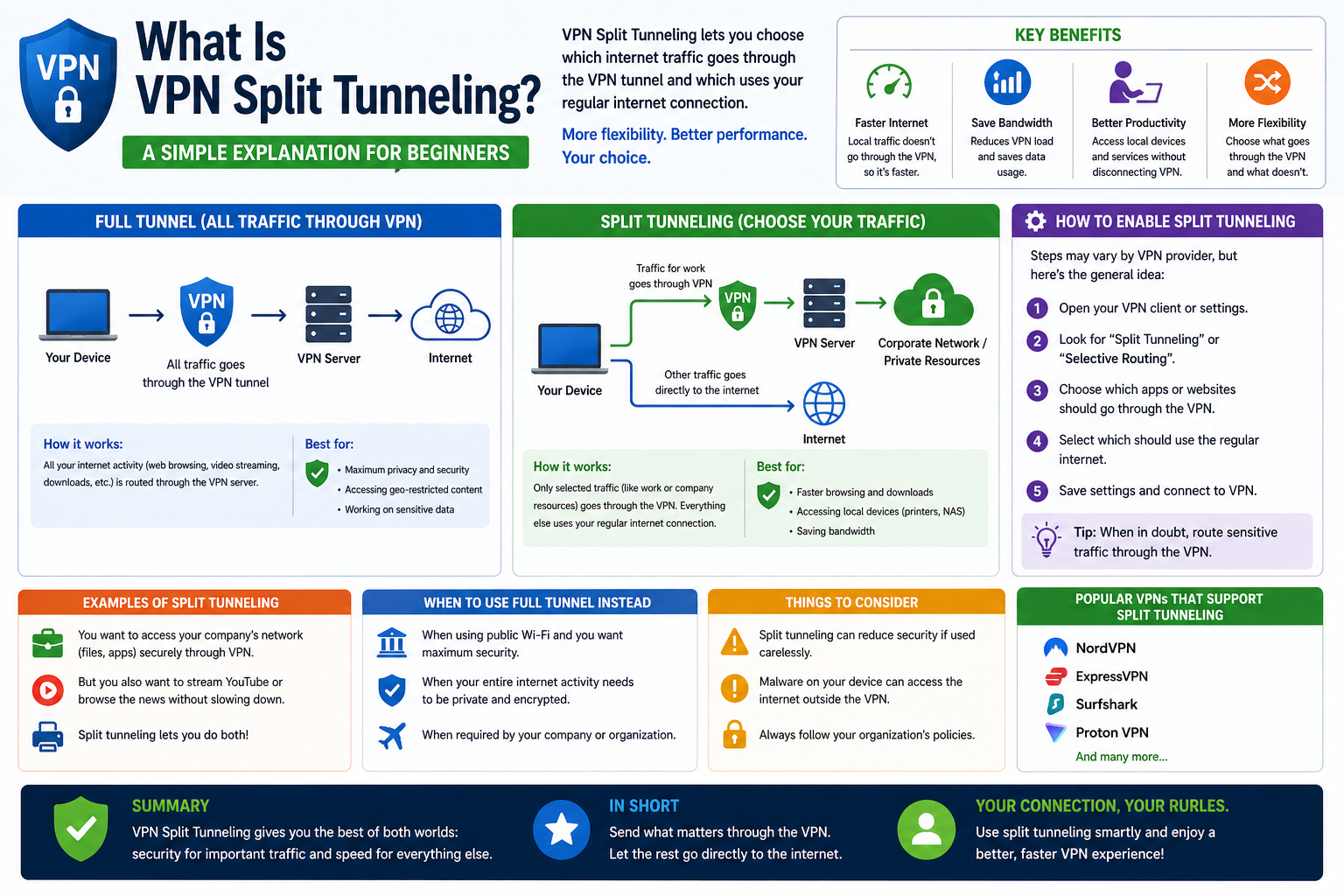
A Virtual Private Network is a communication framework designed to extend private network capabilities over a shared public infrastructure. In practical terms, it creates a protected communication path between a user and a private network, even when the user is physically outside that network perimeter. This technology has become a foundational element in modern enterprise connectivity because it allows organizations to maintain secure access to internal systems without requiring users to be physically present within office environments.
At its core, a VPN is built to solve a fundamental problem in networking: how to safely transmit sensitive data across networks that cannot be fully trusted. The internet, by design, is a public system where data packets travel through multiple intermediate nodes before reaching their destination. Each of these nodes represents a potential exposure point. Without protection, data traveling across these paths could be intercepted, altered, or observed by unauthorized entities.
To address this, VPN technology introduces encryption and tunneling. Encryption ensures that even if data is intercepted, it cannot be understood without the correct cryptographic keys. Tunneling, on the other hand, encapsulates original data packets inside a protected wrapper, which is then transmitted across the public network. This combination effectively creates a “private lane” within a shared highway, allowing secure communication even over unsecured infrastructure.
VPNs are widely used in corporate environments where employees need to access internal systems from remote locations. Whether working from home, traveling, or using public internet connections, users can establish a secure connection to their organization’s internal network. This capability ensures continuity of work without compromising sensitive data or exposing internal systems directly to the internet.
The increasing adoption of cloud computing has further expanded the importance of VPNs. Organizations often distribute their infrastructure across multiple environments, including on-premises servers and cloud-based services. VPNs help unify access to these distributed systems under a consistent security model, ensuring that users can securely interact with resources regardless of where they are hosted.
How VPN Tunnels Secure Data Across Public Networks
The mechanism that makes VPNs effective is the concept of a tunnel. A VPN tunnel is not a physical structure but a logical pathway created through encryption and encapsulation. When a user initiates a VPN connection, their device establishes a secure session with a VPN gateway located within the target private network. This gateway acts as an entry and exit point for encrypted traffic.
Once the tunnel is established, all data leaving the user’s device is wrapped in an encrypted layer before being transmitted across the internet. This encapsulation hides not only the content of the data but also the true destination of internal requests. To external observers, the traffic appears to be directed only toward the VPN gateway, with no visibility into the internal systems being accessed.
Inside the tunnel, data packets remain protected until they reach the VPN gateway. At that point, the gateway decrypts the packets and forwards them to the appropriate internal destination. The reverse process occurs for incoming data: internal responses are encrypted by the gateway before being sent back through the tunnel to the user’s device.
This bidirectional encryption ensures confidentiality, integrity, and authentication. Confidentiality prevents unauthorized access to data content. Integrity ensures that data cannot be modified during transit without detection. Authentication verifies that both endpoints of the connection are legitimate and trusted participants in the communication process.
VPN tunnels can operate in different modes depending on organizational requirements. One common approach is to route all user traffic through the tunnel, regardless of whether it is destined for internal or external resources. This is often referred to as a full-tunnel configuration and provides maximum control and visibility for the organization. However, it also introduces additional processing and bandwidth overhead, which becomes an important factor when evaluating network performance.
Remote Access Architecture and the Role of VPN Gateways
In enterprise environments, VPN connectivity is typically managed through dedicated network devices that act as gateways between external users and internal systems. These gateways are responsible for handling authentication, encryption, routing, and policy enforcement for all VPN traffic.
When a remote user initiates a connection, their VPN client communicates with the gateway to establish a secure session. The gateway verifies user credentials, checks access policies, and determines what level of network access should be granted. Once authentication is successful, a secure tunnel is created between the user’s device and the gateway.
Inside this architecture, the gateway plays a critical role in traffic management. It determines how data flows between the remote user and internal network resources. It also enforces security policies that define which resources are accessible and under what conditions.
For example, a user may be granted access to internal file servers, email systems, and application platforms while being restricted from accessing administrative infrastructure. These policies are centrally managed and applied dynamically based on user identity, group membership, and organizational rules.
VPN gateways also handle encryption and decryption processes, which can be computationally intensive. As the number of connected users increases, so does the processing load on the gateway. This makes efficient traffic management an important consideration in large-scale deployments.
In traditional configurations, the gateway is responsible for routing all traffic generated by VPN users, even traffic that is not intended for internal resources. This design ensures complete visibility and control, but can lead to unnecessary strain on network resources, especially when users access external internet services such as streaming platforms or public websites.
Full Tunnel Behavior and Traffic Flow Inside a VPN
A full tunnel VPN configuration directs all user-generated traffic through the secure VPN tunnel, regardless of its destination. This means that even when a user attempts to access external websites or internet services, their data is first routed through the VPN gateway before being forwarded to the public internet.
This behavior creates a centralized point of control where all traffic can be inspected, filtered, and logged. From a security standpoint, this approach is highly desirable in environments where strict monitoring is required. Organizations can enforce consistent security policies, apply content filtering, and ensure that all outbound traffic adheres to compliance requirements.
However, the full tunnel approach introduces a specific traffic flow pattern that can affect performance. When a user accesses an external website, the request is sent through the encrypted tunnel to the VPN gateway. The gateway then decrypts the request and forwards it to the Internet. The response follows the same path in reverse, traveling back through the gateway and into the tunnel before reaching the user.
This indirect routing increases latency because data must travel an additional hop through the VPN infrastructure. It also increases bandwidth usage on the VPN gateway, since all user traffic—internal and external—is processed by the same system.
In environments with many remote users, this can result in significant resource consumption. The gateway must handle encryption, decryption, routing, and policy enforcement for a large volume of traffic. As a result, network administrators often evaluate alternative approaches to optimize performance while maintaining security standards.
Challenges of Routing All Traffic Through a VPN Tunnel
While full tunnel VPN configurations provide strong security and centralized control, they also introduce operational challenges that can impact both users and network infrastructure. One of the most noticeable challenges is reduced network efficiency.
When every data packet is forced to pass through the VPN gateway, the system becomes a bottleneck for both internal and external traffic. Internal resource access may remain efficient, but external traffic experiences unnecessary detours through the corporate network. This increases latency and can degrade user experience, particularly for bandwidth-intensive applications such as video streaming or large file downloads.
Another challenge involves scalability. As the number of remote users grows, the VPN gateway must handle exponentially more traffic. This requires additional processing power, memory, and network capacity. Without proper scaling, the gateway can become overloaded, leading to slower response times and potential service disruptions.
There is also the issue of inefficient bandwidth utilization. Organizations often pay for high-capacity internet links to support VPN infrastructure. When users route all their internet activity through these links, a significant portion of bandwidth is consumed by non-business-related traffic. This can lead to higher operational costs without delivering additional value to internal operations.
From a user perspective, full tunneling can also introduce limitations in connectivity. Some applications may behave differently when routed through a VPN, especially if they rely on geographic location or direct internet access. This can result in compatibility issues or degraded performance for certain services.
These challenges highlight the need for more flexible routing strategies that differentiate between internal and external traffic, allowing organizations to optimize performance without sacrificing security.
Introducing the Concept of Split Tunneling
Split tunneling emerges as a solution to the inefficiencies associated with full tunnel VPN configurations. Instead of forcing all traffic through the VPN gateway, split tunneling allows selective routing based on destination or policy rules. This means that only traffic intended for internal network resources is sent through the secure tunnel, while all other traffic is directed through the user’s regular internet connection.
This approach effectively divides network traffic into two separate paths: one secure and encrypted path for internal communication, and one direct path for external internet access. The result is a more efficient use of network resources and improved performance for end users.
The concept of split tunneling is built on traffic classification. The VPN client or gateway is configured with rules that define which IP ranges, domains, or network destinations should be considered internal. Any traffic matching these rules is encapsulated and routed through the VPN tunnel. Everything else bypasses the tunnel entirely.
This selective routing reduces the load on VPN infrastructure and minimizes unnecessary encryption overhead. It also allows users to maintain normal internet browsing speeds while still accessing internal corporate resources securely.
Split tunneling is particularly useful in environments where users frequently switch between internal applications and external services. Instead of forcing all traffic through a single path, the system intelligently separates traffic flows based on destination requirements.
Destination-Based Traffic Separation in VPN Environments
At the technical level, split tunneling relies heavily on destination-based routing logic. When a VPN connection is established, the system installs routing rules that determine how different types of traffic should be handled. These rules are typically based on IP address ranges associated with internal networks.
For example, traffic destined for private address spaces such as internal file servers, application hosts, or databases is routed through the VPN tunnel. These destinations are explicitly defined in the VPN configuration to ensure secure access.
On the other hand, traffic destined for public internet resources is excluded from the tunnel. This means that requests to external websites, cloud services, or streaming platforms are sent directly through the user’s local internet connection.
This separation allows for more efficient network utilization. Internal traffic remains protected within the encrypted tunnel, while external traffic avoids unnecessary processing by the VPN gateway. The system effectively makes real-time decisions about routing based on predefined policies.
In more advanced implementations, split tunneling can also be application-aware. Instead of relying solely on IP-based rules, the VPN client may differentiate traffic based on application identity or domain names. This provides even greater flexibility in managing network flows.
Early Design Considerations Before Enabling Split Tunneling
Before implementing split tunneling in a network environment, several design considerations must be evaluated. One of the most important factors is security posture. While split tunneling improves performance, it also introduces potential exposure points because some traffic bypasses corporate security controls.
When external traffic is routed outside the VPN, it is no longer subject to centralized monitoring or filtering. This means that users may be directly exposed to internet-based threats without the protective layer of enterprise security systems. Organizations must carefully assess whether this trade-off is acceptable based on their risk tolerance.
Another consideration is policy enforcement. In a full tunnel setup, all traffic is visible to the organization, allowing consistent enforcement of security policies such as content filtering, data loss prevention, and threat detection. With split tunneling, these controls only apply to traffic passing through the VPN, reducing overall visibility.
Network segmentation also plays a role in design decisions. Administrators must clearly define which resources are considered internal and should be accessible through the VPN. Any ambiguity in these definitions can lead to misrouting of traffic or unintended exposure of internal systems.
Additionally, compatibility with existing infrastructure must be evaluated. Some legacy applications or security tools may assume that all traffic originates from within the corporate network. Introducing split tunneling can alter traffic patterns and require adjustments to these systems.
Impact on Performance, Bandwidth, and Network Resources
One of the primary advantages of split tunneling is improved performance. By reducing the amount of traffic passing through the VPN gateway, organizations can significantly decrease latency and improve response times for users. External internet traffic no longer needs to travel through additional encryption and routing layers, resulting in faster access to online resources.
Bandwidth utilization is also optimized. VPN gateways are no longer required to process all user traffic, which reduces overall load on network infrastructure. This allows organizations to allocate resources more efficiently and support a larger number of concurrent users without upgrading hardware unnecessarily.
For end users, this translates into a smoother experience when accessing both internal and external services. Internal applications continue to benefit from secure VPN connectivity, while internet browsing and cloud services operate at normal speeds.
However, performance improvements must be balanced against security considerations. The separation of traffic paths introduces complexity in monitoring and enforcement, which requires careful configuration and ongoing management to ensure consistent protection across the network environment.
Security Perspective of Encrypted vs Non-Encrypted Traffic Paths
From a security standpoint, split tunneling creates two distinct categories of traffic: encrypted internal traffic and unencrypted external traffic. Each category carries different risk profiles and requires different protective strategies.
Encrypted traffic within the VPN tunnel benefits from strong security controls, including confidentiality, integrity, and authentication. This ensures that sensitive corporate data remains protected as it travels between the user and internal systems.
External traffic, however, bypasses these protections and is subject to the security measures of the public internet and the user’s local network. This can introduce vulnerabilities if users access malicious websites or unsecured services.
Organizations must therefore implement complementary security measures to mitigate these risks. Endpoint protection, secure web gateways, and user awareness training become essential components of a split tunneling environment.
The balance between performance and security is a key consideration in modern network design, and split tunneling represents one approach to achieving that balance when applied appropriately within a controlled policy framework.
Policy-Based Traffic Control in Enterprise VPN Environments
In real-world network environments, split tunneling is not simply a toggle that turns selective routing on or off. It is governed by policy frameworks that define how traffic should behave once a VPN connection is established. These policies are typically enforced at the VPN gateway level and distributed to client devices when they authenticate into the system.
The purpose of policy-based control is to ensure that traffic separation is consistent across all users within a defined group. Instead of relying on manual configuration at the user device, administrators define rules centrally that determine which traffic must pass through the encrypted tunnel and which traffic is allowed to bypass it.
These rules are often tied to user identity and group membership. When a user connects to the VPN, they are assigned a group policy that dictates their network behavior. This approach ensures that different categories of users can have different levels of access and routing behavior based on organizational needs.
For example, a finance department user may be restricted to strict tunneling rules where most traffic is forced through the VPN, while a general employee may be allowed more flexible routing to improve performance. This segmentation allows organizations to balance security and usability without compromising either completely.
Policy-based control also simplifies large-scale management. Instead of configuring individual devices, administrators update a central policy that automatically propagates changes to all affected users. This centralized approach reduces configuration errors and ensures consistent enforcement across the network.
Split Include and Split Exclude Routing Models
Split tunneling implementations generally follow two primary routing models: split include and split exclude. These models define how routing decisions are made and which traffic is prioritized for secure transmission.
In a split include model, only specific traffic is explicitly sent through the VPN tunnel. Everything else is automatically excluded. This approach is highly restrictive and ensures that only predefined internal destinations are accessible through the secure channel. It is often used in environments where security requirements are strict and internal resources must be tightly controlled.
In contrast, a split exclude model allows all traffic to pass through the VPN tunnel except for explicitly excluded destinations. This means that internal traffic and most external traffic flow through the encrypted tunnel, while only selected external services are accessed directly. This approach is more flexible and often used in environments where centralized control is still important, but performance optimization is also a priority.
The choice between these two models depends on organizational priorities. A split include approach minimizes exposure but can reduce flexibility, while a split exclude approach improves usability but may increase the risk surface if not carefully managed.
In both cases, routing decisions are based on predefined network identifiers such as IP address ranges or domain-based rules. These identifiers are distributed to the VPN client during connection establishment and installed into the local routing table.
VPN Client Behavior During Route Installation
When a VPN connection is established, the client device undergoes a dynamic reconfiguration of its network routing table. This process determines how outgoing traffic is directed based on destination addresses.
In a full tunnel configuration, the client installs a default route that directs all traffic through the VPN gateway. This default route overrides local network routing and ensures that all packets are encapsulated and transmitted securely.
In a split tunneling configuration, the routing table is modified more selectively. Instead of overriding the default route, the VPN client adds specific routes for internal networks. These routes take precedence for matching destinations, while all other traffic continues to use the local internet connection.
This dynamic routing adjustment happens automatically during VPN session establishment. The client receives configuration parameters from the VPN gateway, interprets the routing rules, and applies them to the operating system’s network stack.
The routing table is continuously used to make forwarding decisions for every outgoing packet. Each packet is evaluated against the routing rules, and the most specific match determines its path. This process occurs at a very low level in the networking stack, ensuring efficient decision-making without user intervention.
DNS Resolution Challenges in Split Tunneling Environments
One of the most complex aspects of split tunneling is DNS resolution. DNS, or Domain Name System, is responsible for translating human-readable domain names into IP addresses. In VPN environments, DNS behavior must be carefully managed to ensure consistent access to internal and external resources.
In a full tunnel setup, DNS queries are typically routed through the VPN gateway. This ensures that internal domain names are resolved using corporate DNS servers, while external queries are still processed within the secure environment.
In split tunneling scenarios, DNS resolution becomes more complicated. Since external traffic bypasses the VPN, DNS queries may also bypass corporate DNS servers. This can lead to situations where internal domain names are not resolved correctly, or external DNS responses do not align with internal security policies.
To address this, organizations often implement split DNS configurations. In this approach, internal domain queries are routed through the VPN tunnel to corporate DNS servers, while external queries are resolved using local or public DNS services.
This separation ensures that internal resources remain accessible while still allowing efficient resolution of external domains. However, it requires careful configuration to avoid conflicts or leakage of internal domain information to external resolvers.
DNS misconfiguration in split tunneling environments can lead to connectivity issues, where users are unable to access internal applications or experience inconsistent resolution behavior depending on their network state.
Interaction Between Split Tunneling and Firewall Policies
Firewall systems play a significant role in controlling network traffic in VPN environments. When split tunneling is enabled, firewall behavior must be adjusted to account for the fact that not all traffic passes through centralized security points.
In a full tunnel configuration, all user traffic is inspected by the corporate firewall, allowing consistent enforcement of security rules. This includes filtering malicious traffic, blocking unauthorized access, and monitoring data flow.
With split tunneling, only internal traffic is subject to firewall inspection. External traffic bypasses corporate security infrastructure and is handled by the user’s local network and internet service provider.
This shift requires organizations to rethink their security perimeter. Instead of relying solely on centralized firewalls, endpoint security becomes increasingly important. Devices must be protected individually because they may interact directly with external networks.
Firewall policies within the VPN gateway remain critical for internal traffic protection. These policies define which internal resources can be accessed, how traffic is filtered, and what restrictions apply to different user groups.
Administrators must ensure that firewall rules align with split tunneling policies to avoid unintended access or exposure of sensitive systems.
Authentication Flow and Session Establishment Behavior
Before any routing decisions are applied, VPN clients must first complete an authentication process. This process verifies user identity and determines whether access to the network should be granted.
Authentication typically involves credentials such as usernames, passwords, certificates, or multi-factor authentication mechanisms. Once the user is validated, the VPN gateway assigns a session profile that defines their access rights and routing behavior.
This session profile includes group policy information, which specifies whether split tunneling is enabled and how it should be applied. The profile is transmitted to the client during session establishment and remains active for the duration of the connection.
Once authenticated, the VPN client establishes an encrypted tunnel and applies the received configuration settings. At this stage, routing tables are updated, DNS settings may be modified, and traffic policies are enforced.
Session management continues throughout the VPN connection. If a user’s permissions change or if network policies are updated, the session may be renegotiated or terminated, depending on the configuration.
This dynamic nature ensures that access control remains consistent with organizational policies even as user conditions change.
Traffic Classification and Routing Decision Logic
At the heart of split tunneling is traffic classification. Every outgoing packet generated by a device must be evaluated to determine whether it should be routed through the VPN tunnel or sent directly to the Internet.
This classification is based on destination criteria defined in the VPN policy. These criteria typically include IP address ranges, subnets, or domain-based rules. When a packet is generated, the operating system checks its destination against the routing table.
If the destination matches an internal network range, the packet is encapsulated and sent through the VPN tunnel. If it does not match any internal route, it is sent through the default local gateway.
This decision-making process happens continuously and at high speed, allowing a seamless user experience without manual intervention. The efficiency of this system is critical, especially in environments with high traffic volumes or latency-sensitive applications.
In more advanced systems, traffic classification may also include application-level awareness. This allows routing decisions to be made based on the type of application generating the traffic, rather than just the destination address. This adds a s layer of flexibility in managing network behavior.
Security Implications of Bypassing the Encrypted Tunnel
While split tunneling improves performance, it introduces a shift in security dynamics that must be carefully managed. When traffic bypasses the VPN tunnel, it is no longer protected by corporate encryption or monitoring systems.
This means that external traffic is exposed to the security risks of the public internet. Users may unknowingly connect to malicious websites, download harmful content, or interact with unsecured services without the protective oversight of enterprise systems.
This exposure increases the importance of endpoint security. Devices must be equipped with antivirus protection, firewall capabilities, and intrusion detection systems to compensate for the lack of centralized monitoring.
Another security consideration is data leakage. If sensitive information is transmitted over external channels instead of the VPN tunnel, it may be intercepted or exposed. This risk is particularly significant in environments where users handle confidential or regulated data.
Organizations must therefore carefully define which traffic is allowed to bypass the tunnel. Misconfiguration of split tunneling policies can inadvertently expose internal systems or sensitive data to external networks.
Network Address Translation and Traffic Flow Adjustments
Network Address Translation plays a critical role in VPN environments, especially when handling traffic that moves between internal and external networks. In a full tunnel configuration, NAT is typically handled at the VPN gateway, where internal addresses are translated for external communication.
In split tunneling environments, NAT responsibilities are distributed. Internal traffic continues to be processed through the VPN gateway, while external traffic is handled by the user’s local network or internet provider.
This separation reduces the load on centralized NAT systems but introduces variability in how traffic is translated and routed. Each network path may apply different NAT rules, leading to differences in packet behavior depending on the destination.
Proper configuration is essential to ensure consistency and avoid routing conflicts. Misalignment between NAT policies and split tunneling rules can result in connectivity issues or failed communication between systems.
Operational Monitoring and Session Visibility
Monitoring VPN sessions becomes more complex when split tunneling is enabled. In full tunnel configurations, all traffic passes through a centralized point, making it easier to observe and analyze network behavior.
With split tunneling, visibility is reduced because only a portion of traffic flows through the VPN infrastructure. External traffic bypasses monitoring systems, limiting the organization’s ability to track user activity comprehensively.
To address this, administrators rely on session logs, routing statistics, and connection metadata. These logs provide information about which users are connected, which policies are applied, and which internal resources are being accessed.
However, external traffic visibility remains limited unless additional endpoint monitoring tools are deployed. This creates a more distributed security model where visibility is shared between network infrastructure and endpoint devices.
Troubleshooting Routing Conflicts in Split VPN Configurations
Routing conflicts can occur when split tunneling policies are incorrectly configured or when overlapping network definitions exist. These conflicts may result in traffic being sent to incorrect destinations or failing to reach intended resources.
One common issue is overlapping IP ranges between internal and external networks. If routing rules are not clearly defined, the system may misclassify traffic, leading to inconsistent behavior.
Another issue arises when VPN clients fail to update routing tables correctly after connection establishment. This can result in traffic continuing to use default routes instead of VPN-specific paths.
DNS inconsistencies can also cause troubleshooting challenges. If internal domain queries are resolved externally, users may be unable to access internal applications even when the VPN connection is active.
Diagnosing these issues requires careful analysis of routing tables, session logs, and network configuration settings. Understanding how traffic flows through both VPN and non-VPN paths is essential for resolving connectivity problems.
User Experience Variability in Split Tunneling Deployments
The user experience in a split tunneling environment can vary significantly depending on network conditions and configuration policies. When implemented correctly, users benefit from faster internet access and seamless connectivity to internal resources.
However, inconsistencies can arise if routing rules are not properly aligned. Users may experience situations where internal applications are accessible, but external services behave differently depending on the network state.
This variability can create confusion, especially for non-technical users who may not understand why certain applications behave differently when connected to the VPN.
Consistency in policy design and clear separation of internal and external traffic definitions are essential to maintaining a stable user experience.
Advanced Split Tunneling Architectures in Large-Scale Networks
As enterprise networks grow in complexity, split tunneling evolves from a simple routing optimization technique into a structured architectural component. In large-scale environments, thousands of users may connect simultaneously from different geographic locations, devices, and network conditions. This diversity requires split tunneling systems to be highly adaptive, policy-driven, and resilient.
Modern deployments no longer rely on static routing definitions alone. Instead, they incorporate dynamic policy engines that evaluate user identity, device posture, application behavior, and network context in real time. This allows routing decisions to adapt continuously based on changing conditions.
In these advanced architectures, split tunneling is often integrated into broader secure access frameworks. Rather than being an isolated VPN feature, it becomes part of a unified connectivity strategy that governs how all traffic enters and exits the enterprise environment.
The VPN gateway acts as a central policy enforcement point, while client devices act as distributed execution nodes. Each node receives instructions about how to handle specific traffic flows, ensuring consistent behavior across the entire network.
This distributed model improves scalability because decision-making is partially offloaded from centralized infrastructure. However, it also requires highly reliable synchronization between policy systems and client endpoints to prevent inconsistencies in routing behavior.
Device Posture and Context-Aware Routing Decisions
One of the most significant advancements in split tunneling design is the introduction of context-aware routing. Instead of treating all devices equally, modern systems evaluate the security posture of each endpoint before applying routing policies.
Device posture refers to the security state of a device at the time of connection. This includes factors such as operating system version, patch level, antivirus status, encryption settings, and compliance with organizational policies.
If a device meets all security requirements, it may be granted more flexible split tunneling privileges. Conversely, devices that fail compliance checks may be forced into full tunnel mode, where all traffic is routed through the VPN for stricter monitoring.
This adaptive approach ensures that split tunneling is not a static privilege but a dynamic condition that depends on real-time security assessment. It allows organizations to reduce risk exposure while still maintaining performance benefits for trusted devices.
Context-aware routing can also incorporate environmental factors such as network type. For example, a device connected through a secure corporate Wi-Fi network may be treated differently from one connected through a public hotspot.
By combining device posture and environmental context, split tunneling systems can make highly granular decisions about traffic flow, significantly improving both security and efficiency.
Application-Level Awareness in Traffic Segmentation
Traditional split tunneling relies heavily on IP-based routing rules. However, modern applications often use dynamic IP addresses, cloud-based infrastructure, and encrypted communication channels, making static rules less effective.
To address this, advanced systems introduce application-level awareness. This means that routing decisions are based not only on destination addresses but also on the identity of the application generating the traffic.
For example, an enterprise collaboration tool may be configured to always use the VPN tunnel because it accesses sensitive internal data. At the same time, a video streaming application may be configured to bypass the tunnel to preserve bandwidth.
This level of granularity requires deep packet inspection or integration with application metadata. The system must be able to distinguish between different types of traffic even when they share the same network infrastructure.
Application-aware split tunneling improves efficiency by ensuring that only business-critical traffic consumes VPN resources. It also enhances user experience by allowing non-sensitive applications to operate without unnecessary routing delays.
However, it introduces additional complexity in policy management. Administrators must maintain detailed application profiles and continuously update them as software evolves.
Latency Reduction and Performance Tuning Techniques
Latency is a critical performance metric in network communications, especially for real-time applications such as video conferencing, voice communication, and interactive systems. VPN tunnels inherently introduce additional latency due to encryption, routing, and gateway processing.
Split tunneling helps reduce latency by allowing external traffic to bypass the VPN infrastructure entirely. This eliminates unnecessary routing hops and reduces the distance data must travel before reaching its destination.
Performance tuning in split tunneling environments involves careful analysis of traffic patterns. Administrators must identify which applications are sensitive to latency and ensure that they are either routed optimally or excluded from unnecessary VPN processing.
In some cases, internal applications may also benefit from optimized routing paths within the VPN tunnel. This requires careful network design to ensure that internal traffic does not experience bottlenecks at the gateway level.
Latency reduction is not only about speed but also about consistency. Predictable routing behavior ensures that applications perform reliably under varying network conditions.
Security Policy Enforcement in Mixed Routing Environments
Split tunneling introduces a mixed routing environment where some traffic is protected by enterprise security systems while other traffic is not. This creates a challenge for maintaining consistent security enforcement.
Security policies must be carefully designed to account for both traffic types. Internal traffic can be monitored and controlled through VPN gateways, while external traffic requires endpoint-level protection.
Organizations often implement layered security models to address this challenge. These models combine network-based controls with device-based protections to ensure comprehensive coverage.
For internal traffic, policies may include access control lists, intrusion detection systems, and data loss prevention mechanisms. For external traffic, endpoint protection tools and secure browsing controls are commonly used.
Policy enforcement must also consider data classification. Sensitive data should always be routed through secure channels, while less critical traffic may be allowed to bypass the VPN.
This requires careful categorization of applications, services, and data types to ensure that routing decisions align with security requirements.
Identity-Based Access Control and Traffic Segmentation
Identity-based access control plays a crucial role in modern split tunneling systems. Instead of relying solely on network-level rules, access decisions are based on user identity and role within the organization.
When a user connects to the VPN, their identity determines which resources they can access and how their traffic is routed. This ensures that routing behavior is aligned with organizational hierarchy and job responsibilities.
For example, administrative users may be required to route all traffic through the VPN for monitoring purposes, while general users may be granted split tunneling privileges for improved performance.
Identity-based control also enables dynamic policy enforcement. If a user’s role changes, their routing permissions can be updated automatically without requiring manual reconfiguration.
This approach improves security by ensuring that access rights are always aligned with the current organizational structure. It also simplifies management by centralizing control over routing behavior.
Conclusion
Split tunneling represents a significant shift in how secure network connectivity is designed and managed in modern VPN environments. Instead of forcing all user traffic through a centralized encrypted tunnel, it introduces a selective routing approach that separates internal corporate communication from general internet activity. This separation allows organizations to improve performance, reduce unnecessary load on VPN infrastructure, and provide users with a more responsive and efficient network experience.
At the same time, split tunneling is not simply a performance enhancement feature. It is fundamentally a policy-driven networking model that requires careful planning, precise configuration, and continuous oversight. The decision to route traffic outside the VPN tunnel introduces a change in the security boundary, shifting part of the responsibility from centralized network controls to endpoint systems. This means that devices must be properly secured, monitored, and maintained to prevent exposure to external threats.
The effectiveness of split tunneling depends heavily on how well traffic classification rules are defined. When internal and external destinations are clearly separated, the system can efficiently direct traffic along the correct path without user intervention. However, if policies are misconfigured or poorly maintained, issues such as routing conflicts, DNS inconsistencies, or unintended exposure of internal resources can arise.
In larger enterprise environments, split tunneling becomes even more complex as it integrates with identity-based access control, application-aware routing, and hybrid cloud infrastructures. These advanced implementations allow organizations to tailor network behavior based on user roles, device security posture, and application requirements. This level of granularity helps balance security and usability in environments where both are critical.
Despite its advantages, split tunneling also introduces limitations in visibility and centralized monitoring. Since not all traffic flows through the VPN gateway, organizations must rely on distributed security tools and endpoint-level protections to maintain full oversight of user activity. This distributed model requires coordination between network infrastructure and endpoint security systems to ensure consistent protection.
Ultimately, split tunneling is best understood as a strategic networking approach rather than a simple configuration option. It reflects the broader evolution of enterprise networks toward more flexible, distributed, and performance-oriented architectures. When implemented thoughtfully, it enables organizations to optimize resource usage while still maintaining strong security controls over sensitive internal communication.