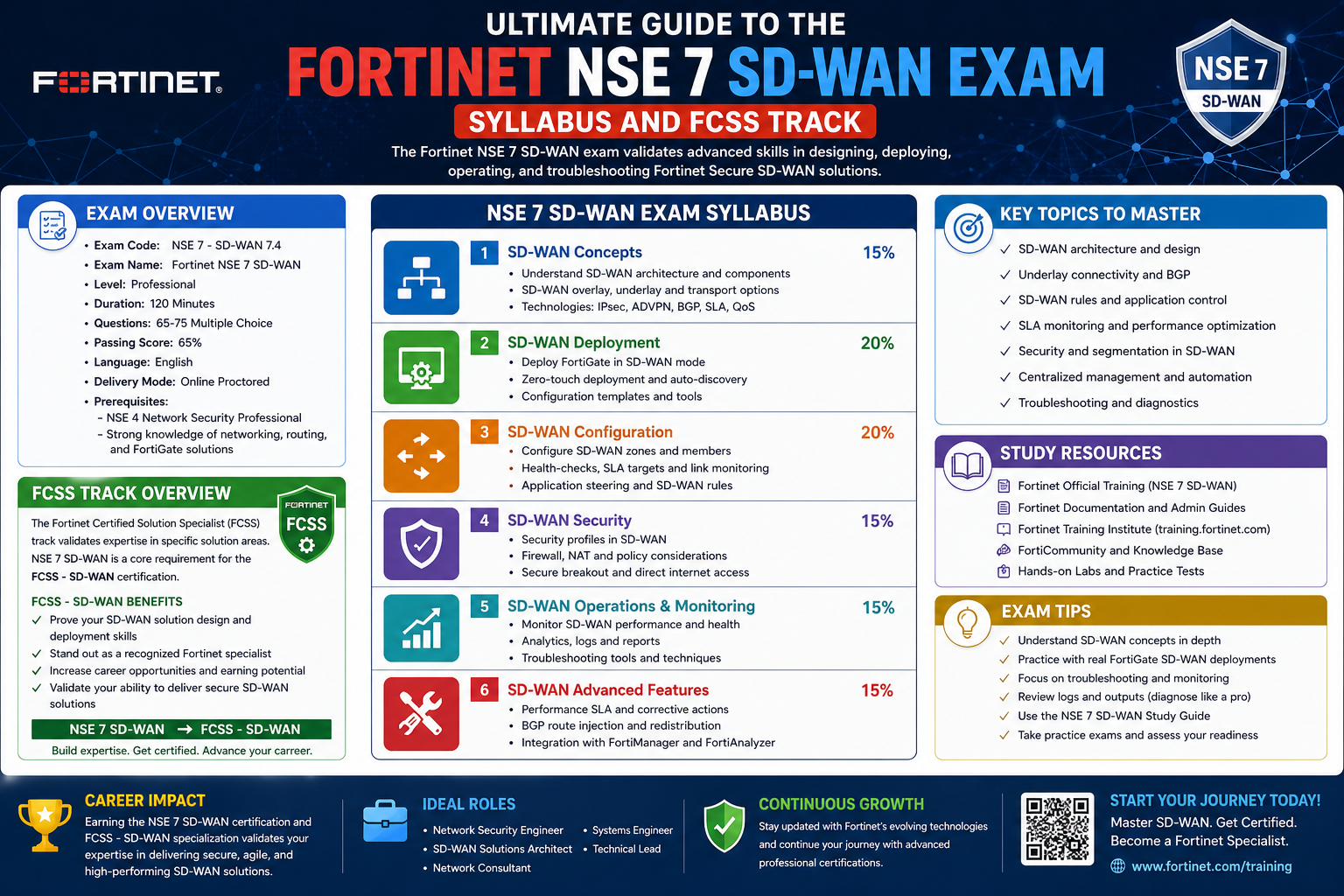
The professional networking and security landscape has undergone a significant transformation over the past decade, and certification frameworks have evolved alongside it to reflect changing industry requirements. Within enterprise environments, there has been a clear shift away from isolated networking functions toward more integrated and software-driven infrastructures. This change has influenced how vendors structure their certification programs, especially those focused on network security and wide area networking technologies. The restructured certification model places stronger emphasis on practical competencies and real-world deployment scenarios rather than purely theoretical knowledge.
Within this evolving ecosystem, SD-WAN has emerged as a foundational technology that reshapes how organizations design and operate their networks. Traditional wide area networks were heavily dependent on fixed infrastructure such as MPLS circuits, which provided reliability but limited flexibility. As cloud adoption increased and enterprise applications became more distributed, organizations needed more adaptive networking solutions capable of intelligently routing traffic across multiple transport types. SD-WAN technology addressed this requirement by introducing centralized control, application-aware routing, and dynamic path selection across hybrid connectivity models.
Fortinet’s SD-WAN implementation plays a particularly important role in this transition due to its integration with security functions and its deployment within FortiGate devices. Instead of treating networking and security as separate layers, Fortinet’s approach merges them into a unified system where routing decisions, policy enforcement, and security inspection operate in coordination. This convergence has made Fortinet SD-WAN solutions widely used in environments that require both performance optimization and strict security control.
As enterprise reliance on SD-WAN grows, the need for professionals who understand its operational complexity has also increased. The certification structure reflects this demand by emphasizing hands-on capability with real deployment tools rather than abstract networking theory. The inclusion of SD-WAN-focused expertise within advanced certification levels demonstrates how critical this technology has become in modern network design. Professionals pursuing these credentials are expected to understand not only how SD-WAN functions conceptually but also how it behaves under real traffic conditions, policy constraints, and multi-site configurations.
The importance of SD-WAN skills extends beyond configuration tasks. Modern enterprise networks require continuous monitoring, optimization, and troubleshooting across distributed environments. This means professionals must be capable of interpreting network behavior under varying conditions, identifying performance bottlenecks, and adjusting policies dynamically. The certification path that includes SD-WAN validates this broader skill set by requiring familiarity with both design principles and operational troubleshooting.
In practice, SD-WAN expertise represents a blend of networking knowledge, security awareness, and platform-specific configuration skills. It requires understanding how data flows across multiple links, how applications are classified and prioritized, and how centralized management systems coordinate policies across large-scale deployments. This combination of skills reflects the real-world expectations placed on network engineers and security professionals in enterprise environments today.
Understanding SD-WAN in Modern Enterprise Networking Environments
Software-defined wide area networking represents a fundamental shift in how organizations connect branch locations, data centers, and cloud services. Unlike traditional WAN architectures that rely on static routing and dedicated circuits, SD-WAN introduces abstraction and centralized intelligence to network management. This allows organizations to dynamically select the best available path for application traffic based on real-time performance metrics, policy rules, and business requirements.
At its core, SD-WAN separates the control plane from the data plane. The control plane is responsible for decision-making, policy enforcement, and network orchestration, while the data plane handles actual packet forwarding. This separation enables centralized control over distributed network devices, allowing administrators to define policies once and apply them consistently across multiple locations. This model significantly reduces operational complexity, especially in large enterprises with hundreds or thousands of branch sites.
A defining characteristic of SD-WAN is its ability to utilize multiple transport types simultaneously. These may include MPLS, broadband internet, LTE, or other connectivity options. Instead of relying on a single path, SD-WAN continuously evaluates link performance and selects the most efficient route for each application. This ensures that critical business applications maintain performance even when certain links experience degradation or outages.
Application awareness is another key aspect of SD-WAN technology. Rather than treating all network traffic equally, SD-WAN solutions classify traffic based on application type and business importance. For example, voice and video traffic may be prioritized over bulk data transfers. This classification allows organizations to align network behavior with business priorities, ensuring that critical services receive the necessary bandwidth and low-latency paths.
In enterprise environments, SD-WAN also plays a major role in cloud connectivity. As organizations increasingly rely on cloud-based applications and services, traditional hub-and-spoke WAN designs become less efficient. SD-WAN enables direct-to-cloud connectivity, reducing latency and improving performance by allowing branch sites to access cloud resources without unnecessary backhauling through central data centers. This shift improves both user experience and network efficiency.
Security integration is another defining feature of modern SD-WAN implementations. Instead of relying on separate security appliances, many SD-WAN solutions incorporate firewalling, encryption, and threat detection directly into the networking platform. This integrated approach ensures that traffic is not only routed efficiently but also inspected and protected throughout its journey across the network. It also simplifies management by reducing the number of separate systems administrators that must be maintained.
Operationally, SD-WAN introduces a higher level of complexity compared to traditional networking models. While it simplifies certain aspects of network management, it also requires a deeper understanding of policies, overlays, tunnels, and dynamic routing behavior. Network professionals must be able to interpret how traffic flows under different policy conditions and how changes in link performance affect application delivery. This requires both theoretical knowledge and practical experience in real-world environments.
The adoption of SD-WAN continues to grow as enterprises prioritize agility, cost efficiency, and cloud readiness. It represents a shift toward intent-based networking, where administrators define desired outcomes rather than configuring individual routing paths. This evolution has made SD-WAN one of the most important technologies in modern network architecture.
Fortinet SD-WAN Architecture and Core Functional Components
Fortinet’s SD-WAN architecture is built around the FortiGate platform, which integrates networking, security, and application intelligence into a single device. This unified approach allows organizations to deploy SD-WAN functionality without introducing additional hardware layers. Within this architecture, FortiGate devices operate as both security appliances and SD-WAN edge nodes, handling traffic routing decisions while simultaneously enforcing security policies.
The architecture typically consists of underlay and overlay networks. The underlay refers to the physical or logical transport connections, such as MPLS links or broadband internet connections. The overlay is built on top of these links and consists of virtual tunnels that carry application traffic between sites. These overlays enable consistent policy enforcement and secure communication across diverse transport types.
Within Fortinet SD-WAN, routing decisions are not based solely on traditional metrics such as hop count or static routes. Instead, they rely on dynamic performance measurements and policy-driven rules. FortiGate devices continuously monitor link quality using metrics such as latency, jitter, and packet loss. These measurements are then used to determine the best path for each application session.
Another critical component of the architecture is the use of IPsec tunnels for secure communication between sites. These tunnels ensure that data remains encrypted while traversing public or untrusted networks. In hub-and-spoke or full-mesh topologies, these tunnels form the backbone of secure connectivity, enabling consistent communication across distributed environments. Advanced configurations may also incorporate dynamic tunnel creation mechanisms that allow automatic scaling of secure paths based on network conditions.
Routing within Fortinet SD-WAN environments is highly flexible. Traditional static routing can be combined with dynamic protocols, allowing organizations to maintain control over traffic flow while benefiting from automated path selection. Policy-based routing plays a central role in determining how traffic is handled. Instead of relying solely on destination-based decisions, routing policies consider application type, source, performance requirements, and business priority.
Another important architectural aspect is segmentation. Fortinet SD-WAN supports virtual domains and network segmentation, allowing organizations to isolate traffic flows based on department, function, or security requirements. This ensures that sensitive data remains separated from general traffic while still benefiting from shared infrastructure.
The integration of security functions within the SD-WAN architecture is one of its most distinctive features. FortiGate devices perform firewall inspection, intrusion prevention, and application control directly within the traffic flow. This eliminates the need for separate security appliances and ensures that security policies are consistently applied across all network paths.
Scalability is also a key consideration in Fortinet SD-WAN architecture. As organizations expand, new branch sites can be added with minimal configuration changes. Centralized management tools allow administrators to deploy consistent configurations across multiple devices, reducing operational overhead and ensuring uniform policy enforcement.
Overall, Fortinet SD-WAN architecture is designed to provide a balance between performance optimization, security integration, and operational simplicity. It enables organizations to manage complex distributed networks while maintaining control over traffic behavior and security posture.
Operational Behavior of Fortinet SD-WAN Systems in Real Network Conditions
The operational behavior of Fortinet SD-WAN environments is defined by continuous evaluation, dynamic decision-making, and policy-based traffic control. Unlike static networking models, SD-WAN systems actively monitor network conditions and adjust traffic flow in real time. This adaptability is essential in environments where network performance can vary significantly due to congestion, link degradation, or external disruptions.
One of the core operational mechanisms is performance-based path selection. FortiGate devices continuously measure network metrics such as latency, jitter, and packet loss across available links. These measurements are used to evaluate whether a link meets predefined performance thresholds. If a link fails to meet requirements, traffic is automatically rerouted to a more suitable path. This ensures consistent application performance even under changing network conditions.
Traffic steering rules are central to SD-WAN behavior. These rules define how different types of traffic should be handled based on application identity, source, destination, and performance requirements. For example, real-time applications such as voice or video conferencing may be assigned high-priority paths with strict latency requirements, while bulk data transfers may be routed through lower-cost links. This prioritization ensures that critical applications receive optimal network resources.
Load balancing is another important operational feature. SD-WAN systems distribute traffic across multiple links to maximize utilization and prevent congestion. This is not a simple equal distribution process but rather an intelligent balancing mechanism that considers link performance and application requirements. As network conditions change, traffic distribution is continuously adjusted to maintain efficiency.
Failover mechanisms also play a critical role in SD-WAN operations. When a primary link becomes unavailable or degrades beyond acceptable thresholds, traffic is automatically shifted to backup links. This process occurs seamlessly and is designed to minimize disruption to end users. The speed and efficiency of failover depend on real-time monitoring and predefined policy configurations.
Traffic shaping is used to control bandwidth usage and ensure fair allocation of network resources. By applying shaping policies, administrators can limit or guarantee bandwidth for specific applications or user groups. This prevents network congestion and ensures that critical applications maintain consistent performance even during peak usage periods.
Application identification is a foundational aspect of SD-WAN behavior. FortiGate devices analyze traffic patterns to identify applications regardless of port or protocol. This allows policies to be applied based on application type rather than network-level attributes alone. As a result, organizations gain greater visibility and control over how applications consume network resources.
The interaction between routing policies and performance monitoring creates a dynamic system that continuously adapts to changing conditions. Unlike static routing environments, SD-WAN systems do not rely on fixed paths. Instead, they make real-time decisions based on current network state and predefined business rules.
Operational complexity arises from the need to balance multiple competing factors, including performance, cost, security, and reliability. Administrators must design policies that account for these factors while ensuring consistent behavior across distributed environments. This requires a deep understanding of how SD-WAN systems interpret and execute routing decisions under different scenarios.
Centralized Management and Orchestration in Fortinet SD-WAN Deployments
Centralized management is a defining characteristic of Fortinet SD-WAN environments, enabling administrators to control large-scale network deployments from a unified interface. This approach eliminates the need to configure each device individually, reducing complexity and improving consistency across distributed infrastructures.
In a centralized model, policies are defined at a global level and pushed to individual FortiGate devices. This ensures that all branch locations operate under the same set of rules while still allowing for localized adjustments when necessary. Centralized management also simplifies policy updates, as changes can be applied across the entire network simultaneously.
Configuration templates play an important role in orchestration. These templates define standardized settings for SD-WAN behavior, including routing rules, performance thresholds, and security policies. By using templates, administrators can ensure consistency while reducing manual configuration errors.
Monitoring and analytics are also centralized, providing visibility into network performance across all sites. Administrators can observe link utilization, application performance, and failure events from a single dashboard. This visibility is essential for maintaining operational stability in complex environments.
Change management is another critical aspect of centralized orchestration. Because SD-WAN environments are highly dynamic, changes to policies or configurations can have immediate effects on traffic behavior. Centralized systems allow for controlled deployment of changes, ensuring that updates are tested and validated before being applied broadly.
The orchestration layer also facilitates automation. Routine tasks such as device provisioning, policy updates, and performance monitoring can be automated, reducing manual workload and improving efficiency. Automation is particularly valuable in large-scale deployments where manual configuration would be impractical.
Centralized management does not eliminate local control. Instead, it provides a hierarchical structure where global policies govern overall behavior while local overrides allow for site-specific requirements. This balance ensures both consistency and flexibility within the network.
Troubleshooting Dynamics and Operational Challenges in SD-WAN Environments
Troubleshooting in SD-WAN environments requires a different mindset compared to traditional networking. Because traffic behavior is dynamic and policy-driven, issues may not always be immediately visible through static configuration inspection. Instead, troubleshooting involves analyzing real-time performance data, policy interactions, and application behavior across multiple links.
One of the primary challenges is identifying whether issues are caused by underlying transport problems or SD-WAN policy decisions. Since SD-WAN continuously shifts traffic based on performance metrics, an application issue may result from routing changes rather than link failure. Understanding this distinction is essential for effective troubleshooting.
Another common challenge is interpreting performance metrics. Latency, jitter, and packet loss values must be analyzed in context, as temporary fluctuations may trigger traffic shifts even if overall link quality remains acceptable. Troubleshooting requires the ability to correlate these metrics with application behavior and user experience.
Overlay tunnels can also introduce complexity. Because SD-WAN relies heavily on virtualized tunnels, issues may arise within the encapsulation layer rather than the physical network. Diagnosing such issues requires visibility into both underlay and overlay traffic flows.
Policy misconfiguration is another frequent source of operational issues. If routing rules are not aligned with application requirements, traffic may be directed through suboptimal paths. This can result in degraded performance even when network links are functioning correctly. Identifying these mismatches requires careful analysis of policy logic and traffic classification behavior.
Centralized management systems can both simplify and complicate troubleshooting. While they provide visibility into network-wide behavior, they also abstract certain device-level details. Troubleshooting, therefore, requires understanding how centralized policies translate into local device actions.
In complex environments, multiple SD-WAN rules may interact simultaneously, creating unexpected traffic patterns. This makes it essential to evaluate how rules are prioritized and how they affect decision-making in real time. Observing these interactions helps identify root causes of performance inconsistencies.
Effective troubleshooting in SD-WAN environments relies on a combination of monitoring tools, log analysis, and conceptual understanding of how policies influence traffic flow. It is not sufficient to examine individual devices in isolation; instead, the entire network behavior must be considered holistically.
SD-WAN Exam Knowledge Domains and Skill Expectations in Real Deployments
The knowledge areas assessed in an advanced SD-WAN certification environment are designed to reflect practical responsibilities in enterprise networking roles. Rather than focusing on isolated configuration commands, the exam framework emphasizes how different components of an SD-WAN solution interact under operational conditions. This includes deployment planning, policy creation, traffic engineering, monitoring, and troubleshooting across distributed environments.
A key expectation is the ability to understand how SD-WAN policies influence routing behavior. These policies are not simple static rules but dynamic decision-making structures that evaluate multiple conditions simultaneously. Factors such as application type, link performance, and user-defined priorities all contribute to how traffic is handled. In real-world environments, this requires professionals to anticipate how changes in configuration will affect traffic flow across multiple branches.
Another important domain is the integration of SD-WAN with existing routing infrastructures. Many enterprise networks still rely on traditional routing protocols, and SD-WAN must coexist with these systems without disrupting established traffic patterns. This requires a clear understanding of route propagation, administrative distance interactions, and how SD-WAN overlays influence underlying routing decisions.
The exam also expects familiarity with operational monitoring concepts. This includes interpreting performance data, identifying anomalies, and understanding how real-time metrics influence traffic steering. Monitoring is not limited to interface status or connectivity checks but extends to application-level performance and end-to-end user experience.
Security integration is another core expectation. Since SD-WAN environments often combine networking and security functions, professionals must understand how firewall policies, encryption mechanisms, and traffic inspection processes interact with routing decisions. This requires awareness of how security policies are applied dynamically across distributed sites.
Finally, troubleshooting skills form a major part of the expected competency. This includes diagnosing misconfigurations, identifying policy conflicts, and resolving performance issues caused by link instability or incorrect traffic classification. The ability to interpret logs, analyze session behavior, and correlate events across multiple devices is essential for success in real deployments.
FortiManager Role in SD-WAN Centralized Deployment Architecture
FortiManager plays a central role in large-scale SD-WAN deployments by providing a unified platform for configuration, policy management, and device orchestration. Instead of managing each FortiGate device individually, administrators use FortiManager to define centralized policies that are distributed across multiple network nodes. This approach significantly reduces operational complexity and ensures consistency across distributed environments.
Within SD-WAN architectures, FortiManager acts as the control point for policy definition. Administrators can create templates that define how SD-WAN rules are applied across branch locations. These templates include configuration elements such as interface settings, routing policies, performance thresholds, and security parameters. Once defined, these templates are deployed to multiple devices simultaneously.
One of the key advantages of centralized management through FortiManager is version control. Changes to SD-WAN configurations can be tracked, reviewed, and rolled back if necessary. This is particularly important in environments where network stability is critical and configuration errors can have a widespread impact.
Policy consistency is another major benefit. In distributed networks, ensuring that each branch site adheres to the same routing and security policies is essential for predictable performance. FortiManager ensures that all devices receive the same configuration baseline while still allowing for localized exceptions where necessary.
FortiManager also provides visibility into network-wide behavior. Administrators can monitor SD-WAN performance metrics across all managed devices from a single interface. This includes link utilization, application performance, and tunnel status. This centralized visibility simplifies operational decision-making and helps identify issues that may span multiple sites.
Change deployment workflows are another important aspect of FortiManager usage. Configuration changes are typically staged, reviewed, and then pushed to devices in a controlled manner. This reduces the risk of misconfiguration and allows administrators to validate changes before they are applied to production environments.
In addition to configuration management, FortiManager supports policy validation. Before deployment, policies can be analyzed for conflicts or inconsistencies. This helps ensure that SD-WAN rules behave as intended once they are applied across the network.
SD-WAN Rule Processing and Traffic Steering Logic
SD-WAN rule processing is one of the most important functional aspects of Fortinet-based deployments. These rules determine how traffic is classified, evaluated, and routed across available network links. Unlike traditional routing, which relies primarily on destination-based decisions, SD-WAN rule processing incorporates multiple dynamic variables.
When traffic enters the SD-WAN system, it is first classified based on predefined criteria. This classification may include application type, source or destination address, user identity, or service category. Once classified, the traffic is evaluated against a set of rules that define how it should be handled.
Each rule typically includes multiple conditions that must be satisfied before it is applied. These conditions may include performance thresholds, link availability, or priority levels. If a rule is matched, the system selects an appropriate path based on the defined strategy, which may include performance-based selection or load balancing.
Rule priority plays a critical role in determining traffic behavior. When multiple rules could potentially apply to the same traffic flow, the system evaluates them in order of precedence. This ensures that more specific or critical rules override general policies.
Traffic steering decisions are not static. They are continuously reevaluated as network conditions change. If a link that was previously selected for a traffic flow becomes degraded, the system may automatically switch to an alternative path that better meets performance requirements. This dynamic adjustment ensures consistent application performance.
In addition to performance-based steering, cost considerations may also influence routing decisions. Organizations often define policies that prioritize lower-cost links for non-critical traffic while reserving high-performance links for business-critical applications.
Rule processing also interacts closely with session persistence mechanisms. Once a session is established, SD-WAN systems may attempt to maintain consistency in routing decisions to avoid session disruption. This requires balancing dynamic optimization with session stability.
Understanding rule processing logic is essential for diagnosing unexpected traffic behavior. In many cases, issues arise not from connectivity failures but from misaligned or conflicting rules that cause traffic to be routed in unintended ways.
Performance SLA Mechanisms and Path Selection Strategies
Performance Service Level Agreement mechanisms are central to SD-WAN decision-making processes. These mechanisms define acceptable thresholds for network performance and are used to evaluate whether a given path is suitable for application traffic. Common metrics include latency, jitter, and packet loss.
Latency measures the time it takes for data to travel from source to destination. In SD-WAN environments, high latency can significantly impact real-time applications such as voice or video communication. Therefore, latency thresholds are often strictly defined within performance SLAs.
Jitter refers to variations in packet delay. Even if average latency is acceptable, high jitter can degrade application quality by causing inconsistent delivery of data packets. SD-WAN systems monitor jitter continuously to ensure stable performance for sensitive applications.
Packet loss represents the percentage of data packets that fail to reach their destination. High packet loss can indicate network congestion or link instability. SD-WAN systems use packet loss thresholds to determine whether a link should remain active for specific traffic types.
Path selection strategies are directly influenced by these performance metrics. When multiple links are available, the system evaluates each one against the defined SLA requirements. The link that best meets the performance criteria is selected for traffic forwarding.
In some configurations, SD-WAN systems use threshold-based selection, where only links that meet minimum performance standards are considered. In others, weighted selection is used, where multiple factors contribute to the final decision.
Continuous monitoring ensures that path selection remains adaptive. If a link begins to degrade, it may be temporarily excluded from selection until performance improves. This dynamic adjustment helps maintain application quality without requiring manual intervention.
Performance SLA mechanisms also support redundancy strategies. By continuously evaluating multiple links, SD-WAN systems can quickly shift traffic when performance degradation is detected, ensuring minimal disruption to end users.
Advanced IPsec VPN Integration and SD-WAN Overlay Design
IPsec VPN integration is a fundamental component of SD-WAN architectures, enabling secure communication between distributed sites. These tunnels provide encrypted connectivity across untrusted networks, ensuring that data remains protected during transmission.
In SD-WAN environments, IPsec tunnels are often dynamically managed. Rather than manually configuring each tunnel, systems can automatically establish secure connections between sites based on policy requirements. This simplifies deployment and reduces configuration complexity.
Overlay design refers to the logical structure built on top of physical network connections. In SD-WAN systems, overlays consist of encrypted tunnels that carry application traffic between endpoints. These overlays allow multiple virtual networks to operate over shared physical infrastructure.
Hub-and-spoke topologies are commonly used in SD-WAN deployments. In this design, branch sites connect to a central hub, which acts as a routing and aggregation point. This simplifies management but may introduce latency for certain traffic patterns.
Full mesh topologies allow direct communication between all sites. While this improves performance for inter-branch communication, it also increases complexity in terms of tunnel management and policy enforcement.
Dynamic tunnel establishment is an advanced feature that allows SD-WAN systems to create secure connections on demand. Instead of maintaining persistent tunnels between all sites, connections are established only when needed, optimizing resource usage.
ADVPN mechanisms further enhance flexibility by enabling automatic discovery of optimal paths between branch sites. This reduces reliance on centralized hubs and improves overall network efficiency.
Overlay design must balance security, performance, and scalability. Too many tunnels can increase overhead, while too few can limit routing flexibility. Proper design ensures that traffic flows efficiently while maintaining secure communication channels.
Traffic Shaping, Bandwidth Control, and Application Prioritization Models
Traffic shaping is a key mechanism used to control how bandwidth is allocated across different types of traffic in SD-WAN environments. It ensures that network resources are distributed according to business priorities rather than simply being consumed on a first-come, first-served basis.
Bandwidth control allows administrators to define maximum and minimum bandwidth limits for specific applications or traffic categories. This ensures that no single application can monopolize network resources, maintaining fairness across the system.
Application prioritization is closely related to traffic shaping. Applications are assigned priority levels based on their importance to business operations. High-priority applications receive preferential treatment in terms of routing decisions and bandwidth allocation.
In practice, prioritization models may differentiate between real-time communication, business-critical applications, and background data transfers. Each category is handled according to its operational importance.
Shaping policies are enforced at the edge of the network, where traffic enters the SD-WAN system. This ensures that bandwidth allocation decisions are applied consistently before traffic traverses the network.
Rate limiting is another important mechanism used in conjunction with traffic shaping. It restricts the maximum rate at which traffic can be transmitted, preventing congestion and ensuring predictable performance.
Queue management plays a role in handling traffic bursts. When multiple flows compete for limited bandwidth, queues determine the order in which packets are transmitted. This ensures that high-priority traffic is not delayed unnecessarily.
Effective traffic shaping requires continuous monitoring and adjustment. As network conditions change, shaping policies may need to be updated to reflect new performance requirements or application demands.
Interpretation of CLI Output and Diagnostic Data in SD-WAN Systems
Understanding diagnostic output is essential for analyzing SD-WAN behavior in real-world environments. CLI output provides detailed insights into routing decisions, session states, and performance metrics that are not always visible through graphical interfaces.
One of the most important aspects of CLI interpretation is session analysis. Each active session contains information about the selected path, applied policies, and performance metrics. By examining this data, administrators can determine why specific routing decisions were made.
Interface statistics provide additional insight into link performance. These statistics include packet counts, error rates, and bandwidth utilization. High error rates or abnormal traffic patterns may indicate underlying connectivity issues.
Routing tables in SD-WAN environments differ from traditional routing tables because they incorporate dynamic policy decisions. Examining these tables helps identify how traffic is being distributed across available links.
Log analysis is another critical diagnostic method. System logs capture events related to policy changes, link status updates, and traffic steering decisions. These logs provide a historical record of network behavior that can be used for troubleshooting.
Performance monitoring outputs show real-time metrics for each link and application flow. These metrics help identify performance degradation and guide corrective actions.
Interpreting diagnostic data requires understanding the relationship between configuration, policy, and observed behavior. Many issues are not caused by system failures but by unintended interactions between policies and network conditions.
Effective use of diagnostic tools allows administrators to isolate problems quickly and understand how SD-WAN systems are behaving under different operational scenarios.
SD-WAN Troubleshooting Methodology in Multi-Site Fortinet Environments
Troubleshooting in SD-WAN environments requires a structured approach because network behavior is no longer determined by fixed routing paths alone. Instead, traffic flows are influenced by dynamic policies, real-time performance metrics, and continuous path evaluation. This makes issue diagnosis more complex than in traditional WAN architectures, where routing decisions are relatively static and predictable.
A fundamental step in troubleshooting is identifying whether the issue is related to connectivity, performance, or policy behavior. Connectivity issues typically involve a complete loss of communication between sites or interfaces going down. These are usually easier to detect because they manifest as obvious outages. Performance issues, however, are more subtle and involve degradation in application responsiveness, increased latency, or intermittent packet loss. Policy-related issues occur when traffic is routed in a way that does not align with expected behavior due to misconfigured rules or incorrect prioritization.
In SD-WAN systems, one of the most common troubleshooting challenges is understanding why traffic is being sent over a particular link. Because path selection is dynamic, the chosen route may change based on performance SLA evaluations. If an application is experiencing poor performance, it is important to determine whether the system is selecting an inappropriate path or whether the underlying link conditions have changed.
Another key aspect of troubleshooting is examining session-level behavior. Each active session contains information about which SD-WAN rule was applied, which interface was selected, and what performance metrics influenced the decision. By analyzing session data, administrators can trace the exact logic used by the system when making routing decisions. This helps distinguish between expected behavior and configuration errors.
Performance metrics play a central role in troubleshooting SD-WAN environments. Latency, jitter, and packet loss must be evaluated over time rather than as isolated values. Short-term spikes may trigger path changes even if the overall link quality is acceptable. Understanding how these metrics fluctuate helps determine whether SD-WAN behavior is functioning as intended or reacting too aggressively to temporary conditions.
Another important troubleshooting dimension involves overlay tunnels. Since SD-WAN systems rely heavily on IPsec tunnels or virtual overlays, issues may arise within the encapsulation layer rather than the physical network. Symptoms such as inconsistent connectivity or partial application failures may indicate tunnel instability, misconfiguration, or asymmetric routing within the overlay structure.
Policy conflicts are another frequent source of operational issues. When multiple SD-WAN rules overlap or contradict each other, traffic may be routed unpredictably. This can result in applications using suboptimal paths or switching between links more frequently than expected. Identifying these conflicts requires careful review of rule priorities and conditions.
Centralized management systems add another layer of complexity. While they simplify configuration across multiple devices, they also abstract individual device behavior. As a result, troubleshooting often requires correlating centralized policy definitions with local device logs and session data. Without this correlation, it can be difficult to understand how a global policy translates into actual traffic behavior at the branch level.
Effective troubleshooting in SD-WAN environments relies on a layered approach. It begins with high-level monitoring to identify affected sites or applications, followed by deeper analysis of session data, performance metrics, and routing decisions. Finally, configuration and policy review are used to identify root causes and implement corrective actions.
SD-WAN Security Integration and Policy Enforcement Behavior
Security integration is a defining characteristic of modern SD-WAN architectures, particularly in Fortinet-based environments where networking and security functions are tightly coupled. Unlike traditional WAN designs, where security is handled by separate appliances, SD-WAN systems integrate firewalling, intrusion prevention, and encryption directly into the routing framework.
This integration means that traffic is not only routed based on performance and policy requirements but also inspected and filtered in real time. Security policies are applied at multiple stages of traffic flow, ensuring that malicious or unauthorized traffic is blocked before it reaches its destination.
One of the key security components in SD-WAN environments is stateful firewall inspection. Every session is tracked, and its behavior is evaluated against defined security rules. This ensures that only legitimate traffic is allowed to traverse the network. Because this inspection occurs within the SD-WAN device itself, there is no need for separate security appliances at each branch location.
Intrusion prevention systems also play an important role. These systems analyze traffic patterns to detect potential threats such as malware, exploits, or abnormal behavior. When suspicious activity is detected, traffic can be blocked, logged, or redirected based on predefined security policies.
Encryption is another critical aspect of SD-WAN security integration. IPsec tunnels ensure that data is encrypted as it travels across public or untrusted networks. This protects sensitive information from interception and ensures compliance with organizational security standards. Encryption is typically applied automatically based on SD-WAN policy definitions, reducing the need for manual configuration.
Application control mechanisms further enhance security by allowing administrators to define which applications are permitted within the network. This goes beyond traditional port-based filtering and enables more granular control over application usage. For example, organizations can restrict access to certain cloud services or prioritize business-critical applications while limiting recreational traffic.
Security policies are closely tied to routing decisions. In many cases, traffic must meet both performance and security requirements before it is allowed to traverse a specific path. This dual-layer evaluation ensures that routing decisions do not compromise security posture.
Logging and monitoring are essential for maintaining visibility into security events. SD-WAN systems generate detailed logs that capture firewall actions, intrusion detection events, and policy enforcement decisions. These logs are used for both real-time monitoring and historical analysis.
The integration of security and networking functions introduces additional complexity in troubleshooting. Issues may arise from interactions between security policies and routing rules, leading to unexpected traffic blocking or rerouting. Understanding how these layers interact is essential for maintaining stable and secure network operations.
Conclusion
The NSE 7 SD-WAN knowledge area represents a shift in how modern networking skills are defined and evaluated, moving away from static configuration understanding toward dynamic, policy-driven network behavior. In today’s enterprise environments, SD-WAN is no longer an optional optimization layer but a core component of how organizations connect branch offices, cloud platforms, and critical business applications. This makes expertise in its design and operation highly relevant for professionals responsible for maintaining reliable and secure network infrastructure.
Across SD-WAN environments, the most important capability is not just the ability to configure features, but to understand how those features interact under real traffic conditions. Routing decisions are influenced by continuously changing performance metrics, application requirements, and security policies. As a result, network behavior becomes fluid rather than fixed, requiring a deeper level of analysis when designing or troubleshooting systems. Professionals working in this space must be able to interpret system behavior in context, rather than relying on isolated configuration checks.
Another key takeaway is the convergence of networking and security within SD-WAN platforms. Traditional boundaries between routing, firewalling, and application control are increasingly blurred. This integration improves efficiency and simplifies infrastructure, but it also introduces additional complexity in understanding how policies are enforced across distributed environments. Successful operation depends on the ability to balance performance optimization with strict security enforcement, ensuring that neither function undermines the other.
Operational visibility and centralized management also play a critical role in maintaining stability across large-scale deployments. The ability to monitor performance in real time, correlate events across multiple sites, and adjust policies centrally provides significant advantages in managing complex networks. However, this also requires professionals to develop strong analytical skills to interpret large volumes of data and identify meaningful patterns.
Ultimately, SD-WAN expertise reflects a broader evolution in networking toward intent-based and adaptive systems. Rather than manually controlling every routing decision, professionals define outcomes and allow the system to dynamically achieve them. This requires a combination of architectural understanding, operational awareness, and troubleshooting capability.
As enterprise networks continue to grow in scale and complexity, the ability to manage SD-WAN environments effectively becomes increasingly valuable. It represents not just a technical specialization, but a foundational skill set for modern network and security professionals operating in cloud-driven, distributed infrastructures.