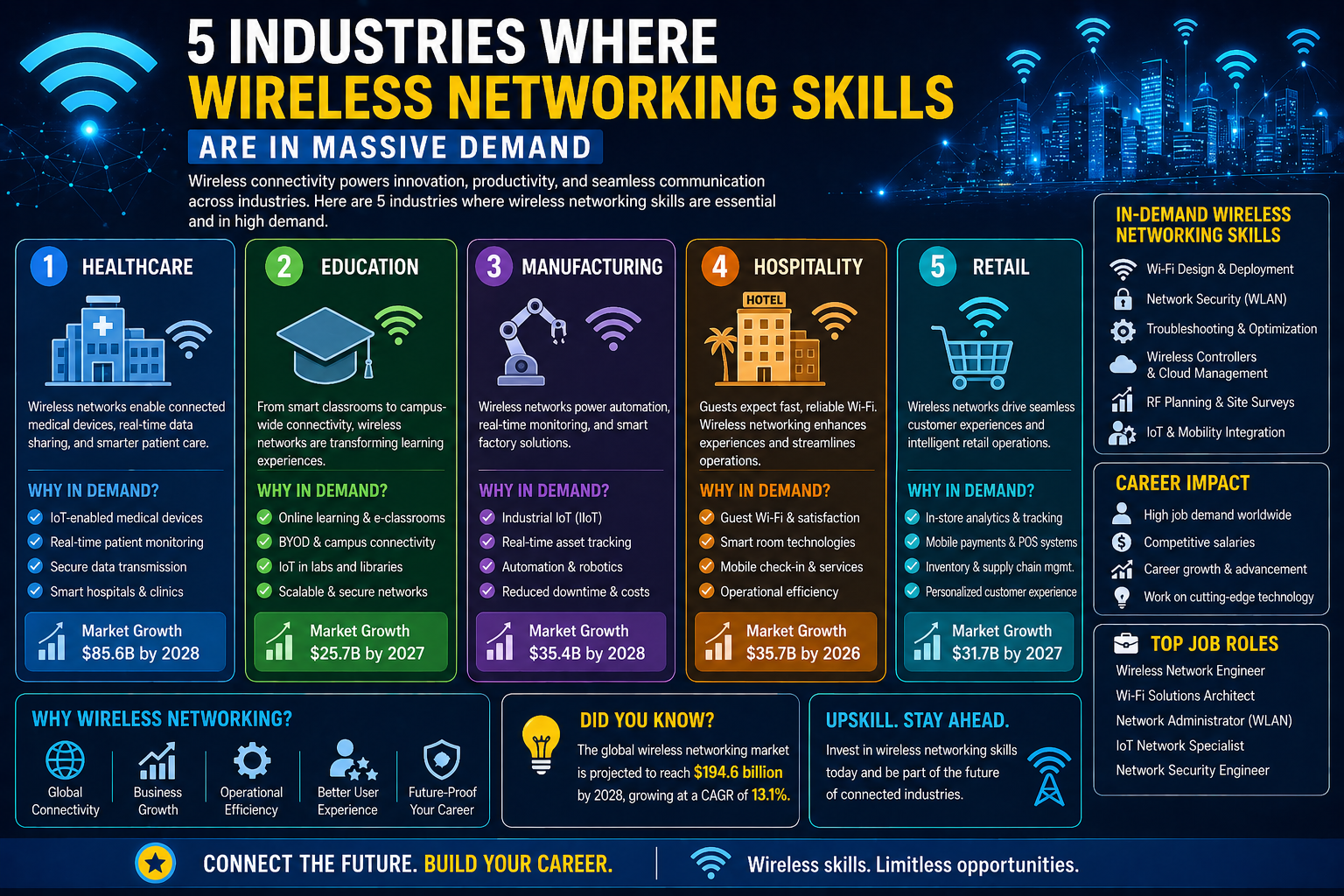
The manufacturing industry is undergoing a profound transformation driven by digital systems, automation, and advanced connectivity solutions that extend far beyond traditional production models. In modern facilities, machines are no longer isolated mechanical units but interconnected systems that continuously exchange information to improve efficiency, reduce downtime, and enhance operational precision. Wireless technologies have become a foundational element in this evolution because they enable flexible, scalable, and real-time communication between sensors, controllers, monitoring systems, and centralized management platforms without the limitations imposed by physical cabling. This shift has created a demand for professionals who understand not only how wireless networks function in controlled office environments but also how they behave in complex industrial settings where interference, physical obstructions, and electromagnetic noise are constant challenges. In manufacturing environments, wireless connectivity supports predictive maintenance systems that rely on continuous data streams from machinery to detect performance degradation before failures occur, allowing organizations to reduce costly production interruptions and extend equipment lifespan. The integration of wireless sensors into production lines also enables granular visibility into every stage of manufacturing, from raw material handling to final product assembly, ensuring that quality control processes are more accurate and responsive than ever before. As factories adopt more automation and robotics, wireless communication becomes essential for coordinating machine movements, synchronizing workflows, and ensuring that autonomous systems operate safely alongside human workers. The complexity of these environments means that wireless networks must be carefully designed, tested, and optimized to handle high device density, variable interference sources, and demanding latency requirements. Professionals with advanced wireless expertise are essential in identifying optimal access point placements, selecting appropriate frequency bands, and implementing security measures that protect sensitive production data from unauthorized access or disruption. Additionally, the rise of industrial Internet-connected devices has introduced new challenges related to scalability, as thousands of sensors and machines may need to operate simultaneously within a single facility without degrading network performance. This requires a deep understanding of spectrum management and network segmentation to ensure reliable communication across all operational zones. Wireless professionals also play a critical role in ensuring compliance with safety and regulatory standards, as manufacturing environments often involve hazardous materials or processes where communication failures could lead to serious consequences. The continued expansion of smart manufacturing systems means that wireless connectivity is no longer an optional enhancement but a core requirement for operational success, and as companies strive for higher efficiency and global competitiveness, the reliance on skilled experts capable of managing these complex wireless infrastructures will continue to increase significantly.
Farming
Agriculture has entered a new technological era where data-driven decision-making is reshaping traditional farming practices into highly optimized, technology-enabled systems that maximize yield, reduce waste, and improve sustainability. Wireless connectivity plays a central role in this transformation by enabling real-time communication between distributed sensors, autonomous equipment, environmental monitoring systems, and centralized agricultural management platforms spread across large and often remote geographic areas. In modern farming operations, sensors embedded in soil continuously measure moisture levels, nutrient content, and temperature variations, transmitting this data wirelessly to analytical systems that help farmers determine the precise timing and quantity of irrigation and fertilization needed for optimal crop growth. Similarly, wireless networks support weather monitoring systems that gather localized atmospheric data to predict changes in rainfall, humidity, and temperature, allowing farmers to make proactive decisions that protect crops from adverse conditions. Livestock management has also benefited significantly from wireless technology, as wearable sensors attached to animals provide continuous health and location tracking, enabling early detection of illness, stress, or unusual behavior patterns that may require intervention. The vast physical scale of agricultural environments introduces unique challenges for wireless deployment, as connectivity must often span large open fields, varying terrain, and remote locations with limited infrastructure support. This requires careful planning to ensure consistent signal coverage and reliable data transmission even in areas where environmental conditions fluctuate dramatically. Wireless professionals in agriculture must consider factors such as signal attenuation caused by vegetation, atmospheric interference, and the impact of seasonal changes on network performance. The increasing use of autonomous farming equipment, including drones and robotic harvesters, further intensifies the need for robust wireless communication systems capable of supporting real-time navigation, coordination, and data exchange between machines operating in the same environment. These systems rely heavily on low-latency communication to ensure precise operation and avoid collisions or inefficiencies during automated tasks. Additionally, wireless networks in agriculture must be designed with energy efficiency in mind, as many field-based devices operate on limited power sources such as solar panels or batteries, requiring optimized communication protocols that minimize energy consumption while maintaining data integrity. Security is also an important consideration, as agricultural systems become more connected and vulnerable to potential cyber threats that could disrupt food production or compromise sensitive operational data. Wireless professionals help safeguard these systems by implementing secure communication frameworks and ensuring that only authorized devices can access critical network resources. As global food demand continues to rise and climate conditions become increasingly unpredictable, the agricultural industry will rely even more heavily on wireless-enabled technologies to maintain productivity, efficiency, and resilience in the face of growing environmental and economic pressures.
Healthcare
The healthcare industry is experiencing rapid technological advancement as wireless communication systems become increasingly integrated into medical environments to support patient care, diagnostics, and operational efficiency. Hospitals and clinical facilities rely on a wide range of connected medical devices that continuously monitor patient vital signs, transmit diagnostic data, and enable real-time communication between healthcare providers, all of which depend on stable and secure wireless networks. These systems have transformed patient monitoring by allowing healthcare professionals to track critical health indicators such as heart rate, blood pressure, oxygen levels, and temperature without requiring patients to remain physically tethered to bedside equipment, thereby improving comfort and mobility while maintaining continuous observation. Wireless technology also supports telemedicine applications, enabling remote consultations and diagnostics that expand access to healthcare services, particularly in underserved or rural areas where specialized medical expertise may not be readily available. The sensitivity of healthcare environments introduces unique challenges for wireless deployment, as medical equipment must operate without interference from surrounding signals, ensuring that diagnostic accuracy and patient safety are never compromised. Wireless professionals working in healthcare must carefully design networks that minimize electromagnetic interference and maintain strict reliability standards to support life-critical applications. In addition to patient care, wireless systems also play a crucial role in hospital operations, including asset tracking, staff coordination, and emergency response management. Medical facilities often contain thousands of mobile devices, ranging from infusion pumps to diagnostic scanners, all of which must be accurately tracked and maintained to ensure availability and functionality when needed. Wireless tracking systems help healthcare organizations manage these assets efficiently, reducing loss, improving maintenance schedules, and ensuring that essential equipment is always accessible. The increasing adoption of Internet-connected medical devices has also introduced new considerations related to data security and patient privacy, as sensitive health information is transmitted across wireless networks that must be protected against unauthorized access or interception. Wireless professionals are responsible for implementing robust encryption methods, secure authentication protocols, and network segmentation strategies to safeguard medical data and maintain compliance with strict regulatory requirements. Furthermore, healthcare environments often require continuous network availability, as even brief disruptions in connectivity can have serious consequences for patient care and clinical decision-making. This necessitates highly resilient wireless architectures with redundancy and failover capabilities to ensure uninterrupted service under all conditions. As healthcare systems continue to evolve toward more digital and interconnected models, the importance of wireless expertise will continue to grow, making it an essential component in the delivery of safe, efficient, and modern medical services.
Energy Systems and Modern Power Infrastructure
The energy industry is undergoing a structural shift away from centralized generation models toward distributed, intelligent, and highly monitored systems that rely heavily on continuous data exchange. Traditional large-scale power plants are gradually being complemented by smaller, decentralized energy sources such as solar arrays, wind installations, hydro units, and experimental microgrid systems that operate closer to end users. These distributed systems require constant monitoring to ensure stability, efficiency, and safety, and wireless communication has become an essential mechanism for enabling that visibility across geographically dispersed locations. In modern energy networks, sensors are embedded throughout generation equipment, transmission lines, and storage systems to capture real-time data on performance, load conditions, temperature fluctuations, and system integrity. This data is transmitted wirelessly to centralized monitoring centers where operators analyze system behavior and make rapid decisions to balance energy supply and demand. The reliance on wireless connectivity in energy systems is particularly important in remote or difficult-to-access environments where physical cabling is impractical or cost-prohibitive. Wind farms located offshore or in isolated rural areas, for example, depend on robust wireless links to communicate operational data back to control centers. Similarly, solar installations spread across large geographical regions require synchronized monitoring systems that can coordinate energy output and detect faults in individual panels or inverters without delay. The complexity of these environments means that wireless professionals must design networks that can withstand environmental interference such as weather conditions, electromagnetic noise, and physical obstructions while maintaining high reliability and low latency. In addition to monitoring generation systems, wireless connectivity also supports energy distribution networks where smart meters and grid sensors provide detailed insights into energy consumption patterns across residential, commercial, and industrial users. This level of visibility allows energy providers to optimize distribution, reduce waste, and respond more effectively to fluctuations in demand. The integration of wireless systems into energy infrastructure also enhances predictive maintenance capabilities, enabling operators to identify potential equipment failures before they occur and schedule maintenance activities that minimize service disruptions. As energy systems become more digitized, cybersecurity becomes an increasingly important concern, since wireless networks controlling critical infrastructure must be protected against unauthorized access and malicious interference. Wireless professionals working in the energy sector are therefore responsible not only for ensuring connectivity but also for implementing robust security protocols that safeguard operational continuity. The expansion of renewable energy and distributed generation systems will continue to increase the demand for advanced wireless expertise, as these technologies rely fundamentally on real-time communication and data-driven decision-making to operate effectively at scale.
Internet Service Providers and Next-Generation Connectivity
The internet service industry is experiencing significant transformation driven by advancements in wireless broadband technologies that are reshaping how connectivity is delivered to homes, businesses, and entire communities. Traditionally, internet service providers relied heavily on fixed wired infrastructure such as fiber-optic cables and coaxial networks, which required extensive physical installation and regulatory approval. However, the emergence of high-speed wireless technologies, including advanced mobile broadband systems, has introduced new possibilities for delivering internet access without the need for extensive physical cabling. Wireless-based internet delivery systems allow providers to deploy connectivity more rapidly, particularly in underserved or rural areas where traditional infrastructure is difficult or economically unfeasible to install. These systems rely on strategically placed wireless towers, antennas, and access points that transmit high-capacity data signals across wide geographic regions, enabling users to access reliable internet services with minimal physical infrastructure. The growing adoption of wireless broadband has also increased competition in the internet service market, as smaller providers can now enter regions that were previously dominated by large telecommunications companies. This shift has created a more dynamic and competitive landscape where service quality, coverage, and performance are key differentiators. Wireless professionals play a crucial role in designing and maintaining these networks, ensuring that signal strength, bandwidth allocation, and network stability are optimized to meet user demand. One of the primary challenges in wireless internet service delivery is managing network congestion, particularly in densely populated areas where large numbers of users may be accessing bandwidth-intensive applications simultaneously. To address this, engineers must carefully design network architectures that balance load distribution and minimize interference between access points. Another important aspect of wireless internet infrastructure is scalability, as providers must continuously expand coverage and capacity to accommodate growing user bases and increasing data consumption. The integration of wireless technologies with fiber backhaul networks further enhances performance by combining the flexibility of wireless access with the high capacity of wired core infrastructure. Security is also a critical consideration in internet service networks, as wireless communication channels must be protected against unauthorized access, data interception, and service disruption. Wireless professionals are responsible for implementing encryption protocols, authentication systems, and network monitoring tools that ensure data integrity and user privacy. As demand for high-speed connectivity continues to grow, especially with the expansion of cloud computing, streaming services, and remote work environments, the importance of skilled wireless experts in the internet service industry will continue to increase significantly.
Smart City Infrastructure and Urban Connectivity Systems
Urban environments are evolving into highly connected ecosystems where wireless technologies serve as the foundation for intelligent city management systems designed to improve efficiency, sustainability, and quality of life. Smart city infrastructure relies on extensive networks of sensors, communication devices, and automated systems that collect and analyze data from various aspects of urban life, including transportation, energy usage, environmental conditions, and public services. Wireless connectivity enables these systems to operate in real time, allowing city administrators to respond quickly to changing conditions and optimize resource allocation across large and complex urban environments. In smart cities, wireless sensors are embedded in infrastructure such as roads, bridges, buildings, and public utilities to monitor structural health, traffic flow, air quality, and water usage. This continuous stream of data provides valuable insights that help city planners make informed decisions about infrastructure development, maintenance scheduling, and environmental management. Traffic management systems, for example, use wireless communication to coordinate traffic signals based on real-time vehicle flow, reducing congestion and improving transportation efficiency. Similarly, smart lighting systems adjust streetlight intensity based on pedestrian activity and environmental conditions, contributing to energy conservation and improved public safety. Waste management systems also benefit from wireless connectivity by using sensor-equipped bins that report fill levels, enabling more efficient collection routes and reducing operational costs. The complexity of smart city environments requires highly reliable wireless networks capable of supporting thousands of interconnected devices operating simultaneously across wide geographic areas. Wireless professionals must ensure that these networks are resilient, scalable, and capable of handling diverse data types with varying latency requirements. In addition, urban environments present unique challenges such as signal interference from buildings, high device density, and varying environmental conditions that can affect network performance. Security is another critical concern in smart city systems, as the integration of digital infrastructure with essential public services increases the potential impact of cyber threats. Wireless experts are responsible for implementing secure communication frameworks that protect sensitive data and ensure the integrity of critical city operations. As urban populations continue to grow, the demand for intelligent infrastructure solutions will expand, making wireless connectivity a central component in the development of sustainable and efficient cities.
Transportation and Logistics Networks
The transportation and logistics industry has become increasingly dependent on wireless communication systems to manage complex supply chains, track assets, and optimize the movement of goods and passengers across global networks. Modern logistics operations require real-time visibility into the location, condition, and status of shipments as they move through various stages of distribution, from manufacturing facilities to final delivery destinations. Wireless tracking technologies, including sensor-based monitoring systems and connected devices, enable logistics providers to maintain continuous awareness of cargo movement without relying on manual tracking methods. These systems improve efficiency by reducing delays, minimizing loss, and ensuring that goods are delivered on time and in optimal condition. In transportation networks, wireless communication supports fleet management systems that monitor vehicle performance, fuel consumption, route efficiency, and driver behavior. This data allows companies to optimize routing strategies, reduce operational costs, and improve overall service reliability. Public transportation systems also rely on wireless connectivity to coordinate scheduling, monitor vehicle locations, and provide real-time updates to passengers regarding arrival times and service changes. Aviation and maritime industries use wireless communication extensively for navigation, safety monitoring, and operational coordination across vast distances where traditional communication methods are limited. The increasing adoption of autonomous transportation technologies, including self-driving vehicles and automated delivery systems, further amplifies the importance of reliable wireless connectivity. These systems depend on low-latency communication to make real-time decisions related to navigation, obstacle detection, and route optimization. Wireless professionals in the transportation sector must design networks that can support high mobility environments where devices are constantly moving between coverage zones without losing connectivity. This requires careful planning of network infrastructure, including the placement of access points, the selection of frequency bands, and the implementation of seamless handoff mechanisms that maintain uninterrupted communication. Security is also a critical concern in transportation networks, as wireless systems are often responsible for transmitting sensitive operational data and controlling critical infrastructure components. Professionals must ensure that communication channels are protected against unauthorized access and potential disruptions that could impact safety or efficiency. As global supply chains continue to expand and transportation systems become more interconnected, the reliance on advanced wireless technologies will continue to grow, making expertise in this field increasingly valuable.
Public Safety and Emergency Response Systems
Public safety and emergency response organizations rely heavily on wireless communication systems to coordinate operations, respond to incidents, and ensure effective communication between field personnel and central command centers. These systems are essential for law enforcement agencies, fire departments, medical emergency services, and disaster response teams that must operate in dynamic and often unpredictable environments. Wireless networks enable first responders to maintain constant communication while moving through different locations, ensuring that critical information can be shared quickly and accurately during emergency situations. In disaster scenarios such as natural catastrophes, wireless communication becomes even more vital, as traditional infrastructure may be damaged or unavailable, requiring mobile and rapidly deployable network solutions. Emergency response systems use wireless technologies to transmit real-time data, including location tracking of personnel, environmental hazard information, and situational updates that support coordinated decision-making. These systems also integrate with public alert mechanisms that provide timely warnings to citizens during emergencies such as severe weather events, industrial accidents, or security threats. The reliability of wireless communication in public safety contexts is critical, as delays or failures can have serious consequences for both responders and affected populations. Wireless professionals working in this sector must design highly resilient networks that can operate under extreme conditions, including high traffic loads, environmental interference, and infrastructure disruptions. Redundancy and failover mechanisms are essential components of these systems to ensure continuous communication even when primary network paths are compromised. Interoperability is another important factor, as public safety agencies often need to coordinate across different jurisdictions and organizational structures that may use varying communication systems. Wireless experts help bridge these systems by implementing standardized communication protocols and ensuring compatibility between different technologies. Security is also a major concern, as emergency communication networks must be protected from unauthorized access or interference that could disrupt critical operations. As emergency response systems continue to evolve with the integration of advanced technologies such as real-time data analytics and connected field devices, the demand for skilled wireless professionals capable of managing these complex and mission-critical networks will continue to rise.
Financial Services and Banking Networks
The financial services industry operates on precision, speed, and uninterrupted access to information systems, making it one of the most demanding environments for wireless networking professionals. Banks, insurance companies, trading platforms, and fintech organizations rely heavily on real-time data exchange to process transactions, monitor markets, and support customer operations across global networks. Wireless technologies have become deeply integrated into financial infrastructure, not as a replacement for wired systems, but as a complementary layer that enables mobility, flexibility, and continuous connectivity in environments where rapid decision-making is essential.
In modern banking environments, wireless networks support a wide range of operations, from customer-facing services such as mobile banking access points in physical branches to internal systems used by employees who require secure mobility within office complexes. Financial institutions often operate across multiple buildings, floors, and secure zones, and wireless connectivity allows staff to move between departments while maintaining uninterrupted access to internal systems. This mobility improves operational efficiency and supports faster response times in customer service and financial processing tasks.
Wireless systems also play a significant role in enabling digital banking transformation. Customers increasingly rely on mobile applications and online platforms to perform transactions, check balances, and manage financial portfolios. Although these services primarily depend on internet infrastructure, the internal systems that support them rely on wireless-enabled environments for testing, monitoring, and administrative access. The increasing demand for always-available financial services means that wireless reliability within financial institutions must meet extremely high standards of uptime and performance consistency.
Security is one of the most critical aspects of wireless networking in financial services. Because financial systems handle sensitive personal and transactional data, wireless networks must be designed with advanced encryption, strict authentication protocols, and continuous monitoring to prevent unauthorized access. Wireless professionals in this sector must account for potential threats such as rogue access points, signal interception, and internal network misuse. Financial institutions often operate in highly regulated environments where compliance requirements dictate how wireless networks are configured, monitored, and audited.
Another important aspect of wireless use in financial environments is support for trading and investment operations. In trading floors, real-time data transmission is essential, as even minor delays in market updates can result in significant financial consequences. Wireless networks provide redundancy and mobility for traders and analysts who require instant access to market data while moving between secure areas. Although core trading systems often rely on high-speed wired connections, wireless systems provide essential backup pathways and mobility layers that ensure continuous access to financial information.
As financial institutions continue to expand globally and adopt hybrid work models, wireless networks are becoming even more important in supporting remote access and distributed operations. Employees working from different locations require secure wireless access to internal systems, requiring careful network design to maintain performance while enforcing strict security controls. Wireless professionals play a central role in ensuring that these distributed systems remain stable, secure, and capable of supporting high transaction volumes without interruption.
Retail and Customer Experience Environments
The retail industry has undergone a major transformation driven by digital technologies and wireless connectivity that enhance both operational efficiency and customer engagement. Modern retail environments rely heavily on wireless systems to support point-of-sale operations, inventory management, customer analytics, and in-store digital experiences. Wireless connectivity enables retailers to create flexible, responsive environments where systems can be quickly adapted to changing business needs without the limitations of fixed wired infrastructure.
In physical retail spaces, wireless networks support mobile point-of-sale systems that allow staff to process transactions anywhere within a store. This reduces customer wait times and improves overall service efficiency. Employees can move freely throughout the retail space while maintaining access to inventory systems, pricing databases, and customer information systems. This mobility enhances customer interaction by enabling staff to provide immediate assistance without returning to fixed checkout counters or workstations.
Inventory management is another critical area where wireless technologies have transformed retail operations. Wireless-enabled sensors and scanning devices allow real-time tracking of stock levels, product movement, and shelf availability. This continuous flow of data helps retailers optimize stock replenishment, reduce overstocking or understocking issues, and improve supply chain coordination. In large retail environments such as supermarkets and warehouses, wireless systems ensure that inventory data remains accurate and up to date across all departments.
Customer experience has also been significantly enhanced through wireless connectivity. Many retail environments now offer personalized shopping experiences driven by data collected through wireless systems. For example, customer movement patterns within stores can be analyzed to optimize product placement and store layout. Wireless systems also enable location-based services that provide personalized offers or product recommendations to customers based on their in-store behavior. These capabilities rely on a complex wireless infrastructure that can track device interactions while maintaining privacy and security standards.
Wireless technology also supports digital signage systems and interactive kiosks that enhance customer engagement. These systems rely on wireless communication to update content dynamically based on promotions, inventory changes, or customer demographics. Retailers can quickly adjust marketing strategies without requiring physical changes to signage systems, improving flexibility and responsiveness.
Behind the scenes, wireless networks are essential for connecting supply chain systems that ensure products are delivered efficiently from distribution centers to retail locations. This includes coordination between warehouses, transportation systems, and store inventory platforms. Wireless professionals play an important role in ensuring that these interconnected systems operate seamlessly, particularly in environments where high device density and constant data exchange are required.
As retail continues to evolve toward hybrid physical-digital experiences, wireless infrastructure will remain a foundational element that enables innovation, personalization, and operational efficiency across the entire industry.
Education Systems and Digital Learning Environments
The education sector has experienced a rapid digital transformation, with wireless technologies playing a central role in enabling modern learning environments that extend beyond traditional classrooms. Schools, universities, and training institutions increasingly rely on wireless networks to support digital learning platforms, interactive tools, and collaborative systems that enhance the educational experience for students and educators.
Wireless connectivity enables students to access learning materials from anywhere within educational facilities, supporting flexible learning models that encourage collaboration and independent study. In classrooms, wireless systems allow teachers to integrate digital resources such as interactive presentations, online assessments, and multimedia content into their lessons. This creates more engaging and dynamic learning environments compared to traditional teaching methods.
In higher education institutions, wireless networks support large-scale academic operations that involve thousands of students and faculty members accessing shared resources simultaneously. These environments require carefully designed wireless infrastructures that can handle high user density without performance degradation. Wireless professionals ensure that coverage areas are optimized across lecture halls, libraries, laboratories, and outdoor spaces to maintain consistent connectivity.
Wireless systems also play a crucial role in supporting remote and hybrid learning models. Students can participate in classes from remote locations while maintaining access to academic resources, communication tools, and collaborative platforms. This flexibility has become increasingly important in modern education systems, allowing institutions to reach broader audiences and accommodate diverse learning needs.
Research activities within academic institutions also depend heavily on wireless connectivity. Laboratories and research facilities often use wireless sensors and data collection systems to monitor experiments, gather environmental data, and support real-time analysis. These systems enable researchers to collect large volumes of data without being physically tethered to equipment, improving efficiency and experimental accuracy.
Security is another important aspect of wireless networks in educational environments. Institutions must protect student data, research information, and administrative systems from unauthorized access. Wireless professionals implement secure authentication systems and network segmentation strategies to ensure that different user groups have appropriate levels of access while maintaining overall network integrity.
As educational institutions continue to expand digital learning initiatives, wireless technologies will remain central to delivering accessible, flexible, and interactive learning experiences across all levels of education.
Hospitality and Tourism Networks
The hospitality and tourism industry relies heavily on wireless connectivity to deliver seamless guest experiences, manage operations, and support communication across large and often geographically distributed facilities. Hotels, resorts, airports, and entertainment venues depend on wireless networks to provide guests with reliable internet access, personalized services, and integrated digital experiences that enhance comfort and convenience.
In hotels and resorts, wireless systems support guest connectivity throughout rooms, common areas, conference facilities, and recreational spaces. Guests expect uninterrupted internet access for work, communication, entertainment, and travel planning, making wireless reliability a critical component of customer satisfaction. Wireless professionals design networks that ensure consistent coverage across large properties with varying architectural structures and environmental conditions.
Operational systems within hospitality environments also rely heavily on wireless connectivity. Staff use mobile devices to manage reservations, coordinate housekeeping services, and handle guest requests in real time. This mobility improves operational efficiency and enables faster response times to customer needs. Wireless systems also support property management platforms that integrate booking systems, billing processes, and customer relationship management tools.
In tourism environments such as airports and transportation hubs, wireless networks support passenger communication systems, flight information displays, and security coordination systems. These networks must handle high user density and fluctuating traffic patterns while maintaining reliability and performance. Wireless professionals must ensure that systems are scalable and resilient enough to accommodate peak travel periods without degradation.
Entertainment venues such as stadiums and theme parks also rely on wireless connectivity to support ticketing systems, crowd management, and interactive guest experiences. Wireless systems enable real-time updates, mobile payments, and location-based services that enhance visitor engagement and streamline operations.
Security is an important consideration in hospitality environments, as guest data and payment information must be protected from unauthorized access. Wireless professionals implement secure network architectures that safeguard sensitive information while maintaining ease of access for legitimate users.
As the hospitality and tourism industry continues to evolve toward more personalized and technology-driven experiences, wireless connectivity will remain a key enabler of innovation, efficiency, and customer satisfaction.
Defense, Aerospace, and Mission-Critical Communication Systems
The defense and aerospace industries represent some of the most demanding environments for wireless communication systems, where reliability, security, and precision are essential. These sectors rely on advanced wireless technologies to support mission-critical operations, secure communications, surveillance systems, and aerospace navigation networks.
In defense applications, wireless systems are used for secure communication between military units, command centers, and field operations. These networks must operate under extreme conditions, including hostile environments, electronic interference, and potential cyber threats. Wireless professionals in this sector must design systems that are highly resilient, encrypted, and capable of functioning even in contested environments.
Aerospace systems also depend on wireless communication for navigation, telemetry, and aircraft monitoring. Aircraft use wireless systems to transmit performance data, environmental conditions, and operational status to ground control systems in real time. This information is critical for ensuring flight safety, optimizing performance, and supporting maintenance operations.
Satellite communication systems form another important component of aerospace wireless infrastructure. These systems enable global communication coverage and support applications ranging from navigation to weather monitoring and scientific research. Wireless professionals must ensure that these systems maintain high reliability and accuracy across vast distances and challenging atmospheric conditions.
Unmanned systems, including drones and autonomous vehicles used in defense and aerospace operations, rely heavily on wireless communication for control, coordination, and data transmission. These systems require low-latency communication to ensure precise operation and situational awareness in dynamic environments.
Security is of paramount importance in defense and aerospace networks. Wireless systems must be protected against interception, jamming, and cyber intrusion. Professionals in this field implement advanced encryption, frequency management, and redundant communication pathways to ensure mission continuity under all conditions.
As defense and aerospace technologies continue to evolve toward greater automation and connectivity, wireless expertise will remain essential for maintaining secure, reliable, and high-performance communication systems across all operational domains.
Conclusion
The growing dependence on wireless technologies across modern industries reflects a fundamental shift in how societies operate, communicate, and innovate. What was once considered a supporting layer of connectivity has now become a core enabler of economic activity, industrial automation, public services, and global communication systems. From manufacturing plants and farms to hospitals, financial institutions, and defense networks, wireless infrastructure has moved beyond convenience and become an essential requirement for operational continuity and strategic development. This transformation is not temporary or limited to a few sectors; it represents a long-term structural change in how information flows through physical and digital environments.
Across all industries discussed, a common theme emerges: the need for real-time communication between distributed systems. Whether it is a factory machine transmitting performance data, a medical device monitoring patient vitals, a smart meter reporting energy usage, or a logistics system tracking goods in transit, wireless connectivity enables instant access to critical information. This immediacy allows organizations to make faster and more informed decisions, reduce inefficiencies, and respond to changing conditions with greater precision. Without wireless systems, many of these capabilities would either be significantly delayed or entirely impossible at scale.
Another important factor driving the demand for wireless expertise is the expansion of Internet of Things ecosystems. Devices are no longer isolated tools performing single tasks; instead, they are interconnected components of larger digital environments. These devices continuously generate and exchange data, creating complex networks that require careful design, management, and optimization. As the number of connected devices increases exponentially, so does the complexity of maintaining stable and secure communication channels. This complexity creates a strong need for professionals who understand wireless signal behavior, network architecture, interference management, and spectrum efficiency.
In addition to technical complexity, environmental diversity across industries adds another layer of challenge. Wireless networks must operate in highly variable conditions, from dense urban environments filled with interference sources to vast agricultural fields with minimal infrastructure, and from sterile hospital environments with strict electromagnetic constraints to remote energy installations exposed to harsh weather conditions. Each environment requires tailored solutions that balance coverage, performance, reliability, and security. This level of customization cannot be achieved through generic network design; it requires deep expertise and practical understanding of wireless behavior in real-world scenarios.
Security considerations further elevate the importance of wireless specialization. As more critical systems rely on wireless communication, the potential impact of security breaches becomes significantly higher. Industries such as finance, healthcare, defense, and energy cannot afford disruptions or unauthorized access to their networks. Wireless systems must therefore incorporate strong encryption, secure authentication mechanisms, intrusion detection capabilities, and continuous monitoring frameworks. Professionals working in this field must not only understand how to build networks but also how to protect them against evolving threats that target wireless vulnerabilities.
The rise of automation and artificial intelligence also reinforces the importance of wireless connectivity. Automated systems depend on continuous data exchange to function correctly, whether they are robotic manufacturing lines, autonomous vehicles, or intelligent energy grids. Artificial intelligence models rely on large volumes of real-time data to make predictions and decisions, and this data often flows through wireless channels before being processed. As automation becomes more widespread, the demand for stable, low-latency, and high-capacity wireless networks will continue to grow, placing additional responsibility on professionals who design and maintain these systems.
Another key dimension is scalability. Modern organizations are no longer limited to localized operations; they operate across cities, countries, and continents. Wireless networks must scale accordingly, supporting thousands or even millions of devices without degradation in performance. This scalability challenge requires advanced planning, dynamic resource allocation, and continuous optimization. Wireless professionals must anticipate growth patterns and design systems that remain efficient even as demand increases unpredictably over time.
Equally important is the role of wireless technologies in enabling innovation. Many of the most transformative advancements in recent years—such as smart cities, telemedicine, autonomous logistics, and precision agriculture—would not be possible without reliable wireless communication. These innovations are not isolated technological achievements; they are interconnected systems that depend on seamless data exchange across multiple layers of infrastructure. Wireless networks act as the invisible backbone that connects these systems and allows them to function as cohesive ecosystems.
The global nature of wireless communication also means that its impact extends beyond individual industries. It influences economic development, access to services, and quality of life on a broader scale. In regions where traditional infrastructure is limited, wireless technologies often provide the first reliable means of connectivity, enabling access to education, healthcare, financial services, and information systems. This democratization of access has far-reaching social and economic implications, reducing barriers and creating new opportunities for growth and inclusion.
Looking forward, the demand for wireless expertise will continue to expand as new technologies emerge and existing systems become more interconnected. The evolution of next-generation networks, increased reliance on edge computing, and continued growth of IoT ecosystems will all contribute to greater complexity and higher performance expectations. Industries will require professionals who can not only manage current systems but also anticipate future challenges and design adaptable, future-ready solutions.
Ultimately, wireless technology is no longer just a technical discipline confined to network engineering teams; it is a foundational component of modern civilization’s infrastructure. Its influence spans every major sector and continues to grow as digital transformation accelerates. The professionals who specialize in this field play a critical role in shaping the efficiency, security, and innovation capacity of organizations worldwide. As industries continue to evolve and become more dependent on real-time data and interconnected systems, wireless expertise will remain one of the most valuable and strategically important skill sets in the global technology landscape.