Modern cloud services are built around one central expectation: systems must remain reliable, responsive, and consistent even when usage grows, or conditions change unexpectedly. Users today interact with applications that are expected to work instantly, regardless of time, location, or demand spikes. This expectation has reshaped how engineers design, build, and maintain systems in cloud environments. Reliability is no longer treated as an optional enhancement but as a core requirement that defines whether a service is usable at all.
At the center of cloud reliability is the idea that systems must be designed with failure in mind. Instead of assuming everything will function perfectly, engineers build services that can tolerate faults, recover quickly, and continue delivering essential functions even under stress. This mindset influences every layer of architecture, from how data is stored to how applications are deployed and monitored.
Cloud environments add another layer of complexity because services are distributed across multiple regions, servers, and networks. Unlike traditional systems that may run on a single machine or data center, cloud systems rely on interconnected components that must communicate seamlessly. If one part fails, others must compensate. This interconnectedness makes reliability both more challenging and more important.
In this context, engineers must think beyond just writing code or deploying applications. They must understand how infrastructure behaves under load, how services interact, and how performance is impacted when something goes wrong. This is where structured thinking frameworks such as SLAs, SLOs, and SLIs become essential, as they help translate abstract reliability goals into measurable targets and actions.
Reliability in cloud systems also depends heavily on automation. Manual processes are too slow and error-prone for modern systems that operate at a global scale. Automation ensures that deployments, scaling, recovery, and monitoring happen consistently and efficiently. This reduces human error and allows systems to respond faster to changing conditions.
Another critical aspect is observability. Engineers must be able to see what is happening inside their systems at all times. Without visibility into performance, errors, and system behavior, reliability becomes guesswork rather than engineering. Observability tools and practices allow teams to detect issues early and respond before users are significantly affected.
Ultimately, modern cloud service reliability is about building systems that are resilient, measurable, and adaptable. It requires a shift in thinking from reactive problem-solving to proactive design. Engineers are expected to anticipate failures, define acceptable performance boundaries, and continuously improve systems based on real-world behavior. This foundation is essential for understanding advanced roles such as Cloud DevOps engineering.
Foundations of SLA, SLO, and SLI in Cloud Delivery
The concepts of Service Level Agreement, Service Level Objective, and Service Level Indicator form the backbone of how cloud services define and measure reliability. These three ideas are closely connected, but each serves a distinct purpose in ensuring that services meet expectations and remain consistent over time.
A Service Level Agreement represents a formal understanding between a service provider and its users or clients. It defines what level of service is expected and what commitments are being made regarding availability, performance, and support. This agreement sets the baseline expectations for how a service should behave. It is not just a technical document but also a business commitment that reflects trust between provider and user.
A Service Level Objective is more technical in nature. It defines specific measurable goals that a service must achieve in order to meet the broader agreement. These objectives translate high-level promises into concrete engineering targets. For example, an objective might specify acceptable levels of uptime or response time. These targets guide engineering teams in designing systems that align with reliability expectations.
A Service Level Indicator represents the actual measurement of system performance. It is the data collected from real system behavior, such as latency, error rates, or availability. Indicators show how the system is performing in practice and whether it is meeting its defined objectives. Without these indicators, it would be impossible to know whether the service is performing as intended.
Together, these three concepts create a structured approach to reliability. The agreement defines expectations, the objectives set measurable goals, and the indicators provide real-time feedback. This structure allows teams to operate with clarity and accountability.
In cloud environments, SLIs are often gathered through monitoring systems that track application performance continuously. These metrics are then compared against SLOs to determine whether the system is healthy. If performance falls below defined thresholds, it signals a need for intervention, optimization, or redesign.
One important aspect of these concepts is that they shift the focus from perfection to acceptable performance. Instead of expecting systems to be flawless, engineers define acceptable ranges of behavior. This allows teams to balance reliability with speed of development, which is essential in fast-moving cloud environments.
Another important idea is error budgeting, which emerges from the relationship between SLOs and SLIs. When systems perform better than expected, teams have the flexibility to innovate or deploy changes. When performance drops, focus shifts toward stability and improvement. This creates a dynamic balance between reliability and development speed.
Understanding SLAs, SLOs, and SLIs is essential for anyone working in cloud DevOps roles because these concepts define how success is measured. They also influence how systems are designed, monitored, and improved over time. Without this framework, maintaining large-scale cloud systems would be inconsistent and difficult to manage.
Role of DevOps in Bridging Development and Operations
DevOps is a methodology and cultural approach that connects software development and IT operations into a unified process. Traditionally, these two areas operated separately, with developers focused on writing code and operations teams responsible for maintaining infrastructure. This separation often led to communication gaps, delays, and inefficiencies in delivering software.
DevOps removes these barriers by encouraging collaboration, shared responsibility, and continuous communication between teams. Instead of working in isolation, development and operations teams work together throughout the entire lifecycle of a service. This includes planning, building, testing, deploying, and maintaining applications.
One of the most important goals of DevOps is to shorten the time between writing code and delivering it to users. This is achieved through automation, continuous integration, and continuous delivery practices. These processes ensure that code changes are tested and deployed quickly while maintaining stability and reliability.
DevOps also emphasizes the importance of feedback loops. Instead of waiting until a product is fully deployed to identify issues, teams continuously monitor performance and user behavior. This allows for rapid adjustments and improvements based on real-world usage.
Another key aspect of DevOps is shared responsibility. In traditional models, developers might consider their job complete once code is delivered, while operations teams handle deployment and maintenance. In DevOps, both teams share accountability for the performance and reliability of the system. This encourages better communication and more thoughtful design decisions.
Automation plays a central role in DevOps practices. Tasks such as testing, deployment, scaling, and monitoring are automated to reduce manual effort and increase consistency. This not only improves efficiency but also reduces the likelihood of human error.
DevOps also supports a culture of continuous improvement. Teams are encouraged to analyze performance, learn from failures, and make incremental improvements over time. This creates a dynamic environment where systems evolve continuously rather than remaining static.
In cloud environments, DevOps becomes even more important because of the scale and complexity of systems. Cloud platforms require fast adaptation, frequent updates, and high levels of reliability. DevOps practices help manage this complexity by providing structure, automation, and collaboration.
Ultimately, DevOps is not just a set of tools or processes but a cultural shift in how software is built and maintained. It encourages transparency, accountability, and shared ownership, which are essential for managing modern cloud systems effectively.
Introduction to Google Cloud Environment for DevOps Engineers
Google Cloud provides a wide range of tools and services designed to support scalable, reliable, and efficient cloud computing. For DevOps engineers, this environment offers the infrastructure needed to build, deploy, and manage applications at enterprise scale.
One of the key characteristics of Google Cloud is its focus on automation and managed services. Many infrastructure components are handled by the platform itself, allowing engineers to focus more on application design and performance rather than manual infrastructure management. This shift enables faster development cycles and more efficient operations.
The environment includes services for computing, storage, networking, monitoring, and deployment. These services are designed to integrate, creating a cohesive ecosystem that supports end-to-end application delivery. DevOps engineers work within this ecosystem to ensure that applications are deployed efficiently and perform reliably.
A significant advantage of this environment is its scalability. Systems can automatically adjust to changes in demand, ensuring that performance remains stable even during traffic spikes. This elasticity is a key requirement for modern cloud applications, which often experience unpredictable usage patterns.
Monitoring and observability are also deeply integrated into the environment. Engineers can track system performance in real time, identify issues, and respond quickly to incidents. This visibility is essential for maintaining service reliability and meeting performance objectives.
Security is another important aspect of the cloud environment. Access control, identity management, and encryption are built into the platform, allowing teams to protect data and systems without adding unnecessary complexity. DevOps engineers must understand how to configure and manage these security features effectively.
Deployment tools within the environment allow for automated and consistent application releases. This ensures that updates can be delivered frequently without disrupting system stability. Continuous delivery pipelines are often used to streamline this process.
The Google Cloud environment also supports distributed systems, allowing applications to run across multiple regions and zones. This improves reliability and reduces latency for users in different geographic locations.
For DevOps engineers, working in this environment requires a combination of technical skills and operational understanding. It is not just about using tools but about designing systems that are scalable, resilient, and efficient. This makes the environment both powerful and complex, requiring careful planning and execution.
Site Reliability Engineering Principles in Practice
Site Reliability Engineering represents a disciplined approach to maintaining system reliability at scale. It combines software engineering principles with operational responsibilities to ensure that systems remain stable, efficient, and responsive.
One of the core ideas in this approach is treating operations as a software problem. Instead of relying on manual intervention, engineers build tools and systems that automate operational tasks. This reduces human error and improves consistency across environments.
Another important principle is embracing failure as a normal part of system behavior. Instead of trying to eliminate all failures, engineers design systems that can recover quickly and continue operating despite issues. This mindset leads to more resilient architectures.
Measurement is also central to this approach. Engineers rely heavily on metrics to understand system behavior and performance. These metrics guide decisions about scaling, optimization, and reliability improvements.
Capacity planning is another key aspect. Systems must be designed to handle expected and unexpected loads without degradation in performance. This requires careful analysis of usage patterns and resource allocation.
Incident management is also an essential component. When systems fail or degrade, there must be clear processes for detecting, diagnosing, and resolving issues. These processes are designed to minimize downtime and restore service as quickly as possible.
Another principle is balancing innovation with stability. Engineers must ensure that new features and updates do not compromise system reliability. This is often managed through structured release processes and testing strategies.
Automation plays a significant role in implementing these principles. Repetitive tasks are automated to improve efficiency and reduce operational burden. This allows engineers to focus on higher-level system improvements.
Overall, site reliability engineering provides a structured framework for managing complex systems. It emphasizes measurement, automation, and resilience, all of which are essential in modern cloud environments.
How DevOps Culture Shapes Cloud Engineering Teams
DevOps culture influences how teams communicate, collaborate, and approach problem-solving in cloud environments. It encourages a shift away from isolated roles and toward shared responsibility for system outcomes.
In a DevOps culture, communication is continuous and transparent. Teams regularly share information about system performance, deployment status, and operational challenges. This ensures that everyone involved has a clear understanding of system behavior.
Collaboration is another defining feature. Developers and operations engineers work together throughout the lifecycle of a service. This reduces delays and improves alignment between code development and system performance.
Accountability is shared across teams. Instead of assigning responsibility to a single group, all members contribute to system reliability and success. This encourages better decision-making and more careful planning.
Continuous learning is also an important part of DevOps culture. Teams regularly analyze system performance, learn from incidents, and implement improvements. This creates an environment of ongoing growth and adaptation.
Automation supports this culture by reducing manual effort and allowing teams to focus on higher-value tasks. It also ensures consistency across processes, which is essential for maintaining reliability.
Experimentation is encouraged within safe boundaries. Teams are allowed to test new ideas and approaches, as long as they do not compromise system stability. This fosters innovation while maintaining control.
Ultimately, DevOps culture reshapes how cloud engineering teams operate by emphasizing collaboration, transparency, and continuous improvement.
Building Continuous Integration Pipelines in Cloud Systems
Continuous integration is a foundational practice in modern cloud engineering where code changes are automatically tested and merged into a shared repository. The goal is to ensure that new code integrates smoothly with existing systems without introducing instability. In large-scale cloud environments, where multiple developers contribute simultaneously, this process becomes essential for maintaining consistency and reducing integration problems.
A continuous integration pipeline is designed to automatically trigger when changes are introduced to the codebase. These changes are validated through a series of automated steps that include compilation, testing, and basic validation checks. This ensures that issues are identified early rather than after deployment, reducing the cost and complexity of fixing errors later in the lifecycle.
One of the key benefits of continuous integration is early detection of defects. Instead of waiting for manual reviews or production failures, issues are surfaced immediately after code is committed. This creates a rapid feedback loop that helps developers correct mistakes quickly and maintain a stable codebase.
Another important aspect is code consistency. When multiple engineers contribute to a project, differences in coding style, structure, and dependencies can create inconsistencies. Continuous integration pipelines enforce standardized checks that help maintain uniformity across the system.
These pipelines also improve collaboration. Since code changes are frequently merged and tested, developers are encouraged to work in smaller, more manageable increments. This reduces the risk of large-scale conflicts and makes it easier to understand the impact of each change.
Automation is central to continuous integration. Without automation, the process would be slow, error-prone, and difficult to scale. Automated pipelines ensure that every change goes through the same validation process, providing consistent results regardless of who made the change.
In cloud environments, continuous integration systems must also handle scalability. As the number of developers and services increases, the pipeline must be able to process multiple changes simultaneously without slowing down. This requires efficient resource management and distributed processing capabilities.
Ultimately, continuous integration serves as the foundation for reliable software delivery. It ensures that code remains stable, testable, and ready for deployment at any time, which is critical for maintaining fast-moving cloud systems.
Continuous Delivery and Deployment Strategies at Scale
Continuous delivery extends the principles of continuous integration by ensuring that code is always in a deployable state. It focuses on automating the release process so that software can be deployed to production quickly and safely whenever needed. This practice is essential in cloud environments where frequent updates and rapid iteration are expected.
In continuous delivery systems, every code change that passes automated tests is prepared for release. However, deployment to production may still require approval or additional validation depending on organizational policies. This ensures that while the system is always ready for release, final control remains with the engineering or operations team.
Continuous deployment takes this concept further by automatically releasing changes to production once they pass all required checks. This removes manual intervention entirely and enables extremely fast delivery cycles. However, it also requires a high level of confidence in automated testing and system stability.
A key aspect of these strategies is deployment automation. Manual deployments are slow, inconsistent, and prone to error. Automation ensures that deployments follow a repeatable and predictable process, reducing risk and improving reliability.
Another important component is rollback capability. When new changes introduce unexpected issues, systems must be able to revert quickly to a stable state. This minimizes downtime and reduces the impact on users.
Feature toggles are also commonly used in deployment strategies. They allow new functionality to be introduced gradually or selectively without affecting all users at once. This provides greater control over how changes are introduced into production environments.
Scalability plays a significant role in deployment strategies. Cloud systems often serve large and unpredictable user bases, so deployment processes must be able to handle high traffic and distributed environments without disruption.
Continuous delivery and deployment also rely heavily on monitoring. After a release, systems must be observed closely to ensure that performance remains stable and no unexpected issues arise. This feedback loop is essential for maintaining reliability.
These strategies collectively enable organizations to deliver software faster while maintaining control over system stability. They form a critical part of modern cloud engineering practices where speed and reliability must coexist.
Designing Automated Testing for Cloud Reliability
Automated testing is a critical component of cloud engineering because it ensures that software behaves as expected before it is deployed. In complex cloud systems, where multiple services interact, testing becomes essential for maintaining reliability and preventing failures.
Different types of automated tests serve different purposes. Unit tests focus on individual components, ensuring that specific functions behave correctly. Integration tests examine how different components interact with each other. System tests evaluate the behavior of the entire application in a simulated environment.
In cloud environments, testing must also account for distributed systems. This includes verifying how services behave under load, how they handle network latency, and how they respond to partial failures. These scenarios are difficult to test manually, but can be simulated through automated frameworks.
Performance testing is another important aspect. It measures how systems behave under different levels of demand. This helps engineers identify bottlenecks and ensure that applications can scale effectively.
Security testing is also integrated into automated pipelines. It ensures that vulnerabilities are detected early in the development process. This includes checking for misconfigurations, insecure dependencies, and access control issues.
One of the key benefits of automated testing is consistency. Every change is evaluated using the same criteria, ensuring that no issues are overlooked due to human error or oversight.
Automated testing also supports faster development cycles. Since tests run continuously in the background, developers receive immediate feedback on their changes. This reduces delays and improves productivity.
Another important aspect is test environment management. Cloud systems often require complex environments that replicate production conditions. Automation helps create and manage these environments efficiently, ensuring that tests are realistic and reliable.
Overall, automated testing provides a safety net for cloud systems. It ensures that changes are validated before deployment, reducing the risk of failures and maintaining system reliability.
Observability Practices and Telemetry in Distributed Systems
Observability refers to the ability to understand the internal state of a system based on the data it produces. In cloud environments, where systems are distributed across multiple services and regions, observability is essential for maintaining visibility and control.
Telemetry data forms the foundation of observability. This includes logs, metrics, and traces that provide detailed information about system behavior. Logs record specific events, metrics measure performance over time, and traces follow requests as they move through different services.
Together, these data sources allow engineers to reconstruct what is happening inside a system. Without observability, diagnosing issues in distributed systems would be extremely difficult.
One of the key challenges in cloud environments is the sheer volume of data generated. Systems produce large amounts of telemetry data continuously, requiring efficient storage, processing, and analysis methods.
Observability also supports proactive monitoring. Instead of waiting for failures to occur, engineers can detect anomalies early and take corrective action before users are affected.
Another important aspect is correlation. Observability tools help connect related events across different services, making it easier to understand the root cause of issues.
Dashboards are often used to visualize system behavior. They provide real-time insights into performance, availability, and error rates. This helps teams quickly identify and respond to problems.
Alerting systems are also part of observability. They notify engineers when specific thresholds are breached or when unusual patterns are detected. This ensures that issues are addressed promptly.
Observability is not just about collecting data but about making it meaningful. Engineers must be able to interpret telemetry data and use it to make informed decisions about system behavior and improvements.
Incident Detection, Response, and Recovery Workflows
Incident management is a structured process for identifying, responding to, and resolving system issues. In cloud environments, where systems operate continuously and serve large numbers of users, incident management is critical for maintaining reliability.
Incident detection involves identifying when something goes wrong. This can be achieved through monitoring systems, alerts, or user reports. Early detection is important for minimizing impact and reducing downtime.
Once an incident is detected, response workflows are activated. These workflows define how engineers investigate the issue, determine its cause, and implement fixes. Clear procedures ensure that responses are efficient and coordinated.
Communication is a key part of incident response. Teams must share information quickly and accurately to ensure that everyone understands the situation. This helps avoid confusion and accelerates resolution.
Recovery involves restoring the system to a stable state. This may include restarting services, rolling back changes, or applying fixes. The goal is to minimize disruption and restore normal operation as quickly as possible.
Post-incident analysis is also an important part of the process. After an incident is resolved, teams review what happened, why it happened, and how it can be prevented in the future. This leads to continuous improvement in system reliability.
Automation can assist in incident response by triggering predefined actions when certain conditions are met. This reduces response time and ensures consistency in handling issues.
Incident management also includes prioritization. Not all issues have the same level of impact, so systems are categorized based on severity. This helps teams focus on the most critical problems first.
Effective incident workflows improve system resilience and reduce the impact of unexpected failures. They are essential for maintaining trust and reliability in cloud services.
Performance Optimization in Cloud-Native Applications
Performance optimization focuses on improving the efficiency, speed, and responsiveness of cloud applications. In distributed environments, performance is influenced by multiple factors, including network latency, resource allocation, and system architecture.
One of the primary goals of optimization is to reduce response time. Users expect applications to react quickly, and even small delays can impact user experience. Engineers work to identify and eliminate bottlenecks that slow down processing.
Resource utilization is another key factor. Cloud systems must use computing resources efficiently to avoid unnecessary costs and ensure scalability. Optimization involves balancing workloads across available infrastructure.
Caching is commonly used to improve performance. By storing frequently accessed data closer to users or services, systems can reduce the need for repeated computation or database queries.
Load balancing also plays an important role. It ensures that traffic is distributed evenly across multiple servers, preventing overload and maintaining consistent performance.
Database optimization is another critical area. Efficient queries, indexing strategies, and data modeling can significantly improve application speed.
Asynchronous processing is often used to handle tasks that do not require immediate responses. This helps reduce delays in user-facing operations.
Performance monitoring is essential for identifying issues and measuring improvements. By analyzing performance data, engineers can make informed decisions about where optimization is needed.
Managing Configuration and Infrastructure as Code
Configuration management and infrastructure as code are practices that allow engineers to define and manage system infrastructure using code-based definitions. This approach brings consistency, repeatability, and scalability to cloud environments.
Instead of manually configuring servers or services, engineers define infrastructure in structured templates. These templates describe resources such as computing instances, networks, and storage systems.
This approach ensures that environments can be reproduced consistently across different stages such as development, testing, and production. It reduces configuration drift and minimizes human error.
Version control is an important aspect of infrastructure as code. Infrastructure changes are tracked over time, allowing teams to review, audit, and roll back modifications if necessary.
Automation is also central to this practice. Infrastructure changes can be deployed automatically, ensuring that environments remain up to date and consistent.
Configuration management ensures that systems remain desired. If deviations occur, automation tools can correct them automatically.
This approach also improves collaboration between teams. Developers and operations engineers can work with the same definitions, reducing misunderstandings and improving efficiency.
Security Integration in DevOps Pipelines
Security integration ensures that security practices are embedded throughout the software development lifecycle. Instead of being treated as a separate phase, security becomes an ongoing process within DevOps workflows.
One key aspect is early detection of vulnerabilities. Security checks are integrated into development pipelines so that issues are identified before deployment.
Access control is also important. Systems must ensure that only authorized users and services can access sensitive resources.
Encryption is used to protect data both in transit and at rest. This ensures that information remains secure even if systems are compromised.
Automated security scanning helps detect vulnerabilities in code, dependencies, and configurations. This reduces the risk of security breaches.
Security monitoring continues after deployment. Systems are observed for unusual behavior that may indicate potential threats.
By integrating security into every stage of development, organizations can build more secure and resilient cloud systems.
Release Engineering and Change Management Practices
Release engineering focuses on managing the process of delivering software changes into production environments. It ensures that releases are predictable, controlled, and reliable.
Change management involves tracking and coordinating modifications to systems. This includes planning changes, assessing risks, and ensuring that updates do not disrupt services.
One important practice is staging releases in controlled environments before deploying to production. This allows teams to test changes under realistic conditions.
Version control is essential for managing releases. It ensures that every change is documented and traceable.
Coordination between teams is also important. Developers, operations engineers, and other stakeholders must work together to ensure smooth releases.
Monitoring after release ensures that any issues are quickly identified and addressed.
Release engineering and change management together help maintain system stability while allowing continuous improvement and innovation.
Managing Service Reliability at Global Cloud Scale
Large-scale cloud systems operate under conditions that are fundamentally different from traditional IT environments. Instead of serving a single organization or a limited internal user base, modern cloud platforms must support millions of users across multiple regions, time zones, and network conditions. This global scale introduces complexity that requires carefully designed reliability strategies.
At this level, reliability is no longer just about preventing failures. It becomes about controlling the impact of failures when they inevitably occur. Systems are expected to degrade gracefully rather than fail. This means that partial functionality must continue even when certain components are under stress or unavailable.
One of the primary challenges at a global scale is consistency. Distributed systems often replicate data across multiple regions to improve availability and performance. However, maintaining consistent data across these locations requires trade-offs between speed, accuracy, and availability. Engineers must decide how to balance these factors based on application requirements.
Latency is another critical factor in global systems. Users expect fast responses regardless of their physical location. To achieve this, cloud systems rely on geographically distributed infrastructure that brings services closer to users. However, this distribution introduces synchronization challenges that must be carefully managed.
Fault tolerance becomes increasingly important at scale. Systems must be designed to handle failures in individual servers, data centers, or even entire regions without affecting overall service availability. This requires redundancy, failover mechanisms, and intelligent routing strategies.
Another important aspect is load distribution. Global systems must handle unpredictable traffic patterns that can vary significantly across regions. Load balancing ensures that no single part of the system becomes overwhelmed while others remain underutilized.
Monitoring at a global scale also becomes more complex. Engineers must aggregate and analyze data from multiple regions in real time. This requires scalable observability systems that can process large volumes of telemetry data efficiently.
Ultimately, managing reliability at a global scale is about designing systems that remain stable under uncertainty. It requires careful planning, continuous monitoring, and the ability to respond quickly to changing conditions.
Advanced CI/CD Pipeline Engineering in Complex Systems
Continuous integration and continuous delivery pipelines become significantly more complex when applied to enterprise-level cloud systems. At this scale, pipelines must handle large codebases, multiple teams, and diverse deployment environments simultaneously.
One of the key challenges is pipeline scalability. As the number of services and developers increases, the volume of code changes grows rapidly. CI/CD systems must be capable of processing multiple builds and deployments in parallel without creating bottlenecks.
Another important factor is dependency management. In large systems, services often depend on one another. A change in one component can affect multiple downstream systems. CI/CD pipelines must account for these dependencies to prevent cascading failures.
Pipeline reliability is also critical. If the CI/CD system itself becomes unstable, it can delay deployments and disrupt development workflows. Redundancy, failover mechanisms, and monitoring are essential to ensure pipeline stability.
Security integration within pipelines becomes more advanced at this level. Automated checks must verify not only code correctness but also compliance with security policies, access controls, and dependency vulnerabilities.
Approval workflows are often integrated into CI/CD pipelines in enterprise environments. Certain changes may require manual review or validation before being deployed to production. This ensures that critical systems remain protected while still benefiting from automation.
Artifact management is another important aspect. Build outputs must be stored, versioned, and retrieved reliably. This ensures that deployments can be reproduced or rolled back if necessary.
Testing within CI/CD pipelines also becomes more sophisticated. Instead of simple unit tests, pipelines may include integration tests, performance tests, and security scans that simulate real-world conditions.
Deployment strategies within CI/CD systems must support flexibility. This includes rolling updates, blue-green deployments, and canary releases, all of which help minimize risk during production changes.
At this level, CI/CD is not just a tool but a complete ecosystem that supports the entire software delivery lifecycle. It ensures that changes move from development to production in a controlled, efficient, and reliable manner.
Deep Dive into Monitoring and Alerting Systems
Monitoring and alerting systems are essential for maintaining visibility into cloud infrastructure and application behavior. In distributed environments, where systems operate across multiple services and regions, monitoring provides the foundation for operational awareness.
Monitoring systems collect data continuously from applications, servers, and network components. This data includes performance metrics, system logs, and event traces that provide insight into system health.
One of the most important functions of monitoring is early detection of anomalies. By analyzing patterns in system behavior, monitoring tools can identify deviations that may indicate potential issues.
Alerting systems are built on top of monitoring data. They notify engineers when certain thresholds are exceeded or when abnormal behavior is detected. These alerts must be carefully configured to avoid unnecessary noise while ensuring that critical issues are not missed.
Alert severity levels help prioritize responses. High-severity alerts indicate urgent issues that require immediate attention, while lower-severity alerts may indicate potential risks or performance degradation.
Correlation between alerts is also important. In complex systems, a single underlying issue may trigger multiple alerts. Monitoring systems must be able to group related alerts to reduce confusion and improve response efficiency.
Dashboards play a key role in monitoring systems. They provide real-time visualizations of system health, allowing engineers to quickly assess performance and identify trends.
Historical monitoring data is also valuable. It helps engineers understand long-term system behavior, identify recurring issues, and plan capacity improvements.
Effective monitoring systems are not just reactive but also proactive. They help teams anticipate problems before they impact users.
Incident Response Engineering in High-Pressure Environments
Incident response in cloud environments requires structured processes that enable teams to react quickly and effectively under pressure. When systems fail or degrade, the primary goal is to restore service as quickly as possible while minimizing user impact.
The first stage of incident response is detection. Incidents are typically identified through monitoring alerts, automated systems, or user reports. Early detection is critical for reducing downtime.
Once an incident is detected, response coordination begins. Teams must quickly determine the scope and severity of the issue. This involves gathering information from monitoring systems, logs, and affected services.
Communication is a central part of incident response. Teams must share updates clearly and frequently to ensure that everyone involved understands the situation. Poor communication can slow down resolution and increase impact.
Role assignment is often used during incident response. Different team members take responsibility for specific tasks such as investigation, mitigation, or communication. This helps streamline the response process.
Mitigation focuses on reducing the impact of the incident. This may involve disabling certain features, redirecting traffic, or rolling back recent changes.
Root cause analysis is conducted after immediate stabilization. This process identifies the underlying cause of the incident and helps prevent similar issues in the future.
Post-incident reviews are also important. They provide an opportunity to analyze what happened, evaluate the response process, and identify improvements.
Automation can assist in incident response by triggering predefined actions when certain conditions are met. This reduces response time and improves consistency.
Incident response engineering is not only about fixing problems but also about improving system resilience over time.
Conclusion
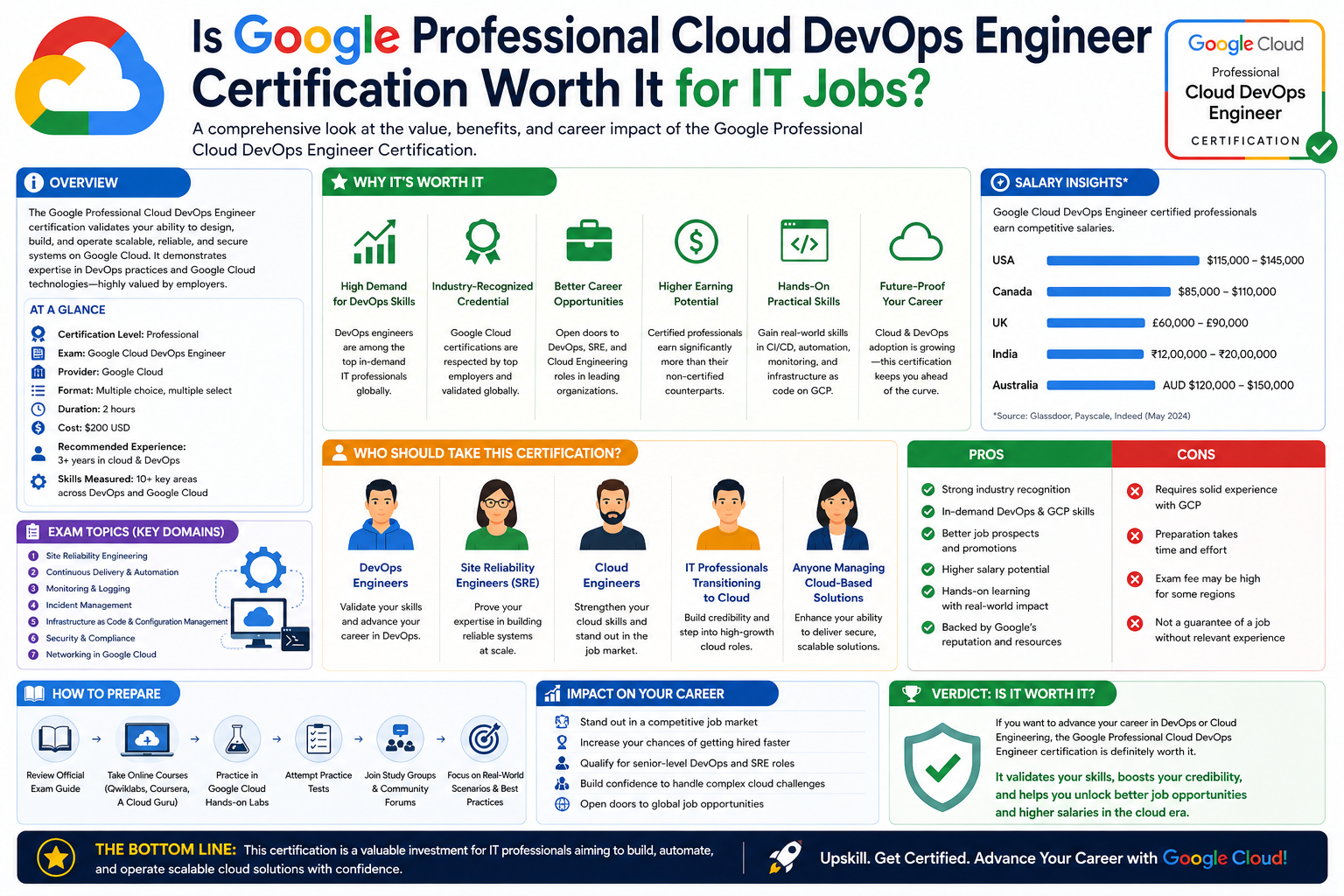
The Google Professional Cloud DevOps Engineer certification represents more than a technical milestone; it reflects a structured way of thinking about how modern cloud systems are built, operated, and improved over time. At its core, the role is shaped by the need to balance speed of delivery with system reliability, ensuring that applications can evolve rapidly without sacrificing stability or user experience. This balance is not achieved through tools alone but through disciplined practices, shared responsibility, and a deep understanding of how distributed systems behave under real-world conditions.
Across cloud environments, success depends on how well engineers can connect development workflows with operational requirements. Practices such as continuous integration, continuous delivery, automated testing, and infrastructure as code are not isolated techniques but interconnected components of a larger system. Each one contributes to reducing friction in software delivery while increasing confidence in system changes. When applied effectively, these practices allow teams to release updates frequently while maintaining predictable performance and minimizing disruption.
Equally important is the emphasis on observability and monitoring. In complex cloud architectures, visibility is essential for maintaining control. Engineers must be able to interpret system behavior through metrics, logs, and traces, transforming raw data into actionable insight. Without this visibility, even well-designed systems can become difficult to manage. Observability ensures that problems are not only detected quickly but also understood in context, enabling faster and more accurate responses.
Incident management and reliability engineering further reinforce the importance of structured operational practices. Systems will inevitably experience failures, especially at scale, and the ability to respond effectively determines overall service quality. Through well-defined response workflows, clear communication, and post-incident learning, teams can reduce downtime and continuously strengthen system resilience.
Security, performance, and infrastructure automation also play critical roles in shaping modern DevOps environments. Security is no longer an external layer but an integrated responsibility embedded throughout the development lifecycle. Performance optimization ensures that systems remain efficient under varying loads, while automation enables consistency, scalability, and reduced operational overhead.
Ultimately, the Google Professional Cloud DevOps Engineer path aligns with a broader shift in the industry toward engineering practices that prioritize adaptability, collaboration, and continuous improvement. It reflects the reality that cloud systems are living environments that require ongoing attention and refinement rather than static deployment. Engineers working in this space are expected to think beyond individual tasks and focus on the long-term health, efficiency, and reliability of the systems they support.
This mindset defines the modern DevOps approach and continues to shape how cloud technologies evolve across industries.