Cloud computing has become one of the most significant shifts in modern information technology, reshaping how organizations build, deploy, and manage digital systems. Over the past decade, enterprises have moved away from traditional on-premises infrastructure toward flexible, internet-based computing environments. This transformation has been driven by the need for scalability, cost efficiency, and faster innovation cycles.
In earlier IT environments, organizations were required to purchase physical servers, maintain data centers, and manage all aspects of hardware lifecycle operations. This approach often resulted in high upfront investment costs and limited flexibility. As business demands became more dynamic, this model started to show limitations, especially when organizations needed to scale quickly or respond to unpredictable workloads.
Cloud computing introduced a different approach by allowing organizations to access computing resources on demand. Instead of owning infrastructure, businesses could now rent resources such as storage, computing power, and networking capabilities from large-scale providers. This shift made it possible for companies of all sizes to access enterprise-grade infrastructure without significant capital expenditure.
As adoption increased, cloud computing became deeply integrated into business operations. Many organizations began migrating critical workloads, applications, and databases into cloud environments. This transition was further accelerated by global digital transformation initiatives, remote work requirements, and the increasing importance of data-driven decision-making.
Today, cloud computing is not just an option but a foundational element of enterprise IT strategy. The widespread adoption of cloud platforms such as Microsoft Azure and Amazon AWS reflects this shift, as organizations increasingly rely on them to power core business systems, customer-facing applications, and large-scale analytics platforms.
The growing reliance on cloud infrastructure has also influenced how organizations approach IT planning. Instead of focusing on hardware procurement and maintenance, businesses now prioritize workload optimization, cloud architecture design, and service integration. This change has created new roles, skills, and operational models within IT departments.
As cloud usage continues to expand, enterprises are increasingly adopting hybrid and multi-cloud strategies. These approaches allow organizations to distribute workloads across multiple environments, improving resilience and flexibility while reducing dependency on a single provider. This trend further highlights the importance of understanding the differences and capabilities of major cloud platforms.
Understanding Public Cloud Ecosystem and Shared Responsibilities
The public cloud ecosystem operates on a shared responsibility model, which defines how responsibilities are divided between cloud providers and customers. This model is fundamental to understanding how cloud platforms function and how security, performance, and operational management are maintained.
In a public cloud environment, the provider is responsible for managing the underlying infrastructure. This includes physical data centers, hardware maintenance, network systems, and core virtualization layers. Customers, on the other hand, are responsible for managing what they deploy in the cloud, such as applications, data, configurations, and access control policies.
This division of responsibility allows organizations to focus more on application development and business logic rather than infrastructure maintenance. It also improves efficiency, as cloud providers operate at a global scale and can optimize resources more effectively than individual organizations.
Within this ecosystem, services are typically categorized into different models such as infrastructure services, platform services, and software services. Infrastructure services provide virtual machines, storage, and networking components. Platform services offer managed environments for application development and deployment. Software services deliver fully managed applications accessible over the internet.
Both Microsoft Azure and Amazon AWS operate within this structure, offering a wide range of services that align with different layers of the cloud stack. While they follow similar models, their implementation approaches and service ecosystems differ in subtle but important ways.
Security is a critical component of the shared responsibility model. Cloud providers implement security measures at the infrastructure level, including physical security of data centers, encryption of storage systems, and network protection. Customers are responsible for securing their applications, managing user access, and ensuring compliance with organizational policies.
Another important aspect of the cloud ecosystem is elasticity. Cloud environments are designed to automatically scale resources based on demand. This means that applications can handle sudden increases in traffic without manual intervention. This capability is especially important for businesses with fluctuating workloads, such as e-commerce platforms, media services, and enterprise applications.
The public cloud model also introduces a pay-as-you-go structure, allowing organizations to pay only for the resources they use. This pricing approach reduces waste and provides financial flexibility, especially for startups and businesses with unpredictable demand patterns.
Overview of Microsoft Azure and Amazon AWS Positioning
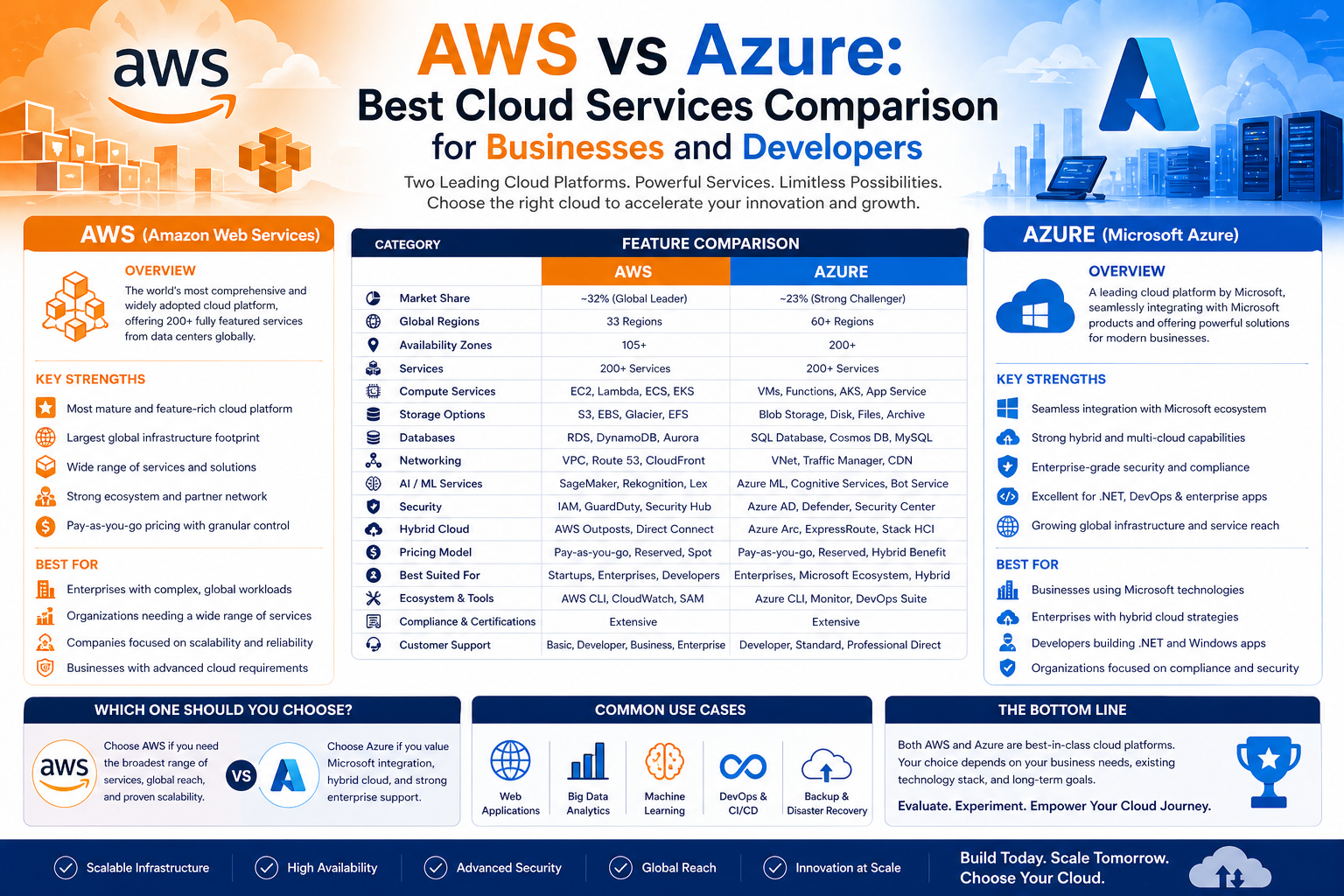
The competitive landscape of cloud computing is largely defined by two major platforms: Amazon AWS and Microsoft Azure. Both platforms offer extensive service portfolios, global infrastructure, and enterprise-level capabilities, making them dominant forces in the cloud industry.
Amazon AWS is widely recognized as the pioneer of modern cloud computing. It established many of the foundational principles of public cloud services, including elastic computing, object storage, and distributed architectures. Over time, it has expanded its offerings to include advanced analytics, machine learning, artificial intelligence, and Internet of Things capabilities. Its early entry into the market has contributed to its strong global adoption and extensive service maturity.
Microsoft Azure, on the other hand, has grown rapidly by integrating cloud services with existing enterprise ecosystems. It benefits significantly from its deep connection with widely used enterprise software environments, which has made it a natural extension for organizations already invested in Microsoft technologies. Azure has positioned itself as a hybrid-friendly platform, supporting both cloud-native and on-premises integration scenarios.
Both platforms provide similar core services, including computing power, storage solutions, networking capabilities, identity management, and security frameworks. However, the way these services are structured and integrated can differ. AWS is often associated with a more modular approach, where users combine various independent services. Azure tends to offer more integrated experiences, particularly for organizations using Microsoft-based environments.
Global infrastructure is another key area where both platforms compete. AWS has built an extensive network of data centers across multiple regions worldwide, allowing it to deliver low-latency services and high availability. Azure has similarly expanded its global footprint, focusing on regional availability and compliance requirements to support enterprise and government workloads.
Enterprise adoption patterns also differ based on organizational needs. AWS is often favored by technology-driven companies and startups due to its flexibility and broad service ecosystem. Azure is frequently chosen by large enterprises with existing Microsoft investments, especially those requiring seamless integration with identity management and productivity tools.
Despite these differences, both platforms continue to evolve rapidly, introducing new services and enhancing existing capabilities. This ongoing innovation ensures that organizations have access to advanced cloud technologies regardless of which platform they choose.
Core Design Philosophy of AWS Cloud Architecture
The architecture of Amazon AWS is built around flexibility, modularity, and scalability. Its design philosophy emphasizes giving users granular control over cloud resources, allowing them to construct highly customized environments tailored to specific workloads and performance requirements.
At the foundation of AWS architecture is the concept of independent services. Each service is designed to perform a specific function, such as computing, storage, or networking. These services operate independently but can be combined to build complex systems. This modular approach allows organizations to select only the components they need without being tied to a rigid structure.
AWS also emphasizes elasticity in its architecture. Resources can be dynamically adjusted based on demand, enabling systems to scale up during peak usage and scale down during low activity periods. This flexibility helps organizations optimize performance while controlling costs.
Another key aspect of AWS architecture is its global infrastructure model. AWS operates through multiple regions and availability zones, each designed to provide redundancy and fault tolerance. This structure ensures that applications remain available even in the event of hardware or regional failures.
AWS computing services are designed to provide high levels of customization. Users can configure virtual machines based on specific requirements such as processing power, memory allocation, and storage capacity. This level of control allows organizations to optimize performance for different types of workloads.
The storage architecture in AWS is also highly distributed. Data is stored across multiple systems to ensure durability and availability. This design helps protect against data loss and supports high-performance access to stored information.
Networking within AWS is designed to provide isolation and security. Virtual networks allow users to create secure environments where resources can communicate without exposure to external threats. This structure supports both internal application communication and external connectivity when required.
Overall, AWS architecture reflects a design philosophy centered on control, flexibility, and scalability, making it suitable for a wide range of applications and industries.
Core Design Philosophy of Azure Cloud Architecture
The architecture of Microsoft Azure is designed around integration, enterprise alignment, and hybrid connectivity. Its approach focuses on providing a unified cloud environment that works seamlessly with existing enterprise systems and Microsoft-based technologies.
Azure architecture emphasizes integration across services. Instead of treating services as completely independent components, Azure often connects them through a unified management and identity framework. This allows organizations to manage resources in a more centralized and consistent manner.
A defining characteristic of Azure architecture is its strong support for hybrid cloud environments. Many organizations operate both on-premises systems and cloud infrastructure. Azure is designed to bridge this gap by enabling smooth connectivity between traditional data centers and cloud-based resources.
Computing in Azure is structured around virtual machines and managed services that integrate closely with other Azure components. This approach simplifies deployment for organizations that already use Microsoft tools and services.
Azure’s global infrastructure is organized into regions and availability zones, similar to other cloud platforms. However, it places strong emphasis on compliance and regional data residency requirements, making it suitable for organizations with strict regulatory needs.
Storage architecture in Azure is designed to support multiple tiers of data access. This allows organizations to choose storage types based on performance and cost requirements. Data can be stored in high-performance tiers for active workloads or lower-cost tiers for archival purposes.
Networking in Azure is built around virtual networks that resemble traditional enterprise networking models. This design makes it easier for organizations to transition from on-premises environments to cloud infrastructure without major architectural changes.
Azure also integrates deeply with identity management systems, providing centralized authentication and access control across services. This enhances security and simplifies user management in enterprise environments.
Overall, Azure architecture reflects a philosophy focused on integration, enterprise compatibility, and hybrid flexibility.
Factors Influencing Cloud Selection Decisions in Enterprises
When organizations evaluate cloud platforms such as Microsoft Azure and Amazon AWS, multiple factors influence their decision-making process. These factors extend beyond technical capabilities and include business requirements, existing infrastructure, operational strategy, and long-term scalability goals.
One of the primary considerations is existing technology investment. Organizations that already rely heavily on Microsoft-based systems may find it more practical to adopt Azure due to its integration capabilities. Similarly, companies that require highly customizable infrastructure may prefer AWS due to its flexible service model.
Scalability requirements also play a significant role. Businesses with rapidly changing workloads often prioritize platforms that can dynamically adjust resources without manual intervention. Both AWS and Azure provide this capability, but their implementation approaches may differ depending on service configuration.
Security and compliance requirements are another critical factor. Organizations operating in regulated industries must ensure that their cloud provider meets specific compliance standards and provides adequate security controls. Both platforms offer extensive security frameworks, but implementation details may influence the final decision.
Cost structure is also a major consideration. While both platforms operate on a consumption-based model, pricing variations across services can impact long-term operational expenses. Organizations often evaluate how pricing aligns with expected usage patterns and workload intensity.
Global availability is important for businesses with international operations. The ability to deploy services in multiple geographic regions helps improve performance and reduce latency. Both AWS and Azure offer extensive global infrastructure, but regional coverage and service availability may differ.
Finally, organizational expertise plays a role in cloud selection. Teams with experience in specific cloud environments may prefer to continue using familiar platforms to reduce training requirements and operational complexity.
These factors collectively shape how enterprises approach cloud adoption and determine which platform best aligns with their strategic objectives.
Cloud Computing Models and Service Layers in Enterprise Environments
Modern cloud computing is built on layered service models that define how resources are delivered and consumed. These models allow organizations to choose the level of control and management they require, depending on their technical expertise and operational needs. The three primary service layers include infrastructure-based services, platform-based services, and fully managed software services.
Infrastructure-based services provide the foundational building blocks of cloud computing. These include virtual machines, storage systems, and networking components. Organizations using this layer have the highest level of control over configuration and system architecture. This model is commonly used when applications require custom environments or specialized performance tuning.
Platform-based services reduce the operational burden by offering managed environments for application development and deployment. Instead of manually configuring infrastructure, developers can focus on building and deploying applications while the platform handles underlying system management tasks such as scaling and maintenance.
Fully managed software services represent the highest abstraction level in cloud computing. In this model, applications are delivered as complete services over the Internet. Users do not manage infrastructure or platform components; instead, they interact directly with the application interface.
Both Amazon AWS and Microsoft Azure provide services across all these layers. However, their implementation approaches differ in how they structure service integration and user interaction. AWS tends to emphasize granular control across infrastructure services, while Azure often integrates services more tightly within a unified ecosystem.
These service layers allow organizations to gradually adopt cloud technologies. Many enterprises begin with infrastructure services and progressively move toward platform and software services as their cloud maturity increases. This progression helps reduce operational complexity while improving efficiency and scalability.
Advanced Computing Capabilities and Workload Optimization
Computing power is one of the most critical components of cloud infrastructure, as it directly impacts application performance, scalability, and responsiveness. Cloud platforms provide virtualized computing environments that can be adjusted based on workload requirements.
In Amazon AWS, computing resources are delivered through highly configurable virtual machines that allow users to define processing power, memory allocation, and storage performance. This flexibility enables organizations to optimize computing environments for specific workloads such as data processing, application hosting, and high-performance computing.
AWS also supports specialized computing instances designed for different use cases. These include compute-optimized environments for processing-intensive tasks, memory-optimized environments for large-scale data handling, and storage-optimized environments for data-heavy applications. This diversity allows organizations to fine-tune performance based on workload characteristics.
In contrast, Microsoft Azure provides computing resources that are tightly integrated with its broader cloud ecosystem. Azure virtual machines are designed to work seamlessly with other Azure services such as storage, networking, and identity management. This integration simplifies deployment and management, especially for organizations already using Microsoft-based systems.
Azure also offers managed computing services that reduce the need for manual infrastructure configuration. These services automatically handle scaling, load balancing, and system updates, allowing organizations to focus more on application development rather than infrastructure management.
Workload optimization in both platforms is achieved through automation and intelligent resource allocation. Cloud environments can dynamically adjust computing capacity based on real-time demand, ensuring that applications maintain performance during peak usage periods while minimizing resource consumption during low-demand periods.
This elasticity is essential for modern applications that experience unpredictable traffic patterns. It allows businesses to maintain consistent performance without over-provisioning resources.
Networking Architecture and Connectivity Models
Networking plays a foundational role in cloud computing, enabling communication between applications, services, and external systems. Cloud networking is designed to provide secure, scalable, and high-performance connectivity across distributed environments.
In Amazon AWS, networking is built around virtual private cloud environments that allow users to create isolated sections within the cloud infrastructure. These environments function as private networks where organizations can define IP ranges, subnets, and routing rules. This isolation ensures that resources remain secure and segregated from other cloud users.
AWS networking also supports advanced connectivity options that enable communication between different cloud environments and on-premises systems. This is achieved through secure gateway configurations and encrypted communication channels that maintain data integrity during transmission.
In Microsoft Azure, networking is structured through virtual network systems that closely resemble traditional enterprise networking models. This design allows organizations to replicate familiar networking structures within the cloud environment, making it easier to transition from on-premises infrastructure.
Azure virtual networks provide capabilities such as subnet creation, traffic routing, and IP address management. These features enable organizations to design complex network architectures that support multiple applications and services.
Connectivity between cloud and on-premises environments is also a key feature of Azure networking. Organizations can establish secure connections that allow seamless integration between local data centers and cloud-based resources. This hybrid connectivity model is particularly important for enterprises undergoing gradual cloud migration.
Both platforms prioritize network security through isolation and encryption. Network traffic is protected through secure communication protocols, and access is controlled through configurable security rules. This ensures that only authorized systems and users can interact with cloud resources.
Data Storage Systems and Information Lifecycle Management
Data storage is one of the most essential components of cloud computing, as it supports everything from application data to backup systems and analytics workloads. Cloud storage systems are designed to be highly scalable, durable, and cost-efficient.
In Amazon AWS, object storage is provided through a distributed system designed for high durability and availability. This system allows organizations to store large volumes of unstructured data such as documents, media files, and backups. Data is automatically replicated across multiple locations to ensure protection against hardware failures.
AWS also provides multiple storage tiers that allow organizations to optimize cost based on data usage patterns. Frequently accessed data is stored in high-performance tiers, while rarely accessed data can be moved to lower-cost archival storage. This tiered approach helps organizations balance performance and cost efficiency.
In Microsoft Azure, object storage is delivered through a system that supports multiple access tiers similar to AWS. These tiers allow organizations to classify data based on how frequently it is accessed. High-performance tiers support active workloads, while cooler tiers are optimized for long-term storage and archival purposes.
Azure storage systems are designed to integrate closely with other Azure services, enabling seamless data flow between storage, computing, and analytics environments. This integration simplifies data management and improves operational efficiency.
Data lifecycle management is an important aspect of cloud storage. Organizations must define policies that determine how data is stored, accessed, and eventually archived or deleted. Cloud platforms provide tools that automate these processes, reducing manual intervention and improving consistency.
Durability and redundancy are also key features of cloud storage systems. Data is stored across multiple physical locations to ensure availability even in the event of hardware failure. This design significantly reduces the risk of data loss compared to traditional storage systems.
Identity Management and Access Control Systems
Identity management is a critical component of cloud security, as it determines how users and systems access cloud resources. Effective identity management ensures that only authorized users can interact with sensitive data and applications.
In Amazon AWS, identity management is handled through a centralized system that allows organizations to define users, roles, and permissions. Access control is implemented through policies that specify what actions users can perform on specific resources.
AWS also supports fine-grained access control, enabling organizations to define highly specific permissions for different user groups. This level of control is essential for large enterprises with complex organizational structures.
In Microsoft Azure, identity management is deeply integrated with enterprise authentication systems. This integration allows organizations to use existing identity frameworks to manage access to cloud resources. As a result, users can access cloud services using familiar credentials and authentication methods.
Azure identity systems also support role-based access control, which allows organizations to assign permissions based on job roles rather than individual users. This simplifies administration and improves security consistency across large environments.
Multi-factor authentication is widely supported across both platforms, adding a layer of security by requiring multiple forms of verification before granting access. This reduces the risk of unauthorized access even if credentials are compromised.
Identity management systems also play a role in regulatory compliance. Organizations must ensure that access to sensitive data is properly controlled and monitored. Cloud platforms provide auditing and logging capabilities that help organizations track user activity and maintain compliance with industry standards.
Security Architecture and Compliance Frameworks
Security is a foundational element of cloud computing, encompassing infrastructure protection, data security, and compliance management. Cloud providers implement multiple layers of security to protect against threats and unauthorized access.
In Amazon AWS, security is built into every layer of the cloud architecture. This includes physical security at data centers, network-level protection, and application-level security controls. AWS also provides encryption tools that protect data both at rest and in transit.
Security monitoring systems continuously analyze cloud environments for potential threats. These systems detect unusual activity and can automatically trigger protective measures when necessary. This proactive approach helps reduce the risk of security breaches.
In Microsoft Azure, security is also integrated across all service layers. Azure emphasizes centralized security management, allowing organizations to monitor and control security policies from a unified interface.
Azure provides advanced threat detection capabilities that analyze patterns of behavior across cloud environments. These systems help identify potential vulnerabilities and respond to security incidents in real time.
Compliance frameworks are another important aspect of cloud security. Organizations operating in regulated industries must adhere to strict standards regarding data handling, privacy, and access control. Both AWS and Azure provide compliance certifications that align with global regulatory requirements.
Encryption is widely used in both platforms to protect sensitive data. Data is encrypted during transmission and while stored in cloud systems, ensuring that unauthorized users cannot access readable information.
Security in cloud environments is a shared responsibility between providers and customers. While providers secure the infrastructure, customers are responsible for securing applications, configurations, and user access.
Hybrid Cloud Strategies and Enterprise Integration Models
Hybrid cloud strategies have become a central approach for modern organizations that need to balance legacy infrastructure with cloud-based innovation. Instead of fully migrating all systems to a single cloud environment, many enterprises choose to operate a combination of on-premises systems and public cloud platforms. This approach allows them to maintain control over sensitive workloads while benefiting from the scalability and flexibility of cloud computing.
In this context, both Microsoft Azure and Amazon AWS provide tools and frameworks that support hybrid integration. However, their approaches differ in design philosophy and implementation focus.
Azure is widely recognized for its strong hybrid capabilities, particularly its ability to extend on-premises environments into the cloud. Many organizations that already use enterprise software systems find it easier to integrate their existing infrastructure with Azure because of its alignment with traditional IT environments. This makes hybrid adoption more seamless for businesses transitioning gradually to cloud platforms.
AWS also supports hybrid architectures through connectivity services that link local data centers with cloud environments. These services enable organizations to extend workloads into the cloud while maintaining existing infrastructure investments. However, AWS typically requires more configuration effort compared to Azure’s more integrated hybrid approach.
Hybrid strategies are often used by organizations that cannot immediately move all workloads to the cloud due to regulatory constraints, data sensitivity, or technical dependencies. In such cases, certain applications remain on-premises while others are migrated to the cloud. This distributed model allows businesses to modernize incrementally without disrupting operations.
A key advantage of hybrid cloud models is flexibility. Organizations can choose where to run specific workloads based on performance, compliance, or cost considerations. This enables them to optimize resource usage while maintaining operational stability.
Another important aspect of hybrid integration is data synchronization. Enterprises must ensure that data remains consistent across both cloud and on-premises environments. This requires secure and reliable data transfer mechanisms that minimize latency and prevent data loss.
Hybrid environments also introduce challenges in monitoring and management. Organizations must maintain visibility across multiple systems, which can increase operational complexity. Cloud platforms address this by providing centralized monitoring tools that aggregate data from different environments into a unified dashboard.
Multi-Cloud Adoption and Strategic Diversification
Multi-cloud adoption refers to the use of multiple cloud service providers within a single organization. Instead of relying on a single platform, businesses distribute workloads across different cloud environments to reduce dependency and increase resilience.
Many organizations adopt multi-cloud strategies using both Microsoft Azure and Amazon AWS. This approach allows them to take advantage of the strengths of each platform while minimizing potential risks associated with vendor lock-in.
One of the primary reasons for adopting a multi-cloud strategy is risk mitigation. By distributing workloads across multiple providers, organizations reduce the impact of potential service disruptions. If one platform experiences downtime, workloads can continue operating on another platform.
Another benefit is performance optimization. Different cloud providers may offer varying levels of performance depending on geographic location or service type. By using multiple platforms, organizations can select the best environment for each workload.
Cost optimization is also a factor in multi-cloud strategies. Pricing structures may vary between providers, allowing organizations to choose the most cost-effective option for specific services or workloads.
However, multi-cloud environments introduce additional complexity. Managing multiple platforms requires advanced coordination, consistent security policies, and standardized deployment practices. Without proper governance, multi-cloud strategies can become difficult to maintain.
Integration between platforms is another challenge. Data must often be transferred between different cloud environments, which requires secure and efficient communication channels. Organizations must ensure that data consistency and security are maintained across all platforms.
Despite these challenges, multi-cloud adoption continues to grow as organizations seek greater flexibility and resilience in their IT strategies.
Performance Optimization and Scalability Engineering
Performance optimization is a critical aspect of cloud computing, as it directly affects application responsiveness and user experience. Cloud platforms are designed to provide scalable infrastructure that can adapt to changing workloads in real time.
In Amazon AWS, performance optimization is achieved through highly configurable computing resources. Organizations can select from a wide range of instance types that are optimized for different workloads, such as compute-intensive applications, memory-heavy processing, or storage-focused operations.
AWS also provides auto-scaling capabilities that automatically adjust computing resources based on demand. This ensures that applications maintain performance during peak usage while minimizing costs during low-demand periods.
In Microsoft Azure, performance optimization is achieved through integrated scaling mechanisms that work across multiple services. Azure applications can automatically adjust resource allocation based on predefined rules or real-time performance metrics.
Azure also supports load-balancing techniques that distribute traffic evenly across multiple computing resources. This helps prevent performance bottlenecks and ensures consistent application responsiveness.
Scalability engineering involves designing systems that can handle increasing workloads without degradation in performance. Cloud platforms provide the infrastructure needed to support both vertical scaling, which increases resource capacity, and horizontal scaling, which adds additional instances to distribute workloads.
Monitoring tools play an important role in performance optimization. These tools collect data on system usage, response times, and resource consumption. Organizations use this information to make informed decisions about scaling and resource allocation.
Efficient architecture design is also essential for performance optimization. Applications must be structured in a way that allows them to take advantage of cloud scalability features without introducing unnecessary complexity.
Cost Management and Resource Efficiency Models
Cost management is one of the most important considerations in cloud computing. While cloud platforms offer flexible pricing models, improper resource management can lead to unexpected expenses.
Both Microsoft Azure and Amazon AWS use consumption-based pricing models, where organizations pay only for the resources they use. This model eliminates the need for large upfront investments but requires careful monitoring to avoid unnecessary costs.
Resource efficiency is achieved through proper allocation and utilization of cloud services. Organizations must ensure that computing resources are appropriately sized for workloads. Over-provisioning leads to wasted resources, while under-provisioning can impact performance.
Cloud platforms provide cost management tools that help organizations track usage and identify inefficiencies. These tools offer insights into resource consumption patterns, allowing businesses to optimize their cloud spending.
Reserved capacity options are also available, allowing organizations to commit to long-term usage in exchange for reduced pricing. This approach is often used for predictable workloads that require consistent resource allocation.
Another aspect of cost management is storage optimization. Data stored in cloud environments can be moved between different tiers based on access frequency. Frequently accessed data is stored in high-performance tiers, while infrequently accessed data is moved to lower-cost storage options.
Automation also plays a role in cost efficiency. Cloud platforms can automatically shut down unused resources, scale down underutilized systems, and optimize workload distribution to reduce costs.
Effective cost management requires continuous monitoring and adjustment. Organizations must regularly evaluate their cloud usage to ensure that resources are aligned with business needs.
Innovation, Artificial Intelligence, and Future Cloud Directions
Cloud computing has become a foundation for innovation in areas such as artificial intelligence, machine learning, and advanced analytics. These technologies rely on large-scale computing power and data processing capabilities that are only feasible in cloud environments.
Both Amazon AWS and Microsoft Azure provide platforms that support AI and machine learning workloads. These platforms offer tools for data processing, model training, and predictive analytics.
AI integration in cloud environments enables organizations to analyze large datasets, automate decision-making processes, and improve operational efficiency. Machine learning models can be trained using cloud-based computing resources and deployed directly into production environments.
Cloud platforms also support real-time data processing, allowing organizations to analyze information as it is generated. This capability is essential for applications such as fraud detection, recommendation systems, and predictive maintenance.
Another emerging trend is edge computing, where data processing occurs closer to the source of data generation rather than centralized cloud data centers. This reduces latency and improves performance for time-sensitive applications.
Serverless computing is also becoming increasingly popular. In this model, organizations do not manage infrastructure directly. Instead, they deploy functions that automatically execute in response to events. This approach simplifies development and reduces operational overhead.
Future cloud development is expected to focus on greater automation, improved integration between services, and enhanced support for distributed computing environments. As cloud platforms continue to evolve, they will play an even more central role in digital transformation.
Enterprise Decision Framework for Cloud Platform Selection
Selecting between Microsoft Azure and Amazon AWS requires a structured decision-making framework that considers technical, operational, and strategic factors. Organizations must evaluate their existing infrastructure, workload requirements, and long-term business goals.
One of the first considerations is organizational alignment. Businesses that rely heavily on enterprise software ecosystems may find it easier to adopt platforms that integrate seamlessly with their existing tools. This reduces migration complexity and accelerates adoption.
Technical requirements also play a major role. Workloads that require high levels of customization may benefit from platforms that offer granular control over infrastructure components. Conversely, workloads that prioritize simplicity and integration may be better suited for more unified environments.
Operational readiness is another factor. Organizations must assess whether their teams have the skills required to manage cloud environments effectively. Training and expertise can significantly influence the success of cloud adoption.
Scalability needs must also be considered. Businesses with rapidly growing or unpredictable workloads require platforms that can scale efficiently without performance degradation.
Security and compliance requirements are critical in regulated industries. Organizations must ensure that cloud platforms meet industry standards and provide necessary compliance certifications.
Ultimately, cloud platform selection is not a one-time decision but an ongoing process. As technology evolves and business needs change, organizations may adjust their cloud strategies to better align with new requirements.
Additional Considerations in Cloud Governance and Operational Control
Beyond architecture, performance, and cost, cloud governance plays a crucial role in ensuring that cloud environments remain secure, compliant, and efficiently managed over time. Governance refers to the policies, controls, and procedures that guide how cloud resources are used across an organization. Without strong governance, even well-designed cloud systems can become fragmented, inefficient, or vulnerable to security risks.
In enterprise environments using Amazon AWS or Microsoft Azure, governance typically involves establishing clear rules for resource creation, access permissions, and usage boundaries. These rules help ensure that teams operate within approved limits and avoid unnecessary duplication of services.
A key element of governance is policy enforcement. Organizations define standardized configurations for resources such as virtual machines, storage accounts, and networking components. These policies ensure consistency across departments and reduce the risk of misconfiguration, which is one of the most common causes of cloud security incidents.
Tagging strategies are also widely used in cloud governance. By assigning metadata to cloud resources, organizations can track ownership, department usage, cost allocation, and lifecycle status. This improves visibility and helps leadership teams understand how cloud spending is distributed across the organization.
Operational control is closely linked with governance. It focuses on how day-to-day cloud operations are managed, including monitoring system health, responding to incidents, and optimizing performance. Cloud platforms provide centralized dashboards that allow teams to observe system behavior in real time and take corrective actions when needed.
Another important aspect is workload segregation. Enterprises often separate environments into development, testing, and production layers. This separation ensures that experimental changes do not impact live systems and allows for safer deployment practices.
As cloud environments grow in complexity, automation becomes essential for maintaining operational efficiency. Automated workflows help enforce governance rules, manage resource provisioning, and reduce manual intervention. This not only improves reliability but also allows IT teams to focus on strategic initiatives rather than routine administrative tasks.
Conclusion
The comparison between Microsoft Azure and Amazon AWS reflects a broader reality of modern cloud computing: there is no single universally “best” platform, only different approaches designed to meet different organizational needs. Both platforms have matured into highly capable ecosystems that support a wide range of workloads, from basic application hosting to advanced data analytics, artificial intelligence, and global-scale enterprise systems.
Throughout their development, both cloud providers have shaped how businesses think about infrastructure. AWS introduced many of the foundational concepts of public cloud computing, emphasizing modular services, deep configurability, and global scalability. Azure, on the other hand, has strengthened its position by focusing on enterprise integration, hybrid connectivity, and alignment with established business software environments. These different philosophies continue to influence how organizations evaluate and adopt cloud solutions.
One of the most important insights from this comparison is that cloud computing decisions are no longer purely technical. They are strategic business decisions that affect cost structures, operational efficiency, security posture, and long-term innovation potential. Organizations must consider not only what a platform can do today but also how well it supports future growth and transformation.
Another key takeaway is the increasing importance of flexibility. Modern enterprises rarely rely on a single deployment model. Instead, they combine public cloud, private infrastructure, and hybrid systems to create environments that match their specific operational requirements. This flexibility allows businesses to optimize workloads based on performance needs, regulatory constraints, and budget considerations.
Security and governance also remain central to cloud adoption. As organizations move more critical systems into cloud environments, the need for strong identity management, access control, and compliance oversight becomes even more important. Both AWS and Azure provide extensive security frameworks, but the responsibility for correct configuration and ongoing management remains with the organization.
At the same time, innovation continues to drive cloud evolution. Emerging technologies such as artificial intelligence, machine learning, automation, and edge computing are reshaping how cloud platforms are used. These advancements are not only improving performance and efficiency but also enabling entirely new categories of digital services and business models.
Ultimately, the choice between AWS and Azure depends on alignment rather than superiority. Organizations that prioritize deep customization, extensive service variety, and mature cloud-native ecosystems may gravitate toward AWS. Those who value enterprise integration, hybrid flexibility, and seamless connection with existing Microsoft environments may find Azure more suitable.
As cloud adoption continues to expand globally, the distinction between platforms will become less about competition and more about complementarity. Many organizations will continue to use multiple cloud environments simultaneously, leveraging the strengths of each to build resilient, scalable, and future-ready digital infrastructures.