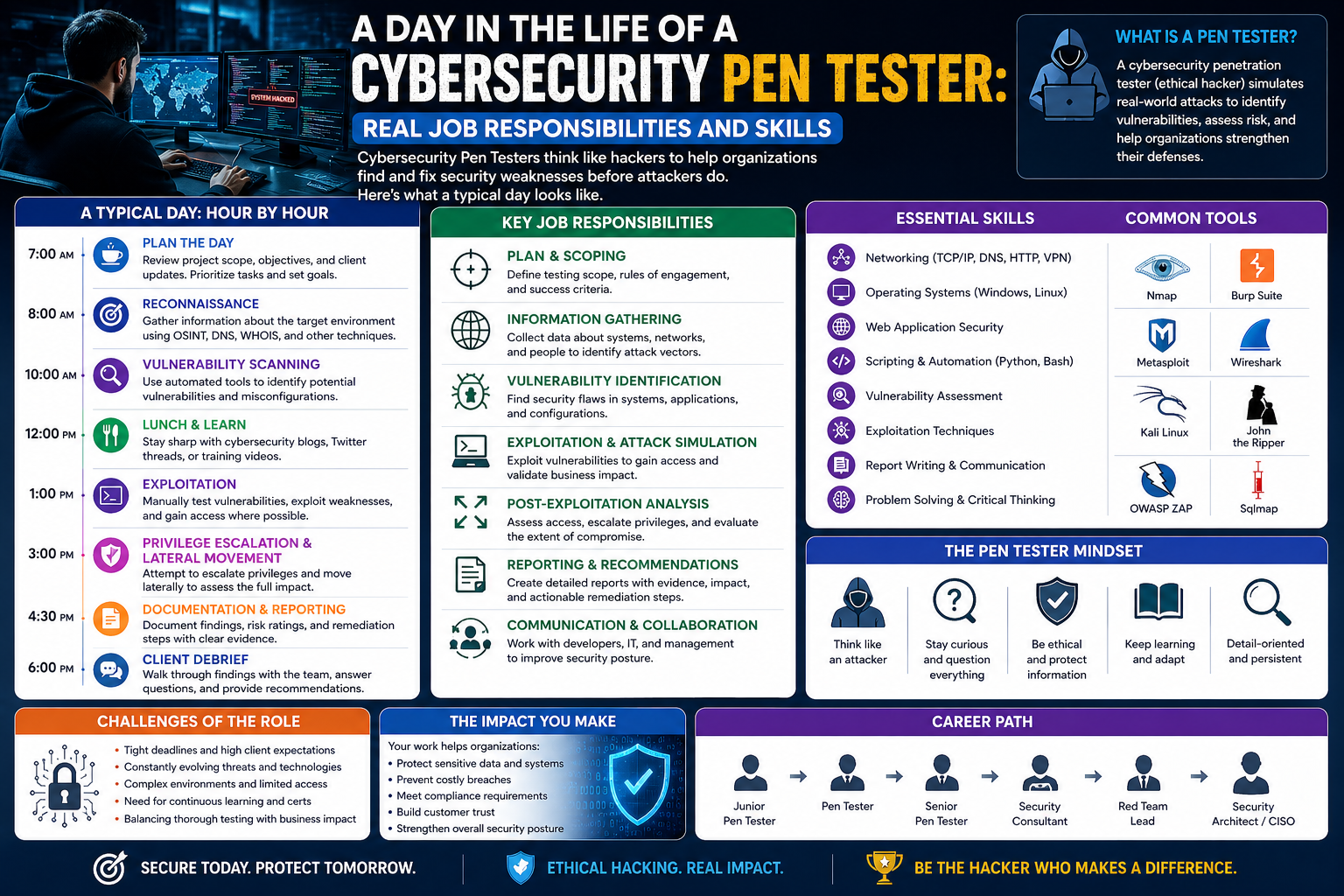
A penetration tester operates within the cybersecurity landscape as a professional responsible for evaluating the strength of digital defenses by attempting to bypass them in controlled conditions. Unlike traditional IT roles that focus on building, maintaining, or optimizing systems, this role is centered around challenging those systems in the same way a malicious attacker might. The objective is not destruction or disruption, but identification of weaknesses before they can be exploited in real-world scenarios.
In modern organizations, digital infrastructure spans across internal networks, cloud environments, web applications, mobile systems, and interconnected devices. A penetration tester examines these environments with the intent of understanding how securely they are configured and whether any gaps exist that could allow unauthorized access. This involves thinking like an adversary while working under strict authorization and defined boundaries.
The role is also deeply analytical. A penetration tester must understand how systems behave under normal conditions to recognize abnormal behavior or vulnerabilities. This requires familiarity with operating systems, network protocols, authentication mechanisms, and application logic. However, technical knowledge alone is not enough. The ability to interpret results, prioritize risks, and understand business impact is equally important.
Penetration testing is often conducted in planned engagements where a company explicitly requests an assessment. These engagements vary in scope and complexity depending on the size of the organization and the systems being evaluated. Some focus on external exposure, while others investigate internal weaknesses or specific applications.
At its core, the role is about improving security posture through simulated attacks. By identifying weaknesses before real attackers do, penetration testers help organizations strengthen defenses, refine security policies, and improve incident readiness.
Core Mindset and Ethical Boundaries of a Pen Tester
The mindset of a penetration tester is a defining aspect of the profession. It requires curiosity, persistence, and a willingness to think unconventionally. Instead of accepting systems at face value, a penetration tester continuously questions how those systems could be bypassed, manipulated, or misused.
This mindset is often described as adversarial thinking. It involves imagining how a malicious actor would approach a target, what paths they might take, and which weaknesses they would prioritize. However, unlike malicious actors, penetration testers operate with permission and within clearly defined ethical boundaries. Every action taken is authorized, documented, and controlled.
Ethics play a central role in this profession. A penetration tester may gain access to sensitive data or discover serious vulnerabilities, but they are required to handle all findings responsibly. Confidentiality is essential, and results are shared only with authorized stakeholders. The goal is always to improve security, not exploit it.
Professional discipline is also important. Even when opportunities for deeper exploration appear during testing, penetration testers must remain within the agreed scope. This ensures that systems outside the tested environment are not affected and that organizational operations remain stable.
Another important aspect of mindset is adaptability. Attack techniques and defensive technologies evolve constantly. A penetration tester must stay aware of new vulnerabilities, changing system architectures, and emerging security trends. This requires continuous learning and practical experimentation.
Ultimately, the ethical framework and mindset of a penetration tester form the foundation of trust between the tester and the organization. Without this trust, penetration testing could not exist as a structured professional discipline.
How Penetration Testing Engagements Begin and Are Structured
Penetration testing engagements typically begin with a clear agreement between the tester and the organization. This agreement defines the scope of work, which outlines exactly what systems, applications, or networks will be tested. Scope definition is critical because it ensures that testing remains controlled and does not interfere with unrelated systems.
Once the scope is defined, the engagement moves into a planning phase. During this stage, objectives are clarified, timelines are established, and testing boundaries are reinforced. Some engagements focus on identifying vulnerabilities in external-facing systems, while others may target internal infrastructure or specific applications.
After planning, the execution phase begins. This is where the penetration tester actively interacts with systems using various techniques to identify weaknesses. The approach is typically structured but flexible, allowing the tester to adapt based on findings as they emerge.
Throughout the engagement, documentation is maintained. Every observation, discovery, and significant action is recorded. This ensures that results can be validated and reproduced if necessary. Documentation also plays a key role in the final reporting stage, where findings are communicated to stakeholders.
Engagements are often iterative. Initial findings may lead to deeper investigation, which can reveal additional vulnerabilities. The process is not strictly linear, as new information can change the direction of testing.
Communication between the tester and the client is also an ongoing aspect of structured engagements. While testers operate independently during technical assessment phases, periodic updates may be provided depending on the agreement. This helps ensure transparency and alignment with expectations.
The structure of penetration testing engagements ensures that testing remains controlled, effective, and aligned with organizational goals. It balances technical exploration with procedural discipline.
Reconnaissance and Information Gathering in Real Scenarios
Reconnaissance is one of the earliest and most important stages of penetration testing. It involves collecting information about the target environment to understand its structure, exposure, and potential weaknesses. This stage is typically divided into passive and active approaches.
Passive reconnaissance involves gathering information without directly interacting with the target systems. This may include identifying publicly available data, observing network-related information, or analyzing organizational details that are openly accessible. The goal is to build an understanding of the target without generating detectable activity.
Active reconnaissance, on the other hand, involves direct interaction with systems. This may include sending requests to servers, analyzing responses, or mapping available services. Active methods provide more detailed insights but also increase the likelihood of detection within monitored environments.
During reconnaissance, penetration testers aim to identify key elements such as system architecture, exposed services, domain structures, and potential entry points. Even small details, such as server configurations or software versions, can provide valuable clues about possible vulnerabilities.
Information gathering also extends to human and organizational factors. Understanding how employees interact with systems, how authentication is handled, and how external communications are managed can reveal non-technical weaknesses.
The effectiveness of reconnaissance often determines the success of later stages. A well-executed information gathering phase provides a strong foundation for identifying meaningful attack paths and reducing guesswork during testing.
Reconnaissance requires patience and attention to detail. It is not about rushing into exploitation but about building a comprehensive picture of the target environment.
External Network Exposure and Initial Access Exploration
External network assessment focuses on systems that are accessible from outside the organization’s internal infrastructure. These may include web servers, email gateways, remote access services, and other internet-facing applications.
The primary goal in this phase is to identify entry points that could potentially be accessed by unauthorized users. Penetration testers analyze exposed services to determine whether they are securely configured and whether any vulnerabilities exist.
This stage often involves examining how systems respond to different types of requests. Variations in responses can reveal information about underlying configurations or potential weaknesses. Testers also evaluate authentication mechanisms to determine their resilience against common bypass techniques.
Initial access exploration is a critical part of external assessment. It involves identifying whether any publicly accessible system could serve as a starting point for deeper access into the environment. This does not necessarily mean immediate full access, but rather finding a foothold that could be expanded.
External systems are often the most exposed part of an organization’s infrastructure. As a result, they are frequently targeted by attackers in real-world scenarios. Penetration testers simulate these conditions to evaluate how well defenses hold up against external threats.
The findings from this stage are often used to prioritize security improvements. Weak external systems can represent a significant risk because they are directly reachable without internal compromise.
Internal Network Assessment and Lateral Movement Thinking
Internal network assessment focuses on systems that are not directly exposed to the internet but are accessible within an organization’s internal environment. This stage simulates the scenario where an attacker has already gained limited access and is attempting to expand control.
Penetration testers examine how systems communicate internally, how permissions are structured, and how resources are shared. The goal is to identify whether restricted access boundaries can be bypassed or misused.
A key concept in this stage is lateral movement thinking. This refers to the ability to move from one system to another within the network by leveraging trust relationships, shared credentials, or misconfigurations. Understanding how systems interact internally is essential to identifying these opportunities.
Internal assessment also involves analyzing privilege levels. Systems often operate with different user roles, and misconfigured permissions can lead to unintended access paths. Identifying these issues helps organizations enforce stronger segmentation and access control.
Unlike external testing, internal assessment often reveals deeper structural issues. These may include outdated systems, inconsistent security policies, or overly permissive configurations.
The insights gained from internal testing are valuable because they highlight how an attacker could escalate access after initial compromise. This helps organizations strengthen internal segmentation and reduce overall risk exposure.
Web Application Security Evaluation in a Practical Context
Web applications are a major focus of penetration testing because they often serve as the primary interface between users and organizational systems. These applications handle authentication, data processing, and user interactions, making them critical targets for security evaluation.
In practical assessments, penetration testers examine how web applications process input, manage sessions, and enforce access controls. Weaknesses in these areas can lead to unauthorized data exposure or manipulation.
Common areas of focus include input validation, authentication mechanisms, and access control logic. Even minor flaws in these components can have significant security implications.
Web application testing also involves understanding application behavior under different conditions. This includes observing how the system responds to unexpected input or unusual user actions.
Penetration testers often analyze how data flows through the application, identifying points where security checks may be insufficient. This helps reveal logical flaws that are not immediately visible through surface-level testing.
Web applications are particularly complex because they integrate multiple components such as databases, APIs, and external services. Each integration point introduces potential risk, making thorough evaluation essential.
Wireless Environment Assessment and Common Weak Points
Wireless networks represent another important area of penetration testing. These environments are often used for convenience and mobility, but they can introduce additional security challenges if not properly configured.
Wireless assessment focuses on understanding how network access is controlled and whether unauthorized devices could potentially connect. Penetration testers evaluate encryption standards, authentication methods, and signal exposure.
One key aspect of wireless testing is identifying weak configurations that could allow unauthorized access or interception of data. This includes analyzing how securely connections are established and maintained.
Wireless environments can also be vulnerable to misconfigurations that unintentionally expose network resources. These issues may not be visible in wired infrastructure, but become apparent in wireless setups.
The goal of this assessment is to ensure that wireless access is as secure as other parts of the network and that no unintended entry points exist.
Social Engineering as a Human-Centered Testing Approach
Social engineering focuses on the human element of security rather than technical systems. It involves evaluating how individuals within an organization respond to manipulation attempts or deceptive communication.
Penetration testers may simulate scenarios where individuals are asked to disclose information or perform actions that could compromise security. These exercises help assess awareness levels and the effectiveness of security training.
Human behavior is often one of the most unpredictable aspects of security. Even well-secured technical systems can be compromised if individuals are not vigilant.
Social engineering assessments highlight the importance of awareness, verification procedures, and organizational culture in maintaining security.
Day-to-Day Workflow and Time Management in Testing Projects
The daily workflow of a penetration tester varies depending on the stage of the engagement. Early stages may involve extensive information gathering, while later stages focus on deeper analysis and validation of findings.
Time management is important because testing often involves multiple parallel tasks. A penetration tester may analyze system responses, document findings, and plan next steps simultaneously.
The workflow is typically structured but flexible, allowing adjustments based on discoveries made during testing. This adaptability is essential because each environment behaves differently.
Documentation is an ongoing activity throughout the day. Recording observations ensures that no detail is lost and that results can be accurately communicated later.
The day-to-day nature of the role is a balance between technical exploration, analytical thinking, and structured reporting activities.
Methodologies and Structured Approaches in Penetration Testing
Penetration testing is not performed in a random or improvised manner. It follows structured methodologies that help ensure consistency, completeness, and professionalism across different engagements. These methodologies provide a roadmap that guides testers through each stage of assessment, from initial understanding of the target environment to final reporting.
A structured approach ensures that no critical area is overlooked. It also helps maintain alignment with the defined scope of the engagement. Depending on the organization or project type, penetration testers may adapt different frameworks, but the underlying goal remains the same: systematically identify weaknesses in a controlled and repeatable way.
Methodologies also support communication between teams. When multiple testers are involved in a project, a shared framework ensures that everyone follows the same logic and terminology. This reduces confusion and improves collaboration during complex assessments.
Another important aspect of structured methodologies is prioritization. Not all vulnerabilities carry the same level of risk. A methodical approach helps testers categorize findings based on potential impact, exploitability, and relevance to business operations.
By following a defined process, penetration testers ensure that assessments are thorough, transparent, and aligned with professional standards.
Tool Usage and the Role of Specialized Security Utilities
Penetration testers rely on a wide range of tools to assist in identifying vulnerabilities, analyzing systems, and validating security weaknesses. These tools are not used randomly but are selected based on the specific phase of testing and the nature of the target environment.
Some tools focus on network analysis, allowing testers to observe communication patterns and identify exposed services. Others are designed for application testing, helping analyze how software handles input and processes data. Some tools assist in password analysis, configuration review, and traffic inspection.
While tools are important, they do not replace human reasoning. A penetration tester must interpret results, verify findings, and understand context. Tools simply accelerate the process of discovery and reduce manual effort in repetitive tasks.
Another key aspect is tool customization. Experienced testers often adjust configurations or combine multiple tools to achieve more precise results. This adaptability is necessary because every environment behaves differently.
Tool usage also requires responsibility. Improper use can disrupt systems or generate false positives. Therefore, penetration testers must understand not only how tools work but also their potential impact on live environments.
Exploitation Phase and Controlled Validation of Weaknesses
Once vulnerabilities are identified, the next stage involves controlled exploitation. This phase is not about causing damage but about confirming whether a weakness is genuinely exploitable and understanding its real-world impact.
Exploitation allows penetration testers to validate findings beyond theoretical analysis. A vulnerability that appears significant in analysis may turn out to be less impactful in practice, while others may reveal deeper system weaknesses when tested carefully.
During this phase, testers focus on maintaining strict boundaries. Every action is performed within the agreed scope, and care is taken to avoid unnecessary disruption. The goal is to demonstrate risk, not to compromise system stability.
Controlled exploitation also helps prioritize vulnerabilities. If a weakness can lead to significant access or data exposure, it is considered more critical than issues with limited impact.
This stage requires precision and careful judgment. Penetration testers must balance exploration with caution, ensuring that validation is accurate while maintaining system integrity.
Privilege Escalation and Access Expansion Analysis
Privilege escalation is the process of evaluating whether limited access can be expanded to higher levels of control within a system. This is a critical area of penetration testing because many real-world attacks rely on gaining initial access and then increasing privileges.
In this stage, testers examine how user roles are defined and enforced. Misconfigurations, weak permissions, or flawed authentication mechanisms can sometimes allow unauthorized elevation of access.
Access expansion analysis also involves understanding how systems trust each other. In some environments, access to one system can lead to indirect access to others due to shared credentials or interconnected services.
The objective is to determine whether security boundaries are properly enforced. If privilege escalation is possible, it indicates that internal controls may not be sufficiently strong.
This stage often reveals deeper architectural issues rather than isolated vulnerabilities. It highlights how systems behave when tested beyond normal usage patterns.
Post-Exploitation Analysis and System Impact Evaluation
After successful exploitation or privilege escalation, penetration testers often move into a post-exploitation analysis phase. This involves understanding what level of control has been achieved and what potential impact it could have in a real attack scenario.
Post-exploitation is not about maintaining access for its own sake. Instead, it focuses on assessing the depth of compromise and identifying what types of information or systems could be affected.
During this phase, testers evaluate data exposure risks, system stability, and the potential for further movement within the environment. This helps organizations understand the full consequences of a security weakness.
Impact evaluation is a critical part of this process. It translates technical findings into business-relevant risks, helping decision-makers understand the severity of vulnerabilities in practical terms.
This stage often forms the basis for final recommendations and remediation priorities.
Reporting Structure and Communication of Findings
One of the most important responsibilities of a penetration tester is documenting and communicating findings in a clear and structured manner. Reporting transforms technical discoveries into actionable insights for stakeholders.
A well-structured report typically includes descriptions of vulnerabilities, evidence of findings, impact analysis, and recommendations for remediation. However, the key challenge lies in presenting this information in a way that is understandable to both technical and non-technical audiences.
Penetration testers must balance detail with clarity. Too much technical complexity can make reports difficult to interpret, while oversimplification can reduce their usefulness.
Communication also involves explaining risk in context. A vulnerability is not just a technical issue but a potential business risk. Effective reporting connects technical findings to real-world consequences.
Another important aspect is accuracy. Every reported issue must be validated and supported with clear evidence. This ensures credibility and helps organizations trust the results.
Reporting is often considered one of the most time-consuming parts of penetration testing, but it is also one of the most valuable deliverables of the entire process.
Interaction with Clients and Professional Communication Skills
Penetration testers frequently interact with clients throughout the engagement lifecycle. These interactions require professionalism, clarity, and the ability to explain complex technical concepts in an accessible language.
During initial phases, communication focuses on defining scope and expectations. As testing progresses, updates may be shared depending on the engagement structure. These updates help ensure transparency and alignment.
After testing is completed, communication becomes more formal and detailed. Testers may present findings, explain risks, and answer questions about vulnerabilities and remediation steps.
Strong communication skills are essential because penetration testers often act as a bridge between technical teams and business decision-makers. They must ensure that both sides understand the implications of security issues.
Professional communication also involves diplomacy. Sensitive findings must be delivered in a constructive manner that encourages improvement rather than defensiveness.
Risk Assessment and Vulnerability Prioritization
Not all vulnerabilities carry the same level of risk. Penetration testers must evaluate findings and prioritize them based on severity, exploitability, and potential impact.
Risk assessment involves analyzing how a vulnerability could be used in a real-world scenario. This includes considering factors such as ease of exploitation, required access level, and potential consequences.
Prioritization helps organizations focus their resources on the most critical issues first. High-risk vulnerabilities are typically addressed before lower-risk ones to reduce immediate exposure.
Penetration testers also consider the environmental context. A vulnerability that is critical in one system may be less significant in another, depending on configuration and exposure.
Effective risk assessment ensures that remediation efforts are practical and aligned with organizational priorities.
Legal Authorization and Scope Enforcement in Engagements
Penetration testing operates within strict legal boundaries. Every action taken during an engagement must be authorized by the organization being tested. Without explicit permission, such activities would be considered illegal.
Scope enforcement ensures that testing remains limited to agreed systems and does not extend into unrelated environments. This protects both the organization and the tester.
Clear documentation of the scope is essential before testing begins. It defines what is included, what is excluded, and what level of testing is permitted.
Penetration testers must adhere strictly to these boundaries. Even if unexpected systems or vulnerabilities are discovered outside the scope, they cannot be pursued without additional authorization.
This legal structure is what differentiates penetration testing from unauthorized hacking activities. It ensures that testing is conducted responsibly and ethically.
Automation, Efficiency, and Manual Analysis Balance
Modern penetration testing often involves a combination of automated tools and manual analysis. Automation helps streamline repetitive tasks such as scanning, data collection, and initial identification of potential issues.
However, automation alone is not sufficient. Many vulnerabilities require human interpretation, logical reasoning, and contextual understanding that automated tools cannot provide.
Penetration testers must balance efficiency with depth. Automation can speed up discovery, but manual analysis ensures accuracy and relevance.
Experienced testers know when to rely on automation and when to perform deeper manual investigation. This balance is essential for effective testing.
Automation also helps manage large and complex environments, allowing testers to focus their attention on more meaningful analysis.
Cloud Environments and Modern Infrastructure Challenges
As organizations increasingly adopt cloud-based systems, penetration testing has expanded to include cloud environments. These systems introduce new challenges due to their distributed nature and shared responsibility models.
Cloud environments often involve multiple layers of configuration, including identity management, storage systems, and virtual infrastructure. Each layer must be evaluated for security weaknesses.
Penetration testers assess how access is controlled, how resources are isolated, and whether configurations expose sensitive data.
One of the key challenges in cloud testing is understanding shared responsibility. Some security aspects are managed by the provider, while others are managed by the organization.
This complexity requires testers to adapt traditional methodologies to modern infrastructure models.
Team Collaboration and Multi-Role Engagement Dynamics
Although penetration testing can sometimes be performed individually, many engagements involve teams of professionals working together. Collaboration allows for broader coverage and deeper analysis.
Team members may focus on different aspects of testing, such as network analysis, application testing, or reporting. This division of responsibilities increases efficiency and coverage.
Effective collaboration requires clear communication and coordination. Findings must be shared among team members to ensure consistency and avoid duplication of effort.
Team-based testing also allows for peer validation, where findings are reviewed and verified by multiple testers before being reported.
This collaborative approach improves accuracy and enhances the overall quality of the assessment.
Advanced Attack Simulation and Real-World Threat Modeling in Penetration Testing
Penetration testing at an advanced level often moves beyond basic vulnerability discovery and focuses on simulating realistic attack scenarios. This approach is commonly referred to as threat modeling through practical simulation. The idea is to replicate how a genuine attacker might behave when targeting an organization with specific objectives in mind, such as data theft, system disruption, or unauthorized access to critical infrastructure.
Instead of testing systems in isolation, advanced penetration testers analyze how different components interact under attack conditions. This includes evaluating how authentication systems, internal networks, cloud services, and user endpoints respond when subjected to coordinated exploitation attempts. The goal is to understand not only whether individual weaknesses exist, but how those weaknesses could be chained together to achieve a larger compromise.
Threat modeling also requires understanding attacker motivations and techniques. Different attackers have different goals, and penetration testers must simulate various scenarios accordingly. Some attackers may focus on financial gain, while others may target disruption or data exposure. Each scenario influences how systems are evaluated and what attack paths are prioritized.
In advanced simulations, testers often mimic multi-stage attacks. These begin with initial access attempts, followed by privilege escalation, lateral movement, and eventual objective completion. Each stage is carefully analyzed to determine how far an attacker could progress within the environment.
This approach provides organizations with a realistic view of their security posture. Instead of isolated vulnerability reports, they receive a comprehensive understanding of how an actual attack might unfold across their systems.
Persistence Techniques and Long-Term Access Evaluation
In real-world attack scenarios, adversaries often attempt to maintain long-term access to compromised systems. Penetration testers evaluate whether such persistence is possible within a controlled environment to understand how resilient a system is against ongoing threats.
Persistence evaluation involves analyzing whether unauthorized access could survive system restarts, password changes, or security updates. It also examines whether hidden access paths or redundant entry points exist within the system architecture.
This stage is important because many organizations focus heavily on preventing initial breaches but may overlook mechanisms that allow attackers to remain undetected over time. Persistence testing helps identify these weaknesses.
Testers also assess detection capabilities during this phase. If persistent access is possible, it is equally important to determine whether such activity would be noticed by monitoring systems or security controls.
The findings from persistence evaluation often highlight gaps in monitoring, logging, and response mechanisms. These insights are valuable for strengthening long-term defensive strategies.
Evasion Techniques and Security Control Testing
Modern security systems often include detection mechanisms such as intrusion prevention systems, firewalls, endpoint monitoring, and behavioral analysis tools. Penetration testers evaluate how effective these systems are by simulating evasion techniques.
Evasion testing does not aim to bypass security for malicious purposes but to assess whether defensive systems can be circumvented under realistic conditions. This helps organizations understand the limitations of their detection capabilities.
During this phase, testers observe how security systems respond to different patterns of activity. They analyze whether alerts are triggered appropriately and whether suspicious behavior is correctly identified.
Evasion testing may also reveal overly sensitive configurations that generate excessive false positives or overly permissive settings that fail to detect meaningful threats.
The goal is to ensure that security controls are both effective and balanced, protecting without hindering legitimate operations.
Real-Time Decision Making During Active Testing
Penetration testing is not a static process. It requires continuous decision-making based on evolving information. As testers uncover new vulnerabilities or unexpected system behaviors, they must decide how to proceed in real time.
This decision-making process is influenced by several factors, including scope limitations, risk levels, and engagement objectives. Testers must constantly evaluate whether to continue exploring a particular path or shift focus to another area of the system.
Real-time decisions also involve prioritizing findings. Some vulnerabilities may lead to more significant access opportunities, while others may be less impactful. Determining where to focus effort is a key part of the testing process.
In addition, testers must be mindful of system stability. If an action could potentially disrupt operations, it must be carefully considered or avoided altogether.
This dynamic workflow makes penetration testing highly analytical and adaptive. No two engagements follow the same path, even when testing similar systems.
Incident Response Simulation and Organizational Preparedness
Some penetration testing engagements include elements of incident response simulation. In these scenarios, testers evaluate how well an organization detects, responds to, and recovers from security incidents.
Instead of simply identifying vulnerabilities, the focus shifts toward operational readiness. Testers may simulate attack scenarios and observe how internal teams react.
This helps determine whether security monitoring systems are effective and whether response procedures are properly implemented. It also reveals how quickly an organization can identify and contain potential threats.
Incident response simulation provides valuable insights into coordination between technical teams, management, and security operations. It highlights communication gaps and procedural weaknesses that may not be visible during standard vulnerability assessments.
The objective is to improve overall resilience, not just system security. Even well-secured environments can be vulnerable if response mechanisms are slow or ineffective.
Data Exfiltration Risk Analysis and Sensitive Information Exposure
One of the most critical aspects of penetration testing is evaluating the risk of data exposure. Data exfiltration analysis focuses on determining whether sensitive information could be accessed or transferred outside the organization without authorization.
Testers examine how data is stored, transmitted, and protected across systems. This includes evaluating encryption mechanisms, access controls, and network segmentation.
In many cases, vulnerabilities are not directly related to system compromise but to improper handling of sensitive data. This may include misconfigured storage, weak access policies, or insufficient data segregation.
Data exfiltration testing helps organizations understand what information is most at risk in the event of a breach. It also highlights pathways that could be used to move data outside secure environments.
The insights gained from this analysis are critical for strengthening data protection strategies and ensuring compliance with security standards.
Configuration Weaknesses and System Mismanagement Issues
Many security vulnerabilities arise not from software flaws but from improper configuration of systems and services. Penetration testers spend significant time identifying these misconfigurations.
Configuration weaknesses may include overly permissive access settings, unnecessary services running on systems, or default configurations that were never hardened.
These issues are particularly common in complex environments where multiple systems are deployed and managed by different teams. Over time, inconsistencies can accumulate and create security gaps.
Testers evaluate whether systems are configured according to best practices and whether unnecessary exposure has been minimized. Even small configuration errors can lead to significant vulnerabilities if left unaddressed.
Identifying these issues helps organizations improve operational discipline and maintain consistent security standards across their infrastructure.
Authentication Mechanisms and Identity Security Evaluation
Authentication systems are a critical component of cybersecurity. They control how users access systems and what level of access they are granted. Penetration testers evaluate whether these mechanisms are secure and resistant to abuse.
This includes analyzing password policies, multi-factor authentication implementation, session handling, and account recovery processes.
Weak authentication systems can lead to unauthorized access even if other security controls are strong. For this reason, identity security is a major focus of penetration testing.
Testers also evaluate how identity systems integrate with other services. Misconfigurations in identity management can create cascading vulnerabilities across multiple systems.
The goal is to ensure that identity verification is robust and that access control mechanisms are properly enforced throughout the environment.
Application Programming Interface (API) Security Assessment
Modern systems often rely heavily on APIs to enable communication between applications and services. These interfaces can become significant attack surfaces if not properly secured.
Penetration testers evaluate APIs to ensure that they enforce proper authentication, validation, and authorization controls. They also analyze how data is processed and whether sensitive information is exposed.
API testing involves understanding how requests are structured and how responses are generated. Weaknesses in these processes can lead to unauthorized access or data leakage.
Because APIs often serve as the backbone of modern applications, their security is essential to overall system protection.
Cloud Identity and Access Management Evaluation
In cloud environments, identity and access management play a central role in security. Penetration testers evaluate how cloud identities are created, managed, and controlled.
This includes assessing role assignments, permission structures, and access boundaries between different cloud resources.
Misconfigurations in cloud identity systems can lead to widespread exposure because cloud platforms often connect multiple services under unified access control frameworks.
Testing in this area helps organizations ensure that cloud permissions are properly structured and that unnecessary access is not granted.
Security Awareness Gaps and Human Factor Vulnerabilities
Even in highly secure technical environments, human behavior can introduce vulnerabilities. Penetration testers evaluate how employees respond to simulated attack scenarios to identify awareness gaps.
These evaluations focus on decision-making, verification practices, and adherence to security policies. Weaknesses in human behavior can sometimes be more impactful than technical flaws.
Understanding these gaps allows organizations to improve training programs and reinforce secure practices across their workforce.
Human factor vulnerabilities remain one of the most unpredictable aspects of cybersecurity, making them an important focus in penetration testing.
Reporting Interpretation and Strategic Security Recommendations
After all testing phases are completed, findings must be translated into strategic recommendations. This involves interpreting technical results in a way that supports long-term security planning.
Reports are structured to highlight key risks, explain their implications, and provide guidance on remediation priorities. However, beyond immediate fixes, penetration testers also offer insights into systemic improvements.
These may include recommendations for architectural changes, policy updates, or enhanced monitoring strategies.
The goal is not only to fix individual vulnerabilities but to improve overall security maturity.
Evolving Nature of Penetration Testing in Modern Environments
Penetration testing continues to evolve alongside technology. As systems become more complex and interconnected, testing approaches must adapt accordingly.
Modern environments include cloud infrastructure, containerized applications, remote work systems, and distributed services. Each of these introduces new security challenges.
Penetration testers must continuously update their knowledge and methodologies to remain effective in these changing landscapes.
The role is becoming increasingly strategic, focusing not just on technical vulnerabilities but on overall security resilience and organizational readiness.
Conclusion
Penetration testing has become an essential discipline in modern cybersecurity, not because it replaces traditional security measures, but because it challenges them in a controlled and realistic way. As organizations continue to expand their digital presence across networks, cloud platforms, applications, and mobile systems, the attack surface grows in both size and complexity. In such an environment, understanding how systems behave under adversarial pressure is no longer optional; it is a fundamental requirement for maintaining security resilience.
At its core, the work of a penetration tester revolves around simulating real-world attack scenarios while operating within strict ethical and legal boundaries. This dual responsibility—thinking like an attacker while acting as a trusted professional—defines the uniqueness of the role. It demands not only technical expertise but also discipline, judgment, and accountability. Every action is guided by scope, authorization, and a clear objective: to improve the security posture of the organization.
What makes penetration testing particularly valuable is its ability to reveal vulnerabilities that automated tools and standard security audits may overlook. Human creativity plays a central role in identifying complex attack paths, misconfigurations, and logical flaws that cannot always be detected through surface-level scanning. By combining technical analysis with critical thinking, penetration testers uncover weaknesses that reflect how systems might be exploited in real-world conditions.
Equally important is the way penetration testing translates technical findings into meaningful business insights. A vulnerability is not just a flaw in code or configuration; it represents a potential risk to data, operations, and reputation. Through structured reporting and communication, penetration testers bridge the gap between technical discovery and strategic decision-making. This allows organizations to prioritize remediation efforts based on actual impact rather than isolated technical severity.
The profession also highlights the importance of continuous learning. As technology evolves, so do attack methods and defensive strategies. Cloud computing, distributed systems, and increasingly complex application architectures require penetration testers to adapt their skills and stay updated with emerging threats. This constant evolution ensures that the role remains relevant and effective in addressing modern security challenges.
Despite its technical nature, penetration testing is also deeply human. It involves understanding behavior, communication patterns, and organizational practices that influence security outcomes. Whether evaluating user awareness, assessing authentication systems, or analyzing access control structures, the human factor remains a critical element in overall security effectiveness.
Ultimately, penetration testing serves as a proactive approach to cybersecurity. Instead of waiting for real attackers to expose weaknesses, organizations use ethical simulations to identify and resolve issues in advance. This forward-looking strategy strengthens defenses, improves resilience, and enhances confidence in digital systems.
In a world where cyber threats continue to grow in sophistication and frequency, the role of penetration testers remains indispensable. They act as controlled adversaries, uncovering hidden risks and helping organizations build stronger, more resilient infrastructures. Their work ensures that security is not just a theoretical design but a tested, validated, and continuously improving practice.