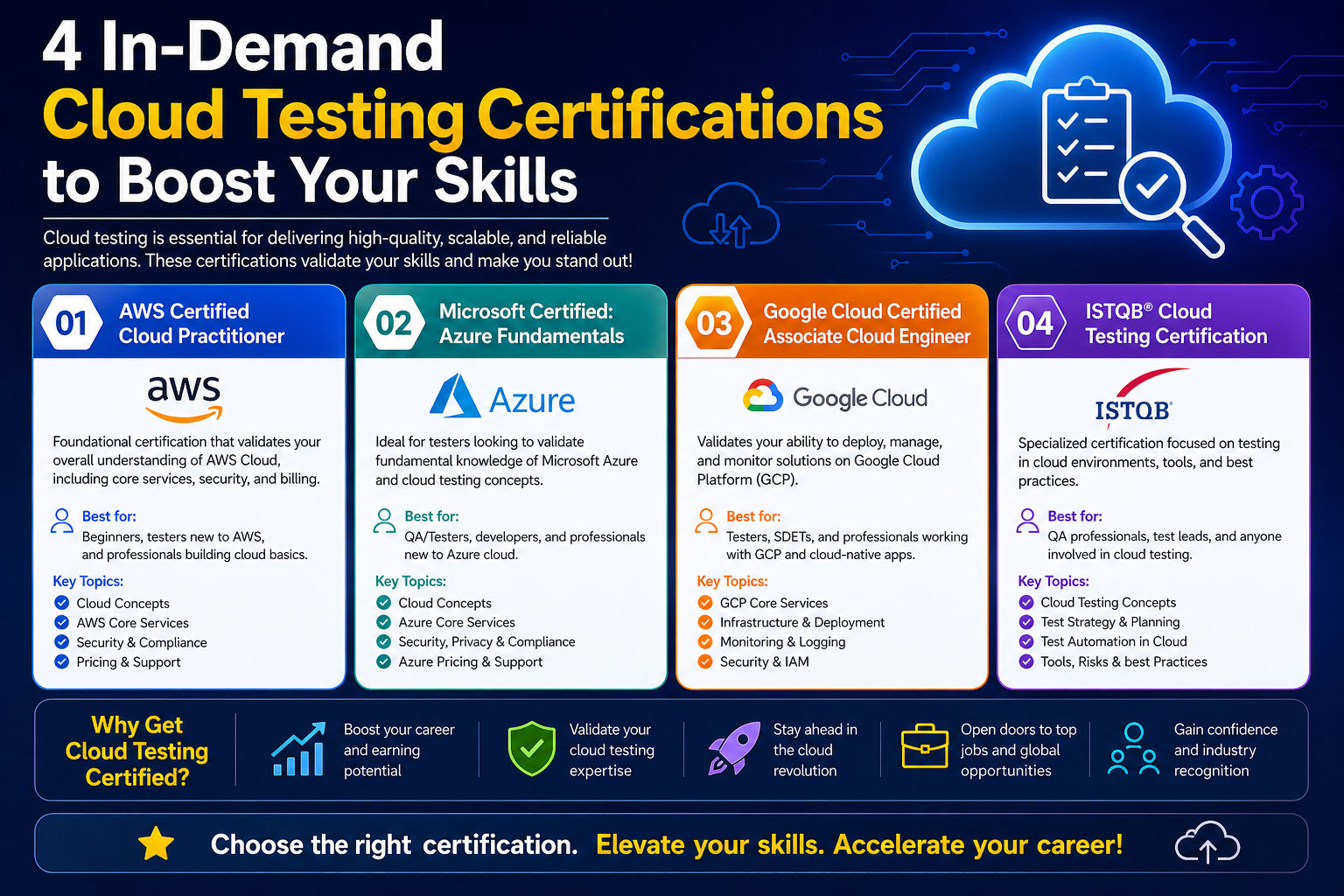
Cloud testing has become an essential part of how modern digital systems are built, deployed, and maintained. As organizations continue shifting their infrastructure from traditional on-premises environments to cloud platforms, the complexity of ensuring reliability, performance, and security has increased significantly. Unlike traditional software environments, where systems were relatively static, cloud-based systems are dynamic, distributed, and highly scalable. This means that testing is no longer just about checking whether a feature works correctly; it is about ensuring that the entire system behaves consistently under varying loads, configurations, and conditions.
At its core, cloud testing refers to the process of validating applications, services, and infrastructure that operate within cloud environments. These environments may include public cloud platforms, private cloud systems, or hybrid architectures that combine both. What makes cloud testing distinct is that it must account for elasticity, multi-tenancy, network variability, and automated scaling. For instance, an application hosted in a cloud environment may behave differently when resources are scaled up or down automatically, and testing must anticipate these changes.
Another defining aspect of cloud testing is its dependence on distributed systems. Unlike traditional applications that run on a single server or a controlled cluster, cloud applications often span multiple regions and data centers. This introduces latency considerations, synchronization challenges, and potential points of failure that are not always visible in localized environments. Testing must therefore include scenarios that simulate real-world usage across different geographies and network conditions.
The evolution of DevOps practices has further transformed cloud testing into a continuous activity rather than a one-time phase in development. Instead of waiting for a dedicated testing stage, modern teams integrate testing into every phase of the development lifecycle. Automated pipelines execute tests whenever code is updated, ensuring that issues are detected early and frequently. However, while automation has improved efficiency, it has also created a new challenge: understanding how to design meaningful tests that truly reflect system behavior in production-like environments.
Cloud testing also intersects heavily with infrastructure management. Since infrastructure is often defined as code in cloud environments, testers must understand not only application logic but also how underlying resources are provisioned and configured. Misconfigured virtual networks, improperly assigned permissions, or insufficient scaling rules can all lead to failures that appear to be application bugs but are actually infrastructure issues. This blending of responsibilities makes cloud testing a multidisciplinary skill.
Security is another critical dimension. Cloud systems are constantly exposed to external access points, APIs, and services that increase the attack surface. Testing must therefore include validation of authentication mechanisms, encryption standards, access control policies, and compliance requirements. Security testing in the cloud is not a separate activity but an integrated part of the overall testing strategy.
Performance and scalability testing also take on greater importance in cloud environments. Applications must not only function correctly under normal conditions but also maintain stability during sudden spikes in traffic. Cloud systems are designed to scale dynamically, but this behavior must be verified through structured testing. Without proper validation, systems may either fail under load or incur unnecessary costs due to inefficient scaling configurations.
In this context, cloud testing becomes more than a technical process; it becomes a strategic capability. Organizations that invest in robust cloud testing practices are better positioned to deliver reliable services, reduce downtime, and maintain customer trust. However, developing this capability requires structured learning, and this is where certifications often play an important role in guiding professionals toward foundational knowledge and practical understanding.
Why Certifications Alone Are Not Enough
Certifications in cloud computing and testing provide a structured pathway for learning, but they are not a substitute for real-world experience. In many cases, IT professionals pursue certifications to validate their knowledge, but the actual complexity of cloud environments often extends beyond what is covered in standardized exams. This gap between theoretical knowledge and practical application is one of the key challenges in developing true cloud expertise.
One of the main limitations of certifications is that they are typically designed around defined objectives and controlled scenarios. While this approach ensures consistency and fairness in evaluation, it does not fully reflect the unpredictable nature of real-world systems. In production environments, issues rarely appear in isolation. Instead, multiple factors such as network latency, configuration errors, service dependencies, and user behavior interact in ways that are difficult to replicate in a testing environment.
Another challenge is that cloud platforms evolve rapidly. New services, features, and architectural patterns are introduced frequently, which means that certification content can quickly become outdated. While foundational concepts remain relevant, the practical implementation of those concepts may change significantly over time. As a result, professionals who rely solely on certifications may find themselves lacking exposure to the latest tools and methodologies used in industry settings.
In cloud testing specifically, practical problem-solving skills are far more important than memorized knowledge. For example, understanding how to design a scalable test environment requires familiarity with system behavior under stress, not just theoretical definitions of load balancing or virtualization. Similarly, identifying performance bottlenecks requires hands-on experience with monitoring tools, logs, and distributed tracing systems.
Certifications also tend to focus on individual components rather than integrated systems. Cloud environments, however, are inherently interconnected. A change in one service can have cascading effects on others, making it essential for testers to understand system-wide interactions. This holistic perspective is often developed through experience rather than structured learning alone.
Despite these limitations, certifications still play an important role in shaping a professional’s foundational understanding. They introduce key concepts, terminology, and architectural principles that are essential for effective communication and collaboration within technical teams. They also provide a structured learning path for individuals who are new to cloud technologies, helping them build confidence before moving on to more complex tasks.
However, relying exclusively on certifications can create a false sense of readiness. Professionals may understand concepts in theory but struggle when faced with real-world scenarios that require adaptability and critical thinking. For example, a certified individual may know how auto-scaling works in principle but may not fully understand how to troubleshoot scaling failures caused by misconfigured policies or unexpected traffic patterns.
This is why cloud testing requires continuous learning beyond certification paths. Practical experimentation, exposure to production environments, and collaboration with experienced engineers are all essential components of skill development. Over time, professionals learn how to interpret system behavior, anticipate potential failures, and design more effective testing strategies.
Ultimately, certifications should be viewed as a starting point rather than a final achievement. They provide direction, structure, and credibility, but true mastery comes from applying knowledge in real-world contexts where complexity, uncertainty, and scale are constantly evolving.
Foundations of Cloud Architecture Knowledge for Testing
A strong understanding of cloud architecture is essential for effective cloud testing because testing in cloud environments is deeply tied to how systems are designed and structured. Cloud architecture defines how computing resources, storage systems, networking components, and application services interact with each other. Without this understanding, testing becomes fragmented and less effective, as it fails to account for the relationships between different system components.
Modern cloud architectures are typically built around distributed systems that prioritize scalability, availability, and fault tolerance. These systems are composed of multiple layers, including front-end interfaces, application logic, data storage, and supporting infrastructure services. Each layer has its own behavior, dependencies, and potential failure points, all of which must be considered during testing.
One of the key principles in cloud architecture is modularity. Applications are often broken into smaller, independent services that communicate through APIs. This microservices-based approach allows for greater flexibility and scalability, but it also introduces complexity in testing. Each service must be tested individually as well as in combination with others to ensure that interactions function correctly under different conditions.
Another important aspect is elasticity, which refers to the ability of cloud systems to automatically adjust resources based on demand. While this feature improves efficiency and performance, it also introduces variability that must be accounted for in testing. Testers must evaluate how systems behave when resources are scaled up or down dynamically, ensuring that performance remains stable and that no data inconsistencies occur during transitions.
Cloud architecture also emphasizes redundancy and high availability. Systems are often deployed across multiple regions or availability zones to prevent downtime in case of failures. From a testing perspective, this means that failure scenarios must be simulated to ensure that backup systems activate correctly and that data replication remains consistent. Without this level of testing, systems may appear stable under normal conditions but fail during unexpected outages.
Security is embedded into cloud architecture at multiple levels. Access control mechanisms, encryption protocols, identity management systems, and network security configurations all play a role in protecting data and services. Testing must therefore include validation of security policies and ensure that only authorized users and systems can access sensitive resources. Misconfigurations in this area can lead to serious vulnerabilities, making security testing a critical part of cloud validation.
Another foundational element is observability, which refers to the ability to monitor and understand system behavior through logs, metrics, and traces. In cloud environments, observability tools are essential for identifying performance issues and debugging failures. Testers rely on these tools to verify system behavior and ensure that applications respond correctly under different conditions.
Understanding cloud architecture also helps testers anticipate potential issues before they occur. By knowing how components interact, testers can design more effective test cases that target weak points in the system. This proactive approach reduces the likelihood of production failures and improves overall system reliability.
In essence, cloud architecture knowledge forms the backbone of effective cloud testing. It provides the context needed to interpret system behavior, design meaningful tests, and ensure that applications perform reliably in complex and dynamic environments.
AWS Solutions Architect Role in Testing Perspective
The AWS Solutions Architect perspective plays a significant role in shaping how cloud testing is approached because it emphasizes the design and structure of cloud systems. Rather than focusing solely on individual services or isolated components, this perspective encourages a holistic understanding of how applications are built and deployed within the AWS ecosystem.
A key aspect of this role is designing systems that are both scalable and resilient. This involves selecting appropriate AWS services, configuring them correctly, and ensuring that they work together efficiently. From a testing standpoint, this design-focused approach provides valuable insight into how systems are expected to behave under different conditions. When testers understand the architectural intent behind a system, they are better equipped to validate whether it performs as intended.
Another important element is fault tolerance. AWS architectures are often designed to handle failures gracefully without affecting overall system availability. This includes using multiple availability zones, load balancing mechanisms, and automated recovery processes. Testing in this context involves simulating failures and verifying that systems recover as expected without data loss or service disruption.
Security is also deeply integrated into AWS architecture design. Identity and access management, encryption strategies, and network segmentation are all part of building secure cloud systems. From a testing perspective, this means validating that security controls are properly implemented and that unauthorized access is prevented under all circumstances.
Performance optimization is another critical consideration. AWS systems are designed to scale based on demand, but this behavior must be carefully tested to ensure efficiency and cost-effectiveness. Poorly configured scaling policies can lead to either resource shortages or unnecessary expenses, both of which impact system performance and business outcomes.
The Solutions Architect mindset also emphasizes trade-offs between different design choices. For example, increasing redundancy may improve reliability but also increase cost. Similarly, optimizing for performance may introduce complexity in system management. Understanding these trade-offs helps testers evaluate whether systems are aligned with business requirements and operational constraints.
By adopting this architectural perspective, cloud testing becomes more strategic and comprehensive. Instead of focusing only on whether individual features work correctly, testers begin to evaluate how entire systems behave under real-world conditions. This shift in thinking leads to more robust testing practices and ultimately more reliable cloud applications.
Azure Fundamentals Role in Testing Perspective
Understanding foundational cloud concepts through Azure’s perspective helps build a structured approach to cloud testing. This perspective focuses on core cloud principles such as resource management, security, compliance, and cost optimization, all of which directly influence how testing is performed in cloud environments.
A key aspect of this foundational knowledge is understanding how cloud resources are provisioned and managed. In Azure environments, resources such as virtual machines, storage accounts, and networking components are created and configured through defined processes. For testers, this knowledge is essential because it provides insight into how environments are built and how configuration changes can impact system behavior.
Security and compliance are also central to this perspective. Cloud systems must adhere to strict standards to protect data and ensure regulatory compliance. Testing, therefore, involves verifying that security configurations are correctly implemented and that systems adhere to required policies. This includes checking access controls, network security rules, and data protection mechanisms.
Another important element is cost awareness. Cloud resources are typically billed based on usage, which means inefficient configurations can lead to unnecessary expenses. Testing must therefore consider not only functional correctness but also resource efficiency. For example, ensuring that systems do not consume excessive resources during idle periods is an important part of cloud validation.
Understanding Azure’s core services also helps testers develop a broader view of system architecture. By learning how different services interact, testers can better understand application behavior and identify potential issues related to integration or configuration.
This foundational perspective encourages a disciplined approach to cloud testing, where attention is given not only to functionality but also to security, efficiency, and compliance.
Testing Strategies in Distributed Cloud Systems
Cloud environments are fundamentally distributed, meaning that applications are no longer executed in a single, predictable location. Instead, they operate across multiple servers, regions, and services that communicate over networks. This distributed nature introduces a wide range of testing challenges that require specialized strategies to ensure reliability and consistency.
One of the most important aspects of distributed cloud testing is understanding system decentralization. Each component in a cloud system often runs independently, yet depends on other components to function correctly. For example, a user-facing application may rely on authentication services, database systems, caching layers, and external APIs. Testing must ensure that each of these components not only works individually but also interacts correctly with others under different conditions.
Latency is another critical factor in distributed systems. Since services may be located in different geographical regions, network delays can affect system performance and user experience. Testing strategies must therefore include scenarios that simulate varying network conditions, including slow connections, packet loss, and regional outages. This helps ensure that applications remain stable even when communication between services is not instantaneous.
Another important consideration is data consistency. In distributed cloud systems, data is often replicated across multiple locations to improve availability and fault tolerance. However, this introduces the risk of synchronization issues, where different nodes may temporarily hold different versions of the same data. Testing must validate that eventual consistency mechanisms work correctly and that data converges to a stable state after updates.
Failure simulation is also a key part of distributed testing strategies. Unlike traditional systems, where failures are relatively isolated, cloud systems are designed to assume that failures will occur regularly. As a result, testers must deliberately introduce failure scenarios such as service outages, network interruptions, and resource exhaustion. The goal is to ensure that the system continues to function or recovers gracefully without affecting the user experience.
Scalability testing is equally important in distributed environments. Cloud systems are expected to handle varying levels of demand by dynamically adjusting resources. Testing must validate whether scaling mechanisms respond appropriately to changes in load. This includes verifying both horizontal scaling, where new instances are added, and vertical scaling, where existing resources are increased.
Observing system behavior in distributed environments requires careful monitoring. Testers rely on logs, metrics, and distributed tracing tools to understand how requests flow through the system. This visibility is essential for identifying bottlenecks, diagnosing failures, and ensuring that system behavior aligns with expectations.
Ultimately, distributed cloud testing strategies focus on resilience, consistency, and adaptability. They ensure that systems remain stable even when individual components fail or when external conditions change unexpectedly.
Automation in Cloud Testing Pipelines
Automation plays a central role in modern cloud testing because of the speed and complexity of cloud-based systems. Manual testing alone is no longer sufficient to validate systems that are continuously updated and deployed across multiple environments. Automated testing pipelines allow organizations to maintain quality while keeping up with rapid development cycles.
A key component of automation in cloud testing is continuous integration. In this approach, code changes are automatically tested whenever they are introduced into the system. This ensures that defects are detected early, reducing the cost and effort required to fix them later in the development process. Automated test suites run whenever new code is committed, providing immediate feedback to developers.
Continuous deployment extends this concept further by automatically deploying tested code to production environments. While this increases efficiency, it also requires highly reliable testing mechanisms to ensure that only stable and validated code is released. Automated tests must therefore cover a wide range of scenarios, including functional correctness, performance behavior, and security validation.
Test automation in cloud environments also includes infrastructure validation. Since cloud systems rely heavily on dynamically provisioned resources, automation tools are used to verify that the infrastructure is configured correctly. This includes checking virtual machine configurations, network settings, storage allocations, and access permissions.
Another important aspect is regression testing. As cloud systems evolve, new updates can unintentionally affect existing functionality. Automated regression tests ensure that previously working features continue to function correctly after changes are introduced. This is particularly important in distributed systems where changes in one service can impact others.
Test orchestration is also essential in automation pipelines. Cloud testing often involves multiple stages, including unit testing, integration testing, performance testing, and security testing. Orchestration tools ensure that these tests are executed in the correct order and that results are properly recorded and analyzed.
Automation also enables scalability in testing itself. Instead of manually executing tests on a single environment, automated pipelines can run tests across multiple configurations and regions simultaneously. This helps identify issues that may only appear under specific conditions.
In addition, automation improves consistency in testing. Manual testing can be subject to human error and variation, whereas automated tests follow predefined rules and produce consistent results. This reliability is crucial in cloud environments where small configuration differences can lead to significant behavioral changes.
Overall, automation transforms cloud testing into a continuous, scalable, and reliable process that supports rapid development and deployment cycles.
Security Validation and Compliance Testing in Cloud Systems
Security validation is a critical aspect of cloud testing because cloud environments are constantly exposed to external access points and potential threats. Unlike traditional systems that operate within controlled environments, cloud systems are accessible over the internet, making them more vulnerable to unauthorized access, data breaches, and configuration errors.
One of the primary goals of security testing is access control validation. This involves ensuring that only authorized users and systems can access specific resources. In cloud environments, access control is typically managed through identity and permission systems that define roles and privileges. Testing must verify that these permissions are correctly configured and enforced.
Another important area is encryption validation. Cloud systems often store and transmit sensitive data, which must be protected through encryption mechanisms. Security testing ensures that data is encrypted both at rest and in transit, and that encryption keys are managed securely.
Network security is also a major focus of cloud testing. Cloud systems rely on virtual networks, firewalls, and routing rules to control traffic flow. Misconfigurations in these areas can expose systems to external threats. Testing must validate that network rules are correctly implemented and that unauthorized traffic is blocked.
Compliance testing is closely related to security validation. Many industries are subject to regulatory requirements that define how data must be handled and protected. Cloud testing must ensure that systems comply with these regulations, including data storage policies, access restrictions, and auditing requirements.
Vulnerability scanning is another important technique used in security testing. This involves identifying potential weaknesses in system configurations, software components, and dependencies. Once vulnerabilities are identified, they must be assessed and prioritized based on their severity and potential impact.
Identity management testing is also critical. Cloud systems often rely on centralized identity providers to authenticate users. Testing ensures that authentication mechanisms are secure, reliable, and resistant to unauthorized access attempts.
Logging and auditing are essential components of security validation. Cloud systems must maintain detailed records of user activity, system changes, and access events. Testing verifies that these logs are accurately generated and securely stored for future analysis.
Security testing in cloud environments is not a one-time activity but an ongoing process. As systems evolve and new threats emerge, security validation must continuously adapt to ensure that systems remain protected.
Performance and Load Engineering in Cloud Environments
Performance testing in cloud environments focuses on ensuring that applications can handle expected and unexpected levels of demand without degradation in user experience. Unlike traditional systems, cloud applications must be prepared for highly variable workloads due to their global accessibility and dynamic scaling capabilities.
Load engineering begins with defining performance expectations. This includes understanding how many users the system must support, how quickly it must respond, and how it should behave under peak conditions. These expectations form the basis for designing test scenarios.
One of the key aspects of performance testing is load simulation. This involves generating virtual user traffic to simulate real-world usage patterns. By gradually increasing load, testers can observe how the system responds and identify the point at which performance begins to degrade.
Stress testing goes beyond normal load conditions by pushing the system beyond its expected capacity. This helps identify breaking points and evaluate how the system behaves under extreme conditions. It also reveals whether the system can recover gracefully after overload conditions are removed.
Scalability testing is closely related to performance evaluation. Cloud systems are designed to scale dynamically, but this behavior must be validated. Testing ensures that additional resources are provisioned when needed and that they are released when demand decreases.
Response time analysis is another important aspect of performance testing. Even if a system remains functional under load, slow response times can negatively impact user experience. Testing must measure how quickly the system responds to requests under different conditions.
Resource utilization monitoring is also essential. Cloud systems consume compute, memory, and network resources, all of which must be used efficiently. Testing helps identify inefficiencies that may lead to performance bottlenecks or increased operational costs.
Performance testing also includes endurance testing, which evaluates system stability over extended periods of operation. This helps identify issues such as memory leaks, resource exhaustion, or gradual performance degradation.
In cloud environments, performance testing is tightly integrated with monitoring tools. These tools provide real-time visibility into system behavior, allowing testers to analyze performance metrics and identify potential issues quickly.
Google Cloud Engineering Perspective in Testing Context
A Google Cloud engineering perspective emphasizes operational reliability, automated management, and system observability. This approach to cloud testing focuses heavily on ensuring that systems remain stable, secure, and efficient in highly dynamic environments.
One of the core principles in this perspective is operational readiness. Systems must be designed not only to function correctly but also to be maintainable and observable in production environments. Testing ensures that systems can be monitored effectively and that issues can be diagnosed quickly when they occur.
Another important focus is automation of operations. Cloud systems are designed to reduce manual intervention by automating tasks such as scaling, deployment, and recovery. Testing validates that these automated processes function correctly under different conditions.
Observability is a central concept in this perspective. It involves collecting and analyzing system data to understand behavior and performance. Testing ensures that logs, metrics, and traces are accurately generated and can be used to diagnose issues.
Reliability engineering is also a key aspect. Systems must be designed to handle failures gracefully without affecting user experience. Testing validates that redundancy mechanisms, failover systems, and recovery processes function as expected.
Security is deeply integrated into this perspective as well. Testing ensures that systems are protected against unauthorized access and that security policies are consistently enforced across all components.
In addition, this approach emphasizes scalability and efficiency. Systems must be able to handle varying workloads while optimizing resource usage. Testing evaluates whether scaling mechanisms respond appropriately and whether resources are allocated efficiently.
This perspective encourages a proactive approach to cloud testing, where potential issues are identified and addressed before they impact production systems.
Transitioning from Manual Testing to Cloud Testing Roles
The shift from manual testing to cloud testing roles represents a major change in both mindset and technical responsibility. Traditional manual testing often focuses on verifying user interfaces, validating workflows, and ensuring that application features behave as expected under controlled conditions. Cloud testing, however, extends far beyond these boundaries. It requires understanding distributed systems, infrastructure behavior, automation pipelines, and service dependencies that operate across multiple environments.
One of the first challenges in this transition is moving away from purely interface-based validation. In cloud environments, many failures do not originate from the user interface but from backend services, network configurations, or scaling mechanisms. A tester must therefore develop the ability to investigate system behavior beyond what is immediately visible on the screen. This involves analyzing logs, monitoring system metrics, and understanding how different services interact within a cloud architecture.
Another key shift is the move from manual execution to automation-driven validation. In traditional testing roles, test cases are often executed manually, especially during regression cycles. In cloud environments, however, manual execution becomes impractical due to the scale and frequency of changes. Automation becomes essential not only for efficiency but also for consistency and coverage. Testers must learn how to think in terms of repeatable, programmable test scenarios that can be executed continuously.
Understanding infrastructure is another critical aspect of this transition. Unlike traditional environments where infrastructure is static and centrally managed, cloud infrastructure is dynamic and often defined through code. This means that testers must understand how environments are provisioned, configured, and scaled automatically. Even without being infrastructure engineers, cloud testers need enough knowledge to identify when issues stem from configuration rather than application logic.
The role of data also changes significantly. In manual testing environments, test data is often static and predefined. In cloud systems, data is frequently distributed, replicated, and continuously updated. This requires testers to understand how data flows through systems and how consistency is maintained across different services. It also means being able to validate scenarios where data is eventually consistent rather than immediately synchronized.
Another important aspect of this transition is adopting a system-level mindset. Manual testing often focuses on individual features or user stories. Cloud testing, however, requires thinking in terms of entire systems and ecosystems. A single user action may trigger multiple backend processes, API calls, and database operations. Testers must therefore understand the full lifecycle of a request and how it moves through the system.
Communication skills also become more important in cloud testing roles. Because cloud environments involve multiple teams—such as development, operations, and security—testers must be able to communicate findings clearly and effectively. This includes describing technical issues in a way that is understandable to different stakeholders and collaborating with engineers to resolve complex problems.
Ultimately, transitioning into cloud testing is not just about learning new tools or technologies. It is about developing a broader understanding of how modern software systems operate and how quality can be ensured in highly dynamic environments.
Advanced Cloud Testing Techniques in Modern Systems
As cloud environments become more complex, advanced testing techniques are required to ensure reliability, scalability, and performance. These techniques go beyond basic functional validation and focus on system behavior under real-world conditions.
One of the most important advanced techniques is chaos testing. This approach involves intentionally introducing failures into a system to observe how it responds. The goal is to validate resilience and ensure that systems can recover from unexpected disruptions. In cloud environments, where failures are inevitable, chaos testing helps identify weak points that may not be visible during normal operation.
Another advanced technique is canary testing. This involves deploying changes to a small subset of users or systems before rolling them out globally. By monitoring behavior in this controlled environment, testers can detect issues early and prevent widespread impact. This technique is especially useful in cloud systems where deployments are frequent and automated.
Blue-green testing is another method used to reduce deployment risks. In this approach, two identical environments are maintained: one active and one idle. New changes are deployed to the idle environment, and once validated, traffic is switched over. This allows for seamless transitions with minimal downtime and provides a safe rollback mechanism if issues arise.
Synthetic monitoring is also widely used in cloud testing. Instead of relying solely on real user traffic, synthetic requests are generated to continuously test system availability and performance. This helps detect issues even when actual user activity is low, ensuring that systems remain operational at all times.
Contract testing is another important technique in microservices-based architectures. Since cloud systems often rely on communication between multiple independent services, contract testing ensures that these services adhere to agreed communication formats. This prevents integration failures caused by unexpected changes in service interfaces.
Another advanced approach is observability-driven testing. This technique uses system metrics, logs, and traces to validate behavior during and after test execution. Instead of only checking whether a test passes or fails, testers analyze how the system behaves internally, providing deeper insight into performance and reliability.
Load pattern modeling is also essential in cloud environments. Instead of applying a uniform load, testers simulate realistic usage patterns that reflect actual user behavior. This includes peak traffic periods, sudden spikes, and gradual increases in demand. By modeling real-world usage, testers can better understand how systems perform under different conditions.
These advanced techniques collectively ensure that cloud systems are not only functional but also resilient, scalable, and reliable under diverse operating conditions.
The Role of CI/CD in Cloud Testing Environments
Continuous Integration and Continuous Deployment systems are fundamental to modern cloud testing practices. These pipelines automate the process of building, testing, and deploying applications, ensuring that changes are validated quickly and consistently.
Continuous Integration focuses on merging code changes into a shared repository frequently. Each change triggers an automated process that includes compilation, unit testing, and integration testing. This ensures that issues are detected early in the development cycle, reducing the risk of larger failures later.
Continuous Deployment extends this process by automatically releasing validated changes into production environments. This requires a high level of confidence in automated testing systems, as deployments happen frequently and with minimal manual intervention.
In cloud testing environments, CI/CD pipelines are responsible for orchestrating multiple types of tests. These include functional tests that verify application behavior, performance tests that evaluate scalability, and security tests that check for vulnerabilities. Each stage of the pipeline plays a role in ensuring system quality.
One of the key advantages of CI/CD in cloud testing is speed. Changes can be validated and deployed within minutes, allowing organizations to respond quickly to user needs and market demands. However, this speed also increases the importance of reliable automation, as errors can propagate rapidly if not detected early.
Another important aspect is environmental consistency. CI/CD pipelines ensure that testing environments closely resemble production environments. This reduces the likelihood of discrepancies between testing and real-world behavior.
Rollback mechanisms are also integrated into CI/CD systems. If a deployment introduces issues, the system can automatically revert to a previous stable version. This adds a layer of safety in cloud environments where continuous deployment is common.
CI/CD also supports parallel testing, where multiple test suites are executed simultaneously. This improves efficiency and allows for broader test coverage without increasing execution time.
Overall, CI/CD systems form the backbone of cloud testing by enabling automation, consistency, and rapid feedback cycles.
Observability and Monitoring in Cloud Testing
Observability is a critical concept in cloud testing because it allows testers to understand what is happening inside a system based on external outputs. Unlike traditional systems, where behavior may be easier to predict, cloud systems require detailed monitoring to understand internal states and interactions.
Observability is built on three main pillars: logs, metrics, and traces. Logs provide detailed records of system events, metrics provide quantitative measurements of system performance, and traces show how requests move through distributed systems. Together, these elements provide a comprehensive view of system behavior.
In cloud testing, observability is used to validate whether systems behave as expected during test execution. For example, if a performance test is running, metrics can show how CPU usage, memory consumption, and response times change under load. Logs can provide additional context about errors or warnings, while traces can reveal bottlenecks in request processing.
Monitoring tools are also used to detect anomalies during testing. These tools can identify unusual patterns in system behavior, such as sudden spikes in error rates or unexpected latency increases. This allows testers to investigate issues in real time.
Another important aspect of observability is correlation. In distributed systems, a single user request may pass through multiple services. Observability tools allow testers to correlate events across these services, making it easier to identify where issues originate.
Alerting mechanisms are also part of observability systems. These alerts notify testers when certain thresholds are exceeded, such as high error rates or resource exhaustion. This helps ensure that issues are addressed quickly.
In cloud testing, observability is not only used for debugging but also for validating test results. It provides evidence of system behavior and helps confirm whether performance and reliability goals are being met.
Evolving Role of Cloud Testers in Modern Organizations
The role of cloud testers has evolved significantly as cloud technologies have become more widespread. Today, cloud testers are expected to have a broad understanding of systems, automation, infrastructure, and security, rather than focusing solely on manual test execution.
One of the key changes is the increased emphasis on technical versatility. Cloud testers are often required to work across multiple domains, including development, operations, and security. This requires a flexible skill set and the ability to understand complex system interactions.
Another important change is the shift toward proactive testing. Instead of simply detecting issues after they occur, cloud testers are now expected to anticipate potential failures and design tests that prevent them. This involves analyzing system architecture, identifying risk areas, and designing targeted test scenarios.
Collaboration has also become a central part of the role. Cloud testers work closely with developers, system engineers, and DevOps teams to ensure that quality is maintained throughout the development lifecycle. This collaborative approach helps improve system reliability and reduces the likelihood of production issues.
Automation expertise is now considered essential. Cloud testers are expected to design and maintain automated test suites that can be executed continuously. This includes writing test scripts, configuring pipelines, and analyzing automated test results.
Conclusion
Cloud testing has become a critical discipline in modern software development as organizations increasingly rely on distributed, scalable, and dynamic cloud environments. Ensuring the reliability, performance, and security of these systems requires more than surface-level validation; it demands a deep understanding of architecture, automation, observability, and system behavior under real-world conditions. Traditional testing approaches are no longer sufficient on their own because cloud systems introduce complexity through microservices, automated scaling, and interconnected services that continuously evolve.
Certifications in cloud technologies can provide a strong foundation by introducing essential concepts, tools, and frameworks. However, they represent only the starting point of a much broader learning journey. True expertise in cloud testing develops through practical experience, where theoretical knowledge is applied to unpredictable and large-scale environments. This includes working with automated pipelines, analyzing distributed system behavior, and validating resilience under varying loads and failure scenarios.
As cloud platforms continue to evolve, the role of testers is also transforming. They are now expected to think beyond individual features and focus on entire systems, ensuring that applications remain stable, secure, and efficient. Ultimately, mastering cloud testing requires a combination of structured learning, hands-on practice, and continuous adaptation to emerging technologies and methodologies.