In radio frequency systems, the phrase “no signal” is rarely an accurate technical description of what is happening. In most real-world cases, a signal is still present, but it is either too weak to be properly interpreted or is being masked by other competing electrical activity in the same frequency range. RF communication does not behave like a simple on-and-off switch where a signal is either fully present or completely absent. Instead, it exists as a continuously varying energy field that must be detected, filtered, and interpreted by a receiver.
When a device reports poor connectivity or no service, what is actually happening is a failure in signal interpretation rather than complete signal absence. The receiver is constantly exposed to a mixture of intended transmissions and unwanted energy from the surrounding environment. This includes signals from other transmitters, reflections from walls and objects, electrical noise from devices, and even natural background radiation. The receiver’s task is to extract meaningful information from this mixture, and when it cannot do so reliably, the system behaves as if no signal exists.
The strength of an RF signal alone does not determine whether communication is successful. Instead, the relationship between the desired signal and everything else present in the environment plays a critical role. Even a strong transmission can become unusable if it is overwhelmed by competing energy. This is why RF engineering focuses heavily on measurement and comparison rather than absolute presence or absence.
Another important aspect is that RF signals weaken as they travel through space. This weakening is not linear and depends on distance, obstacles, and frequency characteristics. As signals spread, they distribute their energy over a larger area, reducing the intensity at any single point. By the time the signal reaches a receiver, it may be extremely faint but still technically present. The receiver’s sensitivity determines whether it can still extract useful information from it.
Understanding RF communication, therefore, requires shifting away from binary thinking. It is not about whether a signal exists, but how strong it is relative to everything else around it, and whether the receiver is capable of distinguishing it from background energy.
Electrical Power Basics in RF: The Watt as a Reference Point
Radio frequency systems are fundamentally electrical systems, and their behavior is described using electrical power. The standard unit of power in physics is the watt, which represents the rate at which energy is transferred or converted. In simple terms, one watt corresponds to one joule of energy being used per second.
In RF engineering, the watt serves as a baseline reference, but it is often too large to be practical for describing most wireless communication scenarios. Many RF systems operate at extremely low power levels compared to everyday electrical devices. For example, household appliances may operate at hundreds or thousands of watts, while RF transmitters used in communication systems often operate at fractions of a watt.
The watt is still important because it provides a universal reference point for understanding energy levels. It allows engineers to compare RF systems with other electrical systems and understand the scale of power being used. However, when dealing with wireless communication, using whole watts frequently becomes impractical because the values involved are typically very small.
Another important aspect of the watt in RF systems is that it represents transmitted power, not necessarily received power. A transmitter may output a certain number of watts, but by the time the signal reaches a receiver, that power may have been reduced by many orders of magnitude due to propagation loss. This distinction is crucial because it highlights the difference between what is sent and what is actually received.
In wireless communication systems, even small variations in transmitted power can have significant effects on coverage and performance. A slight increase in power can extend range or improve reliability, but it can also introduce interference in nearby systems. This is why RF systems are carefully regulated and designed to operate within strict power limits.
The watt, while simple in concept, becomes the foundation for understanding all other RF power measurements. It acts as the starting point from which smaller units are derived, allowing engineers to work with more practical values when analyzing real-world systems.
Milliwatt in Real Wireless Systems and Everyday RF Communication
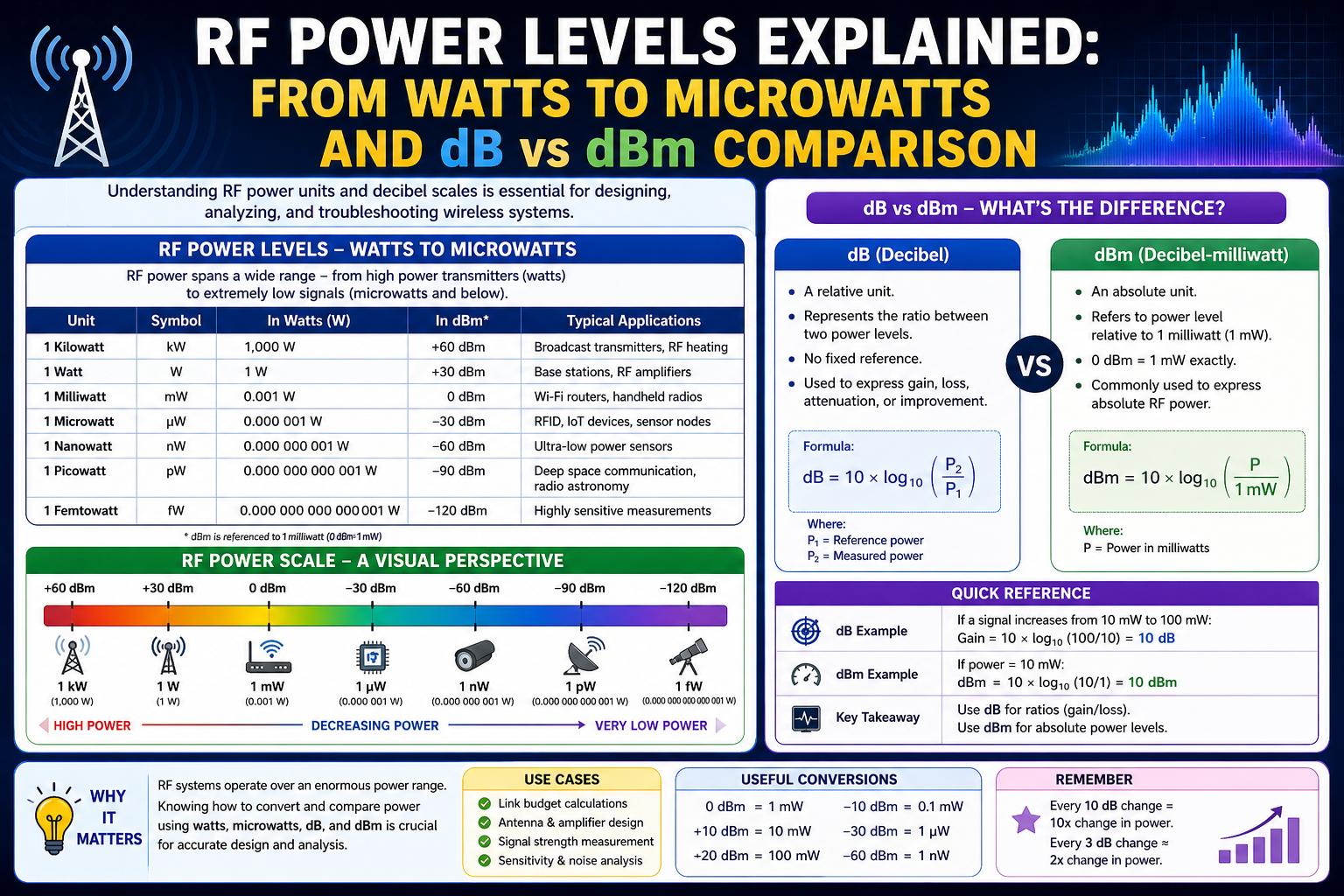
Most practical RF communication systems do not operate at full watt-level power. Instead, they typically use milliwatts, which represent one thousandth of a watt. The milliwatt is written as mW and is the most commonly encountered unit in wireless networking, mobile communication, and IoT systems.
The reason milliwatts are so widely used is that most wireless devices do not require large amounts of power to transmit data effectively over short to moderate distances. In environments such as homes, offices, and industrial spaces, communication usually occurs within relatively small ranges, making high-power transmission unnecessary and even undesirable.
Wireless access points, for example, often operate within a range of a few milliwatts up to fractions of a watt, depending on configuration and regulatory limits. Increasing power beyond what is necessary does not always improve performance and can actually degrade network quality by causing interference between nearby devices.
In IoT systems, the importance of milliwatt-level operation becomes even more significant. Many IoT devices are battery-powered and designed to operate for long periods without maintenance. In such systems, energy efficiency is critical. Reducing transmission power to the lowest usable level directly extends battery life, allowing devices to function for months or even years without replacement or charging.
Another important characteristic of milliwatt-level transmission is its relationship with distance and reliability. While higher power can extend range, it also increases energy consumption and potential interference. Engineers must balance these factors carefully to ensure that communication remains stable without wasting energy or disrupting nearby systems.
Milliwatt measurements also help standardize communication systems. Because most wireless devices operate within similar power ranges, it becomes easier to design networks that are compatible and predictable. This consistency allows devices from different manufacturers to communicate effectively within shared environments.
In practical terms, milliwatts are the most “visible” unit of RF power in everyday wireless systems. Whether connecting to Wi-Fi, using Bluetooth devices, or operating sensor networks, most of the underlying transmission activity occurs within this range. Even though users do not directly interact with these values, they are fundamental to how wireless communication functions.
Microwatt Levels and Ultra-Low Power RF Communication
Below the milliwatt range lies the microwatt level, which represents one millionth of a watt. Microwatt-level power is extremely small and is typically used in specialized applications where energy efficiency is more important than transmission range or speed.
Microwatt operation is most commonly found in ultra-low-power communication systems, particularly in advanced IoT devices and energy-harvesting technologies. These systems are designed to operate with minimal energy input, sometimes relying on environmental sources such as light, vibration, or ambient radio energy to sustain their operation.
At the microwatt level, RF communication becomes highly constrained. Signals are extremely weak, and successful transmission depends heavily on very sensitive receivers and carefully controlled environments. Even small amounts of interference or distance can significantly impact performance.
Despite these limitations, microwatt-level systems are valuable because they enable entirely new categories of devices. Sensors can be deployed in remote or inaccessible locations without requiring batteries to be replaced frequently. This opens possibilities for large-scale environmental monitoring, infrastructure tracking, and distributed sensing systems.
Microwatt RF systems also require highly optimized communication protocols. Because energy is so limited, transmissions must be short, efficient, and carefully timed. Devices often remain in low-power sleep states and only activate briefly to transmit or receive data.
The challenge with microwatt communication is not just generating a signal, but ensuring that the signal remains usable after it has traveled through the environment. Since the transmitted power is extremely low, the receiver must be capable of detecting very weak signals while filtering out background noise.
This level of sensitivity requires careful system design, including optimized antennas, low-noise receiver components, and controlled communication environments. Without these optimizations, microwatt signals would be indistinguishable from background electrical activity.
Why RF Systems Use Very Small Power Units in Practice
One of the most important reasons RF systems rely on milliwatts and microwatts instead of watts is practicality. Wireless communication often deals with extremely small energy levels once signals begin propagating through space. Using whole watts would result in numbers that are difficult to interpret and manage.
As RF signals travel, they lose strength rapidly due to spreading and environmental absorption. This means that even a relatively strong transmission can become extremely weak over distance. Expressing these small values in watts would involve long decimal representations with many zeros, making analysis inefficient and error-prone.
Smaller units like milliwatts and microwatts simplify this representation. They allow engineers to work with manageable numbers that still accurately reflect real-world signal behavior. This makes calculations, comparisons, and system design much more practical.
Another reason for using small units is that RF systems often operate within tightly regulated power limits. These limits are defined to prevent interference between devices and to ensure fair use of the radio spectrum. Because of these restrictions, most systems naturally fall within the milliwatt range.
Additionally, using smaller units helps highlight differences in performance that would otherwise appear insignificant in watt-scale measurements. Small variations in power can have meaningful impacts on signal coverage, reliability, and energy consumption. Representing these values in milliwatts or microwatts makes these differences easier to observe and analyze.
RF communication also benefits from a perspective shift where relative changes matter more than absolute values. In many cases, what matters is not the exact power level, but how it changes as the signal moves through space or interacts with obstacles. This perspective becomes clearer when working with smaller, more precise units.
The Relationship Between Transmit Power and Real-World Signal Experience
In practical RF systems, transmit power is only one part of the overall communication process. A device may transmit at a specific milliwatt level, but what ultimately matters is how much of that power reaches the receiver and whether it is sufficient for decoding information.
As signals travel, they encounter obstacles such as walls, furniture, and environmental structures. These obstacles absorb or reflect energy, reducing the amount that reaches the intended destination. Even open space introduces loss due to the natural spreading of the signal.
This means that the received signal is always a fraction of the transmitted signal. The difference between these values is what determines whether communication is successful. A system may transmit at a high power level but still fail if the environment introduces enough loss.
At the same time, increasing transmit power is not always an effective solution. Higher power can increase interference with other devices and may not significantly improve reception if the main issue is environmental obstruction rather than signal strength.
Instead, RF systems rely on careful balancing of power, sensitivity, and environmental adaptation. Devices are designed to operate efficiently within expected conditions, and communication protocols are optimized to handle variations in signal quality.
Understanding this relationship between transmitted and received power is essential for interpreting real-world RF behavior. It explains why devices may still struggle with connectivity even when they are transmitting at seemingly adequate power levels.
The interaction between watt, milliwatt, and microwatt levels provides a structured way to understand how RF energy behaves across different scales. From transmission to reception, each level represents a different stage in the journey of a wireless signal through space and environment.
Why RF Systems Rely on Logarithmic Measurement Instead of Linear Values
In radio frequency systems, raw power values alone are not sufficient to describe how signals behave in real environments. This is because RF signals can vary across an extremely wide range of magnitudes, from relatively strong transmissions near a device to extremely weak signals after traveling long distances or passing through obstacles. If these values were expressed only in linear units such as watts, milliwatts, or microwatts, the resulting numbers would often become unwieldy and difficult to interpret.
To solve this challenge, RF engineering uses a logarithmic approach to measurement. Instead of representing changes in power as simple additions or subtractions, logarithmic scales represent changes in terms of ratios. This allows both very large and very small values to be expressed in a compact and meaningful way.
The key advantage of logarithmic representation is that it compresses scale without losing relative meaning. In RF systems, what matters most is not the absolute difference between two power levels, but how one compares to another. A signal that is twice as strong is just as significant whether it increases from 1 mW to 2 mW or from 100 mW to 200 mW. Logarithmic measurement captures this proportional relationship more naturally than linear measurement.
This approach also aligns closely with how real-world RF propagation behaves. As signals travel, they do not decrease in a simple linear fashion. Instead, they decay according to exponential and geometric principles, meaning that equal physical distances do not correspond to equal power losses. Logarithmic scaling helps normalize these effects into a more manageable framework.
Because of this, RF engineers rely heavily on decibels as the primary unit of comparison, especially when analyzing gain, loss, and signal quality across systems.
Understanding dB as a Relative Measurement of Change
The decibel, abbreviated as dB, is a unit used to express ratios between two power levels. Unlike watts or milliwatts, it is not an absolute measurement. Instead, it describes how one value compares to another.
At its core, the decibel is based on a logarithmic function. This means that changes in power are expressed in terms of multiplication rather than addition. A small change in dB can represent a large change in actual power, depending on the direction and magnitude of the shift.
One of the most important aspects of dB is that it is dimensionless. It does not represent power directly but rather the relationship between two power values. This makes it extremely flexible for describing gains and losses in RF systems.
For example, when a signal passes through a cable or antenna, it may experience attenuation, meaning a power reduction. This reduction is expressed in negative dB values. Conversely, when a signal is amplified, the increase is expressed as positive dB values.
Because RF systems involve multiple stages of amplification and loss, using a relative measurement like dB allows engineers to track signal changes across complex systems without repeatedly converting between absolute units.
Another important property of decibels is that they can be added and subtracted instead of multiplied and divided. This significantly simplifies calculations in multi-stage systems. For instance, if a signal passes through several components, each introducing gain or loss, the total effect can be determined by summing the individual dB values.
This mathematical simplicity is one of the primary reasons dB is universally used in RF system design and analysis.
The Special Role of dBm as an Absolute RF Power Reference
While dB represents relative change, RF systems also require a way to express absolute power levels. This is where dBm becomes important. dBm is a variation of decibels that uses one milliwatt as a fixed reference point.
In dBm, the reference value is always 1 milliwatt. This means that 0 dBm corresponds exactly to 1 mW of power. From this reference point, all other values are expressed as logarithmic differences relative to 1 mW.
This creates a unified scale that allows both very small and moderately large RF power levels to be expressed in a compact form. For example, values that would otherwise require many decimal places in watts can be represented as simple positive or negative dBm values.
In most wireless communication systems, received signals are extremely small and therefore expressed as negative dBm values. This does not mean the signal is negative in a physical sense, but rather that it is weaker than the 1 mW reference point.
The use of dBm is particularly useful in RF because it allows both transmission power and received signal strength to be expressed on the same scale. This makes it easier to compare system performance across different stages of communication.
Another important feature of dBm is that it aligns closely with human interpretation of signal quality. Small changes in dBm can represent meaningful changes in communication reliability, especially near the lower limits of receiver sensitivity.
Because of this, dBm is widely used in system diagnostics, network analysis, and wireless optimization.
The Rule of 3 dB and 10 dB in RF Power Interpretation
One of the most important practical concepts in RF measurement is the relationship between decibel changes and actual power changes. Because decibels are logarithmic, specific values correspond to predictable power ratios.
A change of 3 dB represents approximately a doubling or halving of power. This means that if a signal increases by 3 dB, its actual power has roughly doubled. Similarly, a decrease of 3 dB means the power has been reduced by about half.
This relationship is extremely useful in RF engineering because it allows quick mental estimation of power changes without requiring detailed calculations.
A change of 10 dB represents a tenfold increase or decrease in power. This is another key reference point in RF systems and is often used to describe significant changes in signal strength.
These two reference points form the basis of many practical RF calculations. Instead of working with complex exponential equations, engineers can use these simple rules to quickly estimate how signals will behave under different conditions.
For example, if a signal increases by 20 dB, this corresponds to a hundredfold increase in power. This is derived from two consecutive 10 dB increases. Similarly, a 20 dB decrease represents a hundredfold reduction in power.
These rules make it easier to understand how small changes in system configuration can lead to large changes in signal performance.
Signal Propagation and the Continuous Loss of RF Energy
As RF signals travel through space, they naturally lose energy due to spreading. This phenomenon is known as propagation loss and is one of the most important factors affecting wireless communication.
Unlike wired systems, where signals are confined to a physical medium, wireless signals spread outward in all directions. As this happens, the same amount of energy is distributed over an increasingly large area. This results in a reduction in signal strength at any given point.
This type of loss increases with distance and is not linear. Instead, it follows a predictable decay pattern that depends on frequency, environment, and transmission conditions.
Higher frequency signals generally experience greater loss over distance compared to lower frequency signals. This is because they interact more strongly with obstacles and are more easily absorbed by materials in the environment.
Propagation loss also increases in environments with many physical barriers. Walls, furniture, and other objects absorb or reflect RF energy, reducing the amount that reaches the receiver.
This continuous reduction in signal strength is one of the main reasons why received signals are often extremely weak compared to transmitted signals. By the time a signal reaches its destination, it may be many orders of magnitude weaker than it was at the source.
Despite this reduction, communication is still possible because receivers are designed to detect and interpret very low-power signals.
Noise Floor and the Invisible Background of RF Environments
In any RF environment, there is always a baseline level of background energy present. This background is known as the noise floor and represents the combined effect of many small and unrelated RF sources.
The noise floor is not a single signal but rather a cumulative effect of many different types of electromagnetic activity. This includes natural sources, electronic devices, and other communication systems operating in the same environment.
Because the noise floor is always present, it sets a practical limit on how weak a signal can be while remaining usable. If a signal becomes too weak relative to the noise floor, it becomes indistinguishable from background energy.
The noise floor is typically expressed in dBm and varies depending on environmental conditions. In quiet environments, it may be relatively low, while in dense urban or industrial environments, it may be significantly higher.
One of the key challenges in RF system design is ensuring that signals remain above the noise floor at the receiver. This requires careful balancing of transmission power, distance, and environmental factors.
Even if a signal is technically present, it cannot be decoded if it is buried within the noise floor. This is why signal strength alone is not sufficient to guarantee communication quality.
Interference and the Competition Between Multiple RF Signals
In addition to noise, RF systems must also deal with interference. Interference occurs when multiple intentional signals overlap in the same frequency range and compete for the receiver’s attention.
Unlike noise, which is generally random, interference comes from structured signals that may or may not be intended for the same receiver. This makes it particularly challenging to manage because interfering signals often have similar characteristics to the desired signal.
Interference can significantly degrade communication quality even when signal strength is relatively high. This is because the receiver must distinguish between multiple valid signals operating in the same space.
In many environments, interference is one of the primary causes of reduced performance. It can lead to packet loss, reduced data rates, and increased transmission errors.
Managing interference requires careful frequency planning, power control, and system coordination. Devices must be designed to minimize overlap and avoid unnecessary competition for shared spectrum.
Unlike noise, which is largely unavoidable, interference can often be controlled or reduced through system design and regulatory measures.
SNR as a Measure of Signal Usability in Real Environments
Signal-to-Noise Ratio, commonly known as SNR, is one of the most important metrics in RF systems. It represents the difference between the desired signal and the background noise floor.
SNR is expressed in decibels and provides a direct measure of how easily a receiver can distinguish a signal from noise. A higher SNR indicates a clearer and more reliable signal.
Because SNR is a ratio, it does not depend on absolute power levels. Instead, it focuses on the relationship between signal and noise. This makes it a more meaningful indicator of communication quality than raw signal strength alone.
A signal with high power but also high noise may have a lower SNR than a weaker signal in a quieter environment. This is why SNR is often a better predictor of performance than transmission power.
SNR is widely used in wireless systems to determine data rates, modulation schemes, and overall link quality. Devices often adjust their behavior based on SNR to optimize performance.
In practical terms, SNR represents how “clean” a signal is. The higher the value, the easier it is for a receiver to accurately decode information.
SINR and the Added Complexity of Interference in RF Systems
Signal-to-Interference plus Noise Ratio, or SINR, extends the concept of SNR by including interference as part of the measurement. Instead of only considering background noise, SINR also accounts for competing signals.
This makes SINR a more comprehensive measure of real-world communication conditions. In many environments, interference plays a significant role in degrading performance, sometimes even more than noise.
SINR is more difficult to measure accurately because it requires distinguishing between noise and interfering signals. In many cases, specialized equipment is needed to separate these components.
Despite this complexity, SINR provides a more realistic representation of actual communication quality in crowded RF environments.
Systems with high SINR values are generally more stable and capable of supporting higher data rates and more reliable communication.
The relationship between SNR, SINR, dB, and dBm forms the foundation of modern RF system analysis, providing a structured way to understand how signals behave in complex and dynamic environments.
Understanding Why RF Environments Are Never Truly “Silent”
In radio frequency systems, a perfectly silent environment does not exist. Even in the absence of intentional transmissions, electromagnetic energy is constantly present. This background activity forms what is known as the RF noise environment, and it plays a critical role in determining whether communication is successful or not.
Noise in RF systems is not a single identifiable source. Instead, it is the combined effect of many different energy contributors operating at the same time. These include natural phenomena, electrical devices, industrial machinery, and other communication systems. Each contributes a small amount of energy that, when combined, creates a continuous baseline level of electromagnetic activity.
This baseline is always present, even in controlled environments. It cannot be eliminated, only managed. Because of this, every RF system must be designed with the assumption that noise will always exist.
The presence of noise means that receivers are never working in isolation. Instead, they are constantly distinguishing between meaningful signals and irrelevant background energy. This process of separation is fundamental to how wireless communication works.
Even in very quiet environments, there is still a measurable noise level. This is why RF engineers treat noise as a constant reference point rather than an exception. It defines the lower boundary of what can be reliably detected.
The Concept of Noise Floor and Its Impact on Communication
The noise floor represents the average level of background RF energy in a given environment. It is not a fixed value but varies depending on location, frequency, and surrounding conditions.
In practical terms, the noise floor determines the weakest signal that can still be detected and interpreted by a receiver. Any signal that falls below this level becomes indistinguishable from background energy and is effectively lost.
Different environments produce different noise floors. For example, rural areas tend to have lower noise levels due to fewer electronic devices and transmissions. Urban environments, on the other hand, have much higher noise floors due to dense networks of wireless systems, industrial equipment, and consumer electronics.
The noise floor is typically expressed in decibels relative to one milliwatt, allowing it to be directly compared with signal strength measurements. This makes it easier to evaluate whether a signal will be usable in a given environment.
One of the key challenges in RF design is ensuring that the desired signal remains sufficiently above the noise floor at the receiver. If the difference between signal and noise becomes too small, communication reliability decreases significantly.
This is why system performance cannot be evaluated based on transmit power alone. Even a strong transmission can fail if the noise floor in the environment is high enough to mask it.
How RF Receivers Interpret Weak Signals in Noisy Environments
RF receivers are designed to extract meaningful information from weak and noisy signals. They do this by filtering and amplifying incoming energy and attempting to isolate the intended transmission.
However, there is a limit to how much noise a receiver can handle. When the noise level becomes too close to the signal level, the receiver can no longer reliably distinguish between the two.
This limitation is not a flaw but a physical constraint. All receivers must operate within the boundaries defined by noise and signal separation. Beyond a certain point, no amount of processing can recover information that has been lost in noise.
Receivers use several techniques to improve signal interpretation. These include filtering out unwanted frequency ranges, amplifying weak signals, and using error correction methods to reconstruct missing data.
Despite these techniques, the quality of communication ultimately depends on the relationship between signal strength and noise level. This relationship is what determines whether data can be decoded accurately.
In many cases, users experience poor connectivity not because the signal is absent, but because it is too weak relative to the noise floor.
The Role of Interference in Real-World RF Performance
While noise is a constant background condition, interference is a more dynamic and often more disruptive factor in RF environments. Interference occurs when multiple intentional transmissions overlap in the same frequency range.
Unlike noise, which is generally random and uncoordinated, interference comes from structured signals that may be competing for the same receiver resources. This makes it particularly problematic in dense wireless environments.
Interference can originate from many sources, including nearby wireless networks, Bluetooth devices, industrial systems, and even improperly configured transmitters. Each of these sources can introduce competing signals that reduce overall communication quality.
The effect of interference is often more severe than noise because it can closely resemble the desired signal. This makes it difficult for receivers to distinguish between useful and unwanted transmissions.
In some cases, interference can completely block communication even when the signal strength is relatively high. This occurs when multiple signals overlap in such a way that the receiver cannot separate them effectively.
Managing interference requires careful frequency planning and coordination between systems. Devices must be configured to minimize overlap and avoid unnecessary competition for shared spectrum.
In modern environments, interference is one of the primary limiting factors in wireless performance.
Why Signal Strength Alone Does Not Determine Network Quality
A common misconception in wireless communication is that stronger signals always result in better performance. While signal strength is important, it is not the only factor that determines communication quality.
Signal strength must always be considered in relation to noise and interference. A strong signal in a noisy environment may perform worse than a weaker signal in a cleaner environment.
This is because receivers are not only detecting signals but also filtering them against background energy. If the background is too strong, even high-power transmissions can become unreliable.
Additionally, increasing signal strength does not always solve performance issues. In some cases, it can actually worsen the situation by increasing interference for nearby devices.
Wireless systems must therefore balance power levels carefully to ensure that signals are strong enough to be usable but not so strong that they create unnecessary disruption.
This balance is one of the key challenges in RF system design and network optimization.
Signal Quality as a Combination of Multiple RF Factors
Signal quality in RF systems is not determined by a single measurement. Instead, it is the result of multiple interacting factors, including signal strength, noise level, interference, and receiver sensitivity.
These factors combine to determine whether a signal can be successfully decoded. A system with high signal strength but also high interference may perform worse than a system with moderate signal strength and low interference.
This complexity is why RF engineers rely on ratio-based measurements such as SNR and SINR rather than absolute power values.
These ratios provide a more complete picture of communication conditions by showing how much usable signal exists relative to unwanted energy.
In practical systems, signal quality determines not only whether communication is possible but also how efficient it is. Higher quality signals allow for faster data rates, lower error rates, and more stable connections.
Lower quality signals may still function but often require additional error correction, retransmissions, or reduced data rates.
How Environmental Conditions Shape RF Performance
RF signals are highly sensitive to environmental conditions. Physical objects, atmospheric conditions, and even human activity can influence how signals propagate.
Obstacles such as walls and buildings absorb or reflect RF energy, reducing signal strength and introducing variability in communication paths. This can create areas where signals are strong in one location and weak just a short distance away.
Environmental reflections can also cause multipath effects, where signals arrive at the receiver through multiple paths. These overlapping signals can interfere with each other, sometimes reinforcing and sometimes canceling out.
Temperature, humidity, and atmospheric conditions can also affect signal propagation, particularly at higher frequencies. These factors influence how RF energy travels through the air and how much is absorbed along the way.
Because of these variables, RF performance is rarely consistent across different environments. Systems must be designed to adapt to changing conditions and maintain communication reliability under a wide range of scenarios.
Practical Interpretation of RF Measurements in Real Systems
In real-world RF systems, measurements such as dBm, SNR, and SINR are used together to evaluate performance. Each measurement provides a different perspective on the same underlying communication process.
dBm provides an absolute reference for signal strength, showing how much power is being received. SNR compares this signal to background noise, indicating how clean the signal is. SINR extends this by including interference, giving a more complete view of environmental conditions.
Together, these measurements allow engineers to diagnose problems, optimize system performance, and predict communication reliability.
In practice, small changes in these values can have significant effects on system behavior. A slight reduction in SNR or SINR can result in noticeable drops in performance, even if signal strength remains relatively stable.
This sensitivity highlights the importance of understanding RF systems as dynamic environments rather than static systems.
The Relationship Between RF Physics and User Experience
Although RF systems are highly technical, their behavior directly impacts everyday user experience. Connectivity issues, slow data rates, and dropped connections are all manifestations of underlying RF conditions.
Users often interpret these issues as simple “signal problems,” but in reality, they are the result of complex interactions between signal strength, noise, interference, and environmental factors.
Understanding these underlying principles helps explain why wireless performance can vary so widely, even within short distances or similar conditions.
It also explains why improving RF performance often requires more than simply increasing power. Instead, it requires a holistic approach that considers the entire communication environment.
RF communication is therefore not just about transmitting signals, but about managing a constantly changing balance between energy, noise, and interference in a shared physical space.
Conclusion
Radio frequency communication is often misunderstood as a simple matter of whether a signal is present or absent, but in reality, it is a continuous and highly dynamic interaction between transmitted energy, environmental conditions, and receiver sensitivity. What appears to be a “no signal” situation is almost always a case of signal degradation, masking, or interpretation failure rather than complete signal loss. Understanding this distinction is essential for making sense of how wireless systems actually behave in real-world environments.
At the core of RF systems is electrical power, expressed in watts, milliwatts, and microwatts. These units describe how much energy is being transmitted, but they do not fully explain how that energy behaves once it leaves the transmitter. As signals travel through space, they weaken due to propagation loss, environmental absorption, and physical obstacles. This natural decay makes small power units essential for practical communication systems, especially in Wi-Fi, mobile networks, and IoT applications.
Because RF signals operate across extremely wide ranges of power, logarithmic measurements such as decibels (dB) and dBm become necessary. These scales allow engineers to express both large and extremely small values in a manageable way while focusing on ratios rather than absolute values. The introduction of reference points such as 1 mW in dBm makes it possible to standardize power measurements across different systems and technologies.
However, signal strength alone is never sufficient to guarantee communication quality. The real performance of any RF system depends on how the signal compares to its environment. Noise floors represent the constant background energy present in all environments, while interference introduces competing signals that further reduce clarity. Together, these factors determine whether a receiver can successfully extract meaningful information from the incoming RF energy.
This is why metrics such as SNR and SINR are critical. They shift the focus from raw signal power to signal usability, showing how clearly a signal stands out from noise and interference. A strong signal in a poor environment can perform worse than a weaker signal in a clean environment, highlighting the importance of ratios over absolute values.
Ultimately, RF communication is about balance. It requires careful coordination between transmit power, environmental conditions, and receiver capability. Every wireless experience, from simple IoT sensors to complex communication networks, is shaped by this delicate interaction of physics and engineering principles operating continuously in the background.
Building on this, it becomes clear that RF systems are fundamentally about managing uncertainty rather than eliminating it. Every wireless link operates under constantly changing conditions, where distance, obstacles, and competing signals continuously reshape performance. Engineers, therefore, focus on designing systems that remain reliable even when conditions are not ideal, rather than expecting perfect signal environments. This is achieved through careful tuning of power levels, sensitivity thresholds, and adaptive communication techniques. As a result, modern wireless networks are resilient not because signals are always strong, but because they are designed to function effectively even when signals are weak, noisy, or partially degraded.