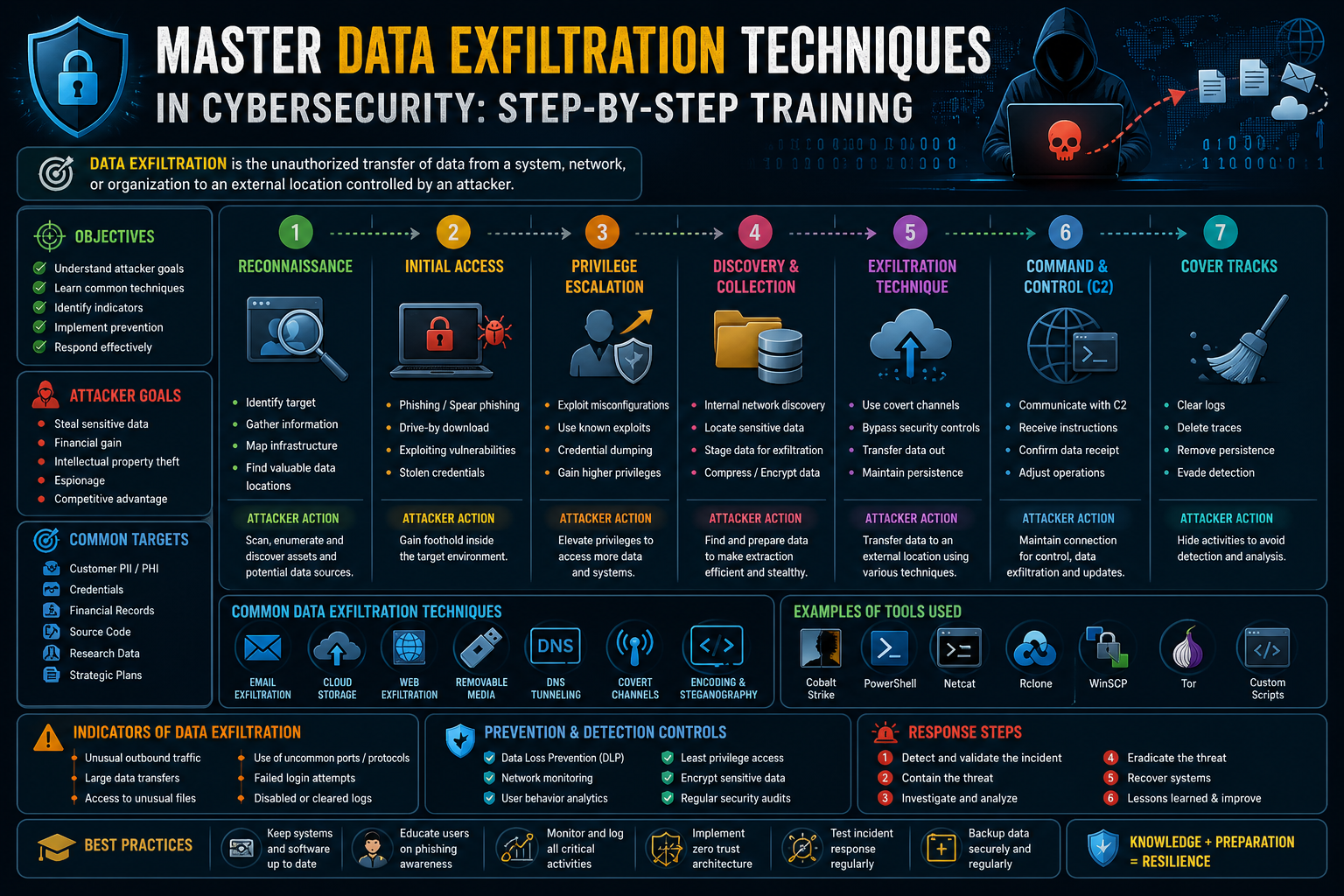
Data exfiltration refers to the unauthorized transfer of information from a private system to an external destination controlled by an attacker. In modern cybersecurity environments, this stage often represents the final objective of a successful intrusion. Once attackers gain access to a network, their focus shifts from exploration and persistence to quietly extracting valuable data without triggering alerts or disruptions.
Unlike earlier forms of cyber theft that relied on obvious mass downloads or direct file copying, modern exfiltration is far more subtle. Attackers understand that businesses deploy monitoring tools, firewalls, and anomaly detection systems designed to flag unusual activity. As a result, they adapt by blending malicious traffic into normal network behavior. The goal is not just to steal data, but to ensure the theft remains invisible for as long as possible.
The nature of stolen data varies depending on the attacker’s intent. It may include customer records, financial documents, intellectual property, authentication credentials, or internal communications. In some cases, attackers are not immediately interested in using the data themselves. Instead, they may store it, sell it, or use it later for targeted attacks such as identity fraud or corporate espionage.
What makes exfiltration particularly dangerous is its ability to occur over extended periods. Instead of transferring large datasets in a single burst, attackers often break information into smaller pieces. These fragments are then disguised as legitimate network traffic, making them extremely difficult to identify. This slow and methodical approach allows malicious activity to persist even in well-secured environments.
Modern networks are also highly interconnected with cloud services, remote applications, and distributed systems. This complexity creates additional pathways that attackers can exploit. The more connections a system has, the more opportunities exist for data to leave the network unnoticed. Attackers take advantage of this by choosing channels that naturally blend into everyday operations.
Another important aspect of exfiltration is the use of trusted protocols. Instead of creating suspicious new communication channels, attackers prefer to use existing ones such as DNS, HTTP, or HTTPS. These protocols are essential for normal internet functionality, which makes blocking or heavily restricting them impractical for most organizations. This reliance on legitimate infrastructure is what gives attackers their stealth advantage.
Understanding how exfiltration works requires shifting perspective from traditional security thinking. It is no longer enough to focus only on preventing unauthorized access. Organizations must also consider what happens after a breach occurs and how data might silently leave the system without detection. This broader view is essential in building resilient defenses against modern cyber threats.
How Attackers Prepare for Stealthy Data Theft
Before initiating data exfiltration, attackers typically spend significant time preparing the environment. This preparation phase often begins immediately after gaining initial access to a system. Rather than acting quickly, attackers carefully study the network to understand its structure, behavior patterns, and security mechanisms.
One of the first objectives is identifying valuable data. Attackers map file systems, databases, and user directories to locate information that holds the highest value. They may also monitor user activity to determine which systems contain sensitive or frequently accessed information. This reconnaissance helps them prioritize what to steal and reduces unnecessary noise during the extraction process.
Another key step is establishing persistence. Attackers ensure they can maintain access even if the system is rebooted or credentials are changed. This may involve creating hidden accounts, modifying scheduled tasks, or embedding malicious code in legitimate processes. Persistence guarantees that exfiltration can continue over time without requiring repeated intrusion attempts.
Once access is stable, attackers begin studying network behavior. They observe traffic patterns during peak and off-peak hours, identify commonly used protocols, and note which external services are frequently contacted. This information is crucial because it allows them to disguise malicious activity as normal traffic. For example, if a network regularly communicates with external web servers, HTTP-based exfiltration becomes a natural choice.
Attackers also test security boundaries. They may send small amounts of data externally to observe whether alerts are triggered. These controlled tests help them refine their techniques before conducting larger transfers. If detection systems respond too quickly, attackers adjust their methods by slowing down transfers or altering communication patterns.
Encryption is another important preparation step. Even if network traffic is intercepted, encrypted data remains unreadable without the proper keys. Attackers often encrypt stolen information before transmission, adding another layer of protection. In some cases, they may also compress data to reduce its size, making it easier to transfer in small fragments.
Timing plays a significant role in preparation as well. Attackers often choose periods of low network activity, such as late-night hours or weekends, when security teams are less likely to monitor systems closely. This reduces the chance of detection and allows exfiltration to proceed with minimal interference.
By the time actual data theft begins, the attacker has already engineered a highly controlled environment. Every step is designed to minimize visibility and maximize efficiency. This careful planning is what distinguishes advanced cyber threats from simple opportunistic attacks.
DNS Tunneling as a Covert Communication Channel
One of the most subtle methods used for data exfiltration involves DNS tunneling. The Domain Name System is a fundamental part of the internet infrastructure, responsible for translating human-readable domain names into IP addresses. Because DNS queries are essential for nearly all online activity, they are rarely blocked or heavily restricted within corporate networks.
Attackers exploit this necessity by embedding data within DNS queries and responses. Instead of using DNS solely for name resolution, they turn it into a hidden communication channel. This technique allows them to send information out of a network without raising immediate suspicion.
In a typical DNS tunneling scenario, data is encoded into subdomain strings. These strings are then sent as part of DNS requests to a server controlled by the attacker. Each request carries a small fragment of the overall data set. On the receiving end, the attacker’s system decodes these fragments and reconstructs the original information.
Because DNS traffic is often overlooked in security monitoring, this method can remain undetected for long periods. Most organizations allow DNS queries to pass freely through firewalls, assuming they are harmless. Attackers take advantage of this trust to create a reliable outbound communication channel.
The structure of DNS also supports this technique. DNS queries are lightweight and frequent, which makes them ideal for transmitting small pieces of data. By spreading information across many queries, attackers avoid creating noticeable spikes in traffic volume.
DNS tunneling can also be enhanced through encryption. Even if security systems inspect DNS payloads, encrypted data appears as random characters, making it difficult to interpret. This further increases the stealthiness of the technique.
However, DNS tunneling is not without limitations. Because each query carries only a small amount of data, exfiltration can be slow. Transferring large datasets may take significant time, which increases the duration of exposure. Despite this, attackers often accept the trade-off in exchange for reduced detection risk.
Organizations that rely heavily on DNS monitoring may eventually detect unusual patterns, such as excessively long domain names or high-frequency queries to unknown servers. These anomalies can indicate potential tunneling activity, but distinguishing them from legitimate behavior remains challenging.
Encoding and Fragmenting Data for Hidden Transfer
To successfully exfiltrate data without detection, attackers rarely transmit complete files in a single stream. Instead, they rely on encoding and fragmentation techniques that break information into smaller, less recognizable components. These components are then distributed across multiple network requests, making them difficult to trace as part of a larger pattern.
Encoding plays a central role in this process. Before transmission, data is often converted into formats that can be embedded within legitimate-looking traffic. This may involve base-level encoding schemes or custom transformations designed to obscure the original content. Once encoded, the data no longer resembles its original structure, reducing the likelihood of detection by automated systems.
Fragmentation further enhances stealth. Large files are divided into smaller segments, each of which is transmitted separately. These segments may be sent through different sessions, protocols, or time intervals. By dispersing the data, attackers ensure that no single transmission appears large or suspicious enough to trigger alerts.
Reassembly occurs on the attacker’s side. Each fragment is collected and reconstructed in the correct order to restore the original information. This process is carefully synchronized to ensure data integrity despite the fragmented nature of transmission.
Attackers also vary the timing of these fragments. Instead of sending data in a continuous stream, they introduce delays between transmissions. This creates the illusion of normal user behavior, such as browsing or routine system communication. Irregular timing patterns help mask the true intent of the traffic.
In some cases, attackers combine fragmentation with multiple communication channels. For example, one portion of data may be sent through DNS queries, while another is transmitted via web requests. This multi-channel approach makes detection even more difficult, as security systems typically monitor protocols independently rather than collectively.
The effectiveness of encoding and fragmentation lies in its simplicity. By reducing data visibility and distributing transmission across normal-looking traffic, attackers significantly lower the risk of triggering defensive mechanisms. This approach is especially effective in environments with high volumes of legitimate network activity.
Why DNS Traffic Becomes a Preferred Exfiltration Path
DNS traffic is one of the most trusted and consistently permitted forms of network communication. Every device connected to the internet relies on DNS to resolve domain names, making it an essential service rather than an optional one. This universal dependency creates an ideal environment for covert data movement.
One of the main reasons attackers prefer DNS-based exfiltration is its predictable allowance through firewalls. Blocking DNS entirely would disrupt internet connectivity, making it an impractical security measure for most organizations. As a result, DNS traffic is often given broad access privileges.
Another advantage lies in its frequency. DNS queries are generated constantly by applications, operating systems, and background services. This high volume of legitimate traffic provides excellent camouflage for malicious activity. Small anomalies are easily lost within the noise of normal operations.
DNS also offers structural flexibility. The domain query format allows for the inclusion of encoded data within subdomains, which can be manipulated without affecting the basic function of the request. This makes it possible to hide meaningful information inside seemingly harmless queries.
Additionally, DNS responses can be used as a return channel. Attackers can send instructions or acknowledgments back to compromised systems using the same mechanism. This bidirectional capability transforms DNS into a full communication channel rather than a one-way data path.
Security teams often focus more heavily on higher-level protocols such as HTTP or application-layer traffic, which can cause DNS monitoring to receive less attention. Attackers exploit this imbalance by selecting DNS as a low-priority inspection vector.
Even when DNS traffic is monitored, distinguishing malicious queries from legitimate ones remains difficult. Many modern applications generate complex or dynamic domain requests, which can resemble tunneling behavior. This overlap creates a gray area that attackers exploit to remain undetected.
Challenges in Detecting DNS-Based Data Leakage
Detecting DNS-based exfiltration is a complex task due to the inherently legitimate nature of DNS traffic. Since nearly every system relies on DNS, security tools must allow it to function freely while still attempting to identify abnormal behavior. This balance between usability and security creates a significant challenge.
One of the primary difficulties is distinguishing normal DNS patterns from malicious ones. Many legitimate applications generate high volumes of DNS requests, especially cloud-based services and distributed systems. These patterns can closely resemble tunneling activity, making it hard to define clear boundaries.
Another challenge lies in encryption and obfuscation. When data is encoded or encrypted within DNS queries, it becomes indistinguishable from random noise. Without context, security systems may struggle to determine whether a query is legitimate or part of a covert channel.
The distributed nature of DNS infrastructure also complicates detection. Queries pass through multiple resolvers and caching systems, which can obscure the original source of the request. This makes tracing the full path of suspicious activity more difficult.
Attackers further complicate detection by using adaptive techniques. They may change domain names frequently, alter query timing, or mimic legitimate traffic patterns. This dynamic behavior reduces the effectiveness of static detection rules.
Another limitation is the sheer volume of DNS data generated within enterprise networks. Monitoring and analyzing every query in real time requires significant computational resources. As a result, many systems rely on sampling or heuristic-based analysis, which may miss subtle indicators of exfiltration.
Despite these challenges, certain behavioral indicators can still provide clues. Unusually long domain names, repetitive query patterns, or communication with unknown external servers may suggest suspicious activity. However, these signals must be interpreted carefully to avoid false positives.
DNS-based data leakage remains one of the most persistent challenges in cybersecurity due to its reliance on essential infrastructure and its ability to blend seamlessly with normal network operations.
HTTP-Based Exfiltration and Its Use of Everyday Web Traffic
HTTP traffic is one of the most commonly exploited channels for data exfiltration because it blends naturally into everyday internet activity. Nearly every organization depends on web communication for cloud services, internal dashboards, APIs, and third-party applications. This constant reliance makes HTTP a highly trusted protocol, which attackers exploit to move stolen data outside a network without drawing attention.
When attackers use HTTP for exfiltration, they embed stolen information within normal-looking web requests. These requests are sent to external servers under their control, often disguised as routine browsing activity or background application communication. From a network perspective, the traffic appears legitimate because it follows expected web communication patterns.
One of the main advantages of HTTP-based exfiltration is its familiarity within enterprise environments. Security systems are designed to allow web traffic because blocking it would disrupt essential business operations. Attackers take advantage of this necessity by ensuring their malicious traffic resembles standard user behavior.
Instead of transferring large volumes of data at once, attackers typically break information into smaller pieces. These fragments are then transmitted across multiple HTTP requests. Each request may appear harmless on its own, but together they form a complete dataset once reassembled by the attacker. This distributed approach reduces the likelihood of detection by anomaly-based monitoring systems.
Attackers also manipulate headers, cookies, and request parameters to hide data within legitimate communication fields. Because these elements are routinely used in web traffic, embedding stolen information within them makes detection more difficult. The requests often mimic common application behavior, such as form submissions or API calls.
Another important factor is timing. Rather than sending continuous streams of data, attackers introduce delays between requests. This pacing helps the traffic resemble normal user interaction patterns, such as browsing or periodic application syncing. Irregular bursts of traffic are avoided because they are more likely to trigger alerts.
HTTP-based exfiltration is especially effective in environments with heavy web usage. The larger the volume of legitimate traffic, the easier it becomes for malicious activity to hide within it. Security teams must therefore analyze not only the presence of HTTP traffic but also its structure, frequency, and destination behavior to identify anomalies.
The Role of HTTPS in Concealing Stolen Data
HTTPS adds layer of complexity to data exfiltration by encrypting communication between endpoints. While HTTP traffic can sometimes be inspected directly, HTTPS encrypts payloads, making it significantly harder for security tools to analyze the content being transmitted. This encryption is designed to protect privacy and data integrity, but it also provides attackers with a powerful concealment mechanism.
When attackers use HTTPS for exfiltration, the encrypted nature of the connection prevents network monitoring tools from easily identifying the contents of the data being sent. Even if traffic is intercepted, the encryption ensures that the information appears as unreadable ciphertext without proper decryption keys.
This limitation creates a major challenge for defenders. Instead of analyzing content, security systems must rely on metadata such as packet size, timing, and destination patterns. Attackers exploit this limitation by carefully shaping their traffic to resemble normal encrypted sessions, such as secure website browsing or legitimate API communication.
Another advantage of HTTPS is its widespread acceptance across networks. Most organizations fully allow encrypted web traffic because many essential services depend on it. Blocking HTTPS would disrupt cloud platforms, authentication systems, and communication tools, making it impractical in most environments. This trust allows attackers to operate within expected traffic flows.
Attackers often choose common ports associated with HTTPS to further disguise their activity. By using standard communication pathways, they reduce the likelihood of triggering firewall rules or intrusion detection alerts. The traffic blends into the background noise of legitimate encrypted sessions.
Even when deep inspection techniques are available, attackers can still evade detection by using techniques such as certificate spoofing or domain impersonation. These methods make malicious traffic appear to originate from trusted sources, further complicating analysis.
The challenge with HTTPS-based exfiltration lies in its dual nature. It is both essential for secure communication and an ideal concealment layer for attackers. This creates a persistent security dilemma where organizations must balance usability with visibility, often sacrificing deep inspection for performance and privacy reasons.
Outbound File Transfers as a Direct Extraction Method
Outbound file transfers represent a more direct form of data exfiltration, where attackers move entire files or datasets from a compromised system to an external destination. Unlike more subtle methods that rely on fragmentation or encoding, this technique focuses on transferring complete data structures, often in compressed or disguised formats.
Attackers may initiate outbound transfers using legitimate file transfer protocols or application-level features. These could include synchronization services, remote upload functions, or automated backup mechanisms. By leveraging existing functionality, attackers avoid creating suspicious new communication channels.
Compression is frequently used before transfer to reduce file size and mask the content structure. Smaller files are easier to move discreetly, and compression also alters the data pattern, making it less recognizable during inspection. Once the file reaches the attacker’s system, it can be decompressed and reconstructed in its original form.
In many cases, outbound transfers are scheduled or delayed to align with normal system activity. For example, data may be sent during backup windows or routine synchronization periods. This timing reduces the likelihood of detection because network activity is already expected during these intervals.
Attackers also take advantage of trusted external storage services or file hosting platforms. By uploading stolen data to legitimate-looking destinations, they further reduce suspicion. These platforms often use encrypted connections and distributed infrastructure, making it difficult to trace or analyze uploaded content.
Another common technique involves masquerading file transfers as system updates or application patches. Because organizations regularly download and upload update files, attackers can disguise their activity within this expected behavior. The similarity between legitimate and malicious transfers complicates detection efforts.
The main risk with outbound file transfers is volume. Large or sudden transfers can trigger alerts in well-monitored environments. To avoid this, attackers often throttle transfer speeds or divide files into smaller batches. This controlled approach helps maintain a low profile while still achieving data extraction goals.
Despite its simplicity compared to other methods, outbound file transfer remains effective because it leverages normal system functions and trusted communication channels. Its success depends not on complexity but on blending seamlessly into routine operations.
Text-Based Protocols as Stealth Communication Channels
Text-based protocols provide another avenue for data exfiltration by allowing attackers to embed stolen information within structured textual communication. These protocols are often used for system messaging, configuration updates, or lightweight data exchange, making them appear harmless in typical network environments.
Attackers exploit these protocols by encoding data into text fields that are normally used for legitimate communication. Because these fields are designed to carry flexible information, they can easily accommodate hidden or manipulated data without breaking protocol rules.
One of the key advantages of text-based protocols is their simplicity. Unlike binary-heavy communication methods, text protocols are easier to manipulate and interpret. This makes them attractive for attackers who want to minimize complexity while maintaining stealth.
Data exfiltration using text protocols often involves embedding information within messages that resemble routine system logs or status updates. These messages may be transmitted between internal services and external endpoints, making them difficult to distinguish from legitimate traffic.
Another technique involves exploiting command-response structures. Attackers can insert encoded data into command outputs or system responses, which are then transmitted as part of normal protocol exchanges. This method takes advantage of expected communication patterns between systems.
Because text-based protocols are often used for debugging or administrative purposes, they may not receive the same level of scrutiny as high-volume data channels. This creates an opportunity for attackers to hide small but meaningful pieces of information within seemingly routine exchanges.
The effectiveness of this approach depends heavily on blending into expected communication behavior. Any deviation in format, frequency, or content structure may raise suspicion. As a result, attackers carefully mimic legitimate message patterns to avoid detection.
While text-based protocols may not support large-scale data transfer efficiently, they are highly effective for slow and steady exfiltration. Small fragments of sensitive information can be transmitted over long periods without triggering alarms, making this method ideal for stealth-focused operations.
Blending Malicious Traffic with Normal Network Behavior
A defining characteristic of modern data exfiltration techniques is their ability to blend seamlessly into normal network behavior. Attackers no longer rely on obvious or high-volume transfers. Instead, they focus on subtle manipulation of existing communication channels to avoid detection.
This blending process begins with understanding baseline network activity. Attackers observe how systems communicate under normal conditions, including traffic volume, timing, and protocol usage. By replicating these patterns, they ensure that their malicious activity does not stand out.
One common strategy is to mimic user-driven behavior. Instead of automated or repetitive transmissions, attackers simulate actions that resemble human interaction, such as browsing, updating applications, or syncing files. This makes malicious traffic appear natural within the broader context of network activity.
Another important aspect is variability. Uniform patterns are easier to detect, so attackers introduce randomness into their communication methods. This may involve varying packet sizes, changing intervals between transmissions, or rotating destination endpoints. These variations help avoid predictable signatures.
Attackers also take advantage of trusted internal systems. By routing exfiltration through legitimate services or compromised internal tools, they reduce the visibility of external communication. Traffic originating from trusted sources is less likely to be flagged by security systems.
In some cases, attackers combine multiple techniques to further enhance blending. For example, they may use encrypted HTTP traffic combined with fragmented data and delayed transmission. Each layer adds complexity, making detection increasingly difficult.
The ultimate goal of blending is invisibility within normal operations. Rather than appearing as an anomaly, malicious traffic becomes indistinguishable from everyday network activity. This allows attackers to maintain long-term access to stolen data without triggering immediate response actions.
Text-Based Exfiltration Through Application Channels
Text-based communication channels inside modern applications often become unexpected pathways for data exfiltration because they are designed to be flexible, lightweight, and highly compatible with different systems. Attackers take advantage of this flexibility by embedding stolen information within normal-looking text exchanges that appear harmless during routine inspection.
Many enterprise systems rely on text-based messaging for internal coordination, logging, and automation. These messages are typically structured in a predictable format but still allow enough variation to carry a wide range of content. Attackers exploit this allowance by inserting encoded data into fields that are normally intended for status updates or system communication.
Once embedded, the data is transmitted as part of ordinary application traffic. Since these messages are expected in daily operations, they do not raise immediate suspicion. The challenge for defenders lies in distinguishing meaningful system communication from messages that have been subtly modified for malicious purposes.
Attackers often take care to preserve formatting consistency. They ensure that messages still appear valid within the application context, even when hidden data is included. This reduces the likelihood of triggering validation errors or alerting automated monitoring tools that rely on structure-based detection.
Another technique involves using multi-step communication flows. Instead of sending complete data in a single message, attackers distribute fragments across multiple exchanges. Each message appears incomplete on its own, but when combined externally, they reveal the full dataset. This fragmentation mirrors legitimate multi-message communication patterns used by modern applications.
Because text-based channels are often used for debugging or system diagnostics, they may not be subjected to deep inspection. This creates an environment where small anomalies can go unnoticed, especially in systems that generate large volumes of routine logs and updates.
The effectiveness of text-based exfiltration depends heavily on blending into expected behavior. Any deviation in message structure or frequency can increase the risk of detection. As a result, attackers carefully mimic normal application workflows to maintain consistency and reduce suspicion.
Outbound Communication Through Trusted Services
Modern networks rely heavily on trusted external services such as cloud platforms, collaboration tools, and software-as-a-service applications. These services are essential for business operations, but they also provide attackers with convenient channels for data exfiltration.
Once inside a system, attackers may route stolen data through these trusted services to avoid raising alarms. Because traffic to these platforms is common and often encrypted, it is difficult for security systems to distinguish legitimate usage from malicious activity.
One common approach involves using application programming interfaces. Many services allow automated data exchange through APIs, which are designed to support high volumes of structured communication. Attackers exploit these interfaces by embedding stolen information within API requests that resemble normal application behavior.
Another method involves synchronizing data with external accounts controlled by the attacker. These accounts may appear legitimate, especially if they are hosted on widely used platforms. By leveraging synchronization features, attackers can gradually transfer data without triggering volume-based alerts.
Cloud storage services also play a significant role in outbound exfiltration. These platforms are designed for accessibility and scalability, making them ideal targets for covert data transfer. Attackers may upload files in small increments or disguise them as routine backups or shared documents.
Collaboration tools present another opportunity. Since these platforms are designed for constant communication and file sharing, malicious activity can easily blend into normal workflows. Attackers may exploit messaging features or file attachments to move data externally.
The main advantage of using trusted services lies in their reputation. Security systems often allow unrestricted access to these platforms because they are essential for productivity. This trust becomes a weakness when attackers use the same channels for unauthorized purposes.
Detection becomes especially challenging when encrypted connections are involved. Since many of these services use secure communication protocols, the actual content of the data is hidden from inspection tools. This forces defenders to rely on indirect indicators such as usage patterns and behavioral anomalies.
Slow and Low Exfiltration Strategies
One of the most effective techniques used by attackers is known as slow and low exfiltration. This method focuses on transferring data in extremely small amounts over long periods of time. Instead of triggering immediate alerts through large or sudden transfers, attackers remain almost invisible by keeping activity below detection thresholds.
The core idea behind this strategy is patience. Attackers understand that most security systems are designed to detect unusual spikes in activity rather than subtle, continuous flows of data. By keeping transfers minimal, they avoid triggering automated responses.
In a slow and low approach, data is carefully broken into very small fragments. These fragments are then transmitted intermittently, often mixed with legitimate network traffic. Each transfer appears insignificant on its own, making it difficult to correlate them as part of a larger exfiltration effort.
Timing plays a crucial role in this strategy. Attackers may wait hours or even days between transmissions. This irregular pattern helps avoid detection systems that rely on frequency analysis. The long duration also makes it harder for analysts to connect related events.
Another important aspect is randomness. Attackers avoid predictable schedules, instead varying transmission intervals to mimic natural network fluctuations. This unpredictability further reduces the likelihood of detection.
Slow and low exfiltration is particularly effective in environments with high baseline traffic. In such settings, small anomalies are easily lost within the noise of normal operations. This allows attackers to operate quietly for extended periods without raising suspicion.
The main disadvantage of this method is time. Extracting large datasets can take weeks or even months. However, attackers often accept this trade-off in exchange for stealth and persistence. The goal is not speed but long-term invisibility.
Multi-Channel Exfiltration Techniques
To increase effectiveness and reduce detection risk, attackers often combine multiple communication channels during exfiltration. This approach, known as multi-channel exfiltration, distributes data across different protocols and services, making it harder to identify a single pattern of malicious activity.
In a multi-channel setup, different parts of the data may be transmitted through separate pathways. For example, one portion might be sent through HTTP traffic, while another is hidden in DNS queries or embedded within application messages. This separation reduces the visibility of the overall operation.
Each channel is chosen based on its level of trust and expected usage within the target environment. Highly trusted channels are used for larger or more sensitive data fragments, while less reliable channels may carry smaller or encoded pieces.
The key advantage of this approach is diversification. By spreading activity across multiple systems, attackers reduce the likelihood that any single monitoring tool will detect the full scope of the exfiltration process. Each channel appears normal when viewed independently.
Coordination is essential for this technique to succeed. Attackers must ensure that data fragments are properly synchronized and can be reassembled at the destination. This often requires careful timing and structured encoding to maintain data integrity.
Multi-channel exfiltration also complicates incident response efforts. Even if one channel is identified and blocked, others may continue operating undetected. This redundancy increases the resilience of the attacker’s operation.
The complexity of monitoring multiple channels simultaneously presents a significant challenge for defenders. Security systems must correlate data across different protocols and services to identify hidden relationships, which requires advanced analytics and behavioral analysis.
Why Modern Exfiltration Is Difficult to Detect
Modern data exfiltration techniques are designed specifically to evade detection systems that rely on traditional security assumptions. Instead of using obvious or high-volume transfers, attackers carefully integrate their activity into normal network behavior.
One major reason detection is difficult is the reliance on legitimate protocols. Since protocols like HTTP, DNS, and HTTPS are essential for everyday operations, blocking or restricting them is not practical. Attackers exploit this necessity by embedding malicious activity within these trusted channels.
Another challenge is encryption. Many modern communication channels are encrypted by default, which prevents security systems from inspecting payload content. Without visibility into the actual data being transmitted, defenders must rely on indirect indicators that are often ambiguous.
The increasing complexity of network environments also contributes to detection difficulty. Modern systems include cloud services, remote access tools, and distributed applications, all of which generate large volumes of legitimate traffic. This creates a noisy environment where malicious activity can easily blend in.
Attackers further complicate detection by mimicking normal behavior. They replicate user activity patterns, adjust timing, and vary data transmission methods to avoid predictable signatures. This adaptability makes static detection rules less effective.
Another factor is the fragmentation of security monitoring. Different tools often focus on specific layers of the network, such as application traffic or system logs. Attackers exploit these gaps by distributing their activity across multiple layers, making it difficult to form a complete picture.
Defensive Awareness and Behavioral Monitoring
Although detecting advanced exfiltration techniques is challenging, understanding behavioral patterns plays a crucial role in improving security visibility. Instead of relying solely on content inspection, modern defense strategies focus on identifying unusual behavior within network activity.
Behavioral monitoring involves analyzing how systems typically operate and flagging deviations from expected patterns. This includes monitoring data transfer volumes, timing consistency, and communication destinations. Even subtle changes can indicate potential malicious activity.
Another important aspect is correlation. By linking events across different systems and protocols, defenders can identify relationships that may not be visible when analyzing individual data streams. This helps uncover multi-channel or fragmented exfiltration attempts.
Baseline modeling is also essential. By establishing what normal network behavior looks like over time, security systems can more easily detect anomalies. This approach is particularly useful in environments with high traffic variability.
However, behavioral monitoring is not without limitations. It requires continuous tuning to reduce false positives and adapt to changing network conditions. Attackers may also adjust their methods in response to observed detection patterns, creating an ongoing cycle of adaptation.
Despite these challenges, behavioral awareness remains one of the most effective tools in identifying modern exfiltration techniques. It shifts the focus from static signatures to a dynamic understanding of how systems behave under normal and abnormal conditions.
The Evolving Nature of Data Exfiltration Threats
Data exfiltration continues to evolve as attackers develop more sophisticated methods to bypass detection systems. What once relied on simple file transfers has transformed into a complex ecosystem of hidden communication channels, encrypted traffic, and behavioral mimicry.
Modern attackers are no longer focused solely on speed or volume. Instead, they prioritize stealth, persistence, and adaptability. This shift reflects the growing maturity of cybersecurity defenses and the need for more subtle offensive techniques.
As networks become more interconnected and reliant on cloud-based infrastructure, the attack surface continues to expand. Each new service, protocol, or integration introduces potential pathways for data leakage. Attackers actively explore these pathways to identify weak points.
The ongoing evolution of exfiltration techniques highlights the importance of continuous awareness. Security is no longer a static barrier but an ongoing process of observation, adaptation, and response.
Conclusion
Data exfiltration represents one of the most critical stages in a cyberattack lifecycle because it directly determines the impact of a security breach. While gaining access to a system is damaging in itself, the true value for an attacker lies in the ability to quietly extract sensitive information without being detected. Over time, exfiltration techniques have evolved from simple file transfers into highly sophisticated operations that blend seamlessly into everyday network activity.
Modern attackers rely heavily on trusted communication channels such as HTTP, HTTPS, DNS, and text-based application protocols. These channels are not chosen at random; they are selected because they are essential for normal business operations and therefore cannot easily be blocked. By embedding malicious activity within these legitimate pathways, attackers gain a significant advantage over traditional security defenses.
Another defining characteristic of modern exfiltration is stealth. Instead of transferring large datasets in obvious bursts, attackers fragment data into small pieces, encode it, and distribute it across multiple sessions or protocols. This slow and low approach ensures that no single event appears suspicious enough to trigger immediate alerts. Over time, however, these small fragments accumulate into complete datasets that can be reconstructed externally.
Encryption further complicates detection efforts. With HTTPS and other secure channels, even if traffic is intercepted, the actual content remains hidden. Security teams are left analyzing metadata such as timing, volume, and destination patterns rather than the actual data being transferred. This limitation shifts the focus from content inspection to behavioral analysis, which is inherently more complex and less precise.
The use of trusted services, cloud platforms, and application interfaces also plays a major role in modern exfiltration strategies. These services are deeply integrated into business workflows, making it difficult to distinguish legitimate usage from malicious activity. Attackers exploit this trust to move data outward while appearing to operate within normal system boundaries.
As networks grow more complex and distributed, detection becomes increasingly challenging. Organizations must monitor not only individual traffic flows but also relationships between different communication channels. Attackers often exploit gaps between monitoring systems, distributing their activity in ways that avoid centralized detection.
Despite these challenges, understanding the underlying behavior of exfiltration provides a strong foundation for defense. Rather than relying solely on static rules or signature-based detection, modern security approaches emphasize behavioral analysis, anomaly detection, and continuous monitoring. By establishing a clear baseline of normal network activity, deviations become more identifiable, even when attackers attempt to disguise their actions.
Ultimately, data exfiltration is not a single technique but a broad category of methods that continue to evolve alongside defensive technologies. The ongoing interaction between attackers and defenders creates a dynamic environment where each side adapts to the other’s advancements. In this landscape, awareness of how exfiltration works is essential for building resilient systems capable of protecting sensitive information against increasingly sophisticated threats.