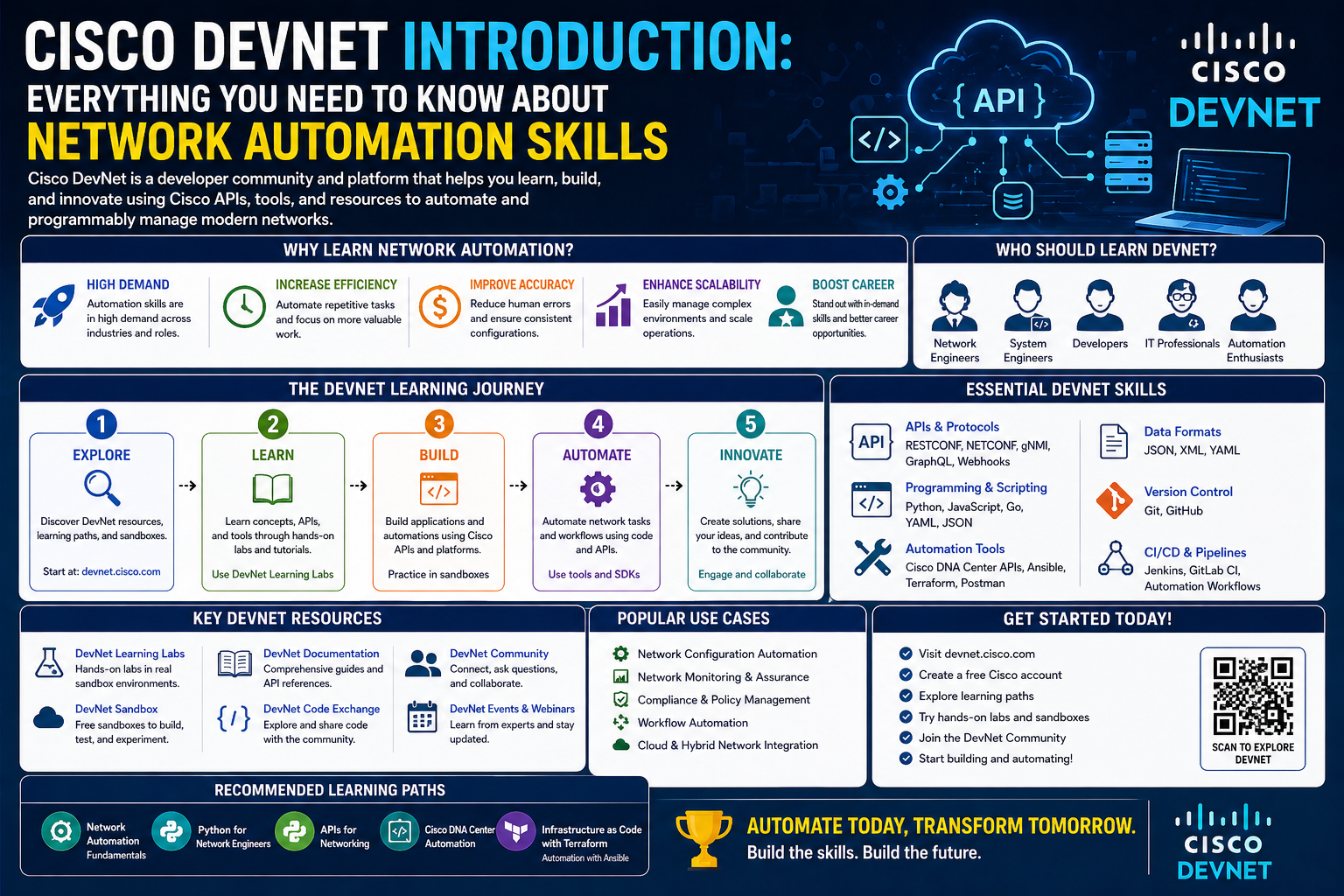
Over the past decade, the information technology industry has undergone a major transformation driven by the increasing need for speed, scalability, and reliability in digital systems. Organizations are no longer satisfied with traditional manual processes for managing infrastructure, deploying applications, or maintaining networks. Instead, there is a growing shift toward automation, software-driven infrastructure, and continuous delivery models that allow businesses to respond quickly to changing demands.
This transformation is largely influenced by the rise of DevOps practices, which emphasize collaboration between development and operations teams. Rather than working in isolation, these teams now share responsibilities for building, testing, deploying, and maintaining applications. This cultural and technical shift has led to faster release cycles, improved system stability, and more efficient use of resources.
As cloud computing continues to expand, organizations are also moving away from rigid, hardware-centric environments toward flexible, software-defined infrastructures. This evolution has created a strong demand for professionals who understand both traditional IT systems and modern software development practices. Skills in automation, scripting, APIs, and infrastructure orchestration have become essential in nearly every IT role.
In this environment, the ability to write code is no longer limited to software developers. Network engineers, system administrators, and cybersecurity professionals are increasingly expected to understand programming concepts and use automation tools to manage complex environments. This convergence of disciplines has reshaped job roles across the IT industry.
The demand for professionals who can bridge the gap between networking and software development has created a new category of hybrid roles. These roles require a combination of technical knowledge in networking systems and practical skills in software engineering. As a result, the traditional boundaries between IT domains have become less defined, leading to a more integrated and collaborative approach to technology management.
The Shift from Traditional Networking to Programmable Infrastructure
Traditional networking relied heavily on manual configuration and device-by-device management. Network administrators would log into individual devices to configure settings, troubleshoot issues, and implement changes. While effective in smaller environments, this approach becomes inefficient and error-prone in large-scale networks.
With the introduction of programmable infrastructure, networks can now be controlled through software interfaces and automation scripts. Instead of manually configuring each device, administrators can use centralized tools and APIs to manage entire networks consistently and efficiently. This shift significantly reduces human error and increases operational speed.
Programmability in networking allows systems to be defined and controlled through code. This means that network configurations can be standardized, version-controlled, and deployed automatically. Changes that once required hours or days of manual effort can now be executed in minutes with greater accuracy.
Another important development in this transition is the use of application programming interfaces. APIs enable different systems and platforms to communicate with each other, allowing for seamless integration across complex IT environments. Through APIs, network devices, cloud platforms, and applications can exchange data and execute commands without manual intervention.
This level of automation has introduced new possibilities for managing IT infrastructure. Organizations can now implement self-healing networks, dynamic resource allocation, and automated security responses. These capabilities not only improve efficiency but also enhance system reliability and security.
As infrastructure becomes more software-driven, IT professionals are expected to adopt new skill sets. Understanding how to interact with APIs, write automation scripts, and design programmable systems has become essential for managing modern networks. This evolution marks a significant departure from traditional networking practices and highlights the importance of software skills in infrastructure management.
Cisco’s Response to Industry Transformation
Cisco, a long-established leader in networking technology, has recognized the significant shift occurring within the IT industry. As organizations move toward automation and software-defined environments, Cisco has adapted its strategy to align with these changes. One of the key outcomes of this adaptation is the introduction of a structured certification approach focused on programmability and DevOps practices.
The purpose of this shift is to ensure that IT professionals are equipped with the skills needed to operate in modern, automated environments. Rather than focusing solely on hardware configuration and traditional networking concepts, the new direction emphasizes software integration, automation workflows, and cloud-based operations.
This evolution reflects a broader understanding that networking is no longer an isolated discipline. It is now deeply interconnected with software development, cloud computing, and cybersecurity. Cisco’s updated approach acknowledges that professionals must be able to work across these domains to remain effective in modern IT environments.
By introducing a certification pathway focused on DevOps and automation, Cisco is addressing the growing need for standardized validation of skills in these areas. Employers increasingly seek professionals who can demonstrate practical knowledge of automation tools and programmable infrastructure. Certifications help provide a clear benchmark for these capabilities.
This approach also reflects the changing expectations of the IT workforce. Professionals are no longer limited to single-domain expertise. Instead, they are expected to have a broader understanding of how systems interact and how automation can be used to improve efficiency and performance.
Cisco’s initiative represents a strategic response to these industry demands. It aims to support professionals in developing relevant skills while also helping organizations identify qualified talent capable of managing modern infrastructure environments.
The Role of DevNet in Modern IT Ecosystems
DevNet represents Cisco’s structured approach to integrating software development principles into networking and infrastructure management. It is designed to support professionals who work at the intersection of development, operations, and networking.
At its core, DevNet emphasizes the importance of programmability in IT systems. This includes the use of APIs, automation frameworks, and software development tools to manage and control infrastructure. The goal is to enable professionals to build more efficient, scalable, and automated systems.
One of the key ideas behind DevNet is the recognition that modern IT environments require cross-disciplinary skills. Network engineers must understand software concepts, while developers must understand infrastructure principles. DevNet serves as a bridge between these domains, helping professionals develop the necessary hybrid skill set.
This approach also reflects the growing importance of cloud computing and distributed systems. As organizations adopt multi-cloud and hybrid cloud strategies, the ability to manage resources across different environments becomes critical. DevNet-related skills help professionals navigate these complex architectures.
Security is another important aspect of this ecosystem. As systems become more interconnected and automated, ensuring secure communication between components is essential. DevNet incorporates security principles into its framework, emphasizing the importance of secure coding practices and protected API interactions.
Collaboration tools and communication platforms also play a role in modern IT environments. DevNet extends into these areas by enabling integration with collaboration systems, allowing organizations to automate workflows and improve team efficiency.
By combining these elements, DevNet provides a comprehensive approach to modern IT operations. It reflects the reality that infrastructure management is no longer limited to physical devices but extends across software, cloud platforms, and integrated services.
Core Domains of Automation and Programmability
Modern IT environments rely on several key domains that form the foundation of automation and programmability. These domains represent the areas where software development principles intersect with infrastructure management.
One of the most important domains is API-driven infrastructure. APIs allow systems to communicate and exchange information programmatically. This enables automation of tasks such as configuration management, monitoring, and provisioning of resources. APIs serve as the building blocks for modern automated systems.
Another critical domain is infrastructure automation. This involves using scripts and tools to manage network devices, servers, and cloud resources without manual intervention. Automation reduces operational complexity and ensures consistency across environments.
Cloud integration is also a major component of modern IT systems. Cloud platforms provide scalable computing resources that can be managed programmatically. Professionals working in this domain must understand how to deploy, configure, and manage cloud-based services using automation tools.
Security automation has become increasingly important as threats grow more sophisticated. Automated security systems can detect anomalies, respond to incidents, and enforce policies without human intervention. This helps organizations maintain a strong security posture while reducing response times.
In addition, IoT integration plays a significant role in modern ecosystems. Connected devices generate large volumes of data that must be managed and analyzed efficiently. Automation helps process this data and integrate IoT systems into broader infrastructure environments.
Collaboration platforms also contribute to this ecosystem by enabling communication and workflow automation. Integrating these platforms with backend systems allows organizations to streamline operations and improve productivity.
Together, these domains form the foundation of programmable infrastructure. They highlight the importance of software-driven approaches in managing complex IT environments.
Structure of Modern Certification Pathways in IT Automation
The evolution of IT roles has led to the development of structured certification pathways that reflect real-world job requirements. These pathways are designed to validate skills at different levels of expertise, ensuring that professionals can progress systematically in their careers.
In modern certification frameworks, entry-level stages typically focus on foundational knowledge. This includes understanding basic networking concepts, introductory programming skills, and awareness of automation principles. These foundational skills are essential for building more advanced capabilities later.
As professionals advance, they move into more specialized areas that focus on specific domains such as enterprise automation, security integration, or cloud infrastructure. At this stage, individuals are expected to apply their knowledge to real-world scenarios and demonstrate practical problem-solving abilities.
Advanced levels emphasize design, architecture, and implementation of complex systems. Professionals at this stage are expected to manage large-scale infrastructures, design automation frameworks, and integrate multiple technologies into cohesive solutions.
This structured approach ensures that individuals develop both theoretical understanding and practical expertise. It also aligns certification pathways with industry requirements, making them more relevant to employers.
Another important aspect of modern certification systems is flexibility. Professionals can often choose specialized tracks based on their job roles or career goals. This allows them to focus on areas that are most relevant to their work while still maintaining a broad understanding of the overall ecosystem.
The progression through these certification levels reflects the increasing complexity of IT environments. As systems become more interconnected and automated, professionals must continuously update their skills to remain effective.
Cisco Certified DevNet Associate and Foundational Skill Development
At the foundational level, the Cisco Certified DevNet Associate certification represents an entry point into the world of network automation and software-driven infrastructure. It is designed to validate essential skills required for working in modern IT environments where programming and networking intersect.
This level focuses on building a strong understanding of core concepts such as network fundamentals, software development principles, and automation techniques. It introduces professionals to the basic tools and technologies used in programmable infrastructure.
A key area of focus is the use of APIs to interact with network systems. Understanding how APIs function and how they are used to retrieve and manipulate data is essential for automation tasks. This knowledge forms the basis for more advanced integration work in later stages.
Another important component is basic programming knowledge, particularly in scripting languages commonly used for automation. These skills enable professionals to write simple scripts that can perform repetitive tasks, manage configurations, and interact with systems programmatically.
Network fundamentals remain an essential part of this certification level. Understanding how data flows through networks, how devices communicate, and how connectivity is established provides the necessary context for implementing automation solutions effectively.
Security principles are also introduced at this stage. Professionals learn how to apply basic security practices when working with automated systems and APIs. This includes understanding authentication methods, secure communication protocols, and data protection techniques.
In addition to technical skills, this foundational level emphasizes problem-solving and analytical thinking. Professionals are encouraged to understand how different systems interact and how automation can be used to improve efficiency and reduce manual effort.
The DevNet Associate level serves as a stepping stone into more advanced areas of IT automation and software integration. It prepares individuals for deeper specialization by establishing a strong technical foundation that supports continuous learning and career progression.
Cisco DevNet Specialist Path and the Move Toward Focused Expertise
As professionals move beyond foundational knowledge in network automation and software-driven infrastructure, the next stage in the learning journey introduces a deeper level of specialization. The Cisco DevNet Specialist path is designed for individuals who already understand core concepts and are ready to apply their skills in specific technology domains. Unlike entry-level learning, this stage focuses on refining expertise in targeted areas where automation and programmability are applied in real operational environments.
At this level, the emphasis shifts from general understanding to practical implementation. Professionals are expected to work with real systems, manage complex workflows, and apply automation techniques to solve domain-specific challenges. The structure allows individuals to align their certification journey with their actual job roles, making the learning process more relevant and immediately applicable.
Specialization areas include enterprise automation, security automation, data center integration, service provider environments, collaboration platforms, and application development using Cisco platforms. Each specialization focuses on a different segment of modern IT infrastructure, reflecting the diversity of roles within the industry.
This stage of certification recognizes that IT environments are no longer uniform. Instead, they are composed of multiple interconnected systems that require different types of expertise. A professional working in a data center environment may focus on infrastructure automation, while another in a security role may focus on automated threat detection and response systems.
By offering multiple specialization tracks, Cisco enables professionals to build depth in their chosen field while still maintaining a connection to the broader DevNet ecosystem. This approach supports career growth and ensures that skills remain aligned with industry demands.
Enterprise Automation and Large-Scale Network Management
Enterprise environments represent some of the most complex IT infrastructures in the modern world. They often include thousands of devices, distributed across multiple locations, connected through hybrid cloud systems, and managed by diverse teams. In such environments, manual configuration is not only inefficient but also unsustainable.
Enterprise automation focuses on simplifying the management of these large-scale systems through programmable interfaces and centralized control mechanisms. Instead of configuring devices individually, administrators can define policies and workflows that are automatically applied across the entire network.
This approach significantly improves consistency and reduces the likelihood of configuration errors. It also enables faster deployment of services, allowing organizations to respond more quickly to business needs. Automation ensures that changes are implemented uniformly, regardless of the size or complexity of the environment.
Another important aspect of enterprise automation is scalability. As organizations grow, their infrastructure must be able to expand without requiring proportional increases in manual effort. Automated systems allow new devices and services to be integrated seamlessly into existing environments.
Monitoring and management also become more efficient through automation. Systems can continuously track performance, detect anomalies, and trigger automated responses when necessary. This reduces downtime and improves overall system reliability.
Enterprise automation also plays a key role in supporting hybrid environments that combine on-premises infrastructure with cloud services. Automation tools help bridge these environments, ensuring consistent management across different platforms.
Data Center Automation and Infrastructure Optimization
Data centers form the backbone of modern digital services, hosting applications, databases, and critical business systems. As demand for computing resources continues to grow, data centers have become increasingly complex and dynamic environments.
Data center automation focuses on managing these environments through programmable systems that reduce manual intervention. This includes automating tasks such as server provisioning, resource allocation, load balancing, and system monitoring.
One of the key benefits of automation in data centers is improved efficiency. Resources can be allocated dynamically based on demand, ensuring optimal utilization without manual oversight. This helps organizations reduce operational costs while maintaining performance standards.
Another important aspect is reliability. Automated systems can detect hardware or software failures and respond immediately by redistributing workloads or initiating recovery processes. This minimizes downtime and ensures continuous service availability.
Infrastructure optimization also involves managing energy consumption and resource efficiency. Automated systems can adjust workloads based on usage patterns, helping reduce unnecessary energy consumption and improve sustainability.
In addition, data center automation supports the rapid deployment of new services. Applications and environments can be provisioned automatically, reducing the time required to bring new systems online. This agility is essential in competitive business environments where speed is critical.
Security Automation and Intelligent Threat Response
As IT systems become more interconnected and complex, security challenges have also increased significantly. Traditional manual security processes are no longer sufficient to handle the volume and sophistication of modern threats.
Security automation addresses this challenge by using programmable systems to detect, analyze, and respond to security incidents in real time. Automated systems can monitor network activity continuously, identify suspicious behavior, and initiate predefined response actions without human intervention.
This approach significantly reduces response time, which is critical in minimizing the impact of security breaches. Automated systems can isolate affected devices, block malicious traffic, and alert security teams immediately when threats are detected.
Another important aspect of security automation is consistency. Manual processes are often subject to human error, but automated systems apply security policies uniformly across all environments. This ensures that security standards are maintained at all times.
Security automation also enables advanced threat analysis. By collecting and analyzing large volumes of data, automated systems can identify patterns that may indicate potential vulnerabilities or ongoing attacks.
Integration with other systems is also a key feature. Security automation tools can interact with network infrastructure, cloud platforms, and application services to provide a coordinated response to threats.
This level of integration allows organizations to build proactive security systems that not only respond to incidents but also prevent them from occurring.
DevOps Integration and Continuous Delivery Practices
DevOps represents a cultural and technical shift in how software is developed, tested, and deployed. It emphasizes collaboration between development and operations teams, enabling faster and more reliable software delivery.
In a DevOps environment, automation plays a central role. Processes such as code integration, testing, deployment, and monitoring are automated to ensure consistency and efficiency. This reduces the time required to deliver new features and updates.
Continuous integration and continuous delivery practices are key components of DevOps. These practices ensure that code changes are automatically tested and deployed through predefined pipelines. This reduces the risk of errors and improves software quality.
Automation also enables rapid feedback loops. Developers can quickly identify issues in their code and make necessary adjustments. This iterative process improves development efficiency and reduces downtime.
Infrastructure management is also integrated into DevOps workflows. Infrastructure as code allows systems to be defined and managed through configuration files, enabling version control and automated deployment.
This approach ensures that infrastructure changes are consistent and repeatable. It also allows teams to quickly replicate environments for testing and production purposes.
DevOps integration requires strong collaboration between different roles within IT teams. Developers, system administrators, and network engineers must work together to design and maintain automated workflows.
API-Driven Architecture in Modern IT Systems
Application programming interfaces have become the foundation of modern IT systems. They allow different software components to communicate and interact with each other in a structured and efficient way.
API-driven architecture enables systems to be modular and flexible. Instead of relying on tightly integrated components, systems can be built using independent services that communicate through APIs.
This approach improves scalability and maintainability. Individual components can be updated or replaced without affecting the entire system.
Automation heavily relies on APIs to perform tasks such as configuration management, data retrieval, and system orchestration. APIs provide a standardized way to interact with infrastructure components.
Another important benefit of API-driven systems is interoperability. Different platforms and technologies can work together seamlessly, even if they were not originally designed to be compatible.
This is particularly important in hybrid environments where organizations use multiple cloud providers and on-premises systems. APIs act as a bridge between these environments, enabling unified management.
Security is also an important consideration in API-driven systems. Authentication and authorization mechanisms ensure that only authorized users and systems can access sensitive functions.
Cloud Integration and Hybrid Infrastructure Management
Cloud computing has become a central component of modern IT environments. Organizations increasingly rely on cloud platforms for scalability, flexibility, and cost efficiency.
Cloud integration involves connecting on-premises systems with cloud services to create hybrid environments. These environments allow organizations to leverage the benefits of both local and cloud-based infrastructure.
Automation plays a key role in managing hybrid environments. It enables consistent configuration and monitoring across different platforms.
Resource provisioning in cloud environments is highly dynamic. Automated systems can allocate computing resources based on demand, ensuring efficient utilization.
Hybrid infrastructure management also involves data synchronization between different environments. Automation ensures that data remains consistent and accessible across platforms.
Another important aspect is workload distribution. Automated systems can determine the most efficient location for running applications based on performance and cost considerations.
Programming Skills and Scripting in Network Automation
Programming has become an essential skill for IT professionals working in automation and DevOps environments. Scripting languages are commonly used to automate repetitive tasks and interact with system APIs.
These skills allow professionals to write code that manages infrastructure components, retrieves data, and performs system configurations automatically.
Understanding programming logic is also important for designing efficient automation workflows. This includes concepts such as loops, conditions, and data structures.
Scripting enables customization of automation processes based on specific organizational requirements. This flexibility is essential in complex IT environments.
Debugging and troubleshooting are also important aspects of programming in automation. Professionals must be able to identify and resolve issues in their scripts and workflows.
Collaboration Platforms and Workflow Automation
Modern IT environments rely heavily on collaboration tools to support communication and teamwork. These platforms are increasingly integrated with automation systems to improve efficiency.
Workflow automation allows organizations to streamline repetitive processes such as notifications, approvals, and reporting.
Integration between collaboration platforms and backend systems enables real-time updates and automated responses to system events.
This improves communication between teams and ensures that important information is shared quickly and efficiently.
Automated workflows also reduce manual administrative tasks, allowing teams to focus on higher-value activities.
Real-World Operational Scenarios in Automated Environments
In practical environments, automation is applied across a wide range of operational scenarios. These include system provisioning, performance monitoring, security enforcement, and incident response.
Automated provisioning allows new infrastructure to be deployed quickly and consistently. Monitoring systems continuously track performance and detect issues before they impact users.
In security scenarios, automated systems respond to threats by isolating affected components and applying mitigation measures.
Incident response workflows ensure that issues are addressed efficiently, reducing downtime and minimizing disruption.
These real-world applications demonstrate the practical value of automation in modern IT environments.
Cisco DevNet Professional Path and Advanced Automation Architecture
As IT environments continue to expand in scale and complexity, the need for highly skilled professionals who can design, implement, and manage end-to-end automation systems becomes more critical. The Cisco DevNet Professional path represents this advanced stage of expertise, where the focus shifts from applying automation concepts to architecting entire systems that operate with minimal manual intervention.
At this level, professionals are expected to understand not only how individual tools and technologies work, but also how they interact within large-scale ecosystems. This includes networking infrastructure, cloud platforms, security systems, application services, and orchestration frameworks. The goal is to build cohesive solutions that integrate all these components into a unified, programmable environment.
Unlike earlier stages, which emphasize foundational knowledge and specialization in specific domains, the professional level requires a holistic understanding of system design. Professionals must be able to evaluate business requirements and translate them into technical architectures that are scalable, secure, and efficient.
A key expectation at this level is the ability to design automation workflows that span multiple systems. These workflows may include provisioning infrastructure, configuring services, enforcing security policies, and monitoring performance. Each component must work together seamlessly to ensure reliable operation.
The complexity of modern IT environments means that automation is no longer optional. It is a fundamental requirement for maintaining operational efficiency. Professionals at the DevNet Professional level are responsible for ensuring that automation systems are robust, maintainable, and adaptable to changing business needs.
Core Principles of Large-Scale System Design
Designing large-scale automated systems requires a deep understanding of several core principles. One of the most important is modularity, which involves breaking down complex systems into smaller, manageable components. Each component should perform a specific function and interact with others through well-defined interfaces.
Modularity improves flexibility and maintainability. When systems are built in modular fashion, individual components can be updated or replaced without affecting the entire architecture. This reduces downtime and simplifies troubleshooting.
Another key principle is scalability. Systems must be able to handle increasing workloads without degradation in performance. This requires careful planning of resource allocation, load distribution, and system architecture.
Scalability is particularly important in cloud-based environments where demand can fluctuate rapidly. Automated systems must be able to adjust resources dynamically to meet changing requirements.
Reliability is also a critical design principle. Automated systems must be designed to handle failures gracefully. This includes implementing redundancy, failover mechanisms, and self-healing capabilities.
Security is integrated into every aspect of system design. Rather than being treated as a separate layer, security is embedded within the architecture. This includes secure communication between components, access control mechanisms, and continuous monitoring for threats.
Finally, observability is essential for managing complex systems. Observability refers to the ability to understand the internal state of a system based on its external outputs. This is achieved through logging, monitoring, and analytics tools that provide real-time insights into system behavior.
Automation Architecture Across Multi-Domain Environments
Modern IT environments are rarely confined to a single domain. Instead, they span multiple environments, including enterprise networks, data centers, cloud platforms, and edge devices. Designing automation across these domains requires careful coordination and integration.
In enterprise environments, automation focuses on managing network devices, user access, and policy enforcement. In data centers, it focuses on resource allocation, virtualization, and workload management. In cloud environments, it focuses on provisioning services and managing distributed applications.
Edge environments introduce additional complexity due to their distributed nature. These environments often include IoT devices and remote systems that must be managed with limited connectivity.
Automation architecture must account for these differences while maintaining consistency across all domains. This is achieved through centralized control systems that coordinate automation tasks across multiple environments.
APIs play a critical role in enabling cross-domain automation. They allow different systems to communicate and exchange information, regardless of their underlying infrastructure.
Orchestration tools are also used to coordinate complex workflows that span multiple systems. These tools ensure that tasks are executed in the correct order and that dependencies are properly managed.
Advanced API Integration and System Orchestration
At the professional level, API integration becomes significantly more complex. Rather than simply interacting with individual services, professionals must design systems where multiple APIs work together as part of larger workflows.
This involves understanding how different systems expose functionality through APIs and how these interfaces can be combined to achieve automation goals. It also requires careful management of authentication, data formats, and error handling.
System orchestration refers to the coordination of multiple automated tasks into a single workflow. Orchestration engines manage the execution of these tasks, ensuring that each step is completed successfully before moving to the next.
For example, a provisioning workflow may involve creating virtual machines, configuring network settings, deploying applications, and applying security policies. Each of these steps must be executed in sequence and monitored for success.
Orchestration systems also provide rollback capabilities, allowing workflows to recover from failures by reverting changes. This ensures system stability even when unexpected issues occur.
Advanced orchestration also includes event-driven automation. In this model, systems respond to real-time events rather than predefined schedules. For example, a system might automatically scale resources when traffic increases or trigger security responses when anomalies are detected.
Infrastructure as Code and Version-Controlled Environments
Infrastructure as code is a fundamental concept in modern automation practices. It involves defining infrastructure configurations using machine-readable files rather than manual processes.
This approach allows infrastructure to be version-controlled, tested, and deployed in a consistent manner. It also enables teams to track changes over time and collaborate more effectively.
Version control systems play an important role in managing infrastructure code. They provide a history of changes, allow multiple contributors to work on the same configuration, and support rollback to previous versions if needed.
Automated pipelines are often used to deploy infrastructure changes. These pipelines validate configurations, test deployments, and apply changes to production environments.
This approach reduces the risk of human error and ensures that infrastructure changes are predictable and repeatable.
Infrastructure as code also supports environment replication. Development, testing, and production environments can be created using the same configuration templates, ensuring consistency across all stages of the software lifecycle.
Security Integration in Automated Systems
Security at the professional level is deeply integrated into automation systems. Rather than being applied after systems are built, security is embedded throughout the entire architecture.
This includes secure design principles that ensure systems are built with protection mechanisms from the beginning. Access control systems define who can interact with different components and what actions they are allowed to perform.
Encryption is used to protect data in transit and at rest. Automated systems ensure that sensitive information is always transmitted securely between components.
Continuous monitoring is also a key aspect of security integration. Systems constantly analyze behavior to detect anomalies that may indicate security threats.
Automated incident response systems can take immediate action when threats are detected. This may include isolating affected systems, blocking malicious traffic, or triggering alerts for security teams.
Policy enforcement is another important aspect. Automated systems ensure that security policies are consistently applied across all environments.
Cloud-Native Automation and Distributed Systems
Cloud-native architectures are designed specifically for distributed environments. These systems are built using microservices, containers, and orchestration platforms that enable scalability and flexibility.
Automation in cloud-native environments focuses on managing dynamic workloads that can move across different infrastructure components.
Containers allow applications to be packaged with all their dependencies, making them portable across environments. Orchestration systems manage the deployment, scaling, and monitoring of these containers.
Distributed systems require careful coordination to ensure consistency and reliability. Automation helps manage communication between services and ensures that system states remain synchronized.
Cloud-native automation also supports self-healing capabilities. Systems can automatically detect failures and restart or replace affected components without manual intervention.
This level of automation is essential for maintaining high availability in large-scale distributed environments.
Observability and Intelligent Monitoring Systems
Observability is a critical component of advanced automation systems. It allows professionals to understand how systems behave in real time and identify potential issues before they escalate.
Observability is achieved through three main components: metrics, logs, and traces. Metrics provide quantitative data about system performance. Logs provide detailed records of system events. Traces show the flow of requests through distributed systems.
Automated monitoring systems collect and analyze this data continuously. They use this information to detect anomalies, predict failures, and optimize performance.
Intelligent monitoring systems can also use machine learning techniques to identify patterns in system behavior. This allows them to detect issues that may not be immediately visible through traditional monitoring methods.
Alerting systems are integrated into observability platforms. These systems notify administrators when predefined thresholds are exceeded or when unusual behavior is detected.
Career Impact of Advanced DevNet Skills
At the professional level, DevNet skills significantly impact career opportunities in IT. Professionals with expertise in automation, API integration, and system orchestration are highly valued in modern organizations.
These skills are applicable across multiple industries, including finance, healthcare, telecommunications, and cloud service providers. Organizations in these sectors rely heavily on automated systems to maintain operational efficiency.
Advanced DevNet skills also open opportunities in system architecture, DevOps engineering, and cloud engineering roles. These positions involve designing and managing complex infrastructure systems.
Professionals at this level are often responsible for leading automation initiatives within organizations. This includes designing workflows, selecting tools, and ensuring system reliability.
The ability to work across multiple domains also increases career flexibility. Professionals can transition between networking, software development, and cloud infrastructure roles more easily.
Evolution Toward Fully Autonomous Infrastructure Systems
The long-term direction of IT infrastructure is moving toward fully autonomous systems. These systems are capable of managing themselves with minimal human intervention.
Autonomous infrastructure uses automation, artificial intelligence, and machine learning to make decisions about resource allocation, performance optimization, and security enforcement.
These systems continuously monitor their own performance and make adjustments in real time. For example, they can scale resources based on demand, optimize network traffic, and detect security threats automatically.
The goal of autonomous infrastructure is to create self-managing environments that can operate efficiently without constant manual oversight.
This represents the next stage in the evolution of IT systems, where human involvement shifts from operational tasks to strategic planning and system design.
Conclusion
The introduction of Cisco’s DevNet certification framework marks a significant turning point in the evolution of IT careers and infrastructure management. As organizations continue to adopt automation, cloud computing, and DevOps practices, the traditional boundaries between networking, software development, and systems administration are steadily dissolving. What was once a clearly separated set of disciplines has now become an interconnected ecosystem where programmability and automation define success.
One of the most important takeaways from this transformation is the shift in skill expectations. IT professionals are no longer evaluated solely on their ability to configure hardware or manage isolated systems. Instead, they are expected to understand how to build and operate systems that are software-driven, scalable, and adaptable. This includes working with APIs, writing automation scripts, designing workflows, and integrating services across multiple platforms.
The DevNet certification pathway reflects this industry reality by offering a structured learning progression from foundational knowledge to advanced architectural design. At the associate level, professionals build an essential understanding of networking concepts combined with basic programming and automation skills. As they move into specialist roles, they begin to apply these skills within specific domains such as security, enterprise systems, or data centers. At the professional level, they transition into system design and orchestration, where the focus shifts to building large-scale automated environments that integrate multiple technologies.
This structured progression is important because it mirrors the way modern IT environments operate. Systems today are not isolated; they are part of a larger, dynamic ecosystem that includes cloud platforms, on-premises infrastructure, distributed applications, and security frameworks. Managing such environments requires more than technical knowledge—it requires the ability to think in terms of systems, workflows, and automation logic.
Another key impact of DevNet is its alignment with DevOps culture. DevOps has changed the way software and infrastructure are delivered by emphasizing collaboration, continuous integration, and continuous deployment. DevNet supports this shift by equipping professionals with the tools and knowledge needed to automate processes and integrate development and operations workflows. This ensures faster delivery cycles, improved reliability, and more efficient use of resources.
The growing importance of APIs and programmable infrastructure is also central to this transformation. APIs have become the universal language of modern IT systems, enabling different technologies to communicate and work together seamlessly. DevNet emphasizes the importance of understanding and leveraging APIs to build flexible and scalable systems. This API-first approach is now a foundational principle in cloud computing, network automation, and application development.
Security considerations are also deeply embedded in this evolving landscape. As systems become more automated and interconnected, the potential attack surface increases. DevNet-related skills help professionals understand how to implement secure automation practices, enforce policies programmatically, and respond to threats in real time. Security is no longer an isolated function but a continuous, integrated process within automated systems.
Perhaps one of the most significant long-term impacts of this shift is the move toward autonomous infrastructure. As automation and intelligence become more advanced, systems are increasingly capable of self-management. This includes self-healing networks, automated scaling, intelligent monitoring, and predictive maintenance. In such environments, the role of IT professionals evolves from manual operators to system designers and strategic architects.
This evolution does not reduce the importance of human expertise; rather, it elevates it. Professionals are now required to focus on higher-level problem-solving, system design, and optimization rather than repetitive operational tasks. The ability to understand how complex systems interact and how automation can be applied effectively becomes a defining skill in modern IT careers.
Cisco’s DevNet framework ultimately represents more than just a certification program. It reflects a broader shift in the industry toward software-defined infrastructure and intelligent automation. By providing structured learning paths, it helps professionals adapt to this changing landscape while ensuring that organizations have access to the skills needed to build and maintain modern digital systems.
As the IT industry continues to evolve, the demand for automation, integration, and programmability will only increase. Professionals who invest in developing these skills position themselves at the forefront of this transformation. The DevNet ecosystem serves as a bridge between traditional networking and the future of software-driven infrastructure, enabling individuals to grow alongside the technology shaping the modern world.