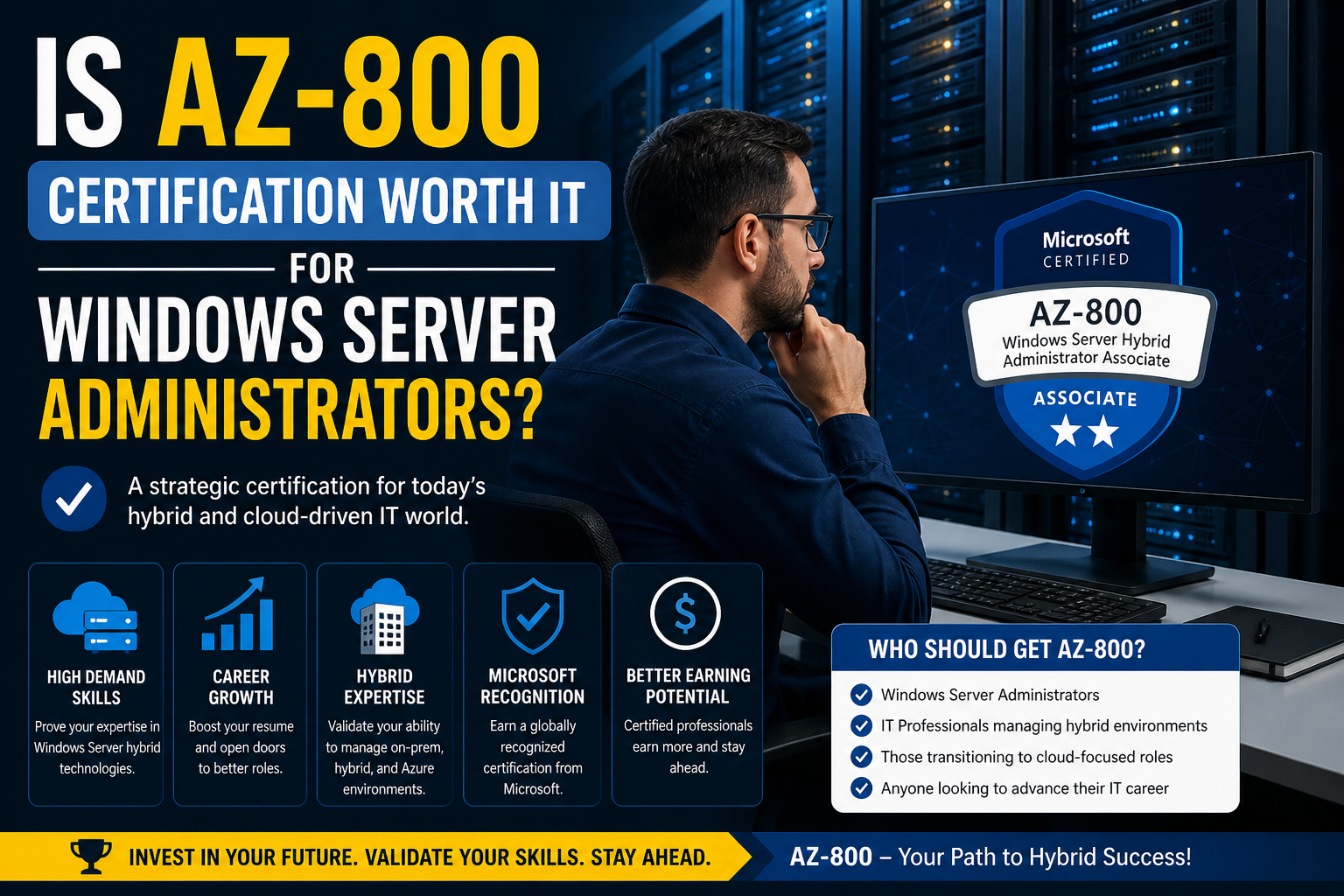
Over the past decade, the role of a Windows server administrator has changed dramatically. Traditional on-premises environments, once the backbone of enterprise IT, are no longer sufficient on their own. Organizations have steadily moved toward hybrid infrastructure models that combine local data centers with cloud services. This shift is driven by the need for scalability, resilience, cost efficiency, and remote accessibility.
In this evolving landscape, companies like Microsoft have developed technologies that bridge on-premises systems with cloud platforms. One of the most widely used operating systems in enterprise environments, Windows Server, now exists as part of a broader ecosystem where cloud integration is not optional but essential.
The AZ-800 exam emerges directly from this transformation. It is not just another certification; it reflects how real-world infrastructure has changed. Instead of focusing solely on traditional server administration, it emphasizes hybrid administration—where administrators must manage workloads that span both physical servers and cloud environments.
Understanding this shift is essential before diving into the exam itself, because the AZ-800 is built around practical, real-world expectations rather than isolated technical theory.
The Purpose and Role of the AZ-800 Exam
The AZ-800 exam, formally known as Administering Windows Server Hybrid Core Infrastructure, is designed to validate the skills required to manage modern enterprise server environments. It focuses on professionals who work with both on-premises systems and cloud-based infrastructure, ensuring they can operate seamlessly across both domains.
Unlike older certifications that focused only on local server environments, this exam reflects a hybrid-first mindset. Administrators are expected to understand how systems interact across environments and how to maintain stability, security, and performance in mixed infrastructure setups.
At its core, the exam evaluates whether a candidate can manage identity systems, virtual machines, storage solutions, networking configurations, and server workloads in a unified hybrid environment. This is critical because modern IT systems rarely exist in isolation anymore.
The AZ-800 is also part of a broader certification path that leads toward advanced hybrid administration expertise. While it focuses on foundational hybrid skills, it prepares candidates for more advanced responsibilities involving enterprise-scale infrastructure management.
Why Hybrid Skills Matter More Than Ever
To understand why the AZ-800 exists, it is important to understand the growing importance of hybrid infrastructure.
Most organizations today are not fully cloud-based, nor are they purely on-premises. Instead, they operate in a hybrid model where some services are hosted locally, while others run in cloud environments. This approach allows companies to maintain control over sensitive systems while benefiting from cloud scalability.
Hybrid environments introduce complexity. Systems must communicate across different platforms, authentication must work seamlessly across boundaries, and data must remain synchronized between on-premises servers and cloud services.
This is where hybrid administrators play a critical role. They ensure that systems remain connected, secure, and efficient regardless of where workloads are hosted. The AZ-800 exam is designed specifically to test whether an individual can handle this complexity in real-world scenarios.
The Foundation: Active Directory in a Hybrid World
One of the most important areas covered in the AZ-800 exam is identity management, particularly through Active Directory Domain Services.
Active Directory has long been the backbone of enterprise identity systems. It controls user authentication, access permissions, and organizational structure within on-premises environments. However, in a hybrid world, Active Directory no longer operates in isolation.
It must integrate with cloud-based identity systems, synchronize user accounts, and maintain consistent authentication policies across environments. This is where hybrid identity solutions become essential.
Administrators must understand how directory synchronization works, how identities are managed across systems, and how authentication flows between on-premises servers and cloud services. These concepts form a significant portion of the knowledge required for the AZ-800 exam.
The complexity of identity management in hybrid environments is one of the reasons this exam is considered valuable. It tests whether professionals can maintain secure and reliable identity systems across a distributed infrastructure.
Managing Servers in a Hybrid Environment
Beyond identity management, the AZ-800 exam evaluates a candidate’s ability to manage Windows Server workloads in hybrid environments.
This includes tasks such as remote server administration, automation using scripting tools, and managing workloads that may be distributed across local and cloud-based systems.
In modern IT environments, administrators rarely sit in front of physical servers. Instead, they rely on remote management tools and automation frameworks to control infrastructure at scale. This requires a strong understanding of how to execute administrative tasks efficiently without direct physical access to systems.
Hybrid server management also involves understanding how workloads behave differently depending on where they are hosted. Performance, latency, security, and scalability all vary between on-premises and cloud environments.
The AZ-800 exam tests whether administrators can adapt to these differences and apply appropriate management techniques depending on the environment.
Virtualization and Containerization in Modern Infrastructure
Another core area covered in the AZ-800 exam is virtualization and container management. These technologies have become fundamental to modern IT infrastructure because they allow organizations to maximize resource efficiency and flexibility.
Virtual machines enable multiple operating systems to run on a single physical machine, while containers provide lightweight environments for running applications consistently across different systems.
Administrators must understand how to deploy, configure, and manage virtual machines in both local and cloud environments. This includes managing resource allocation, ensuring high availability, and optimizing performance.
Containers add another layer of complexity. They allow applications to be packaged with their dependencies, making them portable across environments. However, managing containers requires understanding orchestration, networking, and lifecycle management.
The AZ-800 exam evaluates whether candidates can handle both virtualization and container-based workloads in hybrid environments. This reflects the reality of modern IT infrastructure, where both technologies are widely used.
Networking in Hybrid Infrastructure
Networking is another critical component of the AZ-800 exam. In hybrid environments, networking is not limited to a single location. Instead, it spans across on-premises systems and cloud platforms.
Administrators must understand how to configure DNS, manage network routing, and ensure secure communication between different environments. This includes integrating local network services with cloud-based networking solutions.
One of the key challenges in hybrid networking is maintaining consistency. Systems must be able to resolve names, authenticate users, and transfer data seamlessly across environments.
The exam tests whether administrators can design and manage network infrastructure that supports hybrid operations without introducing security risks or performance issues.
Storage and File Services Across Environments
Storage management is another major area of focus in the AZ-800 exam. Modern organizations generate large amounts of data, and this data must be stored, accessed, and synchronized across environments.
In a hybrid infrastructure, storage is not confined to a single location. Data may be stored locally for performance reasons while also being replicated to cloud storage for redundancy and scalability.
Administrators must understand how to configure file services, manage synchronization, and ensure data integrity across systems. This includes working with shared storage solutions and ensuring that access permissions remain consistent.
Storage management in hybrid environments requires careful planning, as misconfigurations can lead to data loss, security vulnerabilities, or performance degradation.
The Role of Automation in Hybrid Administration
Automation plays a central role in modern server administration. As environments become more complex, manual management becomes inefficient and error-prone.
In a hybrid infrastructure, automation is used to streamline tasks such as system updates, configuration management, and resource provisioning. Administrators often rely on scripting and automation tools to manage repetitive tasks across multiple environments.
The AZ-800 exam expects candidates to understand how automation fits into hybrid administration. This includes executing remote commands, managing automated workflows, and ensuring that systems remain consistent without manual intervention.
Automation not only improves efficiency but also reduces the risk of human error, making it a critical skill for modern IT professionals.
Security Considerations in Hybrid Systems
Security is one of the most important aspects of hybrid infrastructure. When systems are distributed across multiple environments, the attack surface increases significantly.
Administrators must ensure that identity systems are secure, data is protected, and communication between systems is encrypted. This requires a deep understanding of security principles as they apply to both on-premises and cloud environments.
The AZ-800 exam includes scenarios that test a candidate’s ability to maintain secure configurations across hybrid systems. This includes managing access controls, implementing security policies, and responding to potential threats.
Security in hybrid environments is not just about protecting individual systems; it is about ensuring that the entire infrastructure operates securely as a unified system.
The Evolution of the Windows Administrator Role
The AZ-800 exam reflects a broader evolution in the role of Windows administrators. In the past, administrators focused primarily on maintaining physical servers, managing local networks, and handling user accounts within a single environment.
Today, the role has expanded significantly. Administrators are now expected to manage hybrid environments, integrate cloud services, and ensure seamless operation across distributed systems.
This evolution requires a broader skill set and a deeper understanding of how different technologies interact. The AZ-800 exam is designed to validate this modern skill set.
It represents a shift from traditional server management to hybrid infrastructure management, reflecting the direction in which the entire IT industry is moving.
Why the AZ-800 Represents a Modern IT Baseline
The AZ-800 exam is more than just a certification requirement. It represents a baseline of knowledge for modern IT professionals working in Windows-based environments.
As organizations continue to adopt hybrid infrastructure models, the skills tested in this exam become increasingly important. Professionals who understand identity management, virtualization, networking, storage, and automation in hybrid environments are better equipped to handle real-world challenges.
This makes the AZ-800 not just relevant, but increasingly essential for those working in enterprise IT roles.
It serves as a foundation for understanding how modern infrastructure operates and prepares professionals for more advanced responsibilities in hybrid and cloud administration environments.
Active Directory Domain Services in Depth
One of the most heavily weighted areas in the AZ-800 exam is Active Directory Domain Services (AD DS), which remains the backbone of identity management in most enterprise environments using Windows Server.
In real-world administration, AD DS is far more than just user login management. It defines how an entire organization structures access, security boundaries, and resource control. In hybrid environments, AD DS becomes even more critical because it acts as the bridge between on-premises identity systems and cloud-based authentication services.
Administrators are expected to understand the internal structure of Active Directory, including forests, domains, and organizational units. These components define how resources and users are grouped and managed. Proper structuring is essential for scalability and security.
A major focus is also placed on domain controllers, which are responsible for authenticating users and enforcing policies. In enterprise environments, multiple domain controllers are deployed for redundancy and load balancing. The exam expects an understanding of how replication works between these controllers and how consistency is maintained across the network.
Another important aspect is the Flexible Single Master Operations (FSMO) roles. These specialized roles ensure that certain critical operations are handled by a single domain controller to prevent conflicts. Understanding how to identify, transfer, and recover these roles is essential in troubleshooting Active Directory issues.
Group Policy is another central component. It allows administrators to enforce configuration settings across multiple machines. This includes security policies, software installation rules, and system configurations. In large environments, Group Policy becomes a powerful tool for maintaining consistency and compliance.
Hybrid Identity and Directory Synchronization
Modern enterprise environments rarely rely solely on on-premises identity systems. Instead, they integrate local directories with cloud-based identity platforms. This hybrid identity model is a core concept in the AZ-800 exam.
In such environments, user identities are synchronized between the local Active Directory and cloud services. This ensures that users can access both on-premises and cloud resources using a single set of credentials.
Synchronization involves maintaining consistency between identity stores. Changes made in one environment must be reflected in the other. This includes user creation, password changes, group membership updates, and account modifications.
A key concept in this area is identity federation, where authentication is delegated between systems. Instead of maintaining separate login credentials, users are authenticated through a trusted relationship between systems.
Administrators must also understand how authentication flows work in hybrid environments. This includes how tokens are issued, validated, and used across services. Misconfigurations in this area can lead to access issues or security vulnerabilities.
Hybrid identity is one of the most complex topics in the exam because it requires understanding both traditional directory services and modern cloud authentication systems working together.
DNS and Name Resolution in Hybrid Networks
Domain Name System (DNS) is another critical component of a hybrid infrastructure. It acts as the foundation for name resolution, allowing systems to locate services and devices across networks.
In a hybrid environment, DNS is no longer confined to a single network. Instead, it must operate across on-premises and cloud-based infrastructure. This introduces complexity in ensuring that name resolution works consistently across environments.
Administrators must understand how to configure DNS zones, manage forwarders, and ensure proper resolution between internal and external systems. Conditional forwarding is often used to direct queries to the appropriate DNS server based on domain context.
In hybrid setups, integration between local DNS and cloud-based DNS services is essential. This ensures that both environments can resolve each other’s resources without conflict.
DNS troubleshooting is also an important skill. Misconfigured records, replication delays, and incorrect forwarding rules can all lead to connectivity issues that affect entire systems.
DHCP and IP Address Management
Dynamic Host Configuration Protocol (DHCP) plays a vital role in managing IP address allocation across networks. In enterprise environments, DHCP ensures that devices receive correct network configurations automatically.
In a hybrid infrastructure, DHCP must coexist with cloud networking systems. Administrators must ensure that IP address allocation does not conflict across environments.
Key responsibilities include configuring scopes, managing reservations, and ensuring lease distribution is balanced across network segments. High availability configurations are also important to prevent service disruption.
In larger environments, DHCP is often integrated with DNS to ensure that devices are automatically registered in name resolution systems. This integration is critical for maintaining network consistency.
Virtual Machine Management and Hyper-V
Virtualization is a foundational technology in modern IT environments. It allows multiple operating systems to run on a single physical machine, improving resource utilization and flexibility.
In the context of AZ-800, virtualization is primarily focused on Hyper-V, the virtualization platform integrated into Windows Server.
Administrators must understand how to create, configure, and manage virtual machines. This includes allocating resources such as CPU, memory, and storage, as well as configuring networking for virtual environments.
High availability is another key concept. Virtual machines must be configured in a way that ensures minimal downtime in case of hardware failure. This often involves clustering and failover configurations.
Performance optimization is also important. Administrators must ensure that virtual machines are not over-provisioned or under-resourced, which can lead to inefficiencies or system instability.
Snapshots and checkpoints are used to capture system states, allowing administrators to revert changes if necessary. However, they must be managed carefully to avoid storage issues or performance degradation.
Containers and Lightweight Application Hosting
In addition to traditional virtualization, modern environments increasingly rely on containerization. Containers provide a lightweight method of running applications in isolated environments while sharing the host operating system.
Unlike virtual machines, containers do not require a full operating system for each instance. This makes them faster to deploy and more efficient in terms of resource usage.
In Windows-based environments, container management is integrated into the server ecosystem. Administrators must understand how containers are created, managed, and deployed across systems.
Containers are particularly useful in hybrid environments because they can run consistently across different infrastructures. This portability makes them ideal for modern application deployment strategies.
However, container management also introduces challenges such as networking configuration, storage persistence, and security isolation. These are important areas of focus in the AZ-800 exam.
Networking Infrastructure in Enterprise Systems
Networking forms the foundation of all hybrid environments. Without reliable networking, no communication between systems is possible.
Administrators must understand how to configure routing, manage IP addressing, and ensure secure communication between on-premises and cloud environments.
Virtual Private Networks (VPNs) are commonly used to establish secure connections between remote systems and internal networks. These connections must be configured properly to ensure data security and reliability.
Remote access services also play an important role. They allow administrators and users to connect to systems securely from external locations.
Load balancing is another important concept. It ensures that network traffic is distributed evenly across multiple servers, improving performance and reliability.
File Services and Data Synchronization
File services are essential for managing data in enterprise environments. They allow users to store, access, and share files across networks.
In hybrid systems, file services must operate across both local and cloud storage environments. This requires synchronization mechanisms that ensure data consistency.
Distributed File System (DFS) is often used to provide a unified view of shared folders across multiple servers. It allows users to access data without needing to know its physical location.
The SMB (Server Message Block) protocol is also widely used for file sharing in Windows environments. Administrators must ensure proper configuration to maintain performance and security.
Data synchronization between environments is critical. It ensures that users always have access to the most recent version of files, regardless of where they are stored.
Storage Management and High Availability Systems
Storage is one of the most important components of enterprise infrastructure. As data volumes grow, efficient storage management becomes essential.
Administrators must understand how to configure storage pools, manage disk allocation, and ensure data redundancy.
Storage Spaces is a key technology used to combine multiple physical disks into a single logical storage unit. This improves flexibility and resilience.
In advanced configurations, Storage Spaces Direct enables high-availability storage solutions that distribute data across multiple nodes.
Backup and recovery strategies are also critical. Administrators must ensure that data can be restored in case of failure or corruption.
System Monitoring and Performance Optimization
Monitoring system performance is essential for maintaining a stable infrastructure. Administrators must track resource usage, identify bottlenecks, and respond to system alerts.
Performance monitoring tools provide insights into CPU usage, memory consumption, disk activity, and network traffic.
Logs play a critical role in troubleshooting. They provide detailed records of system events, errors, and warnings.
Proactive monitoring helps prevent system failures before they occur. This includes setting up alerts for unusual activity or resource spikes.
Update Management and Patch Deployment
Keeping systems updated is a critical responsibility in enterprise environments. Updates include security patches, feature improvements, and system fixes.
Administrators must ensure that updates are deployed in a controlled manner to avoid system disruptions.
In hybrid environments, update management must account for both on-premises and cloud-based systems. This requires coordination to ensure consistency across environments.
Testing updates before deployment is a common practice to prevent compatibility issues.
Backup Strategies and Disaster Recovery Planning
Data protection is a fundamental aspect of system administration. Backup strategies ensure that data can be restored in case of failure, corruption, or accidental deletion.
Administrators must design backup systems that are reliable, efficient, and scalable.
Disaster recovery planning involves preparing for major system failures. This includes defining recovery objectives, identifying critical systems, and establishing recovery procedures.
In hybrid environments, disaster recovery often involves both local and cloud-based recovery options.
Administrative Tools and Management Interfaces
Modern system administration relies heavily on management tools that simplify complex tasks.
Tools such as graphical management consoles, command-line utilities, and remote management interfaces are commonly used.
PowerShell is one of the most powerful tools for automation and system management. It allows administrators to execute complex administrative tasks through scripts.
Remote management tools enable administrators to manage systems from centralized locations without direct physical access.
Security Hardening and Access Control Mechanisms
Security remains a top priority in all IT environments. Administrators must implement measures to protect systems from unauthorized access and potential threats.
Access control systems define who can access specific resources and what actions they can perform.
Security policies enforce rules across systems to maintain consistency and compliance.
Encryption is used to protect data both at rest and in transit.
Security hardening involves configuring systems to reduce vulnerabilities and minimize attack surfaces.
Managing Hybrid Infrastructure at Scale
As organizations expand their reliance on hybrid environments, the complexity of managing infrastructure increases significantly. In large enterprises, administrators are no longer dealing with a handful of servers or isolated systems. Instead, they are responsible for distributed environments that span on-premises data centers and cloud platforms, often across multiple geographic locations.
In this context, the role of a Windows administrator evolves into that of a hybrid systems engineer. The AZ-800 exam reflects this reality by testing the ability to manage infrastructure at scale, where consistency, automation, and centralized control become essential.
Enterprise environments built on Windows Server are increasingly integrated with cloud services provided by Microsoft. This integration allows organizations to extend their local infrastructure while maintaining centralized governance.
Managing hybrid systems at scale requires careful planning of resource distribution, workload balancing, and system interconnectivity. Administrators must ensure that systems across environments behave as a unified ecosystem rather than isolated components.
Introduction to Azure Integration in Hybrid Environments
A major focus area in modern hybrid administration is integration with cloud platforms such as Microsoft Azure. While the AZ-800 exam is not purely a cloud certification, it heavily emphasizes how on-premises systems interact with cloud-based services.
Hybrid integration allows organizations to extend identity, networking, monitoring, and storage capabilities into the cloud. This creates a unified environment where workloads can move dynamically between local and remote systems.
Administrators must understand how hybrid identity connects on-premises directories to cloud authentication systems, how virtual machines can be extended into cloud environments, and how storage can be synchronized across platforms.
One of the most important aspects of hybrid integration is ensuring that both environments remain consistent. Misalignment between cloud and on-premises systems can lead to authentication issues, data inconsistencies, or service disruptions.
Azure Arc and Unified Management
One of the most significant advancements in hybrid infrastructure management is Azure Arc. This technology enables administrators to extend cloud-based management capabilities to on-premises and multi-cloud environments.
Azure Arc allows organizations to manage servers, Kubernetes clusters, and applications from a single control plane, regardless of where they are hosted. This unified approach simplifies governance and improves visibility across distributed systems.
In traditional environments, administrators often rely on separate tools for managing local and cloud resources. Azure Arc eliminates this fragmentation by providing a consistent management layer.
From an AZ-800 perspective, understanding the concept of centralized hybrid management is critical. Administrators must be able to conceptualize how resources are projected into a unified management system while still physically existing in different environments.
Monitoring and Observability Across Hybrid Systems
Monitoring is one of the most critical components of hybrid administration. Without proper visibility, administrators cannot effectively manage or troubleshoot systems.
In hybrid environments, monitoring extends beyond traditional server metrics. It includes application performance, network latency, security events, and resource utilization across both on-premises and cloud systems.
Modern monitoring systems aggregate data from multiple sources to provide a unified view of infrastructure health. This allows administrators to identify issues before they escalate into critical failures.
Log analysis plays a key role in this process. Logs provide detailed insights into system behavior, authentication events, application errors, and security incidents.
Performance monitoring also includes tracking resource consumption trends over time. This helps administrators identify bottlenecks and plan capacity upgrades proactively.
Advanced Troubleshooting in Hybrid Environments
Troubleshooting in hybrid environments is significantly more complex than in traditional systems. Issues may originate from on-premises infrastructure, cloud services, or the communication layer between them.
One of the biggest challenges is identifying the root cause of problems that span multiple environments. For example, a user authentication failure may be caused by synchronization issues, network latency, or misconfigured identity services.
Administrators must be able to systematically isolate problems by analyzing logs, testing connectivity, and verifying configuration consistency.
Network troubleshooting is particularly important. Hybrid systems rely heavily on stable and secure network connections between environments. Any disruption can lead to service degradation or complete outages.
DNS resolution issues are also common in hybrid setups. Misconfigured records or replication delays can prevent systems from locating resources correctly.
Identity and Authentication Deep Dive
Identity management remains one of the most complex areas in hybrid infrastructure. While earlier parts of the administration focus on basic directory services, advanced hybrid environments require a deeper understanding of authentication flows.
In hybrid systems, identity synchronization ensures that user accounts remain consistent across environments. However, synchronization alone is not enough. Authentication must also be seamless across systems.
This involves understanding token-based authentication, federation services, and conditional access policies.
Security policies often determine how and when users can access resources based on location, device type, or risk level. These policies must be carefully configured to balance security and usability.
Identity-related issues are among the most common causes of hybrid system failures, making this a critical area of focus for administrators.
Security Hardening in Distributed Systems
Security in hybrid environments is significantly more complex than in traditional on-premises systems. The expanded attack surface requires a layered security approach.
Administrators must secure identity systems, network communication, storage systems, and application access points simultaneously.
One of the key principles in hybrid security is least privilege access. Users and systems should only have the permissions they absolutely need to perform their tasks.
Encryption is also essential. Data must be protected both in transit and at rest to prevent unauthorized access.
Security monitoring systems continuously analyze activity across environments to detect anomalies or potential threats.
Security hardening also involves disabling unnecessary services, restricting administrative access, and enforcing strict authentication policies.
Automation and Configuration Management
Automation is a cornerstone of modern hybrid administration. As environments grow more complex, manual configuration becomes impractical and error-prone.
Administrators use automation to deploy systems, configure settings, manage updates, and respond to system events.
Scripting plays a major role in automation strategies. It allows repetitive tasks to be executed consistently across multiple systems.
Configuration management ensures that systems remain desired. This means that even if manual changes are made, automated processes can restore configurations to their intended settings.
Automation also plays a key role in scaling infrastructure. New systems can be deployed rapidly without manual intervention, allowing organizations to respond quickly to changing demands.
Backup, Recovery, and Business Continuity
Data protection is a critical responsibility in enterprise environments. Backup and recovery systems ensure that data can be restored in the event of failure, corruption, or disaster.
In hybrid environments, backup strategies must account for both on-premises and cloud-based systems. This requires coordination between different storage locations and backup mechanisms.
Recovery planning focuses on minimizing downtime and ensuring that critical systems can be restored quickly.
Business continuity planning goes beyond technical recovery. It ensures that organizational operations can continue even during major system failures.
Administrators must define recovery objectives that determine how quickly systems must be restored and how much data loss is acceptable.
Performance Optimization in Enterprise Systems
Performance optimization is essential for maintaining efficient infrastructure. Poorly optimized systems can lead to slow response times, resource exhaustion, and user dissatisfaction.
Administrators must monitor CPU usage, memory allocation, disk performance, and network throughput.
In virtualized environments, resource allocation must be carefully balanced to avoid contention between virtual machines.
Storage performance is also critical. Slow storage systems can significantly impact application performance.
Optimization strategies include load balancing, resource scaling, and system tuning.
Migration Strategies in Hybrid Environments
Many organizations transitioning to hybrid infrastructure must migrate existing systems from traditional environments.
Migration involves moving workloads, data, and services without disrupting operations.
Careful planning is required to ensure compatibility between source and destination environments.
Data integrity is a major concern during migration. Administrators must ensure that no data is lost or corrupted during the process.
Downtime minimization is also a key objective. Many migrations are designed to occur with minimal or zero service interruption.
Role of Governance and Policy Enforcement
Governance ensures that IT systems operate in a controlled and compliant manner. In hybrid environments, governance becomes more complex due to the distribution of resources.
Policies define how systems should be configured, how data should be handled, and how users should interact with resources.
Compliance requirements often dictate how data is stored, accessed, and protected.
Administrators must ensure that governance policies are enforced consistently across both on-premises and cloud environments.
Real-World Hybrid Infrastructure Scenarios
In real enterprise environments, hybrid administration involves managing a wide range of scenarios simultaneously.
An organization may have local servers running critical applications while using cloud services for backup, analytics, or remote access.
Another common scenario involves gradually migrating services from on-premises infrastructure to the cloud while maintaining operational continuity.
Administrators must ensure that both environments remain synchronized and operational during transition periods.
Hybrid environments also support disaster recovery scenarios where cloud systems act as failover environments for local infrastructure.
System Reliability and Fault Tolerance
Reliability is a key requirement in enterprise systems. Administrators must design systems that continue operating even when individual components fail.
Fault tolerance mechanisms ensure that failures do not lead to system-wide outages.
This includes redundant servers, replicated storage, and distributed workloads.
High availability configurations ensure that services remain accessible even during maintenance or unexpected failures.
Exam Perspective: Thinking Like a Hybrid Administrator
From an AZ-800 perspective, success depends on understanding how all these components interact in real-world environments.
The exam does not focus on isolated tasks but instead evaluates how well candidates understand integrated systems.
A hybrid administrator must think beyond individual technologies and focus on how identity, networking, storage, security, and automation work together.
Troubleshooting requires a structured approach that considers multiple layers of infrastructure simultaneously.
Decision-making in hybrid environments often involves trade-offs between performance, security, and cost efficiency.
Evolving Nature of Hybrid Administration
Hybrid administration continues to evolve as new technologies emerge. Cloud integration becomes deeper, automation becomes more intelligent, and monitoring systems become more predictive.
Administrators must continuously adapt to new tools and methodologies.
The role is shifting from reactive system management to proactive infrastructure design and optimization.
Hybrid environments are becoming the standard for enterprise IT, making these skills increasingly essential for modern professionals.
The Increasing Role of AI in Infrastructure Management
Hybrid administration is no longer evolving only through traditional improvements in networking, storage, and virtualization. A major shift is happening through the integration of artificial intelligence and intelligent automation into system management. Modern infrastructure platforms are beginning to include predictive analytics that help administrators anticipate failures before they occur.
In enterprise environments built on Windows Server and integrated with cloud platforms from Microsoft, AI-driven monitoring tools analyze massive amounts of system data in real time. These systems can detect unusual behavior patterns such as sudden spikes in CPU usage, irregular authentication attempts, or abnormal network traffic flows.
Instead of relying solely on manual troubleshooting, administrators are increasingly supported by systems that provide early warnings and automated recommendations. This shifts the role of IT professionals from reactive problem-solving to proactive system optimization.
However, even with advanced automation, human oversight remains essential. Administrators must interpret system insights correctly and make decisions that align with organizational goals, security policies, and operational constraints.
Edge Computing and Distributed Infrastructure Expansion
Another major trend influencing hybrid environments is the rise of edge computing. Instead of centralizing all workloads in data centers or cloud regions, computing resources are increasingly being deployed closer to where data is generated.
This is especially important in industries that require real-time processing, such as manufacturing, healthcare, and logistics. Edge systems reduce latency and improve responsiveness by processing data locally rather than sending it to distant servers.
In hybrid infrastructure models, edge devices often work in coordination with centralized cloud systems. Data may be processed locally and then synchronized with cloud platforms for long-term storage, analysis, or machine learning processing.
For administrators, this introduces new challenges in managing distributed systems that may be physically dispersed across multiple locations. Consistency, security, and synchronization become significantly more complex when infrastructure extends beyond traditional data centers.
The Growing Importance of Zero Trust Security Models
Security architecture in hybrid environments is also undergoing a major transformation with the adoption of zero-trust principles. Traditional security models often relied on perimeter-based defenses, assuming that systems inside the network were inherently trustworthy.
In contrast, zero trust assumes that no system, user, or device should be trusted by default, regardless of location. Every access request must be verified, authenticated, and authorized before being granted.
This approach is particularly important in hybrid environments where resources are distributed across on-premises systems and cloud platforms. The boundary between internal and external networks is no longer clearly defined.
Implementing zero trust requires strong identity verification, continuous monitoring, and strict access control policies. Administrators must ensure that security decisions are made dynamically based on context, risk level, and behavioral patterns.
This security model significantly enhances protection but also increases administrative complexity. It requires careful coordination between identity systems, network security tools, and monitoring platforms.
Increasing Automation Through Infrastructure as Code
Another significant evolution in hybrid administration is the adoption of infrastructure as code (IaC) principles. Instead of manually configuring systems, administrators define infrastructure through machine-readable configuration files.
This approach ensures consistency across environments and allows infrastructure to be deployed, modified, and scaled automatically.
In hybrid environments, IaC plays a crucial role in maintaining consistency between on-premises and cloud systems. It reduces configuration drift and ensures that systems remain aligned with organizational standards.
Automation frameworks also enable rapid recovery in disaster scenarios. Entire environments can be rebuilt quickly using predefined configurations, reducing downtime and improving resilience.
The Shift Toward Unified Hybrid Ecosystems
The long-term direction of hybrid infrastructure is moving toward fully unified ecosystems where on-premises, cloud, and edge environments operate as a single integrated system.
Technologies such as Azure Arc represent early steps in this direction by providing centralized management across distributed environments.
In these unified systems, administrators will no longer think in terms of separate infrastructure domains. Instead, they will manage a single logical environment where workloads dynamically move based on performance, cost, and availability requirements.
This evolution will require a new generation of skills focused on orchestration, automation, and system design at scale.
Continuous Learning as a Core Requirement
As hybrid environments continue to evolve, continuous learning becomes essential for IT professionals. The technologies used today may rapidly change or be replaced by more advanced solutions in the future.
Administrators must stay updated on emerging trends such as container orchestration, serverless computing, AI-driven infrastructure management, and advanced security models.
The AZ-800 exam reflects a snapshot of current hybrid administration practices, but real-world expertise requires ongoing adaptation beyond certification boundaries.
Professionals who succeed in this field are those who continuously expand their understanding of systems integration, automation strategies, and distributed computing architectures.
Hybrid infrastructure is not a static discipline; it is a constantly evolving ecosystem that demands both technical depth and strategic thinking from those who manage it.
Conclusion
The AZ-800 exam represents a significant milestone for professionals working in modern Windows-based infrastructure environments. It reflects the shift from traditional server administration toward a hybrid model where on-premises systems and cloud platforms operate together as a unified ecosystem. This change is driven by the evolving needs of organizations that require flexibility, scalability, and continuous availability across distributed systems.
By covering core areas such as identity management, networking, virtualization, storage, security, and automation, the AZ-800 validates the practical skills required to manage enterprise environments effectively. It is not limited to theoretical knowledge but focuses on real-world administrative challenges that professionals encounter daily.
The growing integration of hybrid technologies means that administrators must be comfortable working across multiple environments while ensuring consistency, security, and performance. Skills tested in this certification help build a strong foundation for handling complex infrastructure scenarios and preparing for more advanced roles in system administration and cloud integration.
Ultimately, the AZ-800 is more than just a certification—it reflects the direction of modern IT operations. Professionals who develop expertise in these areas position themselves to adapt to future technological changes and contribute effectively to the evolving enterprise infrastructures, while also strengthening long-term career growth and industry relevance.