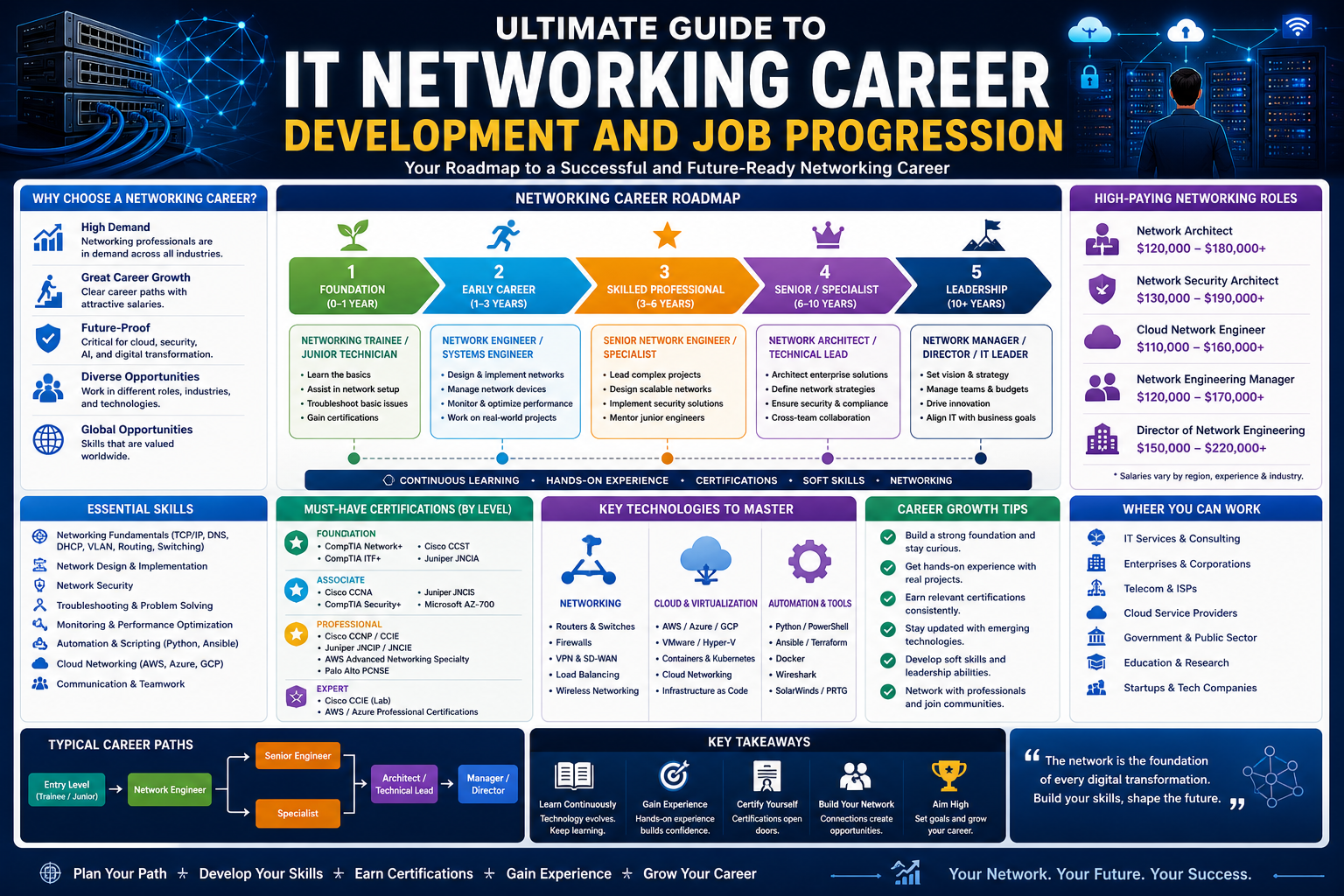
Building a career in IT networking is often less like climbing a single ladder and more like navigating a structured but flexible roadmap. The field itself is broad, covering everything from basic hardware troubleshooting to designing complex enterprise networks that span multiple countries and cloud environments. Because of this depth, many newcomers feel uncertain about where to begin and how each stage connects to the next.
A structured pathway helps remove that confusion by breaking the journey into progressive stages. Each stage builds on the previous one, gradually increasing both technical depth and professional responsibility. Instead of jumping randomly between technologies, learners move in a logical sequence that strengthens core understanding before introducing advanced concepts.
At the entry level, the focus is typically on foundational IT knowledge. This includes understanding how computers operate, how operating systems interact with hardware, and how basic networking concepts like IP addressing and routing function. These fundamentals are essential because they serve as the base for everything that comes later. Without them, more advanced topics can feel disconnected or overly complex.
As individuals progress, they begin to specialize in networking. This is where structured certification paths and hands-on practice become especially important. Networking is not just theory—it is a practical discipline that requires understanding how data moves, how devices communicate, and how systems remain secure and reliable under different conditions.
One of the most important aspects of this journey is consistency. Progress in IT networking is rarely achieved through short bursts of study. Instead, it develops through steady learning, regular practice, and continuous exposure to real or simulated environments. This long-term commitment is what transforms beginners into capable professionals.
Understanding the Foundation of an IT Networking Career
Before diving into advanced networking roles, it is essential to understand what constitutes the foundation of IT. Many professionals underestimate this stage, assuming that networking begins directly with routers and switches. In reality, networking is built on a much broader base of knowledge.
At the core, entry-level IT knowledge includes computer hardware, operating systems, and basic troubleshooting skills. These areas help professionals understand how devices function individually before learning how they connect within a network. For example, knowing how memory, storage, and processors work allows a technician to better understand performance issues that may later appear in networked systems.
Operating systems also play a crucial role. Whether dealing with Windows, Linux, or other environments, understanding file systems, permissions, command-line tools, and system configurations is vital. Networks do not exist in isolation; they rely heavily on operating systems to manage communication and resource sharing.
Another important foundation is basic troubleshooting methodology. IT professionals must learn how to identify problems systematically rather than guessing solutions. This includes isolating issues, testing hypotheses, and verifying outcomes. These skills become increasingly important as networks grow more complex.
Soft skills also begin developing at this stage. Communication, documentation, and analytical thinking are often overlooked but are essential in real-world IT environments. A networking professional frequently needs to explain technical issues to non-technical users, collaborate with teams, and document configurations clearly.
This foundational stage is not about speed but about depth. A strong understanding here ensures that future learning is smoother and more meaningful.
Entering the World of Networking Concepts
Once the foundational IT knowledge is in place, the next stage introduces networking concepts. This is where learners begin to understand how devices communicate within and between networks. It is a shift from individual systems to interconnected systems.
At this stage, key concepts include IP addressing, subnetting, routing, switching, and network protocols. These ideas form the language of networking. Without them, it becomes impossible to understand how data travels from one point to another.
IP addressing is one of the most critical components. It defines how devices are identified on a network. Understanding how IPv4 and IPv6 work, how addresses are assigned, and how they are structured is essential for troubleshooting and design.
Subnetting introduces the concept of dividing networks into smaller segments. This improves efficiency, security, and performance. While it may seem mathematical at first, subnetting becomes a powerful tool once understood, allowing professionals to design scalable networks.
Switching and routing form the backbone of network communication. Switching operates within local networks, directing traffic between devices in the same network. Routing, on the other hand, connects different networks, enabling communication across broader infrastructures like the internet.
Protocols such as TCP/IP, DNS, DHCP, and HTTP define how data is transmitted and interpreted. Each protocol serves a specific function, and understanding their roles helps professionals diagnose issues and optimize performance.
At this stage, learners also begin working with basic network topologies such as star, mesh, and hybrid structures. These layouts determine how devices are physically or logically arranged, influencing performance and reliability.
This phase is where theory starts connecting with practical application. Many learners begin experimenting with simulated environments or small physical setups to reinforce their understanding. Hands-on exposure is critical here because networking concepts become much clearer when observed in action.
The Role of Certification in Shaping a Networking Career
Certifications play a structured role in guiding learners through the networking career pathway. They are not just credentials but structured learning milestones that validate knowledge at different stages.
Entry-level certifications typically focus on general IT and networking fundamentals. These certifications ensure that learners understand basic concepts before moving into more advanced topics. They cover areas such as hardware, software, networking basics, and troubleshooting techniques.
As professionals advance, intermediate certifications introduce more complex networking concepts. These include advanced routing and switching, network security principles, and infrastructure management. At this stage, learners are expected to not only understand concepts but also apply them in practical scenarios.
Advanced certifications represent a high level of expertise. They often focus on designing, implementing, and managing large-scale enterprise networks. Professionals at this stage are expected to handle complex environments, optimize performance, and ensure security across multiple systems.
What makes certifications particularly valuable is their structured progression. They are designed to build knowledge step by step, ensuring that learners do not skip essential concepts. This prevents gaps in understanding that could cause problems later in real-world environments.
However, certifications alone are not enough. They must be combined with hands-on experience. Networking is a practical field, and real-world exposure is essential for understanding how theoretical concepts behave under real conditions.
Many professionals use certifications as checkpoints in their career journey. Each certification represents a milestone, marking progress and readiness for more advanced responsibilities.
Developing Hands-On Experience in Networking
Practical experience is one of the most important components of an IT networking career. While theory provides understanding, hands-on practice builds confidence and problem-solving ability.
One of the most effective ways to gain experience is by building small network environments. These can be physical setups using routers, switches, and computers, or virtual environments using simulation tools. The goal is to replicate real-world scenarios and experiment with configurations.
Through hands-on practice, learners begin to understand how networks behave under different conditions. They can observe how misconfigurations affect connectivity, how routing changes impact traffic flow, and how security settings influence access.
Troubleshooting becomes a key skill during this stage. Instead of relying on theory alone, learners must diagnose and fix real issues. This develops critical thinking and reinforces theoretical knowledge.
Another important aspect of practical learning is experimentation. Trying different configurations, testing various protocols, and simulating failures helps deepen understanding. Mistakes are an essential part of this process, as they provide valuable learning opportunities.
Documentation also becomes important during hands-on practice. Recording configurations, changes, and outcomes helps build professional habits that are essential in real IT environments.
Over time, this practical exposure transforms abstract concepts into real-world skills. It bridges the gap between learning and professional application.
Transitioning from Entry-Level to Intermediate Networking Roles
As professionals gain experience and knowledge, they naturally progress toward intermediate roles in networking. This transition is marked by increased responsibility, deeper technical knowledge, and greater involvement in network management.
At this stage, professionals are expected to handle more complex tasks such as configuring enterprise-level devices, managing network security, and optimizing performance. They may also begin working with larger infrastructures that include multiple locations or cloud environments.
Decision-making becomes more important in intermediate roles. Professionals must evaluate different solutions, consider trade-offs, and implement strategies that align with organizational needs. This requires both technical expertise and analytical thinking.
Collaboration also increases at this stage. Networking professionals often work closely with system administrators, security teams, and software developers. Effective communication becomes essential to ensure that all components of an IT environment work together seamlessly.
Intermediate roles also require a deeper understanding of security. With networks becoming more complex, protecting data and systems becomes a critical responsibility. This includes implementing firewalls, managing access controls, and monitoring for potential threats.
At this stage, professionals begin to specialize. Some may focus on routing and switching, while others may move toward security, cloud networking, or infrastructure design. Specialization helps professionals develop deeper expertise in specific areas of interest.
This transition is a significant milestone in a networking career. It marks the shift from learning and support roles to more independent and strategic responsibilities.
Building a Long-Term Mindset for Networking Success
A successful IT networking career is not defined solely by technical skills. It also requires a long-term mindset focused on continuous learning and adaptability.
Technology evolves rapidly, and networking professionals must keep pace with new developments. This includes updates in protocols, emerging technologies, cloud integration, and security advancements. Staying current is essential for long-term success.
Curiosity plays a major role in this mindset. Professionals who actively explore new technologies and seek to understand how they work tend to grow faster in their careers. This curiosity drives continuous improvement and innovation.
Consistency is another important factor. Learning in IT networking is not a one-time activity. It requires ongoing effort, regular practice, and continuous skill development. Even experienced professionals must keep learning to remain relevant.
Adaptability is equally important. As technologies change, professionals must be willing to adjust their skills and approaches. This flexibility ensures long-term career stability and growth.
Professional networking also contributes to success. Engaging with other IT professionals helps individuals stay informed, share knowledge, and discover new opportunities. These connections often play a key role in career development.
Ultimately, success in IT networking is shaped by a combination of technical knowledge, practical experience, and a strong commitment to continuous growth.
Advancing from Intermediate to Professional Networking Expertise
As an IT networking career progresses beyond the entry stage, professionals begin to operate in more complex and dynamic environments. This phase is often defined by responsibility, independence, and deeper technical engagement with enterprise-level systems. Unlike foundational learning, where the focus is on understanding concepts, this stage emphasizes applying knowledge in real infrastructures where uptime, performance, and security are critical.
At this level, networking professionals are expected to manage larger systems that may include multiple sites, remote users, cloud integrations, and hybrid environments. Networks are no longer simple or isolated—they are interconnected ecosystems that support business operations at scale. Because of this, even small misconfigurations can lead to significant disruptions.
One of the most important shifts during this stage is the move from reactive learning to proactive problem-solving. Instead of simply responding to issues as they arise, professionals begin to anticipate problems, design resilient systems, and implement preventive measures. This requires both technical depth and strategic thinking.
Intermediate professionals also begin to take ownership of network segments. This means they are responsible for ensuring stability, performance, and security within their assigned areas. Accountability becomes a defining feature of this stage, and decisions carry greater weight than before.
Deepening Knowledge of Routing and Switching Technologies
Routing and switching remain at the heart of networking, but at the professional level, the complexity increases significantly. It is no longer about basic configurations but about optimizing performance across large-scale infrastructures.
Advanced routing concepts involve understanding dynamic routing protocols such as OSPF, EIGRP, and BGP. Each of these protocols serves a specific purpose in controlling how data travels across networks. Professionals must understand not only how they function individually but also how they interact within hybrid environments.
BGP, for example, is critical in internet-scale networking. It governs how data is routed between different organizations and service providers. Working with BGP requires a deep understanding of policy-based routing, route filtering, and path selection mechanisms. Mistakes at this level can affect entire network segments or even external connectivity.
Switching technologies has also become more advanced. Concepts such as VLAN design, trunking, spanning tree optimization, and Layer 3 switching are essential for building efficient and scalable local networks. Professionals must ensure that traffic flows smoothly within and between network segments while avoiding loops and congestion.
At this stage, performance optimization becomes a priority. It is not enough for networks to function—they must operate efficiently under heavy loads. This involves analyzing traffic patterns, identifying bottlenecks, and implementing improvements to enhance speed and reliability.
Understanding redundancy and high availability also becomes essential. Enterprise networks must remain operational even in the event of hardware or link failures. Technologies such as link aggregation, failover systems, and redundant routing paths are commonly used to ensure continuous availability.
Introduction to Network Security in Enterprise Environments
As networking responsibilities grow, security becomes an integral part of every decision. In modern IT environments, networks are constant targets for unauthorized access, malware, and data breaches. Because of this, professionals must develop a strong understanding of security principles and implementation strategies.
Network security at this stage goes beyond basic firewall configuration. It involves designing layered defense systems that protect data at multiple levels. This includes securing endpoints, controlling access, encrypting communication, and monitoring traffic for suspicious activity.
Access control becomes a critical component. Professionals must ensure that only authorized users and devices can access specific network resources. This involves implementing authentication systems, role-based access controls, and identity management solutions.
Firewalls and intrusion prevention systems also play a major role. These tools help filter traffic, block malicious activity, and enforce security policies. However, they must be carefully configured to balance security with usability.
Encryption is another key aspect of network security. Data in transit must be protected using secure protocols to prevent interception or tampering. Understanding protocols such as SSL/TLS and VPN technologies is essential for securing communication across public and private networks.
Monitoring and detection systems are also important. Security professionals must continuously analyze logs, traffic patterns, and alerts to identify potential threats. This proactive approach helps prevent incidents before they escalate into major problems.
At this level, networking professionals begin to collaborate closely with cybersecurity teams. This collaboration ensures that security policies are properly integrated into network design and operations.
Expanding into Network Automation and Programmability
One of the most significant shifts in modern networking is the rise of automation and programmability. As networks grow in size and complexity, manual configuration becomes inefficient and error-prone. Automation helps streamline operations, improve consistency, and reduce human error.
Network automation involves using scripts, tools, and software platforms to manage network devices and configurations. Instead of configuring devices individually, professionals can automate repetitive tasks across entire infrastructures.
Programmability introduces the concept of interacting with network devices through APIs. This allows systems to communicate with each other and execute tasks without manual intervention. It represents a major evolution in how networks are managed.
At this stage, networking professionals begin to learn basic programming or scripting languages. These skills enable them to create automation workflows, manage configurations, and analyze network data more efficiently.
Automation also supports scalability. In large enterprise environments, manually configuring hundreds or thousands of devices is impractical. Automation ensures consistency across all devices and reduces deployment time significantly.
Another important benefit of automation is error reduction. Manual configuration often leads to inconsistencies and mistakes. Automated systems follow predefined rules, ensuring accuracy and reliability.
Professionals working with automation also gain exposure to tools that manage infrastructure as code. This approach treats network configurations as programmable assets, allowing them to be version-controlled, tested, and deployed systematically.
This shift toward automation represents a major transformation in networking careers. It requires professionals to think not only as engineers but also as system designers and developers.
Exploring Cloud Networking and Hybrid Infrastructure
Modern IT environments increasingly rely on cloud computing. As a result, networking professionals must understand how traditional networks integrate with cloud platforms. This includes both public and private cloud environments, as well as hybrid architectures that combine on-premises and cloud resources.
Cloud networking introduces new challenges and opportunities. Unlike traditional networks, cloud environments are highly dynamic and scalable. Resources can be created, modified, or removed on demand, requiring flexible networking configurations.
Virtual networks play a key role in cloud environments. These networks operate within cloud platforms and provide isolated environments for applications and services. Understanding how virtual networks function is essential for managing cloud-based infrastructure.
Connectivity between on-premises networks and cloud environments is another critical area. Professionals must design secure and reliable connections that allow seamless communication between different environments. This often involves VPNs, dedicated connections, and hybrid networking solutions.
Load balancing is also an important concept in cloud networking. It ensures that traffic is distributed evenly across multiple resources, improving performance and reliability. Professionals must understand how load balancers operate and how to configure them effectively.
Scalability is one of the main advantages of cloud networking. Systems can automatically adjust resources based on demand, ensuring optimal performance during peak usage periods. Networking professionals must design systems that support this dynamic behavior.
Security remains a major concern in cloud environments. Professionals must ensure that data is protected both in transit and at rest, and that access controls are properly configured across cloud resources.
Understanding cloud networking is now a fundamental requirement for advanced IT professionals, as most modern infrastructures rely heavily on cloud integration.
Strengthening Network Monitoring and Performance Optimization
As networks grow in complexity, monitoring becomes essential for maintaining stability and performance. Professionals must continuously observe network behavior to ensure that systems are operating as expected.
Network monitoring involves tracking traffic flow, device performance, and system health. This data helps identify potential issues before they impact users. Monitoring tools provide real-time insights into network activity, enabling proactive management.
Performance optimization is closely related to monitoring. By analyzing network data, professionals can identify bottlenecks, inefficiencies, and areas for improvement. This allows them to make informed decisions that enhance overall performance.
Latency, bandwidth usage, and packet loss are key metrics in network performance analysis. Understanding these indicators helps professionals diagnose issues and implement corrective measures.
Capacity planning is another important aspect. Networks must be designed to handle future growth without degradation in performance. This requires analyzing current usage patterns and predicting future demands.
Fault detection and troubleshooting also rely heavily on monitoring systems. When issues arise, professionals use monitoring data to quickly identify the root cause and restore normal operations.
At this stage, networking professionals develop a more analytical mindset. They move from simply managing systems to optimizing them for efficiency and reliability.
Developing Expertise in Enterprise Network Design
Enterprise network design is one of the most advanced areas in IT networking. It involves creating large-scale network architectures that support business operations across multiple locations and technologies.
Designing enterprise networks requires a deep understanding of scalability, redundancy, performance, and security. Every design decision must consider both current requirements and future growth.
Hierarchical network design is commonly used in enterprise environments. This approach divides the network into layers, each with specific roles and responsibilities. This structure improves scalability and simplifies management.
Redundancy is a critical design principle. Enterprise networks must remain operational even if individual components fail. This requires careful planning of backup systems, failover mechanisms, and alternative routing paths.
Security must also be integrated into the design process. Rather than being added later, security should be built into the network architecture from the beginning. This includes segmentation, access controls, and monitoring systems.
Designing enterprise networks also involves collaboration with multiple teams, including security, cloud, and infrastructure specialists. Effective communication ensures that all requirements are properly addressed.
At this level, professionals are not just implementing networks—they are designing the foundation of entire IT ecosystems.
Mastering Senior-Level IT Networking Responsibilities
At the senior stage of an IT networking career, professionals move beyond implementation and troubleshooting into architecture, strategy, and long-term infrastructure planning. The focus is no longer just on keeping networks running but on designing systems that are resilient, scalable, secure, and aligned with business goals.
Senior networking professionals are often responsible for entire network ecosystems rather than individual segments. This includes enterprise networks, hybrid cloud systems, data centers, and global connectivity solutions. Decisions made at this level can impact performance, security, and operational efficiency across the entire organization.
One of the defining characteristics of this stage is strategic thinking. Instead of reacting to issues or implementing predefined solutions, senior professionals evaluate business requirements and translate them into technical architectures. This requires a deep understanding of both technology and organizational needs.
At this level, communication also becomes critical. Senior networking professionals frequently collaborate with executives, project managers, security leaders, and software architects. They must be able to explain complex technical concepts in a way that supports decision-making at the business level.
Experience plays a major role here. Years of exposure to different environments help professionals recognize patterns, anticipate challenges, and design more efficient systems. This accumulated knowledge becomes one of their most valuable assets.
Transitioning into Network Architecture and Design Leadership
Network architecture represents one of the highest levels of responsibility in IT networking. Professionals in this role are responsible for designing entire network infrastructures that support organizational goals.
Unlike operational roles, architecture focuses on planning rather than execution. Architects define how networks should be structured, how systems should interact, and how future growth will be supported. These designs must balance performance, cost, security, and scalability.
A key responsibility in network architecture is designing for scalability. Networks must be able to grow without requiring complete redesigns. This involves selecting technologies and structures that can expand efficiently as demand increases.
Redundancy and resilience are also central to architectural design. Systems must be built to withstand failures without disrupting services. This includes redundant links, failover systems, distributed architectures, and geographically diverse deployments.
Security is embedded into every layer of architectural design. Instead of treating security as a separate component, architects integrate it into the foundation of the network. This approach, often referred to as “security by design,” ensures that vulnerabilities are minimized from the outset.
Another important aspect is standardization. Large organizations benefit from consistent configurations and designs across different environments. This simplifies management, reduces errors, and improves interoperability.
Network architects also evaluate emerging technologies. They assess whether new tools, protocols, or platforms can improve performance or efficiency. This requires continuous learning and awareness of industry trends.
At this stage, professionals are no longer just technical experts—they become decision-makers shaping the future of organizational infrastructure.
Advanced Network Security Strategy and Governance
Security at the senior level goes far beyond technical configurations. It becomes a strategic discipline involving governance, risk management, and compliance.
Senior networking professionals play a key role in defining security policies that align with organizational goals and regulatory requirements. These policies guide how networks are designed, operated, and maintained.
Risk assessment becomes a major responsibility. Professionals must identify potential threats, evaluate their impact, and design mitigation strategies. This involves understanding both external threats, such as cyberattacks, and internal risks, such as misconfigurations or human error.
Security governance ensures that policies are consistently applied across the organization. This includes monitoring compliance, auditing systems, and enforcing standards.
Incident response planning is another critical area. Even well-designed networks can experience security incidents. Senior professionals must ensure that there are clear procedures for detecting, responding to, and recovering from security events.
Encryption strategies, identity management systems, and access control frameworks are also refined at this level. These systems must be scalable, secure, and adaptable to evolving threats.
Regulatory compliance becomes increasingly important in enterprise environments. Organizations must adhere to standards related to data protection, privacy, and industry-specific regulations. Networking professionals must ensure that the infrastructure supports these requirements.
At this stage, security is no longer just a technical concern—it becomes a business-critical function integrated into every aspect of network design and operation.
Managing Large-Scale Hybrid and Multi-Cloud Environments
Modern enterprises rarely rely on a single infrastructure model. Instead, they use a combination of on-premises systems, private clouds, public clouds, and edge computing environments. Managing these hybrid systems requires advanced networking expertise.
Hybrid environments introduce complexity because different platforms operate under different architectures and management systems. Networking professionals must ensure seamless communication between these environments.
Connectivity is a major challenge in hybrid networks. Secure and reliable communication channels must be established between on-premises infrastructure and cloud platforms. This often involves VPNs, dedicated connections, and software-defined networking solutions.
Multi-cloud environments add another layer of complexity. Organizations may use multiple cloud providers to optimize performance, cost, or reliability. Networking professionals must ensure interoperability between these platforms.
Latency and performance optimization become critical in distributed environments. Data may need to travel across different regions and platforms, requiring careful design to minimize delays.
Security in hybrid and multi-cloud environments is also more complex. Each platform has its own security model, and professionals must ensure consistent policies across all environments.
Automation plays a key role in managing these systems. Manual configuration is impractical at this scale, so automation tools are used to maintain consistency and efficiency.
At this level, networking professionals must understand both traditional infrastructure and modern cloud ecosystems, integrating them into unified architectures.
Leadership Roles in IT Networking Careers
As professionals reach senior levels, many transition into leadership roles. These roles may include team leadership, technical management, or infrastructure oversight positions.
Leadership in networking requires a combination of technical expertise and people management skills. Leaders must guide teams, coordinate projects, and ensure that technical goals align with business objectives.
One of the key responsibilities of networking leaders is decision-making. They must evaluate different technical solutions and choose the ones that best support organizational needs. These decisions often involve trade-offs between cost, performance, and scalability.
Project management becomes an essential skill. Networking projects often involve multiple teams and complex timelines. Leaders must ensure that projects are completed on time and within budget.
Mentorship is another important aspect of leadership. Senior professionals often guide junior engineers, helping them develop technical skills and understand best practices.
Communication becomes even more critical at this level. Leaders must translate technical details into business language and ensure that stakeholders understand the implications of technical decisions.
Conflict resolution and problem-solving are also part of leadership responsibilities. In complex environments, disagreements and challenges are inevitable, and leaders must navigate these situations effectively.
Leadership roles require a balance between technical depth and strategic thinking. Professionals must remain technically informed while focusing on broader organizational goals.
Emerging Technologies Shaping the Future of Networking
The field of IT networking continues to evolve rapidly, driven by emerging technologies that reshape how systems are designed and managed.
One of the most significant trends is the rise of software-defined networking (SDN). SDN separates control functions from hardware, allowing networks to be managed programmatically. This improves flexibility, scalability, and automation.
Network function virtualization (NFV) is another important development. It replaces traditional hardware-based network functions with software-based solutions, reducing costs and increasing agility.
Artificial intelligence and machine learning are also transforming networking. These technologies enable predictive analytics, automated troubleshooting, and intelligent traffic management.
Edge computing is becoming increasingly important as organizations process data closer to its source. This reduces latency and improves performance for real-time applications.
5G technology is also influencing networking design. It enables faster connectivity, lower latency, and support for a large number of connected devices.
Security technologies continue to evolve as well. Zero-trust architectures are becoming more common, requiring continuous verification of users and devices rather than relying on traditional perimeter-based security.
These emerging technologies require networking professionals to continuously update their skills and adapt to new paradigms.
Continuous Learning and Professional Evolution in Networking Careers
A defining characteristic of successful networking professionals is their commitment to continuous learning. The field evolves too quickly for static knowledge to remain relevant for long.
Senior professionals must stay informed about new technologies, protocols, and best practices. This requires regular study, experimentation, and engagement with industry developments.
Hands-on experience remains important even at advanced levels. New technologies must be tested and understood in practical environments before being deployed in production systems.
Professional evolution also involves expanding beyond technical expertise. Many senior professionals develop skills in strategy, leadership, and business management.
Networking careers are rarely linear. Professionals may move between technical roles, leadership positions, consulting, or specialized architecture roles depending on their interests and opportunities.
Adaptability is essential for long-term success. Those who embrace change and continuously develop their skills are better positioned to thrive in evolving IT environments.
Over time, experience, learning, and leadership combine to shape professionals into experts capable of designing and managing complex global network infrastructures.
Evolving Responsibilities in Complex Network Troubleshooting and Optimization
As networking environments grow in scale and complexity, troubleshooting at the senior level becomes less about fixing isolated issues and more about understanding systemic behavior. Problems are rarely confined to a single device or configuration error; instead, they often emerge from interactions between multiple systems, protocols, and infrastructure layers.
Senior networking professionals develop a holistic approach to troubleshooting. Rather than focusing only on symptoms, they analyze patterns across the entire network. This includes reviewing logs, examining traffic flows, and correlating events across different systems to identify root causes.
One of the key challenges in large-scale environments is distinguishing between correlation and causation. Multiple alerts may appear simultaneously, but only a subset may be directly responsible for the issue. Experienced professionals rely on structured methodologies to isolate the true source of problems.
Network performance optimization also becomes a continuous responsibility at this stage. Instead of reacting to performance degradation, senior engineers proactively tune systems to ensure consistent efficiency. This may involve adjusting routing policies, optimizing bandwidth allocation, or redesigning network segments to reduce congestion.
In many cases, optimization requires balancing competing priorities. For example, improving security may introduce latency, while increasing redundancy may raise costs. Senior professionals must evaluate these trade-offs carefully and align decisions with organizational priorities.
Another important aspect of optimization is capacity forecasting. Networks must be prepared not only for current demand but also for future growth. This involves analyzing usage trends, anticipating business expansion, and designing infrastructure that can scale without disruption.
Strategic Integration of Networking with Business Objectives
At the senior level, networking is no longer viewed as a purely technical function. It becomes tightly integrated with business strategy. Every design decision, upgrade, or optimization effort must support broader organizational goals such as cost efficiency, scalability, customer experience, and operational resilience.
Networking professionals often participate in strategic planning discussions where they translate technical constraints into business implications. For example, they may explain how network latency affects application performance or how infrastructure limitations could impact service delivery.
This requires the ability to communicate complex technical ideas in a clear and business-relevant manner. Technical jargon must be translated into measurable outcomes such as productivity gains, cost savings, or risk reduction.
Budget management also becomes part of the role. Senior professionals may be involved in evaluating technology investments, justifying infrastructure upgrades, or selecting between competing vendor solutions. These decisions must balance technical performance with financial considerations.
Alignment between IT infrastructure and business goals ensures that networking investments contribute directly to organizational success rather than operating in isolation.
Preparing for Future Network Evolution and Innovation
The networking landscape continues to evolve rapidly, and senior professionals must remain forward-looking in their approach. This involves not only managing current systems but also preparing for future technological shifts.
Emerging paradigms such as intent-based networking are changing how networks are designed and operated. Instead of manually configuring devices, administrators define desired outcomes, and systems automatically implement the necessary configurations.
Artificial intelligence-driven network management is also becoming more prominent. These systems can detect anomalies, predict failures, and optimize performance without human intervention. While this does not eliminate the need for human expertise, it shifts the role toward oversight and strategic control.
The increasing adoption of edge computing is reshaping network architecture by distributing processing closer to data sources. This reduces latency and improves responsiveness, particularly for applications such as IoT, real-time analytics, and autonomous systems.
As these technologies evolve, senior networking professionals must continuously evaluate their impact and determine how they can be integrated into existing infrastructures. This requires both technical awareness and strategic foresight.
Ultimately, the senior stage of a networking career is defined by the ability to adapt, innovate, and lead in an environment of constant technological change.
Conclusion
An IT networking career is best understood as a progressive journey rather than a fixed destination. Each stage builds on the previous one, gradually transforming a beginner with foundational knowledge into a highly skilled professional capable of designing, securing, and managing complex global infrastructures. What makes this pathway unique is its combination of technical depth, continuous evolution, and real-world applicability across nearly every industry.
At the beginning of this journey, the focus is on understanding the essentials—how computers operate, how operating systems interact with hardware, and how basic networking principles enable communication between devices. These early concepts may seem simple, but they form the critical foundation upon which everything else is built. Without a strong grasp of fundamentals, advanced topics such as routing protocols, cloud integration, or network automation become significantly more difficult to understand and apply effectively.
As professionals move into networking concepts, they begin to see how individual systems connect to form larger infrastructures. This stage introduces essential technologies such as IP addressing, subnetting, switching, routing, and network protocols. These are not just theoretical ideas but practical tools used daily in real-world environments. Mastery at this level allows individuals to begin troubleshooting real issues and contributing meaningfully to IT operations.
With continued progress, certifications and hands-on experience become important milestones that validate knowledge and reinforce learning. Certifications provide structured guidance, ensuring that learners follow a logical progression of skills. However, it is practical experience that truly solidifies understanding. Building labs, simulating networks, and working with real systems help transform theoretical knowledge into applied expertise.
As professionals advance into intermediate and senior roles, the scope of responsibility expands significantly. Networking is no longer limited to configuring devices or solving isolated problems. Instead, it involves managing enterprise-scale systems, ensuring performance optimization, maintaining security, and supporting business-critical operations. At this level, decision-making becomes more strategic, and professionals must balance technical requirements with organizational goals.
Security also becomes deeply integrated into every aspect of networking. Protecting data, managing access, and defending against evolving cyber threats are no longer optional skills—they are essential responsibilities. Modern networks must be designed with security in mind from the very beginning, rather than treated as an afterthought.
The introduction of cloud computing, automation, and virtualization has further transformed the networking landscape. Professionals are now expected to manage hybrid and multi-cloud environments, automate repetitive tasks, and understand programmable infrastructure. These advancements have not replaced traditional networking skills but have expanded their scope, requiring professionals to continuously adapt and learn.
At the senior level, networking becomes a blend of architecture, leadership, and strategy. Professionals are responsible not only for maintaining systems but also for designing future-ready infrastructures that align with business objectives. They must think beyond immediate technical challenges and consider scalability, resilience, cost efficiency, and long-term innovation.
Leadership roles in networking also emphasize communication and collaboration. Senior professionals often act as bridges between technical teams and business stakeholders, translating complex technical realities into meaningful business insights. This ability to connect technology with organizational goals is a defining characteristic of advanced career stages.
One of the most important themes throughout the entire networking career pathway is continuous learning. Technology evolves rapidly, and what is considered cutting-edge today may become outdated in just a few years. Successful professionals are those who remain curious, adaptable, and committed to ongoing development. Whether through exploring new technologies, refining existing skills, or adapting to industry changes, learning never truly stops in IT networking.
Equally important is the role of hands-on experience. No amount of theoretical knowledge can replace the insights gained from working directly with real systems. Practical exposure helps professionals understand how networks behave under pressure, how failures occur, and how systems can be optimized for better performance.
Ultimately, an IT networking career is shaped by persistence, curiosity, and adaptability. It is a field that rewards those who are willing to grow continuously and embrace both challenges and innovation. Each stage of the journey contributes to building a well-rounded professional capable of navigating complex technological environments.
By following a structured yet flexible career pathway, individuals can move confidently from foundational knowledge to advanced expertise, developing not only technical skills but also strategic thinking and leadership capabilities. This progression ensures that IT networking professionals remain valuable, relevant, and prepared for the evolving demands of the digital world.