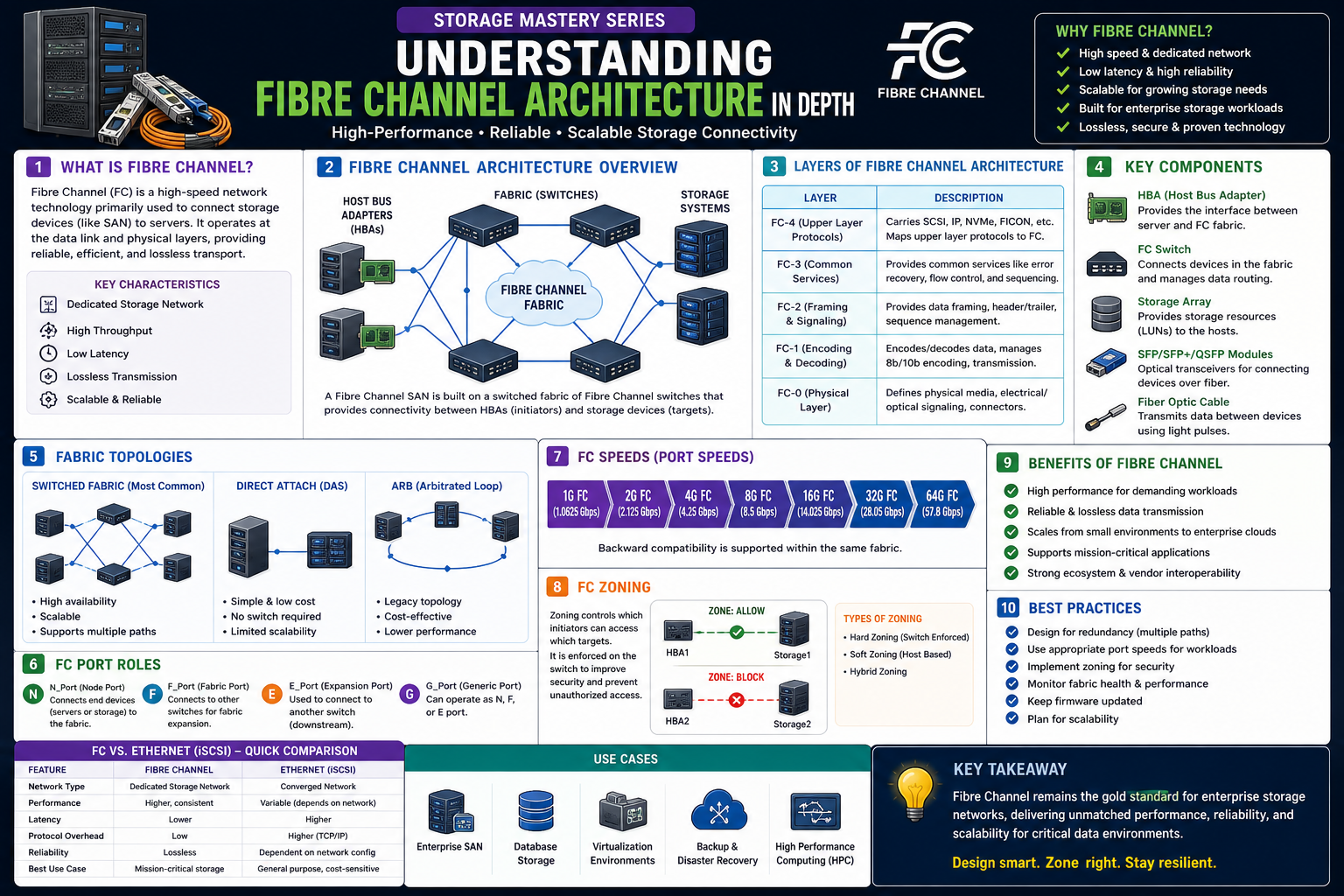
Fibre Channel has long been one of the most important technologies in enterprise storage environments, especially where performance, reliability, and predictable data delivery are critical. At its core, Fibre Channel is not simply a networking protocol in the traditional sense but a specialized high-speed transport mechanism designed specifically for storage area networks (SANs). Unlike general-purpose networking protocols that must handle a wide variety of traffic types and unpredictable workloads, Fibre Channel is purpose-built to move block-level storage data with minimal overhead and extremely high efficiency.
In modern computing environments, where applications rely heavily on continuous data access, Fibre Channel provides the backbone that ensures storage devices appear local to operating systems even when they are physically located across a shared network fabric. This illusion of locality is one of the key architectural strengths of Fibre Channel, allowing servers to access remote storage devices with performance characteristics similar to directly attached disks.
The importance of Fibre Channel becomes even more apparent in environments such as enterprise databases, virtualization clusters, financial systems, and large-scale transactional platforms. In these settings, even minor latency or packet loss can have significant consequences. Fibre Channel addresses these concerns through a combination of hardware-level design, deterministic communication patterns, and a lossless transport model.
The Evolution of Fibre Channel and Its Purpose in Storage Networking
To understand Fibre Channel architecture, it is essential to look at why it evolved in the first place. Before its widespread adoption, storage systems primarily relied on parallel SCSI (Small Computer System Interface), which was highly effective for direct-attached storage but had significant limitations when extended beyond short distances or scaled to large environments.
Parallel SCSI suffered from electrical limitations, signal degradation, and strict device count restrictions. As data centers expanded and storage needs grew, these limitations became increasingly problematic. Fibre Channel was introduced as a solution that could overcome these physical and architectural constraints while maintaining compatibility with existing storage communication models.
One of the most significant design goals of Fibre Channel was distance scalability. Unlike traditional SCSI, which was limited to short cable runs, Fibre Channel enabled reliable communication over much longer distances using optical fiber and, later, also copper-based implementations. This made it suitable not just for local data centers but also for campus-wide and even metropolitan storage deployments.
Another important evolution factor was scalability in terms of connected devices. Fibre Channel introduced a switched fabric architecture that allowed a large number of devices to coexist in a structured and manageable topology. Instead of sharing a single bus like in SCSI, devices communicate through intelligent switches that route frames based on addressing logic.
The protocol also introduced high throughput capabilities that evolved over time from early gigabit speeds to multi-gigabit performance levels. This continuous improvement allowed Fibre Channel to remain relevant in high-performance computing environments even as other storage networking technologies emerged.
Fibre Channel as a Block Storage Transport Mechanism
One of the most important conceptual foundations of Fibre Channel is its relationship with SCSI. Fibre Channel does not replace SCSI; instead, it transports SCSI commands over a high-speed network. This is achieved through the Fibre Channel Protocol (FCP), which encapsulates SCSI commands into Fibre Channel frames.
This design allows operating systems to interact with remote storage devices in a way that is identical to local disk access. From the perspective of the host system, storage devices connected over Fibre Channel appear as locally attached block devices. This abstraction is critical because it allows existing storage-aware applications and operating systems to function without modification.
The FCP layer essentially acts as a translator between the SCSI command set and the Fibre Channel transport mechanism. When a host issues a read or write operation, that request is converted into SCSI commands, encapsulated into Fibre Channel frames, and transmitted across the SAN. At the receiving end, the storage array decapsulates the frames, processes the SCSI commands, and returns the appropriate response.
This tight integration between SCSI and Fibre Channel is one of the reasons why Fibre Channel has remained dominant in enterprise SAN environments for many years. It leverages the maturity of SCSI while enhancing it with a far more robust transport layer.
Fibre Channel Architecture and Layered Design
Fibre Channel architecture is structured in a layered model that is somewhat analogous to the OSI model but specifically optimized for storage communication. Each layer has a distinct responsibility, ensuring modularity and efficient data handling.
At the lowest level is the physical layer, which defines the electrical and optical characteristics of the transmission medium. This includes fiber optics, signaling methods, and data encoding schemes. Above this sits the transmission protocol layer, which handles frame construction, flow control, and error handling.
The upper layers are responsible for protocol mapping, including how SCSI commands are encapsulated and interpreted. This layered structure ensures that Fibre Channel can evolve at the physical level without disrupting higher-level storage communication processes.
A key feature of this architecture is its reliance on frame-based communication. Data is transmitted in discrete frames rather than continuous streams, allowing for precise control, error detection, and retransmission handling. Each frame carries a header, payload, and error-checking information, ensuring data integrity throughout the transmission process.
Switched Fabric Topology and Its Importance
Unlike older bus-based storage systems, Fibre Channel uses a switched fabric topology. In this model, devices do not communicate directly with each other in a shared medium. Instead, they connect to intelligent switches that manage data routing across the network.
This design offers several important advantages. First, it eliminates contention issues that were common in shared-bus architectures. Second, it allows multiple communication paths to exist simultaneously, increasing overall bandwidth utilization. Third, it enables scalable growth, as new devices can be added without disrupting existing communication flows.
Within a Fibre Channel fabric, switches maintain routing tables that determine how frames should be forwarded between devices. This routing is based on Fibre Channel addresses, which are dynamically assigned when devices log into the fabric.
The fabric itself acts as a centralized intelligence layer, coordinating communication between hosts and storage arrays. This separation of physical connectivity from logical communication is one of the defining characteristics of Fibre Channel architecture.
Node Ports and Their Functional Roles
In Fibre Channel networks, communication occurs through specialized interface points known as node ports. These ports define how devices connect to the fabric and interact with other components in the SAN.
One of the most common types is the N_port, which represents a node port on an end device such as a server or storage array. When a device connects to the fabric, its N_port participates in login procedures that establish communication parameters and assign addressing information.
Another important concept is the F_port, or fabric port, which resides on Fibre Channel switches. F_ports provide connectivity between end devices and the fabric itself, acting as intermediaries that manage data flow into the switching infrastructure.
There are also E_ports used for inter-switch communication, allowing multiple switches to form a larger fabric. This interconnection capability enables the creation of large-scale storage networks that span multiple physical locations.
Each of these port types plays a specific role in maintaining the integrity and efficiency of the Fibre Channel environment, ensuring that data flows smoothly across the fabric without congestion or conflict.
Fibre Channel Addressing Structure and Dynamic Allocation
One of the key architectural components of Fibre Channel is its dynamic addressing system. Unlike Ethernet MAC addresses, which are fixed and globally unique, Fibre Channel addresses are dynamically assigned when a device logs into the fabric.
This address is typically composed of three main fields: Domain ID, Area ID, and Port ID. Each field serves a specific purpose in identifying the location and role of a device within the fabric.
The Domain ID identifies the switch or logical grouping within the fabric. The Area ID is used to group related ports within a switch, while the Port ID uniquely identifies a specific port within that group. Together, these fields create a structured addressing scheme that allows efficient routing of frames.
This hierarchical addressing model is essential for scalability. It allows large fabrics to maintain organized communication paths without requiring static configuration for every device.
The Concept of N_Port ID Virtualization (NPIV)
As storage environments evolved to include virtualization technologies, Fibre Channel introduced enhancements such as N_Port ID Virtualization (NPIV). This feature allows multiple virtual N_port identities to share a single physical port on a host system.
In traditional setups, each physical port would correspond to a single Fibre Channel identity. However, with NPIV, a single physical interface can represent multiple virtual nodes, each with its own unique Fibre Channel address.
This capability is particularly important in virtualized server environments, where multiple virtual machines may need direct access to storage resources. Instead of requiring separate physical adapters for each virtual machine, NPIV enables efficient sharing of hardware resources while maintaining logical separation at the storage level.
The result is improved hardware utilization, reduced infrastructure complexity, and greater flexibility in designing storage networks that support virtualization workloads.
World Wide Names and Their Role in Identification
In addition to dynamic addressing, Fibre Channel also uses globally unique identifiers known as World Wide Names (WWNs). These identifiers are similar in concept to MAC addresses in Ethernet networks but are used primarily for device identification rather than routing.
There are two primary types of WWNs: World Wide Node Names (WWNN) and World Wide Port Names (WWPN). The WWNN identifies the device as a whole, while the WWPN identifies individual ports on that device.
WWNs are typically assigned at the hardware level or through firmware configuration, ensuring that they remain consistent regardless of network changes. This stability is crucial for storage environments where persistent identification is required for zoning, access control, and device mapping.
Fibre Channel fabrics use name servers to map these static WWNs to dynamic Fibre Channel addresses. This mapping process allows devices to locate each other without requiring manual configuration of physical addresses.
Flow Control Mechanisms in Fibre Channel Networks
One of the defining features of Fibre Channel is its lossless transport model. Unlike IP-based networks, where packet loss is expected and handled through retransmission, Fibre Channel is designed to prevent loss entirely through built-in flow control mechanisms.
Two primary mechanisms are used to achieve this: Buffer-to-Buffer Credit (BB_Credit) and End-to-End Credit (EE_Credit).
BB_Credit operates at the link level between directly connected ports. It controls how many frames can be transmitted before receiving acknowledgment from the receiving device. This ensures that buffers do not overflow and that no data is lost due to congestion.
EE_Credit operates at a higher level, managing flow control between initiators and targets. It ensures that end-to-end communication remains balanced and that devices do not overwhelm each other with excessive data transmission.
Together, these mechanisms create a tightly controlled data flow environment where transmission is carefully regulated to prevent packet loss, ensuring high reliability and predictable performance across the storage network.
Fibre Channel Zoning and Logical Segmentation
Zoning is a fundamental security and organization mechanism in Fibre Channel environments. It allows administrators to control which devices can communicate with each other within the fabric.
By grouping devices into zones, Fibre Channel ensures that only authorized nodes can discover and interact with each other. This is particularly important in large storage environments where multiple servers and storage arrays coexist.
Zoning is implemented through zone sets, which are collections of individual zones. Only one zone set can be active at a time within a fabric, but devices can belong to multiple zones simultaneously, depending on configuration.
There are different types of zoning, including port-based zoning, where physical port addresses define membership, and WWN-based zoning, where World Wide Names are used for identification. Mixed zoning combines both approaches for greater flexibility.
Zoning works in conjunction with the name server, controlling which devices are visible to each other during discovery. This ensures both security and logical organization within the storage network.
Fibre Channel zoning is often used alongside LUN masking, which operates at the storage array level. While zoning controls fabric-level access, LUN masking controls which logical storage units are visible to specific hosts, creating a layered access control model across the storage environment.
Fibre Channel Fabric Services and the Intelligence Behind the SAN
Fibre Channel networks rely on a set of built-in services that operate within the fabric to manage discovery, login, routing assistance, and overall coordination between devices. These services are not external applications but integral components of the Fibre Channel switch infrastructure. They ensure that every node entering the storage network can properly identify itself, locate other devices, and participate in communication without manual configuration.
At the heart of these services is the idea that a Fibre Channel fabric behaves like an intelligent system rather than a simple collection of switches. When a device connects, it does not immediately begin sending data. Instead, it interacts with fabric services that guide it through a structured onboarding process. This includes identity verification, address assignment, name resolution, and registration with centralized directories maintained by the fabric.
These services also maintain continuous awareness of all connected devices. Whenever a new node joins or leaves the network, fabric services update internal databases so that routing and discovery remain accurate. This dynamic behavior is what allows Fibre Channel networks to scale while maintaining consistency and stability.
The Fabric Login Process and Device Initialization Flow
When a device connects to a Fibre Channel fabric, it must undergo a series of login procedures before it can communicate with other nodes. These login steps are fundamental to establishing identity, capabilities, and communication parameters.
The first step is Fabric Login (FLOGI). During this phase, a device communicates with a fabric switch to request access to the network. The switch responds by assigning a temporary Fibre Channel address and providing information about fabric services. This exchange ensures that the device becomes a recognized participant in the storage network.
Once the fabric login is complete, the device proceeds to Port Login (PLOGI). This stage establishes a session between two end devices, such as a server and a storage array. PLOGI allows both sides to exchange information about their capabilities, buffer sizes, and supported communication parameters.
After PLOGI, the process continues with Process Login (PRLI), which is specifically related to SCSI communication over Fibre Channel. This step enables the exchange of SCSI protocol information, ensuring that both initiator and target understand how to interpret storage commands.
Together, these login stages create a layered initialization process that ensures compatibility, stability, and structured communication across the fabric.
Name Server Functionality and Device Discovery Mechanisms
Within a Fibre Channel fabric, the name server plays a central role in device discovery and communication mapping. When devices log into the fabric, they register their World Wide Names, port information, and service capabilities with the name server.
This registry allows other devices to query the name server to discover available storage targets or initiators. Instead of broadcasting across the network, devices perform targeted queries, which improves efficiency and reduces unnecessary traffic.
The name server maintains a dynamic database that reflects the current state of the fabric. As devices are added or removed, entries are updated in real time. This ensures that the storage environment remains consistent and accurate even in highly dynamic configurations.
The name server also works closely with zoning rules. While it maintains a complete registry of all devices, it only returns information that is permitted by zoning policies. This integration ensures both visibility and security within the fabric.
Fibre Channel Frame Structure and Data Transmission Mechanics
Fibre Channel communication is built around structured data units known as frames. These frames are carefully designed to ensure reliability, efficiency, and error detection during high-speed transmission.
Each frame consists of multiple components, including a header, payload, and cyclic redundancy check (CRC). The header contains routing information, addressing details, and control flags that guide the frame through the fabric. The payload carries the actual data, such as encapsulated SCSI commands or storage responses. The CRC ensures data integrity by allowing the receiving device to detect any corruption during transmission.
Unlike traditional packet-based networks that may allow variable-sized payloads, Fibre Channel frames follow strict formatting rules. This consistency enables predictable performance and simplifies hardware processing within switches and host bus adapters.
Exchange, Sequence, and Frame Hierarchy
Fibre Channel communication is not limited to individual frames. Instead, it operates using a hierarchical structure consisting of exchanges, sequences, and frames.
An exchange represents the highest level of communication and corresponds to a complete operation, such as a SCSI read or write request. Within an exchange, multiple sequences may exist, each representing a logical segment of the operation. Each sequence is further divided into frames, which are the smallest transmission units.
This hierarchical design allows Fibre Channel to manage complex operations efficiently while maintaining strict control over ordering and delivery. If a frame is lost or corrupted, only the relevant sequence or portion of the exchange needs to be retransmitted rather than the entire operation.
This structure is particularly important for maintaining performance in large-scale storage environments where high throughput and low latency are essential.
Ordered Delivery and Reliable Transport Behavior
One of the defining characteristics of Fibre Channel is its ability to maintain the ordered delivery of data. Unlike many IP-based systems, where packets may arrive out of order, Fibre Channel ensures that frames within a sequence are delivered in the correct order.
This behavior is achieved through strict flow control and sequence management mechanisms embedded within the protocol. Each frame carries sequence identifiers that allow the receiving device to reconstruct the original data stream accurately.
This ordered delivery model eliminates the need for complex reassembly logic at higher layers, reducing processing overhead and improving overall performance.
Classes of Service and Communication Guarantees in Fibre Channel
Fibre Channel defines multiple classes of service that determine how data is delivered across the network. These classes are designed to provide different levels of reliability, connection orientation, and resource allocation depending on application requirements.
Although modern implementations primarily rely on Class 3 service, understanding the full model provides insight into the protocol’s design flexibility. Class 1 offers dedicated, connection-oriented communication with guaranteed bandwidth. Class 2 provides acknowledged frame delivery without dedicated paths. Class 3, the most widely used, delivers datagram-style communication without acknowledgment at the frame level but relies on higher-layer protocols for reliability.
The selection of service class impacts how resources are allocated within the fabric and how communication is managed between devices. In practice, Class 3 combined with robust flow control mechanisms provides an optimal balance of performance and efficiency for most storage environments.
Why Class 3 Dominates Modern Storage Networks
Class 3 service has become the standard for modern Fibre Channel deployments due to its simplicity and efficiency. It eliminates the overhead associated with connection management while still maintaining reliability through hardware-level flow control and upper-layer protocol handling.
In storage environments where large volumes of data must be transferred quickly, reducing protocol overhead is essential. Class 3 achieves this by treating each frame as an independent unit of transmission, allowing switches to process data at high speed without maintaining complex session states.
Despite its connectionless nature, Class 3 is still highly reliable due to the lossless design of Fibre Channel networks. The combination of buffer credit flow control and deterministic switching ensures that frames are delivered without loss under normal operating conditions.
Fibre Channel Routing, Switch Behavior, and Fabric Topology Control
Within a Fibre Channel fabric, switches are responsible for determining the most efficient path for frame delivery. This routing process is handled dynamically using internal forwarding tables that map destination addresses to specific output ports.
When a frame enters a switch, the switch examines the destination Fibre Channel address contained in the frame header. It then consults its routing table to determine which port leads toward the target device. The frame is then forwarded accordingly.
This process is repeated at each switch along the path until the frame reaches its destination. Because routing decisions are made independently at each switch, the system remains highly scalable and adaptable to changes in topology.
Fabric Shortest Path First (FSPF) Routing Protocol
To manage routing within the fabric, Fibre Channel uses a specialized protocol known as Fabric Shortest Path First (FSPF). This protocol is responsible for discovering network topology and calculating optimal paths between switches.
FSPF operates similarly to link-state routing protocols used in IP networks, but is specifically designed for Fibre Channel environments. It continuously monitors link states and updates routing tables when changes occur, such as switch additions, failures, or link disruptions.
By maintaining an up-to-date view of the fabric topology, FSPF ensures that data is always routed along the most efficient available path. This reduces latency and prevents bottlenecks in large-scale storage networks.
Inter-Switch Links and Fabric Expansion
Inter-switch links (ISLs) are critical components of Fibre Channel fabrics, allowing multiple switches to be connected into a unified network. These links carry traffic between switches and enable the fabric to expand beyond the limits of a single device.
ISLs must be carefully managed to ensure balanced traffic distribution and optimal performance. In many environments, multiple ISLs are configured between switches to provide redundancy and increased bandwidth.
Some advanced configurations also support trunking, where multiple physical ISLs are combined into a single logical link. This allows for load balancing and improved utilization of available bandwidth across the fabric.
Congestion Management and Traffic Behavior
As Fibre Channel networks scale, congestion management becomes an important consideration. Although the protocol is designed to be lossless, congestion can still occur if buffer credits are exhausted or if traffic patterns become uneven.
Switches use internal mechanisms to monitor buffer availability and adjust frame transmission rates accordingly. If congestion is detected, flow control signals are used to slow down transmission and prevent buffer overflow.
This proactive approach ensures that data integrity is maintained even under heavy load conditions. It also highlights the importance of proper fabric design, including adequate buffer allocation and balanced topology planning.
Storage Virtualization and Multipathing in Fibre Channel Environments
In enterprise storage environments, reliability and continuous availability are critical requirements. Fibre Channel supports these requirements through multipathing, which allows a single host to access storage through multiple physical paths.
Multipathing ensures that if one path fails due to hardware issues or link disruptions, traffic can be rerouted through alternative paths without interrupting application access. This is achieved through host-based software that manages path selection and failover behavior.
The presence of multiple paths also enables load balancing, where traffic is distributed across available connections to optimize performance and reduce congestion.
Virtualization and Shared Storage Access Models
Modern data centers often rely heavily on virtualization technologies, where multiple virtual machines share underlying physical resources. Fibre Channel plays a crucial role in enabling high-performance storage access in these environments.
Through mechanisms such as NPIV and virtual SAN configurations, multiple virtual entities can share physical Fibre Channel ports while maintaining logical separation. This allows storage resources to be allocated dynamically based on workload requirements.
Virtualization introduces additional complexity in terms of storage mapping and access control, but Fibre Channel provides the necessary infrastructure to manage these challenges efficiently.
Storage Arrays and Target Behavior in SAN Environments
Storage arrays in Fibre Channel environments act as target devices that respond to SCSI commands from initiators. These arrays are designed to handle multiple simultaneous connections, often across large-scale fabrics with hundreds or thousands of hosts.
Internally, storage arrays manage incoming requests using queueing systems that prioritize and schedule operations based on performance and consistency requirements. This ensures that high-priority workloads receive appropriate resources while maintaining overall system stability.
The interaction between initiators and storage targets is governed by established login sessions and protocol exchanges, ensuring consistent communication even under heavy load.
Security Considerations and Access Control in Fibre Channel Fabrics
Although Fibre Channel was originally designed for trusted data center environments, modern deployments require strong security controls due to increasing complexity and multi-tenant usage. Security in Fibre Channel is primarily enforced through zoning, authentication mechanisms, and controlled fabric access policies.
Zoning ensures that only authorized devices can communicate, while switch-level controls prevent unauthorized access to fabric services. These mechanisms collectively create a controlled environment where data flows are tightly regulated.
Role of Authentication and Fabric Integrity Controls
Some Fibre Channel implementations support authentication protocols that verify device identity before allowing access to the fabric. This adds a layer of protection beyond zoning and WWN identification.
Fabric integrity is also maintained through continuous monitoring of link states, device behavior, and configuration consistency. Any unauthorized changes or anomalies can trigger alerts or restrict access to maintain stability.
Isolation and Multi-Tenant Storage Design
In environments where multiple departments or organizations share storage infrastructure, isolation becomes a critical requirement. Fibre Channel supports this through a combination of zoning, virtual fabrics, and logical segmentation.
These mechanisms ensure that each tenant operates within a controlled portion of the fabric, preventing unintended access to other tenants’ data while still allowing shared physical infrastructure.
Performance Optimization and Operational Efficiency in Fibre Channel Networks
Buffer credit management plays a significant role in Fibre Channel performance. Proper allocation of BB_Credits ensures that links are fully utilized without causing congestion or packet loss.
If buffer credits are too low, throughput may be limited, especially over long-distance links. If configured correctly, buffer credits allow sustained high-speed data transfer with minimal interruptions.
Latency Considerations in High-Speed Storage Networks
Latency in Fibre Channel environments is influenced by multiple factors, including switch processing time, cable distance, and buffer availability. Because Fibre Channel is designed for deterministic performance, latency remains relatively stable compared to general-purpose networks.
This predictability is especially important for latency-sensitive applications such as databases and real-time analytics systems.
Balancing Throughput and Reliability in SAN Design
Designing a Fibre Channel network involves balancing throughput requirements with reliability and redundancy considerations. Over-provisioning can lead to unnecessary cost, while under-provisioning may result in performance bottlenecks.
Careful planning of fabric topology, ISL distribution, and multipathing configurations ensures that the storage network meets performance expectations under varying workloads.
Fibre Channel Management, Monitoring, and Operational Visibility
In real-world storage environments, Fibre Channel is not just a theoretical architecture but a continuously operating ecosystem that requires careful monitoring and management. Once a fabric is deployed, it becomes essential to maintain visibility into how devices communicate, how traffic flows across switches, and how resources are being utilized. Unlike simpler network setups, Fibre Channel environments demand a higher level of operational awareness because even small misconfigurations can impact critical storage workloads.
Administrators typically interact with Fibre Channel fabrics through management interfaces provided by switches and storage arrays. These interfaces expose detailed information about port status, login activity, frame statistics, and error conditions. By observing this data, it becomes possible to detect early signs of congestion, misrouted traffic, or hardware degradation before they escalate into serious issues.
The operational model of Fibre Channel is built around continuous stability. Once properly configured, the network is expected to run for long periods without disruption. However, this stability depends heavily on ongoing monitoring and proactive maintenance, especially in large-scale environments where hundreds or thousands of devices may be interconnected.
Monitoring Port Health and Link Stability
One of the most important aspects of Fibre Channel management is monitoring the health of physical and logical ports. Each port within the fabric maintains a detailed set of counters that track transmitted frames, received frames, error rates, and link resets.
A stable Fibre Channel environment typically shows consistent frame flow with minimal error counts. Any sudden increase in errors, such as CRC failures, encoding errors, or loss of synchronization, can indicate underlying physical issues such as faulty cables, degraded optics, or unstable connections.
Link stability is equally important. Fibre Channel links are expected to maintain long periods of uninterrupted connectivity. Frequent link resets or state changes may suggest problems with switch ports or end-device interfaces. These issues must be addressed quickly to avoid disruptions in storage access.
Port monitoring also helps identify imbalanced traffic distribution. In some cases, certain ports may carry significantly more traffic than others, leading to congestion on specific paths. By analyzing port-level statistics, administrators can redistribute workloads or adjust multipathing configurations to improve overall efficiency.
Fabric Log Analysis and Event Interpretation
Fibre Channel switches generate detailed logs that capture events occurring within the fabric. These logs include information about device logins, zoning changes, link failures, and routing updates. Proper interpretation of these logs is essential for understanding the behavior of the storage network.
For example, repeated login failures from a specific device may indicate zoning misconfigurations or authentication issues. Similarly, frequent fabric reconfiguration messages may suggest instability in inter-switch links or routing inconsistencies.
Event logs also provide insight into fabric topology changes. When new switches or devices are added, logs record how the fabric adapts and redistributes routing information. This historical data is valuable for diagnosing performance changes or identifying the root cause of unexpected behavior.
Over time, log analysis becomes a key part of maintaining a healthy Fibre Channel environment, as it allows administrators to correlate events and detect patterns that may not be visible through real-time monitoring alone.
Fibre Channel Troubleshooting and Problem Isolation Techniques
Despite its highly structured design, Fibre Channel networks can experience performance issues if not properly configured or maintained. One of the most common problems is congestion caused by insufficient buffer credits or uneven traffic distribution across links.
When buffer credits are exhausted, transmission must pause until resources become available again. This can lead to increased latency and reduced throughput. Identifying buffer credit starvation requires careful analysis of port statistics and traffic flow patterns.
Another common bottleneck occurs when multipathing is not correctly configured. If traffic is routed through a single path instead of being distributed across multiple available links, that path can become overloaded while others remain underutilized.
Switching oversubscription can also contribute to performance degradation. This occurs when the combined traffic demand of connected devices exceeds the capacity of inter-switch links or uplinks to storage arrays.
Diagnosing Connectivity and Login Failures
Connectivity issues in Fibre Channel environments often manifest as failed device logins or missing storage visibility on host systems. These problems typically originate from zoning misconfigurations, incorrect WWN entries, or physical layer issues.
When a device fails to log into the fabric, the first step is to verify physical connectivity. This includes checking cable integrity, port status, and optical signal strength. If the physical layer is stable, the next step is to examine fabric login records to determine whether the device is being recognized by the switch.
Zoning configuration is another critical area of investigation. If a device is not included in the correct zone, it may be unable to discover storage targets even though it is properly connected to the fabric. Similarly, incorrect WWN assignments can prevent devices from being associated with the correct access policies.
By systematically isolating each layer—from physical connectivity to logical configuration—administrators can efficiently identify the root cause of connectivity issues.
Using Frame-Level Analysis for Deep Troubleshooting
In complex scenarios, troubleshooting may require frame-level analysis. Fibre Channel analyzers can capture and inspect individual frames as they traverse the network, providing detailed insight into communication behavior.
This level of analysis can reveal issues such as retransmissions, malformed frames, or unexpected sequence interruptions. It can also help identify timing-related problems where delays between frames indicate congestion or resource contention.
Frame-level diagnostics are particularly useful in high-performance environments where traditional monitoring tools may not provide sufficient granularity. By examining the exact structure and flow of frames, administrators can gain a precise understanding of how data moves through the fabric.
Fibre Channel Evolution and Integration with Modern Storage Technologies
While Fibre Channel remains a dominant technology in enterprise storage, modern data centers increasingly adopt hybrid architectures that integrate multiple networking protocols. These environments often combine Fibre Channel with Ethernet-based storage solutions to achieve flexibility and cost efficiency.
This evolution has led to the development of technologies that bridge traditional Fibre Channel environments with IP-based infrastructures. These hybrid models allow organizations to leverage existing Fibre Channel investments while gradually incorporating newer technologies.
Despite these changes, Fibre Channel continues to be favored in environments where performance predictability and low latency are critical requirements. Its deterministic behavior remains difficult to replicate in general-purpose networking protocols.
Fibre Channel over Ethernet (FCoE) Concepts
One of the most significant developments in storage networking is the concept of Fibre Channel over Ethernet (FCoE). This approach encapsulates Fibre Channel frames within Ethernet networks, allowing storage and data traffic to share the same physical infrastructure.
FCoE was designed to reduce hardware complexity by consolidating storage and network traffic onto unified switches. However, it requires careful configuration to maintain the lossless characteristics that Fibre Channel relies on.
Although FCoE introduces flexibility, it also adds complexity in terms of configuration and troubleshooting. As a result, traditional Fibre Channel remains widely used in environments where simplicity and reliability are prioritized over convergence.
Comparison with iSCSI-Based Storage Networks
Another widely used storage protocol is iSCSI, which transmits SCSI commands over standard IP networks. Compared to Fibre Channel, iSCSI offers lower infrastructure costs and greater flexibility but typically introduces higher latency and variability in performance.
Fibre Channel’s dedicated hardware and lossless design provide more consistent throughput, making it suitable for mission-critical workloads. In contrast, iSCSI is often used in environments where cost efficiency and ease of deployment are more important than absolute performance consistency.
The choice between these technologies depends heavily on workload requirements, budget constraints, and operational complexity considerations.
Conclusion
Fibre Channel remains one of the most refined and purpose-built technologies in enterprise storage networking, designed with a clear focus on performance, reliability, and predictable data delivery. Across its architecture, from frame structure to fabric services and flow control mechanisms, it consistently prioritizes stability and deterministic behavior over general-purpose flexibility. This is one of the key reasons it continues to play a critical role in modern storage area networks, even as alternative technologies evolve.
What makes Fibre Channel particularly powerful is the way it abstracts complexity from the host systems while maintaining strict control within the fabric. Transporting SCSI commands over a specialized high-speed network, it allows storage devices to appear as locally attached resources, simplifying application design and improving operational efficiency. At the same time, its layered architecture ensures that each component of the system has a well-defined responsibility, from physical transmission to logical communication and device discovery.
The fabric itself acts as an intelligent environment where switches, ports, and services work together to manage connectivity dynamically. Features such as zoning, name services, and login processes ensure that devices are properly authenticated, discovered, and segmented according to organizational policies. This level of control is essential in environments where data isolation and secure access are as important as raw performance.
Flow control mechanisms like BB_Credit and EE_Credit further distinguish Fibre Channel from other networking technologies by enforcing a lossless communication model. This guarantees that data integrity is preserved even under heavy load conditions, making it ideal for mission-critical applications such as databases, virtualization platforms, and large-scale transactional systems.
At the operational level, Fibre Channel requires careful monitoring, tuning, and management to maintain optimal performance. While the protocol is inherently stable, its efficiency depends on the proper configuration of zoning, multipathing, buffer credits, and switch topology. When these elements are correctly aligned, the result is a highly resilient storage infrastructure capable of supporting demanding workloads with minimal latency and disruption.
Ultimately, Fibre Channel represents a mature and highly specialized approach to storage networking. Its continued relevance in modern data centers reflects its ability to deliver consistent performance in the environments where reliability cannot be compromised. It provides a tightly controlled, lossless transport system that ensures predictable latency, high throughput, and stable communication even under extreme workloads. By combining structured architecture, intelligent fabric services, and hardware-level optimization, Fibre Channel continues to support mission-critical applications where data integrity and uninterrupted access are essential. Its long-standing evolution and proven operational stability make it a trusted foundation for enterprise storage infrastructures that demand both precision and resilience at scale.