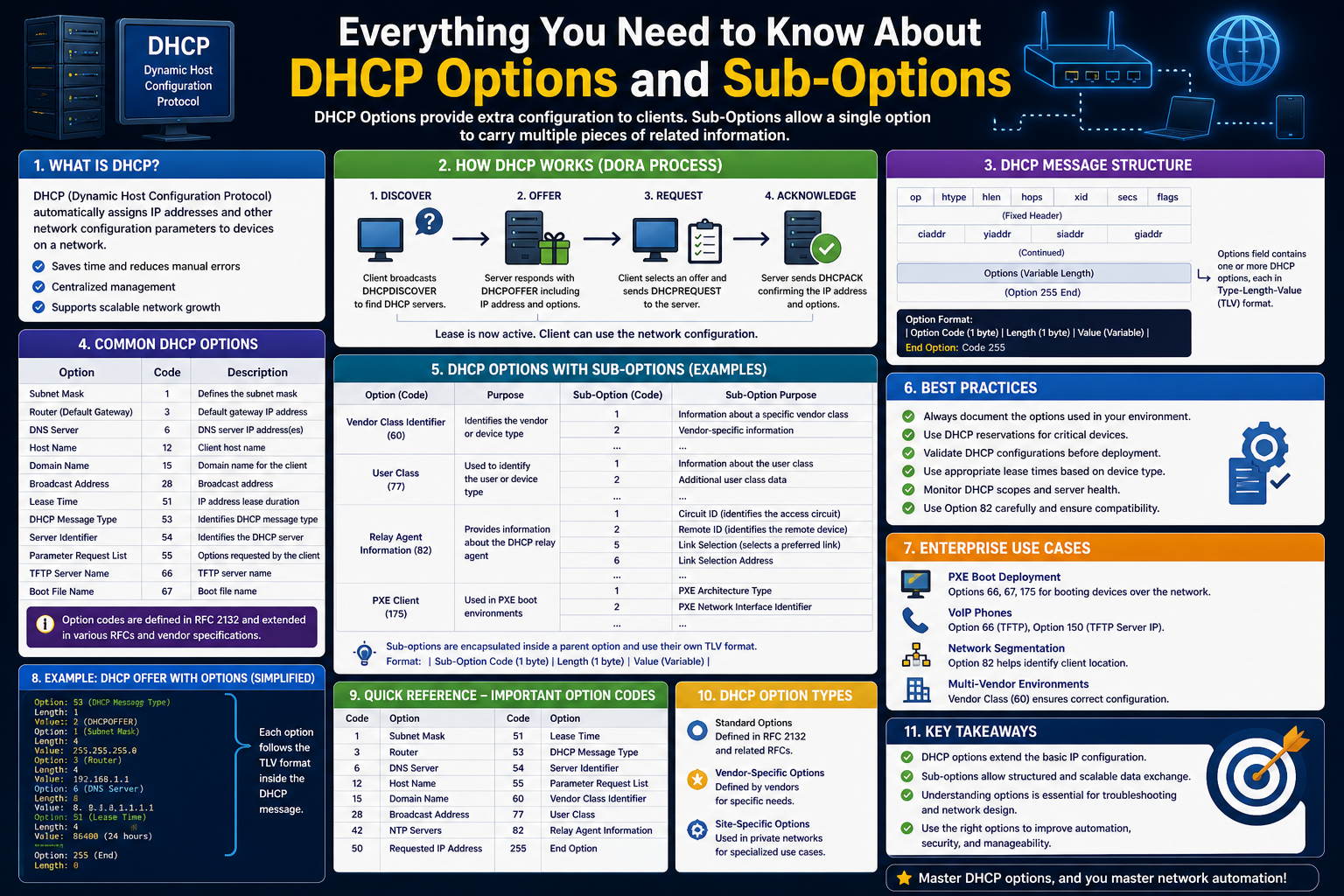
Dynamic Host Configuration Protocol (DHCP) sits at the center of modern network automation. It removes the need for manual configuration of individual devices by assigning essential network settings automatically as soon as a device connects. Without DHCP, every laptop, server, router, or switch would require manual IP configuration, which would not only slow down operations but also increase the risk of human error in large-scale environments.
At its simplest level, DHCP assigns an IP address to a device for a defined period of time, known as a lease. Along with the IP address, it also delivers other critical network parameters such as subnet masks, default gateways, and DNS server information. These elements are required for a device to communicate effectively within a network and beyond it.
However, DHCP is not limited to just basic IP provisioning. It is designed to be flexible and extensible, which is where DHCP options come into play. These options allow administrators to define additional configuration details that go far beyond basic connectivity, enabling automation, provisioning, and advanced network behavior.
In modern enterprise environments, especially those built around large-scale infrastructure and automation frameworks, DHCP becomes a foundational service that supports everything from initial device onboarding to full operating system deployment.
How DHCP Options Extend Basic Network Configuration
DHCP options are essentially additional instructions delivered by a DHCP server to a client device. While the core DHCP process ensures that a device can join the network, options define how that device should behave once it is connected.
These options are identified by numerical codes, each representing a specific type of instruction or configuration parameter. For example, some options tell a device where to find a DNS server, while others may direct it to a network time server or a configuration repository.
What makes DHCP options powerful is their ability to integrate network services into the device initialization process. Instead of requiring manual setup or separate configuration tools, devices can receive all necessary instructions at the moment they request an IP address.
This mechanism is especially important in enterprise and service provider environments where thousands of devices may need to be deployed, updated, or replaced regularly. DHCP options eliminate repetitive manual tasks and allow centralized control over device behavior.
Introducing DHCP Sub-Options and Their Purpose
While DHCP options define broad categories of configuration, sub-options provide even greater precision. Sub-options are used within certain DHCP options to break down instructions into more specific actions.
Not every DHCP option contains sub-options, but when they do, they allow administrators to create structured and multi-layered instructions. This is particularly useful in environments where a single option needs to support multiple types of configuration data.
A good example of this layered structure is Option 43, which is widely used for vendor-specific configurations. In many advanced networking environments, Option 43 is used to support automated provisioning workflows, including Zero Touch Provisioning (ZTP).
Within Option 43, sub-options can define different aspects of the provisioning process, such as which software image should be used, which protocol should retrieve it, and where configuration files are located. This structured approach ensures that complex deployment workflows can be executed automatically without manual intervention.
DHCP in Enterprise Network Automation
In small home networks, DHCP often goes unnoticed because it simply assigns an IP address and basic network settings. However, in enterprise environments, DHCP becomes a strategic tool for automation and orchestration.
Large organizations rely on DHCP not only to assign addresses but also to guide devices through their initial configuration process. When a new device is powered on and connected to the network, DHCP can instruct it to download firmware, retrieve configuration files, and even join specific network segments.
This level of automation significantly reduces deployment time. Instead of manually configuring each device, engineers can rely on DHCP-driven workflows that ensure consistency across all equipment.
In environments where thousands of devices must be deployed or replaced, this automation is not just convenient—it is essential for operational efficiency.
DHCP Options in Network Bootstrapping
One of the most powerful uses of DHCP options is network bootstrapping. Bootstrapping refers to the process by which a device receives everything it needs to become fully operational from scratch.
The Importance of Vendor-Specific DHCP Options
While DHCP is a standardized protocol, vendors often extend its capabilities to support their own hardware and software ecosystems. These extensions are typically implemented through vendor-specific options such as Option 43.
In ecosystems like those built by Juniper Networks, DHCP options are deeply integrated into automation workflows. Devices manufactured within such ecosystems can interpret vendor-specific instructions during the DHCP handshake process, enabling advanced features like automated firmware selection and configuration deployment.
Vendor-specific options are particularly important in Zero Touch Provisioning scenarios. In these environments, a device does not require manual configuration before being deployed. Instead, it relies entirely on DHCP-provided instructions to determine how it should initialize itself.
This approach significantly reduces deployment complexity and ensures that devices are configured consistently across large-scale deployments.
Understanding the Structure of Option 43
Option 43 is one of the most important DHCP options in advanced networking environments because it supports structured sub-options. These sub-options allow multiple instructions to be bundled into a single configuration payload.
Rather than sending a single instruction, Option 43 can carry several pieces of information that guide a device through different stages of initialization.
For example, one sub-option might define which operating system image should be installed, while another specifies the protocol used to retrieve that image. Another sub-option might define where configuration files are stored.
This layered structure makes Option 43 extremely powerful for automated provisioning systems. It allows complex workflows to be encoded into a single DHCP response, which is then interpreted step-by-step by the receiving device.
Sub-Options in Image and Configuration Management
One of the most critical applications of DHCP sub-options is in image and configuration management. When a device is being provisioned, it often needs to download and install a specific software image before it can become operational.
Sub-options can define which version of the software should be installed. For example, a network administrator might specify that certain devices should run a stable release, while others should use a more recent version for testing purposes.
This flexibility allows organizations to control software distribution at scale without manually interacting with each device.
In addition to software images, sub-options can also define configuration files. These files may include settings such as interface configurations, routing policies, authentication parameters, and monitoring endpoints.
By centralizing these instructions within DHCP, organizations ensure that every device is configured according to predefined standards.
Protocol Selection Through DHCP Sub-Options
Another important aspect of DHCP sub-options is the ability to define which protocol should be used for retrieving resources. In many provisioning scenarios, devices need to download files such as operating system images or configuration scripts.
Different environments may use different transfer protocols depending on security requirements, performance considerations, or infrastructure design.
Common protocols include TFTP, FTP, and HTTP. Each has its own advantages and limitations. Sub-options allow administrators to specify which protocol should be used in a given scenario.
For instance, a lightweight protocol like TFTP might be used in environments where simplicity is important, while HTTP might be preferred in more secure or scalable environments.
This level of control ensures that devices interact with network resources in a predictable and controlled manner.
The Relationship Between DHCP and Zero Touch Provisioning
Zero Touch Provisioning (ZTP) is one of the most significant advancements in network automation, and DHCP plays a central role in enabling it.
ZTP allows network devices to be deployed without manual configuration. When a device is connected to the network and powered on, it automatically retrieves all necessary instructions through DHCP and begins configuring itself.
This process typically involves multiple stages, including IP assignment, image selection, software download, and configuration application.
DHCP options and sub-options provide the structured data required for each of these stages. Without them, ZTP would not be possible at scale.
In environments where rapid deployment is essential, such as cloud data centers or large enterprise networks, ZTP dramatically reduces setup time and operational overhead.
Security Considerations in DHCP-Based Automation
While DHCP automation provides significant benefits, it also introduces important security considerations. Because DHCP operates before a device is fully authenticated, it can potentially expose sensitive processes to unauthorized access if not properly secured.
For example, when devices download software images or configuration files, those resources must be protected from unauthorized modification or interception.
To mitigate these risks, organizations often isolate DHCP provisioning environments from production networks. This ensures that only trusted devices and services can participate in the provisioning process.
Additionally, access to image repositories and configuration servers is often restricted to anonymous or controlled access within segmented network zones.
These security measures are essential to maintaining the integrity of automated provisioning workflows.
DHCP as the Foundation of Scalable Infrastructure
As networks continue to grow in size and complexity, the importance of automation becomes increasingly clear. DHCP, along with its options and sub-options, serves as one of the foundational technologies that make this automation possible.
By enabling devices to self-configure based on centralized instructions, DHCP reduces manual workload, improves consistency, and accelerates deployment cycles.
When combined with modern networking ecosystems such as those provided by Juniper Networks, DHCP becomes part of a broader automation strategy that supports scalable, efficient, and standardized infrastructure management.
In large environments where thousands of devices must be deployed and maintained, DHCP is not just a convenience—it is a critical operational component that ensures networks can grow without becoming unmanageable.
How DHCP Communication Shapes Device Initialization
When a device connects to a network, the interaction with DHCP begins long before any meaningful configuration is applied. This early communication phase is critical because it defines how the device will behave for the rest of its initialization cycle. The process starts with a broadcast request, where the device announces its presence and requests configuration parameters from any available DHCP server.
At this stage, the device has no knowledge of the network it has joined. It does not know which subnet it belongs to, where configuration resources are stored, or which services are available. The DHCP server responds with a structured set of instructions that guide the device step by step.
These instructions are not limited to basic IP configuration. They often include extended parameters delivered through DHCP options, which define how the device should proceed with tasks such as boot image retrieval, configuration loading, and service discovery. The entire process is designed to be deterministic, ensuring that every device follows a predictable initialization path.
In large enterprise environments, this deterministic behavior is essential. Without it, devices would require manual setup, which would significantly slow down deployment and introduce inconsistencies across infrastructure.
The Structure of DHCP Exchanges in Complex Networks
The DHCP communication process is built around a sequence of message exchanges between the client and server. Each message carries specific information that gradually builds the device’s configuration state.
The initial request from the device contains minimal information, primarily its hardware identifier and a request for network configuration. The server responds with a proposed configuration, including IP address allocation and optional parameters. The device then acknowledges this configuration, finalizing the lease.
However, in advanced environments, this exchange includes additional layers of information embedded within DHCP options. These options are interpreted by the device after the basic IP configuration is complete, allowing it to proceed with secondary tasks such as downloading operating system images or retrieving configuration files.
This layered approach ensures that DHCP remains lightweight while still supporting complex provisioning workflows.
DHCP Options as Structured Configuration Instructions
DHCP options function as structured instruction sets delivered during the initialization phase of a device. Each option represents a specific category of configuration data, and together they form a complete provisioning profile.
Instead of relying on manual input, devices interpret these options automatically. This allows network administrators to define behavior centrally, rather than configuring each device individually.
In enterprise environments, these options often include information about network services, authentication systems, time synchronization servers, and provisioning endpoints. Each piece of information contributes to the overall configuration state of the device.
The flexibility of DHCP options is what makes them suitable for large-scale automation. They can be adapted to different environments, device types, and operational requirements without changing the underlying protocol.
The Role of Option 66 and Option 150 in Resource Discovery
Among the most widely used DHCP options in provisioning workflows are Option 66 and Option 150. These options are primarily responsible for directing devices to external resources required for bootstrapping and configuration.
Option 66 is commonly used to specify a single server location, often associated with file transfer services. Option 150, on the other hand, can support multiple server addresses, making it more suitable for environments where redundancy is required.
These options are particularly important in environments where devices must retrieve configuration files or software images immediately after connecting to the network. Without them, devices would not know where to locate the resources required to complete their initialization process.
In ecosystems such as those built by Juniper Networks, these options are frequently used as part of automated provisioning workflows. Devices interpret these instructions as part of their startup sequence, enabling them to retrieve the necessary resources without manual intervention.
How Devices Interpret DHCP Option Hierarchies
When multiple DHCP options are present, devices must determine how to prioritize and interpret them. This is achieved through a structured hierarchy defined by the device’s operating system and firmware.
Some options take precedence over others, while certain sub-options are only evaluated if specific conditions are met. This hierarchical interpretation ensures that devices can handle complex configuration scenarios without ambiguity.
For example, if multiple image sources are defined, the device may prioritize one based on internal rules or fallback mechanisms. Similarly, configuration file locations may be evaluated in a specific order until a valid resource is found.
This behavior is essential in large-scale environments where redundancy and failover mechanisms are required. By allowing multiple configuration paths, DHCP ensures that devices can still initialize successfully even if certain resources are unavailable.
The Function of DHCP Relay in Distributed Networks
In large networks, DHCP servers are not always located within the same subnet as the devices they serve. To bridge this gap, DHCP relay mechanisms are used.
A DHCP relay agent forwards requests from devices in one subnet to a DHCP server located in another subnet. It then returns the server’s response to the original device.
This mechanism is essential in distributed network environments where centralized DHCP servers manage multiple network segments. Without relay functionality, each subnet would require its own DHCP server, which would increase complexity and administrative overhead.
DHCP relay also plays a role in maintaining consistent configuration policies across geographically distributed infrastructure. By centralizing DHCP logic, organizations can ensure that all devices receive uniform configuration instructions regardless of their physical location.
DHCP Scope Design and Address Allocation Strategy
A DHCP scope defines the range of IP addresses and configuration parameters that a DHCP server can assign to devices within a specific network segment. Scope design is a critical aspect of network planning because it determines how efficiently addresses are allocated and managed.
Within each scope, administrators define not only the range of available IP addresses but also the associated DHCP options that apply to devices in that network. This allows different network segments to receive different configuration profiles based on their function or location.
For example, a production network might receive one set of configuration options, while a testing environment receives another. This separation ensures that devices behave appropriately based on their operational context.
Scope design also influences scalability. Poorly designed scopes can lead to address exhaustion or configuration conflicts, while well-structured scopes support long-term network growth.
Vendor Classes and Device-Specific Configuration Logic
In advanced DHCP environments, devices can be categorized into vendor classes. A vendor class represents a group of devices that share similar characteristics or come from the same manufacturer.
This classification allows DHCP servers to deliver different configuration options based on device type. For example, routers, switches, and servers may each receive different provisioning instructions even if they are on the same network segment.
Vendor classes are especially useful in heterogeneous environments where multiple hardware platforms coexist. They allow administrators to tailor configuration behavior without creating separate infrastructure for each device type.
In ecosystems such as those provided by Juniper Networks, vendor-specific logic is often used to support advanced provisioning workflows. Devices interpret DHCP options differently based on their firmware capabilities, enabling more precise control over initialization behavior.
The Importance of Option Parsing in Device Firmware
When a device receives a DHCP response, it must parse the included options and determine how to apply them. This process occurs within the device’s firmware or operating system during the early stages of boot.
Option parsing involves interpreting numerical identifiers, validating data formats, and mapping values to internal configuration parameters. This process must be highly reliable because errors at this stage can prevent the device from completing its initialization.
Different devices may interpret the same DHCP options in slightly different ways depending on their firmware design. This is why standardization and vendor documentation are important in enterprise environments.
Once options are parsed, the device begins executing the instructions in sequence, which may include contacting external servers, downloading files, or applying configuration templates.
DHCP and Automated Image Deployment Workflows
One of the most advanced uses of DHCP options is in automated image deployment. In this workflow, a device receives instructions that guide it to download and install a specific operating system image immediately after connecting to the network.
This process eliminates the need for manual installation and ensures that all devices run standardized software versions. It also allows organizations to update devices at scale by simply modifying DHCP option configurations.
Image deployment workflows typically involve multiple stages, including resource discovery, protocol selection, file retrieval, and installation execution. Each stage is guided by DHCP options or sub-options that define the required behavior.
This level of automation is particularly valuable in environments where devices are frequently replaced or upgraded, such as data centers or large enterprise networks.
Configuration File Distribution Through DHCP Mechanisms
In addition to software images, DHCP is also used to distribute configuration files. These files contain detailed settings that define how a device should operate within the network.
Configuration files may include interface definitions, routing policies, authentication parameters, and monitoring configurations. By delivering these files through DHCP, organizations ensure that devices are configured consistently from the moment they join the network.
The process typically involves specifying a file location through DHCP options, after which the device retrieves and applies the configuration automatically. This eliminates the need for manual configuration and reduces the likelihood of errors.
In many automated environments, configuration files are stored alongside software images, allowing both to be retrieved from the same location during the provisioning process.
Security Boundaries in DHCP-Driven Provisioning Systems
While DHCP-based automation provides significant operational advantages, it also introduces important security considerations. Because DHCP operates early in the network initialization process, it must be carefully controlled to prevent unauthorized access or configuration manipulation.
One of the primary security concerns is ensuring that only trusted devices and servers participate in the DHCP exchange. If an unauthorized server responds to DHCP requests, it could potentially deliver malicious configuration instructions.
To mitigate this risk, many environments isolate DHCP provisioning networks from production traffic. This ensures that only approved systems can interact during the initialization phase.
Access to configuration and image repositories is also tightly controlled. In many cases, these resources are placed in segmented network zones with restricted access policies.
These security measures are essential for maintaining the integrity of automated provisioning workflows and preventing unauthorized modifications.
DHCP as a Foundation for Scalable Network Architecture
As networks continue to grow in complexity, DHCP remains a foundational technology for scalable infrastructure design. Its ability to automate configuration delivery makes it essential for environments that require rapid deployment and consistent configuration management.
When integrated with advanced networking ecosystems such as those developed by Juniper Networks, DHCP becomes part of a broader automation framework that supports end-to-end device lifecycle management.
This integration allows organizations to deploy, configure, and manage devices at scale without requiring manual intervention at each stage of the process.
The result is a highly efficient network architecture where devices can be added, updated, or replaced with minimal operational overhead.
The Evolution of DHCP in Highly Automated Networks
As networks have grown beyond simple connectivity models into fully automated ecosystems, DHCP has evolved from a basic configuration service into a central orchestration mechanism. In modern infrastructures, DHCP is no longer just responsible for assigning IP addresses. It plays a direct role in shaping how devices are provisioned, configured, and integrated into production environments.
This evolution is driven by the increasing need for speed, consistency, and scalability. Organizations no longer deploy a handful of devices at a time. Instead, they deploy thousands of interconnected systems that must operate under unified policies from the moment they join the network.
DHCP enables this level of coordination by delivering structured instructions that guide devices through every stage of initialization. These instructions go beyond basic networking parameters and extend into software deployment, configuration management, and service discovery.
In advanced ecosystems such as those built around Juniper Networks technologies, DHCP becomes an essential part of automated lifecycle management. It supports not only device onboarding but also ongoing configuration updates and infrastructure scaling.
Zero Touch Provisioning as a DHCP-Driven Workflow
Zero Touch Provisioning (ZTP) represents one of the most advanced applications of DHCP in modern networking. It allows devices to be fully configured and operational without any manual intervention.
When a device is powered on in a ZTP-enabled environment, it immediately begins the DHCP process. Instead of simply receiving an IP address, it also receives detailed instructions that guide it through its entire setup lifecycle.
These instructions may include references to software images, configuration files, transfer protocols, and authentication parameters. Each of these elements is delivered through DHCP options and sub-options that are interpreted sequentially by the device.
The key advantage of ZTP is that it eliminates the need for manual configuration. Devices can be shipped directly to deployment locations, powered on, and automatically integrated into the network based on predefined policies.
This approach is especially valuable in environments where speed and consistency are critical, such as large-scale enterprise networks, service provider infrastructures, and cloud data centers.
The Role of DHCP in Device Lifecycle Automation
In automated network environments, DHCP is not limited to initial device configuration. It plays a continuous role throughout the device lifecycle, supporting tasks such as reconfiguration, updates, and redeployment.
When devices are rebooted or replaced, DHCP can deliver updated configuration instructions that reflect changes in network policy or infrastructure design. This ensures that devices remain aligned with current operational requirements.
Lifecycle automation also includes firmware updates and configuration synchronization. By modifying DHCP-provided instructions, administrators can trigger large-scale updates across entire device fleets without manual intervention.
This dynamic behavior allows networks to adapt quickly to changing requirements while maintaining consistency across all connected systems.
Multi-Stage Provisioning Through DHCP Instructions
Advanced provisioning workflows often involve multiple stages, each guided by DHCP-provided information. These stages are designed to progressively transform a device from an unconfigured state into a fully operational network component.
The first stage typically involves basic network initialization, where the device obtains an IP address and minimal connectivity parameters. Once this is complete, the device moves into the second stage, where it retrieves additional instructions for software and configuration deployment.
In the final stage, the device applies configuration settings, installs required software components, and integrates into the network environment.
Each stage is driven by DHCP options that define what the device should do next. This staged approach ensures that complex provisioning workflows are executed in a controlled and predictable manner.
DHCP and Automated Image Selection Logic
One of the most powerful capabilities enabled by DHCP in modern environments is automated image selection. Devices can be instructed to download specific operating system images based on predefined rules.
These rules may be based on device type, hardware capabilities, or network location. DHCP options and sub-options provide the necessary parameters to determine which image should be selected during the provisioning process.
For example, a device may receive instructions to install a stable software version in production environments, while development environments may receive more recent or experimental versions.
This flexibility allows organizations to maintain strict control over software versions while still supporting diverse operational requirements.
In ecosystems such as those provided by Juniper Networks, image selection is tightly integrated into provisioning workflows, ensuring that devices automatically receive the correct software without manual intervention.
Dynamic Configuration Assignment Through DHCP Policies
Modern DHCP systems are capable of applying dynamic policies based on device characteristics and network context. These policies determine which configuration options are delivered to each device.
Instead of assigning static configurations, DHCP servers evaluate incoming requests and apply rules that determine the appropriate response. This allows for highly flexible and context-aware provisioning.
For example, devices located in different geographic regions may receive different DNS settings, routing configurations, or security policies. Similarly, devices with different roles may receive specialized configurations tailored to their function.
This dynamic behavior is essential in large-scale environments where static configurations would be too rigid to manage effectively.
Integration of DHCP with Network Service Discovery
In addition to provisioning and configuration, DHCP plays an important role in service discovery. Devices can use DHCP-provided information to locate critical network services such as authentication servers, logging systems, and time synchronization services.
This integration ensures that devices can immediately connect to required services without manual configuration. It also allows organizations to centralize service definitions and distribute them automatically through DHCP.
Service discovery through DHCP reduces complexity and ensures that devices are consistently connected to the correct infrastructure components.
In advanced environments, this mechanism is used to support distributed architectures where services may be located across multiple network segments or data centers.
DHCP in Large-Scale Infrastructure Standardization
One of the primary benefits of DHCP in enterprise environments is its ability to enforce standardization across large numbers of devices. By centralizing configuration delivery, DHCP ensures that all devices follow consistent operational rules.
This standardization is critical in environments where even small configuration differences can lead to operational inconsistencies or failures.
Through DHCP options, organizations can define baseline configurations that apply universally across all devices, while still allowing for targeted customization where necessary.
This balance between consistency and flexibility is what makes DHCP a foundational technology in large-scale infrastructure management.
Failover and Redundancy in DHCP Systems
In mission-critical environments, DHCP systems must be designed with redundancy to ensure continuous availability. If a primary DHCP server becomes unavailable, a secondary server must be able to take over without disrupting network operations.
Failover mechanisms ensure that devices can still receive configuration information even in the event of infrastructure failures. This is essential for maintaining uninterrupted provisioning and network access.
Redundant DHCP configurations often include synchronized scopes and shared configuration policies. This ensures that all servers provide consistent responses regardless of which one handles a request.
In highly resilient environments, DHCP redundancy is considered a core requirement rather than an optional feature.
Security Enforcement Through DHCP-Based Controls
Security plays a central role in modern DHCP deployments. Because DHCP operates early in the network connection process, it must enforce strict controls to prevent unauthorized access or configuration injection.
One common security approach involves isolating provisioning networks from production environments. This ensures that only trusted devices can participate in the initial configuration process.
Another approach involves restricting access to configuration repositories and software image servers. These resources are typically placed in controlled network zones with strict authentication requirements.
In addition, DHCP responses must be validated to ensure they originate from authorized servers. This helps prevent malicious actors from injecting false configuration data into the network.
These security measures are essential for maintaining trust in automated provisioning systems.
DHCP and Scalable Device Onboarding Strategies
As organizations scale, onboarding new devices becomes increasingly complex. DHCP simplifies this process by enabling automated onboarding workflows that require minimal human interaction.
Devices can be shipped directly to deployment locations, connected to the network, and automatically configured based on predefined policies.
This approach eliminates the need for manual setup and significantly reduces deployment time. It also ensures that all devices are configured consistently, regardless of where they are deployed.
Scalable onboarding strategies rely heavily on DHCP options to define the complete initialization process for each device type.
Cloud-Integrated DHCP Architectures
In modern cloud-integrated environments, DHCP is often extended beyond traditional network boundaries. It becomes part of a larger orchestration system that spans both physical and virtual infrastructure.
Cloud-integrated DHCP systems can dynamically assign configuration parameters based on cloud-based policies. This allows devices to be provisioned consistently across hybrid environments that include on-premises and cloud resources.
These architectures support seamless integration between physical networking equipment and virtualized services.
In ecosystems such as those associated with Juniper Networks, cloud integration is often used to extend DHCP-driven automation into hybrid and multi-cloud environments.
DHCP as a Control Plane for Network Behavior
In advanced networking architectures, DHCP functions as part of the control plane that defines how devices behave within the network.
Instead of simply providing connectivity parameters, DHCP influences routing behavior, service access, and configuration state. This makes it a key component in defining network behavior at scale.
By centralizing control through DHCP, organizations can modify network behavior dynamically without needing to manually reconfigure individual devices.
This level of control is essential in environments where rapid adaptation is required.
Orchestration of Heterogeneous Network Environments
Modern networks often consist of a wide variety of devices from different vendors, each with unique configuration requirements. DHCP helps unify these environments by providing a standardized mechanism for delivering configuration instructions.
Through vendor-specific options and dynamic policies, DHCP can accommodate heterogeneous environments without requiring separate provisioning systems.
This orchestration capability ensures that all devices, regardless of type or manufacturer, can be integrated into a unified network architecture.
Long-Term Role of DHCP in Automated Infrastructure
As networking continues to evolve toward full automation, DHCP remains a foundational protocol that supports device initialization, configuration delivery, and service integration.
Its ability to deliver structured, dynamic, and scalable instructions ensures that it will continue to play a central role in network architecture design.
In advanced ecosystems such as those built by Juniper Networks, DHCP is deeply embedded into automation frameworks that manage the entire lifecycle of network devices.
Its continued evolution reflects the broader shift toward self-configuring, self-healing, and fully automated network environments.
Conclusion
Dynamic Host Configuration Protocol has evolved far beyond its original purpose of simply assigning IP addresses to devices. In modern networking environments, it has become a foundational mechanism for automation, orchestration, and large-scale infrastructure management. The use of DHCP options and sub-options has transformed it into a highly flexible system capable of guiding devices through complex initialization workflows without requiring manual intervention.
At the core of this transformation is the shift from static configuration to dynamic, policy-driven provisioning. Instead of manually configuring each device, network administrators can define behavior centrally and distribute it automatically through DHCP. This change has fundamentally altered how networks are designed, deployed, and maintained, especially in enterprise and service provider environments.
One of the most significant advantages of DHCP options is their ability to extend basic network configuration into full lifecycle management. A device no longer simply receives an IP address and gateway information. It can also receive instructions that define where to retrieve operating system images, how to apply configuration files, and which protocols to use for communication. This layered approach allows devices to transition from unconfigured hardware into fully operational network components in a matter of minutes.
Sub-options add another layer of precision to this system. By breaking down complex instructions into structured components, they allow DHCP to handle sophisticated provisioning workflows. For example, a single option can contain multiple sub-options that define image selection, transfer protocol, and configuration file location. This structured approach ensures that even highly complex deployment scenarios can be automated reliably and consistently.
In large-scale environments, this capability becomes essential. Organizations that manage thousands of devices cannot rely on manual configuration processes without introducing delays and inconsistencies. DHCP-driven automation ensures that every device follows the same standardized process, regardless of where or when it is deployed. This consistency is critical for maintaining operational stability across distributed infrastructure.
The integration of DHCP with Zero Touch Provisioning further amplifies its importance. ZTP allows devices to be deployed without any pre-configuration, relying entirely on DHCP to guide them through initialization. From the moment a device is powered on, it begins receiving instructions that determine its software, configuration, and network behavior. This eliminates the need for specialized technical intervention during deployment and significantly reduces operational overhead.
In ecosystems supported by platforms such as Juniper Networks, DHCP plays a central role in enabling this level of automation. Devices are designed to interpret DHCP options as part of their boot sequence, allowing them to automatically retrieve images, apply configurations, and integrate into the network. This tight integration between hardware, software, and network services creates a seamless provisioning experience that scales efficiently across large infrastructures.
Security considerations also play an important role in DHCP-based automation. Because DHCP operates early in the network connection process, it must be carefully controlled to prevent unauthorized access or manipulation. Organizations typically isolate provisioning networks, restrict access to configuration repositories, and enforce strict validation of DHCP responses. These measures ensure that automated workflows remain secure and resistant to external interference.
Despite its complexity, DHCP remains highly efficient because it operates using simple, structured messages. This simplicity allows it to scale effectively across large environments while still supporting advanced functionality. The protocol’s ability to balance simplicity with extensibility is one of the key reasons it continues to be widely adopted in modern networking architectures.
Another important aspect of DHCP is its role in standardization. By centralizing configuration delivery, it ensures that devices across the network follow consistent operational rules. This standardization reduces configuration drift, minimizes errors, and improves overall network reliability. In environments where consistency is critical, such as data centers and enterprise networks, this capability is invaluable.
DHCP also supports flexibility through dynamic policy assignment. Instead of delivering static configurations, it can evaluate device characteristics and network context to determine appropriate settings. This allows organizations to tailor configurations based on device type, location, or role, all while maintaining centralized control. This balance between flexibility and control is essential in modern heterogeneous environments.
The protocol’s ability to support service discovery further enhances its value. Devices can use DHCP-provided information to locate essential services such as authentication systems, logging servers, and time synchronization sources. This reduces configuration complexity and ensures that devices can immediately integrate into the broader network ecosystem.
As networks continue to evolve toward hybrid and cloud-integrated models, DHCP is also adapting to support these architectures. It is increasingly used in conjunction with cloud-based orchestration systems that manage both physical and virtual infrastructure. This integration allows DHCP to extend beyond traditional network boundaries and participate in global infrastructure management strategies.
Redundancy and failover mechanisms ensure that DHCP remains reliable even in critical environments. By deploying multiple servers and synchronizing configuration data, organizations can ensure the continuous availability of provisioning services. This reliability is essential in environments where downtime can have a significant operational impact.
Looking at the broader picture, DHCP represents a shift toward fully automated infrastructure management. It is no longer just a background service but a core component of network intelligence. By enabling devices to self-configure and integrate automatically, it reduces the need for manual intervention and allows networks to scale more efficiently.
DHCP options and sub-options form the backbone of modern network automation. They transform a simple configuration protocol into a powerful orchestration tool capable of managing complex provisioning workflows across large-scale environments. Through integration with Zero Touch Provisioning, vendor-specific enhancements, and cloud-based architectures, DHCP continues to evolve as a critical enabler of modern networking.
As organizations continue to expand their infrastructure and adopt more automated systems, the role of DHCP will only become more significant. Its ability to deliver structured, scalable, and dynamic configuration instructions ensures that it remains a fundamental building block of network design. In combination with advanced networking ecosystems such as those developed by Juniper Networks, DHCP will continue to support the transition toward fully automated, self-managing network environments that define the future of connectivity.