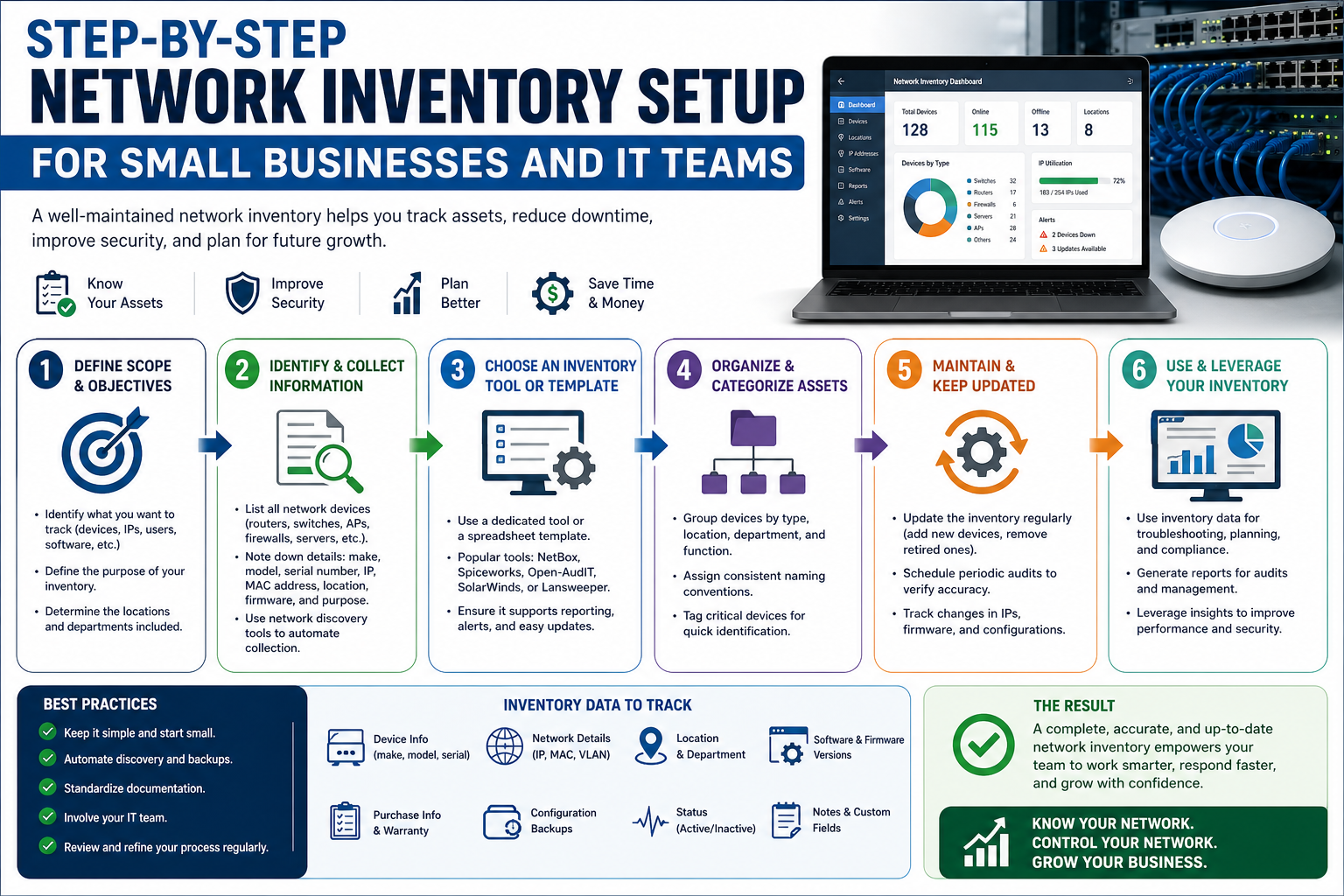
Setting up your first network inventory is not just a technical task—it is a strategic move that defines how effectively you can manage, secure, and scale your IT environment. Before diving into tools, diagrams, or automation, it is essential to understand what a network inventory actually represents and why it plays such a critical role in modern organizations. At its core, a network inventory is a comprehensive record of all devices, systems, connections, and configurations within your network. It provides visibility, structure, and control over what might otherwise become a chaotic and unmanageable environment.
When organizations begin their journey into network inventory management, they often underestimate its importance. Many assume that simply knowing which devices exist is enough. In reality, a proper inventory goes far beyond listing hardware. It includes detailed insights into configurations, relationships between devices, software versions, access permissions, and even usage patterns. This depth of information allows IT teams to make informed decisions, reduce risks, and maintain operational efficiency.
A strong foundation in networking concepts is essential for building an effective inventory system. Understanding how data flows, how devices communicate, and how networks are structured enables you to interpret the information your inventory system provides. Without this foundational knowledge, even the most advanced tools will produce data that is difficult to act upon. When you understand the “why” behind network operations, the inventory becomes more than a database—it becomes a powerful management tool.
The Role of Visibility in Network Management
Visibility is one of the most critical aspects of managing any network. Without clear insight into what exists within your environment, it becomes nearly impossible to maintain control. Network inventory provides this visibility by creating a structured overview of all components within your system. This includes not only obvious elements like computers and servers but also less visible components such as virtual machines, network interfaces, and background services.
As networks grow, visibility becomes increasingly challenging. In small environments, it may be possible to manually track devices and connections. However, as organizations expand, manual tracking quickly becomes inefficient and error-prone. Devices are added, removed, or reconfigured frequently, and keeping up with these changes without an automated system is nearly impossible. This is where a well-implemented network inventory becomes indispensable.
With proper visibility, IT teams can quickly identify what is connected to the network at any given time. This includes authorized devices as well as any unauthorized or unknown connections. The ability to detect unfamiliar devices is particularly important for maintaining security, as it helps prevent unauthorized access and potential breaches. Visibility also enables faster troubleshooting, as issues can be traced back to specific devices or configurations more efficiently.
Building Awareness of Network Assets
One of the primary goals of a network inventory is to create awareness of all assets within the network. These assets include hardware such as desktops, laptops, servers, switches, and routers, as well as software applications, operating systems, and services. Each asset plays a role in the overall functioning of the network, and understanding these roles is key to effective management.
Asset awareness goes beyond simply knowing that a device exists. It involves understanding its purpose, configuration, and relationship to other components. For example, a server may host multiple applications, each serving different departments within an organization. Without proper inventory tracking, it can be difficult to determine how changes to that server might impact other systems.
This level of awareness also supports better decision-making. When IT teams have a clear understanding of their assets, they can plan upgrades, allocate resources, and identify potential risks more effectively. It also allows organizations to avoid redundancy, ensuring that resources are used efficiently rather than duplicated unnecessarily.
Supporting Growth and Scalability
As organizations evolve, their networks must adapt to new demands. This includes accommodating additional users, integrating new technologies, and expanding into new locations. A well-maintained network inventory plays a crucial role in supporting this growth by providing a clear picture of current capabilities and limitations.
Scalability requires careful planning. Without an accurate inventory, it is difficult to determine whether the existing infrastructure can handle increased demand. For instance, adding new users may require additional bandwidth, storage, or processing power. By analyzing inventory data, IT teams can identify areas where upgrades are needed and plan accordingly.
Growth also introduces complexity. As networks become larger and more interconnected, the risk of misconfigurations and inefficiencies increases. A detailed inventory helps manage this complexity by providing a structured framework for organizing and tracking changes. It ensures that expansions are implemented in a controlled and predictable manner, reducing the likelihood of disruptions.
Managing Costs and Resources
Effective network management is not only about performance and security—it is also about controlling costs. Networks require significant investment in hardware, software, and maintenance. Without proper oversight, these costs can quickly escalate. A network inventory provides the data needed to manage resources efficiently and avoid unnecessary expenses.
One of the key benefits of inventory management is the ability to track resource utilization. By understanding how devices and systems are being used, organizations can identify underutilized assets and reallocate them where needed. This reduces the need for additional purchases and ensures that existing resources are used to their full potential.
Inventory data also supports budgeting and financial planning. By keeping track of hardware lifecycles, software licenses, and maintenance schedules, organizations can anticipate future expenses and allocate funds accordingly. This proactive approach helps prevent unexpected costs and ensures that critical systems remain operational.
Enhancing Network Performance and Reliability
A well-maintained network inventory contributes significantly to overall performance and reliability. By providing detailed information about network components and their configurations, it enables IT teams to identify potential issues before they escalate into major problems.
Performance issues often arise from misconfigurations, outdated software, or overloaded resources. With accurate inventory data, these issues can be detected and addressed more quickly. For example, if a network segment is experiencing congestion, the inventory can help identify which devices are contributing to the problem and whether additional capacity is needed.
Reliability is also improved through better maintenance practices. Inventory systems can track the status of devices, including firmware versions and update histories. This ensures that all components are kept up to date, reducing the risk of failures and vulnerabilities. Regular maintenance becomes more manageable when all relevant information is centralized and easily accessible.
Strengthening Security Through Awareness
Security is one of the most compelling reasons to implement a network inventory. In today’s digital landscape, threats are constantly evolving, and organizations must remain vigilant to protect their data and systems. A comprehensive inventory provides the foundation for effective security measures by ensuring that all devices and connections are accounted for.
One of the key challenges in network security is identifying potential entry points for attackers. Unauthorized devices, outdated software, and misconfigured systems can all create vulnerabilities. By maintaining an up-to-date inventory, IT teams can quickly identify and address these weaknesses.
Inventory data also supports access control. By understanding which users have access to specific resources, organizations can implement policies that restrict access based on roles and responsibilities. This reduces the risk of unauthorized access and helps protect sensitive information.
In addition, inventory systems can track changes within the network. This includes the addition of new devices, updates to configurations, and modifications to access permissions. By monitoring these changes, organizations can detect suspicious activity and respond more effectively to potential threats.
Supporting Compliance and Governance
Many organizations operate in regulated environments where compliance with industry standards and legal requirements is essential. Network inventory plays a crucial role in meeting these requirements by providing detailed records of network components and their configurations.
Compliance often involves demonstrating that systems are secure, properly maintained, and operating within defined parameters. A comprehensive inventory provides the documentation needed to support these claims. It allows organizations to show that they have control over their network and are actively managing potential risks.
Governance is another important aspect of network management. It involves establishing policies and procedures that guide how the network is used and maintained. Inventory data supports governance by providing the information needed to enforce these policies and ensure consistency across the organization.
Addressing the Challenges of Modern Networks
Modern networks are more complex than ever before. They often include a mix of on-premises infrastructure, cloud services, and remote connections. This complexity introduces new challenges in terms of management, security, and performance.
A network inventory helps address these challenges by providing a unified view of the entire environment. It brings together information from different sources and presents it in a structured format. This makes it easier to understand how different components interact and where potential issues may arise.
Remote work and mobile devices have also changed the way networks are used. Employees may access the network from various locations and devices, increasing the number of endpoints that need to be managed. A comprehensive inventory ensures that all these endpoints are accounted for and properly secured.
Establishing a Baseline for Future Improvements
Before any improvements can be made to a network, it is necessary to understand its current state. A network inventory provides this baseline by documenting existing components and configurations. This serves as a reference point for future changes and enhancements.
Having a baseline allows organizations to measure progress and evaluate the impact of changes. For example, if a new system is implemented, the inventory can be used to compare performance before and after the change. This helps determine whether the improvement was successful and identify any areas that may need further adjustment.
The baseline also supports troubleshooting. When issues arise, it is easier to identify the root cause if there is a clear record of how the network was configured previously. This reduces downtime and ensures that problems are resolved more efficiently.
Preparing for the Next Steps
Understanding the purpose and importance of network inventory is the first step toward building an effective system. It provides the context needed to make informed decisions and ensures that the process is aligned with organizational goals. With a solid foundation in place, the next step is to explore the tools, methods, and strategies used to create and maintain a network inventory.
As you move forward, it is important to keep in mind that network inventory is not a one-time task. It is an ongoing process that requires regular updates and continuous monitoring. By approaching it with the right mindset and a clear understanding of its value, you can create a system that supports your network’s growth, security, and performance over the long term.
Selecting the Right Approach for Building Your Network Inventory
Once the purpose and importance of a network inventory are clearly understood, the next phase involves deciding how to actually build and implement the system. This stage is where strategy begins to turn into execution. The choices made here will directly impact how effective, scalable, and manageable your inventory becomes over time.
There is no single “correct” way to create a network inventory. Each organization has its own requirements based on size, complexity, budget, and operational goals. Some environments demand highly automated systems capable of handling thousands of devices, while others may function well with simpler approaches. The key is to align your approach with your current needs while keeping future growth in mind.
The first step is defining the scope of your inventory. This means deciding what you want to track and how detailed the information should be. For some organizations, a high-level overview of devices may be sufficient. Others may require in-depth details such as firmware versions, configuration settings, and usage patterns. Establishing this scope early helps prevent unnecessary complexity and ensures that your system remains focused and efficient.
Another important consideration is how the data will be stored and accessed. Centralized systems are typically preferred because they allow all relevant information to be stored in a single location. This makes it easier to maintain consistency and ensures that everyone within the organization is working with the same data. Accessibility is equally important, as different teams may require access to different parts of the inventory.
Understanding Network Discovery Techniques
At the heart of any network inventory system lies the process of discovery. This is how the system identifies devices and gathers information about them. Without effective discovery methods, the inventory would quickly become incomplete and unreliable.
Network discovery can be performed in several ways, each with its own strengths and limitations. One of the most common methods is IP-based scanning. This involves scanning a range of IP addresses to identify active devices on the network. It is a straightforward approach that provides a basic overview of what is connected, but it may not always provide detailed information about each device.
Another widely used method involves the use of protocols such as SNMP, which allows systems to query network devices for detailed information. This can include device type, manufacturer, configuration details, and performance metrics. SNMP is particularly useful for gathering information from routers, switches, and other network infrastructure components.
For endpoints such as computers and servers, technologies like WMI can be used to retrieve detailed system information. This includes operating system details, installed software, and hardware specifications. By combining multiple discovery methods, organizations can build a more complete and accurate picture of their network.
It is also important to consider how frequently discovery processes should run. Networks are dynamic environments where changes occur regularly. Devices may be added, removed, or reconfigured at any time. Running discovery processes at regular intervals ensures that the inventory remains up to date and reflects the current state of the network.
Organizing and Structuring Inventory Data
Collecting data is only part of the process. Once information has been gathered, it needs to be organized in a way that makes it useful. Without proper structure, even the most detailed inventory can become difficult to navigate and interpret.
One effective approach is to categorize devices based on their roles within the network. For example, devices can be grouped into categories such as servers, workstations, network infrastructure, and mobile devices. This makes it easier to locate specific assets and understand their functions.
In addition to categorization, it is important to establish consistent naming conventions. Clear and standardized naming helps prevent confusion and ensures that devices can be easily identified. For instance, including location, function, and device type in the name can provide valuable context at a glance.
Relationships between devices should also be documented. Networks are not just collections of individual components—they are interconnected systems. Understanding how devices are linked to one another is essential for troubleshooting and planning. This includes mapping connections between switches, identifying which servers host specific applications, and tracking dependencies between systems.
Another key aspect of structuring data is prioritization. Not all devices are equally critical to operations. Core infrastructure components, such as main servers and network switches, should be given higher priority in the inventory. This ensures that they receive the attention they require and that any issues affecting them are addressed promptly.
Implementing Network Mapping Strategies
Mapping is a crucial component of network inventory, as it provides a visual representation of the network’s structure. While raw data is useful, visual maps make it easier to understand how everything fits together.
Several types of network maps can be created, each serving a different purpose. Logical maps focus on how data flows through the network. They illustrate IP addressing schemes, routing paths, and relationships between different segments. These maps are particularly useful for understanding traffic patterns and diagnosing connectivity issues.
Physical maps, on the other hand, show the actual layout of devices and connections. This includes cables, switches, and physical locations. Physical maps are valuable for tasks such as equipment installation, maintenance, and troubleshooting hardware issues.
Functional maps provide another layer of insight by showing how different systems interact to deliver services. For example, a functional map might illustrate how a web application relies on multiple servers, databases, and network components. This helps identify dependencies and ensures that all necessary components are accounted for.
Creating these maps requires accurate data from the inventory system. As the inventory is updated, the maps should also be refreshed to reflect any changes. Automated mapping tools can simplify this process by generating visual representations based on real-time data.
Integrating Automation into Inventory Management
Automation plays a vital role in modern network inventory systems. Manually updating records is not only time-consuming but also prone to errors. Automation ensures that the inventory remains accurate and up to date without requiring constant manual intervention.
One of the primary benefits of automation is continuous monitoring. Automated systems can detect changes in the network as they occur, such as the addition of new devices or modifications to existing configurations. These changes can be recorded automatically, ensuring that the inventory always reflects the current state of the network.
Automation also supports alerting mechanisms. When certain conditions are met, such as the detection of an unauthorized device or a configuration change, the system can generate alerts. This allows IT teams to respond quickly and address potential issues before they escalate.
Another advantage of automation is consistency. Automated processes follow predefined rules, reducing the likelihood of human error. This ensures that data is collected and recorded in a consistent manner, making it easier to analyze and interpret.
Despite its benefits, automation should be implemented thoughtfully. It is important to define clear rules and parameters to ensure that the system behaves as expected. Overly aggressive automation can lead to unnecessary alerts or data overload, while insufficient automation may fail to capture important changes.
Evaluating Scalability and Flexibility
As networks grow and evolve, the inventory system must be able to adapt. Scalability is a critical factor in ensuring that the system remains effective over time. This involves not only handling an increasing number of devices but also accommodating new technologies and requirements.
A scalable system should be able to expand without significant changes to its core structure. This means that adding new devices or network segments should not require a complete overhaul of the inventory. Flexible systems allow for incremental growth, making it easier to adapt to changing needs.
Flexibility also extends to customization. Different organizations have different requirements, and the inventory system should be able to accommodate these variations. This includes the ability to track specific types of data, generate customized reports, and integrate with other systems.
It is also important to consider how the system handles changes in scale. For example, if the organization experiences a size reduction, the inventory system should be able to adjust accordingly. This ensures that resources are not wasted on maintaining unnecessary capacity.
Managing Network Segmentation and Device Diversity
Modern networks often consist of multiple segments, each serving different purposes. These segments may include internal networks, guest networks, and specialized environments for specific applications. Managing these segments effectively requires careful organization within the inventory system.
Segmentation helps improve security and performance by isolating different types of traffic. For example, separating guest access from internal systems reduces the risk of unauthorized access. The inventory system should reflect these segments and provide visibility into each one.
Device diversity adds another layer of complexity. Networks may include a wide range of devices, from traditional desktops and servers to mobile devices, IoT equipment, and virtual machines. Each type of device may require different methods of discovery and management.
To handle this diversity, the inventory system should be capable of recognizing and categorizing different device types. This ensures that all components are accounted for and that appropriate management strategies can be applied to each one.
Establishing Data Accuracy and Integrity
The value of a network inventory depends heavily on the accuracy of its data. Inaccurate or outdated information can lead to poor decision-making and increased risk. Ensuring data integrity is, therefore, a critical aspect of inventory management.
Regular updates are essential for maintaining accuracy. Automated discovery processes help keep the inventory current, but it is also important to periodically review and verify the data. This may involve cross-checking information with physical inspections or validating configurations.
Consistency is another important factor. Data should be recorded in a standardized format to ensure that it can be easily interpreted. This includes using consistent naming conventions, units of measurement, and classification systems.
Access control also plays a role in maintaining data integrity. Limiting who can modify the inventory helps prevent unauthorized changes and ensures that updates are made in a controlled manner. Audit trails can provide additional oversight by tracking changes and identifying potential issues.
Preparing for Advanced Monitoring and Analysis
As the network inventory system becomes more established, it can serve as a foundation for advanced monitoring and analysis. The data collected can be used to identify trends, optimize performance, and support strategic planning.
Monitoring tools can leverage inventory data to provide real-time insights into network activity. This includes tracking bandwidth usage, identifying bottlenecks, and detecting anomalies. By integrating monitoring with inventory management, organizations can gain a more comprehensive understanding of their network.
Analysis of inventory data can also reveal patterns and opportunities for improvement. For example, identifying frequently used devices or applications can help prioritize upgrades and resource allocation. Similarly, detecting underutilized assets can lead to cost savings and improved efficiency.
The combination of accurate inventory data and advanced analysis capabilities enables organizations to move from reactive management to proactive optimization. Instead of simply responding to issues as they arise, IT teams can anticipate challenges and implement solutions before they impact operations.
Laying the Groundwork for Continuous Improvement
Building a network inventory is not a one-time project but an ongoing process that evolves alongside the network itself. The systems and strategies implemented during this phase will determine how effectively the inventory can support future growth and adaptation.
Continuous improvement involves regularly evaluating the effectiveness of the inventory system and making adjustments as needed. This may include refining discovery processes, updating data structures, or integrating new technologies. Feedback from users and stakeholders can provide valuable insights into areas for improvement.
By establishing a strong and flexible foundation, organizations can ensure that their network inventory remains a valuable asset over time. It becomes not just a record of what exists but a dynamic tool that supports decision-making, enhances performance, and strengthens overall network management.
Expanding Network Inventory into Operational Intelligence
As a network inventory matures, its role shifts from being a static record of assets into something far more powerful: a source of operational intelligence. At this stage, the inventory is no longer just about knowing what exists in the network. It becomes a dynamic system that helps interpret behavior, predict issues, and guide decision-making across IT operations.
Operational intelligence comes from combining raw inventory data with context. Devices are no longer just entries in a list—they become part of a living ecosystem. Their relationships, usage patterns, dependencies, and performance trends all contribute to a deeper understanding of how the network functions as a whole.
This transformation requires consistent enrichment of inventory data. Basic device information, such as IP addresses and hardware specifications, is only the starting point. Over time, additional layers of information are added, including uptime history, traffic patterns, security status, and configuration changes. Each layer increases the value of the inventory and enhances its usefulness in real-world decision-making.
Strengthening Real-Time Awareness of Network Activity
Modern networks operate in real time, and inventory systems must evolve to reflect this reality. Static snapshots of infrastructure are no longer sufficient in environments where changes occur by the second. Real-time awareness allows IT teams to understand not only what exists in the network, but what is happening within it at any given moment.
This level of awareness is achieved by continuously collecting and updating data from network devices. Every connection, disconnection, configuration change, or performance fluctuation contributes to the overall picture. When this information is centralized within the inventory system, it becomes possible to observe patterns as they emerge.
Real-time visibility also plays a critical role in identifying anomalies. Sudden spikes in traffic, unexpected device behavior, or unauthorized connections can be detected quickly. This allows teams to respond before minor issues escalate into major disruptions.
The challenge lies in balancing detail with performance. Collecting too much data too frequently can overwhelm systems, while collecting too little can result in blind spots. Effective inventory design ensures that real-time monitoring is both efficient and meaningful.
Enhancing Endpoint Management Through Inventory Data
Endpoints represent one of the most diverse and rapidly expanding components of modern networks. These include desktops, laptops, mobile devices, virtual machines, and increasingly, IoT devices. Managing such a wide variety of endpoints requires structured and reliable inventory data.
A strong inventory system tracks each endpoint’s identity, configuration, software status, and network activity. This allows IT teams to maintain control over devices regardless of where they are located or how they are being used. Endpoint visibility is particularly important in environments that support remote work or bring-your-own-device policies.
Inventory data helps identify outdated or non-compliant endpoints. Devices that are missing security updates, running unauthorized software, or exhibiting unusual behavior can be flagged for review. This ensures that endpoint management is not reactive but continuously enforced.
Another important aspect of endpoint management is lifecycle tracking. Devices have defined lifespans, and knowing when they were deployed, upgraded, or retired helps organizations plan replacements and avoid unexpected failures. Inventory systems provide the historical context needed to manage these lifecycles effectively.
Managing Software Ecosystems and Application Dependencies
Hardware is only one part of the network ecosystem. Software plays an equally important role, and managing it requires the same level of visibility and control. A comprehensive network inventory includes detailed information about installed applications, versions, dependencies, and usage patterns.
Software environments are often complex, with multiple applications relying on shared services or underlying systems. Without proper tracking, changes to one component can unintentionally impact others. Inventory systems help map these relationships, making it easier to understand how applications interact.
This is particularly important for critical business systems. Applications that support finance, communication, or customer operations often depend on multiple interconnected services. Inventory data helps identify these dependencies, reducing the risk of disruption during updates or maintenance.
License management is another key aspect of software tracking. Many applications operate under licensing agreements that require regular renewal or usage monitoring. Inventory systems help ensure compliance by tracking license availability and usage across the network.
Improving Network Security Through Continuous Verification
Security within a network is not a one-time configuration—it is an ongoing process of verification and adjustment. Network inventory plays a central role in maintaining this continuous security posture by ensuring that all devices and connections are accounted for and properly managed.
Continuous verification involves regularly confirming that devices in the network match expected configurations. Any deviation from the established baseline can indicate a potential issue. This could include unauthorized devices, unexpected configuration changes, or outdated software versions.
Inventory systems also support segmentation policies by clearly defining which devices belong to which network zones. This helps enforce access restrictions and reduces the risk of lateral movement within the network in the event of a breach.
Another important aspect of security supported by inventory data is vulnerability management. By maintaining up-to-date records of software versions and system configurations, organizations can quickly identify devices that are exposed to known vulnerabilities and prioritize remediation efforts.
Supporting Incident Response and Troubleshooting
When network issues occur, speed and accuracy are critical. A well-maintained network inventory significantly improves the effectiveness of incident response by providing immediate access to relevant information about affected systems.
During an incident, IT teams often need to answer key questions quickly: which devices are affected, how they are connected, and what recent changes may have contributed to the issue. Inventory data provides the foundation for answering these questions efficiently.
Troubleshooting becomes more structured when inventory information is available. Instead of manually investigating each component, teams can use inventory data to trace dependencies and isolate the root cause more effectively.
Historical data is particularly valuable in this context. By reviewing past configurations and changes, it becomes easier to identify what may have triggered a problem. This reduces downtime and improves the overall efficiency of incident resolution.
Integrating Network Inventory with Automation Workflows
As networks grow in complexity, automation becomes essential for maintaining efficiency. Network inventory systems serve as a critical input for automation workflows, providing the data needed to execute tasks without manual intervention.
Automation can be applied in many areas, including device provisioning, configuration management, and software updates. Inventory data ensures that these automated processes are accurate and targeted, reducing the risk of errors.
For example, when a new device is added to the network, automation systems can use inventory data to assign it to the correct network segment, apply security policies, and install required software. This reduces onboarding time and ensures consistency across the environment.
Automation also supports continuous compliance. Inventory systems can trigger automated checks to ensure that devices remain aligned with security and operational standards. If deviations are detected, corrective actions can be initiated automatically or flagged for review.
The integration of inventory and automation creates a feedback loop where changes in the network are continuously detected, processed, and acted upon. This significantly reduces manual workload and improves operational efficiency.
Managing Multi-Site and Distributed Network Environments
Many organizations operate across multiple locations, each with its own network infrastructure. Managing these distributed environments requires a centralized view that can consolidate data from all sites into a single inventory system.
Multi-site visibility allows IT teams to understand how different locations are connected and how resources are distributed. This is particularly important for organizations that rely on wide-area networks or cloud-based services.
Each site may have unique requirements, configurations, and constraints. Inventory systems help standardize management practices across locations while still allowing for local flexibility where needed.
Distributed environments also introduce challenges related to latency, connectivity, and synchronization. Inventory systems must be designed to handle these challenges by ensuring that data remains consistent and up to date across all locations.
Supporting Virtualization and Cloud-Based Infrastructure
Virtualization and cloud computing have significantly changed the structure of modern networks. Instead of relying solely on physical hardware, many organizations now operate in hybrid environments that include virtual machines, containers, and cloud services.
These environments introduce additional layers of complexity to network inventory management. Virtual resources can be created, modified, or destroyed dynamically, often without direct physical interaction.
Inventory systems must be capable of tracking these virtual components alongside traditional hardware. This includes monitoring virtual machine instances, cloud storage resources, and dynamically allocated network interfaces.
One of the key challenges in virtual environments is maintaining accurate relationships between physical and virtual resources. A single physical server may host multiple virtual machines, each with its own configuration and role. Inventory systems help map these relationships to provide a complete view of the environment.
Cloud resources also require careful tracking, particularly when it comes to cost management and resource allocation. Inventory data helps organizations understand how cloud services are being used and identify opportunities for optimization.
Enabling Predictive Analysis and Capacity Planning
As more data is collected through network inventory systems, it becomes possible to move beyond reactive management and into predictive analysis. This involves using historical and real-time data to forecast future network needs and potential issues.
Capacity planning is one of the most important applications of predictive analysis. By understanding current usage patterns, organizations can anticipate when additional resources will be required. This helps prevent performance bottlenecks and ensures that infrastructure can support future growth.
Predictive analysis can also identify trends that may indicate upcoming problems. For example, gradual increases in resource usage may suggest that a system will eventually become overloaded. Early detection allows for proactive upgrades or optimizations.
This level of insight depends heavily on the quality and consistency of inventory data. The more accurate and comprehensive the data, the more reliable the predictions will be.
Evolving Network Inventory into a Strategic Asset
Over time, network inventory becomes more than just an operational tool—it evolves into a strategic asset that supports long-term planning and decision-making. It provides a foundation for aligning IT infrastructure with business objectives and ensuring that technology investments deliver maximum value.
Strategic use of inventory data includes planning infrastructure upgrades, evaluating technology adoption, and assessing risk exposure. It allows organizations to make informed decisions based on real data rather than assumptions.
As networks continue to evolve, the importance of maintaining a well-structured and continuously updated inventory only increases. It becomes a central reference point for understanding the entire digital environment and guiding its future direction.
Strengthening Governance and Role-Based Access Control
As network inventories become more detailed and deeply integrated into daily operations, governance becomes a critical factor in maintaining order and reliability. Governance in this context refers to the set of rules, responsibilities, and controls that determine how inventory data is accessed, modified, and maintained. Without clear governance, even the most advanced inventory system can become inconsistent, unreliable, or vulnerable to misuse.
One of the most important aspects of governance is role-based access control. Not every user within an organization should have the ability to modify inventory data. Different teams require different levels of access depending on their responsibilities. For example, network engineers may need full access to device configurations and system mappings, while support staff may only require read-only visibility to assist with troubleshooting. By defining clear access roles, organizations ensure that data integrity is preserved while still enabling collaboration across teams.
Governance also helps maintain accountability. When changes are made within the inventory system, it should be clear who made them and why. This traceability reduces the risk of accidental misconfigurations and helps resolve disputes or issues when inconsistencies arise. Over time, structured governance transforms the inventory from a simple technical tool into a controlled and reliable source of truth for the entire organization.
Aligning Inventory Practices with Organizational Change
Networks do not exist in isolation—they evolve alongside the organizations they support. As business priorities shift, new technologies are adopted, and teams restructure, the network inventory must adapt accordingly. Aligning inventory practices with organizational change ensures that the system remains relevant and continues to reflect the real-world environment accurately.
When new departments are introduced or existing ones are restructured, inventory categories and classifications may need to be updated. Similarly, the introduction of new technologies such as cloud platforms, remote work solutions, or automation tools requires adjustments in how assets are tracked and categorized. If the inventory system does not evolve alongside these changes, it gradually loses accuracy and effectiveness.
This alignment also involves communication between technical teams and business stakeholders. Inventory data should not exist in isolation within IT departments; it should support broader organizational decision-making. When leadership understands how infrastructure changes impact resources and capabilities, they can make more informed strategic decisions.
By continuously aligning inventory practices with organizational development, the system remains a living framework rather than a static record. It reflects not only what the network is today, but also how it is evolving.
Conclusion
A network inventory is far more than a technical checklist of devices and connections. It is the foundation of understanding how an entire IT environment operates, evolves, and supports business activity. Without it, networks quickly become opaque, making it difficult to manage performance, enforce security, control costs, or plan for future growth. With it, organizations gain clarity, structure, and control over increasingly complex digital systems.
At its core, a well-maintained inventory brings visibility to everything that exists within a network. This visibility is essential because modern infrastructure is no longer simple or static. Devices are constantly added, configurations are frequently updated, and users connect from multiple locations using a wide range of endpoints. In such an environment, guessing or relying on incomplete information is not sustainable. Accurate inventory data ensures that decisions are based on reality rather than assumptions.
Security is one of the most significant benefits of maintaining a strong network inventory. When every device and connection is accounted for, it becomes much easier to detect unauthorized access, outdated systems, or suspicious activity. This level of awareness strengthens an organization’s ability to respond to threats and maintain a secure operating environment. In addition, compliance requirements become easier to manage when there is clear documentation of assets, configurations, and changes over time.
Operational efficiency is also greatly improved through structured inventory management. IT teams can troubleshoot issues faster, plan upgrades more effectively, and allocate resources where they are needed most. Instead of reacting blindly to problems, they can rely on accurate data to guide their actions. This reduces downtime, improves performance, and allows teams to focus on more strategic initiatives rather than repetitive manual tasks.
As networks continue to grow in complexity with cloud integration, virtualization, and remote connectivity, the importance of inventory systems will only increase. They serve as a bridge between raw infrastructure and meaningful insight, transforming technical data into actionable intelligence. When properly implemented and continuously maintained, a network inventory becomes a long-term asset that supports stability, scalability, and informed decision-making across the entire organization.