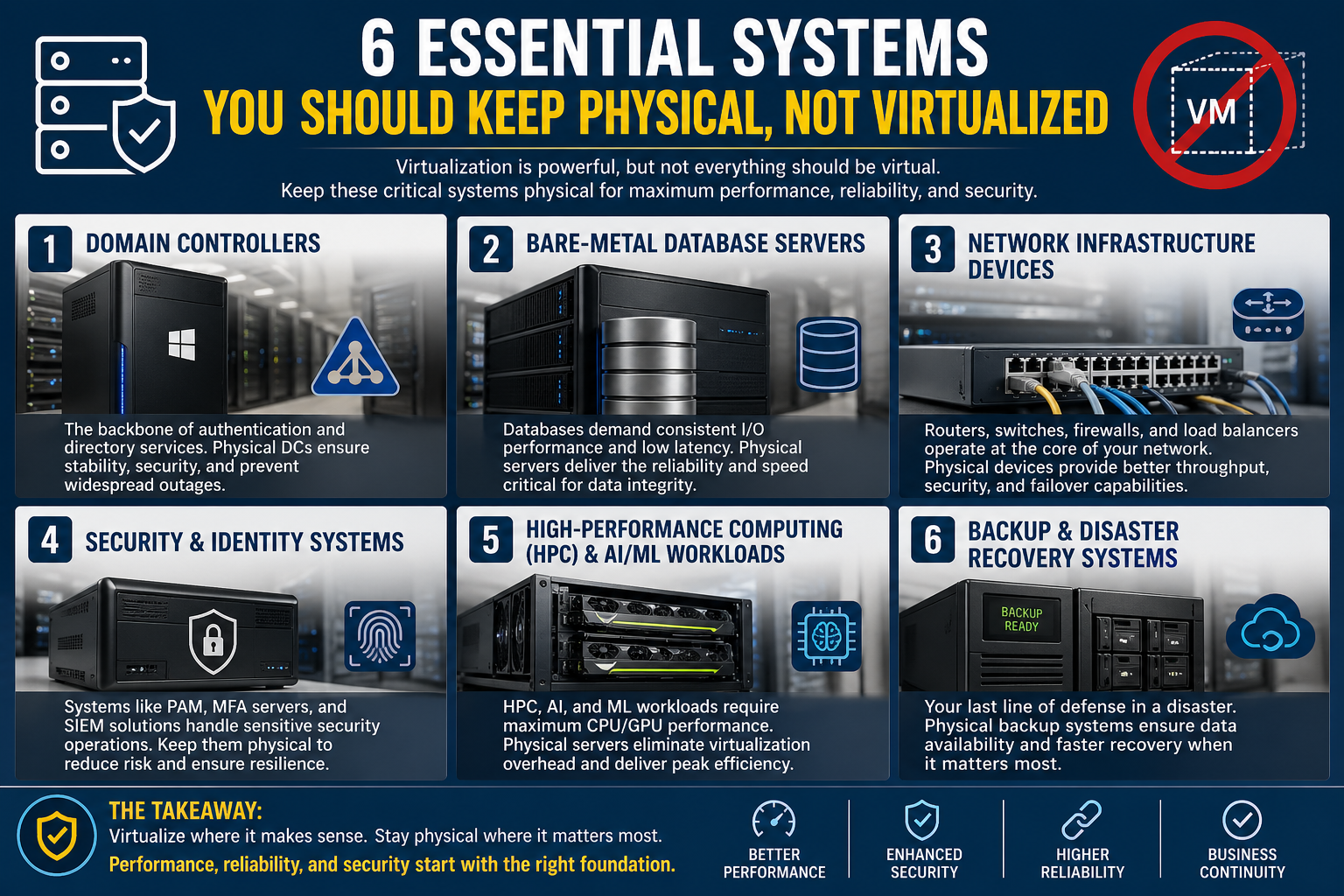
Modern IT environments have moved far beyond the traditional model of one physical server running one operating system and one application stack. Virtualization has become a foundational layer in data centers, enterprise infrastructure, and even small business setups. It allows multiple virtual machines to operate on a single physical host, improving utilization and simplifying management. At first glance, this seems like an ideal direction for all workloads.
However, the assumption that every system can or should be virtualized is where problems begin to emerge. While virtualization offers flexibility, scalability, and cost efficiency, it is not universally suitable. Some systems are tightly bound to physical resources, others depend on extremely low latency, and many suffer from performance degradation when abstracted away from hardware.
Understanding where virtualization fits—and where it does not—is essential for designing stable infrastructure. The risks are not always obvious at first. A system may appear to function normally after migration, only to reveal hidden performance bottlenecks, compatibility issues, or licensing conflicts under real-world load. These challenges often surface during peak usage or failure scenarios, when stability matters most.
The key idea is not to reject virtualization, but to recognize its boundaries. Certain workloads demand direct hardware access, predictable performance, or strict vendor validation that virtual environments cannot always guarantee. Identifying these workloads early prevents operational instability and costly redesigns later.
Hardware-Dependent Systems That Require Direct Physical Access
One of the strongest limitations of virtualization appears in systems that rely heavily on specialized hardware components. While virtual machines emulate general computing environments effectively, they cannot perfectly replicate every aspect of physical hardware behavior.
Applications that depend on specialized processing units such as GPUs, ASICs, or custom hardware accelerators often struggle in virtual environments. Even when virtualization platforms provide hardware passthrough capabilities, performance can still vary due to abstraction layers and scheduling overhead.
For example, systems designed for real-time signal processing, scientific computation, or industrial control may rely on precise timing and direct hardware interaction. Introducing virtualization into such environments can create unpredictable latency. Even minor delays in processing cycles may cause cascading performance issues in tightly synchronized systems.
Storage-heavy applications also fall into this category. Systems that rely on high-speed disk input/output operations, such as large-scale database engines or logging platforms, may experience performance bottlenecks when operating within virtualized storage layers. Although modern hypervisors are highly optimized, they still introduce additional layers between the application and physical storage devices.
Another challenge arises from CPU architecture specialization. Some applications are compiled or optimized for specific instruction sets. When moved into a virtual machine running on different hardware, fallback mechanisms may reduce efficiency or cause incompatibility. In rare cases, software may fail to execute entirely if required instructions are unavailable.
These constraints highlight an important principle: virtualization is not a substitute for hardware specificity. When a workload depends on deterministic hardware behavior or specialized processing capabilities, running it directly on physical infrastructure often remains the safer and more predictable option.
Performance-Critical Workloads and Latency-Sensitive Applications
Not all performance demands are equal. Some systems can tolerate minor delays without noticeable impact, while others require near-instantaneous response times. Virtualization introduces abstraction layers that can affect latency in subtle but significant ways.
Latency-sensitive applications, such as financial trading systems, real-time analytics engines, and high-frequency transaction platforms, are particularly vulnerable. These systems depend on microsecond-level response times where even small delays can affect outcomes. Virtual machine scheduling, hypervisor overhead, and shared resource contention can introduce variability that is unacceptable in these environments.
Real-time communication systems also face similar challenges. Voice processing, live streaming infrastructure, and interactive collaboration platforms rely on consistent timing. When virtualization introduces jitter or uneven processing delays, the quality of service may degrade in ways that are difficult to predict or control.
Another often overlooked area is industrial automation. Systems controlling robotics, manufacturing equipment, or sensor-driven processes must respond to input signals within strict timing windows. A virtualized environment may not guarantee the deterministic behavior required for such precision.
Even when performance degradation is minimal on average, inconsistency is the real concern. Virtual machines share underlying physical resources, which means workload spikes from other systems can temporarily impact performance. This unpredictability makes virtualization unsuitable for workloads where timing consistency is more important than raw throughput.
In many cases, organizations attempt to mitigate these issues using resource reservation or dedicated host configurations. While these approaches improve stability, they do not eliminate the underlying variability introduced by virtualization layers. For truly time-critical systems, direct hardware deployment remains the most reliable approach.
Storage-Intensive Systems and Database Performance Challenges
Databases and storage-heavy applications are among the most commonly virtualized workloads, but they are also among the most frequently affected by performance limitations. While many modern database engines run successfully in virtual environments, not all workloads behave predictably under virtualization.
High-throughput transactional systems require consistent disk performance. When multiple virtual machines share the same physical storage infrastructure, input/output operations can become uneven. This can result in latency spikes during peak usage, especially when storage is heavily utilized by other workloads.
Large analytical databases face similar challenges. These systems often perform continuous scanning, aggregation, and indexing across massive datasets. Any delay in disk access or memory allocation can significantly extend query execution times. Although virtualization platforms offer caching and optimization features, they cannot fully eliminate contention at the physical storage level.
Another important factor is storage architecture complexity. Virtual environments often introduce additional abstraction layers such as virtual disks, storage pools, and distributed file systems. Each layer adds overhead, increasing the distance between the application and the physical disk. While these layers provide flexibility, they also introduce performance variability.
Database replication and clustering add another dimension of complexity. In virtual environments, synchronization between nodes may be affected by network latency within the virtualization layer itself. This can impact consistency models and failover timing, especially in distributed database systems.
Backup and snapshot operations also behave differently in virtualized storage environments. While snapshots are convenient, they can introduce temporary performance degradation during creation or restoration. In high-demand database environments, even short interruptions can affect user experience or transactional integrity.
For workloads where consistent storage performance is critical, physical deployment or carefully isolated storage configurations often provide more predictable outcomes than fully virtualized setups.
Applications With Strict Licensing and Hardware Binding Requirements
Software licensing is another area where virtualization introduces complications that are not immediately obvious. Many enterprise applications rely on licensing mechanisms tied directly to physical hardware identifiers such as MAC addresses, CPU serial numbers, or storage device signatures.
When such software is moved into a virtual environment, these identifiers may change or be abstracted. As a result, licensing systems may fail to recognize the environment as valid. This can lead to application shutdowns, restricted functionality, or unexpected compliance issues.
Some vendors have adapted to virtualization by introducing flexible licensing models. However, not all software providers have fully aligned with virtual infrastructure practices. In certain cases, licensing terms explicitly restrict or limit virtual deployment, requiring additional subscriptions or enterprise agreements.
Operating systems and productivity suites also fall into this category. While they often run successfully in virtual machines, licensing rules may differ significantly from physical deployments. Organizations sometimes underestimate the long-term cost implications of large-scale virtual desktop environments.
Hardware dongles and physical security keys present another challenge. These devices are designed to authenticate software by interacting directly with physical ports. Virtual environments may not reliably support such hardware interactions without specialized configuration, and even then, stability is not guaranteed.
License enforcement systems may also behave unpredictably in dynamic virtual environments where machines are frequently cloned, migrated, or scaled. This can trigger false license violations or require repeated reactivation processes.
Because licensing is both a technical and legal concern, it must be evaluated carefully before virtualization. In some cases, the cost and complexity of adapting licensing structures outweigh the benefits gained from virtualization itself.
Vendor-Supported Environment Restrictions and Compliance Risks
Even when software technically runs well in a virtual machine, vendor support policies can create operational risks. Many software vendors define strict support boundaries, specifying whether their applications are supported in virtualized environments.
If an issue arises in a virtual machine that is not officially supported, vendors may refuse to provide troubleshooting assistance. This creates a significant gap in accountability, especially in enterprise environments where vendor support is critical for maintaining uptime.
This issue often becomes visible only after deployment. A system may appear stable during testing, but when production issues occur, support teams may decline responsibility due to virtualization being outside supported configurations. This leaves internal teams or consultants responsible for diagnosing and resolving complex issues without vendor guidance.
Certain specialized applications are particularly sensitive to this restriction. Engineering tools, media production software, and industry-specific platforms may function in virtual environments but remain officially unsupported. This creates a hidden operational risk that can affect long-term stability.
Compliance requirements can also intersect with vendor restrictions. Some industries require validated configurations that include strict hardware and software combinations. Virtualization may introduce deviations that complicate compliance audits or certification processes.
Organizations sometimes attempt to work around these limitations by creating “supported-like” virtual environments that mimic physical systems as closely as possible. However, this approach does not always guarantee vendor cooperation during critical failures.
Ultimately, vendor support policies play a major role in determining whether virtualization is a safe choice. Ignoring these policies can lead to significant operational uncertainty, especially in mission-critical systems where external support is essential.
Legacy Systems and Aging Infrastructure Dependencies
Legacy systems present one of the most complex challenges in virtualization planning. These systems often rely on outdated software architectures, undocumented dependencies, or hardware-specific behaviors that were never designed with virtualization in mind.
In many cases, legacy applications run on older operating systems that depend on specific hardware timing or device interactions. When migrated to virtual environments, subtle differences in hardware emulation can cause instability or unexpected behavior.
Another common issue is configuration sensitivity. Legacy systems are often the result of years of incremental changes, patches, and workarounds. These systems may function correctly only within very specific environments. Virtualization introduces a new layer of abstraction that can disrupt these delicate balances.
Migrating legacy systems directly into virtual machines without redesign often leads to hidden problems. While the system may boot successfully, performance issues or functional inconsistencies may appear over time. These issues can be difficult to trace because they stem from deep architectural assumptions in the original system.
Some legacy systems also depend on physical peripherals or external hardware interfaces that are difficult to replicate in virtual environments. Serial devices, specialized controllers, and outdated communication protocols may not translate cleanly into virtual infrastructure.
A more reliable approach often involves rebuilding or modernizing legacy applications before virtualization. However, this process requires significant effort and planning, which is why many organizations attempt direct migration instead. Unfortunately, this shortcut frequently leads to long-term maintenance challenges.
Legacy systems highlight an important reality: virtualization is not a universal migration strategy. Some systems require modernization before they can safely operate in abstracted environments, and skipping this step introduces operational risk.
Network Appliances That Lose Integrity When Virtualized
Network infrastructure is one of the most sensitive layers in any IT environment, and not all networking functions behave reliably when moved into virtual machines. Traditional physical network appliances such as routers, switches, and specialized load balancers are designed to handle traffic with extremely low latency and highly predictable packet processing behavior.
When these systems are virtualized, they are no longer directly interacting with dedicated network hardware. Instead, they rely on virtual switches, shared network interfaces, and hypervisor-managed packet routing. This introduces additional processing layers that can subtly alter timing, throughput, and packet prioritization.
In high-demand environments, even small changes in packet handling can lead to congestion, jitter, or inconsistent routing behavior. These issues are especially noticeable in environments that depend on strict service-level agreements for network performance.
Virtual network appliances also compete for underlying physical network interface cards. When multiple virtual machines share a single physical adapter, traffic prioritization becomes dependent on hypervisor scheduling rather than dedicated hardware pathways. This can lead to uneven performance during peak traffic conditions.
Certain network functions, such as deep packet inspection or high-speed routing, require deterministic behavior that is difficult to guarantee in virtual environments. Even when modern virtualization platforms offer enhanced networking features, they still cannot fully replicate the predictability of dedicated hardware appliances.
Security Infrastructure and Perimeter Defense Systems
Security systems form the backbone of enterprise protection strategies, and they often operate most effectively when deployed on dedicated hardware. Firewalls, intrusion detection systems, and intrusion prevention systems rely on consistent packet inspection and immediate response capabilities.
When these systems are virtualized, they inherit the same limitations as other network-dependent workloads. They must process traffic through virtual switches and shared interfaces, which can introduce delays in packet inspection or rule enforcement.
A critical concern is the potential for latency in threat detection. Security appliances must analyze traffic in real time to identify malicious behavior. Even small delays can allow harmful packets to pass through before inspection rules are fully applied.
Virtual environments also introduce additional attack surfaces. The hypervisor layer itself becomes a potential point of exploitation. If compromised, it can expose multiple virtual security appliances simultaneously, reducing the effectiveness of isolation.
Another challenge arises from multi-tenant environments. When security systems share physical infrastructure with other workloads, resource contention can degrade their responsiveness. This is particularly problematic in environments where security systems must operate under constant high load.
In physical deployments, security appliances are isolated from general-purpose workloads, ensuring consistent performance and reducing risk exposure. Virtualization can blur these boundaries, making it more difficult to guarantee strict separation between sensitive security functions and other system activities.
High-Performance Computing and Scientific Workloads
High-performance computing environments are designed to process large-scale computations at maximum efficiency. These workloads often involve complex simulations, mathematical modeling, and data-intensive processing that require direct access to CPU, memory, and sometimes specialized accelerators.
Virtualization introduces overhead that can interfere with the fine-grained performance tuning required in these environments. Even small inefficiencies in CPU scheduling or memory allocation can accumulate across thousands of processing cycles, resulting in measurable performance degradation.
Scientific computing workloads often rely on parallel processing frameworks where multiple nodes must operate in precise coordination. Virtual environments can introduce variability in timing that disrupts synchronization between nodes.
Memory bandwidth is another critical factor. High-performance applications frequently push system memory to its limits. When multiple virtual machines share the same physical memory pool, contention can occur, reducing overall throughput.
In addition, some scientific workloads require direct access to hardware interconnects or specialized processing units. Virtualization may abstract these components in ways that reduce efficiency or limit functionality.
While virtualization can be useful for development or testing environments in scientific computing, production-level high-performance workloads often benefit more from bare-metal deployments where hardware resources are fully dedicated.
Real-Time Systems in Telecom and Industrial Control
Real-time systems operate under strict timing constraints where every millisecond matters. Telecommunications infrastructure, industrial automation systems, and embedded control networks all depend on predictable timing behavior to function correctly.
Virtualization introduces a level of uncertainty that is incompatible with strict real-time requirements. Hypervisors must manage multiple virtual machines simultaneously, which can lead to scheduling delays that are unacceptable in time-critical environments.
In telecommunications systems, packet routing and signal processing must occur within defined time windows. Delays introduced by virtualization layers can disrupt synchronization across network nodes, leading to degraded service quality or dropped connections.
Industrial control systems face similar challenges. Machines, sensors, and control units often operate in tightly coordinated loops where timing precision is essential. Even slight deviations in processing time can affect mechanical operations or safety mechanisms.
Embedded systems used in manufacturing or energy distribution often rely on deterministic hardware behavior. Virtual environments cannot always guarantee the same level of predictability, especially under variable system load.
Because real-time systems prioritize timing accuracy over resource efficiency, they are among the least suitable candidates for virtualization. Physical deployment ensures that processing occurs exactly when needed, without interference from other workloads.
GPU-Intensive and AI Workloads Under Virtual Constraints
Modern artificial intelligence and machine learning workloads rely heavily on GPU acceleration. These systems process massive datasets and perform complex mathematical operations that require direct access to graphics processing units.
While virtualization platforms now offer GPU passthrough and virtual GPU technologies, these solutions still introduce abstraction layers that can limit performance. Shared GPU resources may not deliver the same efficiency as dedicated hardware access.
Training large AI models requires sustained computational throughput over long periods. Any inconsistency in GPU availability or memory bandwidth can slow down training processes significantly.
In virtual environments, GPU resources may be dynamically allocated among multiple virtual machines. This can lead to contention when multiple workloads attempt to use the same physical GPU simultaneously.
Another concern is memory fragmentation within GPU resources. Virtualization layers may partition GPU memory in ways that reduce efficiency for large-scale processing tasks.
High-end AI workloads often require direct, uninterrupted access to hardware acceleration. While virtualization can support smaller-scale inference tasks or development environments, production-level training systems often perform better on dedicated GPU servers.
Distributed Systems and Cluster Sensitivity to Virtualization Overhead
Distributed systems rely on coordination between multiple nodes to function as a unified computing environment. These systems are highly sensitive to timing, communication latency, and resource synchronization.
Virtualization can introduce variability in inter-node communication. Even when network performance appears stable, internal scheduling within the hypervisor can cause uneven delays between virtual machines.
Clustered systems such as distributed databases, search engines, and large-scale data processing frameworks depend on consistent node behavior. When virtualization introduces unpredictable latency, it can affect replication timing and consensus mechanisms.
Resource contention is another concern. In a shared virtual environment, multiple nodes may compete for CPU, memory, or storage resources. This competition can lead to uneven performance distribution across the cluster.
Some distributed systems attempt to compensate for these issues through redundancy and load balancing. However, these mechanisms are designed to handle external failures rather than internal virtualization-induced variability.
In tightly synchronized clusters, even small performance differences between nodes can lead to bottlenecks or inefficiencies. Physical deployments reduce this variability by ensuring each node operates on dedicated hardware.
Backup, Replication Timing, and Data Consistency Challenges
Data protection systems such as backups and replication services are essential for maintaining system reliability. However, virtualization can introduce timing challenges that affect how these processes operate.
Snapshot-based backups are commonly used in virtual environments, but they can temporarily impact system performance during creation. When multiple virtual machines initiate snapshots simultaneously, storage systems may experience increased load, leading to performance degradation.
Replication systems that synchronize data between primary and secondary environments rely on consistent timing. Virtualization can introduce slight delays in data transmission, which may accumulate over time and affect consistency.
In environments with heavy write activity, these delays can become more pronounced. Storage systems may struggle to maintain real-time replication across virtualized layers, especially when multiple workloads compete for disk access.
Backup scheduling in virtual environments also requires careful planning. If too many systems initiate backup processes simultaneously, it can lead to resource spikes that affect overall system stability.
While virtualization simplifies backup management through automation, it also introduces new complexities in timing and resource allocation that must be carefully controlled to avoid performance issues.
Time Synchronization and Precision-Dependent Services
Accurate time synchronization is essential for many modern computing systems. Financial systems, distributed applications, authentication services, and logging frameworks all depend on precise timekeeping.
Virtualization can affect time accuracy due to differences in how virtual machines interact with host system clocks. Virtual machines often rely on hypervisor-level time synchronization, which may not always be perfectly aligned with physical hardware clocks.
In environments where microsecond-level accuracy is required, even small discrepancies in timekeeping can create inconsistencies in logs, transaction ordering, or event correlation.
Some systems attempt to correct these discrepancies using synchronization protocols. However, virtualization overhead can still introduce drift under heavy system load or resource contention.
Time-sensitive applications such as authentication systems also depend on precise timestamps to validate sessions or tokens. Inconsistent time behavior can lead to authentication failures or security inconsistencies.
Distributed logging systems face similar challenges. If virtual machines are not perfectly synchronized, event ordering across systems may become unreliable, making troubleshooting and forensic analysis more difficult.
Physical deployments provide more stable timekeeping behavior because they reduce abstraction layers between system clocks and hardware timers.
Virtual Desktop Infrastructure Limits in Real-World Deployment
Virtual Desktop Infrastructure (VDI) is often promoted as a flexible way to centralize user environments, simplify management, and reduce endpoint dependency. While these advantages are real, VDI is not universally suitable for every workload or user profile.
One of the primary challenges with virtual desktops is user experience consistency under load. When many users access virtual desktops simultaneously, resource contention can occur at the host level. CPU scheduling delays, memory pressure, and storage bottlenecks can all affect responsiveness.
Unlike physical desktops, where each user has dedicated hardware, virtual desktops share underlying infrastructure. This means performance is indirectly tied to the behavior of other virtual machines on the same host. Even a single resource-intensive user session can affect others.
Graphically intensive applications perform especially poorly in some virtual desktop environments. Even with GPU acceleration, rendering performance may not match dedicated physical workstations. This is particularly noticeable in design, engineering, and media production workflows.
Network dependency is another critical factor. Virtual desktops require continuous connectivity to data centers. Any network instability can directly impact usability, making the system highly sensitive to latency and bandwidth fluctuations.
In environments where users require uninterrupted, high-performance computing, physical endpoints often provide more predictable and stable performance compared to virtual desktops.
Endpoint Devices That Depend on Local Hardware Integration
Some computing environments rely heavily on direct interaction with local hardware devices. These may include scanners, specialized input devices, biometric systems, or industrial controllers.
When such endpoints are virtualized, communication between the virtual machine and physical device must pass through additional abstraction layers. This can introduce delays or compatibility issues, especially when drivers are not fully optimized for virtual environments.
Peripheral devices that require real-time interaction may behave unpredictably when accessed through virtual sessions. Even small communication delays can disrupt workflows or cause device synchronization failures.
USB redirection and device passthrough technologies attempt to bridge this gap, but they are not always reliable in high-demand environments. Certain devices may disconnect unexpectedly or fail to initialize correctly after migration.
In industries such as healthcare, manufacturing, and logistics, endpoint reliability is critical. Devices such as diagnostic equipment or barcode scanners must function consistently without interruption.
Physical endpoints ensure direct hardware communication without virtualization overhead, reducing the risk of latency or compatibility issues.
Storage Area Networks and Latency-Sensitive Data Pipelines
Storage Area Networks (SANs) are commonly used in enterprise environments to provide centralized, high-speed storage access. While SANs can integrate with virtualized systems, they also introduce potential performance bottlenecks when heavily virtualized workloads are involved.
Virtual machines accessing shared SAN resources must compete for bandwidth and input/output operations. This can lead to unpredictable latency, especially when multiple workloads generate simultaneous storage requests.
Data pipelines that rely on continuous ingestion and processing are particularly sensitive to storage delays. Even minor interruptions in disk access can disrupt streaming data workflows or delay processing stages.
Virtualization layers add additional complexity by introducing virtual disk abstraction. Each virtual disk operation must be translated through the hypervisor before reaching physical storage, increasing processing overhead.
In high-performance environments, this additional layer can become significant under sustained load. Storage performance may fluctuate depending on the number of active virtual machines and their workload intensity.
While caching and tiered storage systems help mitigate some of these issues, they do not fully eliminate the underlying contention caused by shared infrastructure.
Multi-Tenant Environments and Resource Contention Risks
Multi-tenant environments are designed to host multiple workloads on shared infrastructure while maintaining logical separation. Virtualization is a key enabler of this model, but it also introduces inherent risks related to resource contention.
When multiple tenants share the same physical hardware, resource allocation becomes a balancing act. CPU, memory, storage, and network resources must be distributed dynamically based on demand.
This dynamic allocation can lead to unpredictable performance patterns. One tenant’s workload spike may temporarily affect another tenant’s performance, even if logical isolation is maintained.
Noisy neighbor problems are a common issue in multi-tenant virtual environments. A single resource-intensive virtual machine can consume disproportionate system resources, reducing performance for others on the same host.
In environments where strict performance guarantees are required, this variability can be problematic. Physical isolation provides more predictable resource allocation by dedicating hardware to specific workloads.
Security concerns also arise in multi-tenant setups. Although virtualization provides logical isolation, the shared nature of underlying hardware introduces potential side-channel risks.
Backup Storms and Infrastructure Saturation Events
Backup processes are essential for maintaining data resilience, but in virtualized environments, poorly timed or uncoordinated backups can lead to infrastructure saturation.
When multiple virtual machines initiate backups simultaneously, storage systems can experience sudden spikes in input/output demand. This phenomenon is often referred to as a backup storm.
During such events, system performance may degrade significantly as storage resources become saturated. Applications running on the same infrastructure may experience delays or temporary slowdowns.
Snapshot-based backup mechanisms, while efficient, can also contribute to performance issues if not carefully managed. Creating snapshots across multiple virtual machines at the same time can strain underlying storage systems.
Replication processes add another layer of complexity. Continuous data replication between primary and secondary systems must operate within available bandwidth and storage capacity constraints.
When backup and replication processes overlap, competition for resources can intensify, leading to system-wide performance degradation.
Proper scheduling and resource management are essential to prevent these issues, but they require careful planning and monitoring.
Licensing Migration Complexities in Large-Scale Virtualization
As organizations scale virtualization across large environments, software licensing becomes increasingly complex. Many licensing models were originally designed for physical infrastructure and do not always translate cleanly into virtual environments.
Some software licenses are tied to physical hardware identifiers. When systems are virtualized, these identifiers may change dynamically, creating challenges in maintaining compliance.
In large-scale virtual deployments, frequent provisioning and de-provisioning of virtual machines can complicate license tracking. Ensuring that each instance remains properly licensed requires robust management systems.
Certain enterprise applications impose restrictions on virtual deployments or require specific licensing tiers for virtual environments. These conditions can significantly increase operational costs.
Licensing audits in virtual environments can also become more complicated due to the dynamic nature of resource allocation. Tracking usage across multiple virtual machines requires detailed monitoring.
Organizations often underestimate the administrative overhead associated with maintaining compliance in virtualized infrastructures.
Migration Risks from Physical to Virtual Environments
Migrating systems from physical infrastructure to virtual environments is not always a straightforward process. While virtualization tools can replicate system images, they do not always account for hidden dependencies or environmental assumptions.
Some applications rely on specific hardware timing or system behavior that may not translate accurately into virtual machines. These subtle dependencies can lead to unexpected issues after migration.
Configuration drift is another common risk. Over time, physical systems may accumulate unique configurations that are not fully documented. When these systems are cloned into virtual environments, inconsistencies may emerge.
Legacy applications are particularly vulnerable to migration issues. They may depend on outdated drivers, specific hardware behavior, or tightly coupled system components.
Data migration also introduces risks. Transferring large datasets into virtual storage systems can expose performance limitations or compatibility issues that were not apparent in physical environments.
In many cases, migration requires not just copying systems, but redesigning them to function properly in virtualized infrastructure.
Hypervisor Layer Complexity and Hidden Performance Overhead
The hypervisor is the core component that enables virtualization, but it also introduces an additional layer between applications and physical hardware. This layer is responsible for managing resource allocation, scheduling virtual machines, and translating hardware requests.
While modern hypervisors are highly optimized, they still introduce some degree of overhead. This overhead may not be noticeable in small-scale deployments but can become significant in large, resource-intensive environments.
CPU scheduling is one of the most important functions of the hypervisor. It determines how processing time is allocated among virtual machines. In heavily loaded systems, scheduling delays can accumulate.
Memory management also plays a critical role. Virtual machines often share physical memory resources, which must be carefully allocated to prevent conflicts or overcommitment.
Input/output operations must be translated through virtualization layers, adding processing steps between applications and physical devices. This can introduce latency, especially under high load.
Although these overheads are generally small on a per-operation basis, they can accumulate significantly in high-performance environments.
Recovery Systems and Failover Limitations in Virtual Environments
High-availability systems are designed to ensure continuity of operations in the event of hardware or software failure. Virtualization enhances many aspects of failover through features like live migration and automated recovery.
However, these systems are not without limitations. Failover processes rely on shared infrastructure, which can itself become a point of failure.
If underlying storage or network systems are affected, virtual machines may not be able to migrate or recover as expected. This creates a dependency chain that extends beyond individual virtual instances.
Live migration tools require available resources on target hosts. In heavily loaded environments, these resources may not always be available immediately.
Replication delays can also affect failover readiness. If data synchronization is not up to date, failover systems may experience inconsistencies during recovery.
Although virtualization improves flexibility in recovery planning, it does not eliminate the need for robust physical infrastructure and careful redundancy design.
Hypervisor Security Risks and Virtual Machine Escape Scenarios
While virtualization is often considered a security-enhancing technology due to isolation between workloads, it is not immune to vulnerabilities. The hypervisor itself becomes a critical layer of trust, and if compromised, it can expose the entire virtual environment to significant risk.
One of the most serious concerns is the possibility of virtual machine escape. This occurs when malicious code running inside a virtual machine breaks out of its isolated environment and gains access to the underlying host system or other virtual machines. Although such attacks are rare, their impact can be severe because they undermine the core security boundary of virtualization.
The attack surface in virtualized environments is broader than in traditional physical systems. It includes not only the guest operating systems but also hypervisor interfaces, virtual device drivers, and management consoles. Each additional layer introduces potential vulnerabilities that must be carefully secured and monitored.
Misconfigurations also contribute to security risks. In complex virtual environments, administrative errors such as overly permissive access controls or improperly segmented networks can unintentionally expose sensitive workloads. Because virtual machines are easy to clone and deploy, insecure configurations can propagate quickly across environments if not properly controlled.
Another concern is shared resource exposure. Although virtual machines are logically isolated, they may still share underlying CPU caches, memory buses, or storage systems. In some advanced attack scenarios, these shared components can be exploited for side-channel attacks that leak sensitive information.
For these reasons, virtualization security requires continuous monitoring, strict access control, and regular patching of both guest systems and hypervisor software.
Containerization Versus Virtual Machines in Workload Placement
As modern infrastructure evolves, containerization has emerged alongside virtualization as a lightweight alternative for application deployment. However, the differences between these two technologies are often misunderstood, leading to poor workload placement decisions.
Virtual machines simulate entire operating systems, including kernel-level functionality, while containers share the host operating system kernel and isolate applications at the process level. This fundamental difference affects performance, portability, and resource usage.
Containers generally consume fewer resources and start faster than virtual machines, making them suitable for microservices and stateless applications. However, they are not a replacement for virtualization in all cases. Workloads requiring full operating system isolation, custom kernel configurations, or strict security boundaries are still better suited for virtual machines.
A common mistake in infrastructure design is treating containers and virtual machines as interchangeable. In reality, they solve different problems. Virtualization provides stronger isolation and compatibility for legacy or complex systems, while containerization focuses on efficiency and rapid scaling.
In environments where both technologies are used together, workload placement becomes critical. Misplacing stateful or hardware-dependent applications inside containers can lead to instability, just as over-virtualizing lightweight services can waste resources.
Understanding the boundaries between these technologies helps prevent architectural inefficiencies and ensures that each workload runs in the most appropriate environment.
Edge Computing Constraints and Distributed Virtualization Limits
Edge computing has introduced new challenges for virtualization strategies. Unlike centralized data centers, edge environments operate closer to data sources and users, often in constrained hardware environments with limited compute, storage, and power resources.
Virtualization at the edge must balance efficiency with resource limitations. Running multiple virtual machines on small edge devices can quickly exhaust available CPU and memory capacity, reducing system responsiveness.
Network reliability is another critical factor. Edge environments often operate with intermittent or high-latency connectivity to central systems. Virtual machines that depend on constant synchronization with remote infrastructure may experience degraded performance or instability.
In addition, edge workloads frequently require real-time responsiveness. Applications such as IoT data processing, smart surveillance, and industrial monitoring must react quickly to local events. Virtualization overhead can introduce delays that are more noticeable in these constrained environments than in large data centers.
Power consumption also becomes a consideration. Virtual machines introduce additional processing overhead, which can increase energy usage on edge devices that operate under strict power budgets.
Because of these constraints, edge computing often requires carefully optimized virtualization strategies or hybrid approaches that minimize abstraction layers while preserving essential functionality.
Observability, Monitoring, and Diagnostic Complexity in Virtual Environments
Monitoring and observability are essential for maintaining healthy IT systems, but virtualization introduces additional complexity in diagnosing performance and operational issues.
In physical environments, system metrics directly reflect hardware behavior. CPU usage, memory consumption, and disk activity are easier to interpret because each metric corresponds to dedicated resources. In virtual environments, however, these metrics are abstracted across multiple layers.
A single physical host may support dozens of virtual machines, each generating its own resource demands. This makes it difficult to determine whether performance issues originate from a specific virtual machine or from contention at the host level.
Hypervisor-level metrics provide additional insight, but they are often more complex to interpret. Administrators must correlate data across virtual machines, host systems, and shared infrastructure components to identify root causes.
Storage and network monitoring also become more complicated. Virtualized storage systems introduce caching layers and abstraction mechanisms that can mask underlying bottlenecks. Similarly, virtual networking adds multiple routing layers that obscure packet flow visibility.
Another challenge is metric overload. Virtual environments generate large volumes of telemetry data, which can make it difficult to distinguish meaningful signals from background noise. Without proper filtering and correlation, important issues may be overlooked.
Effective observability in virtual environments requires integrated monitoring strategies that span both virtual and physical layers. Without this holistic view, diagnosing performance degradation or system failures becomes significantly more complex.
Conclusion
Virtualization has fundamentally reshaped modern computing by making infrastructure more flexible, scalable, and easier to manage. It has enabled organizations to consolidate hardware, improve resource utilization, and deploy systems faster than traditional physical environments ever allowed. From data centers to desktop environments, virtualization now plays a central role in how IT systems are designed and operated.
However, despite its widespread adoption, virtualization is not a universal solution. The assumption that every workload can be safely moved into a virtual environment overlooks important technical and operational limitations. Certain systems depend heavily on direct hardware access, predictable performance, or strict vendor-supported configurations that virtualization cannot always guarantee.
Workloads that require real-time processing, low-latency communication, or high-performance computing often experience measurable degradation when abstracted through hypervisors. Even when performance differences appear minor in controlled environments, they can become significant under sustained production loads or peak traffic conditions.
Similarly, systems that rely on specialized hardware, tightly bound licensing models, or vendor-certified environments may face compatibility and support challenges when virtualized. These issues are not always immediately visible during migration, but they can emerge later in the form of instability, compliance risks, or operational inefficiencies.
Another important consideration is complexity. Virtualization introduces additional layers between applications and physical hardware. While these layers provide abstraction and flexibility, they also introduce overhead, potential bottlenecks, and new points of failure. In large-scale environments, these factors can accumulate and impact system reliability in subtle but meaningful ways.
It is also important to recognize that virtualization does not eliminate the need for strong architectural planning. High availability, redundancy, security, and performance optimization still depend on careful design decisions. In some cases, adding virtualization without proper evaluation can increase complexity without delivering proportional benefits.
Ultimately, successful infrastructure design requires balance. Virtualization should be applied where it provides clear advantages, but avoided or carefully evaluated in scenarios where physical systems offer more stability, predictability, or performance assurance. Understanding these boundaries allows organizations to make informed decisions that align technology choices with operational requirements.
As computing environments continue to evolve, virtualization will remain a powerful tool. However, its effectiveness depends on thoughtful application rather than universal adoption.